© Korean Powder Metallurgy Institute 975
-1. Introduction
Zinc flakes became even more interesting due to their well corrosion resistance and therefore, the Zn lacquer is used for coating in particular of fasteners in the automotive and machine manufacturing industries. Furthermore, due to the increased requirement of replacement of CrVI zinc coatings the interest in using lamellar Zn flake lacquers increased recently.
2. Experiments
The present work focuses on the investigation of the milling process to produce Zn flakes and to optimize the process parameters by a laboratory horizontal high energy ball mill, the Simoloyer CM01-2l system, with a grinding chamber capacity of 2 liters. The processing route is dry where the atmosphere is controlled under inert gas (Ar) and the vessel temperature was varied from 0-90°C. An industrial production of metal flakes with a 100 l milling system (Simoloyer) was described in previous work.
The parameters to be investigated are very multifaceted and they could be listed as rotor velocity, milling time, powder quantity, powder/ball ratio, atmosphere of the milling process, the temperature of the process, type and quantity of the PCA. If a conventional procedure to test each combination in the parameter constellation is used, the expenditure of tests will be very high. Thus in this work an orthogonal test procedure was created and the details were described earlier. The Grinding unit which carries mainly rotor, vessel and grinding media was cleaned before and
after each test by dry/wet-cleaning.
Measurement of particle size was carried out by laser diffraction, using a coulter LS200. The measurement of thickness and diameter of the flakes followed by SEM (Philips XL30), the tap density by tap-densitometry KDM01 which was developed and manufactured by Zoz GmbH according to the DIN-ISO 3953 for this project. The water coverage analysis of the Zn flakes was carried out by a measurement of areas of sprayed surface which was sprayed from powder/water mixtures on a reference substrate.
3. Results and Discussions
Different kind of Zn starting powder, zinc dust with D50<10µm, fine zinc powder D50<50µm and coarse powder
with D50<200µm, were tested. The results show that the
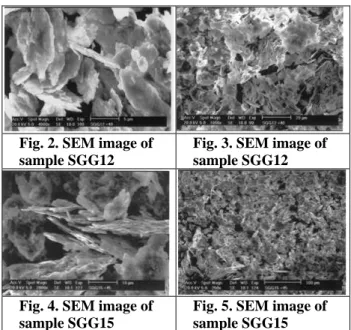
variation of particle size of starting powder exerts no influence on the geometry and size of produced Zn flakes. The results of the measurement of particle size, tap density, thickness and diameter of the flakes are shown in table 1. Figure 1 displays a typical distribution of the Zn flakes and in Figures 2-5 show the SEM images of the Zn flakes.
We have used three different types of Zn powders (fine, medium and coarse) for preparing Zn flakes. All of them show the same trend of flake formation. The final geometry of flakes made by the different starting powders fine, medium and coarse particle size had similar form and size depending on the process parameters. It means there are at least three procedures for the operating of Zn powder, namely deformation, milling (cutting) and cold welding and 2006 POWDER METALLURGY
World Congress
PA02-W-16
Highly Economic and High Quality Zinc-flake Manufacturing by
High Kinetic Processing
H. Ren1, H. U. Benz1, O. Chimal V.2, M.S. Corral G.2, Y. Zhang3,D. Jaramillo V.2 and H. Zoz1-2 1
Zoz GmbH, D-57482 Wenden, Germany
2
CIITEC-IPN, Mexico City, C.P. 02250 México D. F., México
3
Hunan Tianxin Boli Techn. Comp., Changsha 410004, P. R. China [email protected]
Abstract
The present paper is a parameter study of zinc flake production using a Simoloyer CM01 horizontal high energy rotary ball mill. The manufactured flakes have a dimension in thickness (t) < 1 µm and diameters (d) 5-100 µm, consequently a ratio d/t up to 200. The flake geometry is mainly controlled by the variation of process parameters such as rotary speed of the rotor, ratio of powder/ball charge, load ratio of the system, process temperature, operating model and the quantity of process control agent (PCA). The Zn flakes were characterized by SEM, tap densitometry, laser diffraction and water coverage measurement.
© Korean Powder Metallurgy Institute 976 -Fig. 1. particle size distribution of Zn flakes produced by HEM
the parameters determine the final size and form, and the starting particle size appears not influential. The values of milled flakes such as tap density and thickness are similar to that from the best commercial reference flakes.
Zn flake sample Part. size (µm) Cover-age (m2/g) Diam./ thickn. Thickn. (µm) Tap dens. (g/cm3) SGG10 12,67 0,17 15,36 0,82 2,13 SGG11 10,58 0,20 15,09 0,70 2,00 SGG12 14,17 0,20 20,21 0,70 1,91 SGG13 13,54 0,17 16,42 0,82 2,16 SGG14 15,67 0,16 18,33 0,85 2,07 SGG15 15,29 0,18 19,63 0,78 2,17 SGG16 15,46 0,16 17,64 0,88 2,20 SGG17 15,87 0,15 17,43 0,91 2,24 SGG18 19,17 0,14 18,60 1,03 2,13 Ref. flake 20,37 0,27 39,23 0,52 2,00
According to the results of experiments it could be observed that the significant parameters are the rotor velocity, quantity of PCA, processing time and powder charge quantity. Those parameters are in strong interactions and thus the results were influenced co-operatively from them.
Organic PCA has strong influence to the brightness and size of flakes. By increasing the quantity of PCA the color of flakes becomes darker and the size smaller. The rotor velocity changes size and thickness. Even through by increasing the rotor velocity the process time is reduced, higher velocity leads to an intense cold welding and then the thickness also increases.
Generally, for the production of Zn flakes the HEM process seems superior to the traditional drum milling.
1. Most distinguishing improvement is that the kinetic of the processing is much higher than that from a drum mill, and furthermore, it is variable in a wide range.
2. A very interesting application is the potential of alloying different powders in situ during the process to create mechanic alloyed Zn flakes, e.g. by adding other pigment in to the milling process to produce black Zn flake.
3. The process can be controlled under inert gas atmosphere in order to avoid oxidation during dry milling procedure. 4. The temperature of the processing chamber is controllable. By using a thermal exchanger, the temperature of the cooling/heating fluid can be controlled and changed in order to achieve required temperature.
5. Industrial equipment up to 400/900 liters available which can meet the requirement of industrial large volume production.
6. Auto-batch and semi-continuous systems using carrier gas in a closed circuit are available which ensures a quick and safe discharging process respect a continuous operation. 7. Due to a closed cycle discharging system the production and discharging system is economic and environmentally friendly.
Fig. 2. SEM image of sample SGG12
Fig. 3. SEM image of sample SGG12
Fig. 4. SEM image of sample SGG15
Fig. 5. SEM image of sample SGG15
4. Summary
This work shows that well formed Zn flakes are produced very quickly by HEM-Simoloyer under dry condition and superior performance compared to conventional processing route. Advanced works like chemical analysis of the Zn flakes and salt spray tests of the Zn lacquer coating will be published at next. The potential of industrial large volume production seems realistic by 100/400L systems.