Copyright ⓒ the Korean Society for Transplantation, 2016
Tacrolimus-induced, Transplant-associated Thrombotic
Microangiopathies after Lung Transplantation
Ji Soo Choi, M.D.1, Song Yee Kim, M.D.1, Jin Gu Lee, M.D.2, Soo Jeong Kim, M.D.3, Myung Jin Song, M.D.1, Bo Ra Yoon, M.D.1, Moo Hyun Kim, M.D.1,
Moo Suk Park, M.D.1 and Hyo Chae Paik, M.D.2
Division of Pulmonology, Department of Internal Medicine, Institute of Chest Diseases, Severance Hospital, Yonsei University College of Medicine1, Department of Thoracic and Cardiovascular Surgery, Yonsei University College of Medicine2, Division of Hematology, Department of Internal Medicine, Severance Hospital, Yonsei University College of Medicine3, Seoul, Korea
We report a case of tacrolimus-induced transplant-associated thrombotic microangiopathies (TA-TMA) after lung transplantation. A 71-year-old man underwent lung transplantation secondary to idiopathic pulmonary fibrosis. After 4 months, he presented with abdominal discomfort and dyspnea, and was diagnosed with hemolytic anemia and thrombocytopenia. Tacrolimus was con-sidered the cause of the TMA. Tacrolimus was stopped and several sessions of plasma exchange were performed immediately after diagnosis of TA-TMA. However, his platelet count did not normalize, gastrointestinal bleeding was recurrent, and severe pneumonia developed, following which he died. TA-TMA are rare but severe, life-threatening complications in lung transplant recipients. Therefore, the possibility of TA-TMA should be considered in posttransplant recipients.
Key Words: Thrombotic microangiopathies, Lung transplantation, Tacrolimus
중심 단어: 혈전미세혈관병증, 폐이식, 타크로리무스
Received March 25, 2016 Revised May 26, 2016 Accepted June 9, 2016
Corresponding author: Song Yee Kim
Division of Pulmonology, Department of Internal Medicine, Institute of Chest Diseases, Severance Hospital, Yonsei University College of Medicine, 50-1 Yonsei-ro, Seodaemun-gu, Seoul 03722, Korea Tel: 82-2-2228-1940, Fax: 82-2-393-6884
E-mail: [email protected]
Case Report
INTRODUCTION
FK 506 (tacrolimus) is a metabolite of the fungus Strep-tomyces tsukubaensis with potent immunosuppressive activ-ity and has been effective in preventing rejection of allog-rafts of the liver, kidney, small intestine, and heart(1,2). This medication has many complications, including infection, cardiac damage, liver and kidney damage, hyperkalemia, and various neuropsychiatric problems such as loss of appe-tite, insomnia, and confusion. Among them, thrombotic mi-croangiopathies (TMAs) is a rare but severe,
life-threat-ening complication(3).
Many reports have described tacrolimus induced trans-plant-associated TMA (TA-TMA) in solid organ or bone marrow transplant patients. Most cases of this complication have been reported in kidney transplant patients(4). Deve-lopment of TA-TMA following lung transplantation is rare; therefore, we report the case of a patient who developed TA-TMA with severe pneumonia and gastrointestinal bleed-ing after lung transplantation.
CASE REPORT
A 71-year-old man underwent right lung transplantation for idiopathic pulmonary fibrosis. He had a history of coro-nary artery occlusive disease with hypertension and diabetes mellitus. His immunosuppressive regimen included tacroli-mus, 3 mg twice a day; mycophenolate 500 mg twice a day; and deflazacort 9 mg twice a day with prophylactic
trime-J Korean Soc Transplant 2016;30:94-97 http://dx.doi.org/10.4285/jkstn.2016.30.2.94
95
Ji Soo Choi, et al: Transplant-associated Thrombotic Microangiopathies after Lung Transplant
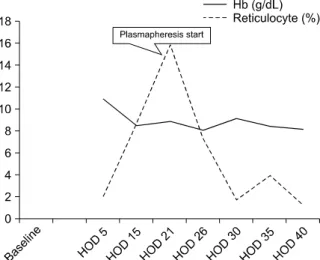
Fig. 1. Hemoglobin (Hb): baseline over 1 month prior to presen-tation. Plasmapheresis was started on hospital day (HOD) 21, and repeated at 12 times.
Fig. 2. Platelet: baseline over 1 month prior to presentation. Pla-smapheresis was started on hospital day (HOD) 21, and repeated at 12 times.
thoprim/sulfamethoxazole, itraconazole, and valganciclovir. His general condition was good immediately after lung transplantation.
At postoperative day 101, he visited the emergency de-partment with progressively aggravating abdominal dis-comfort and dyspnea. On physical examination, there was unremarkable sign except decreased skin turgor. On initial laboratory evaluation, hemoglobin was 10.5 g/dL, leukocyte was 4,090/L, and platelet was 199,000/mm3
. Serum crea-tinine was elevated (1.51 mg/dL; baseline, 0.9 mg/dL), and C-reactive protein was elevated at 67.4 mg/L. The liver function test and prothrombin and partial thromboplastin times were normal. Chest radiography showed mild pleural effusion on the right transplanted lung and diffuse reticulo-nodular opacities combined pneumonic consolidation on the left lung. Initial tacrolimus level was high at >30.0 ng/mL. Esophagogastroduodenoscopy (EGD) showed gastric and duodenal ulcers.
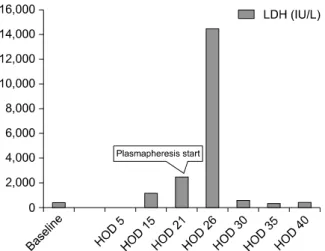
By hospital day 5, leukocyte had decreased to 2,260/L, platelet to 51,000/L, and hemoglobin to 7.5 g/dL, indicat-ing normocytic normochromic anemia. On hospital day 21, leukocyte was recovered to 7,560/L after mycophenolate and trimethoprim/sulfamethoxazole were stopped; however, anemia and thrombocytopenia persisted (hemoglobin 7.1 g/dL, platelet 23,000/L). Lactate dehydrogenase (LDH) had in-creased to 2,481 IU/L, haptoglobin was markedly dein-creased to <10 mg/dL and reticulocyte count was elevated to 15.8%,
suggesting hemolysis. Fibrin degradation products was slightly elevated to 6.14 µg/mL (normal range; 0∼5 µg/mL) and d-dimer was elevated to 485 ng/mL (normal range; 0∼ 243 ng/mL). However serum fibrinogen, thrombin time was normal range, 388 mg/dL and 18 seconds, respectively. Mic-roscopic review of the peripheral blood smear showed the weak positive of schistocytes and the number of nucleated red blood cells was elevated 18/100 white blood cell (WBC; normal range; 0∼2.3/100 WBC). Serum creatinine was ele-vated to 2.17 mg/dL. The test for the enterotoxigenic Esche-richia coli was negative. The diagnosis was TMA, which in-cluded thrombotic thrombocytopenic purpura (TTP), lytic uremic syndrome (HUS), and microangiopathic hemo-lytic anemia (MAHA) associated with various systemic diseases. The findings were not consistent with other diag-nosis of TMA, and other causes of TMA were not presented definitely; therefore, we established a diagnosis of TA-TMA associated with tacrolimus. We stopped tacrolimus, and plas-mapheresis was initiated every alternate day with daily transfusion. After management, the laboratory findings of hemolysis were transiently recovered. LDH and reticulocyte count decreased to 545 IU/L and 2.49%, respectively. Fur-thermore, schistocytes were not showed on peripheral blood smear, and hemoglobin and platelet increased to 11 g/dL and 44,000/L, respectively.
However, severe infection was co-existed. Fungal pneu-monia developed in the right lung and pneupneu-monia in the
96
J Korean Soc TransplantㆍJune 2016ㆍVolume 30ㆍIssue 2
Fig. 3. Serum Lactate dehydrogenase (LDH) level: baseline over 1 month prior to presentation. LDH elevated on hospital day (HOD) 26, then decreased by taking plasmapheresis.
left lung was aggravated. Intravenous antibiotics for bacteria and fungus were administered.
On hospital day 26, his blood pressure decreased to 77/48 mmHg, and hematochezia developed. His hemoglobin de-creased to 7.1 g/dL and platelet was 46,000/L. The finding of EGD showed a gastric ulcer bleeding and a duodenal ulcer. Although hemostasis was performed through EGD, he developed recurrent gastrointestinal bleeding. His hemoglo-bin decreased to 6.1 g/dL, and platelet to 10,000/L (Figs. 1, 2). Massive transfusion, daily plasmapheresis (total 12 times), and repeated hemostasis via EGD were continued. Although LDH and reticulocyte count were recovered grad-ually (481 IU/L and 1.21%, respectively) which showed the improvement of TA-TMA, the hemoglobin and platelet con-tinuously decreased due to recurrent gastrointestinal bleeding (Fig. 3). Furthermore, pneumonia was not controlled and the general condition of patient was deteriorated. Ultimately, he died on hospital day 40 (postoperative day 141) due to se-vere infection and recurrent gastrointestinal bleeding.
DISCUSSION
TMA is a syndrome that represents endothelial injury, microvascular thrombosis, and fibrin deposition leading to MAHA and thrombocytopenia due to platelet consumption. TMA includes TTP, HUS, and MAHA associated with vari-ous systemic diseases or conditions including pregnancy, vasculitis, and other autoimmune disorders(5).
Tacrolimus is a useful immunosuppressive agent that im-proves the survival of organ transplant recipients, but has many complications. Trimarchi et al.(6) reported that tacro-limus could induce TMA through its direct and endothe-lin-1-mediated vasoconstrictor effects on the renal vascula-ture, leading to tissue hypoxia, endothelial cell damage, and deposition of platelets and fibrin in the glomeruli. However, the pathogenesis of tacrolimus associated TA-TMA is con-troversial.
Development of tacrolimus induced TA-TMA can be life-threatening; however, if detected early, they can be cured. In previous reports, tacrolimus induced TMA after solid organ transplantation developed in 0.5% to 3% of transplant patients(7). Most cases have been reported in kid-ney(6), liver(8), and bone marrow transplant recipients(9). However, there are few case reports in lung transplant patients. Myers et al.(10) reported a case of HUS in a lung transplant recipient receiving tacrolimus. They described that a 60-year-old woman with a history of lung trans-plantation for severe chronic obstructive pulmonary disease developed tacrolimus-associated HUS that resolved after dis-continuation of tacrolimus(10). Boyer et al.(11) also re-ported that a 25-year-old woman with a history of lung transplantation secondary to cystic fibrosis had developed tacrolimus induced TA-TMA. Tacrolimus was stopped and replaced with cyclosporine, and complication was resolved with no subsequent complications(11).
A disintegrin and metalloproteinase with a thrombo-spondin type 1 motif, member 13 (ADAMTS-13), a pro-tease enzyme which splits ultra-large von Willebrand factor (vWF) multimers into smaller vWF fragments, prevents the entry of large multimers of vWF into the circulation(8). Idiopathic TTP is typically associated with ADAMTS-13 de-ficiency resulting from inherited defect, genetic mutation, or the acquisition of inhibitory antibodies to ADAMTS-13(12). TA-TMA and TTP have similar mechanisms such as endo-thelial damage; however, ADAMTS-13 deficiency is rarely observed in TA-TMA. We did not check the ADAMTS-13 activity level in our patient; therefore, this was a limitation in differentiating TA-TMA from TTP in this case.
We report an uncommon case of posttransplantation ta-crolimus induced TA-TMA with gastrointestinal bleeding and severe pneumonia in a lung transplant recipient. Similar
97
Ji Soo Choi, et al: Transplant-associated Thrombotic Microangiopathies after Lung Transplant
to earlier studies(10,11), stopping tacrolimus plus plasma-pheresis led to improvement of TMA; however, the patient died because of combined gastrointestinal bleeding and pneumonia.
TA-TMA is a rare but severe, life-threatening complica-tion in lung transplant recipients; therefore, the possibility of TA-TMA should be considered in posttransplant reci-pients.
REFERENCES
1) Klintmalm G. A review of FK506: a new immunosuppre-ssant agent for the prevention and rescue of graft rejection. Transplant Rev 1994;8:53-63.
2) Mach-Pascual S, Samii K, Beris P. Microangiopathic hemo-lytic anemia complicating FK506 (tacrolimus) therapy. Am J Hematol 1996;52:310-2.
3) Matsusaki T, Morimatsu H, Sato T, Sato K, Mizobuchi S, Morita K. Thrombotic microangiopathy after living-donor liver re-transplantation. J Anesth 2010;24:614-7. 4) Nakazawa Y, Hashikura Y, Urata K, Ikegami T, Terada M,
Yagi H, et al. Von Willebrand factor: cleaving protease activity in thrombotic microangiopathy after living donor liver transplantation: a case report. Liver Transpl 2003; 9:1328-33.
5) Ho VT, Cutler C, Carter S, Martin P, Adams R, Horowitz M, et al. Blood and marrow transplant clinical trials network
toxicity committee consensus summary: thrombotic micro-angiopathy after hematopoietic stem cell transplantation. Biol Blood Marrow Transplant 2005;11:571-5.
6) Trimarchi HM, Truong LD, Brennan S, Gonzalez JM, Suki WN. FK506-associated thrombotic microangiopathy: re-port of two cases and review of the literature. Transplanta-tion 1999;67:539-44.
7) Humar A, Jessurun J, Sharp HL, Gruessner RW. Hemolytic uremic syndrome in small-bowel transplant recipients: the first two case reports. Transpl Int 1999;12:387-90. 8) Nwaba A, MacQuillan G, Adams LA, Garas G, Delriviere
L, Augustson B, et al. Tacrolimus-induced thrombotic mi-croangiopathy in orthotopic liver transplant patients: case series of four patients. Intern Med J 2013;43:328-33. 9) Kojouri K, George JN. Thrombotic microangiopathy
follow-ing allogeneic hematopoietic stem cell transplantation. Curr Opin Oncol 2007;19:148-54.
10) Myers JN, Shabshab SF, Burton NA, Nathan SD. Successful use of cyclosporine in a lung transplant recipient with tacro-limus-associated hemolytic uremic syndrome. J Heart Lung Transplant 1999;18:1024-6.
11) Boyer NL, Niven A, Edelman J. Tacrolimus-associated throm-botic microangiopathy in a lung transplant recipient. BMJ Case Rep. Epub 2013 Feb 8. DOI: http://dx.doi.org/10. 1136/bcr-2012-007351.
12) Chinen Y, Kuroda J, Ohshiro M, Shimura Y, Mizutani S, Nagoshi H, et al. Low ADAMTS-13 activity during hemor-rhagic events with disseminated intravascular coagulation. Int J Hematol 2013;97:511-9.