Photovoltaic Efficiencies on Dye-Sensitized Solar Cells Assembled with
Graphene-Linked TiO
2Anode Films
A-Young Kim, Jieun Kim, Min Young Kim,† Seung Won Ha,† Ngyen Thi Thuy Tien,† and Misook Kang* Department of Chemistry, College of Science, Yeungnam University, Gyeongsan, Gyeongbuk 712-749, Korea
*E-mail: [email protected]
†Korea Science Academy of Korea Advanced Institute of Science and Technology, Busan 614-822, Korea
Received June 14, 2012, Accepted July 19, 2012
To promote the photoelectric conversion efficiency of dye-sensitized solar cells (DSSCs), graphene is intro-duced as a working electrode with TiO2 in this study, because it has great transparency and very good conductivity. XRD patterns indicate the presence of graphene and TiO2 particles in graphene-linked TiO2
samples. Moreover, TEM pictures also show that the nano-sized TiO2 particles are highly dispersed and well-linked onto the thin layered graphene. On the basis of the UV-visible spectra, the band gaps of TiO2, 1.0 wt % graphene-TiO2, 5.0 wt % graphene-TiO2, and10.0 wt % graphene-TiO2 are 3.16, 2.94, 2.25, and 2.11 eV, respectively. Compared to pure TiO2, the energy conversion efficiency was enhanced considerably by the application of graphene-linked TiO2 anode films in the DSSCs to approximately 6.05% for 0.1 wt % graphene-TiO2 with N719 dye (10.0 mm film thickness and 5.0 mm × 5.0 mm cell area) under 100 mW/cm2 of simulated sunlight. The quantum efficiency was the highest when 1.0 wt % of graphene was used. In impedance curves, the resistance was smallest for 1.0 wt % graphene- TiO2-DSSC.
Key Words : Graphen, Graphene-linked TiO2, Dye-sensitized solar cells, Energy conversion efficiency,
Impedance
Introduction
In order to enhance the photovoltaic efficiency of dye-sensitized solar cells (DSSC), electrons, which are trans-ferred from the LUMO of dye molecules, should be accept-ed easily and donataccept-ed to the external surface of the semi-conductor film1-5 as shown in Scheme 1. However, a limita-tion is imposed by the loss of electrons that are moved and then dropped down onto a spherical surface of a semi-conductor film. The electron is expected to migrate rapidly to the surface of a defected semiconductor film that is well-arranged by self assembly with electron capturing and donating properties and converted into an FTO-conducting electrode without electron loss, thereby increasing the energy conversion efficiency.
Here, in order to absorb as much sun-light as possible and
to easily donate the captured electrons from dye molecules to the external surface of the semiconductor film, we have tried to introduce graphene as a DSSC-electrode in this study. Graphene has gained lots of attention lately due to its newly discovered amazing and unique characteristics. It is well-known as an allotrope of carbon, a sheet of honey-combed linked carbon atoms, with a C-C bond length of 0.142 nanometers.6-8 It has some special features that make it optimal for photochemical devices such as solar cells, because it has great transparency and very good conductivity with low resistance- only 10−6Ω·cm/sheet. Though it absorbs very little in the visible range, an absorbance of only 2.3% of incident white light, graphene has increased possible absorp-tion in the UV range of longer wavelengths, resulting in graphene acting as a UV stabilizer. Moreover, the energy gap of graphene can be tuned and scales inversely with the width, despite the fact that initially there is no band gap, a main drawback of graphene. In addition, at room temper-ature, it has exceptionally high electron mobility, greater than 15,000 cm2/Vs. On the basis of these properties, recent-ly, graphene has been applied to photocatalysis.9-11 Parti-cularly, Zhang et al.9 reported photocatalytic activity for hydrogen evolution on TiO2/graphenenanocomposites. An
enhancement of photocatalytic hydrogen evolution was observed over the TiO2/GS composite photocatalysts: 1.6
times larger for TiO2/2.0 wt % GS than that of Degussa P25.
However, cases have so far rarely been applied to DSSC and more detailed study is thus required.
Graphene is a great candidate due to its interesting charac-teristics, especially in the electrochemistry field, and we
Scheme 1. Cell assembly configuration of the photovoltaic efficiency of dye-sensitized solar cells (DSSC).
TiO2 was synthesized in this study. The synthesized samples
were characterized by X-ray diffraction (XRD), transmission electron microscopy (TEM), UV-visible spectroscopy, and impedance analysis. The photovoltaic performance of the grephen-TiO2/dye (N719) solar cell was evaluated from the
overall conversion efficiency, fill factor (FF), Voc and Jsc. In
addition, the efficiency was compared with that of a pure TiO2 sample prepared using the same synthesis method.
Experimental Section
Preparation of Graphene and Graphene-Linked TiO2. For the preparation of graphene, graphite oxide should first be made12,13: 6.0 g of graphite powder was added to 300.0 mL of concentrated H2SO4 at a temperature of 0oC with
stirring for 2 h and sonicating for 1 h. Into the mixture, 24.0 g of KMnO4 was infused maintaining temperature at < 10,
followed by an hour at 35oC. After cooling, 100.0 mL of distilled water for dilution was poured into the mixture, and it was washed by 300.0 mL H2O. 80.0 mL of 30% H2O2 was
dropped into the mixture, and then the precipitation was washed with 1.0 L of 5% HCl and 4.0 L of H2O. The product
(graphite oxide) was dried at 60 oC for 24 h. The prepared graphite oxide (0.5 g) in the previous step was put in 300 mL of ethylene glycol with stirring, followed by sonication for 2 h. As a reducing agent, 0.5 mL of hydrazine hydrate was dropped slowly into the mixture and stirred overnight. The final mixture was thermally treated in an autoclave at T = 300, and the obtained precipitate was washed first with ethanol 3 times and H2O for five times, and lastly with
ethanol again. The product (graphene) was dried at 60 oC for 24 h. Graphene-linked TiO2 with various mol fractions of
graphene (1.0, 5.0, and 10.0 wt %) was then prepared. 10.0 g of titanium tetraisopropoxide (TTIP, 99.95%, Junsei Chemical, Japan) was added to a beaker of 200.0 mL H2O. Based on
the weight % graphene (1.0, 5.0, and 10.0 wt %), the graphite oxide was added to the mixed solution, and was then sonicated for 1 h. 1.0 mL of hydrazine hydrate was dropped into the mixture and stirred for 5 h. This mixture was transferred into an autoclave and thermally treated at a temperature of 180oC for 6 h. The obtained compounds were washed with ethanol and water and dried at 60 oC for 24 h. Finally, for comparison, pure nano-sized TiO2
particles were synthesized by a commercialized solvother-mal method.14
Characteristics of Graphene and Graphene-TiO2s. The synthesized graphene and graphene-linked TiO2s powders
were examined by XRD (MPD, PANalytical, at Yeungnam University Instrumental Analysis Center) with nickel-filter-ed CuKα radiation (30 kV, 30 mA) at 2θ angles ranging from 10 to 80º, a scan speed of 10º min–1 and a time constant of 1 s. The sizes and morphologies of the graphene and graphene-linked TiO2 particles were measured by TEM
(H-7600, Hitachi, at Yeungnam University Instrumental Analysis Center) operated at 120 kV. The solid-UV-visible spectra
sphere over the special range of 200 to 800 nm. TGA mea-surements of graphite and graphene were collected using a PerkinElmer TGA instrument equipped with a platinum crucible. Samples were heated from room temperature to 900 oC with a heating rate of 10 oCmin−1 while the chamber was continuously purged with O2 gas at a rate of 25 mL/min.
Manufacturing Dye-Sensitized Solar Cells (DSSCs) Assembled with Graphene-Linked TiO2. To manufacture dye-sensitized solar cells (DSSCs), a paste of the graphene-linked TiO2 was produced by mixing 2.0 g of graphene-TiO2
powders with a mixture consisting of 5.0 g of α-tepinol, 0.5 g of cellulose, and 20 mL of ethanol, after sonication for 24 h at 1200 Wcm−2. A graphene-TiO2 film was fabricated by
coating onto an FTO conducting glass plate (Hartford FTO, ~30 ohmcm−2, 80% transmittance in visible region) using a squeeze printing technique. The film was treated by heating at 450 ºC for 30 minutes to remove the additives. For DSSC manufacture, the prepared thin film electrode was immersed in a 3.0 × 10⁻⁴ M N719 dye solution at room temperature for 2 h, rinsed with anhydrous ethanol and dried. A Pt-coated FTO electrode was placed over the dye-adsorbed graphene-TiO2 electrode, and the edges of the cell were sealed with a
sealing sheet (PECHM-1, Mitsui-Dupont Polychemical). The redox electrolyte consisted of 0.5 mol KI, 0.05 mol I2,
and 0.5 mol 4-tert-butylpyridine as a solvent. The photo-current-voltage (I-V) curves were used to calculate the Jsc,
Voc, FF, and overall conversion efficiency of the
graphene-TiO2-DSSCs. I-V curves were measured under white light
irradiation from a xenon lamp (max. 150W) using a sun 2000 solar simulator (ABE technology). The light intensity was adjusted with a Si solar cell for approximated AM-1.5 radiation. The incident light intensity and active cell area were 100 mWcm−2 (one sun illumination) and 0.25 cm2 (0.5 × 0.5 cm), respectively.
The AC-impedance measurements were performed with a potentiostat-galvanostat equipped with a ComPactStat elec-trochemical interface from IVIUM technology under con-stant light illumination of 100 mWcm−2. EIS of the graph-ene-TiO2-DSSCs was performed under constant light
illumi-nation and open-circuit conditions. The applied bias voltage and AC-amplitude were set at open-circuit voltage of the graphene-TiO2-DSSCs and 10 mV between the FTO/Pt
counter electrode and the FTO/graphene-TiO2/dye working
electrode, respectively. The frequency range explored was 0.1-100 kHz.
Results and Discussion
Characteristics of Graphene and Graphene-TiO2. For preparation of the graphene-TiO2, we synthesized graphite
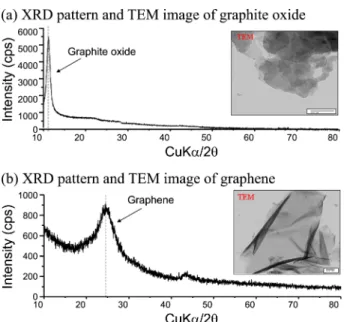
oxide and graphene as mentioned in experimental section. Figure 1 shows the XRD patterns and TEM images of the graphite oxide and graphene powder. The graphite oxide displays a (001) diffraction peak at 2θ = 11.1o 15 as shown in figure a). After the reduction of graphite oxide by hydrazine
hydrate to transfer the graphene, a new (002) diffraction peak appears at about 2θ = 24.1o corresponding to an inter-planar distance of 0.42 nm as shown in Figure b). This means that the periodic structure of graphite oxide was eliminated and the conjugated graphene network was successfully established with forms of thin layered nano-sheet as shown in TEM photos.
To identify the thermal stability of graphene, TG analysis was conducted. As shown in Figure 2, with increasing temper-ature, graphite oxide starts to degrade at low temperature. The weight losses are attributed to the evaporation of ab-sorbed small molecules like water with exothermic de-composition until 170oC, and the decomposition of the residual oxygen-containing functional groups in the region of 170-550oC, since chemical reduction of graphite oxide usually results in incompletely reduced products. For graph-ene, the weight loss was not determined until 480oC, and then there was loss in the region of 480-700oC, which was ascribed to main-chain pyrolysis with combustion. Notably, the graphene can remain stable, since the graphene-TiO2
film is treated by heating at 450 ºC for 30 minutes to remove the additives in a step of assembling the DSSCs.
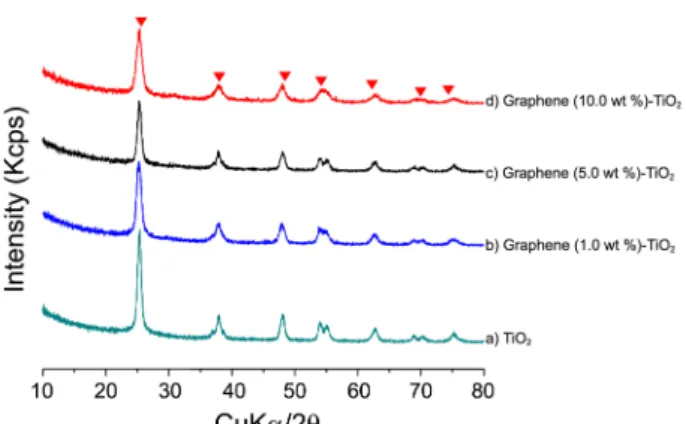
Figure 3 shows the XRD patterns of the 1.0, 5.0, and 10.0 wt % graphene-TiO2 and pure TiO2. Without thermal
treat-ment above 500 oC, the graphene-TiO2 exhibited an anatase
structure. The anatase structure showed peaks at 25.3, 38.0, 48.2, 54, 63, and 68° 2θ, which were assigned to the (d101),
(d004), (d200), (d105), (d211), and (d204) planes, respectively.16
However, the peak intensity at most of the planes decreased slightly with increasing graphene content compared to that of pure TiO2. Generally, the crystalline domain sizes decrease
with increasing line-broadening of the peaks. The line broadening of the peak of the A (101) index is related to the size of the hexagonal crystalline phase. Scherrer’s equation, t = 0.9λ/βcosθ, was used to estimate the crystalline domain size, where λ is the wavelength of the incident X-rays, β is
the full width at half maximum (FWHM) height in radians, and θ is the diffraction angle. When the FWHM of the peak at 25.3º 2θ was selected, the calculated crystalline domain sizes were 33, 27, 25, and 21 nm for TiO2 and 1.0, 5.0, and
10.0 wt % graphene-TiO2s, respectively.
Figure 4 shows TEM images of the particle shapes of TiO2
and 10.0 wt % graphene-TiO2. A relatively uniform mixture
of rhombic and spherical particles with sizes ranging from 10 to 20 nm was observed in the TiO2 particles. Surprisingly,
when graphene was added to the TiO2, it was confirmed that
TiO2 nano-particles were highly and stably dispersed over
Figure 1. XRD patterns and TEM images of the graphite oxide and graphene powders.
the surface of the nano-sheet of graphene. This result means that the graphene was well-linked to the TiO2 chemically.
The UV-visible spectra of the 1.0, 5.0, and 10.0 wt % graphene-TiO2 and pure TiO2 powders were obtained to
determine the relationship between the solar energy conver-sion efficiency and the spectroscopic properties. The absorp-tion band for the octahedral symmetry of Ti4+ normally appears at approximately 350-380 nm. In the spectra of graphene-TiO2, the absorption bands were slightly shifted to
a longer wavelength compared to pure TiO2, and the
broad-ened tail may indicate a graphene component. The absorp-tion coefficient is given by the following equaabsorp-tion, which is often called the Tauc law17: (αhv)1/2 = β(hv − Eg), where Eg
is the Tauc optical band gap, α = 2.303A/d (A: optical density and d: thickness of the sample), ϖ is the incident light angular frequency and is a parameter depending on the transition type of the absorption edge. β is a constant that depends on the width of the localized states in the band gap. The plot of αhv vs hv of TiO2 and graphene-TiO2 are shown
in Figure 5. The intercept of the abscissa axis with the full line of the (αhv)1/2 vs hv plot allows the determination of optical band gap. The band gaps obtained by extrapolation using the Tauc’s equation17 in pure TiO2, 1.0, 5.0, and 10.0
wt % graphene-TiO2 were about 3.16, 2.94, 2.25, and 2.11
eV, respectively. Band gaps in semiconductor materials are closely related to the wavelength range absorbed, where the band gap decreases with increasing absorption wavelength.
As graphene plays an important role of electron receiving and giving in DSSCs, and its light absorption is therefore important, the electron transfer is more crucial to enhance the DSSC performance.
Photovoltaic Performance of Graphene-TiO2-DSSC. The photoelectric properties were measured using a volt-meter and ampere volt-meter (Model 2000, Keithley) with a variable load. A voltmeter above power failure and a lock-in amplifier were used. A 150 W illuminant Xenon lamp was employed as a radiation source at an AM-1.5 radiation angle. The light intensities were measured using a power analyzer and thermal smart-sensor. The FF and solar energy conver-sion efficiency (η) were calculated according to Eqs. (1) and (2), respectively.
FF = Imax × Vmax /Isc × Voc (1) η (%) = Pout/Pin × 100 = Imax × Vmax/Pin × 100 = Isc × Voc × FF (2)
Figure 6 shows the photocurrent-voltage curves of the
Figure 3. XRD patterns of pure TiO2 and graphene-TiO2
synthe-sized.
Figure 4. TEM images of pure TiO2 and graphene-TiO2.
Figure 5. UV-visible spectra of pure TiO2 and graphene-TiO2. TiO2 Graphene (1%)-TiO2 Graphene (5%)-TiO2 Graphene (10%)-TiO2 Bandgap (eV) 3.16 2.94 2.25 2.11
DSSCs assembled with the pure TiO2 and the 1.0, 5.0, and
10.0 wt % graphene-TiO2. The FF, Voc, Jsc, and overall
energy efficiency were determined as described above. The film thickness was in the range of 8.0-10.0 mm and the unit cell area was fixed with dimensions of 5.0 mm × 5.0 mm. A DSSC assembled with pure TiO2 had a Voc of 0.77 V and a
Jsc of 8.69 mAcm−2 at an incident light intensity of 100 mW/
cm2. The power conversion efficiency was 4.42% for the pure TiO2 anatase structure, but increased to 6.05% in the
DSSC made from 1.0 wt % graphene-TiO2 film, with a Jsc of
12.89 mAcm−2 and a Voc of 0.68 V. On the other hand, the
efficiency was slightly reduced in the DSSC made with a
graphene content > 10.0 wt %, which confirmed that graph-ene-TiO2 is a better material in DSSCs than pure TiO2.
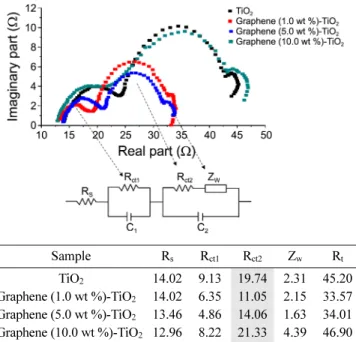
The EIS results of graphene-TiO2-DSSCs are presented by
Nyquist plots in Figure 7. In general, the impedance spec-trum of the DSSC shows three semicircles in the frequency range of 0.1-100 kHz. The first semicircle, Rct1, is related to
the charge transfer at the counter electrode measured in the kHz range. The second semicircle, Rct2, is related to the
electron transport at the graphene-TiO2/dye/electrolyte
inter-face in the range of 1-100 Hz. The third semicircle, Zw,
shows the Warburg diffusion process of I/I3 in the electro-lyte, measured in the mHz range.18 Otherwise, the ohmic serial resistance (Rs) is associated with the series resistance
of the electrolytes and electric contacts in the DSSC. These three semicircles indicate the Rct1, Rct2 and Zw of an
equi-valent circuit, as shown under the table. The second semi-circle decreased significantly due to the effects of the doping of graphene. The TiO2-DSSC and 10.0 wt % graphene-TiO2
-DSSC appeared to have a higher total resistance in the current path across the device than that of the 1.0 and 5.0 wt % graphene-TiO2-DSSCs. Notably, Rct2 was largely
decreased in the cell assembled with the 1.0 wt % graphene-TiO2-DSSC compared to that of the pure TiO2-DSSC. It is
notable that the electron flow from the LUMO of the dye to the FTO through the conduction band of graphene-TiO2
became more efficient. In the case of the first and third semicircles, four DSSCs showed similar values because the preparation conditions of counter electrodes were the same. The Rs related to the sheet resistance of the FTO did not show any significant change because the same FTO glasses were used in all samples. Therefore, it is notable that the electron charge transfer improved at the semiconductor/dye/ electrolyte interface due to the effects of graphene dopant into TiO2.
IPCE in Figure 8 indicates the number of incident photons inside the cell and their contribution to the efficiency.19 IPCE is defined as the ratio of the number of electrons in the external circuit produced by an incident photon at a given wavelength. DSSCs that primarily respond to the
wave-Sample Voc (V) Jsc (mA/cm2) Fill factor Efficiency (%) TiO2 0.77 8.69 0.66 4.42 Graphene (1.0 wt %)-TiO2 0.68 12.89 0.69 6.05 Graphene (5.0 wt %)-TiO2 0.71 11.15 0.66 5.22 Graphene (10.0 wt %)-TiO2 0.70 6.75 0.70 3.31 Figure 6. Solar energy conversion efficiency of the DSSCs fabricated with pure TiO2 and graphene-TiO2.
Sample Rs Rct1 Rct2 Zw Rt
TiO2 14.02 9.13 19.74 2.31 45.20
Graphene (1.0 wt %)-TiO2 14.02 6.35 11.05 2.15 33.57
Graphene (5.0 wt %)-TiO2 13.46 4.86 14.06 1.63 34.01
Graphene (10.0 wt %)-TiO2 12.96 8.22 21.33 4.39 46.90
Figure 7. Impedance curves of the DSSCs fabricated with pure TiO2 and graphene-TiO2.
Figure 8. IPCE curves of the DSSCs fabricated with pure TiO2 and
had the highest quantum number, which is corresponding to the absorption peak of N719 dye due to visible t2 to π* metal
to ligand charge transfer. The quantum efficiency of the TiO2-DSSC was about 33%, but this was increased to about
44% in the 1.0 wt % graphene TiO2-DSSC. As a result, the
quantum efficiency was increased to approximately 11%, which confirmed that the graphene-TiO2 electrode induced
more photons. Moreover, the measured IPCE values were broad over the entire wavelength range in graphene-TiO2
-DSSC. It represents that the larger amounts of dye molecules are adsorbed, and more light is transmitted through and scattered in the graphene-TiO2 layer than in the TiO2
photo-electrode.
Conclusions
We have synthesized graphene-linked TiO2 in this study in
which TiO2 particles were evenly spiked on the surface of
graphene nano-sheet. Graphene-linked TiO2 materials were
prepared to enhance the solar energy conversion efficiency. In comparing the performance with that of pure TiO2, the 1.0
wt % graphene-TiO2 DSSC showed superior solar energy
conversion efficiency. In 100 mWcm−2 simulated sunlight, the 1.0 wt % graphene-TiO2 DSSC exhibited good
perfor-mance with a solar energy conversion efficiency of approxi-mately 6.05%, Voc of 0.68 V, Jsc of 12.89 mAcm−2, and FF of
0.69. The quantum efficiency of the graphene-DSSC was more enhanced by about 11% compared to that of TiO2
-DSSC. Additionally, the resistance was largely decreased in the cell assembled with the 1.0 wt % graphene-TiO2-DSSC
compared to that of the pure TiO2-DSSC.
Acknowledgments. This work was supported by 2010
which the authors are very grateful.
References
1. Chae, J.; Kim, D. Y.; Kim, S.; Kang, M. J. Ind. Eng. Chem. 2010, 16, 906.
2. Lee, Y.; Chae, J.; Kang, M. J. Ind. Eng. Chem. 2010, 16, 609. 3. Ko, K. H.; Lee, Y. C.; Jung, Y. J. J. Colloid Interf. Sci. 2005, 283,
482.
4. Dhas, V.; Muduli, S.; Agarkar, S.; Rana, A.; Hannoyer, B.; Banerjee, R.; Ogale, S. Sol. Energy 2011, 85, 1213.
5. Curtiss, S.; Kovash, Jr.; Hoefelmeyer, D. J.; Logue, B. A. Electro-chimica Acta 2012, 67, 18.
6. Stankovich, S.; Dikin, D. A.; Piner, R. D.; Kohlhaas, K. A.; Kleinhammes, A.; Jia, Y.; Wu, Y.; Nguyen, S. B. T.; Ruoff, R. S. Carbon 2007, 45, 1558.
7. Wang, X.; Zhi, L.; Mullen, K. Nano Lett. 2008, 8, 323.
8. Zhou, K.; Zhu, Y.; Yang, X.; Li, C. New J. Chem. 2010, 34, 2950. 9. Zhang, X.; Sun, Y.; Cui, X.; Jiang, Z. Inter. J. Hydrogen Energy
2012, 37, 811.
10. Li, Z.; Chen, Y.; Du, Y.; Wang, X.; Yang, P.; Zheng, J. Inter. J. Hydrogen Energy 2012, 37, 4880.
11. Hou, C.; Zhang, Q.; Li, Y.; Wang, H. J. Hazard. Mater. 2012, 205, 229.
12. Wu, J.; Shen, X.; Jiang, L.; Wang, K.; Chen, K. Appl. Surf. Sci. 2012, 256, 2826.
13. Ng, Y. H.; Iwase, A.; Bell, N. J.; Kudo, A.; Amal, R. Catal. Today 2011, 164, 353.
14. Yeo, M.-K.; Kang, M. Water Res. 2006, 40, 1906.
15. Hu, H.; Wang, X.; Wang, J.; Liu, F.; Zhang, M.; Xu, C. Appl. Surf. Sci. 2011, 257, 2637.
16. Choi, H.-J.; Kang, M. Inter. J. Hydrogen Energy 2007, 32, 3841. 17. Tauc, J. Amorphous and Liquid Semiconductors; Plenum Press:
New York, 1974; p 171.
18. Chae, J.; Kang, M. J. Power Sources 2011, 196, 4143.
19. Shen, Q.; Sato, T.; Hashimoto, M.; Chen, C.; Toyoda, T. Thin Solid Films 2006, 499, 299.