sion of the neural elements28). In addition, elderly people are more vulnerable to external forces as a result of senile or post-menopausal osteoporosis, decreased pliability, and weakness of muscle tone. For these reasons, lumbar spinal diseases are com-monly observed in the elderly.
Although spinal disorders are not typically regarded as life threatening, they can lead to chronic pain and significant limita-tion of activity15). Therefore, symptomatic lumbar spinal disease should be treated irrespective of patient age. An accurate assess-ment of the potential morbidities associated with spinal proce-dures is necessary to guide treatment41). Conservative treatment such as medication, physical therapy, and steroid injection may relieve the symptoms in some cases48). However, surgical treat-ment, and even fusion surgery, is typically needed for medically refractory cases with moderate to severe lumbar spinal disease.
INTRODUCTION
Life expectancy has dramatically increased as a result of sev-eral factors including improved nutritional support, advanced quality of life, and development of medical and surgical tech-niques. As the population of the world is aging, the number of patients suffering from lumbar spine disease has increased con-siderably, especially within the Republic of Korea. In addition, newly developed imaging equipment facilitates more sensitive and wider diagnosis of various disease entities.
The pathophysiologic and anatomic changes associated with the degenerative process include thickening of the ligaments, enlargement or loosening of the facet joints, and loss of water from discs28). These changes may lead to a narrowing of the spi-nal caspi-nal and segmental instability with subsequent
compres-Perioperative Risk Factors Related to Lumbar Spine
Fusion Surgery in Korean Geriatric Patients
Jung-Hyun Lee, M.D.,1 Hyoung-Joon Chun, M.D.,1 Hyeong-Joong Yi, M.D.,1 Koang Hum Bak, M.D.,1 Yong Ko, M.D.,1 Yoon Kyoung Lee, Ph.D.2 Department of Neurosurgery,1 Hanyang University Medical Center, Seoul, Korea
Red Cross College of Nursing,2 Chong-Ang University, Seoul, Korea
Objective : Life expectancy for humans has increased dramatically and with this there has been a considerable increase in the number of patients suffering from lumbar spine disease. Symptomatic lumbar spinal disease should be treated, even in the elderly, and surgical procedures such as fu-sion surgery are needed for moderate to severe lumbar spinal disease. However, various perioperative complications are associated with fufu-sion sur-gery. The aim of this study was to examine perioperative complications and assess risk factors associated with lumbar spinal fusion, focusing on geriatric patients at least 70 years of age in the Republic of Korea.
Methods : We retrospectively investigated 489 patients with various lumbar spinal diseases who underwent lumbar spinal fusion surgery between 2003 and 2007 at our institution. Three fusion procedures and the number of fused segments were analyzed in this study. Chronic diseases were also evaluated. Risk factors for complications and their association with age were analyzed.
Results : In this study, 74 patients experienced complications (15%). The rate of perioperative complications was significantly higher in patients 70 years of age or older than in other age groups (univariate analysis, p=0.001; multivariate analysis, p=0.004). However, perioperative complications were not significantly associated with the other factors tested (sex, comorbidities, operation procedures, fusion segments involved).
Conclusion : Increasing age was an important risk factor for perioperative complications in patients undergoing lumbar spinal fusion surgery whereas other factors were not significant. We recommend good clinical judgment and careful selection of geriatric patients undergoing lumbar spi-nal fusion surgery.
Key Words : Complication · Elderly patients · Lumbar spinal fusion.
Clinical Article
•Received : February 23, 2012 •Revised : April 19, 2012 •Accepted : June 13, 2012 •Address for reprints : Hyoung-Joon Chun, M.D.
Department of Neurosurgery, Hanyang University Medical Center, 17 Haengdang-dong, Seongdong-gu, Seoul 133-792, Korea Tel : +82-2-2290-8494, Fax : +82-2-2281-0954, E-mail : [email protected]
•This is an Open Access article distributed under the terms of the Creative Commons Attribution Non-Commercial License (http://creativecommons.org/licenses/by-nc/3.0)
lateral, both oblique, and dynamic views (flexion and exten-sion) were obtained for all patients except those with traumatic lesions, who were evaluated with only AP and lateral views. Ad-ditionally, all enrolled patients underwent magnetic resonance imaging and computed tomography (CT) scanning of the lum-bar lesion preoperatively. Plain radiographs with AP and lateral views were obtained immediately after surgery, and then at 1, 3, 6, and 12 months thereafter. Additional CT scans were per-formed as follow-up to evaluate perioperative complications as needed.
Co-morbidities
All patients were evaluated for co-morbidities such as cardio-vascular, renal, pulmonary, and endocrine problems. Co-mor-bidities were subdivided as follows : cardiovascular (hyperten-sion, coronary artery disease, and congestive heart failure), renal disease (renal cyst and acute or chronic renal failure), pulmonary (chronic obstructive pulmonary disease and asthma), endocrine (hyperthyroidism, hypothyroidism, and diabetes mellitus), liver disease (fatty liver, liver cyst, hepatitis, liver cirrhosis), rheuma-toid arthritis, peptic ulcer disease, and others.
Surgical treatment
We performed several types of fusion surgery according to the patient’s lumbar spine disease. In general, surgery was per-formed in degenerative cases when conservative treatment over three months failed to improve the patient’s symptoms. We used three different surgical approaches: trans-pedicular screw fixa-tion (TPSF), posterior lumbar interbody fusion (PLIF), and a combined approach. In the present study, all techniques were used interchangeably by the two neurosurgeons. In patients who only underwent TPSF, postero-lateral fusion was simultaneously performed at the intertransverse process space with autologous lamina bone and an allograft.
Postoperative care
Patients were ambulated from postoperative day 2 with a rigid molded plastic brace or lumbar corset. Patients were initially treated with analgesia for control of acute pain by intravenous injection, and then quickly weaned to mild oral narcotic therapy and NSAIDs that were discontinued as soon as possible. Complications
The term “complication” is broadly and differently defined in The majority of the elderly population has the concomitant
problem of associated comorbidities. Advanced patient age, medical comorbidities, nutritional needs, life expectancy, and bone quality are important issues to consider when discussing spine surgery in the elderly. Many previous studies have em-phasized the morbidity associated with surgical treatment of lumbar spinal disease in the elderly10,24) and have recommended non-surgical treatment for elderly patients22). Consequently, spine surgery in the elderly has generally been thought to be as-sociated with an increased risk of perioperative complications. However, several authors recently claimed that surgical treat-ment of the elderly is both safe and efficacious because of newly developed surgical techniques and improved instruments36,45). Ragab et al.36) studied the safety and outcome of lumbar spinal surgery in patients 70 years of age or older and found that sur-gical treatment of lumbar spinal diseases in the elderly has a high success rate and satisfaction level, with results comparable to those in a younger population.
Many previous reports focused on outcome assessments of specific procedures or diagnoses or outcomes as a function of age distribution19,37,39,40). This study systematically analyzed pre-viously reported risk factors in Korean patients. The aim of the study was to examine perioperative complications and assess the risk factors associated with lumbar spinal fusion, focusing on geriatric patients at least 70 years of age.
MATERIALS AND METHODS
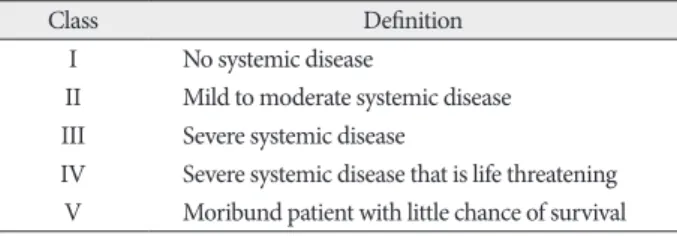
Patient populationThe present study included 489 patients who underwent lum-bar spine fusion surgery (LSFS) from 2003 to 2007. Exclusion cri-teria were age between 66 and 69 years, decompression only, an-terior interbody fusion, a follow-up period less than 12 months, and severe co-morbidity [American Society of Anesthesiolo-gists (ASA) classification of physical status >III] (Table 1). LSFS was performed by one neurosurgeon at a single institute, Han-yang University Medical Center. The patients were divided ac-cording to the definition of ‘geriatric’ into group 1 (older than 70 years) and group 2 (younger than 65 years). We enrolled pa-tients with various preoperative diagnoses including degenera-tive spine disease, spine trauma, and revision surgery after the previously mentioned diseases, and excluded patients suffering from spine tumors to avoid unexpected co-morbidities. Data re-lated to these patients were evaluated by a single observer using the standard hospital chart, outpatient notes, electronic medical records, operative reports, and preoperative and postoperative imaging studies. The following demographic variables were evaluated : principal diagnosis, previous spine surgery, treatable or non-treatable medical co-morbidities, bone mineral density (BMD), surgical approach, and segment of fusion.
Radiological evaluation
Preoperative plain radiographs including anteroposterior (AP),
Table 1. The American Society of Anesthesiologists classification of
physical status
Class Definition
I No systemic disease
II Mild to moderate systemic disease
III Severe systemic disease
IV Severe systemic disease that is life threatening
tion, mal-position of instrumentation, and aggravated neurolog-ic symptoms when compared with preoperative status. However, postoperative systemic complications such as pneumonia, bowel ileus, or renal failure were excluded because they could be caused by any surgery with general anesthesia. All complications were verified by retrospective chart reviews. In addition, any need for reoperation during the follow-up period was noted, and the reason was recorded.
Evaluation of outcome
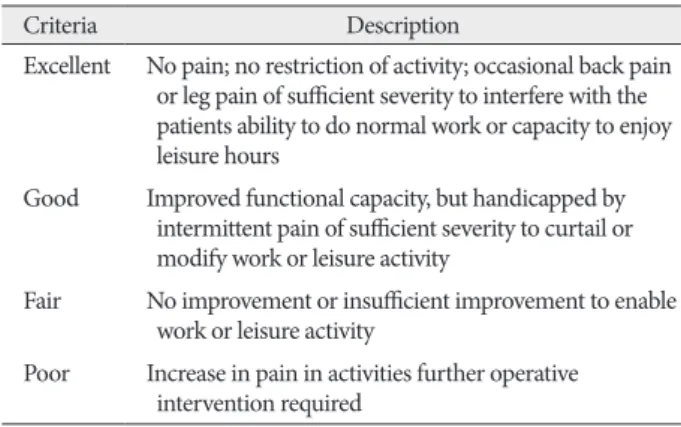
The patients enrolled in the present study were followed up for at least 12 months postoperatively. To evaluate objective neurologic improvement, we used the visual analogue scale (VAS) and MacNab’s criteria (Table 2).
Statistical analysis
Several univariate statistical analyses were performed to esti-mate the association among various factors as follows : Student’s t-test for the analysis of relationships among BMD, age, and sex; chi-square test for age and underlying disease; and logistic regres-sion models to determine the relationship between age and other factors with the occurrence of complications. Finally, we used bi-nomial univariate logistic regression analysis to evaluate the cor-relation between the occurrence of complications and age, sex, preoperative diagnosis, comorbidities, ASA class, and procedural details. p-values <0.05 were considered statistically significant.
Variables significant on univariate analysis were further tested in multivariate logistic regression models. Multivariate general-ized linear models were applied to assess the statistical signifi-cance of each individual variable while adjusting for other co-variates. p-values <0.05 were considered significant. Because the focus of the present study was elderly patients, age was kept in the regression model throughout regardless of its significance. For each variable, ORs and 95% CIs were calculated. A prede-termined subset analysis was performed to characterize com-plication rates according to age and to identify specific risk fac-tors. Descriptive and procedural information were compiled, and complication rates were calculated according to the previ-ously described definition. Univariate and multivariate logistic regression analyses were used to identify factors associated with complications in elderly patients. All statistical analyses were performed with SPSS statistical software version 16.0 (SPSS Inc., Chicago, IL, USA).
RESULTS
Patient populationDuring the five-year study period, 489 patients who met the inclusion criteria underwent instrumented fusion surgery (Ta-ble 3). Of these, 197 patients (40%) were male and 292 (60%) were female, and there were 197 patients (40%) in group 1 and 292 patients (60%) in group 2. The mean age was 57.8 years (group 1, 58.27 years; group 2, 75.91 years). The general condi-the published literature. In this study, a complication was
de-fined as any event requiring specific management during the perioperative period, including the intra-operative and post-op-erative periods. Based on a PubMed search of previous literature with the keyword “complication,” we considered the following to be complications : intra-operative complications such as dura tear, and postoperative complications including infection, spon-dylitis, hematoma accumulation, wound dehiscence or infec-Table 2. MacNab’s criteria
Criteria Description
Excellent No pain; no restriction of activity; occasional back pain or leg pain of sufficient severity to interfere with the patients ability to do normal work or capacity to enjoy leisure hours
Good Improved functional capacity, but handicapped by
intermittent pain of sufficient severity to curtail or modify work or leisure activity
Fair No improvement or insufficient improvement to enable
work or leisure activity
Poor Increase in pain in activities further operative
intervention required
Table 3. Demographic and procedural details*
Parameter No. of patient (%)
Sex Male 197 (40) Female 292 (60) Age ≥70 197 (40) <65 292 (60) Cormobidity Exist 218 (45) None 271 (55) ASA class I 342 (70) II 126 (26) III 21 (4) Operation procedure PLIF 95 (19) TPSF 287 (59) Combined app. 107 (22) Fusion segment 1 level 242 (49) 2 levels 190 (39) 3 levels 47 (9) 4 levels 8 (2) 5 levels 2 (0.5) Complication Occur 74 (15) None 415 (85)
*PLIF : Posterior lumbar interbody fusion, TPSF : transpedicular screw fixation, Combine app. : combined approach with TPSF and PLIF
was a statistically significant association between age and un-derlying disease (p=0.038) (Table 5).
Complications
Although there was a trend toward increased incidence of complications in patients who underwent surgery for degenera-tive disease, there was no statistically significant correlation be-tween diagnosis and overall complications. The overall inci-dence of degenerative disease, trauma, and reoperation was 11.8%, 2.0%, and 1.2%, respectively (Table 6).
Complications arising in the 74 patients are listed in Table 7. Intraoperative dura tearing occurred in 2.0% of the patients. The total postoperative complication rate in all patients was 13%, and the overall peri-operative complication rate in patients 70 years of age or older was 9%. Among these complications, 35 cases were re-treated (6 cases of dura tearing, 12 cases of wound dehiscence, 4 cases of hematoma accumulation, 6 cases of wound infection, and 7 cases of implant failure).
The results of the logistic regression analysis are displayed in Table 8. Age was the only statistically significantly factor in both univariate and multivariate analyses (p=0.001 and 0.004). Other factors such as sex, comorbidities, and operation procedure tion of most patients was ASA class I (342 patients) or II (126
patients) with a few patients in ASA class III. The distribution of surgical procedures was as follows : 287 patients (59%) with TPSF, 95 patients (19%) with PLIF, and 107 patients (22%) with combined procedure. Single-level fusion surgery was performed in 242 patients (49%) whereas the remainder underwent a multi-segment procedure. The average fusion multi-segment length was 1.64 segments. The most commonly treated levels were L4-5 and L3-4. Additionally, 45% of patients had comorbidities, and complications were encountered in 74 patients (15%).
Comorbidities
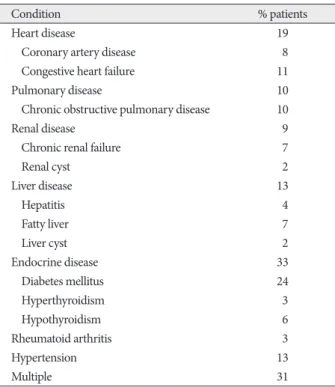
Among the observed comorbidities the most common prob-lem was endocrine disease, which was present preoperatively in 33% of the patients. Endocrine disease was subdivided into dia-betes mellitus (24%), hypothyroidism (6%), and hyperthyroid-ism (3%). Other comorbidities were cardiovascular disease (19%), hypertension (13%), liver disease (13%), pulmonary dis-ease (10%), and renal disdis-ease (9%). In addition, 31% of the pa-tients had more than one comorbidity (Table 4). We also estimat-ed the correlation between age and underlying disease. Almost half of the geriatric patients had underlying diseases and there Table 4. Concomitant disease in 218 patients who underwent surgery
for spinal fusion
Condition % patients
Heart disease 19
Coronary artery disease 8
Congestive heart failure 11
Pulmonary disease 10
Chronic obstructive pulmonary disease 10
Renal disease 9
Chronic renal failure 7
Renal cyst 2 Liver disease 13 Hepatitis 4 Fatty liver 7 Liver cyst 2 Endocrine disease 33 Diabetes mellitus 24 Hyperthyroidism 3 Hypothyroidism 6 Rheumatoid arthritis 3 Hypertension 13 Multiple 31
Table 5. Univariate analysis between age and concomitant disease*
Variable Concomitant disease p value
Exist None
Age 0.038
≥70 99 98
<65 119 173
*Bold value indicate p<0.05
Table 6. Incidence of complications according to disease
Disease Complication incidence (%) p value
Degenerative disease 58 (11.8) 0.094 Spinal stenosis 18 (3.7) Spondylolisthesis 16 (3.3) Spondylolysis 9 (1.8) Herniated disc 5 (1.0) Trauma 10 (2.0) Burst fracture 7 (1.4) Fracture dislocation 2 (0.4) Compression fracture 1 (0.2) Reoperation 6 (1.2) Total 74 (15.1)
Table 7. Complications in 74 patients*
No. of Complication (%)
Intraoperative 10 (2.0) Postoperative 64 (13)
Dural tearing 8 (1.6) Wound dehiscence 15 (3.1)
Other 2 (0.4) No interval change of Sx. 12 (2.4)
Aggravating Sx. 10 (2.0)
Hematoma/seroma 9 (1.8)
Wound infection 9 (1.8)
Superficial 6 (1.2)
Deep (eg. spondylodiscitis) 3 (0.6)
Implant failure 9 (1.8)
Screw malposition 6 (1.2)
Screw fracture 1 (0.2)
Cage malposition 1 (0.2)
Bone graft malposition 1 (0.2)
*Patients may have had more than 1 complication. The total complication rate is the percentage of patients experiencing any complication
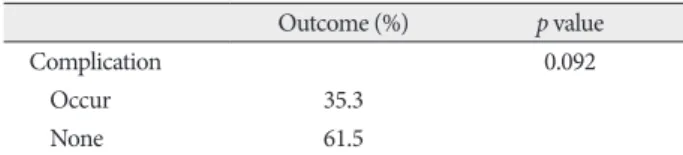
eration procedure, and fusion segment. In addition, there was no statistically significant relationship between perioperative complications and neurologic outcome (p=0.092) (Table 12).
DISCUSSION
The number of elderly persons in the Republic of Korea con-tinues to grow, with an expected 38.2% of people older than 65 years by the year 2050. This greatly exceeds the worldwide mean of 16.2%. An aging population will suffer from age-relat-ed degenerative diseases, such as disorders of the spine. Today, elderly people live longer, have more active lifestyles, and have a great desire to be pain free throughout the last decades of life. Advances in anesthesiology, spinal instrumentation, and post-operative care have made spinal procedures safer, with a de-crease in morbidity and mortality and improved patient out-comes7). Additionally, they have allowed more extensive and complex procedures to be performed in at-risk populations, such as the elderly7). Identifying predictors of complications or poor outcome in the geriatric population is important for peri-operative risk assessment and for implementing appropriate preventative measures.
There is no standard definition of “complication” in the spine literature37). Various classification systems have been used, often were not statistically significant. In addition, a greater number
of fusion segments was not predictive of complications. Osteoporosis
According to the present data, older patients and female tients had a lower T-score than younger patients and male pa-tients on univariate analysis (Table 9). However, there was no statistically significant relationship between low bone mineral density and perioperative complications (p=0.446 for sex and 0.761 for age) (Table 10).
Neurologic symptoms
Preoperatively, the mean VAS was six points in geriatric pa-tients and seven points in younger papa-tients. However, the final VAS was two in older patients and one in younger patients. There was a statistically significant difference between the two groups. Based on the mean MacNab criteria, both groups had good outcomes (Table 11). Worsening or maintenance of the preoperative status during the course of the follow-up period was seen in 17 (3.4%) of the 489 patients and was generally at-tributed to back pain, radiating pain to the leg, or neurogenic claudication. The remaining patients had relief of approximately 57.5% of their symptoms compared with preoperative status. There was no significant correlation with age, comorbidities, op-Table 8. Results of univariate and multivariate analysis*
Variable Complication (%) p value
Univariate Multivariate Age 0.001 0.004 ≥70 44 (9.0) <65 30 (6.1) Sex 0.961 0.862 Male 30 (6.1) Female 44 (9.0) Cormobidity 0.998 0.758 Exist 31 (6.3) None 43 (8.8) Operation procedure 0.282 0.456 PLIF 11 (2.3) TPSF 29 (5.9) Combined app. 34 (6.9) Fusion segment† 0.343 0.281 1 level 26 (5.3) 2 levels 39 (8.0) (RR=0.609) 3 levels 6 (1.2) (RR=0.445) 4 levels 2 (0.4) (RR=0.445) 5 levels 0 (0)
*Values are listed as OR (95% CI). Bold values indicate p<0.05. †A relative risk
of 1 means there is no difference in risk between the two groups. A RR of <1 means the event is less likely to occur in the experimental group than in the control group. A RR of >1 means the event is more likely to occur in the experi-mental group than in the control group. RR : relative risk, PLIF : posterior lumbar interbody fusion, TPSF : transpedicular screw fixation
Table 9. Univariate analysis of age and sex related with bone mineral
density*
Variable T-score (mean) p value†
Sex 0.021 Male -0.29 Female -1.50 Age≥70 0.011 Male -0.76 Female -2.09 Age<65 0.042 Male +0.01 Female -1.10 Age 0.046 ≥70 -1.55 <65 -0.61
*T-score -1.0 or greater is “normal”, T-score between -1.0 and -2.5 is “low bone
mass”(or “osteopenia”), T-score -2.5 or below is “osteoporosis”. †p<0.05
Table 10. Univariate analysis between bone mineral density and sex, age
associated with complication*
Variable T-score a/w complication p value
Occur None Sex 0.446 Male -0.05 -0.31 Female -1.58 -1.48 Age 0.761 ≥70 -1.71 -1.54 <65 -0.50 -0.63
the rate for patients older than 75 years was higher (18%). Our data also showed a difference between the older and younger groups; the complication rate of the older group was 9%, while that of the younger group was 6%. There was a statistically signif-icant association between age and perioperative complications (univariate analysis, p=0.001; multivariate analysis, p=0.004).
The relationship between comorbidities and surgical outcome has historically been controversial. Early studies investigating the effect of age on decompression with fusion for lumbar ste-nosis found that the presence of multiple comorbidities was as-sociated with perioperative complications24,32,43). Katz et al.24) found that greater cardiovascular, musculoskeletal, and overall comorbidities led to poorer scores in most of the outcome mea-surements. However, for lumbar spinal fusion in the elderly, several recent studies have found the opposite to be true1,2,4,5,26). Although Daubs et al.9) did not find an association between co-morbidities and complications, it is unclear whether they only studied the effect of individual diseases or the total number of comorbidities. The results of our study indicate that for lumbar fusions in the elderly, the number of comorbidities is not asso-ciated with perioperative complications (univariate analysis,
p=0.998; multivariate analysis, p=0.758).
Sanjay et al.47) found no correlation between diagnosis and overall incidence of complications (p=0.08), although a trend toward increased complications in patients undergoing surgery for neoplastic or infectious pathology was observed. In this subset of the patient population, patients with preoperative di-agnoses of infection and neoplasm were more often affected by isolated and multiple complications (p=0.05 and p=0.02, re-spectively). Patil et al.33) reviewed 26233 admissions for patients with surgically managed spine metastases from the National In-patient Sample, a public database maintained by the Agency for Healthcare Research and Quality and found a higher complica-tion rate in elderly patients. In this series, however, there was no statistically significant association between primary diagnosis and the rate of complication (p=0.094). Previous studies have suggested a higher incidence of complications with revision surgery compared with primary surgery2,18,43), possibly because scar tissue from the previous surgery may deform anatomy and to suit the investigator, making analysis
and comparison of the literature diffi-cult8,37,39,43). In the current study, a previ-ously validated classification of compli-cations was not used. Most previous studies in the literature used a binary system, and included systemic
compli-cations associated with surgery38). In the present study, however, we did not choose a binary system of complications and exclud-ed systemic complications because it was unclear whether sys-temic complications occurring in the perioperative period were related to spine surgery. The incidence of complications in this current analysis was 15.1%, which is a little lower than that in several previous retrospective studies2,10,33,46). In a review of 105 spine surgery articles, Nasser et al.30) reported an overall pooled complication incidence of 16.4%. The most common periopera-tive complication observed in this study was wound dehiscence, at a rate of 2.6%, while laceration of the dura was the most com-mon intraoperative complication (1.6%). Reoperation after spi-nal fusion surgery may be considered a failure of the initial sur-gery by the patient and surgeon and represents an additional procedure in patients who are already at significant risk for com-plication7). Mok et al.27) recently evaluated the need for revision surgery in patients undergoing adult spine surgery, finding a cu-mulative rate of 25.8%, while Cloyd et al.7) reported a reopera-tion rate of 27.4% in patients at least 65 years old who presented with a wide range of spine pathologies. In this study, the rate of revision surgery due to complications was approximately 47%, but age was not associated with the need for reoperation.
Cloyd et al.7) found that age is a risk factor for major postop-erative complications with an OR of 1.04 (p=0.039). A ten-year increase in age is associated with a 48% greater risk for a major postoperative complication. An alarming 24.2% of elderly pa-tients incur a major postoperative complication and 53.2% ex-perienced at least one in-hospital complication. The rates of complications for spinal arthrodesis in elderly patients are high-ly variable, ranging from 14 to 80%4,5,26,31,35). Okuda et al.31) found that patients older than 70 years who had undergone posterior lumbar interbody fusion for spondylolisthesis had a complica-tion rate of 16%, which was not significantly different from that in younger patients; however, these authors admittedly exclud-ed minor complications from their analysis. Kilinçer et al.26) also found that age did not affect the complication rates of pos-terior lumbar interbody fusion, but they did not report a com-plication rate separately for older patients. Vitaz et al.45) found that elderly patients with lumbar spinal disease can be surgical-ly treated in a similar fashion to younger patients. On the other hand, Deyo et al.10) retrospectively analyzed a statewide hospital discharge registry and compiled data on more than 18000 hos-pitalizations over a two-year period. Patients with nondegener-ative pathologies were excluded from the analysis. These au-thors reported an overall complication rate of only 10.3% for the surgical treatment of degenerative lumbar spine disease, although
Table 11. Comparison of outcome according to age*
Value Age Follow up period
Preoperative Postoperative 1 month 3 month 6 month 12 month
VAS ≥70 6 4 4 4 3 2
(mean) <65 7 4 3 3 2 1
*VAS : visual analogue scale
Table 12. Analysis of symptom improving according to complication*
Outcome (%) p value
Complication 0.092
Occur 35.3
None 61.5
procedures for a variety of indications, such as to restore sagittal balance, revise failed constructs, debride infections, or resect large spinal tumors7). In our study, there was no significant as-sociation between the number of segments fused and the risk of perioperative complications in patients of all ages, including the elderly (univariate analysis, p=0.343; multivariate analysis,
p=0.281). We therefore believe that the number of fusion
seg-ments may be not significantly associated with perioperative complications in lumbar spinal fusion surgery, therefore fusion extension should be determined by the surgeon as the occasion demands.
While the findings of the current study are important, there are several limitations. First, this study is a retrospective analysis, for which the limitations are well known. Retrospective studies may underestimate the actual complication incidence through the introduction of investigator recall bias21,42). A disproportion-ate reliance on the memory of different investigators and the accuracy of medical records may lead to falsely low reported rates of complication21). Differences in the interpretation of the patients’ degree of pain and neurologic examinations may also lead to a biased result. Second, there are several other opportu-nities for bias in the present study. There was significant case complexity in our patient population; thus the current study population may not represent the spine surgery population as a whole. Therefore, these findings may not be generalizable to a wider group of spinal fusion surgery patients. Third, we used our own definition of spinal fusion surgery complications. This definition may not represent the views of all spine surgeons, and inclusion of adverse medical events may not be an accept-able methodology to the general spine surgery community.
CONCLUSION
The number of spinal fusion surgeries performed for lumbar spinal disease has increased due to improved surgical techniques and advances in medical treatment, including anesthesia. How-ever, various complications are associated with fusion surgery. The incidence of complications in this series is similar to that in previously published papers. In this study, increasing age was an important risk factor for perioperative complications in patients undergoing lumbar spinal fusion surgery. There was no signifi-cant difference between the various procedures in terms of out-come. The general condition of patients with respect to a num-ber of chronic diseases did not affect the risk of perioperative complications. An important finding of the present study is that the occurrence of complications did not affect clinical outcome. Therefore, if good clinical judgment and careful patient selection are applied, fusion surgery may be performed in geriatric pa-tients, even in those with many concomitant diseases.
• Acknowledgements
This work was supported by the research funding of Hanyang University (HY-2011-N). Institutional Review Board was approved by Hanyang
Uni-increase the risk of injury to vascular structures, soft tissues, or visceral organs8). It may also affect wound healing and increase the risk of surgical site infections. Sidhu et al.43) found that the complication rate of revision lumbar surgery was three to five times higher than the reported rates for primary surgery. In that study, the overall complication rate for revision surgery at the same operative level was 42%. However, in the current study, the complication rate of 1.2% for reoperation was lower than that for primary surgery (14%).
Several studies have shown increased rates of complication with fusion versus non-fusion procedures6,16,23). Fusion and in-strumentation surgeries are generally more complex than non-fusion surgeries and the potential for injury and infection may be greater41). However, the indications for lumbar fusion in the treatment of spine segment instability due to various causes re-main controversial11). Our indications for lumbar spinal fusions have included severe low back pain25,49), mechanical or iatrogen-ic spinal instability3,14,18), degenerative spondylolisthesis12,13,29,34,44), and traumatic lumbar spinal injury. In our practice the decision to perform spinal fusion with instrumentation is based on the individual patient. Part of this consideration includes the pa-tient’s overall health status and ability to withstand a longer op-eration. Some authors believe that pedicle screw or rod fixa-tion-type fusion procedures have become the gold standard for arthrodesis11). These procedures obviate the extensile exposure required for intertransverse fusion procedures and require less bone graft material, thereby minimizing donor-site morbidity and complications. It has also been proposed that interbody fu-sion offers restoration of load-bearing capacity to the ventral spinal column and maintenance of interspace disc height, and that the smaller exposure results in fewer complications11). In this study, a significant association was not detected between fusion type and risk of perioperative complications in patients of all ages, including the elderly (univariate analysis, p=0.282; multivariate analysis, p=0.456).
Elderly patients who present with symptomatic spinal pathol-ogy may require single or extensive lumbar fusions to ensure adequate fusion and prevent future instrumentation-related complications7). Several studies have suggested that longer fu-sion lengths lead to an increased risk of complications in the el-derly4,5,35). Carreon et al.4) found an OR of 2.4 for postoperative complications in older patients undergoing lumbar arthrodesis with instrumentation. Similarly, Casinelli et al.5) found that fu-sion of four or more segments was predictive of complications. The mean number of levels fused in these studies was 2.4 and 1.9, respectively. On the other hand, Daubs et al.9) studied pa-tients older than 60 years who underwent spinal arthrodesis with a mean of 9.1 levels fused and found no association be-tween the length of fusion and complication risk. Moreover, Glassman et al.17) found that extending the fusion length may actually offer improved clinical outcomes in the setting of poor sagittal balance or spinal cord compression. Elderly patients may require extensive multilevel thoracolumbar spinal fusion
20. Hanley EN Jr : The indications for lumbar spinal fusion with and with-out instrumentation. Spine (Phila Pa 1976) 20 : 143S-153S, 1995 21. Hess DR : Retrospective studies and chart reviews. Respir Care 49 :
1171-1174, 2004
22. Johnsson KE, Rosén I, Udén A : The natural course of lumbar spinal stenosis. Clin Orthop Relat Res : 82-86, 1992
23. Katz JN : Lumbar spinal fusion. Surgical rates, costs, and complications.
Spine (Phila Pa 1976) 20 : 78S-83S, 1995
24. Katz JN, Lipson SJ, Larson MG, McInnes JM, Fossel AH, Liang MH : The outcome of decompressive laminectomy for degenerative lumbar stenosis. J Bone Joint Surg Am 73 : 809-816, 1991
25. Katz JN, Lipson SJ, Lew RA, Grobler LJ, Weinstein JN, Brick GW, et al. : Lumbar laminectomy alone or with instrumented or noninstrumented arthrodesis in degenerative lumbar spinal stenosis. Patient selection, costs, and surgical outcomes. Spine (Phila Pa 1976) 22 : 1123-1131, 1997 26. Kilinçer C, Steinmetz MP, Sohn MJ, Benzel EC, Bingaman W : Effects of age on the perioperative characteristics and short-term outcome of posterior lumbar fusion surgery. J Neurosurg Spine 3 : 34-39, 2005 27. Mok JM, Cloyd JM, Bradford DS, Hu SS, Deviren V, Smith JA, et al. :
Reoperation after primary fusion for adult spinal deformity : rate, rea-son, and timing. Spine (Phila Pa 1976) 34 : 832-839, 2009
28. Morgalla MH, Noak N, Merkle M, Tatagiba MS : Lumbar spinal steno-sis in elderly patients : is a unilateral microsurgical approach sufficient for decompression? J Neurosurg Spine 14 : 305-312, 2011
29. Mullin BB, Rea GL, Irsik R, Catton M, Miner ME : The effect of postlaminectomy spinal instability on the outcome of lumbar spinal ste-nosis patients. J Spinal Disord 9 : 107-116, 1996
30. Nasser R, Yadla S, Maltenfort MG, Harrop JS, Anderson DG, Vaccaro AR, et al. : Complications in spine surgery. J Neurosurg Spine 13 : 144-157, 2010
31. Okuda S, Oda T, Miyauchi A, Haku T, Yamamoto T, Iwasaki M : Surgi-cal outcomes of posterior lumbar interbody fusion in elderly patients. J
Bone Joint Surg Am 88 : 2714-2720, 2006
32. Oldridge NB, Yuan Z, Stoll JE, Rimm AR : Lumbar spine surgery and mortality among Medicare beneficiaries, 1986. Am J Public Health 84 : 1292-1298, 1994
33. Patil CG, Lad SP, Santarelli J, Boakye M : National inpatient complica-tions and outcomes after surgery for spinal metastasis from 1993-2002.
Cancer 110 : 625-630, 2007
34. Porter RW : Spinal stenosis and neurogenic claudication. Spine (Phila
Pa 1976) 21 : 2046-2052, 1996
35. Raffo CS, Lauerman WC : Predicting morbidity and mortality of lum-bar spine arthrodesis in patients in their ninth decade. Spine (Phila Pa
1976) 31 : 99-103, 2006
36. Ragab AA, Fye MA, Bohlman HH : Surgery of the lumbar spine for spi-nal stenosis in 118 patients 70 years of age or older. Spine (Phila Pa
1976) 28 : 348-353, 2003
37. Rampersaud YR, Moro ER, Neary MA, White K, Lewis SJ, Massicotte EM, et al. : Intraoperative adverse events and related postoperative com-plications in spine surgery : imcom-plications for enhancing patient safety founded on evidence-based protocols. Spine (Phila Pa 1976) 31 : 1503-1510, 2006
38. Ratliff JK, Lebude B, Albert T, Anene-Maidoh T, Anderson G, Dagosti-no P, et al. : Complications in spinal surgery : comparative survey of spine surgeons and patients who underwent spinal surgery. J Neurosurg
Spine 10 : 578-584, 2009
39. Rihn JA, Patel R, Makda J, Hong J, Anderson DG, Vaccaro AR, et al. : Complications associated with single-level transforaminal lumbar inter-body fusion. Spine J 9 : 623-629, 2009
40. Romano PS, Campa DR, Rainwater JA : Elective cervical discectomy in California: postoperative in-hospital complications and their risk fac-tors. Spine (Phila Pa 1976) 22 : 2677-2692, 1997
versity Medical Center (HYUH-IRB-2011-R-35). This manuscript has been reviewed and corrected by English editorial services and statistical service of Hanyang University Medical Service Center.
References
1. Benz RJ, Ibrahim ZG, Afshar P, Garfin SR : Predicting complications in elderly patients undergoing lumbar decompression. Clin Orthop Relat
Res : 116-121, 2001
2. Boakye M, Patil CG, Ho C, Lad SP : Cervical corpectomy : complica-tions and outcomes. Neurosurgery 63 : 295-301; discussion 301-302, 2008
3. Caputy AJ, Luessenhop AJ : Long-term evaluation of decompressive surgery for degenerative lumbar stenosis. J Spinal Disord 6 : 461-472, 1993
4. Carreon LY, Puno RM, Dimar JR 2nd, Glassman SD, Johnson JR : Peri-operative complications of posterior lumbar decompression and ar-throdesis in older adults. J Bone Joint Surg Am 85 : 2089-2092, 2003 5. Cassinelli EH, Eubanks J, Vogt M, Furey C, Yoo J, Bohlman HH : Risk
factors for the development of perioperative complications in elderly patients undergoing lumbar decompression and arthrodesis for spinal stenosis : an analysis of 166 patients. Spine (Phila Pa 1976) 32 : 230-235, 2007
6. Cho KJ, Suk SI, Park SR, Kim JH, Kim SS, Choi WK, et al. : Complica-tions in posterior fusion and instrumentation for degenerative lumbar scoliosis. Spine (Phila Pa 1976) 32 : 2232-2237, 2007
7. Cloyd JM, Acosta FL Jr, Cloyd C, Ames CP : Effects of age on periopera-tive complications of extensive multilevel thoracolumbar spinal fusion surgery. J Neurosurg Spine 12 : 402-408, 2010
8. Daniels AH, Riew KD, Yoo JU, Ching A, Birchard KR, Kranenburg AJ, et al. : Adverse events associated with anterior cervical spine surgery. J
Am Acad Orthop Surg 16 : 729-738, 2008
9. Daubs MD, Lenke LG, Cheh G, Stobbs G, Bridwell KH : Adult spinal deformity surgery : complications and outcomes in patients over age 60.
Spine (Phila Pa 1976) 32 : 2238-2244, 2007
10. Deyo RA, Cherkin DC, Loeser JD, Bigos SJ, Ciol MA : Morbidity and mortality in association with operations on the lumbar spine. The influ-ence of age, diagnosis, and procedure. J Bone Jint Surg Am 74 : 536-543, 1992
11. Elias WJ, Simmons NE, Kaptain GJ, Chadduck JB, Whitehill R : Com-plications of posterior lumbar interbody fusion when using a titanium threaded cage device. J Neurosurg 93 : 45-52, 2000
12. Esses SI, Huler RJ : Indications for lumbar spine fusion in the adult.
Clin Orthop Relat Res 2 : 87-100, 1992
13. Feffer HL, Wiesel SW, Cuckler JM, Rothman RH : Degenerative spon-dylolisthesis. To fuse or not to fuse. Spine (Phila Pa 1976) 10 : 287-289, 1985
14. Frazier DD, Lipson SJ, Fossel AH, Katz JN : Associations between spinal deformity and outcomes after decompression for spinal stenosis. Spine
(Phila Pa 1976) 22 : 2025-2029, 1997
15. Garfin SR, Mirkovic S, Herkowitz HN : Spinal stenosis: indications for laminectomy. Instr Course Lect 43 : 411-414, 1994
16. Glassman SD, Alegre G, Carreon L, Dimar JR, Johnson JR : Periopera-tive complications of lumbar instrumentation and fusion in patients with diabetes mellitus. Spine J 3 : 496-501, 2003
17. Glassman SD, Berven S, Bridwell K, Horton W, Dimar JR : Correlation of radiographic parameters and clinical symptoms in adult scoliosis.
Spine (Phila Pa 1976) 30 : 682-688, 2005
18. Gumbs AA, Hanan S, Yue JJ, Shah RV, Sumpio B : Revision open anteri-or approaches fanteri-or spine procedures. Spine J 7 : 280-285, 2007 19. Haid RW Jr, Subach BR, McLaughlin MR, Rodts GE Jr, Wahlig JB Jr :
C1-C2 transarticular screw fixation for atlantoaxial instability : a 6-year experience. Neurosurgery 49 : 65-68; discussion 69-70, 2001
46. Wang MC, Chan L, Maiman DJ, Kreuter W, Deyo RA : Complications and mortality associated with cervical spine surgery for degenerative disease in the United States. Spine (Phila Pa 1976) 32 : 342-347, 2007 47. Yadla S, Malone J, Campbell PG, Maltenfort MG, Harrop JS, Sharan
AD, et al. : Early complications in spine surgery and relation to preoper-ative diagnosis : a single-center prospective study. J Neurosurg Spine 13 : 360-366, 2010
48. Yamashita K, Ohzono K, Hiroshima K : Five-year outcomes of surgical treatment for degenerative lumbar spinal stenosis: a prospective obser-vational study of symptom severity at standard intervals after surgery.
Spine (Phila Pa 1976) 31 : 1484-1490, 2006
49. Yone K, Sakou T, Kawauchi Y, Yamaguchi M, Yanase M : Indication of fusion for lumbar spinal stenosis in elderly patients and its significance.
Spine (Phila Pa 1976) 21 : 242-248, 1996
41. Sauerland S, Lefering R, Neugebauer EA : Retrospective clinical studies in surgery : potentials and pitfalls. J Hand Surg Br 27 : 117-121, 2002 42. Schwender JD, Casnellie MT, Perra JH, Transfeldt EE, Pinto MR, Denis
F, et al. : Perioperative complications in revision anterior lumbar spine surgery : incidence and risk factors. Spine (Phila Pa 1976) 34 : 87-90, 2009
43. Sidhu KS, Herkowitz HN : Spinal instrumentation in the management of degenerative disorders of the lumbar spine. Clin Orthop Relat Res : 39-53, 1997
44. Smith EB, Hanigan WC : Surgical results and complications in elderly patients with benign lesions of the spinal canal. J Am Geriatr Soc 40 : 867-870, 1992
45. Vitaz TW, Raque GH, Shields CB, Glassman SD : Surgical treatment of lumbar spinal stenosis in patients older than 75 years of age. J