파킨슨병 환자에서 양측 시상밑부 뇌심부자극의 효과:
신촌 세브란스 병원의 6개월 추적 관찰 결과
연세대학교 의과대학 신경과학교실, 신경외과학교실a
신혜원 장진우
a손영호
The Effect of Bilateral Subthalamic Nucleus Stimulation in
Parkinson’s Disease: Experiences From 6 Month Follow-up in
Sinchon Severance Hospital
Hae-W on Shin, MD, JinW oo Chang, MD
a, Young Ho Sohn, MD
Department of Neurology, Neurosurgerya Yonsei University College of Medicine, Seoul, Korea
Background: Bilateral deep brain stimulation (DBS) of the subthalamic nucleus (STN) is known as an effective
neurosurgical procedure for the treatment of advanced Parkinson disease (PD). Although short- and long-term effects of STN stimulation in PD are relatively well known, an interim analysis of its efficacy is essential for us to continue with this procedure in the future. We present the clinical outcome of 6 month follow-up in patients who were assessed in our hospital after bilateral STN stimulation.
Methods: Twenty-nine patients with PD treated with bilateral STN DBS were included in this study. The effect
of STN DBS was assessed at 6 months after surgery, which included the followings; motor disability in ‘DBS- off/on, medication-off/on’ states, activity of daily living (ADL) in ‘medication-off/on’ states, levodopa-induced motor complication, daily levodopa and levodopa-equivalent dosage, neuropsychological assessment and quality of life.
Results: Nineteen patients completed the follow-up assessment. STN stimulation produced significant
improve-ments in the motor disability score both during ‘medication-off’ and ‘medication-on’ states. The ADL score was improved only in ‘medication-off’ states. The amount of levodopa-induced dyskinesia and response fluctuation also significantly decreased. Scores of Korean version of Mini-mental status examination (K-MMSE), Korean version of Consortium to Establish a Registry for Alzheimer’s Disease (CERAD-K) and Beck Depression Inventory (BDI) did not change. Daily levodopa and levodopa-equivalent dosages were significantly reduced. No serious side effect was encountered.
Conclusions: Bilateral STN DBS is a relatively safe and beneficial treatment for PD patients with levodopa-
induced motor complications. In order to obtain a better prognosis in the future, we should assess the long-term outcome and the clinical predictive factors of STN DBS.
J Korean Neurol Assoc 26(2):110-117, 2008
Key Words: Parkinson disease, Deep brain stimulation, Subthalamic nucleus, Short-term effects
Received December 17, 2007 Accepted February 9, 2008 *Young Ho Sohn, MD
Department of Neurology, Yonsei University College of Medicine, 250 Seongsanno, Seoul, 120-752, Korea
Tel: +82-2-2228-1601 Fax: +82-2-393-0705 E-mail: [email protected]
서 론
파킨슨병에서의 시상밑부 뇌심부자극은 운동 합병증을 보이 는 진행된 파킨슨병 환자에게 시행되고 있다. 레보도파는 파킨 슨병 환자의 가장 효과적인 치료 약물이지만 파킨슨병이 진행 되면서 약물의 장기복용으로 인한 운동합병증인 운동기복과 이 상운동이 대부분 발생하게 된다. 시상밑부 뇌심부자극은 이러 한 환자에서 운동증상을 호전시키고 이상운동을 감소시키며 도 파민제제의 용량을 줄일 수 있는 장점이 있다.1-19 이는 3개월 에서 12개월 사이의 여러 단기 추적 관찰을 통하여 증명이 되었 으며1,3-5,8-12,17,19 이후로도 2년,2 3년,6,14,15 4년,13,14 그리고 5년16까지도 그 효과가 지속된다는 것이 보고되고 있으며 다 기관 연구13에서도 이러한 사실이 입증되었다. 우리나라에서는 2005 년부터 파킨슨병에서의 뇌심부자극에 대한 보험 혜택이 가능해 진 이후에 이를 시행받는 파킨슨병 환자들의 수가 빠른 속도로 증가하고 있다. 비록 시상밑부 뇌심부자극의 단기 효과는 기존 의 많은 연구 결과를 통하여 이미 증명이 되었으나 국내 기관의 치료 결과에 대한 보고는 부족한 실정이다. 따라서 현재까지 수 술을 시행받은 환자들의 치료 효과와 수술로 인한 부작용을 조 사하는 것이 앞으로의 뇌심부자극의 적응증과 방향을 설정하는 데에 필수적일 것이다. 이에 이 연구에서는 시상밑부 뇌심부자 극을 시행받은 파킨슨병 환자에서 수술 후의 단기 추적 관찰을 통하여 파킨슨병 증상과 신경정신기능, 삶의 질을 비교하여 수 술의 효과를 평가하고, 수술의 부작용을 조사하고자 하였다.
대상과 방법
1. 대상
2004년 1월부터 2005년 12월까지 연세대학교 신촌 세브란 스 병원에서 시상밑부 뇌심부자극을 시행받은 29명의 환자를 대상으로 하였다. 수술 대상자는 5년 이상의 유병 기간을 가진 75세 미만의 특발성 파킨슨병 환자로 레보도파 약물과 관련된 운동합병증을 가지고 있고 수술 전 약물반응 검사에서 Unified Parkinson Disease Rating Scale (UPDRS) 운동 점수(part III score)가 33% 이상 향상되는 경우를 포함시켰다.20 Korean version of Consortium to Establish a Registry for Alz-heimer’s Disease (CERAD-K)를 이용한 인지 검사에서 치매 로 진단된 경우에는 수술 대상자에서 제외하였다.2. 방법
1) 수술 방법 시상밑부 뇌심부자극은 모든 환자에게 양측을 함께 시행하 였다. 정위뇌자기공명영상을 통하여 시상밑부 좌표값을 얻고 미세 전극을 AC-PC선을 지나는 축을 따라서 전진시키면서 각 지점의 전기 활성도를 미세 전극기록을 통하여 기록하면서 시 상밑부 경계를 확인한 뒤 전기자극기로 이를 자극하여 환자의 운동증상이 향상되는 것을 관찰하면서 목표를 결정하였다. 정 해진 목표 지점에 전극을 삽입하고 위치를 투시방사선촬영으로 확인한 뒤 두개골에 고정하였다. 파동발생기는 쇄골 아래의 피 부밑에 삽입하고 전극선과 연결하였다. 파동발생기의 프로그래 밍은 수술 1개월 후에 시행하였다. 2) 임상 평가수술 전과 프로그래밍 후 6개월 후에 UPDRS part I(정신, 인지), II(일상생활능력), III(운동증상), IV(운동합병증)를 이용 하여 정신 상태, 행동 및 정서와 일상생활, 운동증상, 그리고 운동합병증을 평가하였다. UPDRS part II와 part III는 수술 전 평가에서는 약효가 없는(‘medication-off’) 상태와 약효가 있는(‘medication-on’) 상태를 측정하였다. ‘medication-off’ 상태는 전날 저녁부터 다음날 아침까지 항파킨슨제제를 복용하 지 않은 상태로 마지막 약 복용 후 약 12시간 이후로 정하였고, ‘medication-on’ 상태는 아침 공복 상태에서 평소에 복용하던 레보도파 용량의 1.5배를 투약한 후 환자가 ‘가장 좋은 상태’ 라 고 평가하는 시간의 상태로 정하였다. 수술 후 평가에서는 뇌자 극이 있는 상태에서 약효가 없는(‘DBS-on, medication-off’) 상태를 12시간 이상 약을 복용하지 않고 측정하였고, 뇌자극을 끄고 1시간 후에 뇌자극이 없고 약효가 없는 상태(‘DBS-off, medication-off’)를 측정하였다. 또 뇌자극이 없고 약효가 있 는 상태(‘DBS-off, medication-on’)를 뇌자극을 끈 상태에서 수술 후의 레보도파 상용량의 1.5배를 투약한 후 환자가 ‘가장 좋은 상태’로 평가하는 시간에 측정하였다. 그리고 뇌자극을 켠 후 1시간 후에 뇌자극이 있고 약효가 있는 상태(‘DBS-on, medication-on’)를 측정하였다. UPDRS part III 는 총점과 떨 림(항목 20, 21번), 경직(항목 22번), 운동완만(항목 23-26번), 중심증상(항목 27-30번)으로 나누어 평가하였다. UPDRS part IV는 이상운동(항목 32-25번)과 운동기복(항목 36-39번) 항목 을 나누어서 평가하였고, 이상운동은 UPDRS part IV 이외에 Clinical Dyskinesia Rating Scale (CDRS)21을 추가로 시행하 였다. 이 외에 수술 전후에 CERAD-K를 사용하여 인지기능을 비교하였고 Beck Depression Inventory (BDI)로 우울증을 평 가하였다.22 BDI는 0-59점의 점수를 측정하여 0-9점은 “우울 증이 없음”, 10-17점은 “우울 경향이 있음”, 18-24점은 “우울 증이 있음” 그리고 25점 이상은 “심한 우울증”으로 분류하였다. 삶의 질에 대한 평가는 short-form 36 (SF-36) health survey 를 사용하였다.23 약물 용량은 레보도파의 용량과 레보도파 동 등약효량을 환산하여 비교하였다.4 3) 부작용 평가 뇌심부자극의 부작용은 수술과 관련된 부작용과 뇌자극과 관 련된 부작용으로 나누어 조사하였다. 4) 통계분석 통계분석은 paired t-test를 이용하여 수술 전후의 결과를 비교 분석하였다. UPDRS part III는 수술 전의 ‘medication-
Table 1. Characteristics of the patients
Characteristics Mean±SD (range)
Age (year) 58.8±8.8 (42-73)
Sex Male 5
Female 14
Symptom duration (years) 11.8±4.8 (6-20)
Stage (medication-off) II 5
III 14
UPDRS I 2.8±2.5
UPDRS II (medication-off) 16.0±6.7
UPDRS III (medication-off) 36.1±12.2
UPDRS IV 6.4±2.4
Response of levodopa (%) 65.8±10.5
Dosage of levodopa (mg/day) 781.6±283.6 (300-1400) Levodopa-equivalenet dose
(mg/day) 898.0±311.0 (375-1515)
UPDRS; Unified Parkinson Disease Rating Scale.
Table 2. Symptoms of parkinsonism (UPDRS scores) in ‘medication-off’ and ‘medication-on’ condition
Before surgery After surgery 6 months
DBS-off DBS-on (improvement %)
UPDRS III Total medication-off 36.1±12.2 32.4±8.5 12.5±6.7a (62.8)c
medication-on 11.8±4.6 14.9±7.9 7.6±5.6 (39.0) Tremor medication-off 6.8±5.5 7.2±5.2 1.5±2.0a (80.2)c,d medication-on 0.7±1.4 2.3±2.8 0.9±1.4 Rigidity medication-off 5.1±3.5 3.3±2.8* 0.6±1.1a (81.4)c medication-on 1.3±1.4 1.3±1.4 0.1±0.3b (93.2) Bradykinesia medication-off 13.9±5.0 12.2±4.8 4.9±4.6a (65.2)c medication-on 5.3±3.2 6.6±5.7 3.1±4.3b (41.0)
Axial symptoms medication-off 7.9±4.0 7.0±3.0 3.0±2.2a (57.8)c
medication-on 3.4±3.0 3.3±1.8 1.9±1.7 UPDRS II medication-off 16.0±6.7 8.4±5.8a (46.0) medication-on 5.6±3.3 4.5±3.0 UPDRS IV Dyskinesia 3.0±2.1 1.1±1.6b (37.9) Motor fluctuation 3.4±1.0 1.2±1.2b (62.0) CDRS 4.6±3.6 1.6±2.5b (65.9)
ap<0.05 compared with the preoperative ‘medication-off’ condition, bp<0.05 compared with the preoperative ‘medication-on’ condition, cp<0.05
compared with the postoperative ‘DBS-off, medication-off’ condition, dp<0.05 compared with the postoperative ‘DBS-off, medication-on’ condition.
UPDRS; Unified Parkinson Disease Rating Scale, DBS; deep brain stimulation, CDRS; Clinical Dyskinesia Rating Scale. off’와 수술 후의 ‘DBS-off, medication-off’, ‘DBS-on,
medication-off’ 상태를 각각 비교하였고, 수술 전의 ‘medi-cation-on’과 수술 후의 ‘DBS-on, medication-on’ 상태를 비교하였다. 수술 후 ‘DBS-off, medication-off’ 상태와 ‘DBS- on, medication-off’ 상태를 비교하였다. 또, 수술 후 약물과 놔자극에 대한 파킨슨병의 운동증상의 호전정도를 수술 후 ‘DBS-on, medication-off’와 ‘DBS-off, medication-on’ 상태에서의 UPDRS part III 점수 비교를 통하여 분석하였다. 수술 후 약을 끊은 경우에는 ‘DBS-off, medication-on’ 상태 와 ‘DBS-on, medication-on’ 상태를 평가하지 않았다. 따라 서 ‘DBS-on, medication-off’와 ‘DBS-off, medication-on’
의 비교와 수술 전 ‘medication-on’과 수술 후 ‘DBS-on, medication-on’의 비교는 17명 환자의 자료를 분석하였다.
결 과
1. 환자의 특성
수술 환자 29명 중 19명이 연구에 포함되었다. 추적 기간 중 한 명의 환자에서 수술 3개월 후 급성 뇌경색이 발생하였고 한 명의 환자가 허리뼈관 협착으로 수술을 시행받아 수술 후 평가 가 불가능하였다. 한 명의 환자는 해외로 이민을 가면서 추적 관찰이 되지 않았고, 7명의 환자는 수술 후 평가에 협조하지 않 았다. 대상 환자의 연령은 평균 58.8±8.8(범위 42-73)세였고 성비는 남자가 5명, 여자가 14명이었다. Hohn & Yahr stage는 5명이 stage II였고 14명이 stage III였다. 환자의 증상지속 기간은 평균 11.8±4.8(범위 6-20)년이었다(Table 1).2. 파킨슨병의 임상증상
UPDRS part III 점수는 수술 전후에 ‘medication-off’와 ‘medication-on’ 상태에서 모두 62.8%와 39.0%로 유의하게 호전되었다. 떨림, 경직, 운동완만, 중심증상 항목 모두 수술 전의 ‘medication-off’ 상태와 비교하였을 때 수술 후의 ‘DBS- on, medication-off’ 상태에서 각각 80.2%, 81.4%, 65.2%, 57.8%의 호전을 보였고, 수술 전의 ‘medication-on’ 상태와
Table 3. Comparison of quality of life by SF-36 in preoperative
and postoperative periods
SF-36 domain Preoperative evaluation (%) Postoperative evaluation (%) Physical function 52.6±14.8 61.9±24.0a Role (physical) 49.8±12.1 61.2±16.7a Body pain 46.3±22.0 60.0±20.7a General health 46.9±13.1 55.7±20.1a Vitality 42.4±16.1 56.0±20.1a Social function 52.5±19.9 63.2±20.6a Role (emotional) 56.8±18.7 69.3±22.4a Mental health 48.6±22.8 60.0±14.8a
ap<0.05, compared with preoperative evaluation.
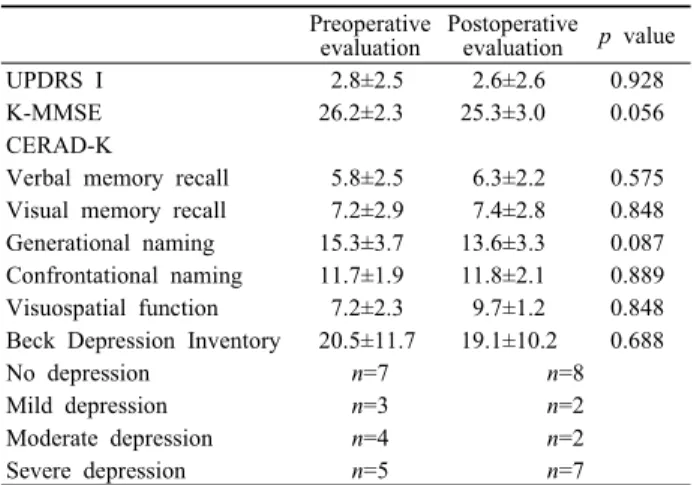
Table 4. Comparison of neuropsychological function in
preope-rative and postopepreope-rative period
Preoperative
evaluation Postoperative evaluation p value
UPDRS I 2.8±2.5 2.6±2.6 0.928
K-MMSE 26.2±2.3 25.3±3.0 0.056
CERAD-K
Verbal memory recall 5.8±2.5 6.3±2.2 0.575
Visual memory recall 7.2±2.9 7.4±2.8 0.848
Generational naming 15.3±3.7 13.6±3.3 0.087
Confrontational naming 11.7±1.9 11.8±2.1 0.889
Visuospatial function 7.2±2.3 9.7±1.2 0.848
Beck Depression Inventory 20.5±11.7 19.1±10.2 0.688
No depression n=7 n=8
Mild depression n=3 n=2
Moderate depression n=4 n=2
Severe depression n=5 n=7
UPDRS; Unified Parkinson Disease Rating Scale, K-MMSE; Korean version of mini-mental status examination, CERAD-K; Korean version of Consortium to Establish a Registry for Alzheimer’s Disease. 수술 후 ‘DBS-on,medication-on’을 비교하였을 때 경직, 운 동완만은 93.2%, 41.0% 호전되었으나 떨림과 중심증상 항목 점수는 변화가 없었다(Table 2). 수술 전 ‘medication-off’과 수술 후 ‘DBS-off, medication-off’ 사이에는 떨림, 운동완만, 중심증상 항목과 총점의 의미 있는 차이가 없었으나 경직 항목 은 수술 전 5.1±3.5점과 비교하여 수술 후에 3.3±2.8점으로 의미있는 차이를 보였다. 수술 후 ‘DBS-off, medication-off’ 와 ‘DBS-on, medication-off’를 비교하였을 때에 UPDRS part III 의 모든 항목에서 의미 있는 호전을 보였다. 또 수술 후의 ‘DBS-on, medication-off’ 상태에서의 떨림 항목 점수가 ‘DBS-off, medication-on’ 상태보다 낮았다. UPDRS part II 점수는 ‘medication-off’ 상태에서는 46.0% 호전되었으나 ‘medication-on’ 상태에서는 호전되지 않았다(Table 2). UPDRS part IV의 이상운동점수는 37.9% 감소하였고 운동기복점수는 62.0%의 호전이 있었으며, CDRS 점수는 65.9%의 호전을 보였 다(Table 2).
3. 약물 용량
하루 레보도파 동등약효량은 898.0±311.0 mg에서 447.1± 283.2 mg으로 46.8% 감소하였고 레보도파용량은 781.6± 283.6 mg에서 410.5±302.6 mg으로 44.2% 감소하였다. 두 명의 환자는 수술 후 도파민제제의 복용을 중단할 수 있었다.4. 삶의 질
SF-36 8개 항목 각각의 수술 전후의 점수를 비교한 결과 신 체적 기능, 신체적 역할 제한, 통증, 일반 건강, 활력, 사회적 기능, 감정적 제한, 정신건강 항목 모두 수술 후 호전되었다 (Table 3).5. 인지기능 및 우울증
UPDRS I의 점수는 수술 전후에 차이가 없었다. 인지기능 검 사에서는 K-MMSE 점수가 수술 전은 평균 26.2±2.3이었고 수술 후의 점수는 25.3±3.0으로 유의한 차이가 없었고, CERAD- K의 언어 및 시공간 기억력, 시공간 기능, 언어유창성능력 항목 별 점수 모두 차이를 보이지 않았다. BDI 점수도 수술 전 평균 20.5±11.7점에서 수술 후 19.1±10.2로 차이가 없었다(Table 4). 수술 전 BDI 점수에서 ‘심한 우울증’으로 분류된 환자는 5명 이었고 이들은 수술 후에도 그대로 ‘심한 우울증’으로 분류되었 다. ‘경미한 우울증’으로 평가된 환자 중 한 명이 수술 후에 ‘심 한 우울증’으로 분류되었다. 또 ‘경미한 우울증’과 ‘중등도의 우 울증’으로 분류된 환자 7명 중에서 중 5명이 ‘우울증 없음’으로 호전되었다.6. 뇌심부자극 프로그래밍 변수
총 38개의 전극 중 25개의 전극은 단극 자극, 13개는 이중 단 극 자극을 사용하였다. 평균 전압, 주파수, 자극 박동폭은 오른 쪽 전극에서 각각 2.8±0.6 V, 134.5±13.1 Hz, 61.6±6.90 μs 이었고 왼쪽 전극에서는 2.6±0.6 V, 132.4±5.6 Hz, 60.0± 0.0 μs였다.7. 부작용
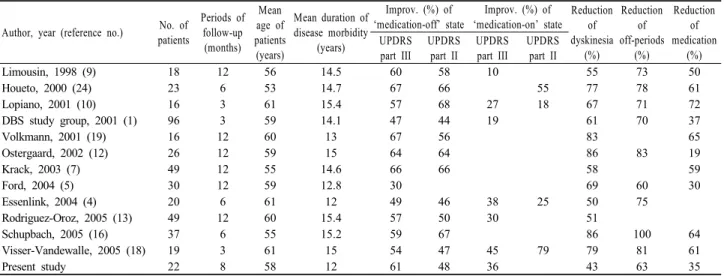
1) 수술과 연관된 부작용Table 5. Comparison of short-term follow-up studies of subthalamic nucleus stimulation
Author, year (reference no.) patientsNo. of
Periods of follow-up (months) Mean age of patients (years) Mean duration of disease morbidity (years) Improv. (%) of ‘medication-off’ state Improv. (%) of ‘medication-on’ state Reduction of dyskinesia (%) Reduction of off-periods (%) Reduction of medication (%) UPDRS part III UPDRS part II UPDRS part III UPDRS part II Limousin, 1998 (9) 18 12 56 14.5 60 58 10 55 73 50 Houeto, 2000 (24) 23 6 53 14.7 67 66 55 77 78 61 Lopiano, 2001 (10) 16 3 61 15.4 57 68 27 18 67 71 72 DBS study group, 2001 (1) 96 3 59 14.1 47 44 19 61 70 37 Volkmann, 2001 (19) 16 12 60 13 67 56 83 65 Ostergaard, 2002 (12) 26 12 59 15 64 64 86 83 19 Krack, 2003 (7) 49 12 55 14.6 66 66 58 59 Ford, 2004 (5) 30 12 59 12.8 30 69 60 30 Essenlink, 2004 (4) 20 6 61 12 49 46 38 25 50 75 Rodriguez-Oroz, 2005 (13) 49 12 60 15.4 57 50 30 51 Schupbach, 2005 (16) 37 6 55 15.2 59 67 86 100 64 Visser-Vandewalle, 2005 (18) 19 3 61 15 54 47 45 79 79 81 61 Present study 22 8 58 12 61 48 36 43 63 35
UPDRS; Unified Parkinson Disease Rating Scale, Improv; improvement. 한 명의 환자에서 수술 후 뇌실내출혈이 발생하였다. 이는 자연 회복되었으며 환자의 신경학적 증상의 악화를 초래하지 않았다. 두 명의 환자에서 수술 후 2개월, 12개월 후에 전선이 위치한 곳의 피하 감염이 발생하였는데, 두 명 모두 항생제 치 료로 회복되었다. 2) 뇌자극과 연관된 부작용 두 명의 환자에서 뇌자극 후 정신행동 이상을 보였다. 한 명 의 환자는 병적인 쾌감 및 행복감을 보였고 다른 한 명에서는 상황에 맞지 않는 말과 행동, 혼동이 나타났다. 이러한 증상은 서서히 호전되어 추적 관찰 시에는 완전히 회복되었다. 다섯 명 의 환자에서 발음 장애가 발생하였고, 세 명의 환자에서 체중 증가가 있었다.
고 찰
이 연구에서는 파킨슨병 환자에서 시상밑부 심부뇌자극에 대 한 6개월 후의 효과와 부작용에 대하여 알아보았다. 시상밑부 심부뇌자극은 ‘medication-off’ 상태에서의 운동증상과 일상 생활 수행능력을 각각 62.8%과 46.0% 향상시켰고 이는 현재 까지 보고된 3-12개월 사이의 결과와 비슷하였다(Table 5). ‘medication-off’ 상태에서 UPDRS part III 점수의 항목별 향 상 정도를 비교하였을 때에는 경직이 가장 많은 호전을 보였고 중심증상이 호전 정도가 가장 낮았다. ‘medication-on’17 상태 에서의 운동증상은 39.0%로 의미 있게 좋아졌으나 일상생활 수 행능력은 차이가 없었다. 수술 후의 ‘medication-on’ 상태는 당시의 레보도파 상용용량의 1.5배를 1회 복용 후 평가하였는 데, 수술 후 레보도파 용량이 수술 전에 비하여 줄었음에도 불 구하고 ‘medication-on’ 상태에서의 운동증상이 호전된 것은 약물 효과와 뇌심부자극의 상승 효과가 있음을 반영하는 결과 이다.1,9,25 ‘medication-on’ 상태에서 수술 전후에 UPDRS part II 점수의 차이가 없었으므로 이 운동증상의 호전이 환자의 일 상수행 기능의 향상으로 이어지지는 않았다고 할 수 있다. 수술 전의 ‘medication-off’ 상태와 수술 후의 ‘DBS-off, medi-cation-off’ 상태의 UPDRS III 점수에서 경직 항목이 유의한 호전을 보였다. 이는 뇌자극을 끄고 1시간 후에 뇌자극의 효과 가 완전히 없어지지 않았기 때문일 가능성이 있다. 그러나 다른 항목은 차이가 없었기 때문에 이러한 가능성 이외에도 전극의 통과에 의한 뇌병변으로 인한 효과일 가능성이 있다. 수술 후의 ‘DBS-off, medication-off’ 상태와 ‘DBS-on, medication- off’ 상태를 비교하였을 때에 UPDRS part III 모든 항목에서 의 미 있는 호전을 보였는데 이는 순수한 뇌자극만의 효과를 반영 하는 소견이라고 할 수 있겠다. 또 뇌자극의 효과와 약물 효과 를 비교하였을 때에 떨림 항목에서 뇌자극의 효과가 더 큰 것으 로 나타난 것은 약물로 충분한 효과를 보이지 않는 떨림 증상의 경우 뇌자극으로 약물보다 좋은 반응을 기대할 수 있다는 간접 적인 증거라고 할 수 있다. 레보도파 동등약효량은 수술 후 평균 46.8% 감소하였다. 수 술 후의 도파민 동등약효량은 447.1±283.2 mg/day로 다른 연 구들과 비슷하지만, 수술 전은 898.0±311.0 mg으로 다른 연구 에 비하여 낮은 용량을 사용했던 점이 다른 연구들의 약물 감소 량에 비하여 적은 수치를 나타낸 이유로 생각할 수 있다.1,3,5,8-12,17,19,24 수술 전 약물 용량이 낮은 이유는 정확하지 않다. 환 자의 평균 증상 기간은 12년으로 다른 연구들과 비슷하였고 (Table 5), 수술 전 평가에서 보인 레보도파 약물에 대한 반응 정도도 65.8%로 차이가 없었다. 같은 효능을 나타내는 레보도 파 용량이 인종 간에 차이가 있을 가능성이 있으나 이는 앞으로 의 추가 연구를 통하여 비교해 보아야 할 것이다. UPDRS part IV 점수로 평가한 이상운동과 운동기복은 수술 전에 비하여 각각 37.9%와 62.0%의 호전을 보였는데, 운동기 복의 호전은 다른 연구 결과들과 비슷하였으나 이상운동에 대 한 효과는 적었다(Table 5). 뇌심부자극의 이상운동에 대한 효 과의 기전은 수술 후 레보도파의 용량을 줄임으로써 나타나는 간접적인 효과로 추정하고 있으므로9,11,26,27 이번 연구에서 이상 운동에 대한 효과가 적었던 이유를 설명할 수 있다. CDRS로 평가한 이상운동의 정도는 65.9%로 호전되었고, 그 정도가 UPDRS part IV의 이상운동 항목보다 컸다. 이는 뇌심부자극이 이상운동의 지속 시간보다는 이상운동의 정도에 더 효과적이라 는 것을 시사하는 소견이다. 뇌심부자극이 파킨슨병의 운동증상과 일상생활 수행능력을 호전시키지만 실제로 환자가 느끼는 삶의 질도 향상되는지에 대해서는 논란이 있다.28-30 이번 연구에서는 SF-36 설문지의 모든 항목이 수술 전에 비하여 향상되었다. SF-36 설문지23는 일반적인 삶의 질을 평가하는 도구로 정상인과 다양한 질병에 대한 전반적인 삶의 질의 정도를 파악할 수 있으나,31 파킨슨병 환자들이 특이적으로 가지고 있는 일상생활의 제한점을 대변하 지는 못하는 한계가 있다.32 따라서 SF-36 설문지 이외에 파킨 슨병에 적합한 설문지를 추가적으로 사용하여 평가해야33 뇌심 부자극이 실제로 파킨슨병의 삶의 질에 어떠한 영향을 미치는 지 정확하게 알 수 있을 것이다. 인지기능은 수술 전후에 차이가 없었다. 시상밑부 뇌심부자 극 후 인지기능이 감소된다는 보고가 있으나,34,35 아직 대규모 의 비교 연구가 없어 이러한 인지기능의 감소가 수술에서 기인 한 것인지 파킨슨병 자체의 자연 경과와 관련된 것인지 확실하 지 않다. 이 연구에서는 기억력 및 언어능력, 시공간능력 모두 수술 후에 변화가 없었고, 이는 다른 연구 결과와 함께36-38 시 상밑부 심부뇌자극이 인지장애를 악화시키지 않는다는 결론을 뒷받침하는 소견이었다. 그러나 CERAD-K 검사지가 주로 알쯔 하이머병의 진단을 위한 도구이므로 파킨슨병에서 가장 많이 동반되어있는 것으로 알려져 있는 언어 유창성능력의 저하와 전두엽 수행기능장애 등을 자세히 조사하지 못했던 한계점이 있다. 따라서 실제 이러한 기능에 변화가 있었다고 하더라도 발 견되지 않았을 가능성이 있다. 이러한 점을 보완하기 위하여 전 두엽기능 평가 도구를 수술 전후의 인지 검사 평가에 추가해야 할 것으로 생각한다. 우울증은 뇌심부자극에 영향을 받지 않았 다. 수술 전 BDI에서 ‘우울증 없음’이나 ‘경미한 우울증’ 또는 ‘중등도의 우울증’에 속했던 환자는 수술 후 호전되기도 하고 악 화되기도 하였으나, 수술 전 ‘심한 우울증’으로 분류된 환자의 경우에는 모두가 수술 후에도 그대로 심한 우울증이 있는 것으 로 평가되어 수술 전의 ‘심한 우울증’은 수술 후에 호전될 가능 성이 떨어질 것으로 판단할 수 있었다. 수술과 관련된 부작용인 출혈과 감염은 다른 연구와 비교하 였을 때 비슷하거나 적은 수에서 발생하였다.1,3,5,8-12,17,19,24,25 뇌자극과 관련된 부작용으로 가장 많았던 발음곤란은 추적 관 찰 기간까지 계속되었다. 이는 시상밑부 주변 뇌연수경로의 자 극으로 인한 것으로 뇌자극을 끄면 호전되었다. 발음곤란이 발 생한 환자들은 운동증상이 호전되었음에도 불구하고 이로 인한 일상생활에의 불편함을 호소하였다. 수술 직후 발생한 정신행 동장애는 일시적이었고 추적 관찰 시점에는 없었다. 뇌자극 후 급성기에 발생하는 정신행동장애는 여러 가지 기전으로 설명한 다. 수술 전 환자의 정신적인 취약성, 뇌전극의 위치 및 자극 위 치, 수술 후 레보도파의 감량 등이 연관된 인자이다.39 증상을 보였던 세 명의 환자 모두 뇌자극 직후에 레보도파를 감량하지 않았고 수술 전 의미 있는 정신행동장애를 보이지 않았으므로 시상밑부와 연접한 둘레주변 영역의 자극이 일시적인 정신행동 장애를 가져왔을 것으로 생각한다. 뇌자극 전극 위치나 전압, 주파수 등을 바꾸지 않았음에도 불구하고 시간이 지나면서 증 상이 호전된 것은 뇌의 신경유연 적응 기전이 작용하였을 가능 성을 생각할 수 있겠다. 결론적으로, 시상밑부 뇌심부자극은 파킨슨병의 운동증상과 일상생활 수행능력을 향상시켰고 이와 함께 삶의 질도 향상시 켰다. 또 도파민제제의 용량을 줄일 수 있었고 운동기복을 감소 시키는 효과가 있었다. 수술이나 뇌자극으로 인한 부작용은 일 시적이거나 환자의 일상생활에 영향을 크게 미치지 않았다. 따 라서 파킨슨병에서의 시상밑부 뇌심부자극은 비교적 안전하면 서 효과적인 치료 방법이라고 할 수 있겠다. 그러나 이 연구에 서 시행한 추적 관찰이 단기적이라는 데에 한계점이 있다. 장기 추적 관찰에 대한 연구에서 3-12개월째에 보였던 수술 효과가 2년, 3년, 4년까지 지속적으로 유지되는 경우도 있었으나2,14,15 3년, 4년, 5년째에는 수술의 효과가 감소하는 경우도 있으므 로,6,7,13,16 이 연구에서 보인 수술 효과가 장기적으로 어떠한 경 과를 보일지에 대한 추가적인 연구가 필요할 것이다. 이와 동시 에 수술 후 임상 효과와 환자의 실제 삶의 질의 예후를 예측할 수 있는 인자를 조사하는 것이 수술 효과의 극대화를 위하여 필 요할 것이다.
REFERENCES
1. Deep-Brain Stimulation for Parkinson’s Disease Study Group. Deep-brain stimulation of the subthalamic nucleus or the pars interna of the globus pallidus in Parkinson’s disease. N Engl J Med 2001;345:956-963.
2. Capecci M, Ricciuti RA, Burini D, Bombace VG, Provinciali L, Iacoangeli M, et al. Functional improvement after subthalamic stimulation in Parkinson’s disease: a non-equivalent controlled study with 12-24 month follow up. J Neurol Neurosurg Psychiatry 2005;76: 769-774.
3. Capus L, Melatini A, Zorzon M, Torre P, Carraro N, Moretti D, et al. Chronic bilateral electrical stimulation of the subthalamic nucleus for the treatment of advanced Parkinson’s disease. Neurol
Sci 2001;22:57-58.
4. Esselink RA, de Bie RM, de Haan RJ, Steur EN, Beute GN, Portman AT, et al. Unilateral pallidotomy versus bilateral subthalamic nucleus stimulation in Parkinson’s disease: one year follow-up of a randomised observer-blind multi centre trial. Acta Neurochir (Wien) 2006;148:1247-1255; discussion 1255.
5. Ford B, Winfield L, Pullman SL, Frucht SJ, Du Y, Greene P, et al. Subthalamic nucleus stimulation in advanced Parkinson’s disease: blinded assessments at one year follow up. J Neurol Neurosurg
Psychiatry 2004;75:1255-1259.
6. Gan J, Xie-Brustolin J, Mertens P, Polo G, Klinger H, Mollion H, et al. Bilateral subthalamic nucleus stimulation in advanced Parkinson’s disease: three years follow-up. J Neurol 2007;254:99-106. 7. Krack P, Batir A, Van Blercom N, Chabardes S, Fraix V, Ardouin C, et al. Five-year follow-up of bilateral stimulation of the subthalamic nucleus in advanced Parkinson’s disease. N Engl J Med 2003;349:1925- 1934.
8. Kumar R, Lozano AM, Kim YJ, Hutchison WD, Sime E, Halket E, et al. Double-blind evaluation of subthalamic nucleus deep brain stimulation in advanced Parkinson’s disease. Neurology 1998;51: 850-855.
9. Limousin P, Krack P, Pollak P, Benazzouz A, Ardouin C, Hoffmann D, et al. Electrical stimulation of the subthalamic nucleus in advanced Parkinson’s disease. N Engl J Med 1998;339:1105-1111. 10. Lopiano L, Rizzone M, Bergamasco B, Tavella A, Torre E, Perozzo P, et al. Deep brain stimulation of the subthalamic nucleus: clinical effectiveness and safety. Neurology 2001;56:552-554.
11. Moro E, Scerrati M, Romito LM, Roselli R, Tonali P, Albanese A. Chronic subthalamic nucleus stimulation reduces medication require-ments in Parkinson’s disease. Neurology 1999;53:85-90.
12. Ostergaard K, Sunde N, Dupont E. Effects of bilateral stimulation of the subthalamic nucleus in patients with severe Parkinson’s disease and motor fluctuations. Mov Disord 2002;17:693-700.
13. Rodriguez-Oroz MC, Obeso JA, Lang AE, Houeto JL, Pollak P, Rehncrona S, et al. Bilateral deep brain stimulation in Parkinson’s disease: a multicentre study with 4 years follow-up. Brain 2005;128: 2240-2249.
14. Rodriguez-Oroz MC, Zamarbide I, Guridi J, Palmero MR, Obeso JA. Efficacy of deep brain stimulation of the subthalamic nucleus in Parkinson’s disease 4 years after surgery: double blind and open label evaluation. J Neurol Neurosurg Psychiatry 2004;75:1382-1385. 15. Romito LM, Scerrati M, Contarino MF, Bentivoglio AR, Tonali P, Albanese A. Long-term follow up of subthalamic nucleus stimulation in
Parkinson’s disease. Neurology 2002;58:1546-1550.
16. Schupbach WM, Chastan N, Welter ML, Houeto JL, Mesnage V, Bonnet AM, et al. Stimulation of the subthalamic nucleus in Parkinson’s disease: a 5 year follow up. J Neurol Neurosurg Psychiatry 2005;76:1640-1644.
17. Thobois S, Mertens P, Guenot M, Hermier M, Mollion H, Bouvard M, et al. Subthalamic nucleus stimulation in Parkinson’s disease: clinical evaluation of 18 patients. J Neurol 2002;249:529-534. 18. Visser-Vandewalle V, van der Linden C, Temel Y, Celik H, Ackermans L, Spincemaille G, et al. Long-term effects of bilateral subthalamic nucleus stimulation in advanced Parkinson disease: a four year follow-up study. Parkinsonism Relat Disord 2005;11:157-165. 19. Volkmann J, Allert N, Voges J, Weiss PH, Freund HJ, Sturm V. Safety and efficacy of pallidal or subthalamic nucleus stimulation in advanced PD. Neurology 2001;56:548-551.
20. Defer GL, Widner H, Marie RM, Remy P, Levivier M. Core assessment program for surgical interventional therapies in Parkinson’s disease (CAPSIT-PD). Mov Disord 1999;14:572-584.
21. Hagell P, Widner H. Clinical rating of dyskinesias in Parkinson’s disease: use and reliability of a new rating scale. Mov Disord 1999; 14:448-455.
22. Beck AT, Ward CH, Mendelson M, Mock J, Erbaugh J. An inventory for measuring depression. Arch Gen Psychiatry 1961;4: 561-571.
23. Ware JE Jr, Sherbourne CD. The MOS 36-item short-form health survey (SF-36). I. Conceptual framework and item selection. Med Care 1992;30:473-483.
24. Houeto JL, Damier P, Bejjani PB, Staedler C, Bonnet AM, Arnulf I, et al. Subthalamic stimulation in Parkinson disease: a multidiscip-linary approach. Arch Neurol 2000;57:461-465.
25. Esselink RA, de Bie RM, de Haan RJ, Lenders MW, Nijssen PC, Staal MJ, et al. Unilateral pallidotomy versus bilateral subthalamic nucleus stimulation in PD: a randomized trial. Neurology 2004;62: 201-207.
26. Krack P, Limousin P, Benabid AL, Pollak P. Chronic stimulation of subthalamic nucleus improves levodopa-induced dyskinesias in Parkinson’s disease. Lancet 1997;350:1676.
27. Fraix V, Pollak P, Van Blercom N, Xie J, Krack P, Koudsie A, et al. Effect of subthalamic nucleus stimulation on levodopa-induced dyskinesia in Parkinson’s disease. Neurology 2000;55:1921-1923. 28. Drapier S, Raoul S, Drapier D, Leray E, Lallement F, Rivier I, et
al. Only physical aspects of quality of life are significantly improved by bilateral subthalamic stimulation in Parkinson’s disease. J Neurol 2005;252:583-588.
29. Gronchi-Perrin A, Viollier S, Ghika J, Combremont P, Villemure JG, Bogousslavsky J, et al. Does subthalamic nucleus deep brain stimulation really improve quality of life in Parkinson’s disease?
Mov Disord 2006;21:1465-1468.
30. Schupbach M, Gargiulo M, Welter ML, Mallet L, Behar C, Houeto JL, et al. Neurosurgery in Parkinson disease: a distressed mind in a repaired body? Neurology 2006;66:1811-1816.
31. Jenkinson C, Peto V, Fitzpatrick R, Greenhall R, Hyman N. Self-reported functioning and well-being in patients with Parkinson’s disease: comparison of the short-form health survey (SF-36) and the Parkinson’s Disease Questionnaire (PDQ-39). Age Ageing 1995; 24:505-509.
suitable as a self-report measure of the health status of older adults with Parkinson’s disease? Qual Life Res 1997;6:213-216. 33. Peto V, Jenkinson C, Fitzpatrick R. PDQ-39: a review of the
development, validation and application of a Parkinson’s disease quality of life questionnaire and its associated measures. J Neurol 1998;245 Suppl 1:S10-14.
34. Jahanshahi M, Ardouin CM, Brown RG, Rothwell JC, Obeso J, Albanese A, et al. The impact of deep brain stimulation on executive function in Parkinson’s disease. Brain 2000;123(Pt 6):1142-1154. 35. Daniele A, Albanese A, Contarino MF, Zinzi P, Barbier A, Gasparini
F, et al. Cognitive and behavioural effects of chronic stimulation of the subthalamic nucleus in patients with Parkinson’s disease. J
Neurol Neurosurg Psychiatry 2003;74:175-182.
36. Alegret M, Junque C, Valldeoriola F, Vendrell P, Pilleri M, Rumia J, et al. Effects of bilateral subthalamic stimulation on cognitive function in Parkinson disease. Arch Neurol 2001;58:1223-1227. 37. Ardouin C, Pillon B, Peiffer E, Bejjani P, Limousin P, Damier P,
et al. Bilateral subthalamic or pallidal stimulation for Parkinson’s disease affects neither memory nor executive functions: a consecutive series of 62 patients. Ann Neurol 1999;46:217-223.
38. Perozzo P, Rizzone M, Bergamasco B, Castelli L, Lanotte M, Tavella A, et al. Deep brain stimulation of the subthalamic nucleus in Parkinson’s disease: comparison of pre- and postoperative neuro-psychological evaluation. J Neurol Sci 2001;192:9-15.
39. Houeto JL, Mesnage V, Mallet L, Pillon B, Gargiulo M, du Moncel ST, et al. Behavioural disorders, Parkinson’s disease and subthalamic stimulation. J Neurol Neurosurg Psychiatry 2002;72:701-707.