RESEARCH NOTE
POLICY ISSUES FOR THE EFFICIENT
MANAGEMENT OF AGRICULTURAL WATER IN
KOREA
1Kim Hong-Sang*
Key words: agricultural water use, water management, irrigation
development, pricing system, governance, monitoring system
ABSTRACT
The purpose of this paper is to discuss problems with agricultural water management and policy directions in Korea. To address this purpose, this paper overviews the situations and characteristics of agricultural water and examines changes in the water use and associated environment.
This paper suggests several problems that make it difficult to achieve efficient water use and management. Especially, old and small sized facilities, decreasing farmer participation, increasing government subsidy, unsystematic water management and supply services, no economic incentive, inactive local governments etc. are emphasized.
As well, this paper provides policy direction as follows; repair and reinforcement of existing facilities, modernization of irrigation systems, farmers' participation in regional water management, building new governance, reforming the pricing system, establishing monitoring systems and introducing new rice production systems to save irrigation water.
I. Introduction
Korea is classified as one of the nations that will continue to suffer from water shortages in the near future, and currently has strong water stress problems due to the highest intensity of water utilization in OECD member countries after Spain. Annual average precipitation in Korea is 1,271mm, and the total amount of water resources is presumed to be about 127.6 billion ㎥ per year. The annual average precipitation is about 1.3 times as much as the world average. However, the average amount of water resources per capita per annum is about 2,705㎥, which is only one tenth (1/10) of that of the world average, 26,800㎥. In addition utilization intensity (share of total use in annual fresh water resources) in Korea is about 35%, which is the highest among the OECD member countries, next to Belgium and Spain. This high level of utilization intensity implies environmentally unsustainable water usage since Korea may conceivably suffer significant water stress and may have difficulty in developing additional water resources.
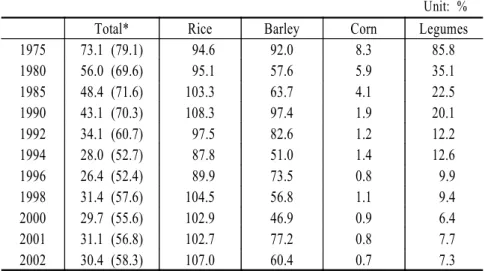
Its staple food, rice, requires large amounts of irrigation water. Over the past several decades, Korean agricultural policy has been focused on increasing rice self-sufficiency to reserve the country’s level of security. The government has pursued this objective through various types of policy instruments. In particular, the government has made consistent efforts to develop irrigation water systems. The agricultural sector still accounts for about 61% of total water use (48%, when including river maintenance) and paddy fields consume about 99% of irrigation water. However, Korea has the lowest grain self-sufficiency rate among OECD members. The food grain self-sufficiency ratio has decreased since the 1970s, and recorded its lowest ratio in 1996 at 26.4% (excluding that for feed use, 52.4%). The overall variation was 73.1% in 1975 to 29.3% in 2001 (see Table 1). However, the self-sufficiency ratio of rice, the most important crop in Korea, has been relatively increasing from year to year since
the 1970s, and has been more than 100% since 1999. This is mainly due to consistent efforts by the Korean government to increase and maintain rice self-sufficiency. For this goal, the Korean government has focused on the construction of farmland systems, and investment in agricultural land and water development. The Korean government has made special efforts to develop irrigation facilities for paddy fields.
In the 1990s, the food self-sufficiency goal became controversial under the pressure of the WTO system with regards to opening the Korean rice market and the push to increase international grain prices. It is interesting to note that the success of irrigation system development has resulted in a very high inventory level of over-stocked rice and now threatens the priority of irrigation development. Although the current Korean agricultural situation asks for more focus on the “operation” and “management” of agricultural water and irrigation facilities, irrigation development and water management still play a very important role with the looming issue of water scarcity problems in the near future.
Water scarcity is becoming very problematic in Korea due to
TABLE 1. Self-Sufficiency Ratio of Food Grains
Unit: % Total* Rice Barley Corn Legumes 1975 73.1 (79.1) 94.6 92.0 8.3 85.8 1980 56.0 (69.6) 95.1 57.6 5.9 35.1 1985 48.4 (71.6) 103.3 63.7 4.1 22.5 1990 43.1 (70.3) 108.3 97.4 1.9 20.1 1992 34.1 (60.7) 97.5 82.6 1.2 12.2 1994 28.0 (52.7) 87.8 51.0 1.4 12.6 1996 26.4 (52.4) 89.9 73.5 0.8 9.9 1998 31.4 (57.6) 104.5 56.8 1.1 9.4 2000 29.7 (55.6) 102.9 46.9 0.9 6.4 2001 31.1 (56.8) 102.7 77.2 0.8 7.7 2002 30.4 (58.3) 107.0 60.4 0.7 7.3 * The values inside the parentheses mean food grains excluding feed use. Source: MAF. Major Statistics in Agriculture and Forestry. annually.
increasing water usage competition between agricultural, domestic, and industrial sector use. There is no economic incentive, however, to save irrigation water and divert it for other uses. This problem is fundamentally related to under-pricing and free access or government intervention in the management of irrigation water. Korean farmers do not fully pay for their water use and do not fully participate in water management activities. Also, there are so many problems that make it difficult to achieve efficient irrigation water use and management. We need to survey the situations and check these problems.
The purpose of this paper is to check the problems of agricultural water management and to provide policy directions in Korea. To address this purpose, this paper first overviews the situations and characteristics of agricultural water use and examines changes in the Korean water use and associated environment. II. Current Situation of Agricultural Water Use and
Management
1. Water Use and Irrigation Development
1.1. Water use
Korea has a humid East Asian monsoon climate with four distinct seasons with large seasonal and geographical variations in rainfall. Summer monsoons bring abundant moisture from the ocean and produce heavy rainfall from typhoons. About 70% of the annual precipitation is concentrated during four months (June to September), which is sometimes even too much for heavy water consuming rice cultivation. Although total rainfall is sufficient for agricultural needs, heavy rainfall from typhoons during summer months often causes severe damage to cropping and other properties. Dry summer periods also occasionally occurs from May to June, the time that requires heavy water use for rice seedling nurseries and transplantation. Overall, Korea has to overcome the damage from water scarcity problems during the dry
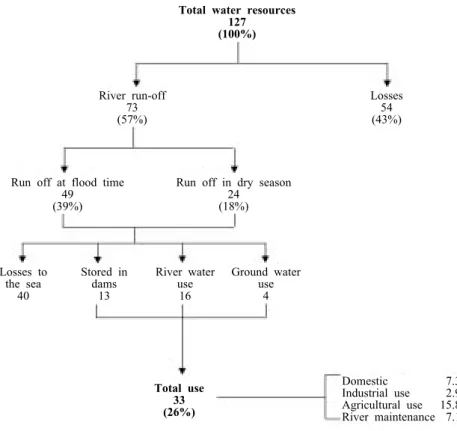
FIGURE 1. General Status of Water Resources in Korea
Unit: billion cubic meters
Total water resources 127 (100%) River run-off 73 (57%) Losses 54 (43%) Total use 33 (26%) Domestic 7.3 Industrial use 2.9 Agricultural use 15.8 River maintenance 7.1 Losses to the sea 40 Stored in dams 13 River water use 16 Ground water use 4 Run off at flood time
49 (39%)
Run off in dry season 24
(18%)
periods of May and June, from floods from June to September. Most dam sites were developed to secure water resources. These adverse condition forced the Korean government to develop irrigation facilities such as reservoirs, pumping and drainage stations, weirs, canals, etc.
Among total water resources in Korea, 57% (73.1 billion ㎥) accounts for river runoff, 43% (54.5billion ㎥) evaporates and infiltrates as a direct loss (1998). Among river runoff, 67.4% (49.3 billion ㎥) runs off in flooding time and 32.6% (23.8 billion ㎥) is ordinary runoff. The amounts of yearly used water are 33.1 billion ㎥ including 3.7 billion ㎥ of ground water (see Figure 1). As mentioned before, utilization intensity (share of
total use in annual fresh water resources) in Korea is about 35%. Japan, whose agricultural situation is very similar to that of Korea is only 21%. Therefore, the condition of additional freshwater development in Korea is worse than that of Japan, resulting in strong water stress.
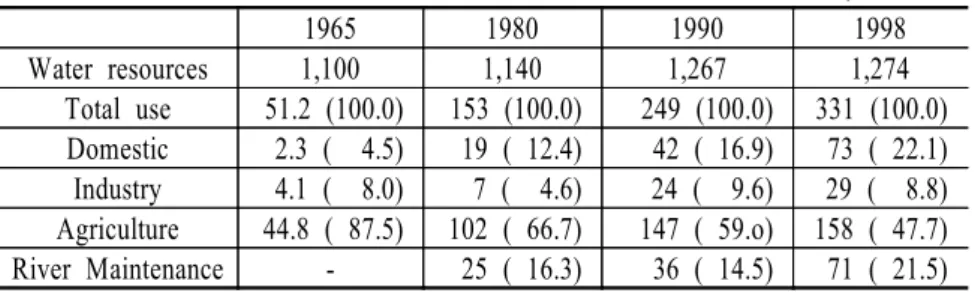
Water demand mainly consists of domestic use, industrial use, agricultural use and river maintenance use. River maintenance use has been stressed since the 1970s when environmental problems were at issue. Water becomes more and more scarce because water use competition is increasing amongst the industrial, domestic, and agricultural sectors. The portion of agricultural use in total fresh water use has decreased continuously since the 1960s. It has fallen from 88% in 1965 to 67% in 1980, to 59% in 1990, and finally to 48% in 1998. However, it is still above 60% when
TABLE 2. Water Use in Korea
Unit: million ㎥/year, %
1965 1980 1990 1998 Water resources 1,100 1,140 1,267 1,274 Total use 51.2 (100.0) 153 (100.0) 249 (100.0) 331 (100.0) Domestic 2.3 ( 4.5) 19 ( 12.4) 42 ( 16.9) 73 ( 22.1) Industry 4.1 ( 8.0) 7 ( 4.6) 24 ( 9.6) 29 ( 8.8) Agriculture 44.8 ( 87.5) 102 ( 66.7) 147 ( 59.o) 158 ( 47.7) River Maintenance - 25 ( 16.3) 36 ( 14.5) 71 ( 21.5) Source: MOCT·KOWACO. 2000. Water Vision 2020.
TABLE 3. Agricultural Water Use in Korea.
Unit: million ㎥/year TOTAL
Paddy fields Uplands
Livestock use Total Irrigated irrigatedNot Total Irrigated irrigatedNot 22,596 (9,578) 18,019 (7,387) 14,191 (5,597) 3,828 (1,790) 4,346 (2,191) 139 (62) 4,197 (2,129) 231 Note: The values inside the parentheses mean the amount of water used
effectively though water is supplied directly by rainfall.
Source: MAF·KARICO. 1999. 12. Report on the Amount of Rural Water Demand.
river maintenance is excluded (see Table 2). Total water use in the agricultural sector is presumed to be about 22,596 million ㎥ when it includes the amount of water used effectively even though it is supplied directly by rainfall. Paddy fields use about 80% of the total water in agricultural sectors and irrigated paddy fields use about 60% of that. But the amount of irrigated water for rice producing paddy fields in agricultural use is about 99% of the water use supplied by irrigation facilities (see Table 3). This means that irrigation development projects for rice production in paddy fields have been the most important agricultural and rural development programs in Korea.
1.2. Irrigation Development
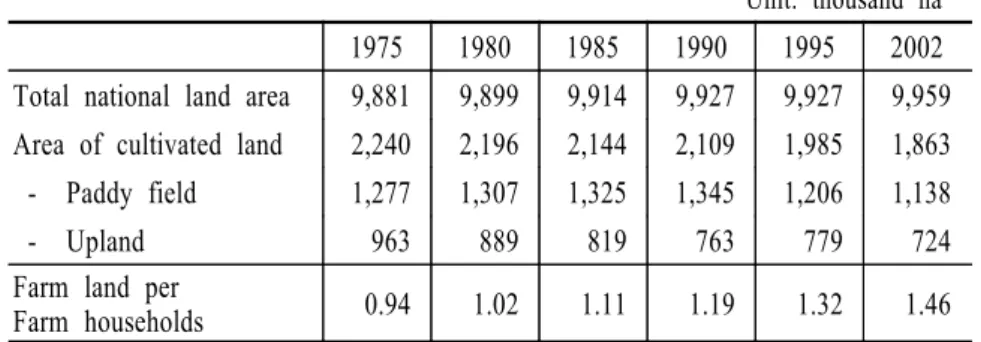
Considering Korea’s climatic and topographical conditions, it is not extremely favorable for farming. The area of arable land is relatively small while the large portion of this land is spread over the southwest coast and gentle mountain slope areas. Amongst the total territory of 9,959 thousand hectares, only about 18.7% is suitable for cultivation, 64.4% is forest and the rest is for urban, industrial and roadway uses (2002). The land available for agriculture consists of 1,138 thousand hectares of paddy field and 724 thousand hectares of upland, which are intensively developed and used. Additionally, the size of farmland per farm household is only 1.46 hectares (see Table 4).
TABLE 4. Acreage of Cultivated Land
Unit: thousand ha 1975 1980 1985 1990 1995 2002 Total national land area 9,881 9,899 9,914 9,927 9,927 9,959 Area of cultivated land 2,240 2,196 2,144 2,109 1,985 1,863 - Paddy field 1,277 1,307 1,325 1,345 1,206 1,138
- Upland 963 889 819 763 779 724
Farm land per
Farm households 0.94 1.02 1.11 1.19 1.32 1.46 Source: MAF. Major Statistics in Agriculture and Forestry. annually.
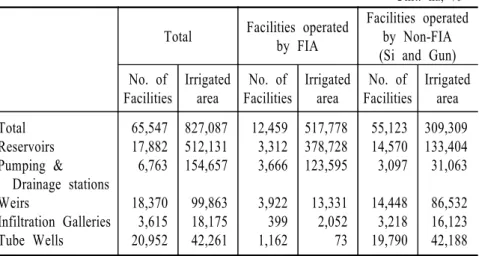
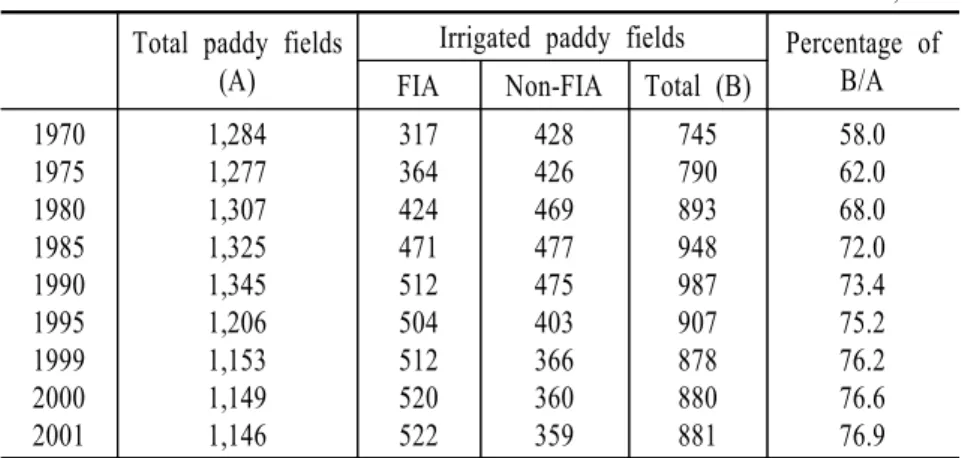
The history of irrigation goes back as early as the first century when the ancient Shila Dynasty constructed weirs to divert the stream flows to paddy fields. The reservoirs began to be used for irrigation purposes in 390 A.D. Since then, various sizes of reservoirs and weirs have been built for irrigation. Today, major irrigation facilities are reservoirs, pumping and drainage stations, weirs, tube wells and infiltration galleries. In terms of irrigated area, reservoirs are the most important irrigation facilities. Among the total irrigated areas, 827,087 hectares, 61.9 % (512,131 hectares) are irrigated by reservoir and 18.7 % are irrigated by pumping and drainage stations (2001) (see Table 5). Even though many irrigated paddy fields have been converted to non-agricultural uses, the percentage of irrigated paddy fields in total paddy fields have increased continuously since the 1970s (see Table 6).
The history of irrigation development can be classed into three stages. In stage I (before 1945), large numbers of small irrigation projects were implemented by employing traditional methods. In stage II (1946 - 1961), efforts were made to repair
TABLE 5. Irrigated Area by Irrigation Facilities (as of the end of 2001) Unit: ha, % Total Facilities operated
by FIA
Facilities operated by Non-FIA (Si and Gun) No. of Facilities Irrigated area No. of Facilities Irrigated area No. of Facilities Irrigated area Total Reservoirs Pumping & Drainage stations Weirs Infiltration Galleries Tube Wells 65,547 17,882 6,763 18,370 3,615 20,952 827,087 512,131 154,657 99,863 18,175 42,261 12,459 3,312 3,666 3,922 399 1,162 517,778 378,728 123,595 13,331 2,052 73 55,123 14,570 3,097 14,448 3,218 19,790 309,309 133,404 31,063 86,532 16,123 42,188 Source: MAF·KARICO. 2002. Yearbook of Agricultural Land and Water
the irrigation systems damaged during World War II and the Korean War. In stage III (1962 - present), extensive efforts were made to develop new water resources for agricultural use. Since 1971, when the Rural Modernization Promotion Act was legislated, the government has initiated the implementation of comprehensive agricultural development projects.
The Korean government regarded agricultural land and water development projects as the most fundamental way to boost agricultural competitiveness and to maintain rice self-sufficiency. It has invested enormous amounts of financial resources in irrigation development during the last two decades (see Table 7). Accordingly, there has been a lot of interest among government agencies in seeing the fruits of these investments. There has been a growing concern that irrigation projects are not functioning up to expected standards of performance. The government, therefore, has made great efforts to maximize possible benefits from the project in many areas including technical, economic, social and institutional areas.
Recent rapid urbanization and industrialization has raised living standards in rural area and has resulted in increased water
TABLE 6. Change in the Irrigated Paddy Fields
Unit: thousand ha, % Total paddy fields
(A)
Irrigated paddy fields Percentage of B/A FIA Non-FIA Total (B)
1970 1975 1980 1985 1990 1995 1999 2000 2001 1,284 1,277 1,307 1,325 1,345 1,206 1,153 1,149 1,146 317 364 424 471 512 504 512 520 522 428 426 469 477 475 403 366 360 359 745 790 893 948 987 907 878 880 881 58.0 62.0 68.0 72.0 73.4 75.2 76.2 76.6 76.9
Source: MAF·KARICO. 2002. Yearbook of Agricultural Land and Water Development Statistics.
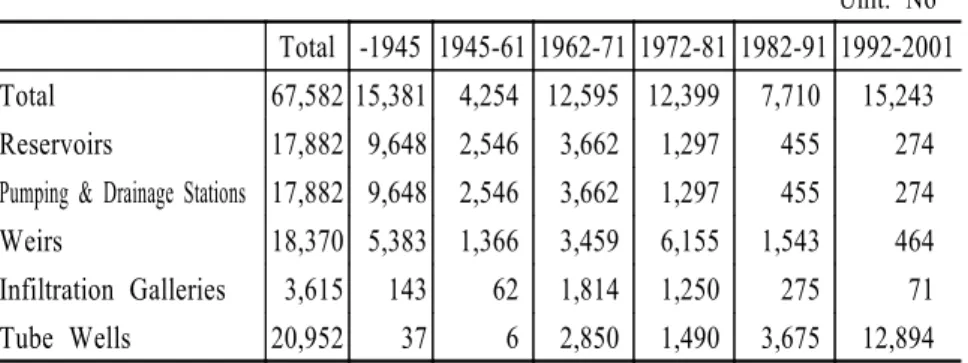
TABLE 7. Age of Irrigation Facilities
Unit: No Total -1945 1945-61 1962-71 1972-81 1982-91 1992-2001 Total 67,582 15,381 4,254 12,595 12,399 7,710 15,243 Reservoirs 17,882 9,648 2,546 3,662 1,297 455 274 Pumping & Drainage Stations 17,882 9,648 2,546 3,662 1,297 455 274 Weirs 18,370 5,383 1,366 3,459 6,155 1,543 464 Infiltration Galleries 3,615 143 62 1,814 1,250 275 71 Tube Wells 20,952 37 6 2,850 1,490 3,675 12,894
Source: MAF·KARICO. 2002. Yearbook of Agricultural Land and Water Development Statistics.
demand for various sectors like municipal, industrial, and intensive farming. The government has begun to take appropriate measures to ease possible conflicts in water allocation among these sectors. They include development of potential water resources, rehabilitation of existing facilities and efficient use of existing water resources. New water resources are limited and even if available, they are often too costly to develop partly due to soaring land prices and labor costs experienced during recent decades. Therefore, emphasis has been put on the rehabilitation and efficient utilization of existing water resources. KARICO (Korea Agricultural and Rural Infrastructure Corporation), ICs (Irrigation Clubs) and individual farmers under the government's support are involved in this activity. Recently, one of the major irrigation policies is to support and enhance their activities to improve water management efficiency.
2. Current Water Management Systems and Associated Organizations
The local-level operation and management of agricultural water is divided into two organizations : The Korea Agricultural and Rural Infrastructure Corporation (KARICO) and Irrigation Clubs (ICs) with the support of city or county authorities. KARICO manages large-sized areas exceeding 50 hectares, while ICs manage small-
size lands of 5 to 50 hectares. The federal government institution for the development and management of irrigation system is the Ministry of Agriculture and Forestry (MAF). The Rural Development Bureau (RDB) in the Ministry of Agriculture and Forestry is the governmental institution responsible for policy decisions on various land and water resource development projects and maintenance of facilities for agricultural purposes. RDB has the ultimate responsibility for planning and budgeting all rural infrastructure improvement projects and supervision of related Local Government bodies such as KARICO and ICs.
KARICO, a semi-autonomous agency operated under the control of RDB is responsible for implementation of new and rehabilitation projects for land and water resources development, for improvement of the agricultural base and for better rural life, entirely from feasibility study to construction completion. KARICO, a government-run corporation, was established in 2000 through a merger of three existing organizations, 104 branches of Farmland Improvement Associations (FIAs), the Rural Development Corporation (RDC), and the Federation of Farmland Improvement Association (FFIA). KARICO has a provincial office in each of the nine provinces and has 7 large-scale project offices. Each of the nine provincial offices has 85 branch offices throughout rural areas. KARICO has a total of 7,000 employees with many professional experts and engineers.
ICs are farmer's organizations who manage the country’s irrigation systems. Farmers who have irrigated farmland outside of KARICO can organize groups called ICs. The local government, city or county supervise ICs and their activities. ICs are responsible for the management of small-scale irrigation areas which are at least 5 ha and less than 50. Typical IC irrigation systems cover 15-20 ha of irrigation area with one water resource facility : tank, weir, pumping station, tube-well, or gallery.
Farmers, as members of ICs, elect their chairmen and make their own regulations at a general meeting with full participation of all members. The regulations generally outline the duties and responsibilities of the chairman and staff, election policies,
appointment of staff, organization, operation and management work to be done, and imposition of water charges on each member. The chairman appoints his assistants mostly on a voluntary basis, as well as some salaried staff also according to regulations. He has responsibilities for rehabilitation, improvement, as well as the regular operation and management work of IC systems under the supervision of the city or county. He must also prepare the imposition and collection system of water charges to members, and the annual budget plan which are both subject to approval at general meetings.
In addition, other than ICs, there are also grass-root organizations named “Heungnonggye” water user groups in rural communities that manage agricultural water. As an agricultural water user representative, the “Heungnonggye” represents the voice of farmers to KARICO. However, they have some difficulties in gaining support for their opinions since they have no strong representative power over the rural community and lack enough authority to coordinate farmers. Efficient management of agricultural water and irrigation facilities is an urgent task for KARICO. Without farmers' active participation in water management, it is hard to secure cost effectiveness and a high quality water supply service. Therefore, continuous efforts to build institutional strength and follow-up education for the community are needed to allow them to participate actively and effectively in water management.
3. Problems
3.1. Old and small sized irrigation facilities
Old age and inadequate size are the main problems for irrigation facilities in Korea. Old facilities cannot control and save water effectively (see Table 7). More than 55% of irrigation reservoirs whose irrigated areas are above 60% of the total irrigated areas in Korea were constructed before 1945. About 30% of the pumping stations are more than 20 years old. About 98% of irrigation reservoirs have an effective storage capacity less than
1 million ㎥, and 79% of pumping stations are powered by electric motors less than 100 HP. Moreover, most tube wells and infiltration galleries service less than a 10 hectare area.
Large portions of the existing irrigation systems were designed and constructed before 1960. Most of these systems use only an unlined earth canal and inadequate water regulating devices. Furthermore, some of these facilities are outdated and are not functioning efficiently. It is now estimated that over half of the existing irrigation facilities are in need of modernization or rehabilitation to improve the efficiency of water management and to save operation and management cost - especially labor costs. 3.2. Increase of government subsidy and decrease of farmers’
participation in water management
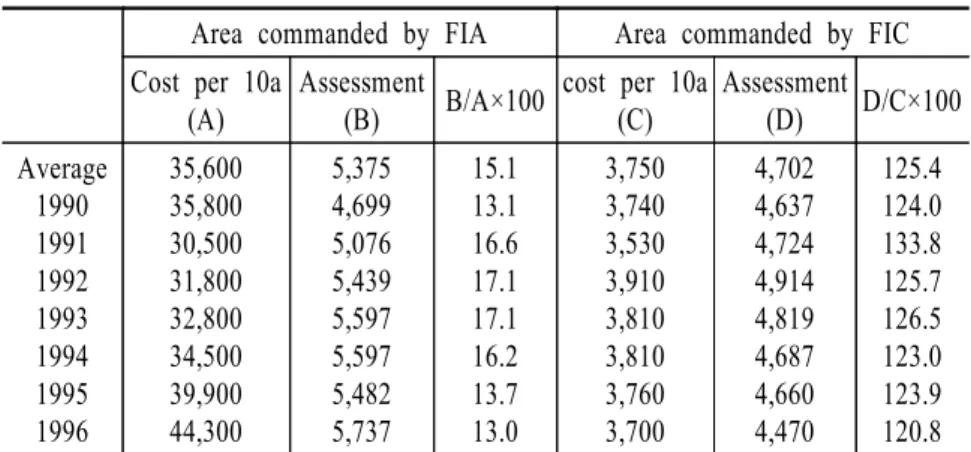
Until the 1980s, benefit principle had traditionally been the main rule to control irrigation facilities management. But since 1987, the government has subsidized current expense deficits to relieve farmers’ burdens. It decided to reduce farmers’ water charges in order to encourage them and to adjust the income gap between rural and urban workers. The Farmland Improvement Association Act regulated the water charge, which compensated only 15% of FIA’s managerial costs during the 1990s (see Table 8). The rest of the institutional expenses and operation and management costs were subsidized by the government. Furthermore, KARICO has taken the entire cost burden of the irrigation facility administration since 2000. Under the FIA scheme, farmer participation was frequent. But after the launch of KARICO, voluntary farmer activity for managing irrigation facilities decreased. This made the water use efficiency problem one of the most important issues relating to water management.
The government decision to subsidize 100% of the water charge for KARICO covered areas evoked another complaint from IC’s members to correct imbalances for water charges between KARICO areas and IC areas. It is also expected that a government subsidy would reduce irrigation efficiency through improper operation and management of irrigation systems with decreased farmer responsibility.
TABLE 8. Status of Water Charge Assessed by Operator of Irrigation Facilities
Unit: won Area commanded by FIA Area commanded by FIC Cost per 10a
(A)
Assessment
(B) B/A×100
cost per 10a (C) Assessment (D) D/C×100 Average 1990 1991 1992 1993 1994 1995 1996 35,600 35,800 30,500 31,800 32,800 34,500 39,900 44,300 5,375 4,699 5,076 5,439 5,597 5,597 5,482 5,737 15.1 13.1 16.6 17.1 17.1 16.2 13.7 13.0 3,750 3,740 3,530 3,910 3,810 3,810 3,760 3,700 4,702 4,637 4,724 4,914 4,819 4,687 4,660 4,470 125.4 124.0 133.8 125.7 126.5 123.0 123.9 120.8 Source: MAF·KARICO. Yearbook of Agricultural Land and Water Development
Statistics. annually.
3.3. Unsystematic management and water supply service
It is widely observed that many Korean farmers still suffer from insufficient water services. This situation is mainly due to improper water distribution and the lack of irrigation water during drought seasons. In many irrigation systems, less than 50% of irrigation water reached command areas. This problem is caused by the lack of advanced water management knowledge and the absence of proper distribution systems. Recently developed large-scale irrigation systems would also require extensive knowledge of up-to-date techniques to operate efficiently.
3.4. No economic incentive to save and reuse irrigation water Current rapid expansion of urban and industrial areas throughout the country has resulted not only in decreasing farmland but also the pollution of irrigation water. With the inflow of polluted water to irrigation canals, an increase of management costs reduce the productivity and quality of agricultural products. In sum, an increase in pollution results in more severe water scarcity problems. But we do not make efforts to save and reuse irrigation
water. There is no incentive to do so.
With this irrigation water reuse problem, the water scarcity problem is a major social issue in Korea. The agricultural sector uses about 48% of the total water use in Korea. The non- agricultural sector argues that we should shift the priority of water use from the agricultural sector to water use for the non- agricultural sector. This problem is deeply related to under-pricing, and free access or government intervention in the management of irrigation water. Setting a proper pricing system in water use is desired.
3.5. Inactive role of local government
Recently, many irrigation facilities such as reservoirs in rural areas have been used for non-agricultural purposes even though they were constructed solely for irrigation. For a more efficient use of future water resources, irrigation systems should also include water supply for rural communities other than agricultural uses. This various water supply/use is associated with water quality which is a very important social issue. Water quality problems cannot be fully resolved through the efforts of existing water management organizations. This problem needs to be addressed by local governments. However, they are not interested in agricultural water management in Korea.
III. Policy Directions
1. Changes in the Environment of Water Use and Management
1.1. Emergence of water shortage problems and water right disputes
We will experience severe water scarcity problems in coming years. Rapid economic growth has precipitated more water demand in domestic and industrial sectors while recently, the voice of the pro-environmental NGOs asking to stop additional construction of reservoirs has increased. Thus, we also need to
check the possibility of additional water development and water saving.
Water rights problems among different sectors and different regions have been the most current issues in Korea. Especially, water rights problems among different regions in relation to water use have been major issues. An official report from the Korean government (MOCT․KOWACO, 2000) provides ample information regarding water use and precipitation from different regions. The Korean government recognizes the importance in solving water rights problems at a sub-national level. The government tends to establish water development projects in connection with regional economic development programs to decrease complaints and controversy from water development and use at a sub-national level.
In Korea, it is not important to estimate the costs and benefits related to irrigation water development and water use and management because almost 100% of the cost was once supported by governmental subsidies. But now, the Korean government must estimate the costs and benefits of all irrigation development projects and open this information to the public. In addition, some expert groups supported by the Ministry of Construction and Transportation (MOCT) are trying to calculate the marginal benefit from irrigation and water transfer use for agriculture to other uses during the dry season.
We do not measure the volume of water each farmer receives and it cannot be measured because of differing irrigation methods. It was measured at the irrigated area level until 1999. When we try to reform the pricing system, we should introduce the measuring system at the irrigated area level again and determine price level by using farmer income data and the marginal benefit from irrigation and transferring water use for agricultural to other uses.
1.2. Aging of farmers and decrease of farmers' participation in water management
water management. Farmers are the members of IC’s(Irrigation Clubs) and Heungnonggye, the water user group of KARICO. Maintenance and repair works of irrigation facilities may be classified as regular maintenance, annual maintenance, and emergency repairs. Regular maintenance covers minor repair discovered by canal masters or Heungnonggye members during their daily work. This kind of maintenance work may be undertaken by Heungnonggye members on a voluntary basis or with the help of material supply by KARICO.
Recently, the shortage of manpower to manage water and aging farmers are becoming very problematic in Korean rural society. The sense of community among farmers has weakened. The active leadership power for managing water and irrigation facilities efficiently at the community level appears to be absent. These problems are mainly due to aging farmers. It is difficult to manage water and irrigation facilities efficiently without farmers’ active participation.
1.3. Increase of the impact of international norms
The WWF(World Water Forum), the WWC(World Water Council), the WCW(World Commission on Water in the 21th Century), and the UNCSD recommended that water should be treated as an economic good and efforts for water conservation should be made. Korean farmers do not fully pay for their water use and do not fully participate in water management activities. Korean farmers have not paid water use fees since 2000. The government decision to subsidize 100% of the water charge for KARICO covered areas evoked another complaint from ICs’ members to correct imbalances for water charges between KARICO areas and IC areas. It is also expected that a government subsidy would reduce irrigation efficiency through improper operation and management of irrigation systems with decreased farmer responsibility. The Korean government and farmers should accept the international norm, efficiency, environmental soundness, equity and among others, the full cost recovery principle.
2. Policy directions
2.1. Repair and reinforcement of existing facilities
In the early stage of irrigation development, the uppermost priority was put on the expansion of irrigation facilities such as the construction of reservoirs and canals. Recently, development of new water resources and supply systems has become very difficult from prohibitive construction costs associated with complicated water use rights. Another problem with construction is environmental and is associated with serious disturbances and protests from other interest groups. Therefore, repair and reinforcement of existing irrigation systems are considered to be the best alternative to meet the increasing water demand.
We also need to check the amount of water loss during delivery and the amount that can be secured. Trying to decrease water loss during delivery is more important than developing additional water resources. Difficulties in developing additional water resources and less than a mere 50% irrigation water delivery ratio shows the importance of delivery loss. We need to do a comparative analysis between the cost of upgrading irrigation systems and the decreased benefit from water loss during delivery.
2.2. Modernization of irrigation systems
Water supply in rural areas has changed as living conditions and the agricultural and industrial environment has improved. Even though most irrigation facilities were designed solely to supply water for irrigation, the current systems convey water not only for irrigation but also for household, industry, and livestock breeding as well as environmental needs. Furthermore, these systems also often supply water to streams to secure a minimum stream flow and water quality. Patterns of irrigation have changed from seasonal rice irrigation to year-round irrigation for agricultural production both in the paddy fields and uplands. The peak and normal water demands of irrigation systems have become far higher than the
originally assumed values due to mechanization of transplantation processes in rice cultivation. Therefore, modernization of the irrigation structure, automatic control of water distribution and development of various income sources are necessary to operate irrigation systems properly. Many experts recommend that installing TM/TC and central control systems as an integrated central water management system can give rational water distribution based on real-time flow rates and water level monitoring.
2.3. Farmers’ participation in regional water management Irrigation facilities and irrigation systems are widely spread through out the nation. Efficient maintenance of irrigation facilities can be achieved by farmers’ voluntary participation. Maintenance and repair works for irrigation facilities could be classified as regular maintenance, annual maintenance, and emergency repairs. Regular maintenance, which covers only minor repair jobs, could be done by farmers during their daily work. Annual maintenance check ups are usually carried out during the non-irrigation season. Regular maintenance work is very important and effective because it is undertaken by farmers on a voluntary basis in real-time.
With farmers' participation, continuous education also plays an important role in water management. Education can improve farmers’ capability to manage water and irrigation facilities. It is disappointing, however, that current education programs for water users (farmers) are not very effective. They must be refined to provide a better quality of education. International organizations, such as IBRD and OECD, recommended that we make efforts to introduce ‘participatory irrigation management’ that could inspire farmers through active participation in water management.
2.4. Building new governance
It is important that different related bodies such as federal & local governments, KARICO, ICs, and other farmer groups, should play their roles in order to increase the efficiency of irrigation development and water management. Proper management for irrigation water needs to be seen as a combination of efforts at
the field level and at the water source and delivery levels. Public irrigation bureaucracies must recognize that they cannot and should not fulfil all tasks. Decentralized service delivery can solve problems such as declined service level and farmers’ low willingness to pay for services. Policies should encourage more decentralized irrigation-provision services. Many countries are achieving better-quality services by decentralizing local government responsibility for delivering water and transferring operation and maintenance functions, especially at the secondary and tertiary canal level, to water user associations and farmers (Ariel Dinar, 1998). However, the Korean government did the opposite by centralizing irrigation systems. We need to reform and rebuild water governance.
Local government and farmers must actively participate in water management to build efficient monitoring systems. Most monitoring systems need high transaction costs to maintain. As mentioned above, the operation and management of agricultural water is classified into two categories: management by KARICO and by ICs. KARICO can be operated efficiently through the help of farmers groups, “Heungnonggye.” Important information from monitoring cannot be gathered without the help of local governments and farmers. The active participation by local governments and farmers can decrease the cost of building monitoring systems in water use and management. Therefore, we need to introduce an incentive system that will encourage active local government and farmer participation in water management. 2.5. Reforming the pricing system
Currently, farmers are not required to pay for water use even though full cost recovery is achieved on domestic and industrial water supply in Korea. All investment, operation, and maintenance costs have been subsidized by the government since 2000. As a result, farmers and operating organizations have little interest in water pricing and saving. This is a major constraint in irrigation management development. Therefore, the water usage fee must be determined on the basis of actual water consumption which is
believed to be an incentive for improved water saving. It will be possible however, through advanced direct and indirect circumstance improvement.
One of the problems with the irrigation water pricing alternative is the difficulty in measuring the volume of water each farmer receives. Nonetheless, this alternative mechanism can be promoted and tested. Among these alternative mechanisms are user-based allocation rules such as cost recovery based on water deliveries to entire villages or to a water user association.
2.6. Establishing monitoring systems
Korea is classified as one of the nations that will suffer from water shortages in the near future. Water demand tends to increase gradually and it is pre-estimated to be 37 billion ㎥ in 2020, which is a 28% increase compared to current demand. As well, agricultural use consumes more than 60% of fresh water while paddy fields consume about 99% of the irrigated water from irrigation facilities. With a high utilization intensity, these numbers clearly show that saving irrigation water and diverting it for other uses is the best way to solve the water scarcity problem in Korea. To enhance water use efficiency, improving irrigation water use efficiency can solve problems related to water use intensity in Korea. An interesting thing to note is the self-sufficiency ratio of rice, a crop that uses most of the irrigation water, has been above 100% since 1999. We can therefore decrease the portion of agricultural fresh water use under the condition of introducing systems for checking the technical and economical efficiency of irrigation water utilization in Korea. In particular, we should change irrigation patterns. We need modernization of irrigation structures, automatic control of water distribution, and active farmer participation. All of these can only be realized by reforming the pricing system and water governance structures. We should also try to calculate the irrigation water that can be saved. 2.7. Introducing new rice production systems to save irrigation
water
need to change the rice irrigation structure for the next generation who might be susceptible to water shortage. After we collect data on marginal benefit from irrigation and transferring water use from agriculture to other uses, we must try to decrease the amount of irrigation water per acreage. Water saving technologies can increase other costs such as labor costs which can, in turn, give farmers certain disbenefits. Water use technical efficiency indicators are strongly linked with water use economic efficiency indicators. When we try to introduce new irrigation systems to save water, we need to check the impacts of the application on farmers’ incomes.
REFERENCES
Ariel Dinar. 1998. “Water Policy Reforms: Information Needs and Implementation Obstacles.” Water Policy 1: 367-382.
FFIA and KREI. 1995. Rice Farming and Water Management in East Asia. (in Korean). Seoul, Korea.
FFIA. 1996. Irrigation Water Management in East Asia. (in Korean). Seoul, Korea.
Im, Sang-Bong et al. 2001. “Community Participation in the Management of Agricultural Water in Korea.” ICID 1st Asian Regional Conference, Seoul.
KCID and RDC. 1996. Water in Asia in 2000s: Demand and Supply of Rural Water and Its Efficient Management. (in Korean). Seoul, Korea.
Kim, Hong-Sang. 2001a. “Cost Share on the Management of Irrigation System among Government, Local Autonomy and User.” (in Korean). KCID Journal 8(1).
______. 2001b. “Investment in Land and Water in the Republic of Korea.” FAO, RAP's Regional Consultation on Investment in Land and Water, Bangkok, Thailand.
______. 2003. “Irrigation Development and Water Management System in Korea.” OECD Expert Meeting on Agricultural Water Quality and Water Use Indicators. Kyeongju, Korea.
Subsidy Program for the Irrigation Water Management System. (in Korean). Korea Rural Economic Institute, Korean.
Korean National Committee on Irrigation and Drainage, International Commission on Irrigation and Drainage. 2001. Rice Culture in Asia.
MAF. annually(a). Agriculture and Fishery Statistical Yearbook. (in Korean). Korea.
MAF. annually(b). Major Statistics in Agriculture and Forestry. (in Korean). Korea.
MAF. annually(c). Data of Public Affairs. (in Korean). Korea.
MAF and KARICO. annually. Yearbook of Agricultural Land and Water Development Statictics. (in Korean). Korea.
MOCT and KOWACO. 2000. Water Vision 2020. (in Korean).
OECD. 1998. “Sustainable Management of Water in Agriculture: Issues and Policies.” The Athens Workshop.
Peter Rogers. 2002. Water Governance in Latin America and the Caribbean. Inter-American Development Bank.
Saleth, R. Maria and Ariel Dinar. 2000. “Institutional Changes in Gobal Water Sector: Trends, Patterns, and Implications.” Water Policy 2: 175-199.
Rural Research Institute of KARICO. 2000. A Study on the Performance of Agricultural Infrastructure Projects and the Measures of Efficient Rural Development. (in Korean). Ansan, Korea.