Contents lists available atScienceDirect
Journal of Water Process Engineering
journal homepage:www.elsevier.com/locate/jwpeAddition of biochar into activated sludge improves removal of antibiotic
cipro
floxacin
Do Gun Kim
a, Donggeon Choi
a, Seungyong Cheon
a, Seok-Oh Ko
a, Seoktae Kang
b, Seungdae Oh
a,*
aDepartment of Civil Engineering, Kyung Hee University, Yonggin 17104, Republic of Korea
bDepartment of Civil and Environmental Engineering, Korea Advanced Institute of Science and Technology (KAIST), Daejeon 34141, Republic of Korea
A R T I C L E I N F O Keywords: Biochar Ciprofloxacin Activated sludge Adsorption Wastewater treatment A B S T R A C T
This study evaluated the effectiveness of treating a ciprofloxacin (CIP)-containing waste stream by activated sludge dosed with apple-tree-derived biochar (AB). AB was dosed to activated sludge-inoculated bioreactors with varied AB volume ratios (10 %, 20 %, and 40 % of AB to the total volume). The AB-dosed bioreactors were operated by feeding by 1 mg L−1of CIP. At steady state, the AB-dosed bioreactors achieved significantly en-hanced CIP removal (up to 94 %) and the removal efficiency was positively correlated with the AB volume ratio, suggesting the key role of AB on controlling the removal efficiency of AB. The CIP removals occurring in the bioreactors at steady state were largely through adsorption to AB. This work further carried out systematic assessment on the adsorption kinetics, isotherm, and characteristics of CIP on AB in variable environmental conditions. CIP adsorption onto AB was controlled by diffusion in macropores, π-π electron-donor-acceptor interactions, and electrostatic attraction. Our results suggested that hardwood-derived biochar may be a pro-mising bio-waste additive for improving micropollutant removals in activated sludge processes, which has im-plications on further devising a simple and cost-effective treatment option for antibiotics-bearing waste streams.
1. Introduction
Ciprofloxacin (CIP) is a second-generation antibiotic fluor-oquinolone that has been widely used for several decades. CIP interferes with bacterial DNA replication and transcription by inhibiting DNA gyrase and topoisomerase [1]. It is one of the most commonly pre-scribed fluoroquinolone antibiotics for various infections (e.g., skin, urinary, respiratory, and gastrointestinal tract) due to broad-spectrum antibacterial activity against Gram-negative and -positive bacteria [2]. Extensive use in clinical and domestic settings has led to the widespread occurrence of CIP in both natural and engineered water environments. CIP occurs at substantially high concentrations in waste streams asso-ciated with hospitals and pharmaceutical manufacturers. In particular, up to 31 mg L−1of CIP was detected in pharmaceutical wastewater and 2.5–6.5 mg L−1was measured in surface water samples of lakes and
rivers associated with impacts of drug manufacturers [3]. CIP can cause mortality and genotoxicity even at a few micrograms per liter for var-ious organisms, including primary producers (e.g., freshwater cyano-bacteria and plants) essential for the function and resilience of aquatic ecosystems [4,5]. A substantial body of literature suggests that CIP carries toxicological consequences at concentrations detectable in a
variety of environments.
The majority of CIP is likely released in urban waste streams through sewage disposal due to use in clinical and household en-vironments (e.g., toilet wastewater can exhibit high levels of CIP ex-creted in urine and feces) [6]. Wastewater treatment plants (WWTPs) are tasked with controlling the transport of CIP to reduce ecological risks, but removal rates in conventional activated sludge processes (CASP) and anaerobic sludge processes vary greatly (20–95 %) across different WWTPs, suggesting unpredictable, if not unsatisfactory, CIP control [6,7]. Full-scale membrane bioreactors exhibit higher removal rates (73 % on average) compared with those of CASP [8]. Several organisms (e.g., bacteria, fungi, and microalgae) are capable of meta-bolizing CIP [9–11]. A Bradyrhizobium isolate originating from acti-vated sludge (AS) achieved 70 % removal via co-metabolic pathways at environmentally relevant levels of CIP [11], implying a potential use as an auxiliary source for bioaugmentation on CIP-bearing waste streams. However, biological degradation alone using pure or mixed cultures usually takes several days, making such means less feasible in full-scale WWTPs with relatively brief- hydraulic retention times, requiring other treatment alternatives to CASP for effective control.
Wastewater treatment processes capable of reliably eliminating
https://doi.org/10.1016/j.jwpe.2019.101019
Received 24 August 2019; Received in revised form 19 October 2019; Accepted 21 October 2019
⁎Corresponding author at: Department of Civil Engineering, Kyung Hee University, 1732 Deogyeong-daero, Giheung-gu, Yongin-si, Gyeonggi-do, 17104, Republic
of Korea.
E-mail address:[email protected](S. Oh).
Journal of Water Process Engineering 33 (2020) 101019
2214-7144/ © 2019 Elsevier Ltd. All rights reserved.
from nonrenewable coal [13].
Biochar is a carbonaceous material that can be produced from pyrolysis (thermal degradation without oxygen) of a wide range of biomass (e.g., wood, rice straw, and bamboo) [16]. While AC produc-tion is expensive and highly energy-demanding, the use of biochar may be cost-effective and environment-friendly (e.g., sequestering carbon and valorizing organic waste) [13]. Various types of biochar have been tested for pollutants adsorption, including antibiotics, metals, and in-dustrial chemicals [17–19]. In addition to the adsorption capacity, re-cent research has explored the capabilities of biochar as a microbial carrier due to its large porosity and surface area [16]. Hence, this study aimed to evaluate the technical feasibility of mitigating CIP by direct dosage of biochar to AS. To test the effects of biochar, AS-inoculated reactors were dosed with biochar at different amounts. The CIP removal and other essential functions (e.g., organic matter removal and biomass yield) of biochar-dosed reactors were monitored from reactor start-up to quasi-steady state and compared with a control AS reactor without biochar. This present study also attempted to identify the removal routes (e.g., physicochemical and biological) of CIP in biochar-dosed AS reactors and critically evaluated physicochemical mechanisms con-trolling the fate of CIP. The results of this work have implications on expanding current wastewater treatment options for micropollutant removal.
2. Materials and methods
2.1. Establishment of bioreactors
AS was taken from an aerobic tank of a local municipal WWTP. The AS sample was washed twice with phosphate-buffered saline (PBS, pH 7.4). Four one liter laboratory bioreactors were inoculated with AS (3 g L−1volatile suspended solids [VSS]). The four reactors werefilled with a range of biochar volume ratios: 0 %, 10 %, 20 %, and 40 % of total working volume. Thefilling ratios were comparable to a typical range (e.g., up to 70 %) of microbial carriers used in many biocarrier reactors [20], as the effects of biochar as a microbial carrier as well as an ad-sorbent were to be examined in this study. The apple tree biochar (AB) made from Malus pumila was purchased from a local manufacturer (Yougi Industry Co., Ltd., Korea). The purchased biochar was sieved by particle size between 4.8–6.4 mm, washed twice with deionized water (DIW) to remove dirt debris and dried in the oven at 105 °C for 12 h. The bulk density of AB was 0.15 ± 0.04 g mL−1and the AB dosage corresponding to the 10 %, 20 %, and 40 % ABfilling ratio was 1.6, 3.7, and 9.8 g mL−1, respectively. All reactors consisted of an air diffuser connected to an air pump to maintain consistent dissolved oxygen. The feed was prepared with a composition similar to ElNaker et al. [21] containing 2,100 mg L−1glucose, 65.8 mg L−1K2HPO4, 43.7 mg L−1
KH2PO4, 800 mg L−1 NH4Cl, 53 mg L−1 CaCl2, 270 mg L−1
MgSO4·7H2O, 9.8 mg L−1FeSO4·7H2O, and 10 ml of trace mineral
so-lution (0.35 mg L-1ZnSO4·7H2O, 0.21 mg L-1MnSO4·H2O, 2.1 mg L-1
excluding biomass. Glass bottles werefilled with 200 mL synthetic feed containing 1 mg L−1CIP. 1.6, 3.7, and 9.8 g L-1of pre-treated AB was
put into the bottles, which were equivalent to the volumetric AB ration of 10, 20, and 40 % as in the bioreactors, respectively. The adsorption of CIP to AS was investigated in the same manner where only AB was replaced with AS, at a dose of 3 g VSS L−1as initially inoculated for the bioreactor set-up. Time course CIP adsorption data were fitted to pseudo-first-order, pseudo-second-order and Weber and Morris intra-particle diffusion models [23], as shown in Eqs.(1)–(3), respectively:
= − dq dt ka1(qe q) (1) = − dq dt ka2(qe q) 2 (2) = ⋅ + qt kdifft1/2 c (3)
where, q (mg g−1) is the adsorbed CIP amount at time t, qe(mg g−1) is
the equilibrium adsorption amount of CIP, ka1(min−1) is the
pseudo-first-order adsorption rate constant, ka2(mg g−1min−1) is the
pseudo-second-order adsorption rate constant, kdiff (mg g−1 min-1/2) is the
intra-particle diffusion rate constant, and c is a constant representing the thickness of boundary layer.
2.3. Analysis of CIP adsorption isotherm
Isotherm experiments of CIP to AB were carried out using 0.1 g of AB in 50 mL glass vials containing 40 mL of DIW. CIP concentrations established in the vials ranged from 2.5–250 mg L−1. The vials were
shaken at 150 rpm for 24 h at room temperature (RT). Similar experi-ments were performed using AS (instead of AB) at a dose of 0.1 g dry weight and at CIP concentrations of 0.5–21.3 mg L−1. Experimental
data were fitted to the Langmuir, Freundlich, Sips and Dubinin–Kaganer–Radushkevich isotherm models as given in Eqs. (4)–(7)[24]: = + q q K C K C 1 e L L e L e max, (4) = qe K CF e1n (5) = + q q K C K C ( ) 1 ( ) e S S e β S e β max, (6) = − qe qSexp( k εad 2) (7)
where, qeis the equilibrium adsorption amount (mg g−1), qmax,Lis the
maximum adsorption capacity of the Langmuir isotherm (mg g−1), Ceis
the equilibrium adsorbate concentration (mg L−1), KLis the Langmuir
isotherm constant (L mg−1), KF is the Freundlich isotherm constant
related to adsorption capacity (mg g−1 [L mg−1]1/n), 1/n is a
heterogeneity, qmax,Sis the maximum adsorption capacity of the Sips
isotherm (mg g−1), KS(L mmol−1) is the Sips isotherm model constant,
β is the Sips isotherm model exponent related to surface heterogeneity, qSis the saturation capacity of Dubinin–Kaganer–Radushkevich
iso-therm (mg g−1), and kad is Dubinin–Kaganer–Radushkevich isotherm
constant related to adsorption energy (mol2 kJ-2). The term ε is the Polanyi potential defined as in Eq.(8)and the free energy of adsorption (E, kJ mol−1) was calculated using Eq.(9):
⎜ ⎟ = ⎛ ⎝ + ⎞ ⎠ ε RT C ln 1 1 e (8) = − E (2kad) 0.5 (9)
where R is the universal gas constant (8.314 J mol−1K−1) and T is temperature (oK). A dimensionless constant (R
L) representing the
affi-nity of an adsorbent and adsorbate system was calculated based on the KLof the Langmuir isotherm using Eq.(10);
= + R K C 1 1 L L 0 (10)
where, C0is the initial adsorbate concentration.
2.4. Evaluation of CIP adsorption at different pHs
The adsorption capacity of CIP to AB and AS was measured at a pH range of 2.2–10.5. The pH was adjusted using 0.1 M HCl and 0.1 M NaOH. The initial CIP concentrations were 100 and 33 mg L−1for AB and AS, respectively. The adsorbent doses were 0.04 and 0.22 g dry weight for AB and AS, respectively. 50 ml vials were used and shaken at 150 rpm for 24 h at RT during these adsorption experiments.
2.5. CIP biodegradation test
Removal routes of CIP in the bioreactors at steady state were de-termined using glass separateflasks where the same bioreactor opera-tional conditions were established. The mixed liquor suspension in-cluding AB was taken from AB40 at day 42. Biofilms attached on AB were detached using vortexing (30 s), followed by sonication (1 min) as described previously [25]. Both the suspended and detached biofilm biomasses were mixed, washed using PBS, and resuspended into glass flasks with 1 mg L−1 CIP-containing synthetic feed. The glass flasks
were maintained with operational conditions identical to the bior-eactors and CIP concentrations were followed for 96 h.
2.6. Characterizing surface properties of AB and AS
Surfaces (e.g., microstructure and attached biofilm) of AB were vi-sualized using a scanning electron microscopy (SEM). AB specimens were taken from AB40 at day 42. Biofilms on AB surfaces were fixed using 2.5 % glutaraldehyde in PBS for 2 h. Thefixed specimens were dehydrated with ethanol following the procedures previously described [26]. The ethanol-treated specimens were dried at 105 °C for 12 h and sputtered with platinum (Pt) to a thickness of 5 nm. The pre-treated AB specimens were subjected to the MERLIN field emission scanning electron microscope (FE-SEM; Carl Zeiss, Germany). Fourier-transform infrared (FTIR) spectra were obtained using powders of AB and AS ground to less than 50μm in diameter. The ground samples were dried in a freeze dryer (FDB 5503, Operon, Korea) for 3 days. The potassium bromide (KBr) pellets were prepared containing 0.25 % of AB or AS and KBr. IR-spectra were determined using a Nicolet iS10 FTIR spectro-photometer (Thermo Scientific, USA) in the wavenumber range of 4,000–400 cm−1. The zeta potential was measured at a concentration
of 5 g samples in 1 L 0.01 M KCl aqueous solution, using a zeta potential analyzer (ZetaPlus, Malvern, UK), at a pH range of 3–10. Specific sur-face area was analyzed using nitrogen physisorption with Brunauer –-Emmelt–Teller (BET) method (BELSORP-max; BEL, Japan).
2.7. Analytical methods
CIP (CAS number: 85721-33-1) was purchased from Sigma-Aldrich Korea. A CIP stock solution (100 mg L−1) was prepared in DIW and stored in amber bottles at 4 °C until use. The concentration of CIP was determined using a YL9100 high-performance liquid chromatography system (Young-Lin Instrument Co. Ltd., South Korea) with an ultra-violet detector (278 nm) [19]. Chromatographic separation was con-ducted at 30 °C on a Zorbax Eclipse Plus C18 column (250 mm × 4.6 mm id, 5μm; Agilent, USA) at 1.0 mL min−1of aflow rate with 100 μL
of the injection volume. The mobile phase was prepared in 25 mM NaH2PO4 adjusted to pH 2.5 using phosphoric acid and mixed with
acetonitrile (82:18 v/v). COD, NH4+-N, and VSS were measured
ac-cording to standard methods [27]. The Mann-Whitney U test was per-formed to assess statistical significance on differential characteristics. Fig. 1. (A) CIP concentrations in effluents from the four bioreactors. The dash-dot line represents the influent CIP concentration. (B) sCOD concentrations in effluents from the four reactors. The CIP and COD concentrations were measured at the end of each feeding cycle (3.5 days of a cycle duration). Markers represent the mean value of triplicate measurements with < 5 % of standard deviation from the mean. The COD removal rates at steady state (days 24.5–42) among the four reactors did not differ significantly (P > 0.05 by Mann-Whitney U test).
showed negligible removals (< 0.5 %). Although a single reactor was run with each condition, the CIP removal performance was quite stable at steady state, suggesting little stochastic variation in the reactor performance. The CIP removal rate of AB10, AB20, and AB40, respec-tively, at steady state was significantly higher than (P < 0.05 by Mann-Whitney U test) that of the control reactor. The OLS regression analysis (Fig. S1) of the CIP removal rates at steady state in relation to the AB volumetric ratio further revealed a significantly positive relationship (r = 0.99 with P < 0.05), strongly suggesting the critical role of AB on controlling the fate of CIP.
CIP removal in a laboratory-scale membrane bioreactor with 15 g L−1 mixed liquor suspended solids was 53 % [28] and an up-flow biological aerated filter reached approximately 78 % [29], while the removal rate of an anaerobic reactor was found to be relatively low (15–40 %) [30]. A sulfate-reducing up-flow sludge bed reactor dis-played 90 % removal from 1 mg L−1CIP-containing influent, which decreased to 65 % with an increase of CIP influent concentration to 5 mg L−1[31]. Considering the removal rates previously reported, direct dosage of AB to AS, with its 40 % ABfilling ratio, was found to provide outstanding performance on CIP removal relative to other biological systems as well as the control (i.e., AS alone) used in this study.
The potential effects of AB dosage on the essential performances (organic matter and ammonia nitrogen removals) of AS were examined. Fig. 1B shows soluble organic matter (represented by soluble COD [sCOD]) removal in the effluents from the control and three AB-dosed reactors. While the bioreactors were fed by the influent with 2,000 mg L−1of sCOD for the entire feeding cycles, effluent sCOD concentrations were 198 ± 12 mg L-1in the first feeding cycle and remained stable (45–65 mgL-1) at days 14–42. All reactors achieved high levels of steady
state sCOD removal rates (> 97 %). In addition, all reactors showed similar VSS levels (1.0–1.3 g L-1
) and NH4+-N removal rates (46–50 %)
at steady state. These results collectively suggested that organic matter, ammonia removal, and biomass yield of AS dosed with 10–40 % AB volumetric ratios addition were comparable to those of the control re-actor, suggesting that direct addition of AB into activated sludge may not affect/disrupt the key original performances (i.e., removals of conventional organic contaminants) while significantly improving controlling antibiotic waste streams.
3.2. Role of AB as a microbial carrier on antibiotic removal
The surfaces of the virgin (as-purchased), nitric acid-treated, and biofilm-attached AB are visualized inFig. 2. The biofilm-attached AB was sampled from AB40 at steady state. Compared with Fig. 2A (virgin), Fig. 2B shows holes and macropores with less impurities, suggesting that nitric acid pre-treatment effectively eliminated debris and impurities. Fig. 2C clearly illustrates a non-homogenous, irregu-larly aggregated biofilm distribution on the surface, including cocci-like bacteria. A feedstock material used for pyrolysis affects the micro-structure of the biochar surface and its physicochemical properties
[32]. The surface structure of AB resembled that of biochar derived from a typical hardwood, withfiber cells, vessels, and large pore spaces, as observed by Gibson [33]. Cocci-like bacteria observed in the AB (Fig. 2C) are often found in ASflocs and designated “G-bacteria” by morphology, which include phylogenetically diverse organisms that play a role in aerobic degradation of organic matter in AS [34].
The biofilm attached to AB visualized inFig. 2C and the outstanding CIP removal that occurred in AB40 (Fig. 1) both at steady state led us to examine the potential contribution of biomass on the CIP removal. Both suspended and biofilm biomasses were taken from AB40 and inoculated into separate glassflasks (with other experimental conditions identical to those of AB40) fed with 1 mg L−1of CIP. The abiotic condition was established without biomass inoculation and the biotic condition with both suspended and biofilm biomasses. Time-course CIP concentrations in the two conditions were followed over four days (Fig. S1), slightly longer than a feeding cycle duration. The CIP levels did not change (< 0.01 mg L-1 of change) in the abiotic condition, whereas slightly decreasing CIP (0.98 mg L-1and 0.94 mg L-1at day 1 and 4,
respec-tively) was detectable in the biotic condition, suggesting a minor con-tribution of biosorption/biodegradation to the overall CIP removal. Since the tempo of the biotic removal was comparable to the previous Fig. 2. SEM images of virgin (A), nitric acid-treated (pretreated) (B), and bio-film-attached (C) biochar. The dark boxes supply scales.
kinetics estimate (about 0.01–0.08 d-1) [10], our and previous study
collectively suggested that CIP in the biotic conditions is relatively stable and persistent.
3.3. Adsorption kinetics of CIP on AB and AS
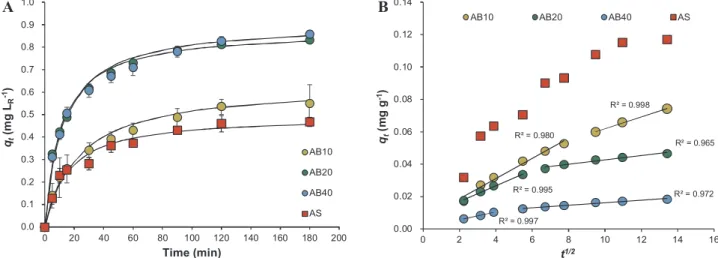
Micropollutants such as pharmaceutical and personal care products and industrial chemicals in CASP are removed with various routes through biodegradation, sorption, hydrolysis/photolysis, and volatili-zation [22]. AB indeed acted as a microbial carrier (Fig. 2C). Since the biological removal extent observed in a separate flask was much less significant than the overall CIP removals (94 %) that occurred in the AB-dosed bioreactors at steady state, which prompted further in-vestigation on the contribution of other removal routes (e.g., CIP ad-sorption to AB). Pretreated AB (using nitric acid) and AS directly taken from an aeration tank of a full-scale WWTP, neither of which had been exposed to CIP, were used for characterizing adsorption kinetics. Fig. 3A shows time-course adsorption of CIP in glass vials with 10 %, 20 %, and 40 % of AB and 3 g VSS L−1of AS, respectively, simulating the same settings established in the three AB-dosed and control reactor. In contrast to the minor CIP removal contributed by biomass over the four days (Fig. S1), CIP was rapidly and substantially removed within three hours (Fig. 3A). The pseudo-second-order kinetic model was the bestfit (r2> 0.99) for the experimental results with the hardwood-based bio-char, as previously reported for adsorption of a range of trace organic pollutants, including CIP, to other types of biochars [17–19,35]. The adsorption rate constant per unit volume (LR) varied with AB
volu-metric ratios similarly simulated as in the AB-dosed reactors was as-sessed: AB40 (48.1 LR mg-1 min-1) > AB20 (7.4) > AB10 (1.1) > AS
(0.4). The qevalue was in the order of AB40 (0.776 mg LR-1) > AB20
(0.772) > AB10 (0.513) > AS (0.432). The much faster and greater adsorption to AB than AS highlighted the significant contribution of the AB-mediated CIP adsorption removal rather than the AS-mediated biosorption in the AB-dosed reactors at steady state.
While adsorption to AB and AS could be described well with the pseudo-second-order kinetic model, only AB-mediated adsorption (not AS-mediated) wasfitted well to the Weber–Morris intraparticle diffu-sion model (multilinear plots with r2> 0.96 inFig. 3B), suggesting
intraparticle diffusion could be more significant in AB-mediated ad-sorption relative to AS. Adad-sorption processes consist of three steps: 1) boundary-layer diffusion within the layer on the adsorbent surface, 2) intra-particle diffusion of adsorbates into the pores and 3) adsorption on the adsorption sites either on the surface or in the pores of
adsorbents, which is fast and not rate-limiting [36]. The kinetics results suggested that CIP was adsorbed onto the adsorption sites on the outer surface of AB, which is easily accessible, in thefirst linear stage, while CIP was transported into the sites in inner pores with higher resistance in the second linear stage. We also observed that the period of thefirst stage increased as the amount of AB increased, providing more outer surfaces. The intercept of the plots, i.e., c in Eq.(3), was significantly smaller than qe, indicating that the boundary layer played a minor role
in adsorption.
3.4. Adsorption isotherm of CIP on AB and AS
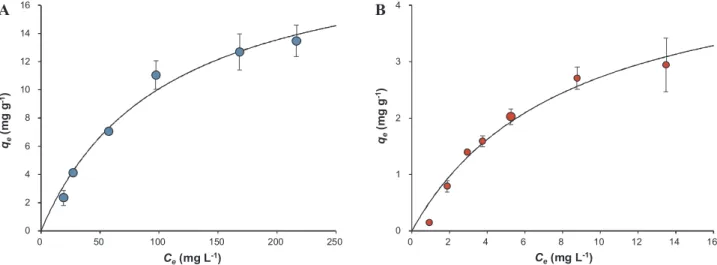
Fig. 4illustrates the increasing adsorption capacity of CIP with the increase of CIP liquid concentration. The maximum adsorption capacity obtained using the Langmuir isotherm (a betterfit to the experimental results than other models) was 20.7 and 5.0 mg g−1(Table 2), while RL
was in a range of 0.30–0.81 and 0.28–0.94 for AB and AS, respectively. Given the adsorption behaviors classified based on RLvalues:
irrever-sible (0), favorable (0–1), and unfavorable (> 1) [24], CIP adsorption to both AB and AS was found to be favorable. The maximum CIP ad-sorption capacity values measured in this study were in an agreement with previous estimates: 10–96.3 mg g−1by various types of biochar
(Table S1) and 3.4 by AS [37]. These results supported the greater CIP adsorption capacity by the AB-dosed reactors for the longer period (Fig. 1A).
The goodfit of the Langmuir isotherm model and the unity (1.00) of β (Sips isotherm) suggested that CIP adsorption onto both BC and AS could be accomplished through monolayer and homogeneous adsorp-tion and that adsorpadsorp-tion enthalpy was not affected by surface coverage [24]. Experimental data were fitted to the Dubinin–Kaganer–Ra-dushkevich isotherm model to infer apparent adsorption energy, since it is often used to describe the adsorption mechanism with a Gaussian energy distribution onto a heterogeneous surface [24]. The adsorption mechanism can be predicted depending on the apparent free energy of adsorption (E): physical (E < 8), ion exchange (8 < E < 16), and strongly chemical (E > 16) [24]. The E value was 9.4 and 11.8 kJ mol−1for AB and AS, respectively, implying that adsorption occurred primarily by ionic exchange between ionizable protons on the acidic surface [–Cπ–H3O+]) [38] and/or the exchange of electrons between
adsorbates and adsorbents [39].
Fig. 3. Kinetics of CIP adsorption to AB with different filling ratio and AS. (A) Time course of CIP adsorption amount. The line represents the pseudo-second-order adsorption kinetic model prediction. The symbols and error bars represent the mean (n = 3) and the standard deviation, respectively. (B) CIP adsorption char-acterized by the Weber–Morris intraparticle diffusion model. Each symbol represents the mean of triplicate measurements with < 5 % of standard deviation from the mean.
3.5. CIP-mediated shifts in surface properties
Fig. 5A presents the FTIR spectra of the pre-treated and CIP-ad-sorbed AB, which identified the presence of the OeH bond in hydroxyl functional groups (the band observed at 3200–3500 cm−1), aliphatic
CH2asymmetric stretch (2917 cm−1), aliphatic CH2symmetric stretch
(2850 cm−1), the stretching of symmetric and asymmetric vibration of C]O in CO2(2360 cm−1), ketonic and carboxylic C]O (1703 cm−1),
C]C of the aromatic ring or highly conjugated C]C bond generated during pyrolysis of raw material (1595 cm−1), and bending vibration of methyl (1384 cm−1). The presence of CO2(2360 cm−1) was probably
attributed to the low temperature during manufacture of the AB, often detected in those of other types of biochars under slow pyrolysis at relatively low temperatures (400 °C) [40]. The peak at 1270 cm−1 as-signed to a phenolic CeOH bond was probably attributable to adsorbed CIP molecules. In addition, the peak of aromatic C]C bonds shifted from 1595 to 1583 cm−1, indicating thatπ-π electron-donor-acceptor (EDA) interactions contributed to the adsorption [41]. The carbon atom bonded tofluorine (C]C*-F) in CIP molecules is a π-electron-acceptor due to the strong electron-withdrawing ability offluorine [42]. Theπ-π EDA interactions in the organic compounds adsorption by carbon-based materials contribute significantly to the adsorption of aromatics to biochar and graphitic materials [19,43].
The spectrum (Fig. 5B) of AS and CIP-adsorbed AS included peaks associated with the OeH of a hydroxyl group compound (polyalcohol and saccharides, 3200∼3500 cm−1), the vibration H-bonds between
OH groups of cellulose and NH in the amide groups (3280 cm−1), the stretching vibration of CeH stretch (2924 cm−1), C-H
2asymmetric and
symmetric stretch (2852 cm−1), stretching asymmetrical vibrations of COO−in peptides and proteins (1652 cm−1), stretching vibration of CeN and NeH of amide II of the protein polymer (1548 cm−1), NH
3+
in peptide (1402 cm−1), and CeOeC of amide III or aromatic ethers (1242 cm−1) [44]. The intensities of all peaks at 3280–1652 cm−1
decreased after CIP adsorption, indicating that a variety of functional groups on AS surfaces were involved in CIP adsorption. Zhang et al. [45] found that most of the functional groups of extracellular polymeric substances of aerobic sludge, including carboxyl, hydroxyl, and amine bind with CIP. They also reported that EPS contributed to approxi-mately 50 % of CIP removal by aerobic sludge. Meanwhile, a peak at 1032 cm−1 appearing after CIP adsorption represented the CeF stretching of CIP, supporting the CIP adsorption onto AS.
3.6. Effects of pH on Zeta potential and CIP adsorption
Fig. 6A shows the zeta potential and the CIP adsorption amount of AB under different pHs. The zeta potential of AB was −21.7 mV at pH 3.1, decreased to−49.3 mV at pH 6, and then further decreased 51.7 mV at pH 10.0. Biochars show a range of zeta potential from−20 to 0 mV at pH 3.5, which decreases as pH increases [46]. The point of zero charge is 3.05 for a tea-leaf biochar [19]. The surface charge of AB was significantly more negative than those previously reported, suggesting that the AB used in this study could have a high adsorption potential to Fig. 4. Modeling of CIP adsorption isotherm with (A) AB and (B) AS. Solid lines represent the Langmuir isotherm model prediction. The symbols and error bars represent the mean (n = 3) and standard deviation, respectively.
cationic metals via higher electrostatic attraction.
The highest CIP adsorption potential was recorded at pH 6.3 and decreased whether the pH rose or fell. The optimum CIP adsorption of AB was at the pH range relevant to those in municipal wastewaters, consistent with other studies [19,35]. The highest adsorption achieved at a nearly neutral pH was attributable to strong hydrophobic effects andπ-π EDA interactions. CIP exists dominantly as a cation (CIPH2+),
zwitterion (CIPH±) and anion (CIP−) when the pH is < 5.9, 6.1–8.7
and > 8.9, respectively, because of the two dissociation constants (pKa) of CIP. One of the pKas is 5.9 for the carboxylic acid group and the other is 8.8 for the amine group on the piperazine moiety. CIPH±has
the highest hydrophobicity among three CIP species [43] and is an ef-fectiveπ-electron-acceptor, taking part in strong π-π EDA interactions with the graphite structures of the AB. The pH-dependent adsorption observed inFig. 6A could be attributable to several mechanisms. As pH decreases, theπ-electron accepting ability of CIP increases (i.e., favor-able to adsorption), while the electrostatic attraction and hydro-phobicity decrease (i.e., unfavorable to the adsorption) [47]. Therefore, hydrophobicity and the electrostatic repulsion likely dominantly af-fected CIP adsorption under acidic pH. In contrast, as pH increases, the electrostatic attraction, the π-electron accepting ability, and hydro-phobicity decrease due to deprotonation and ionization [48], which are all unfavorable to the adsorption, which led to a significant decrease of CIP adsorption.
The zeta potential and the CIP adsorption of AS at a range of pH values are presented inFig. 6B. The surface of AS is negative due to the ionization of the anionic functional groups, such as carboxylic acid and phosphate [49]. The zeta potential of AS taken from oxic tanks of three municipal WWTPs was in a range of−0.1 to −5 at pH 3 and of −20 to −30 at pH 12 [50]. The zeta potential of AS was 0 to−5 mV at pH 3 and decreased to−20 mV at pH 7 [51].
The CIP adsorption potential onto AS was the highest at pH 6.3 and fell as pH either increased or decreased, as observed with AB. The ad-sorption of CIPH± at nearly neutral conditions could be due to a
combination of electrostatic attraction, cation exchange of the proto-nated amine, cation bridging of divalent cations, and the anionic car-boxyl group of CIP±[52]. These results suggested that CIP adsorption
to AS may be suppressed by protonation of anionic carboxyl groups under acidic conditions and/or by the increase of electrostatic repulsion under alkaline condition.
3.7. CIP removals in AB-dosed AS systems: mechanism and practical implication
While several studies have documented CIP adsorption to biochars
with other biomass sources [19,35], little is known about the char-acteristics and mechanism of CIP adsorption to hardwood-based bio-char. This work provided insights into mechanisms facilitating CIP adsorption to AB, a hardwood-derived biochar. First, the CIP adsorption kinetics could be primarily governed by the diffusion within macro-pores rather than meso/micromacro-pores. It was supported by the kinetics model (Webber-Morris) (Fig. 3A andTable 1) and significantly larger macropores relative to mesopores and micropores. The latter was ex-perimentally validated with the SEM images (Fig. 2B) and the smaller volume (0.00887 and 0.00265 cm3g−1) and specific surface area (2.02 and 2.33 m2g−1) of mesopores and micropores, respectively, measured
using the BET analysis. Second, the CIP adsorption to AB also involved hydrophobic effects of CIP, π- π EDA interactions, and electrostatic attraction between CIP and AB, inferred from the surface character-ization results (Figs. 5 and 6). The proposed mechanism was also sup-ported by the apparent adsorption energy (E of the Dubinin–Kaga-ner–Radushkevich isotherm,Fig. 4andTable 2).
Direct dosage of AB into AS could greatly enhance CIP removal (Fig. 1A) largely via adsorption to AB rather than biodegradation/ biosorption. Because the biomass tested in this study was taken from Fig. 6. Zeta potential and CIP adsorption potential at a range of pH. (A) CIP adsorption to AB. (B) CIP adsorption to AS. The symbols and error bars represent the mean (n = 3) and standard deviation, respectively.
Table 1
Parameters of adsorption kinetic models.
Model Parameter AB10 AB20 AB40 AS
Pseudo- ka1(min−1) 0.041 0.072 0.069 0.052 first- qe(mg g−1) 0.063 0.042 0.016 0.108 order qe(mg LR−1) 0.513 0.772 0.776 0.432 r2 0.962 0.963 0.954 0.941 Pseudo- ka2(g mg−1 min−1) 0.680 2.00 4.91 0.522 second- ka2(LRmg−1 min−1) 1.11 7.35 48.1 0.418 order qe(mg g−1) 0.073 0.047 0.018 0.124 qe(mg LR−1) 0.599 0.867 0.878 0.496 r2 0.991 0.994 0.991 0.998
Intra- First kdiff(g mg−1 min-1/2) 6.23 × 10⁻³ 4.87 × 10⁻³ 2.42 × 10⁻³ – particle stage c (mg g−1) 6.21 × 10⁻³ 7.30 × 10⁻³ 0.90 × 10⁻³ – diffusion r2 0.980 0.995 0.997 – Second kdiff(g mg−1 min-1/2) 3.64 × 10⁻³ 1.36 × 10⁻³ 0.77 × 10⁻³ – stage c (mg g−1) 2.55 × 10⁻² 2.91 × 10⁻² 0.86 × 10⁻² – r2 0.998 0.965 0.972 –
Note. The mean value of triplicate measurements at each time point was used for model prediction.
the AB-dosed reactor at steady state, CIP likely had been already ad-sorbed to the biomass, therefore severely limiting further biosorption-mediated CIP removal that could possibly occur. In contrast, the AS samples freshly taken from full-scale WWTPs showed rapid and sig-nificant biosorption potential, highlighting considerable sorption po-tential to AS (Figs. 3 and 4andTables 1 and 2). Accordingly, CIP re-movals observed in the control reactor until day 21 could occur via biosorption to suspended biomass. Compared with the limited adsorp-tion capacity by suspended biomass in the control system at steady state, addition of AB could significantly improve the removal capacity (94 % CIP removals in AB40). Our adsorption kinetics and isotherm parameters demonstrated the high adsorption rate, maximum adsorp-tion capacity, and affinity of CIP to AB (Figs. 3 and 4andTables 1 and 2). The CIP concentration tested in this study greatly exceeds the typical levels of CIP (e.g., less than dozens ofμg L−1) in municipal wastewater influents, suggesting that AB-dosage might be effective for treating CIP-bearing waste streams at a wide range of environmentally relevant le-vels. Despite the effectiveness, given that municipal waste streams carry a lot of organic and inorganic compounds that may compete/interfere with the antibiotic adsorption to biochar, we should therefore suggest further experimental investigations (e.g., antibiotic removal perfor-mance, breakthrough time, and regeneration strategy of biochar) of the removal performance, using both the bench and pilot-scale AS systems dosed with biochar receiving real wastewaters.
CIP removals in full-scale WWTPs are often attributed to biosorption onto AS biomass [12,52], while CIP represents a poorly biodegradable micropollutant [52]. The disappearance of CIP resulting from adsorp-tion to wasted AS (WAS), not biodegradaadsorp-tion, may give rise to another critical issue, as the CIP released with WAS may perturb ecosystems of post-treatment processes (e.g., anaerobic digestion) and biosolid-amended sites. For example, our previous study revealed that > 0.5 mg L−1 of CIP could cause significant inhibition on aerobic activated sludge (e.g., potential heterotrophic and nutrient removal activities) and anaerobic methanogenic sludge (e.g., fermentation and methane production activities) with alteration on the microbial community structure and diversity [7]. Given the faster and higher adsorption ca-pacity of AB than AS, dosing biochar into AS would help effectively remove CIP from the WAS as well as the wastewater effluents.
The performances of biochar-dosed bioreactors can be further im-proved through modifying surface properties of biochar. There are many factors (e.g., biomass feedstock, pyrolysis condition such as temperature, and pretreatment) affecting the surface properties (e.g., surface-to-volume ratio) of biochar and thus potentially enhancing the treatment performance (adsorption kinetics/isotherm). Hence, the AB dosage (10–40 %) tested in this study (Fig. 1) may be further reduced through surface modification of biochar as both an adsorbent and a microbial carrier. Despite its great adsorption capacity of biochar as
lated with the added amount of AB, achieving up to 94 % of CIP re-movals by AB-dosed AS reactors, while a control AS reactor without AB showed a non-detectable removal. Adsorption kinetics and isotherm results suggested the majority of CIP was removed by adsorption onto AB primarily via intraparticle diffusion, π-π EDA interaction, and hy-drophobic and electrostatic attraction. The outstanding CIP removal rates observed in this work proposed that direct dosage of biochar into AS system may be a cost-effective and simple alternative treatment option for antibiotic-bearing waste streams.
Declaration of Competing Interest
The authors declare that they have no known competingfinancial interests or personal relationships that could have appeared to influ-ence the work reported in this paper.
Acknowledgments
This work was supported by a Korea Environment Industry & Technology Institute (KEITI) through Subsurface Environmental Management (SEM) Projects, funded by Korea Ministry of Environment (MOE) (2019002480005).
Appendix A. Supplementary data
Supplementary material related to this article can be found, in the online version, at doi:https://doi.org/10.1016/j.jwpe.2019.101019.
References
[1] R.K. Nam, R. Saskin, Y. Lee, Y. Liu, C. Law, L.H. Klotz, Increasing hospital admission rates for urological complications after transrectal ultrasound guided prostate biopsy, J. Urol. 189 (2013) S12–S17.
[2] W. Castro, M. Navarro, C. Biot, Medicinal potential of ciprofloxacin and its deri-vatives, Future Med. Chem. 5 (2013) 81–96.
[3] S. Sahlin, D.G.J. Larsson, M. Ågerstrand, Ciprofloxacin: EQS data overview, The Department of Environmental Science and Analytical Chemistry (ACES) Report 15, Stockholm University, Stockholm, 2018.
[4] A. Hartmann, E.M. Golet, S. Gartiser, A.C. Alder, T. Koller, R.M. Widmer, Primary DNA damage but not mutagenicity correlates with Ciprofloxacin concentrations in German hospital wastewaters, Arch. Environ. Contam. Toxicol. 36 (1999) 115–119. [5] A.A. Robinson, J.B. Belden, M.J. Lydy, Toxicity offluoroquinolone antibiotics to
aquatic organisms, Environ. Toxicol. Chem. 24 (2005) 423–430.
[6] Y. Luo, W. Guo, H.H. Ngo, L.D. Nghiem, F.I. Hai, J. Zhang, S. Liang, X.C. Wang, A review on the occurrence of micropollutants in the aquatic environment and their fate and removal during wastewater treatment, Sci. Total Environ. 473–474 (2014) 619–641.
[7] D. Kim, L.N. Nguyen, S. Oh, Ecological impact of the antibiotic ciprofloxacin on microbial community of aerobic activated sludge, Environ. Geochem. Health (2019),https://doi.org/10.1007/s10653-019-00392-6.
[8] P. Verlicchi, M. Al Aukidy, E. Zambello, Occurrence of pharmaceutical compounds in urban wastewater: removal, mass load and environmental risk after a secondary treatment-a review, Sci. Total Environ. 429 (2012) 123–155.
[9] I.A. Parshikov, T.M. Heinze, J.D. Moody, J.P. Freeman, A.J. Williams,
J.B. Sutherland, The fungus Pestalotiopsis guepini as a model for biotransformation
of ciprofloxacin and norfloxacin, Appl. Microbiol. Biotechnol. 56 (2011) 474–477. [10] J.Q. Xiong, M.B. Kurade, J.R. Kim, H.S. Roh, B.H. Jeon, Ciprofloxacin toxicity and its co-metabolic removal by a freshwater microalga Chlamydomonas mexicana, J. Hazard. Mater. 323 (2017) 212–219.
[11] L.N. Nguyen, L.D. Nghiem, S. Oh, Aerobic biotransformation of the antibiotic ci-profloxacin by Bradyrhizobium sp. isolated from activated sludge, Chemosphere 211 (2018) 600–607.
[12] A. Jia, Y. Wan, Y. Xiao, J. Hu, Occurrence and fate of quinolone and fluor-oquinolone antibiotics in a municipal sewage treatment plant, Water Res. 46 (2012) 387–394.
[13] K.A. Thompson, K.K. Shimabuku, J.P. Kearns, D.R.U. Knappe, R.S. Summers, S.M. Cook, Environmental comparison of biochar and activated carbon for tertiary wastewater treatment, Environ. Sci. Technol. 50 (20) (2016) 11253–11262. [14] L. Sbardella, J. Comas, A. Fenu, I. Rodriguez-Roda, M. Weemaes, Advanced
biolo-gical activated carbonfilter for removing pharmaceutically active compounds from treated wastewater, Sci. Total Environ. 636 (2018) 519–529.
[15] J. Streicher, A.S. Ruhl, R. Gnirß, M. Jekel, Where to dose powdered activated carbon in a wastewater treatment plant for organic micro-pollutant removal, Chemosphere 156 (2016) 88–94.
[16] F.R. Oliveira, A.K. Patel, D.P. Jaisi, S. Adhikari, H. Lu, S.K. Khanal, Environmental application of biochar: current status and perspectives, Bioresour. Technol. 246 (2017) 110–122.
[17] C. Chen, W. Zhou, D. Lin, Sorption characteristics of N-nitrosodimethylamine onto biochar from aqueous solution, Bioresour. Technol. 179 (2015) 359–366. [18] T. Chen, L. Luo, S. Deng, G. Shi, S. Zhang, Y. Zhang, O. Deng, L. Wang, J. Zhang,
L. Wei, Sorption of tetracycline on H3PO4 modified biochar derived from rice straw and swine manure, Bioresour. Technol. 267 (2018) 431–437.
[19] J. Li, G. Yu, L. Pan, C. Li, F. You, S. Xie, Y. Wang, J. Ma, X. Shang, Study of ci-profloxacin removal by biochar obtained from used tea leaves, J. Environ. Sci. 73 (2018) 20–30.
[20] J.C. Leyva-Díaz, J. Martín-Pascual, J.M. Poyatos, Moving bed biofilm reactor to treat wastewater, Int. J. Environ. Sci. Technol. 14 (2017) 881–910.
[21] N.A. ElNaker, M. Elektorowicz, V. Naddeo, S.W. Hasan, A.F. Yousef, Assessment of microbial community structure and function in serially passaged wastewater electro-bioreactor sludge: an approach to enhance sludge settleability, Sci. Rep. U. K. 8 (2018) 7013.
[22] S. Oh, S. Choi, Microbial community enhances biodegradation of bisphenol A through selection of Sphingomonadaceae, Microbial Ecol. 77 (2018) 631–639 2019. [23] W.J. Weber, C. Morris, Kinetics of adsorption on carbon from solution, J. Sanity.
Eng. Div. Am. Soc. Civil Eng. 89 (1963) 31–59.
[24] K.Y. Foo, B.H. Hameed, Insights into the modeling of adsorption isotherm systems, Chem. Eng. J. 156 (2010) 2–10.
[25] N. Kobayashi, T.W. Bauer, M.J. Tuohy, T. Fujishiro, G.W. Procop, Brief ultra-sonication improves detection of biofilm-formative bacteria around a metal im-plant, Clin. Orthop. Relat. Res. 457 (2007) 210–213.
[26] K. Leinweber, P.G. Kroth, Capsules of the diatom Achnanthidium minutissimum arise fromfibrillar precursors and foster attachment of bacteria, Peer J. 3 (2015) e858,https://doi.org/10.7717/peerj.8582015.
[27] APHA, AWWA, WEF, Standard Methods for the Examination of Water and Wastewater, 22nd ed., (2012) Washington, DC.
[28] N. Dorival-García, A. Zafra-Gómez, A. Navalón, J. González, J.L. Vílchez, Removal of quinolone antibiotics from wastewaters by sorption and biological degradation in laboratory-scale membrane bioreactors, Sci. Total Environ. 442 (2013) 317–328. [29] H. Zhang, Y. Jia, S.K. Khanal, S.H. Lu, H. Fang, Q. Zhao, Understanding the role of
extracellular polymeric substances on ciprofloxacin adsorption in aerobic sludge, anaerobic sludge, and sulfate-reducing Bacteria sludge systems, Environ. Sci. Technol. 52 (2018) 6476–6486.
[30] B. Yan, C.H. Niu, J. Wang, Kinetics, electron-donor-acceptor interactions, and site energy distribution analyses of norfloxacin adsorption on pretreated barley straw, Chem. Eng. J. 330 (2017) 1211–1221.
[31] Y. Jia, S.K. Khanal, H. Shu, H. Zhang, G.H. Chen, H. Lu, Ciprofloxacin degradation in anaerobic sulfate-reducing bacteria (SRB) sludge system: mechanism and path-ways, Water Res. 136 (2018) 64–74.
[32] L. Zhao, X. Cao, O. Mašek, A. Zimmerman, Heterogeneity of biochar properties as a function of feedstock sources and production temperatures, J. Hazard. Mater. 256–257 (2013) 1–9.
[33] L.J. Gibson, The hierarchical structure and mechanics of plant materials, J. R. Soc. Interface 9 (2012) 2749–2766.
[34] H. Liang, K.E. DeMeester, C.-W. Hou, M.A. Parent, J.L. Caplan, C.L. Grimes, Metabolic labelling of the carbohydrate core in bacterial peptidoglycan and its applications, Nat. Commun. 8 (2017) 15015.
[35] J.G. Shang, X. Kong, L.L. He, W.H. Li, Q.J.H. Liao, Low-cost biochar derived from herbal residue: characterization and application for ciprofloxacin adsorption, Int. J. Environ. Sci. Technol. 13 (2016) 2449–2458.
[36] Y.Y. Sun, H. Li, G.C. Li, B.Y. Gao, Q.Y. Yue, X.B. Li, Characterization and cipro-floxacin adsorption properties of activated carbons prepared from biomass wastes by H3PO4activation, Bioresour. Technol. 217 (2016) 239–244.
[37] Z.W. Zeng, X.F. Tan, Y.G. Liu, S.R. Tian, G.M. Zeng, L.H. Jiang, S.B. Liu, J. Li, N. Liu, Z. Yin, Comprehensive adsorption studies of doxycycline and ciprofloxacin anti-biotics by biochars prepared at different temperatures, Front. Chem. 6 (2018) 80. [38] C. Peiris, S.R. Gunatilake, T.E. Mlsna, D. Mohan, M. Vithanage, Biochar based re-moval of antibiotic sulfonamides and tetracyclines in aquatic environments: a cri-tical review, Bioresour. Technol. 246 (2017) 150–159.
[39] Y. Wang, X. Wang, X. Wang, M. Liu, L. Yang, Z. Wu, S. Xia, J. Zhao, Adsorption of Pb(II) in aqueous solutions by bamboo charcoal modified with KMnO4via
micro-wave irradiation, Colloid Surf. A 414 (2012) 1–8.
[40] M. Jouiad, N. Al-Nofeli, N. Khalifa, F. Benyettou, L.F. Yousef, Characteristics of slow pyrolysis biochars produced from Rhodes grass and fronds of edible date palm, J. Anal. Appl. Pyrol. 111 (2015) 183–190.
[41] L. Jiang, Y. Liu, G. Zeng, F. Xiao, X. Hu, X. Hu, et al., Removal of 17β-estradiol by few-layered graphene oxide nanosheets from aqueous solutions: external influence and adsorption mechanism, Chem. Eng. J. 284 (2016) 93–102.
[42] B. Yan, C.H. Niu, J. Wang, Kinetics, electron-donor-acceptor interactions, and site energy distribution analyses of norfloxacin adsorption on pretreated barley straw, Chem. Eng. J. 330 (2017) 1211–1221.
[43] X. Peng, F. Hu, J. Huang, Y. Wang, H. Dai, Z. Liu, Preparation of a graphitic ordered mesoporous carbon and its application in sorption of ciprofloxacin: kinetics, iso-therm, adsorption mechanisms studies, Microporous Mesoporous Mater. 228 (2016) 196–206.
[44] M. Kowalski, K. Kowalska, J. Wiszniowski, J. Turek-Szytow, Qualitative analysis of activated sludge using FT-IR technique, Chem. Pap. 72 (2018) 2699–2706. [45] H. Zhang, Y. Jia, S.K. Khanal, H. Lu, H. Fang, Q. Zhao, Understanding the role of
extracellular polymeric substances on ciprofloxacin adsorption in aerobic sludge, anaerobic sludge, and sulfate-reducing Bacteria sludge systems, Environ. Sci. Technol. 52 (2018) 6476–6486.
[46] E.M.C.C. Batista, J. Shultz, T.T.S. Matos, M.R. Fornari, T.M. Ferreira, B. Szpoganicz, R.A. de Freitas, A.S. Mangrich, Effect of surface and porosity of biochar on water holding capacity aiming indirectly at preservation of the Amazon biome, Sci. Rep. U. K. 8 (2018) 10677.
[47] Z. Yang, R. Xing, W. Zhou, Adsorption of ciprofloxacin and Cu2+ onto biochars in the presence of dissolved organic matter derived from animal manure, Environ. Sci. Pollut. Res. 26 (2019) 14382–14392.
[48] D. Huang, X. Wang, C. Zhang, G. Zeng, Z. Peng, J. Zhou, Sorptive removal of io-nizable antibiotic sulfamethazine from aqueous solution by graphene oxide-coated biochar nanocomposites: influencing factors and mechanism, Chemosphere 186 (2017) 414–421.
[49] W. Zhang, P. Yang, P. Xia, S. Xu, Y. Liu, F. Liu, D. Wang, Dynamic variation in physicochemical properties of activated sludgefloc from different WWTPs and its influence on sludge dewaterability and settleability, Colloid. Surface. A 467 (2015) 124–134.
[50] N. Tixier, G. Guibaud, M. Baudu, Effect of pH and ionic environment changes on interparticle interactions affecting activated sludge flocs: a rheological approach, Environ. Technol. 24 (2003) 971–978.
[51] C. He, A. Giannis, J.-Y. Wang, Conversion of sewage sludge to clean solid fuel using hydrothermal carbonization: hydrochar fuel characteristics and combustion beha-vior, Appl. Energy 111 (2013) 257–266.
[52] F. Polesel, K. Lehnberg, W. Dott, S. Trapp, K.V. Thomas, B.G. Plosz, Factors influ-encing sorption of ciprofloxacin onto activated sludge: experimental assessment and modelling implications, Chemosphere 119 (2015) 105–111.
[53] Y. Dai, N. Zhang, C. Xing, Q. Cui, Q. Sun, The adsorption, regeneration and en-gineering applications of biochar for removal organic pollutants: a review, Chemosphere 223 (2019) 12–27.