448 DOI 10.3343/kjlm.2009.29.5.448
448
Escherichia coli, Klebsiella pneumoniae
및
Proteus mirabilis에서
플라즈미드매개성 AmpC β
β-lactamase를 검출하는 3가지 표현형 검사법의 비교
Comparison of 3 Phenotypic-detection Methods for Identifying Plasmid-mediated AmpC
β
-lactamase-producing Escherichia coli, Klebsiella pneumoniae, and Proteus mirabilis Strains
Wookeun Lee, M.D.
1, Bochan Jung, M.D.
1, Seong Geun Hong, M.D.
1, Wonkeun Song, M.D.
2, Seok Hoon Jeong, M.D.
3,
Kyungwon Lee, M.D.
3, Hyo-Sun Kwak, Ph.D.
4Department of Laboratory Medicine1, CHA University, Sungnam; Department of Laboratory Medicine2, Hallym University College of
Medicine, Seoul; Department of Laboratory Medicine and Research Institute for Antimicrobial Resistance3, Yonsei University College of
Medicine, Seoul; Center for Food Safety Evaluation4, Korea Food and Drug Administration, Seoul, Korea
이우근
1∙정보찬
1∙홍성근
1∙송원근
2∙정석훈
3∙이경원
3∙곽효선
4 CHA 의과학대학교 진단검사의학과1 , 한림대학교 의과대학 진단검사의학과2 , 연세대학교 의과대학 진단검사의학과 및 세균내성연구소3 , 식품의약품안전청 식품안전평가부4 448 448Background : Plasmid-mediated AmpC β-lactamases (PABLs) have been detected in the strains of Escherichia coli, Klebsiella spp., Proteus mirabilis, and Salmonella spp. PABLs may be difficult to detect and might interfere in the therapeutic and infection-control processes. Although several PABL-detection methods based on phenotypes have been reported, the Clinical and Laboratory Standards Institute currently does not recommend a routine detection method for PABLs. The aim of this study is to compare the performances of 3 phenotypic PABL detection methods.
Methods : Total 276 non-duplicated clinical isolates of E. coli (N=97), K. pneumoniae (N=136), and P. mirabilis (N=43) were collected from 14 hospitals in Korea between April and June 2007 in a non-consecutive and non-random manner. Multiplex PCR was performed to detect the PABL genes. Further, 3 phenotypic detection methods-cephamycin-Hodge test, Tris-EDTA (TE) disk test, and com-bination-disk test with 3-aminophenylboronic acid (BA)-were performed using cefoxitin and cefote-tan disks.
Results : PABL genes were detected by multiplex PCR in 122/276 isolates, including 14/97 E. coli, 105/136 K. pneumoniae, and 3/43 P. mirabilis isolates. The combination-disk test with BA showed higher sensitivity (98.4%), specificity (92.2%), and efficiency (96.3%) than the cephamycin-Hodge (76.2%, 96.1%, and 88.6%, respectively) and the TE-disk (80.3%, 91.6%, and 87.9%, respectively) tests.
Conclusions : The combination-disk test with BA is a simple, efficient, and interpretable test that can be applicable in clinical laboratories in-volved in the detection of PABLs in clinical isolates of E. coli, K. pneumoniae, and P. mira-bilis. (Korean J Lab Med 2009;29:448-54)
Key Words : AmpC β-lactamase, Boronic acid, Hodge test, Tris-EDTA disk test
Received :April 10, 2009 Manuscript No :KJLM09-050 Revision received :June 24, 2009
Accepted :August 5, 2009
Corresponding author :Seong Geun Hong, M.D.
Department of Laboratory Medicine, CHA University, 351 Yatap-dong, Bundang-gu, Sungnam 463-712, Korea Tel : +82-31-780-5463, Fax : +82-31-780-5476 E-mail : [email protected]
*Part of this work was presented at the 7th International Symposium on Antimicrobial Agents and Resistance, Bangkok, Thai, 2009.
*This work was supported by a research grant from the Korea Food and Drug Administration (0705Hangsaengjae174).
INTRODUCTION
AmpC β-lactamases hydrolyze extended-spectrum cepha-losporins and are present in many gram-negative bacilli. ampCgenes are originally chromosomal in Citrobacterspp., Enterobacter spp., Morganellaspp., Hafniaspp., and Ser-ratiaspp. [1]. Since 1989, plasmid-mediated AmpC β -lac-tamases (PABLs) have been detected worldwide in the strains of Escherichia coli, Klebsiellaspp., Proteus mirabilis, and Salmonellaspp. [1, 2] Decreased susceptibility to cefoxitin in Enterobacteriaceae may indicate the involvement of AmpC, but cefoxitin resistance may also be attributable to the dec-rease in the outer membrane permeability [3]. PABL-pro-ducing strains may also be susceptible to cefoxitin and cefo-tetan according to the current breakpoint criteria [4]. It may be difficult to detect PABLs, which are known to interfere with the therapeutic and infection control processes [5]. Therefore, it is important to develop methods that can easily and appropriately detect PABLs in clinical isolates. Although several phenotypic methods for their detection have been reported, CLSI currently does not recommend testing for PABLs [6]. Phenotypic-detection methods can be divided into following 2 categories: ones that detect AmpC activi-ties in enzyme extracts and the others that evaluate the inhibitory effects induced by AmpC inhibitors. Three-dimsional extraction test has been reported as a reliable en-zyme-extraction method, but this method is complicated and not applicable to clinical microbiology laboratories [7]. Cephamycin-Hodge test and Tris-EDTA (TE)-disk test were reported as simple and sensitive phenotypic-detection me-thods [5, 8]. Boronic acid (BA), cloxacillin, and Syn2190 have been identified as AmpC inhibitors [7, 9, 10]. Several phe-notypic-detection methods have been developed using these inhibitors, but the one developed using BA, which was first introduced by Yagi et al. [11], is relatively available. The aim of this study is to compare the performance of the follow-ing 3 phenotypic-detection methods: cephamycin-Hodge test, TE-disk test, and combination-disk test with BA, for identifying PABL-producing E. coli, K. pneumoniae, and P. mirabilisstrains.
MATERIALS AND METHODS
1. Strains and antibiotic susceptibility test
A total of 276 non-duplicated clinical isolates of E. coli (N=97), K. pneumoniae(N=136), and P. mirabilis(N=43) were collected from 14 hospitals in Korea between April and June 2007 in a non-consecutive and non-random manner. Disk-diffusion-susceptibility tests for cefoxitin, cefotetan, and cefepime were performed according to the CLSI recommen-dations [12].
2. Multiplex PCR for plasmid-mediated ampC genes
All the isolates were tested for plasmid-mediated ampC genes using multiplex PCR developed by Perez-Perez and Hanson [13].
3. Cephamycin-Hodge test
The surfaces of MacConkey agar (MCA) plates were inocu-lated with a lawn of the indicator strain, E. coli ATCC 25922, according to the CLSI disk-diffusion method [12]. After the agar surface dried, a test strain was heavily streaked from the center of the plate to the periphery and a cephamycin disk (BD Diagnostic Systems, Sparks, MD, USA) was placed at the center. The plates were incubated overnight at 35℃, and the presence of definite growth of the indicator organ-ism in the inhibition zone along with the test strain was interpreted as positive.
4. TE-disk test
TE disks were prepared in-house by applying 20 μL of a 1:1 mixture of saline and 100× Tris-EDTA (Sigma-Aldrich Corp., St. Louis, MO, USA) to sterile filter paper disks, fol-lowing which the disks were dried and stored at 2-8℃. A lawn of E. coliATCC 25922 was inoculated on the surface of a Mueller-Hinton agar (MHA) plate. Immediately prior to incubation, a TE disk premoistened with 20 μL of saline was inoculated with several colonies of the test organism
and placed face down on the MHA plate adjacent to a disk containing any one of the following: cephamycins, cefoxitin, or cefotetan. The plates were incubated overnight, and an indentation in the zone of inhibition was interpreted as posi-tive [5].
5. Combination-disk test with boronic acid
3-Aminophenylboronic acid (120 mg; Sigma-Aldrich Corp., St. Louis, MO, USA) was dissolved in 3 mL of dimethyl sul-foxide and 3 mL of sterile distilled water was added to this solution [4]. Next, 20 μL of the BA solution was dispensed onto disks containing cefoxitin or cefotetan. A test strain was inoculated on MHA plates according to the CLSI guide-line [12]. Disks containing cefoxitin, cefotetan, cefoxitin plus 400 μg of BA, and cefotetan plus 400 μg of BA were plated on the MHA plates. The plates were incubated overnight, and an increase in the zone size of ≥5 mm for either cefox-itin or cefotetan in the presence of BA compared with that of either drug alone was considered as positive result [4, 11].
6. Data analysis
Sensitivity was defined as the probability that a positive test result (TP) indicates the presence of PABL on the basis of the plasmid-mediated ampCgene-producing strains (PCR+), i.e., TP/PCR+. Specificity was defined as the
prob-ability that a negative test result (TN) excludes the presence of PABL from the plasmid-mediated ampC gene non-pro-ducing strains (PCR-), i.e., TN/PCR-. Efficiency (accuracy) was defined as the ratio of the true findings (true-positive+ true-negative results) to all the test results. For compar-ing the efficacy of the phenotypic-detection methods, we used the Cochran Q test, and a Pvalue <0.05 was consid-ered statistically significant. Statistical analyses were per-formed using Microsoft Excel 2000 (Microsoft Corporation, Redmond, WA, USA).
RESULTS
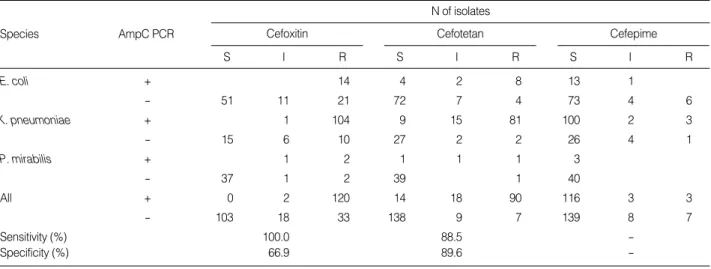
All the AmpC PCR-positive strains were non-suscepti-ble to cefoxitin, while 14 strains (9 K. pneumoniae, 4 E. coli, and 1 P. mirabilis) were susceptible to cefotetan (Table 1). Of the 276 strains tested, 122 were positive with the mul-tiplex PCR (E. coli, 14/97; K. pneumoniae, 105/136; and P. mirabilis, 3/43). DHA group genes were predominantly ob-served in E. coli(N=8) and K. pneumoniae(N=102) and were also observed in 1 of the 3 PABL-producing P. mirabilis. MOX group genes were detected in all the studied species, but the prevalence was relatively low in E. coli (N=2) and
K. pneumoniae(N=1). Of the 3 PABL-producing P. mirabilis, 2 were MOX-type enzyme producers. CIT group genes (CMY-like genes originated from Citrobacter freundii) were detect-ed in only 3 strains of E. coli[13]. Amplicons of EBC group
Abbreviations: S, susceptible; I, intermediate; R, resistant. Species AmpC PCR N of isolates Cefoxitin S I R Cefotetan S I R Cefepime S I R E. coli + 14 4 2 8 13 1 - 51 11 21 72 7 4 73 4 6 K. pneumoniae + 1 104 9 15 81 100 2 3 - 15 6 10 27 2 2 26 4 1 P. mirabilis + 1 2 1 1 1 3 - 37 1 2 39 1 40 All + 0 2 120 14 18 90 116 3 3 - 103 18 33 138 9 7 139 8 7 Sensitivity (%) 100.0 88.5 -Specificity (%) 66.9 89.6
genes (including MIR-1 and ACT-1, which were originated from Enterobacter cloacae) were observed in 1 E. coliand 2 K. pneumoniae strains [13] (Table 2).
A total of 93 PABL-producing strains were positive with the cephamycin-Hodge test, but 29 PABL-producing strains were not detected by this method. The overall sensitivity, specificity, and efficiency of the cephamycin-Hodge test were 76.2%, 96.1%, and 88.6%, respectively. By TE -disk test, 98 strains were determined as PABL-producers, while 24 strains were false-negatives. The overall sensitivity, specificity, and efficiency of the TE-disk test were 80.3%, 91.6%, and 87.9%, respectively. Combination-disk test with BA detect-ed 120 strains of the 122 producers, but 12
PABL-non-producers were also tested positive by this method. The overall sensitivity, specificity, and efficiency of the combi-nation-disk test with BA were 98.4%, 92.2%, and 96.3%, respectively (Table 3). The efficiency of the combination-disk test with BA was significantly better than that of the former 2 methods (Cochran Q=16.1, P<0.05).
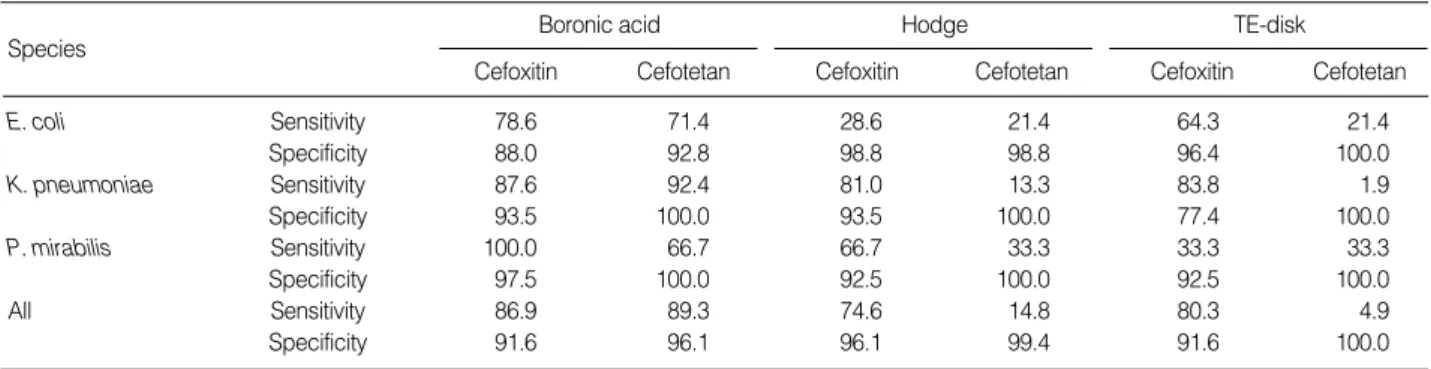
The performance of the phenotypic-detection methods was also analyzed on the basis of the tested antibiotic disks, i.e., cefoxitin or cefotetan. The sensitivity of cefoxitin-Hodge test was 74.6%, while that of cefotetan-Hodge was 14.8%. A similar result was obtained by TE-disk test when it was evaluated with a single disk of cefoxitin or cefotetan. The most sensitive results were obtained with the combination disk test with BA: the sensitivity was 86.9% with cefoxitin and 89.3% with cefotetan (Table 4).
DISCUSSION
There is no CLSI guidelines for phenotypic methods to screen and detect AmpC activity in clinical isolates of E. coli,
Species Types of ampC genes
CIT DHA EBC MOX Total
E. coli 3 8 1 2 14
K. pneumoniae 0 102 2 1 105
P. mirabilis 0 1 0 2 3
Table 2. Distribution of plasmid mediated ampC genes within study isolates Species AmpC PCR Cefoxitin Positive (%) Negative (%) Hodge Positive (%) Negative (%) TE-disk Positive (%) Negative (%) E. coli Positive 13 (92.9) 1 (7.1) 5 (35.7) 9 (64.3) 9 (64.3) 5 (35.7) Negative 10 (12.0) 73 (88.0) 1 (1.2) 82 (98.8) 3 (3.6) 80 (96.4) K. pneumoniae Positive 104 (99.0) 1 (1.0) 86 (81.9) 19 (18.1) 88 (83.8) 17 (16.2) Negative 2 (6.5) 29 (93.5) 2 (6.5) 29 (93.5) 7 (22.6) 2 (77.4) P. mirabilis Positive 3 (100) 0 (0.0) 2 (66.7) 1 (33.3) 1 (33.3) 2 (66.7) Negative 0 (0.0) 40 (100) 3 (7.5) 37 (92.5) 3 (7.5) 37 (92.5) All Positive 120 (98.4) 2 (1.6) 93 (76.2) 29 (23.8) 98 (80.3) 24 (19.7) Negative 12 (7.8) 142 (92.2) 6 (3.9) 148 (96.1) 13 (8.4) 141 (91.6) Efficiency 96.3% 88.6% 87.9%
Table 3. Comparison of 3 phenotypic detection methods for plasmid-mediated AmpC β-lactamase producing-isolates
Species Boronic acid Cefoxitin Cefotetan Hodge Cefoxitin Cefotetan TE-disk Cefoxitin Cefotetan E. coli Sensitivity 78.6 71.4 28.6 21.4 64.3 21.4 Specificity 88.0 92.8 98.8 98.8 96.4 100.0 K. pneumoniae Sensitivity 87.6 92.4 81.0 13.3 83.8 1.9 Specificity 93.5 100.0 93.5 100.0 77.4 100.0 P. mirabilis Sensitivity 100.0 66.7 66.7 33.3 33.3 33.3 Specificity 97.5 100.0 92.5 100.0 92.5 100.0 All Sensitivity 86.9 89.3 74.6 14.8 80.3 4.9 Specificity 91.6 96.1 96.1 99.4 91.6 100.0
K. pneumoniae, and P. mirabilis[6]; these strains could be non-susceptible to cephamycin mainly because of PABLs. Although several phenotypic screening methods have been used in clinical microbiology laboratories for the detection of PABLs in clinical isolates, only a few studies have thus far evaluated the performance of various phenotypic screen-ing methods [14, 15]. Therefore, we attempted to compare the performance of the commonly used phenotypic screen-ing methods.
Our data showed that all plasmid-mediated ampCgene producers were non-susceptible to cefoxitin, while some were susceptible to cefotetan. Therefore, cefoxitin was con-sidered as a better PABL-screening indicator than cefote-tan. This could be because of the fact that cefotetan is more active than cefoxitin [16].
In this study, 4 groups of ampCgenes, namely, CIT, DHA, EBC, or MOX, were analyzed, and ACC- and FOX-type AmpC producers were not included in the analysis. There-fore, the performance for ACC and FOX enzyme-produc-ing strains might be different from that of the strains ana-lyzed in this study.
We have reported that more sensitive results can be ob-tained if modified-Hodge tests are conducted on MCA plates (reported in the 18th ECCMID, 2008, P-892). Lee et al. re-ported in the 18th ECCMID, showed that bile improved the performance of modified-Hodge test when MCA was used (2008, P-891). Although we used carbapenemase-produc-ing strains in this study, it was apparent that better results could have been obtained by performing cephamycin-Hodge test using MCA. Therefore, we used MCA instead of MHA to detect AmpC β-lactamase-producing strains.
The usefulness of the antimicrobial-disk-susceptibility test using cephamycins as the phenotypic screening test for PABL-producers was investigated. Because all PABL producers were non-susceptible to cefoxitin, the suscepti-bility to cefoxitin can be used to rule out the possisuscepti-bility of PABL producers (Table 1). Several strains could be regard-ed as false-positives without even conducting the pheno-typic AmpC confirmatory test; therefore, there might be serious risks involved in the selection of antimicrobial agents for the treatment of infections caused by these strains. The
sensitivity of cefotetan susceptibility was higher (88.5%) than Hodge test or TE disk test, but not higher than that of the combination-disk test; however, the specificity was the low-est (89.6%) compared to that of all th 3 phenotypic-detec-tion methods (Table 1, 3). Although the possibility of obtain-ing false-positive results was reduced by usobtain-ing cefotetan, the sensitivity also decreased. The results of cefepime sus-ceptibility seemed to be unrelated to PABL-producers (Table 1). Resistance to cefoxitin as well as to oxyimino-β-lactams is not specific to AmpC enzyme because cefoxitin resistance can also be produced by certain other enzymes or by dec-reased permeability of the outer membrane [17-22]. Other confirmatory tests are required in this regard [23].
The results of the 3 methods varied depending on the anti-biotics and bacterial species used. Hodge test and TE-disk test performed using cefoxitin showed better results than those performed using cefotetan, but the combination-disk test with BA showed relatively better results using cefotetan instead of cefoxitin (Table 4). This could be because of the increase in the inhibitory effects of BA by the higher activity of cefotetan. Using cefoxitin, the sensitivity of the combi-nation-disk test with BA was 86.9%. Tan et al. [14] reported a 94% sensitivity of the combination-disk test with BA when the zone size of ≥4 mm was used as a positive criterion. We obtained a 92.6% sensitivity using the same cutoff criteri-on, but the specificity was reduced from 91.6% to 87.0%. On the other hand, when the test was performed with cefotetan alone using the same criterion, the sensitivity of the com-bination-disk test increased to 95.1% from 86.9% (data not shown). Collectively, the best results were obtained when each method was considered using both cefoxitin and cefote-tan. The sensitivity of the combination-disk test with BA was 98.4% when the results were evaluated using both cefox-itin and cefotetan and when the increase in zone size of ≥5 mm was used as a positive criterion (Table 3). In addition, Song et al. [15] reported that the combination of cefoxitin-BA and cefotetan-cefoxitin-BA disk tests detected 98.4% of PABL-producing strains. Two PABL-PABL-producing strains-1 E. coli
and the other K. pneumoniae-showed false-negative results when combination-disk test with BA was used, and all the
Of the 12 false-positive strains, 10 were E. coli(Table 3). Such phenotypic results for these E. colistrains might be because of the increased activities of chromosomal AmpCs, but it is necessary to determine the cause of obtaining false-positive results in the 2 K. pneumoniaestrains. The sensi-tivities of the Hodge test and TE-disk test were 76.2% and 80.3%, respectively. It was difficult and obscure to interpret the results of the Hodge test or TE-disk test, and the test procedures were relatively more complex than the proce-dure of the combination-disk test. Among the 3 methods tested, the combination-disk test was found to be the most sensitive and efficient test (Table 3). However, recently, a study showed that 3-aminophenylboronic acid inhibited the activity of KPC-type β-lactamase [24]. Doi et al. [24] re-ported that 3-aminophenylboronic acid could be used for detecting the expression of KPC-type β-lactamase in K. pneumoniae and E. coli. The only limitation of our study is that it lacked KPC-type β-lactamase-producing strains.
In conclusion, we evaluated the performance of 3 pheno-typic-detection methods for identifying PABL-producing
E. coli, K. pneumoniae, and P. mirabilisstrains. The sus-ceptibility to cefoxitin can be used as a better screening in-dicator than that to cefotetan. The performance of the 3 screening methods can be increased by using both cefox-itin and cefotetan. The combination-disk test with BA is a simple, sensitive, and interpretable test that can be appli-cable in clinical laboratories involved in the detection of PABL-producing E. coli, K. pneumoniae, and P. mirabilis
strains.
REFERENCES
1. Yang K and Guglielmo BJ. Diagnosis and treatment of extended-spectrum and AmpC β-lactamase-producing organisms. Ann Phar-macother 2007;41:1427-35.
2. Papanicolaou GA, Medeiros AA, Jacoby GA. Novel plasmid-medi-ated β-lactamase (MIR-1) conferring resistance to oxyimino- and alpha-methoxy β-lactams in clinical isolates of Klebsiella pneumoniae. Antimicrob Agents Chemother 1990;34:2200-9.
3. Ardanuy C, Linares J, Dominguez MA, Hernandez-Alles S, Benedi VJ, Martinez-Martinez L. Outer membrane profiles of clonally related
Klebsiella pneumoniae isolates from clinical samples and activities of cephalosporins and carbapenems. Antimicrob Agents Chemother 1998;42:1636-40.
4. Coudron PE. Inhibitor-based methods for detection of plasmid-medi-ated AmpC β-lactamases in Klebsiella spp., Escherichia coli, and Pro-teus mirabilis. J Clin Microbiol 2005;43:4163-7.
5. Black JA, Moland ES, Thomson KS. AmpC disk test for detection of plasmid-mediated AmpC β-lactamases in Enterobacteriaceae lacking chromosomal AmpC β-lactamases. J Clin Microbiol 2005;43:3110-3. 6. Clinical and Laboratory Standards Institute. Performance standards for antimicrobial susceptibility testing. Seventeenth informational supplement, M100-S17. Wayne, PA: Clinical and Laboratory Stan-dards Institute, 2007.
7. Coudron PE, Moland ES, Thomson KS. Occurrence and detection of AmpC β-lactamases among Escherichia coli, Klebsiella pneumoniae, and Proteus mirabilis isolates at a veterans medical center. J Clin Micro-biol 2000;38:1791-6.
8. Yong D, Park R, Yum JH, Lee K, Choi EC, Chong Y. Further modi-fication of the Hodge test to screen AmpC β-lactamase (CMY-1)-pro-ducing strains of Escherichia coli and Klebsiella pneumoniae. J Micro-biol Methods 2002;51:407-10.
9. Netzel TC, Jindani I, Hanson N, Turner BM, Smith L, Rand KH. The AmpC inhibitor, Syn2190, can be used to reveal extended-spectrum β-lactamases in Escherichia coli. Diagn Microbiol Infect Dis 2007;58: 345-8.
10. Beesley T, Gascoyne N, Knott-Hunziker V, Petursson S, Waley SG, Jaurin B, et al. The inhibition of class C β-lactamases by boronic acids. Biochem J 1983;209:229-33.
11. Yagi T, Wachino J, Kurokawa H, Suzuki S, Yamane K, Doi Y, et al. Practical methods using boronic acid compounds for identification of class C β-lactamase-producing Klebsiella pneumoniae and Esche-richia coli. J Clin Microbiol 2005;43:2551-8.
12. Clinical and Laboratory Standards Institute. Performance standards for antimicrobial susceptibility testing. Approved Standard, M02-A9. Wayne, PA: Clinical and Laboratory Standards Institute, 2006. 13. Perez-Perez FJ and Hanson ND. Detection of plasmid-mediated AmpC
β-lactamase genes in clinical isolates by using multiplex PCR. J Clin Microbiol 2002;40:2153-62.
14. Tan TY, Ng LS, He J, Koh TH, Hsu LY. Evaluation of screening meth-ods to detect plasmid-mediated AmpC in Escherichia coli, Klebsiella pneumoniae, and Proteus mirabilis. Antimicrob Agents Chemother
2009;53:146-9.
15. Song W, Jeong SH, Kim JS, Kim HS, Shin DH, Roh KH, et al. Use of boronic acid disk methods to detect the combined expression of plas-mid-mediated AmpC β-lactamases and extended-spectrum β -lac-tamases in clinical isolates of Klebsiella spp., Salmonella spp., and
Pro-teus mirabilis. Diagn Microbiol Infect Dis 2007;57:315-8.
16. Ayers LW, Jones RN, Barry AL, Thornsberry C, Fuchs PC, Gavan TL, et al. Cefotetan, a new cephamycin: comparison of in vitro antimi-crobial activity with other cephems, β-lactamase stability, and pre-liminary recommendations for disk diffusion testing. Antimicrob Agents Chemother 1982;22:859-77.
17. Wachino J, Doi Y, Yamane K, Shibata N, Yagi T, Kubota T, et al. Molec-ular characterization of a cephamycin-hydrolyzing and inhibitor-resistant class A β-lactamase, GES-4, possessing a single G170S sub-stitution in the omega-loop. Antimicrob Agents Chemother 2004; 48:2905-10.
18. Poirel L, Naas T, Nicolas D, Collet L, Bellais S, Cavallo JD, et al. Char-acterization of VIM-2, a carbapenem-hydrolyzing metallo-β -lacta-mase and its plasmid- and integron-borne gene from a Pseudomonas
aeruginosa clinical isolate in France. Antimicrob Agents Chemother
2000;44:891-7.
19. Martinez-Martinez L, Pascual A, Hernandez-Alles S, Alvarez-Diaz
D, Suarez AI, Tran J, et al. Roles of β-lactamases and porins in activ-ities of carbapenems and cephalosporins against Klebsiella
pneumo-niae. Antimicrob Agents Chemother 1999;43:1669-73.
20. Martinez-Martinez L, Hernandez-Alles S, Alberti S, Tomas JM, Bene-di VJ, Jacoby GA. In vivo selection of porin-deficient mutants of
Kleb-siella pneumoniae with increased resistance to cefoxitin and
expand-ed-spectrum-cephalosporins. Antimicrob Agents Chemother 1996; 40:342-8.
21. Hernandez-Alles S, Conejo M, Pascual A, Tomas JM, Benedi VJ, Mar-tinez-Martinez L. Relationship between outer membrane alterations and susceptibility to antimicrobial agents in isogenic strains of
Kleb-siella pneumoniae. J Antimicrob Chemother 2000;46:273-7.
22. Hernandez-Alles S, Benedi VJ, Martinez-Martinez L, Pascual A, Aguilar A, Tomas JM, et al. Development of resistance during antimi-crobial therapy caused by insertion sequence interruption of porin genes. Antimicrob Agents Chemother 1999;43:937-9.
23. Jacoby GA. AmpC β-lactamases. Clin Microbiol Rev 2009;22:161-82. 24. Doi Y, Potoski BA, Adams-Haduch JM, Sidjabat HE, Pasculle AW, Paterson DL. Simple disk-based method for detection of Klebsiella
pneumoniae carbapenemase-type β-lactamase by use of a boronic acid compound. J Clin Microbiol 2008;46:4083-6.