− 294 − ABSTRACT
The quasi-solid-state hybrid electrolytes were synthesized by chemical cross-linking reaction of methacrylate-functional-ized SiO2 (MA-SiO2) and tetra (ethylene glycol) diacrylate in aqueous electrolyte. A quasi-solid-state electrolyte synthe-sized by 6 wt.% MA-SiO2 exhibited a high ionic conductivity of 177 mS cm-1 at room temperature. The electrochemical H2 sensor assembled with quasi-solid-state electrolyte showed relatively fast response and high sensitivity for hydrogen gas at ambient temperature, and exhibited better durability and stability than the liquid electrolyte-based sensor. The simple con-struction of the sensor and its sensing characteristics make the quasi-solid-state hydrogen sensor promising for practical application.
Keywords : Quasi-Solid-State Electrolyte, Hybrid Electrolyte, Electrochemical Sensor, Hydrogen Sensor, Ionic Conductivity
Received : 18 February 2019, Accepted : 11 April 2019
1. Introduction
As the renewable energy sources, fuel cells have been received much attention in transportation and stationary power generation [1-3]. Fuel cell is an electrochemical powering device that converts the chemical energy directly into the electrical energy by using hydrogen gas as a fuel. Hydrogen gas is being also widely used in many chemical processes and other industrial applications including aerospace, energy, medical and biomass processing [4-6]. How-ever, the use of hydrogen may raise many safety con-cerns, and thus the detection of potentially hazardous hydrogen is receiving increased attention. In this respect, the development of the hydrogen sensors has been an important research topic in the field of pro-cess control and hydrogen detection for the sake of safety. In view of their application, the sensors should fulfill the requirements such as high sensitivity, low
cost, long-term stability, high reliability, simple con-struction and easy operation. Further, the ambient temperature operation is an important criterion to achieve safe and reliable performance [7,8]. For this purpose, the electrochemical gas sensors have been widely used because of their high sensitivity, simplic-ity, low power consumption, easy operation and low cost compared to other types of sensors [9-13]. The electrochemical gas sensors are gas detectors that measure the concentration of a target gas by oxidiz-ing or reducoxidiz-ing the target gas at a sensoxidiz-ing (workoxidiz-ing) electrode and measuring the resulting current. The electrochemical hydrogen sensor typically consists of proton-conducting liquid electrolyte and three elec-trodes (working, reference and counter elecelec-trodes) [14-18]. Unfortunately, the electrochemical sensors employing liquid electrolyte suffer from some draw-backs such as limited stability and durability, which are mainly attributed to the leakage and evaporation of the electrolyte. These problems could be overcome by replacing the liquid electrolyte by solid electro-lyte. Compared to liquid electrolyte, solid electrolyte can be used in the form of thin film or pellet without any separator, which permits the fabrication of
com-*E-mail address: [email protected] DOI: https://doi.org/10.33961/jecst.2019.03405
This is an open-access article distributed under the terms of the Creative Commons Attribution Non-Commercial License (http://creativecommons.org/licenses/by-nc/4.0) which permits unrestricted non-commercial use, distribution, and reproduction in any medium, provided the original work is properly cited.
pact device without electrolyte leakage and avoids deterioration of the sensing property. However, the main disadvantage of solid electrolytes is that they exhibit low ionic conductivities at room temperature, which precludes their practical applications in the electrochemical sensors operating at ambient condi-tions.
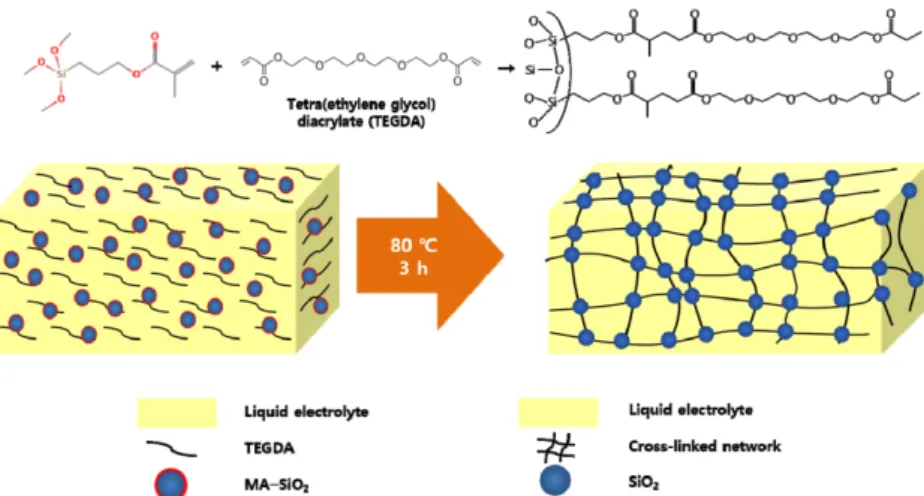
In this study, we prepared the highly conductive quasi-solid-state hybrid electrolytes by chemical cross-linking reaction of reactive SiO2 particles and tetra (ethylene glycol) diacrylate (TEGDA) in aque-ous electrolyte. As the reactive SiO2 particles, we synthesized mesoporous SiO2 particles containing methacrylate groups on their surface to induce the free-radical reaction with TEGDA [19]. The methac-rylate-functionalized SiO2 (MA-SiO2) particles dis-persed in aqueous electrolyte reacted with TEGDA, resulting in the formation of a three-dimensional net-work, as schematically demonstrated in Fig. 1. The electrochemical hydrogen sensor was fabricated by employing an optimized quasi-solid-state hybrid electrolyte and Pt-based working electrode. The H2 sensing performance was then evaluated and com-pared with that obtained in the electrochemical gas sensor assembled with sulfuric acid.
2. Experimental
2.1. Synthesis of mesoporous MA-SiO2 particles
Mesoporous MA-SiO2 particles were synthesized, as reported in our previous work [19].
Cetyltrimeth-ylammonium bromide (0.4 g) and L-lysine (0.045 g) were added to 140 ml of a mixture of water/octane (10:1 by volume), and the solution was stirred at 70oC in a three-necked flask reactor. Styrene (3.3 g),
tetraorthosilicate (4.0 g) and azobis(2-methylpropio-namide) dihydrochloride (0.14) were added into the reactor, and the mixture was stirred for 20 h at 70oC
under a nitrogen atmosphere. After the reaction, the resulting solution was centrifuged and washed with ethanol. Polystyrene template was removed by heat-ing at 550oC for 10 h to obtain mesoporous SiO
2
nanoparticles. Surface modification of mesoporous SiO2 particles was carried out by using 3-methacry-loxypropyltrimethoxy silane (MEMO, Evonik). Sil-ica particles (0.5 g) was dispersed in methanol via ultrasonication for 30 min, and 10.3 mmol L-1 of
MEMO was added into the solution. The mixture was stirred for 1 h in order to induce surface func-tionalization with methacrylate groups. The resulting solution was centrifuged and washed with methanol several times. Mesoporous MA-SiO2 particles were finally obtained as white powder after vacuum drying at 70oC for 12 h.
2.2. Synthesis of quasi-solid-state hybrid electrolyte TEGDA and benzoyl peroxide (BPO) was pur-chased from Sigma-Aldrich, and used as a cross-link-ing agent and a thermal radical initiator, respectively. Proper amount of TEGDA (10.0 wt.%) and BPO (0.2 wt.%) were dissolved in sulfuric acid (3.0 M H2SO4). Different amounts of MA-SiO2 particles
Fig. 1. Schematic illustration for synthesis of quasi-solid-state hybrid electrolyte using MA-SiO2 particles and TEGDA at
2.3. Sensor fabrication
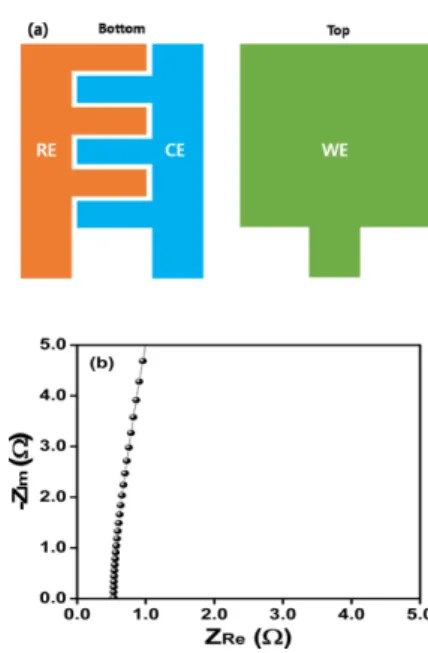
The electrochemical sensor consists of the three p l a na r e l e c t r ode s , whi c h w e r e pa t t e r ne d on poly(tetrafluoroethylene) (PTFE) surface, as pre-sented in Fig. 2(a). Both carbon reference electrode (RE) and Pt counter electrode (CE) were faced each other on the bottom side, and the Pt working elec-trode (WE) supported on porous carbon was pat-terned on the top side. The precursor solution containing MA-SiO2 particles, TEGDA and BPO in H2SO4 electrolyte was cast by doctor blade on the bottom electrode. The sensor was then fabricated by sealing the bottom electrode and the top electrode together. The assembled sensor was placed at 80 °for 3 h to induce in-situ chemical cross-linking reaction and thus convert the precursor electrolyte solution to cross-linked quasi-solid-state electrolyte. After ther-mal curing, the quasi-solid-state electrochemical H2 sensor was finally obtained. The thickness of quasi-solid-state hybrid electrolyte was measured to be about 2 mm.
2.4 Characterization and measurements
The morphologies of the mesoporous MA-SiO2
particles were examined using FE-SEM (JEOL JSM-6330F) and TEM (JEOL JEM-2010). BET surface area of the mesoporous MA-SiO2 particles was
measured by a nitrogen adsorption-desorption method using a 3 Flex Surface Characterization Analyzer (Micromeritics). FT-IR spectra were obtained using a Magna IR 760 spectrometer in the range of 500-2,000 cm-1 with KBr powder-pressed pellets. The pH values of 3.0 M H2SO4 aqueous
elec-trolyte and quasi-solid-state elecelec-trolyte were mea-s u r e d b y u mea-s i n g p H m e t e r ( 2 A A 3 1 2 , X y l e m Analytics). AC impedance measurements of the blocking cells with stainless-steel (SS) electrodes were performed using an impedance analyzer (IM6, Zahner Electrik) to measure the ionic conductivity [20-22]. AC im pedance spectrum of the SS/ electrolyte/SS cell in Fig. 2(b) consists of a spike
displaced from the origin, which represents a resistor in series with a capacitor. The intercept on the real axis (X-axis) gave the resistance of the quasi-solid-state electrolyte, and the ionic conductivity could be calcu-lated from its thickness and surface area. Cyclic vol-tammetry (CV) of the electrochemical sensor with three-electrode configuration was performed in the potential range of -0.8 to 0.8 V vs. carbon reference electrode at a scan rate of 1 mV s-1 using a CHI660D
electrochemical workstation. During CV experiments, constant flow of H2 gas (100 ppm H2 in nitrogen) was supplied to the working electrode. The electrochemical response of the sensor was evaluated using the same hydrogen gas (100 ppm H2 in nitrogen). The sensor was connected to Bio-Logic SP-300 potentiostat. The gas source was fed toward the working electrode using a mass flow controller. Current response of the electrochemical sensor was reported in chronoamper-ometric mode [23]. All the measurements were car-ried out at room temperature and common relative humidity of 40-50%. In order to investigate the elec-trochemical behaviour of the elecelec-trochemical sen-sors with different electrolytes, the electrochemical impedance spectroscopy (EIS) were performed using Zahner Electrik IM6 impedance analyzer in the
fre-Fig. 2. (a) Electrode pattern consisted of three planar electrodes (working, reference and counter electrodes) in the electrochemical sensor. (b) AC impedance spectrum of the SS/electrolyte/SS cell for measuring the ionic conductivity at 25oC.
quency range of 10 mHz to 1 MHz at an amplitude of 10 mV before and after testing sensor performance.
3. Results and Discussion
FE-SEM image of the mesoporous MA-SiO2 parti-cles is presented in Fig. 3(a). The MA-SiO2 particles have spherical shape with an average diameter of around 30 nm. From the TEM image shown in Fig. 3(b), it is found that that the mesoporous MA-SiO2 particles have inner-pore channels that can provide pathways for H+ ions to move through the
meso-porous SiO2 particles. The BET surface area and pore volume of the MA-SiO2 particles were measured to be 292.3 m2 g-1 and1.14 cm3 g-1, respectively.
The MA-SiO2 particles have reactive C=C double bonds on their surface, and thus they can serve as inorganic cross-linking sites through free radical reac-tion with TEGDA in the aqueous electrolyte. In order to confirm the chemical cross-linking reaction between
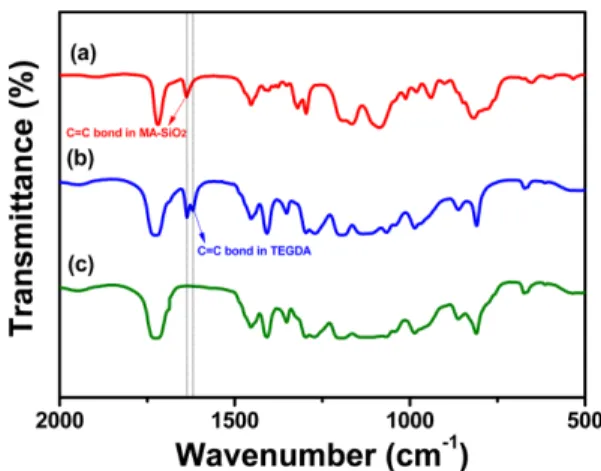
mesoporous MA-SiO2 particles and TEGDA, FT-IR spectra were analyzed before and after thermal cross-linking reaction. The FT-IR spectrum of MA-SiO2 particles in Fig. 4(a) showed symmetrical stretching vibration of siloxane (Si-O-Si) at 766 cm-1 and
asym-metrical stretching vibrations at 1190 and 1082 cm-1.
The spectrum also exhibited a small peak at 1636 cm-1,
which is a characteristic peak of C=C double bond in the methacrylate group on the surface of MA-SiO2 particles [24,25], indicating the MA-SiO2 particles have reactive groups to permit free-radical reaction. Fig. 4(b) presents the FT-IR spectrum of the mixture of MA-SiO2 particles and TEGDA before thermal cross-linking reaction. In addition to peak of C=C double bond in the MA-SiO2 particles, the peak corre-sponding to C=C double bonds in TEGDA could be also observed at 1618 cm-1. The FT-IR spectrum of the
quasi-solid-state hybrid electrolyte obtained after ther-mal cross-linking reaction revealed that the peaks cor-responding to C=C double bonds in the MA-SiO2 particles (1636 cm-1) and TEGDA (1618 cm-1)
disap-peared after thermal cross-linking, as shown in Fig. 4(c). From these results, it was confirmed that meth-acrylate groups on the surface of MA-SiO2 particles reacted with TEGDA through free radical reaction to form the three-dimensional cross-linked network, as demonstrated in Fig. 1.
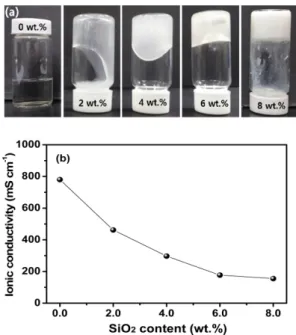
Fig. 5(a) presents photographs of the cross-linked hybrid electrolytes cured by different amounts of MA-SiO2 particles. After cross-linking reaction using MA-SiO2 particles and TEGDA, the electrolyte
Fig. 3. (a) FE-SEM and (b) TEM images of the MA-SiO2
particles.
Fig. 4. FT-IR spectra of (a) MA-SiO2 particles, (b) mixture of MA-SiO2 particles and TEGDA and (c) cross-linked quasi-solid-state hybrid electrolyte.
became highly viscous gel and finally non-fluidic due to the formation of three-dimensional cross-linked networks. It should be noted that the complete solidi-fication without fluidity was not occurred when the MA-SiO2 content was less than 6 wt.%, which is attributed to low degree of cross-linking at low MA-SiO2 content. This result suggests that the content of the MA-SiO2 particles should be higher than 6 wt.% in order to prepare the dimensionally stable quasi-solid-state electrolyte. Fig. 5(b) shows the ionic con-ductivities of the quasi-solid-state hybrid electrolytes as a function of MA-SiO2 content at room tempera-ture. For comparison, the ionic conductivity of the liquid electrolyte is also shown in the figure. As shown, the ionic conductivity of the quasi-solid-state electrolyte was decreased with increasing MA-SiO2 content. The cross-linking reaction causes an increase in the resistance for ion migration due to the formation of three-dimensional networks, which results in a decrease of the ionic conductivity. For the electrolyte systems under study, the optimum MA-SiO2 content was determined to be 6 wt.% when con-sidering both ionic conductivity and dimensional sta-bility. Accordingly, the quasi-solid-state hybrid
electrolyte synthesized by 6 wt.% MA-SiO2 was used to in assembling the electrochemical hydrogen sen-sor. The ionic conductivity of the optimized electro-lyte was 177 mS cm-1 at room temperature, which is
a sufficiently high ionic conductivity for sensor applications.
The electrochemical sensor was assembled using a carbon as a reference electrode. To confirm the capa-bility of carbon as a quasi-reference electrode, we performed cyclic voltammetry of the electrochemi-cal sensor with carbon reference electrode in 3.0 M H2SO4 aqueous electrolyte and observed the potential shift as a function of cycle. Fig. 6 presents CVs of the electrochemical sensor as a function of cycle, which were obtained in the presence of H2 gas. The anodic peak corresponding to the hydrogen oxidation is observed around -0.74 V and the cathodic peak for oxygen reduction appeared at 0.51 V. During the sub-sequent 5 cycles, the CVs show very stable currents without any signs of drifting or shifting of the peak potential. This result indicates that the carbon quasi-reference electrode exhibits a notable stability and reliability with low potential drift in the aqueous electrolyte. Lee et al. also demonstrated that the porous carbon electrode could be used as reliable quasi-reference electrode in the acid aqueous electro-lyte [26].
The electrochemical performance of the H2 sensor was examined using amperometric measurements by sequentially exposing the sensor to 100 ppm hydro-gen in nitrohydro-gen and then going to stop of gas flow.
Fig. 5. (a) Photographs of liquid electrolyte and quasi-solid-state hybrid electrolytes cured with different amounts of MA-SiO2 particles and (b) ionic conductivities of quasi-solid-state hybrid electrolytes as a function of content of MA-SiO2 particles.
Fig. 6. Cyclic voltammograms of the electrochemical sensor with carbon reference electrode in 3.0 M H2SO4 aqueous electrolyte at a scan rate of 1 mV s-1.
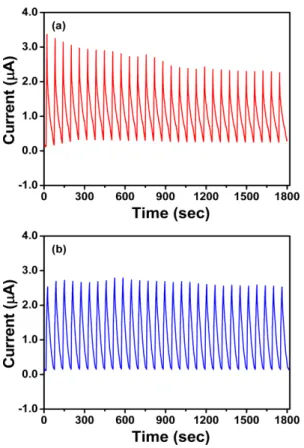
Fig. 7 shows the responses of the sensors assembled with liquid electrolyte and quasi-solid-state hybrid electrolyte to the repeated exposure of hydrogen gas. A fast response up to maximum current was observed within 12.0 sec. Upon stop of gas exposure, the cur-rent starts to decrease. It is well known that the elec-trochemical redox processes take place at the electrodes, i.e., oxidation at the working electrode and reduction at the counter electrode [27,28].
H2(g) → 2H+ + 2e−
1/2 O2 + 2H+ + 2e−→ H 2O
These redox reactions result in a flow of electrons as an external electrical current of the sensor, as depicted in Fig. 8. Both electrochemical reactions can only occur where the H+ ions, electron (or electrode)
and gas phases are all in contact. It is thought that the solubility and diffusion coefficient of H2 in the liquid electrolyte are larger than those in the quasi-solid-state electrolyte. The pH of 3.0 M H2SO4 solution (-0.68) is lower than that of quasi-solid-state electrolyte (-0.54), indicating higher concentration of H+ ions in the liquid
electrolyte. Moreover, the ionic conductivity is much higher in the liquid electrolyte (0.78 S cm-1) than
quasi-solid-state hybrid electrolyte (0.18 S cm-1).
Accordingly, the sensor response was more rapid and the initial sensing current was higher in the liquid electrolyte-based sensor than sensor employing quasi-solid-state hybrid electrolyte. This result demonstrates that a type of electrolyte system plays an important role in determining the gas sensing per-formance of the electrochemical sensor [29,30].It should be noted that the current response of the sen-sor with quasi-solid-state electrolyte was more stable during the repeated cycles, indicating the stable and reproducible redox processes at the electrodes. This result suggests that the hydrogen sensor employing a quasi-solid-state hybrid electrolyte can operate for much longer periods of time than the sensor assem-bled with liquid electrolyte.
In order to understand the electrochemical behav-ior of the electrochemical sensors with different elec-trolytes, their EIS analysis was performed. The resulting AC impedance spectra before and after amperometric measurements are shown in Fig. 9. The obtained spectra were analyzed using the equivalent circuit given in the inset of Fig. 9(a). In this circuit, RE is the electrolyte resistance, which is corresponding to the real axis intercept. RCT is the charge transfer resis-tance and CPEdl denotes the constant phase element of the double layer capacitance to reflect the depressed
Fig. 7. Electrochemical response of the electrochemical H2
sensor upon exposure to 100 ppm H2. Sensor was assembled with (a) sulfuric acid electrolyte and (b) quasi-solid-state hybrid electrolyte cured by 6.0 wt.% MA-SiO2 particles.
Fig. 8. Operating principle of the electrochemical H2
semicircular shape, and Zw is Warburg impedance. In the sensor with liquid electrolyte, the values of RE and RCT increased after test. The increase of RE is mainly attributed to the gradual loss of liquid electrolyte during test, resulting from the evaporation of solvent under open H2 atmosphere condition. At the same time, the electrolyte depletion retarded the charge transfer reaction at the electrolyte-electrode interface, resulting in increase of RCT.In contrast, the sensor with quasi-solid-state electrolyte exhibited the almost same values in RE and RCT before and after test. This result can be ascribed to the effective encapsulation of liquid electrolyte in the three-dimensional cross-linked networks as well as the good interfacial con-tact between quasi-solid-state electrolyte and
elec-(TEGDA). A quasi-solid-state electrolyte synthe-sized with 6 wt.% MA-SiO2 and 10 wt.% TEGDA formed the three-dimensional cross-linked networks without fluidity and exhibited a high ionic conductiv-ity of 177 mS cm-1 at room temperature. The
electro-chemical H2 sensor was assembled with quasi-solid-state hybrid electrolyte, and its sensing performance was investigated. The quasi-solid-state electrochemi-cal sensor showed relatively fast response and high sensitivity for hydrogen gas, and its sensing response was more stable than the sensor with liquid electro-lyte. The simple, low cost, compact and robust con-struction of the electrochemical sensor and its high performance allowed the sensor to be used in various applications where hydrogen gas is utilized, espe-cially fuel cell vehicles and stationary power genera-tion systems.
Acknowledgement
This work was supported by the Technology Inno-vation Program funded by the Ministry of Trade, Industry and Energy (MOTIE, Korea) (10069215).
References
[1] M. Inci and O. Turksoy, J. Cleaner Production, 2019, 213, 1353-1370.
[2] T. Sadhasivam, K. Dhanabalan, S.-H. Roh, T.-H. Kim, K.-W. Park, S. Jung, M. D. Kurkuri, H.-Y. Jung, Int J Hydrogen Energy, 2017, 42(7), 4415-4433.
[3] H.-Y. Park, T.-Y. Jeon, K.-S. Lee, S. J. Yoo, Y.-E. Sung and J. H. Jang, J. Electrochem. Sci. Technol., 2016, 7(4), 269-276.
[4] B. H. Weiller, J. D. Barrie, K. A. Aitchison and P. D. Chaffee, Mater. Res. Soc. Symp. Proc. 1994, 360, 535-540.
[5] R. Thimmappa, S. Shafi, S. Freunberger and M.O. Thotiyl, Int. J. Hydrogen Energy, 2016, 41(47), 22305-22315.
[6] H. Han, S. Baik, B. Xu, J. Seo, S. Lee, S. Shin, J. Lee, J. H. Koo, Y. Mei, C. Pang and T. Lee, Adv. Funct. Mater., 2017, 27, 1701618.
Fig. 9. AC impedance spectra of the electrochemical sensors assembled with (a) liquid electrolyte and (b) quasi-solid-state hybrid electrolyte, which were obtained before and after sensor test. The equivalent circuit corresponding the spectra is given in the inset in (a).
[7] M. Shi and F. C. Anson, J. Electroanal. Chem., 1996, 415(1-2), 41-46.
[8] B. Limoges, C. Degrand and P. Brossier, J. Electroanal. Chem., 1996, 402(1-2), 175-187.
[9] F. H. Garzon, R. Mukundan and E. L. Brosha, Solid State Ionics, 2000, 136-137, 633-638.
[10] S. Akbar and W. Weppner, J Mater. Sci., 2003, 38(23), 4639-4660.
[11] J. Zosel, G. Schiffel, F. Gerlach, K. Ahlborn, U. Sasum, V. Vashock and U. Guth, Solid State Ionics, 2006, 177(26-32), 2301-2304.
[12] G. Korotcenkov, S. D. Han and J. R. Stetter, Chem. Rev., 2009, 109(3), 1402-1433.
[13] T. Hubert, L. Boon-Brett, G. Black and U. Banach, Sens. Actuators B: Chem., 2011, 157(2), 329-352.
[14] Y. Dobrovolsky, L. Leonova and A. Vakulenko, Solid State Ionics, 1996, 86-88, 1017-1021.
[15] G. Korotcenkov, S. D. Han and J. R. Stetter, Chem. Rev., 2009, 109(3), 1402-1433.
[16] C. O. Park, J. W. Fergus, N. Miura, J. Park and A. Choi, Ionics, 2009, 15(3), 261-284.
[17] P. Pasierb and M. Rekas, J. Solid State Electrochem., 2009, 13(1), 3-25.
[18] J. F. M. Oudenhoven, W. Knoben and R. van Schaijk, Procedia Engineering, 2015, 120, 983-986.
[19] W.-K. Shin, J. Cho, A. G. Kannan, Y.-S. Lee and D.-W.
Kim, Sci. Rep., 2016, 6, 26332.
[20] D.-W. Kim, J.-M. Ko and J.-H. Chun, J. Power Sources, 2001, 93(1-2), 151-155.
[21] R. Miao, B. Liu, Z. Zhu, Y. Liu, J. Li, X. Wang and Q. Li, J. Power Sources, 2008, 184(2), 420-426.
[22] M. Li, X. Wang, Y. Wang, B. Chen, Y. Wu and R. Holze, RSC Adv., 2015, 5(65), 52382-52387.
[23] E. Jayanthi, N. Murugesan, A. S. Suneesh, C. Ramesh and S. anthonysamy, J. Electrochem. Sci., 2017, 164(8), H5210-H5217.
[24] Y.-S. Lee, J. H. Lee, J.-A. Choi, W. Y. Yoon and D.-W. Kim, Adv. Funct. Mater., 2013, 23(8), 1019-1027. [25] W-.K. Shin, Y.-S. Lee and D.-W. Kim, J. Mater. Chem.
A, 2014, 2(19), 6863-6869.
[26] J. Lee, N. Jackel, D. Kim, M. Widmaier, S. Sathyamoorthi, P. Srimuk, C. Kim, S. Fleischmann, M. Zeiger and V. Presser, Electrochim. Acta, 2016, 222, 1800-1805.
[27] M. Sakthivel and W. Weppner, Sens. Actuators B, 2006, 113(2), 998-1004.
[28] L. Leonova, L. Shmygleva, A. Ukshe, A. Levchenko, A. Chub and Y. Dobrovolsky, Sens. Actuators B: Chem., 2016, 230, 470-476.
[29] K. S. Kim and G. S. Chung, Sens. Actuators B: Chem., 2011, 157(2), 482-487.
[30] A. Sanger, A. Kumar, A. Kumar and R. Chandra, Sens. Actuators B: Chem., 2016, 234, 8-14.