2284
Copyrightⓒ The Korean Institute of Electrical Engineers
Design of Surface-Mounted Permanent Magnet Synchronous Motor
Considering Axial Leakage Flux by using 2-Dimensional
Finite Element Analysis
Byeong-Hwa Lee*, Hyung-Il Park** and Jae-Woo Jung
†Abstract– This paper deals with optimum design of surface mounted permanent magnet synchronous motor (SPMSM) for automotive component. For a compact system structure, it was designed as a motor with a 14-pole 12-slot concentrated winding and hollow shaft. The motor is a thin type structure which stator outer diameter is relatively large compared to its axial length and is designed to have a high magnetic saturation for increasing the torque density. Since the high magnetic saturation in the stator core increases the axial leakage flux, a 3-dimensional (3-D) finite element analysis (FEA) is indispensable for torque analysis. However, optimum designs using 3-D FEA is inefficient in terms of time and cost. Therefore, equivalent 2-D FEA which is able to consider axial leakage flux is applied to the optimization to overcome the disadvantages of 3-D FEA. The structure for cost reduction is proposed and optimum design using equivalent 2-D FEA has been performed.
Keywords: Finite element analysis, Torque, Leakage flux, Equivalent magnetic circuit, Surface mounted permanent magnet synchronous motor.
1. Introduction
As the automotive system becomes more electronic, the demand for small motors is continuously increasing. In particular, importance of motors that drive the system has been emphasized due to the trend of electric components such as electric power steering, electric brakes, regenerative dampers [1-4]. The drive motors and integrated starter/ generators applied to the X-EV are mainly designed as interior permanent magnet synchronous motors (IPMSM), and middle and large size of motors are mainstream [5,6]. On the other hand, the motors for chassis components are designed as surface-mounted permanent magnet synchro-nous motors (SPMSM) as small motors of less than about 1 kW. The response time and package of the system are most important when designing such a chassis part drive motor. Therefore, maximizing the torque density is the top priority for the motor design.
In order to increase the torque density in the prototype design, a concentrated winding is applied to 14-poles and 12-slots with fractional slot model which has high winding coefficient. In a structure having a fractional slot model, even if the magnetic saturation of the stator core is designed to be relatively high, it is not sensitive to the cogging and torque ripple [7-9]. Therefore, the magnetic flux density of the stator core can be designed to be 1.8 T
or more for increasing the torque density.
Due to the leakage magnetic flux in the axial direction, a motor having such a high magnetic saturation cannot accurately predict torque by using only 2-dimensional (2-D) finite element analysis (FEA) [10]. The 3-dimensional (3-D) FEA should be used for accurate analysis but it is inefficient in terms of time, effort and cost. In order to compensate for the disadvantages of 3-D FEM, this paper proposes an equivalent 2-D FEA that has advantage in terms of speed and can consider axial leakage flux. By using proposed analysis method, shape design was performed based on the new structure derived to reduce the material cost of the prototype, and the design result of the final model was analyzed.
2. Prototype and Designed Model
This chapter discusses the structural features of the prototype and the new structure for the design.
2.1 Structure and characteristics of prototype
A prototype with a 14-pole, 12-slot concentrated winding and a hollow shaft is shown in Fig. 1(a), permanent magnets (PMs) are attached to the shaft. In order to prevent the PMs from scattering on the shaft due to the centrifugal force when the motor is driven, it is molded with plastic resin as shown in Fig. 1(b), and its thickness is 0.3mm on one side. If plastic molding is not applied, an airgap is created between the outer diameter of the permanent magnet and the inner diameter of the stator core. Generally, the † Corresponding Author: Advanced Brake Engineering Team, R&D
Center, Hyundai Mobis, Korea. ([email protected])
* Electric Powertrain R&D Center, Korea Automotive Technology Institute, Korea. ([email protected])
** Advanced Brake Engineering Team, R&D Center, Hyundai Mobis, Korea. ([email protected])
value is 0.4 to 5mm considering the mechanical tolerance of the part. In this case, the mechanical airgap and the magnetic airgap are identical. However, if the PMs are wrapped with a plastic molding of about 0.3mm and the mechanical airgap is designed to be 0.4-0.5mm, the magnetic airgap will be 0.7-0.8mm. With this structure, there is a phenomenon that the magnetic air-gap is increased, and the torque density is reduced.
2.2 Structure of design model
The following three design concepts were applied to the design model for the new structure of prototype.
- Magnetic air-gap reduction - Block shaped PM
- Grain boundary diffusion PM
The magnetic air-gap was changed from 0.8 mm to 0.65 mm including the plastic molding part. In order to prevent the PMs from scattering, a SUS sleeve having a thickness of 1.5 mm on one side was used instead of the plastic molding. On the other hand, in the case of a PM shape, an arc shape is applied in a general SPMSM, which is inefficient in terms of cost because of an increase in machining cost. Therefore, it was considered to change to block shape in order to reduce machining cost. Finally, a grain boundary diffusion magnet was used to reduce the material cost by reducing the amount of rare earth material used in the PM [11,12]. The new structure that three concepts are reflected is shown in Fig. 2.
3. Effects of Leakage flux and 2-D FEA Considering Axial Leakage Flux
This section deals with the definition of the axial leakage flux due to the high magnetic flux density of the stator core and the equivalent 2-D FEA that takes into account the axial leakage flux using by 2-D FEA.
3.1 Effects of axial leakage flux
Generally, 2-D FEA is used in motor analysis to perform no-load and on-load analysis. However, in the case of the prototype, the error is small in no-load back EMF calculated by 2-D FEM and 3-D FEA, but the torque value differs at maximum load. This is a phenomenon caused by a prototype with a thin structure and a magnetic flux density of 1.8T or more in the stator core, and 3-D FEA is required for accurate analysis. Fig. 3 shows torque analysis results of the prototype calculated using 2-D FEA and 3-D FEA. It can be seen that the average value of the torque calculated by 2-D FEA is 6.0% higher than that calculated by 3-D FEA. In addition, as shown in Fig. 4, the maximum
(a) (b)
Fig. 1. Rotor structure of prototype: (a) Before plastic
molding application; (b) After plastic molding application
Fig. 3. Torque wave form and value of prototype according
to analysis method
Fig. 4. On-load voltage waveform and value of prototype
according to analysis method Core
Winding PM Shaft
value of the induced voltage and the shape of the waveform have different results according to the analysis method. Therefore, when the design is performed through 2-D FEA, the performance may be overestimated, and the actual speed may not be satisfied due to the estimation error of the maximum value of the induced voltage as well as the unsatisfactory torque.
In order to analyze the cause of the torque difference according to the analysis method in the prototype, the magnetic flux density distribution at the no-load and on-load condition were examined by using 3-D FEA. Fig. 5 shows the result of analysis at no-load and on-load condition. That of figure shows magnetic flux density distribution at the contour surface in the core tooth tip region of the stator. When no-load is applied, the magnetic flux density due to the leakage magnetic flux in the axial direction is 0.1 T, while the on-load is 0.25 T, which is increased to a level that cannot be ignored when the characteristics are predicted. In the other hand, Unlike IPMSM, axial flux leakage in the radial direction is not considered because the amount of magnetic flux leaking in the axial direction in the rotor itself is not large in SPMSM. For this reason, in the case of a model with high magnetic saturation, the no-load back EMF calculated by 2-D FEA is consistent with the result of 3-D FEA, but the analysis results difference occurs at the torque with maximum
current condition. In order to overcome the limitations of the existing analysis method, an analysis method that complements the 2-D FEA is presented and the design result is derived with high reliability.
3.2 2-D FEA with considering axial leakage flux
In order to consider the axial leakage flux in the 2-D FEM, a method of compensating the magnetic permeability in the slots of the stator is applied. The permeability correction factor was calculated by using the equivalent magnetic circuit analysis method assuming the path of the axial leakage magnetic flux and then reflected in the slot in the 2-D FEA modeling.
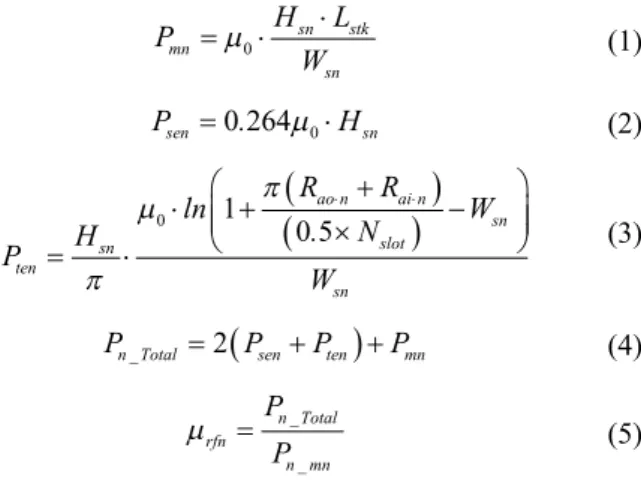
To estimate the permeability correction factor, we define the permeance Pmn of the main leakage flux path and the permeances Psen and Pten of the axial leakage path as shown in Fig. 6. At this time, an equivalent magnetic circuit analysis method was used to calculate the permeance of leakage flux path [13]. The permeance of main leakage flux path that can be considered in the 2-D FEM is calculated as (1). The axial leakage flux entering the air at the tip end of the tooth starting from the air at the tip end is obtained from (2). On the other hand, the permeance of the magnetic circuit leaking through the axial air from the center of the tooth to the center of the opposing tooth is obtained by (3).
The sum of all the permeances considering both ends of the stator can be expressed as (4). Finally, the ratio of the total permeance to the permeance of the main leakage path can be expressed as (5), which can be defined as μrf as the permeability correction factor. In the equation Wsn is width of the airspace, Hsn is length of the airspace on radial direction, and d is distance between stator teeth.
The calculated permeability correction factor is interpreted and reflected in the slot during 2-D FEA. Since the calculated permeability correction factor has a value higher than the specific permeability of air, it can be expected that the leakage through the main leakage path is higher than that calculated by the conventional analysis (a) (b)
0.1T 0.25T
(c) (d)
Fig. 5. 3-D Distribution of magnetic flux density of
prototype calculated by 3-D FEA. (a) No-load condition; (b) On-load condition (c) No-load condition with contour surface (d) On-load condition with contour surface
mn P ten P sn H sn W
d
sen PFig. 6. Permeance of main leakage flux path and axial
method. Because of this effect, the torque value is estimated to be lower than that of the conventional 2-D FEA. 0 sn stk mn sn H L P W m × = × (1) 0 0 264 sen sn P = . m ×H (2)
(
)
(
)
0 1 0 5 ao n ai n sn slot sn ten sn R R ln W . N H P W p m p × × æ + ö × çç + - ÷÷ ´ è ø = × (3)(
)
2n _ Total sen ten mn
P = P +P +P (4) n _ Total rfn n _ mn P P m = (5)
4. Magnetic Circuit Design Considering New Structure
In this chapter, the design of the magnetic circuit of the new structure is discussed by using the equivalent 2-D FEA analysis with the magnetic permeability correction coefficient.
4.1 Shape of initial model and modeling of proposed 2-D FEA
The permeability correction factor was applied to the equivalent 2-D FEA as shown in Fig. 7. The permeability correction factor was calculated by dividing the total area into six-areas and then reflected in the analysis.
Table 1. Design variable and range
Design variable Unit Design range
Width of PM mm 6.7 - 7.9
Thickness of PM mm 2.15, 2.25
Slot opening mm 1.0 - 3.6
Since the magnetic permeability correction factor varies depending on the shape of the stator core and the PM, parametric modeling according to the shape change is required. In this paper, Jmag, a commercial software, is used to automatically model the magnetic permeability correction factor according to the shape change.
4.2 Objective function and design variable range
New structure was designed in such a way as to keep the prototype's torque value and the terminal voltage for ensuring the rated speed at the same level while reducing the PM usage. The cogging torque also has a major influence on the characteristics of the system, so the goal is to design the cogging torque to be similar to the prototype. In the design parameters, the thickness of the PM was reduced by 0.1 mm and 0.2 mm from the conventional 2.35mm, respectively. On the other hand, the PM width and slot opening were examined at a constant interval in the design range as shown in Fig. 8 and Table 1.
4.3 Analysis result and final model selection
Using the equivalent 2-D FEA, the characteristics of the given design variables were estimated, and the designable area was determined. Fig. 9 (d) shows that the designable area is very narrow as a result of the PM thickness of 2.15mm. On the other hand, Fig. 10 shows the characteristics of PM width and slot opening change when the permanent magnet thickness is 2.25mm. As shown in Fig. 10 (d), it can be seen that the designable region is distributed over a relatively larger area than the case where the PM thickness is 2.15mm. Because the tolerance of PM or the stator core may be unsatisfactory at the time of fabrication, the design point is determined at the PM thickness of 2.25mm, which is comparatively large in the designable region, and the values of the design parameters summarized in Table 2.
4.4 Verification of the final model
To verify the reliability of the equivalent 2-D FEA which can take into account the axial leakage flux proposed in this paper, we compared the 3-D FEA results with those of the final design model. On the other hand, in order to confirm the difference in the result when interpreting the final design model with the existing 2-D FEA, conventional 2-D FEA results were also compared simultaneously with equivalent 2-D FEA and 3-D FEA μrf2=1.22
μrf3=1.38 μrf4=1.52
μrf5=1.60
μrf6=1.67
μrf1=1.44
Fig. 7. The shape of the initial design model and the
permeability correction factor
Thickness of PM
Width of PM
Slot opening
0.97
0.97
1
Average torque (P.U.)
Magnet Width (mm) 6.8 7 7.2 7.4 7.6 7.8 Sl ot o pe ni ng ( m m ) 1 1.5 2 2.5 3 3.5 0.8 0.85 0.9 0.95 1 (a) (b) (c) 설계 가능 영역Designable area Magnet width (mm) (d)
Fig. 9. Examination of characteristics of permanent magnet
thickness 2.25mm. (a) Maximum torque; (b) Terminal voltage; (c) Cogging torque; (d) Designable area
(a) (b) (c) 설계 가능 영역 설계 포인트 Designable area Design point Magnet width (mm) (d)
Fig. 10. Examination of characteristics of permanent magnet
thickness 2.15mm. (a) Maximum torque; (b) Terminal voltage; (c) Cogging torque; (d) Designable area
Table 2. Design variable of final designed model
Design variable Unit Design range
Width of PM mm 7.5
Thickness of PM mm 2.25
Slot opening mm 3.6
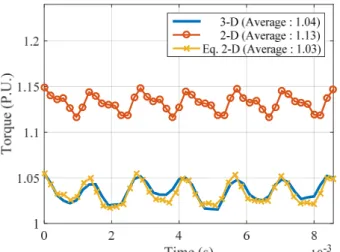
results. The results of torque analysis according to the three analysis methods are shown in Fig. 11. The results of 3-D FEA and equivalent 2-D FEA analysis have similar values with 0.01%p and satisfy the prototype torque characteristics.
However, in the conventional 2-D FEA results, it can be seen that the torque value is 10% larger than the 3-D FEA result. On the other hand, the terminal voltage also varies depending on the analysis method. As shown in Fig. 12, the results of 3-D FEA and equivalent 2-D FEA show that the maximum value of terminal voltage, phase, and waveform are similar. On the other hand, in the conventional 2-D FEA results, the maximum value of the terminal voltage is
Fig. 11. Comparison of torque analysis results by analysis
method
Fig. 12. Comparison of terminal voltage analysis results by
analysis method
estimated to be 0.54 V smaller than the 3-D FEA result, and the phase is also different. These results show that the torque and rated speed of the motor manufactured based on conventional 2-D FEM design cannot satisfy the target value.
5. Comparative Analysis of Design Results The weight and price of the prototype and final model are compared in Table 3 and Table 4, respectively. Price and weight based on that of prototype is compared as per unit (P.U.). In the final model, the total weight increased by18% due to the addition of the rotor core, which was not included in the prototype, but the total price was reduced by 11%p despite the addition of the rotor core price. In Prototype, the cost of permanent magnet, which accounts for 54.3% of total price, was reduced, resulting in a reduction of total material cost. On the other hand, when the design is carried out using the conventional 2-D FEA, the calculated torque value is 13% higher than the proto-type torque. Therefore, the material cost reduction effect is calculated as 16.5%p, which may overestimate the design cost reduction effect.
We could not compare the measured value and the analytical value of the model that was finally designed because of the problem of manufacturing condition. However, the value of the torque obtained through 3-D FEA is well within 5% of the experimental results [14]. When we consider that the torque value calculated by Eq. 2-D FEA is similar to the 3-D FEA result, the design method dealt with in this paper can be considered to be reliable.
6. Conclusion
In this paper, the design of SPMSM considering axial leakage flux is discussed. In a motor with a high magnetic
Table 3. Weight by each part
Part list Prototype [P.U.] Final Model [P.U.]
Stator core 0.481 0.478
Rotor core - 0.192
PM 0.083 0.075
Winding 0.436 0.436
Total 1.0 1.18
Table 4. Material cost by each part
Part list Prototype [P.U.] Final Model [P.U.]
Stator core 0.147 0.146
Rotor core - 0.058
PM 0.543 0.377
Winding 0.258 0.258
saturation and a thin magnetic circuit structure, the axial leakage magnetic flux cannot be ignored during the characteristic analysis. In order to consider such leakage flux, it is necessary to carry out analysis through 3-D FEA to obtain reliable results. However, the use of 3-D FEA in the design process of calculating the analysis model of many conditions is limited in terms of time and cost. In order to solve these problems, we propose an equivalent 2-D FEA, which is a 2-2-D FEA combined with an equivalent magnetic circuit analysis method and analyze various models within a short time by using it for design.
In the final model, the weight of the rotor core was increased by 18 % due to the added rotor core to reduce material costs. However, the rate of weight increase can be minimized by removing portions that will not affect the flux path in the rotor core in the future. Also, considering the weight reduction ratio of the part where the plastic molding is changed to the SUS sleeve, it is considered that it is possible to design with similar level in terms of weight. In this paper, the analysis and design are carried out for a small motor of about 800W. However, the analysis and design method discussed in this paper can be used as a useful reference for the design of a motor with a large diameter and a short axial length, regardless of the power of the motor.
Acknowledgements
This research was supported by the Advanced Brake Engineering Team, Hyundai Mobis.
References
[1] Hoon Y., Changhoe K., Wankyo J., Dokun K., and Jaeseung C., “Development of Smart Booster Brake System for Regenerative Brake Cooperative Con-trol,” SAE Paper, no. 2011-01-2356, 2011.
[2] Giseo P., Seibum C., and Dongyoon H., “Develop-ment of Clamping Force Estimation Algorithm and Clamp-force Sensor Calibration on Electromechanical Brake Systems,” Transaction of KASE, vol. 24, no. 3, pp. 365-371, April 2016.
[3] Choong-Sung L., Kyung-Tae J., Jung-Pyo H., Hae-Joong K., and Young-Kyung K., “Design of Brushless Permanent Machine with Skewed Stator for Electrical Power Steering System,” Journal of Korean Magnetics
Society, vol. 25, no. 6, pp. 189-197, Dec. 2015.
[4] Ji-Hyun C., Doo-Beom S., and Jin-Ho K., “Design of Resonance Linear Electric Generator System for Vibration Energy Harvesting in Vehicle Suspension,”
Journal of the Korea Academia-Industrial Cooper-ation Society, vol. 15, no. 6, pp. 1357-3362, 2014.
[5] Jae-Woo J., Byeong-Hwa L., Do-Jin K.m, Jung-Pyo
H., Jae-Young K., Seong-Min J., Do-Hoon S., “Mechanical Stress Reduction of Rotor Core of Interior Permanent Magnet Synchronous Motor,”
IEEE Transactions on Magnetics, vol. 48, no. 2, pp.
911-914, Feb. 2014.
[6] S. Lim, S. Min, and J. Hong, “Shape design optimization of interior permanent magnet motor for vibration mitigation using level set method,”
International Journal of Automotive Technology, vol.
17, no. 5, pp. 917-922, June 2016.
[7] Luigi A., Massimo B., and Nicola B., “Design of a Low-Torque-Ripple Fractional-Slot Interior Permanent-Magnet Motor,” IEEE Transactions on Industry
Applications, vol. 50, no. 3, pp. 1801-1808,
May-June 2014.
[8] Z. Z. Zolkapli, M. L. Mohd Jamil, S. M. Al-Habshi, A. Jidin, and M. N. Othman, “Torque Ripple Mini-mization Technique in Fractional-Slot PM Brushless Machines,” in Proceedings of IEEE Conference on
Energy Conversion, Johor Bahru, Malaysia, Oct.
2014.
[9] Gu-Won C., Woo-Sung J. Ki-Bong J. and Gyu-Tak K., “The Optimal Design of Fractional-slot SPM to Reduce Cogging Torque and Vibration, J. Electr. Eng.
Technol., vol. 7, no. 5, pp. 753-758, Sep. 2012.
[10] Johannes H. J. Potgieter, and Maarten J. Kamper, “Calculation Methods and Effects of End-Winding Inductance and Permanent-Magnet End Flux on Performance Prediction of Nonoverlap Winding Permanent-Magnet Machines,” IEEE Transactions on
Industry Applications, vol. 50, no. 4, pp. 2458- 2466,
July-Aug. 2014.
[11] Liang C., David H., Jiabin W., Andrew C., Martin S., and William O., “Reduced Dysprosium Permanent Magnets and Their Applications in Electric Vehicle Traction Motors,” IEEE Transactions on Magnetics, vol. 51, no. 11, No. 8109004, Nov. 2015.
[12] Chaowei L., Shuai G., Wenbiao F., Renjie C., and Aru Y., “Dysprosium Diffusion Behavior and Micro-structure Modification in Sintered Nd-Fe-B Magnets via Dual-Alloy Method,” IEEE Transactions on
Magnetics, vol. 49, no. 7, pp. 3233- 3236, Jul. 2013.
[13] Yu Chen, Z. Q. Zhu, and David Howe., “Three Dimensional Lumped Parameter Magnetic Circuit Analysis of Single-Phase Flux-Switching Permanent-Magnet Motor,” IEEE Transactions on Industry
Applications, vol. 44, no. 6, pp. 1701-1710, Nov.-Dec.
2008.
[14] Jae-Han Sim, Dong-Gyun Ahn, Doo-Young Kim, and Jung-Pyo Hong, “Three-Dimensional Equivalent Magnetic Circuit Network Method for Precise and Fast Analysis of PM-Assisted Claw-Pole Synchronous Motor,” IEEE Transactions on Industry Applications, vol. 54, no. 1, pp. 160-171, Jan.-Feb. 2018.
Byeong-Hwa Lee She received the B.S.
degrees in electrical engineering from Changwon National University, Chang-won, Republic of Korea, in 2006, and the M.S. and Ph.D. degree in automotive engineering from Hanyang University, Seoul, Republic of Korea, in 2009 and 2013, respectively. Since 2013, she has been a Senior Engineer with the Electric Power Train Center, Korea Automotive Research Institute, Daegu, Republic of Korea. Her research interests include the design and analysis of traction motor for electric vehicle.
Hyung-Il Park He received the B.S.
degree in electrial, electronic, and communication engineering education and the M.S. and Ph.D. degrees in electrical engineering from Chungnam National University, Daejeon, Republic of Korea, in 2010, 2012 and 2016, respectively. He joined the R&D center, Hyundai Mobis Co. Ltd., Yongin, Republic of Korea in September 2016 and is currently a principal research engineer. His research interests include in the design and characteristic analysis of motors/generators.
Jae-Woo Jung He received the B.S.
and M.S. degrees in electrical engine-ering from Changwon National Uni-versity, Changwon, Republic of Korea, in 2005 and 2007, respectively, and the Ph.D. degree in automotive engineering from Hanyang University, Seoul, Republic of Korea, in 2013. From 2009 to 2012, he has been developed PMSM for automotive application. Since 2013, he was a Research Staff Member with the R&D center, Hyundai Mobis Co. Ltd., Yongin, Republic of Korea. His research interests include the design and analysis of various electromagnetic devices for electromechanical brake system.