Journal of Contemporary Eastern Asia Vol. 19, No. 2: 234-263
DOI: 10.17477/jcea.2020.19.2.234
The EU’s Public Diplomacy in Asia and the World through Social Media: Sentiment and Semantic Network Analyses of Official Facebook Pages of European External Action Service and EU Delegation to the Republic of Korea
Sung-Won Yoon1 and Sae Won Chung 2
This study aims to assess the quality of the EU's public diplomacy efforts through social media. Specifically, this research explores the headquarters of European public diplomacy (European External Action Service, EEAS) and its subordinate agent (EU Delegation to South Korea, EUDK). The main research question is “how coherently and effectively does the EU execute public diplomacy strategies in the third countries?'' This study employs both quantitative and qualitative approaches—the former for the results presentation and the latter for the results interpretation. The results are summarized in two points. First, both the EEAS and the EUDK maintained an objective position by posting only neutral perspectives on their social media. Second, the narratives of the main actors were the same, but the main themes were different according to their contexts. The analysis discusses the effectiveness of the EU’s strategic narratives by focusing on measuring message reception. Its limited findings were that social media postings could not induce the audiences’ active discussion of the EU’s diplomatic performances. The conclusion suggests that the EU should identify the expectations from its global counterparts and use these to forge the Union’s strategic narratives.
Keywords: Public Diplomacy, Strategic Narratives, Semantic Network Analysis, Sentiment Analysis, Narrative Analysis, European External Action Service, EU Delegation to South Korea
1 (First) [email protected], Division of Business Administration, The University of Suwon.
2 (Corresponding) [email protected], Division of International and Area Studies, Pukyong National University
(Funding Source) This work was supported by the Ministry of Education of the Republic of Korea and the National Research Foundation of Korea (NRF-2019S1A5A2A03037349).
©2020 This is an Open Access paper distributed under the terms of the Creative Commons Attribution-‐No Derivative Works License (https://creativecommons.org/licenses/by-‐nc-‐nd/3.0/) which permits unrestricted use, distribution, and reproduction in any medium, provided the original work is properly cited. However, the work may not be altered or transformed.
1. Introduction
The EU’s image as a ‘trading giant’ and ‘economic powerhouse’ has often been overshadowed by conflicting depictions such as a ‘political dwarf and military pigmy’ (Walker, 2000). For the past decade, the EU has made concerted effort to overcome such image incongruity. This attempt to carve a consistent and positive international image was triggered by the signing of the Lisbon Treaty in 2007. This treaty, implemented in 2009, has brought about some major institutional changes to enhance the EU’s salience and visibility in international relations. These measures are threefold. First the EU established two significant posts—Permanent President of the European Council and High Representative of the Union for Foreign Affairs and Security Policy (HR). These posts may sound incongruous per se due to the complexity of the EU as a political entity, and some media even simply refer to the positions as ‘President of the EU’ and ‘Foreign Minister of the EU’ respectively to help the general public’s understanding. In creating these offices, the EU clarified the voices responsible for the EU’s position on external issues. Second, the EU created the European External Action Service (EEAS), a highly specialized structure dealing with its international relations with the outside world. Now all the EU Delegations located in overseas countries are under the supervision of EEAS, and the Delegation ambassadors report to the HR who controls the EEAS. Third, based on the aforementioned ‘hardware’ aspects, the EU strengthened its public diplomacy, which is the ‘software’ aspect. In 2016, EEAS released its European Union Global Strategy (EUGS) as a report named Shared Vision, Common Action: A
Stronger Europe (European External Action Service, 2016). The main objective of this paper
addresses the EU’s willingness to build a stronger union and to play a more evident collective role around the globe (European External Action Service, 2016). It consists of three parts: (i) Our
Shared Interests and Principles, (ii) The Priorities of our External Action, and (iii) From Vision to Action (European External Action Service, 2016). In its third part, the EU presented its
commitment to establish stronger connections with Asian partners which are centred with ASEAN members and their plus three (China, Japan and South Korea). It will develop “a more politically rounded approach” which encompasses security building, reconciliation processes, non-proliferation, human rights promotion and democratic transitions (European External Action Service, 2016, p.38).
By suggesting the Union’s diplomatic strategies, it stressed the importance of propagation of the EU’s foreign policy by social media as a priority task. EEAS has actively employed diverse ranges of social media—such as Facebook, YouTube, Instagram, Twitter and Flicker—to put into practice the EU’s diplomatic strategies. The guidelines are disseminated to all EU Delegations in the world. Among the social media options, this paper specifically focuses on Facebook due to its popularity. Facebook remains the world’s most widely used social media platform (Statcounter, n.d.). Based on Statcounter social media stats worldwide available data up to 30 June 2020, Facebook has 74% of the global social media market share (Statcounter, n.d.). This paper pays
specific attention to South Korea as a representative case because of South Korea’s obscure presence in Northeastern Asia and its strategic importance for the European Union. According to Bridges (2008), comparing China and Japan, South Korea has been “a comparatively unknown and apparently obscure part of Asia,” but it has remained as “one of the world’s hot-spots of geopolitical and strategic interests” due to South Korea’s economic success and its convoluted relations with North Korea (p. 213). In this regard, since 2010, South Korea and the European Union have made extraordinary progress in establishing sound diplomatic relations (Chung & Lee 2019). The representative example was evolving their bilateral relations into a strategic partnership. Since then, both parties established several important platforms (such as Framework Agreement enacted in 2014, Free Trade Agreement signed in 2011 and Crisis Management Participation Agreement enacted in 2016) to develop of bilateral relations (Chung & Lee 2019). By examining the South Korean case, this research could illuminate the reasons for the lack of success of the Union’s public diplomacy efforts and area coverage.
This paper aims to assess the EU’s social media diplomatic strategies by investigating Facebook. It focuses on addressing the research question “how does the EU execute public diplomacy strategies coherently and effectively in third countries?” Based on the above research question, this paper was able to draw three hypotheses:
Hypothesis 1 (H1). Both EEAS and EUDK Facebook pages coherently project their messages
to their target audiences.
Hypothesis 2 (H2). Both EEAS and EUDK Facebook pages would have a different promotion
focus due to dealing with their different target audiences.
Hypothesis 3 (H3). Both EEAS and EUDK Facebook postings would have drawn more ‘likes’
or ‘comments’ if the target audiences had properly received the messages from these organizations.
By specifically investigating the coherence of public diplomacy efforts between EEAS and EU Delegation to the Republic of Korea (EUDK), the effectiveness of EUDK’s promotion strategies upon the Korean general public will be explored. For this purpose, this paper adopts an
automated-semantic network analysis using text-mining software (NodeXL). This paper makes
three significant contributions to this field of study. First, it develops a new analytical platform for the existing studies on public diplomacy—from qualitative analysis (such as discourse/narrative
analyses) to computer-assisted quantitative text analysis (semantic network analysis and sentiment analysis). Second, it employs a creative and credible methodology by using a mixed approach
between quantitative (for the results) and qualitative (for the data interpretations) analysis. Finally, it enables more systematic and scientific analysis of the EU’s diplomatic strategies thanks to Big Data analytics.
The focus of this paper is to analyse the EU’s online strategic narratives to assess the quality of the Union’s diplomatic performance. The literature review examines a set of empirical studies on public diplomacy through social media. It then outlines the theoretical framework for this analysis by covering the basic features of strategic narratives. In the data and methodology section, this paper suggests data profile and methodologies (sentiment analysis and semantic network
analysis). The research analysis outcomes in the formats of tables and figures are then discussed,
including a re-examining of the effectiveness of EU’s public diplomacy efforts through social media based on the basic features of the strategic narratives. Finally, the conclusion suggests further implications for future studies.
2. Literature Review: Public Diplomacy through Social Media
As Cull (2009) stated, public diplomacy emerged in the 1960s amid extreme confrontation between Democracy and Communism. It is also said that public diplomacy eventually played a pivotal role in dismantling Communist States while reinforcing the US’ global power in international politics (Critchlow, 2004). As globalisation accelerated and digital media has rapidly proliferated, the nature of public diplomacy has changed accordingly. Newly coined terms such as ‘digital diplomacy’, ‘public diplomacy’, ‘e-diplomacy’ reflect this change. This type of public diplomacy is characterised by two features. First, the number of participating players has expanded. Typically, public diplomacy was undertaken by diplomats who physically negotiated, represented and communicated with foreign publics. However, as information-sharing for promoting culture and political values despite geographic and political constraints became possible, the players in the realm of public diplomacy have expanded to non-state actors. (London School of Economics and Political Science, 2016). Seib (2012) argued that
“…[t]oday, it would be an act of unthinkable stupidity to disregard ‘the common people’…in the conduct of foreign affairs…Empowered by their unprecedented access to information, many people have a better sense of how they fit into the global community, and they are less inclined to entrust diplomacy solely to diplomats. They want to be part of the process” (Seib, 2012, p.105).
Second, the communication mechanism has changed from one-way information dissemination to multi-directional interactions. No government can build up credibility and trust from the public without engaging and exchanging ideas with them in an open platform (Collins & Bekenova, 2019). Therefore, state actors practice their public diplomacy by using media technologies in ways to “tailor foreign-policy and nation-branding messages to the unique characteristics of local audiences with regard to history, culture, values and tradition” (Manor & Segev, 2015).
In this regard, the EU accelerated the practice of digital diplomacy. In the aforementioned EEAS’ report in 2016, the Union emphasized its strategic communications by saying that:
“[t]he EU will enhance its strategic communications, investing in and joining up public diplomacy across different fields, in order to connect EU foreign policy with citizens and better communicate it to our partners. We will improve the consistency and speed of messaging on our principles and actions. We will also offer rapid, factual rebuttals of disinformation. We will continue fostering an open and inquiring media environment within and beyond the EU, also working with local players and through social media” (Manor & Segev, 2015, p. 23).
As Lynch pointed out, the EU still lacks effective communication with international society (EPC Working Paper, 2005). The EU is undoubtedly a major global actor, but at least in the eyes of the common public, its role and influence in international relations seem to be still limited (Cross & Melissen, 2013). Cross & la Porte (2017) argued that the EU needs to work on public diplomacy in order to recover its negative image during the financial crisis, refugee crisis and terrorism the EU suffered for the past decade. They stressed that e-diplomacy based on the internet should be the goal the EU should target (Cross & La Porte, 2017).
Currently, EEAS, as well as other EU institutions, are operating their social media channels (EEAS, n.d.). Out of a variety of social media, this paper focuses on Facebook. Facebook is, according to David Tunney, Head of Social Media for the EEAS, “vital for interaction with people and for highlighting some of the work of the High Representative and the EEAS more generally” (Digital Diplomacy, para. 4). A significant amount of research has been conducted across the world to measure the impact of the use of social media on public diplomacy. Some exemplary studies include Li & Wang (2010), Metzgar (2012), Zaharna & Rugh (2012), Renken (2014), Dodd & Collins (2017), Yachi et al. (2017), and Uysal & Schroeder (2019). However, there are not many studies on the EU. Instead, the research focuses on individual European countries—Dumčiuvienė (2016) analyzed Lithuanian Embassy’s Twitter account, and Sevin & Ingenhoff (2018) compared Austrian, Belgian, New Zealand and Switzerland. More recently, Collins & Bekenova (2019) compared European embassies’ Facebook homepages in Kazakhstan.
In this context, this paper seeks to analyse Facebook homepages of EEAS and EUDK. Both of them maintain their respective Facebook homepages. This paper makes two significant contributions to this area of research. First, it fills the gap in the case studies on assessing the impact of social media on the EU. Second, by comparing the EEAS’ and EUDK’s respective Facebook homepages, it sheds light on similarities and differences in the digital strategies at the supranational governance level and national level.
3. Theoretical Framework: Strategic Narratives
In public diplomacy, communication plays a vital role. Edmund Gullion preferred explaining public diplomacy as propaganda (The CPD Blog, n.d). Edward R. Murrow, an American broadcast journalist and war correspondent, described his and President John F. Kennedy’s works as an identical job as a government propagandist (Snow, 2013). After 9/11, nation-states are likely to emphasize the significance of their communication in terms of exchanging stories. Former US Secretary of Condoleezza Rice gave her speech on public diplomacy on March 14, 2005, as follows:
“We spoke openly and candidly and truthfully, and we have been faithful to the tradition that open debate is the only antidote to closed minds. As a result, we achieved much success in the last century. But the challenges of today are much different than the challenges of yesterday and when it comes to our public diplomacy we simply must do better. […] And to be successful we must listen. An important part of telling America’s story is learning the stories of others” (US Department of State Archive, 2005, paras. 1-2).
Secretary Rice subsequently emphasised that telling America’s story to the world, nurturing America’s dialogue with the world and advancing universal values for the world are the main critical tasks of public diplomacy (US Department of State Archive, 2005). Like the US, every nation-state has its mission of public diplomacy, sharing their stories strategically with the world. Freedman inquired how the narrative could be deployed strategically to counter opponents in military conflict (Freeman, 2006). Extending Freedman’s study, Miskimmon et al. (2013) raised discussions around how we understand persuasion and influence in international affairs more broadly. Their argument was that narrative has wider relevance to understanding a more extensive range of global affairs other than military issues (Miskimmon, O’Loughlin, & Roselle, 2017).
Strategic narratives can be defined as one of the measures for the global political actors to construct “a shared meaning of the past, present, and future of international politics to shape the behavior of domestic and international actors” (Miskimmon, O’Loughlin, & Roselle, 2013, p.3). These narratives can extend their influence, manage expectations and change the discursive environment they operate (Miskimmon, O’Loughlin, & Roselle, 2013). Against this backdrop, for the EU, the strategic narratives can be useful to prove or convince the Union’s values and models to non-Europeans. The EU can also identify and describe its presence, roles and impacts in the international system. Through such narratives, the EU can manage other actors’ expectations and then construct the international system.
Strategic narratives consist of the three-fold communicative process: Formation,Projection,
are formed by asking “what is the role of political actors in constructing strategic narratives?” and “through what institutions and procedures are narratives agreed upon ?” (Miskimmon, O’Loughlin, & Roselle, 2013, p. 8) Projection deals with “how narratives are projected (or narrated) and contested, particularly in a new media environment” (Miskimmon, O’Loughlin & Roselle, 2013, p.8). Finally, reception addresses how narratives are received, how these narratives are reached or saturated and how individuals understand and process information from the narratives (Miskimmon, O’Loughlin, & Roselle, 2013). Analysis of these empirical studies was directed to approaching narratives with manual and qualitative analysis. This research attempts to measure the strategic narratives innovatively by conducting computer-assisted text mining techniques—
sentiment analysis and semantic network analysis. As mentioned above, it will provide
interpretations based on qualitative analysis. The mixed approach between qualitative and quantitative analyses may be a novel approach to analysing strategic narratives.
4. Data and Methodology
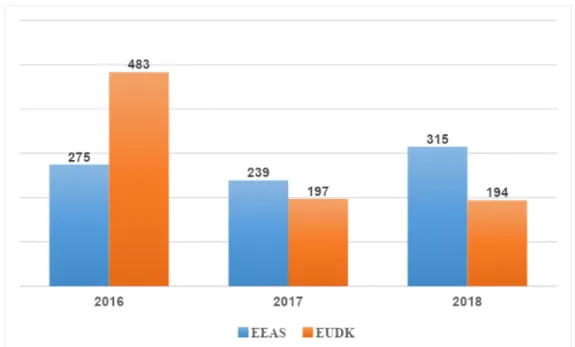
The research materials of this paper are the official Facebook pages of EEAS and EUDK. The EEAS page was established in January 2011, and the EUDK page was established in May 2012. For the data collection and visualisation, NodeXL was employed. The data collection period was from January 2016 to December 2018. The research period of focus is 2016 as this was the most eventful year for both the EU and South Korea. In 2016, the EU’s global influence was challenged due to the Brexit Referendum in June. For the EU’s relations with South Korea, the fully-fledged strategic partnership was unfolding as the agreement covering the political and security pillars had been fully activated in that year (Pacheco Pardo, Desmaele, & Ernst, 2018). The number of postings is presented in Figure 1.
Figure 1. Number of Postings in EEAS and EUDK Facebook Pages
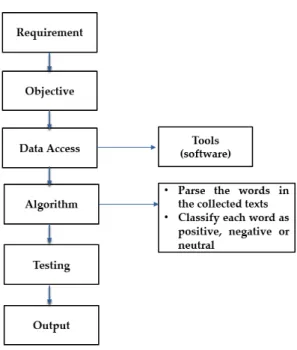
This paper will employ two quantitative research methods based on text-mining techniques. First, sentiment analysis is one of text mining techniques which speculates and categorises positive or negative emotions in the given texts. Sentiment analysis consists of several steps and techniques, and their overview is given in Figure 2. The requirement is importing an appropriate package within the data collection software. For example, in the case of accessing Twitter data with Python, the researchers installed Tweepy and TextBlob (Kunal et al., 2018). The research objective requires developing “an algorithm that would take the query of the person’s name for whom the user wants to calculate the percentage of positive tweets and the percentage of negative tweets” (Kunal et al., 2018, p.310). Data access is a collection process by using appropriate software. The algorithm refers to “parsing the words in the collected texts” and “classifying each word as positive, negative or neutral” (Kunal et al., 2018, p. 309). Afterwards, the researchers tested the collected data set and presented the data in a table format (Kunal et al., 2018). The core of sentiment analysis is detecting word classification into three categories.
Figure 2. A Flow Chart of Sentiment Analysis (Kunal et al., 2018, p. 309).
To conduct the sentiment analysis, this paper employed NodeXL by using ‘sentiment analysis’ functions to detect either positive, negative and neutral words within the collected texts. NodeXL was selected because it contains diverse functions like data importer (collecting the postings from a range of social media), data analysis (centrality measures, words and word-pairs) and data visualisation (network visualisation in a network mapping) (NodeXL Korea, 2015). This software is usually known as a tool for network analysis, but it also contains the sentiment analysis function. These functions are the reason that NodeXL was selected as the analytic software for this research. This analytical tool allowed us to detect the sentiments in the postings of EEAS and EUDK Facebook pages, and discern the specific nuances of their strategic narratives in the multi-level settings.
Second, semantic network analysis is “a form of content analysis that identifies the network of associations between concepts expressed in a text” (Jiang, 2018, p.2). Automated semantic network analysis consists of three critical processes: (i) Utilising/Sampling; (ii) Coding; and (iii) Reducing. The process is summarised in Figure 3.
Figure 3. An Overview of Semantic Network Analysis (van Atteveldt, Kleinnijenhuis, &
Schlobach, 2008, p. 17)
Semantic network analysis can explore the networks of key salient words in media discourse (Kim & Kim, 2015). It also can extract essential representations from a massive amount of unstructured data (Kim & Kim, 2015). According to Entman’s definition of framing [34], the essential representations can be interpreted as framings. In this regard, semantic network analysts conducted computer-assisted methodology to explore the framings within the text. Van Atteveldt extracted associative framings from terrorism-related news texts (van Atteveldt, Kleinnijenhuis, & Schlobach, 2008). Schultz et al. (2012) analysed the strategic framings of the BP Crisis. Motta and Baden focused on dealing with the framing evolution process by chronologically presenting network mappings. David et al. (2014) verified the reliability of the computer-assisted semantic network by applying it to news framing analysis.
For the data interpretation, in the qualitative analysis, the framework of strategic narratives formulated by Miskimmon, O’Loughlin & Roselle (2017) will be adopted. They suggested that there are three different types of strategic narratives: international system narratives, an identity
narrative and policy narratives (Miskimmon, O’Loughlin, & Roselle, 2017). International system narratives are the descriptions of how the world is structured and operated and who are the main
international actors in terms of determining their stories, values and goals (Miskimmon, O’Loughlin, & Roselle, 2017). Policy narratives support why certain political actors’ policy is necessary and desirable and how it will be successfully developed (Miskimmon, O’Loughlin, & Roselle, 2017).
5. Results
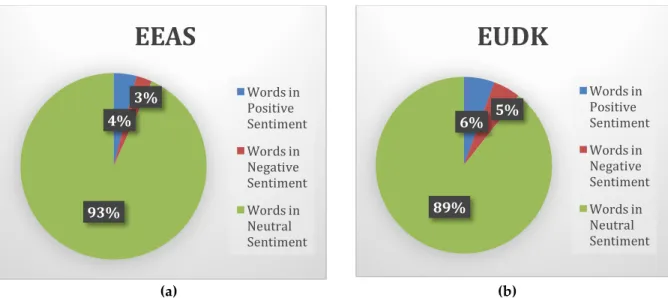
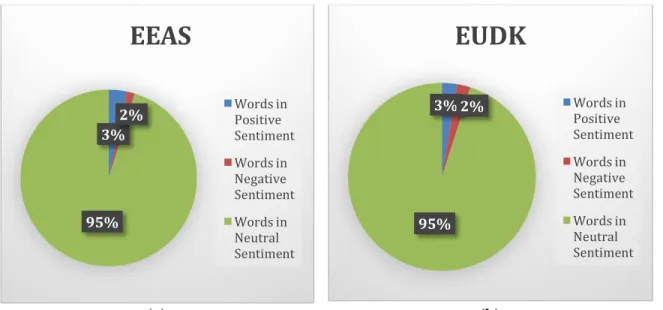
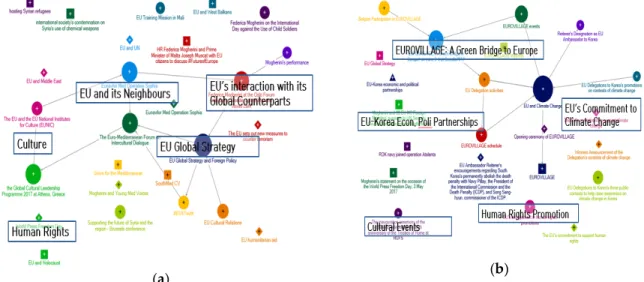
The results are presented according to two methodologies: sentiment analysis and semantic network analysis. For the sentiment analysis, the results are presented in the format of two pie charts and two separate tables. The pie charts show words in the three different sentimental categories: (i) Words in positive sentiment; (ii) Words in negative sentiment and (iii) Words in neutral sentiment. The tables illustrate which words were the most frequently mentioned in the postings of EEAS and EUDK Facebook pages. Through this process, this paper will present how these two organisations promoted their public diplomacy in terms of determining prevalent sentiment and promotion focus. For the semantic network analysis, the results will be presented in a format of network mappings. Through these mappings, this study will present the associative framings of these two organisations and suggest the framing evolution process over the research period.
The results of EEAS and EUDK Facebook page postings in 2016 are shown in Figure 4, Tables 1 and 2 (sentiment analysis) and Figure 5 (semantic network analysis).
(a) (b)
Figure 4. EEAS (a) and EUDK (b) Sentiment Analysis of Facebook Postings in 2016
4% 3% 93%
EEAS
Words in Positive Sentiment Words in Negative Sentiment Words in Neutral Sentiment 6% 5% 89%EUDK
Words in Positive Sentiment Words in Negative Sentiment Words in Neutral SentimentTable 1
Top 20 Words Frequently Mentioned in EEAS Facebook Postings, 2016
EEAS General count Positive count Negative count
1 EU 70 support 18 threat 9
2 Federica 63 work 15 terrorism 8
3 Mogherini 62 protection 12 violation 7
4 European 59 important 10 discrimination 7
5 high 42 free 10 crisis 6
6 representative 38 unity 9 conflict 6
7 today 38 commitment 9 difficult 6
8 international 31 supporting 9 evil 6
9 union 30 peace 9 attacks 6
10 humanitarian 21 protect 7 betraying 6
11 Europe 21 celebrate 6 attack 6
12 female 20 award 6 pain 5
13 genital 20 right 6 harm 5
14 mutilation 20 dignity 5 risks 5
15 more 19 won 5 suffering 5
16 political 19 respect 4 subjected 5
17 support 18 happy 4 appalling 5
18 nuclear 18 confidence 4 elimination 5
19 still 17 freedom 4 torture 5
20 foreign 17 defeat 4 lost 4
Table 2
Top 20 Words Frequently Mentioned in EUDK Facebook Postings, 2016
EUDK General count Positive count Negative count
1 EU 196 together 26 any 18
2 Europe 79
for the sake of (somebody or
something) 19 violence 6
3 European 60 to be abundant 17 terror 6
4 more 53 new 16 went 4
5 Korea 38 superlative of "good") the most (the 14 for the (negative) reason of 3
6 world 32 delicious 12 no/not 3
7 the EU 27 in the future 12 negative character 2
8 together 26 facing toward 10 negative situation 2
9 let's investigate 25 more in detail explanation 10 approaching 2
10 more detail 25 important 9 threats 2
11 Mogherini 25 day 9 happened 2
12 2016 24 Well In a (negative) relations 2
13 planned 24 to know 8 circumstances 2
14 today 23 more in number 8 life-threatening 2
15 day 23 opportunity 8 warning 2
16 last 23 to do more 6 difficult 2
17 women 23 big 6 a little 2
18 yesterday 22 to receive 6 (negative) effect 2
19 against 21 very (good) 6 negative conditions 2
20 various 20 Increasingly (good) 5 Force 2
In 2016, superficially, both the postings of EEAS and EUDK were more of neutral sentiment. EUDK recorded higher percentages of the words in positive or negative sentiments, but, regarding the frequencies of the words, these emotions would not be detected by the followers of EUDK Facebook pages. Reviewing frequently-mentioned words on both pages, we made three interesting findings. First, the main theme emphasis of EEAS and EUDK were slightly different. For example, EEAS emphasised Federica Mogherini, High Representative of the EU for Foreign Affairs and Security Policy, as a main character in the Facebook postings. EUDK highlighted the EU-South Korea co-operation as a central theme in their postings. Second, they have different contrasting
orientations to present positive emotions. EEAS Facebook postings suggested the EU’s values, such as ‘peace’, ‘dignity’ and ‘freedom’. EUDK Facebook postings presented a brighter future of EU-South Korea relations by mentioning ‘abundant’ and ‘opportunity’. EUDK and EEAS had an identical orientation to address the negative emotions. EEAS and EUDK strongly rejected the emotions which block EU value promotions by mentioning the words like ‘violence’, ‘torture’ and ‘life-threatening’. To better understand the narrative, it is worth investigating associative framings supporting the strategic narratives of EEAS and EUDK. The results are shown in Figure 5.
(a) (b)
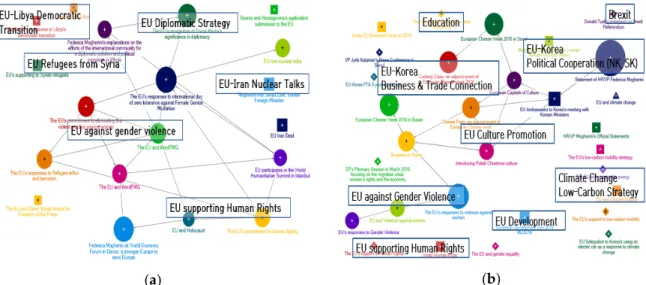
Figure 5 EEAS (a) and EUDK (b) Semantic Mappings of Facebook Postings in 2016
Concerning semantic mapping (Figure 5) and strategic narrative interpretations, there were a couple of informative findings. First, EEAS and EUDK have an identical set of international
system narratives, war on terror, but their associative framings were different. For example, EEAS’
associative framing was EU-Iran nuclear talks, but EUDK’s associative framing was the EU-Korea political co-operation to deal with North Korea’s nuclear crisis. Possibly, these associative framings were determined by their geographical proximity. Second, EEAS projected stronger
identity narratives than EUDK. In Figure 5 (a), EEAS Facebook postings were saturated by the
framings related to human rights promotion and democracy promotion. In Figure 5 (b), EUDK’s postings are shown to have less posts promoting the Union’s core values. Finally, EUDK has a more substantial policy narrative focus than EEAS. In Figure 6 (a), EEAS’ associative framing of
policy narratives could be ‘EU Diplomatic Strategy’ (namely, EU Global Strategy). In Figure 5
(b), EUDK had a more diverse range of associative framings to policy narratives such as ‘EU Development,’ ‘Climate Low-Carbon Strategy,’ ‘Education,’ ‘EU Cultural Promotion,’ and ‘EU-Korea Business and Trade Connection’. Considering these associative framings related to the
strategic narratives, we were able to suggest EEAS played a role as an identity promoter and EUDK’s role was as a policy or action promoter.
The results of EEAS and EUDK Facebook page postings in 2017 are presented in Figure 6, Tables 3 and 4 (sentiment analysis), and Figure 7 (semantic network analysis).
(a) (b)
Figure 6 EEAS (a) and EUDK (b) Sentiment Analysis of Facebook Postings in 2017
Table 3
Top 20 Words Frequently Mentioned in EEAS Facebook Postings, 2017
EEAS General count Positive count Negative count
1 EU 204 support 26 attack 12
2 European 147 supporting 22 terrorism 10
3 Mogherini 122 work 21 conflict 9
4 Federica 120 peace 14 issues 8
5 more 114 freedom 14 difficult 6
6 union 77 celebrate 12 attacks 6
7 find 55 love 10 discrimination 6
8 today 52 great 10 conflicts 6
9 Europe 51 strong 10 strike 6
3% 2% 95%
EEAS
Words in Positive Sentiment Words in Negative Sentiment Words in Neutral Sentiment 3% 2% 95%EUDK
Words in Positive Sentiment Words in Negative Sentiment Words in Neutral Sentiment10 Syria 51 peaceful 9 crisis 5
11 here 47 stability 8 slow 4
12 world 46 important 8 flee 4
13 people 45 leading 8 radicalization 4
14 young 43 clear 7 crime 4
15 rights 43 happy 7 violation 4
16 high 41 protection 7 deprived 3
17 future 38 ready 7 tragic 3
18 out 38 helping 6 slowly 2
19 international 38 top 6 displaced 2
20 countries 34 commitment 6 violent 2
Table 4
Top 20 Words Frequently Mentioned in EUDK Facebook Postings, 2017
EUDK General count Positive count Negative count
1 EU 245 improving better and 23 hatred 3
2 Korea 87 to exist 15 not any 3
3 European 85 in detail 12 negative relationship 3
4 2017 64 event 11 disgust 3
5 union 54 care for 11 some 3
6 more 49 identical 10 to be involved (in a negative situation) 3
7 European Union 46 well 10 violence 2
9 7017 43 (additionally) Also 8 negative decision 2 10 eurovillage 43 to become (a good thing) 7 be caused by (negative reason) 2
11 EDSK 38 continuing 7 terrorism 2
12 climate 33 special 6 beaten 2
13 Seoullo 31 interests 6 did something negative 2
14 change 30 many (good things) 5 does not exist 2
15 green 29 important 5 lost 2
16 bridge 29 something 5 to struck 2
17 Korean 28 significantly 4 concern 2
18 more 27 best 4 matter 2
19 today 26 positive 4 trouble 2
20 many/more 23 work 4 lack 2
Regarding the results of the sentiment analysis of 2017 Facebook postings of EEAS and EUDK, we made three findings. First, as in 2016, EEAS and EUDK have different principal themes. In the EEAS Facebook posting, Syria gained attention after HR Mogherini. In EUDK Facebook postings, Eurovillage on the Seoullo 7017 was the event with the most attention. The
Seoullo 7017 project was about transforming the Seoul Station overpass highway, which was built
in 1970, into a pedestrian walkway in 2017 (Visitseoul.net, n.d). 7017 in Seoullo 7017 was made by two final numbers from each year of establishment of overpass highway (‘70’ from 1970) and pedestrian walkway (‘17’ from 2017) (Visitseoul.net, n.d). Eurovillage was an event led by EUDK with other EU Member State embassies happened on the Seoullo 7017 (EEAS, n.d.). This event shows that the EU supports Seoul’s metropolitan policy initiative by promoting the EU, its member states and its efforts to combat global climate change (EEAS, n.d.). Second, the construction of the positive sentiment was different between the two organisations. EEAS promoted ‘peace’ and ‘freedom’, while EUDK promoted EU-South Korea co-operation by emphasising togetherness.
Finally, their orientation of addressing negative emotion has been unchanged by mentioning the words like ‘violence’.
(a)
(b)
Figure 7 EEAS (a) and EUDK (b) Semantic Mappings of Facebook Postings in 2017
According to the results in Figure 7 and Figure 5, the number of associative framings seemed to have decreased in 2017. EEAS’ main focus was EU Global Strategy, and EUDK’s main focus was Eurovillage at Seoullo 7017 (climate change and EU promotion). The 2017 results suggest three findings. First, both EEAS and EUDK had no associative framings to address international
system narratives. Second, in identity narrative, both organisations promoted the EU as a human
right promoter in the world. Finally, EEAS and EUDK had a different set of associative framings to address policy narratives. EEAS focused on EU Global Strategy, and EUDK was devoted to EU’s efforts to combat climate change.
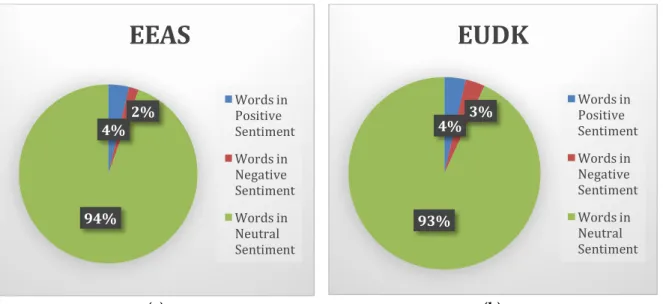
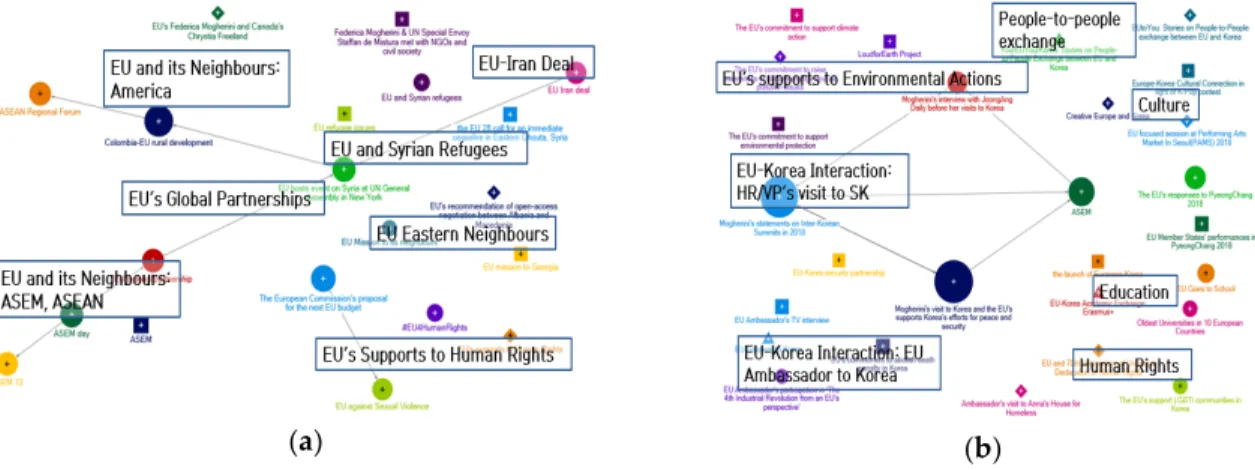
The results of EEAS and EUDK Facebook page postings in 2018 are in Figure 8, Tables 5 and 6 (sentiment analysis) and Figure 9 (semantic network analysis).
(a) (b)
Figure 8 EEAS (a) and EUDK (b) Sentiment Analysis of Facebook Postings in 2018
Table 5
Top 20 Words Frequently Mentioned in EEAS Facebook Postings, 2018
EEAS General count Positive count Negative count
1 EU 127 peace 27 conflict 11
2 Federica 91 work 19 difficult 8
3 Mogherini 87 support 17 irreversible 5
4 European 61 protect 13 displaced 5
5 today 41 ready 12 violation 4
6 world 41 commitment 10 genocide 4
7 people 35 free 7 torture 4
8 more 35 stability 6 fears 3
9 women 32 works 5 fleeing 3
10 union 30 constructive 5 persecution 3
11 peace 27 strongest 5 dangerous 3
12 day 26 supports 5 hard 3
13 Europe 24 best 5 relentlessly 3
14 rights 24 better 5 crisis 3
15 security 22 happy 5 killed 3
4%2% 94%
EEAS
Words in Positive Sentiment Words in Negative Sentiment Words in Neutral Sentiment 4% 3% 93%EUDK
Words in Positive Sentiment Words in Negative Sentiment Words in Neutral Sentiment16 international 21 well 5 fault 2
17 #standup4humanrights 21 clean 4 waste 2
18 refugees 20 enough 4 confusion 2
19 year 20 reliable 4 suffered 2
20 work 19 leading 4 lost 2
Table 6
Top 20 Words Frequently Mentioned in EUDK Facebook Postings, 2018
EUDK General count Positive count Negative count
1 EU 202 support 16 issues 14
2 Korea 118 peace 13 something uncertain 11
3 European 84 happy 11 death 8
4 2018 55 supports 10 penalty 8
5 #euinkorea 55 enjoy 9 discrimination 4
6 #eu 47 free 7 miss 3
7 ambassador 44 creative 7 critical 3
8 European Union (in Korean language) 44 thank 6 queer 3
9 delegation 43 inspiring 6 break 2
10 Europe (in English) 41 ready 6 unable 3
11 korean 34 encourage 6 disgust 3
12 Europe (in Korean language) 34 good 6 disability 3
13 seoul 33 reconciliation 6 hatred 3
14 university 33 award 6 disabled 3
15 week 30 well 5 something negative because of 3
16 union 27 friendly 5 left 2
17 Michael 26 best 4 not 2
18 Reiterer 25 right 4 defect 2
19 programme 25 freedom 4 bad 2
20 Korea (in Korean) 24 commitment 4 not existing 2
Regarding the 2018 results, the degree of neutrality remained unchanged comparing the results with those in 2016 and 2017. There are three points to address. First, EEAS and EUDK both emphasised their chief executives, respectively. EEAS paid more attention to highlight HR Mogherini as its main actor of Facebook posts. EUDK did emphasise H.E. Michael Reiterer as a main actor of the Facebook postings as he was newly appointed in 2017. Second, the posts on both Facebook pages addressed peace promotion as the main keyword for representing the positive emotion. Finally, the two had different keywords for negative emotion. For example, EEAS frequently mentioned the word ‘conflict’ and ‘violation’ which opposed the peace promotion. EUDK stressed the word ‘death’ and ‘penalty’ which opposed the human right promotion. The results illustrate that their concentration of promoting the EU to the world seemed to be more convergent than before. For a more detailed explanation, we will look at the associative framings below in Figure 9.
(a) (b)
Figure 9 EEAS (a) and EUDK (b) Semantic Mappings of Facebook Postings in 2018
In contrast to the results in 2016 (Figure 5) and 2017 (Figure 7), both EEAS and EUDK seemed to contain associative framings addressing international system narratives. EEAS attempts to explain more about the system between the EU and its global partners (The US, ASEAN and other state actors in the Union’s neighborhood area). EUDK is likely to explain more about the system of cooperation between the EU and South Korea by looking at the associative framings like “EU-Korea interaction” and “EU Ambassador to Korea”. EEAS has stronger emphasis on building international system narratives than EUDK. Regarding identity narrative, their associative framings were slightly different. For EEAS, the EU promotes peace settlement in the Union’s proximate region. For EUDK, the EU promoted human rights and environmental protection. For the policy narratives, they seemed to have an identical orientation. EEAS stressed that ASEM and EUDK promoted a people-to-people exchange as a means of promoting the connectivity between Asia and Europe.
6. Discussion
So far, this paper has attempted to assess the quality of the EU’s public diplomacy efforts through social media pages of EEAS and EUDK by assessing the coherence and effectiveness of these organisations. By looking at the results, this research was able to examine the coherence of the messaging by assessing how the Union’s strategic narratives are formed, projected and transferred to their target audiences.
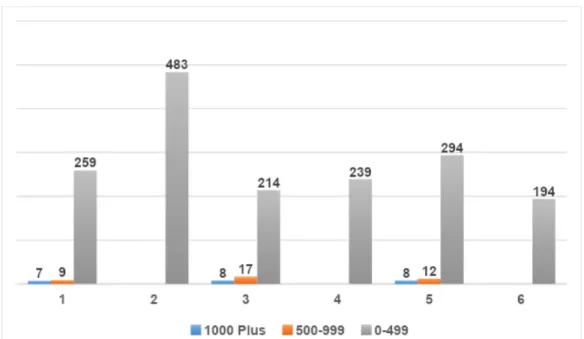
As mentioned above, strategic narratives comprise three communicative processes (Formation/Projection/Reception). In the formation process, when the strategic narratives were constructed, the EEAS was the main institution, and the EUDK was the subordinate institution. Their prominent role is to promote the European Union to their target audience (Tables 1 to 6). The word frequencies based on the sentiment analysis point out that the words related to the Union’s values (such as peace and freedom (positive), fighting against terrorism and violence(negative)) were emphasised. The EU’s narrative projection can be found from semantic network mappings given in Figures 5, 7 and 9. EEAS and EUDK projected different narratives considering different elements of narratives. EEAS emphasised the EU’s regional and global partnership building, and EUDK prioritised the EU’s closer partnership with South Korea. The narratives are based on their neighbouring regions (Middle East for EEAS and Asia for EUDK). In terms of character, EEAS presented HR/VP Federica Mogherini as the main character and EUDK depicted H.E. Michael Reiterer as the main character. Both heads of these institutions are symbolic figures of the EU. The general atmosphere of the narratives promotes feelings of peace. The main themes of these institutions’ Facebook pages are their achievements (The EU-Iran deal for EEAS; EUROVILLAGE for EUDK). In the reception process, this paper was not able to calculate the exact number of visits to the Facebook posts. However, the number of likes or comments attached to the posts can be helpful to assess how their messages are transferred to their audiences. The results are summarised in Figures 10 and 11.
Figure 10 Number of Likes Distribution to EEAS and EUDK Facebook Page Postings
Figure 11 Number of Comments Distribution to EEAS and EUDK Facebook Page Postings
Public diplomacy through social media is regarded as an innovative strategy: it is quicker and easier to disseminate messages from this platform. However, Kollins & Bekenova (2019) criticise
such a strategy because the public reception of the messages in target countries remains unclear. In other words, this strategy is still one-way and top-down so that its effectiveness is still questionable due to lack of message receivers’ receptions (Kollins & Bekenova, 2019). In order to prove the effectiveness of messaging through Facebook posts, it will be helpful to assess the number of likes or comments generated by the posts. The data in this study suggested that most of EEAS and EUDK Facebook postings received only a small number of ‘likes’ or ‘comments’. This means that EEAS and EUDK are not likely to draw comprehensive responses from the receivers by transmitting public diplomacy messages on Facebook. This implies that in order to improve bilateral relations, EEAS and EUDK should examine what the public in the target countries expects from the European Union and target their messaging accordingly.
7. Conclusion
Overall, this paper aims to analyze the EU’s online strategic narratives by focusing on EEAS and EUDK Facebook postings from 2016 to 2018. This paper also attempts to assess the quality of the Union’s diplomatic performance by conducting two text mining techniques: sentiment analysis and semantic network analysis. In considering all the research data and results, we can suggest several comprehensive findings. First, the neutral sentiment was predominant in both EEAS and EUDK Facebook postings. They maintain an objective position in reporting their affairs or performances. Their intention may be to create less bias towards the Union’s performances on the global stage. Second, the main actors were the same, but the main themes were different. EEAS and EUDK have consistently emphasised their representatives. EEAS highlighted peace and human rights as central values, but EUDK posted on a range of areas of promotion (e.g. EU-Korea co-operation in 2016, Eurovillage in 2017 and the EU ambassador to South Korea in 2018). Third, both EEAS and EUDK Facebook postings had a similar range of associative framings to the
international system narratives, but these framings were differently presented according to their
geographical proximity (EEAS: Iran, EUDK: North Korea). In 2018, the EEAS more ambitiously presented a range of the Union’s global partnership by expanding its reach from the neighbours to its remote global counterparts (such as US or ASEAN). Fourth, EEAS and EUDK both had similar associative framings supporting the EU’s identity narratives such as democracy, peace and human right promotion. Finally, EEAS and EUDK had a different range of associative framings addressing the Union’s policy narratives. EEAS mainly concerned with European Neighborhood Policy and ASEM. EUDK was devoted to EU-South Korea trade connection and climate change policies. EEAS focus implies the EU’s broad perspective, and EUDK focus implies the EU’s consideration of its co-operation with South Korea in smaller parts.
Addressing the research question, it is necessary to revisit the results that came out of
sentiment analysis and semantic network analysis. The EU’s two diplomatic institutions (EEAS
them were inclined to emphasise the European Union as their keywords of their postings on Facebook. Associative framings from semantic networks (Figures 5, 7 and 9) illustrate that the Union’s global influence and actorness were constantly highlighted. However, it is limited in measuring the effectiveness of the EU’s public diplomacy strategy (such as being unable to examine the number of reads of each posting). Despite such limitations, the number of likes and comments at least illustrate the audiences’ active responses to the Union’s diplomatic strategic postings on Facebook. In terms of interest level, the audience in the data set probably show the lower level of interest to the Union’s diplomatic performance on the globe more generally.
For testing the three hypotheses, this study was able to examine these despite some limitations of the methods employed. Regarding the first hypothesis (H1), by comparing most frequently mentioned words and associative framings, this paper was able to suggest both EEAS and EUDK coherently projected their international system narratives and identity narratives to the target audiences. Hence, the first hypothesis can be accepted. For the second hypothesis (H2), the results indicate that both institutions projected different concentrations of the policy narratives according to their regional focuses (EEAS- Europe and neighbouring regions, EUDK-Korea and Asia). Their different promotion focus comes out of their regional proximity, not their target audiences. For the last hypothesis (H3), these institutions are not likely to transfer their messages properly to their target audiences. Their postings did not generate active discussion of their diplomatic performance from their audiences, so this hypothesis is likely to be rejected.
This paper has put forward some suggestions for both EEAS and EUDK. For the EUDK, in terms of international system narratives, the Union should provide more context regarding its global partnership. In order to do this, EEAS should develop a more thorough explanation of the Union’s connection with other global counterparts who are messaging to broader audiences. For the EUDK, the EU should devote more effort to providing comprehensive explanations of Korea relations. This might be helpful to promote a further perception of improvement in EU-Korea relations among the EU-Korean public. In terms of identity narratives, both EEAS and EUDK were consistent in terms of promoting human rights, democracy and peace in the world. However, they continuously increase their visibility on the globe. In comparison with the US and China, the EU seemed to have a weaker presence. In terms of policy narratives, EEAS and EUDK had a different focus on promotion. However, it seems that both of them are failing to explain why these policies are essential and necessary. In order to improve this, the EU should put more effort to invite their global counterparts by emphasising the importance. To tackle this, the EU could actively participate in global co-operation platforms and could also engage in joint activities with these global counterparts.
EEAS and EUDK have so far given a sound performance of promoting the EU and its values to the Union’s global counterparts. However, impaired perception between the Union’s economic performance (as a ‘powerhouse’) and political performance (as a ‘dwarf’) persists as one of the biggest obstacles for the EU’s public diplomacy to overcome this the EU will need to establish
more effective and sustainable e-diplomacy strategies. To achieve this task, the EU first should investigate and measure what global counterparts anticipate from the Union. It is now time for the EU to listen to others’ stories, in order to tell its narratives effectively.
References
Bridges, B. (2008). The European Union and the Korean Conundrum. In Balme, R. & Bridges, B. (Eds.), Europe-Asia relations: Building multilateralisms (pp. 213-232). Basingstoke: Palgrave.
Chung, S. W., & Lee, J. (2019). Building the pillars of the EU-South Korea strategic partnership. Asia Europe Journal, 17, 327–340.
Collins, N., & Bekenova, K. (2019). Digital diplomacy: success at your fingertips. Place
Branding and Public Diplomacy, 15, 1-11.
CPD Blog. Public diplomacy before Gullion: the evolution of a phrase, by Cull, N. Available online: https://www.uscpublicdiplomacy.org/blog/public-diplomacy-gullion-evolution-phrase (accessed 15 May 2020).
Critchlow, J. (2004). Public diplomacy during the Cold War: the record and its implications.
Journal of Cold War Studies, 6, 75–89.
Cross, M., & Melissen, J. (Eds.) (2013). European public diplomacy: soft power at work. New York, the US: Palgrave MacMillan.
Cross, M., & La Porte, M. (2017). The European Union and image resilience during times of crisis: the role of public diplomacy, The Hague Journal of Diplomacy, 12, 257-282. Cull, N. (2009). “Public diplomacy: lessons from the past,” CPD Perspectives on Public
diplomacy, Available online:
http://uscpublicdiplomacy.org/sites/uscpublicdiplomacy.org/files/legacy/publications/pers pectives/CPDPerspectivesLessons.pdf (accessed 11 May 2020)
David, C., Legara, E. F. T., Atun, J. M. L., & Monterola, C. P. (2014). News frames of the population issue in the Philippines. International Journal of Communication, 8, 1247– 1267.
Digital Diplomacy, "Interview: David Tunney, Head of social media for the EEAS: 'Traditional diplomacy is being transformed by social media and online communication',” April 29 2014, Available online: http://digitaldiplomacy.ro/interview-david-tunney-head-social-
media-eeas-traditional-diplomacy-transformed-social-media-online-communication/?lang=en (accessed 14 May 2020)
Dodd, M. D., & Collins, S. J. (2017). Public relations message strategies and public diplomacy 2.0: An empirical analysis using Central-Eastern European and Western Embassy Twitter accounts, Public Relations Review, 43, 417–425.
Dumčiuvienė, A. (2016). Twiplomacy: the meaning of social media to public diplomacy and foreign policy of Lithuania, Lithuanian Foreign Policy Review, 35, 91-115.
Entman, R. (1993). Framing: Toward Clarification of a Fractured Paradigm. Journal of
Communication, 43, 51–58.
European External Action Service (EEAS), “Shared vision, common action: A stronger Europe,” June 2016, Available online:
http://eeas.europa.eu/archives/docs/top_stories/pdf/eugs_review_web.pdf (accessed 11 May 2020).
European External Action Services, Available online:
https://eeas.europa.eu/headquarters/headquarters-homepage_en/9005/The%20EEAS%20and%20Social%20Media (accessed 14 May 2020).
EEAS, EU Delegation to the Republic of Korea, Invitation to Eurovillage on 3-4 June 2017, Available online: https://eeas.europa.eu/delegations/south-korea/26001/node/26001_nn (accessed 17 May 2020).
Freedman, L. (2006). Networks, culture and narratives. Adelphi Papers, 45, 11-26.
Jiang, K., Anderton, B. N., Ronald, P. C., & Barnett, G. A. (2018). Semantic Network Analysis Reveals Opposing Online Representations of the Search Term “GMO”. Global
Challenges, 2. 1-8.
Kim, L., & Kim, N. (2015). Connecting opinion, belief and value: Semantic Network Analysis of a UK public survey on embryonic stem cell research. Journal of Scientific
Communication, 14, 1-23.
Kunal, S., Saha, A., Varma, A., & Tiwari, V. (2018). Textual dissection of live twitter reviews using naive bayes. Procedia Computer Science, 132, 307-313.
Li, X., & Wang, J. (2010). Web-based public diplomacy: The role of social media in the Iranian and Xinjiang riots. Journal of International Communication, 16, 7–22.
London School of Economics and Political Science. (2016). Review roundtable: Naked diplomacy: Power and statecraft in the digital age by Tom Fletcher. Available online: http://blogs.lse.ac.uk/lsereviewofbooks/2016/07/18/review-roundtable-naked-diplomacy-power-and-statecraft-in-the-digital-age-by-tom-fletcher/ (accessed 14 May 2020). Lynch, D. (2005). "Communicating Europe to the World: What Public Diplomacy for the EU?"
EPC Working Paper No.21 Available online: http://www.isn.ethz.ch/Digital-
Library/Publications/Detail/?ots591=0c54e3b3-1e9c-be1e-2c24-a6a8c7060233&lng=en&id=16968 (accessed 11 May 2020)
Manor, I., & Segev, C. (2015). "America’s selfie: How the US portrays itself on its social media accounts," In Bjola, C. & Holmes, M. (Eds.), Digital diplomacy: theory and practice (pp. 89–108). New York: Routledge.
Metzgar, E. T. (2012). Is it the medium or the message? Social media, American public diplomacy & Iran. Global Media Journal, 1, 1–16.
Miskimmon, A., O’Loughlin, B., & Roselle, L. (2013). Strategic narratives: communication
power and the new world order. London: Routledge.
Miskimmon, A., O’Loughlin, B., & Roselle, L. (2017). Forging the World: Strategic narratives
and international relations. Ann Arbor: University of Michigan Press.
Motta, G., & Baden, C. (2013). Evolutionary factor analysis of the dynamics of frames:
Introducing a method for analyzing high-dimensional semantic data with time-changing structure. Communication Methods and Measures, 7, 48–82.
NodeXL Korea (2015). Catching Up NodeXL (in Korean). Seoul: Paradigm Book.
Pacheco Pardo, R., Linde, D., & Maximillan, E. Vrije Universiteit Brussel, Institute for European Studies, EU-Republic of Korea Relations Putting the Strategic Partnership to Work, May 2018, by Available Online: https://www.ies.be/node/4791 (accessed 20 July 2020). Renken, W. (2014). Social media use in public diplomacy: A case study of the German missions’
Facebook use, MSc Thesis, University of Stirling, UK, and Lund Universiteit, Sweden, Available online:
http://lup.lub.lu.se/luur/download?func=downloadFile&recordOId=4770251&fileOId=47 70252 (accessed 14 May 2020).
Schultz, F., Kleinnijenhuis, J., Oegema, D., Utz, S., & van Atteveldt, W. (2012). Strategic framing in the BP crisis: A semantic network analysis of associated frames. Public
Relation Review, 38, 97–107.
Seib, P. (2012). Real-time diplomacy: politics and power in the social media era. London: Springer.
Sevin, E., & Ingenhoff, D. (2018). Public diplomacy on social media: Analyzing networks and content. International Journal of Communication, 12, 3663-3685.
Snow, N. (2013). Truth is the best propaganda: Edward R. Murrow’s speeches in the Kennedy
years. McLean: Miniver Press.
Statcounter, Social Media Stats Worldwide June 2019-June 2020, Available online: https://gs.statcounter.com/social-media-stats (accessed 20 July 2020).
US Department of State Archive, Announcement of Nomination of Karen P. Hughes as Under Secretary State for Public Diplomacy and Public Affairs and Dina Powell as Assistant Secretary of State for Educational and Cultural Affairs. Secretary Condoleezza Rice, Benjamin Franklin Room Washington, D.C., March 14, 2005. Available online: https://2001-2009.state.gov/secretary/rm/2005/43385.htm (accessed 15 May 2020). Uysal, N., & Schroeder, J. (2019). Turkey’s Twitter public diplomacy: towards a “new” cult of
personality. Public Relations Review, 45, 1-9.
van Atteveldt, W., Kleinnijenhuis, K., & Schlobach, S. (2008). Good news or bad news?
Conducting sentiment analysis on Dutch text to distinguish between positive and negative relations. Journal of Information Technology & Politics, 5, 73-94.
Visitseoul.net, All about Seoullo 7017!, May 16, 2017, Available online:
http://english.visitseoul.net/tours/All-about-Seoullo-7017_/21502 (accessed 17 May 2020).
Walker, M. (2000). Europe: Superstate or Superpower? World Policy Journal, 17, 7-16. Yarchi, M., Samuel-Azran, T., & Bar-David. L. (2017). Facebook users’ engagement with
Israel’s public diplomacy messages during the 2012 and 2014 military operations in Gaza. Place Branding and Public Diplomacy, 13, 360–375.
Zaharna, R. S., & Rugh, W. A. (2012). Issue theme: the use of social media in US public diplomacy, Global Media Journal,11, 1–8.