© Korean Powder Metallurgy Institute 1319
-Near Net Shape Processing of RE-Ba-Cu-O Bulk Superconductors
M. Murakami1,a, M. Fujishiro1, T. Miyazaki1, S. Nariki2, N. Sakai2 and I. Hirabayashi2 1Shibaura Institute of Technology, 3-7-5Toyosu, Koto-ku, Tokyo 135-8548 Japan
2Superconductivity Research Laboratory, 1-10-13 Shinonome, Koto-ku, Japan a[email protected]
Abstract
Several practical applications of melt-textured bulk superconductors require the complex-shaped products such as curved, ring-shaped, and drilled blocks rather than simple shaped pellets. However, melt-textured bulk superconductors are often damaged when they are cut, grinded, or drilled. With the aim of reducing such damages, we have investigated the preparation of the complex-shaped bulk superconductors by previously machining binder-added precursors and pre-sintered precursors. We could produce various complex-shaped bulk superconductors without cracking from these machined precursors
Keywords : superconductivity, machining, sintering, grain growth, mechanical properties
1. Introduction
Melt-textured RE-Ba-Cu-O (RE: rare earth elements) bulk superconductors can trap magnetic fields much larger than permanent magnets1. Therefore they have high
potential in high-power magnetic suspension systems and high field applications. Several practical applications of melt-textured bulk superconductors require the complex -shaped products such as curved, ring-shaped, and drilled blocks rather than simple shaped pellets. In general, complex-shaped bulk products are prepared by machining melt-grown massive blocks. However, melt-textured bulk samples are often damaged when they are mechanically machined. In particular, it is difficult to machine the section along a(b)-direction due to the poor mechanical strength. In addition, the method of machining melt -textured bulk is generally very expensive. With the aim of reducing such damages and machining cost, we have investigated the preparation of the complex-shaped bulk superconductors by previously machining the precursors compacted with organic binders or the sintered bodies.
2. Experimental and Results
The powders of Gd210 and BaCuO2, CuO were mixed in
a molar ratio of 0.9:1.5:1.9. 0.5wt% of Pt and 20wt% of Ag2O were also added to the mixtures. The mixtures were
uni-axially pressed into pellets of 30 mm diameter and rectangular pellets with dimensions of 50×20×15 mm3, and
further subjected to cold isostatic pressing (CIP) under a pressure of 200 MP. The precursors were sintered at 925-950ºC for 2h and then were mechanically machined
with grinding and drilling2. Melt-processing was performed
in air. For oxygen annealing, the melt-textured samples were heated in flowing pure oxygen gas at 400ºC for 150h.
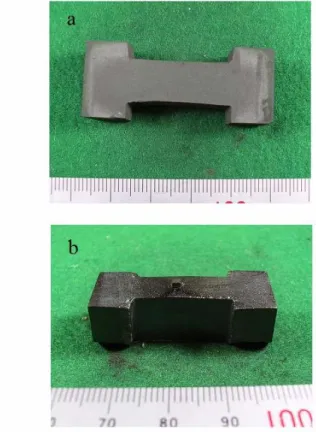
Fig. 1 (a) The precursor machined into H-bar shape after sintering; (b) Melt textured sample.
2006 POWDER METALLURGY World Congress
C14-01-1 *Invited
© Korean Powder Metallurgy Institute 1320 -discussed. They should have a self-contained caption and be positioned in center margin within the column. If they do not fit into one column they may be placed across both columns in which case place them at the top or at the bottom of a page. Fig. 1(a) shows a photo of H-shaped Gd-Ba-Cu-O sample fabricated by grooving a sintering precursor. This H-shaped precursor was prepared by grinding the side wall of the sample sintered at 950°C. Fig. 1(b) shows a photo of the sample after melt-processing. One can see clear sector boundaries on the surface of the melt grown H-shaped Gd-Ba-Cu-O bulk, which shows that single grain can be formed even when the precursor has a complex shape.
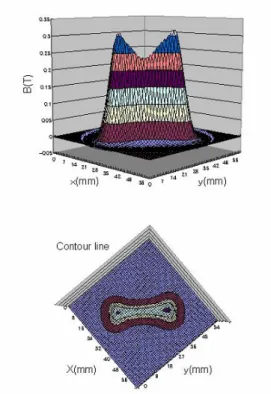
Fig. 2 shows the trapped-field distribution of the H-shaped Gd-Ba-CuO bulk superconductor at 77K. As shown in the figure, H-shaped bulk sample exhibited the maximum trapped field of 0.3T at the both sides of sample, reflecting its shape. The field distribution shows that there is no appreciable defect in the sample.
Fig. 3(a) shows the photo of sintered Gd-Ba-Cu-O precursor in which many holes are drilled artificially. This sample was first sintered at 925-950°C and then 17 holes of 2mm diameter were drilled prior to melt-processing.
Fig. 2 Trapped field distribution of a H-bar shapeds ample
Fig. 3(b) shows the photo of the sample after melt -processing. The single-domain sample could be successfully fabricated. The field measurements of melt-grown Gd-Ba -Cu-O bulk superconductor with 17 hole showed that the
trapped field distribution has a single peak with the peak value of 0.47T. This value is comparable to that of single grain bulk sample of 25mm diameter without holes. The present results show that multiple holes can be successfully introduced into melt-textured Gd-Ba-Cu-O without cracking using the present technique.
Fig. 3 (a) Sintered sample with 17 holes drilled; (b) Melt textured sample.
3. Summary
Complex-shaped bulk superconductors were fabricated by mechanically machining sintered precursors. We believe that the near net shape processing of bulk superconductor by machining sintered precursor will be a useful method for producing the complex-shaped bulk samples
4. References
1. M. Tomita and M. Murakami, Nature, 421 pp.517-520 (2003).
2. S. Nariki, N. Sakai, M. Murakami, I. Hirabayashi: Supercond. Sci. Technol. 17 (2004) S31