Root Cause Analysis of the Failure of PORV Downstream Steam Discharging Pipe System
Connected to the Main Steam Line
J. C. Jo,a S. O. Yu, Y. J. Cho, J. Y. Park, M. J. Jhung, H. J. Kim, Y. G. Yune
a
Safety Issue Research Department, Korea Institute of Nuclear Safety, Yuseong-gu, Daejeon, [email protected]
1. Introduction
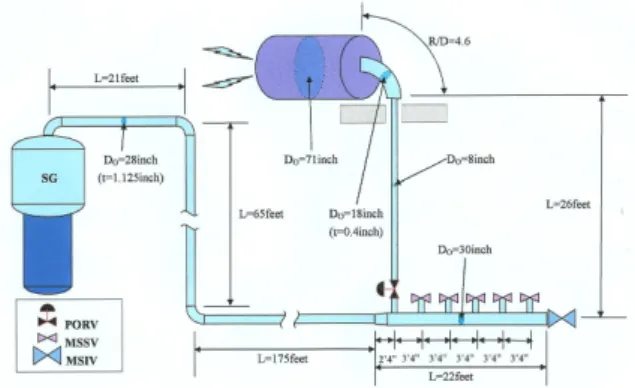
On April 16, 2005, the Kori Unit 1 plant was being retrieved from the zero reactor power at the final stage of the 23rd periodic overhaul when manual operation for opening the PORV (Power Operated Relief Valve) was performed at a low speed to reduce the pressure of main steam line with an MSIV (Main Steam Isolation Valve) and 5 MSSVs (Main Steam Safety valves), which remained closed (see Fig. 1).
When the pressure in the main steam line reached about 7.115 MPa and a reactor operator switched the PORV operation mode from “Manual” to “Auto” to speed up the pressure reduction process. Immediately after that the PORV opened fully in a short time due to higher pressure beyond the PORV setpoint, which resulted in excessively rapid reduction of pressure in the main steam line system.
A little later on, the operator closed the valve manually to mitigate the unexpected transient response of system. Due to the abrupt pressure reduction of steam generator and main steam line caused by the sudden opening of PORV, the reactor shut down by the low pressure signal of safety injection and some main steam separation valves seemed to be actuated.
Fig. 1. Schematic diagram of the main steam line
As the result of the rapid release of high pressure steam to the atmosphere through the PORV, the supports for the curved pipe spool of about 3.3 m long and 300 kg weight, which had been connecting the straight pipe line in the downstream of the PORV and a silencer for reducing noise generated by the steam discharging to the atmosphere, were broken away. At the same time, the pipe spool was separated and projected from the line.
Finally it flew and collided with the outer wall of the RWST located about 50 m away, resulting in mechanical damage on it with the maximum permanent deformation of about 60 mm in the radial direction at the local part of wall.
Although the release of radiation did not occur, it will be meaningful to find out the root-cause of such incident by calculating the transient hydraulic loads resulting in the unwelcome failure of pipe line in the downstream of the PORV for the purpose of establishing the appropriate regulatory action.
Considering this as a safety-related issue, a comprehensive analysis was performed to find the root cause and evolution process of this event out.
2. Analysis
In this study, transient thermal-hydraulic and projectile motion analyses were performed systematically.
Using the RELAP5, thermal hydraulic system analysis was performed to investigate thermal hydraulic response characteristics in the main steam line when PORV opens or closes.
Also, one-dimensional flow analysis code Flowmaster was used to predict thermal hydraulic transient responses, where the piping system after the PORV was included in the analysis model. The transient responses of the main steam line and the piping system after the PORV as depicted in Fig 2 were investigated with the opening and closing of the PORV.
∞ P ρ∞ S P zi zj o P ρo ∞ C m& I V I R S R z pipe A (shock) air
Main Steam Line
Dead End steam link A S V (interface) PORV Curved pipe spool Silencer
Fig. 2 Simplified model for calculation of shock forces In addition to the analysis by thermal-hydraulic codes, transient piping pressures and forces caused by high pressure steam flow disturbances were calculated analytically. The properties of shocks generated by sudden opening and closing of PORV were investigated and the forces acting on the pipe segment were calculated, which could be enough to make the piping system projectile flown to the air.
All of these thermal hydraulic analyses were verified by two-dimensional CFD analysis of main steam line and piping system after PORV using CFX 5.6.
Finally projectile analysis of flying pipe was performed to find the trajectories of the projectile and their velocity and angle.
3. Results and Discussion
Thermal hydraulic analysis by RELAP5 indicated that rapid rise of the pressure in the main steam line can occur due to the sudden opening and closing of the PORV, which was also shown from the Flowmaster code calculation of the main Transactions of the Korean Nuclear Society Autumn Meeting
steam line with the piping system which is attached in the downstream of the PORV (see Figs. 3 and 4).
Transient piping pressures and forces caused by high pressure steam flow disturbances were estimated and the resultant force acting on the pipe segment during opening of the PORV was found to be enough to blast off the curved pipe spool of 300 kg with the initial velocity of 20 m/sec and launch angle of 45 degrees (see Figs. 5 and 6).
Also when the PORV is suddenly closed, there is a pressure rise by about 3.5 times of the initial value, which is considered to be able to open the MSSV instantaneously.
All of these thermal hydraulic analyses were verified by two-dimensional CFD analysis of the main steam line with the piping system of downstream of the PORV using the CFD code CFX 5.6.
Initial velocity and launch angle of the flying piping system based on the thermal hydraulic analysis were consistent with those obtained from the projectile analysis (see Fig. 7).
4. Conclusion
The lessons-learned from the present study can be summarized as follows.
It could be possible to prevent such pressure shock damage on the piping system by designing carefully the piping and support systems to be robust enough to accommodate the potential forces generated by sudden operation of PORV. Also, the improved technical and procedural requirements for assuring appropriate design and installation should be developed and the operators should thoroughly observe the operation procedures. In addition, the design of supports of piping system outside the building should be carefully reviewed and the status of their installations should be inspected periodically to avoid such transient incident occurred at Kori Unit 1station.
REFERENCES
[1] ANSYS, ANSYS Structural Analysis Guide, ANSYS, Inc., Houston, 2004.
[2] Thermal Hydraulics Group, 1998, RELAP5/MOD3 Code Manual Volume IV : Code Structure, System Models, and Solution Methods, Scientech, Inc., NUREG/CR-5535. [3] Flowmaster International Ltd., 2000, Flowmaster 2, The New User Training Course, July.
[4] KINS, 2005, “Safety injection and reactor trip due to unskilled operation during zero power reactor characteristics test at Kori unit 1,” Report on the accidents and incidents of nuclear power plant, 2005-6.
[5] Moody, F.J., 1990, Introduction to Unsteady Thermofluid Mechanics, John Wiley & Sons, New York. [6] Fauske, H.K., 1985, “Flashing flows-some practical guidelines for emergency releases,” Plant Operations Prog. 4:132. 0 1 2 3 4 5 63 64 65 66 67 68 69 70 71 72 73 74 75 76 77 78 79 80 P r e ssu r e ( b a r s) Time (seconds) MSIV Dead-end (6m) PORV Volume (0m) SG side (-6m) SG side (-34.7m) SG side (-52.9m) SG side (-68.2m) SG side (-76.2m) Plant Data
Fig. 3 Steam line pressure behavior – long term
0.00 0.25 0.50 0.75 1.00 1.25 1.50 1.75 2.00 65 66 67 68 69 70 71 72 73 74 75 S ta ti c P re s s u re (b a r( a )) Time(sec) Steam Generator(SG) Midway between SG and PORV Just Before PORV Between MSSV#1 and #2 MSIV Dead-End
Fig. 4 Pressure transient at various section at Open-to-Close/Close-to-Open Time of PORV=0.05sec.
0 30 60 90 120 150 180 210 240 0 3 6 9 12 S o o Mass flowrate, [kg/s] ∞ P ∞ ρ S P o P ρo ∞ C m& I V I R S R S V o C ∞ P ∞ ρ S P o P ρo ∞ C m& I V I R S R S V o C ∞ P PS PORV
Fig. 5 Effect of steam discharge rate on shock pressure
0.00 0.02 0.04 0.06 0.08 0.10 0 300 600 900 1200 RS+RI Interface force, R I Shock force, RS Unsteady force, RU F o rc e , [k N ] time, [sec] Blowdown force, Rbd Form loss, K=0.35 at z/D=0.6~0.8
Figure 6. Behavior of forces due to shock and open pipe reaction by sudden opening of PORV