716
-High Power Switchable Dual-Wavelength Linear Polarized Yb-Dozped Fiber
Laser around 1120 nm
Xiaojuan Liu1*, Bangcai Huang2, Gongxiang Wei1, Kezhen Han1, Yan Huang1, and Fangfang Liu1
1School of Science, Shandong University of Technology, Zibo, Shandong 255049, China 2China Electronics Technology Group Corporation, 46th Research Institute, Tianjin 300220, China
(Received June 27, 2016 : revised September 18, 2016 : accepted November 1, 2016)
A single-and dual-wavelength switchable polarized Yb-doped double-clad fiber laser around 1120 nm based on a pair of fiber Bragg gratings (FBGs) is demonstrated. The polarization-maintaining (PM) linear cavity is composed of a double clad PM Yb-doped fiber (YDF) and a pair of PM FBGs. The laser can operate in stable dual-wavelength or wavelength-switching modes due to the polarization hole burning (PHB) and the spatial hole burning (SHB) enhanced by the PM linear cavity. In dual-wavelength operation, the two orthogonally polarized wavelengths are centered at 1118.912 nm and 1119.152 nm, with an interval of 0.24 nm and a signal to noise ratio (SNR) of 35 dB. The maximum output power is 14.67 W when the launched LD pump is 24 W corresponding to an optical efficiency of 61.1%. The lasing lines switchover may be realized by adjusting the polarization controller (PC) fitted in the cavity. The two single-wavelengths are 1118.912 nm and 1119.152 nm. When the injected LD pump is 24 W, the highest output powers are 7.68 W and 8.64 W corresponding to optical efficiencies of 32% and 36% respectively. The spectral linewidth of the lasing lines are 0.075 nm and 0.07 nm, and the average numerical values of PER are 20.3 dB and 19.9 dB, respectively.
Keywords : Dual-wavelength fiber lasers, Ytterbium doped fiber lasers, Polarization maintaining, Fiber Bragg gratings (FBGs)
OCIS codes : (060.3510) Lasers, fiber; (140.3615) Lasers, ytterbium; (060.2420) Fibers, polarization-maintaining; (060.3735) Fiber Bragg gratings
*Corresponding author: [email protected]
Color versions of one or more of the figures in this paper are available online. *
This is an Open Access article distributed under the terms of the Creative Commons Attribution Non-Commercial License (http://creativecommons.org/ licenses/by-nc/3.0/) which permits unrestricted non-commercial use, distribution, and reproduction in any medium, provided the original work is properly cited.
*Copyright 2016 Optical Society of Korea
I. INTRODUCTION
Dual-wavelength fiber lasers with narrow line-width operation and uniform amplitude output have attracted a lot of research interest due to their important applications in special fields such as lidar-radar systems, study of high -bit-rate soliton pulses, differential absorption measurements of trace gases, optical wavelength division multiplexed (WDM) systems, microwave photonic generation, high resolution spectroscopy, optical fiber sensing, and even terahertz sources [1-4]. In particular, for frequency-tunable, high-power, and low phase noise microwave or millimeter-wave generation, a switchable dual-wavelength fiber laser is considered to be a desirable candidate because microwave generation in this way does not require a high-quality frequency-tunable
microwave reference source, and the system cost and complexity is therefore reduced [5, 6]. Meanwhile, a single polarization laser can be applied in nonlinear frequency conversion, interferometric fiber sensors, pumping of active crystals and optical parametrical devices [7].
Erbium (Er)-doped fibers (EDFs) are the most commonly used gain medium in dual-wavelength lasers in both experimental and numerical simulation. However, strong mode competition induced by the homogeneous broadening of EDF restricts the well-controlled generation of dual wavelength fiber lasers at room temperature [8-10].
Compared to Er-doped fibers, the advantage of ytterbium (Yb)-doped fiber (YDF) is the high absorption coefficient, which means that a relatively shorter length of YDF is enough for signal amplification [11, 12]. Similarly to EDF,
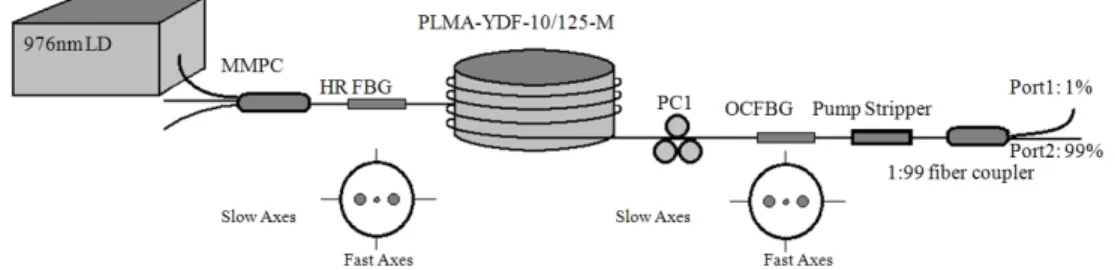
FIG. 1. Experimental setup of the high power switchable linear polarized Yb-doped fiber laser at 1120 nm. the output spectrum of YDF is also homogeneous broadening,
and polarization hole burning (PHB) is, as an important approach, widely utilized to generate dual-wavelength output in YDF lasers.
Additionally, due to the combination merits such as wave-length-selective nature, fiber compatibility and ease of use, fiber Bragg gratings (FBG) are used extensively as narrow band reflectors [13-15] in such kinds of YDF lasers. Most of all, polarization-maintaining (PM) FBG (PM-FBG) written in a high birefringence fiber recently attracted a great deal of interest in the design of multi-and dual-wavelengths lasers. Feedback from the PM-FBG in the cavity results in two linearly orthogonally polarized modes, which are separated both in wavelength and polarization. Lasers oscillating on different linearly-polarized modes greatly enhance the PHB in the cavity, which will restrain the mode competition and facilitate the laser operation. Additionally, by adjusting the polarization controller (PC) fitted into a resonant cavity, the laser can be operated in stable dual-wavelength and single-wavelength switchable modes at room temperature.
The single-and dual-wavelength operation in this paper is observed when we research the high power linearly polarized cladding pumped YDF laser at 1120 nm based on polarized maintaining linear cavity (corrected to: based on a polarization-maintaining linear cavity), which will be reported in another paper. And now, for the first time, a high power single-and dual-wavelength switchable YDF laser around 1120 nm is illustrated. In the dual-wavelength operation, the two orthogonally polarized lasing wavelengths are centered at 1118.912 nm and 1119.152 nm, with a separation of 0.24 nm and optical signal-to-noise ratios (SNR) of 35 dB. The maximum output power is 14.67 W when the launched LD pump is 24 W, corresponding to an optical efficiency of 61.1%. In single-wavelength operations, the two individual wavelengths are 1118.912 nm and 1119.152 nm, respectively. When the injected LD pump is 24 W, the highest output power is 7.68 W and 8.64 W, corresponding to optical efficiency of 32% and 36%, respecti-vely. The spectral linewidth of each single-wavelength laser is 0.076 nm and 0.07 nm, and the average polarization extinction ratio (PER) is 20.3 dB and 19.9 dB, respectively. Such a high power dual-wavelength fiber laser with an interval of 0.24 nm can be used as a light resource in microwave generation.
II. EXPERIMENTAL SETUP
The schematic diagram of the dual-wavelength Yb-doped double-clad fiber laser in the experiment is shown in Fig. 1. A homemade laser diode (LD) is employed as pumping source with a maximum output power of 25 W, and it is multimode fiber pigtailed with a numerical aperture (NA) of 0.21 and a core diameter of 105 μm. A pumping protector is inserted to prevent the backward light with the same fibers as the pigtail fiber of LD pump. A (2+1)×1 multimode pumping combiner (MMPC) is used to couple the LD pump into the laser cavity, whose two pumping input fibers have the same parameters as the pigtail fibers of the LD pump, while the signal input fiber and the output fiber have the same parameters of 10/130 μm with a NA of 0.075, respectively. The linear-cavity fiber laser consists of totally PM devices including a 10-m long Yb-doped fiber and a pair of FBGs, which can lead to the more stable lasing oscillation. The FBGs are inscribed in photosensitive PM fiber (PM085-LNA, Nufern Inc.), which have the same core and cladding diameters as the gain fiber, and are fabricated by scanning phase mask technology. The FBG with high reflectivity (HRFBG) above 99% at 1120 nm is spliced to one end of the gain fiber, and the output coupler FBG (OCFBG) with a reflectivity of 20% is spliced to the other end of the gain fiber to form a cavity. The bandwidths of the HRFBG and the OCFBG are 0.3 nm and 0.2 nm, respectively. The 10-m long double clad Yb-doped fiber (PLMA-YDF-10/125-M, Nufern Inc.) is used as a gain medium, which has a core diameter of 10 μm with an NA of 0.075, and an inner cladding diameter of 125 μm with nominal cladding absorption of 4.95 dB/m at 976 nm. The PM elements of the linear cavity are spliced with fast axes aligning to each other. A PC (PC1) is fitted between the gain fiber and the OCFBG to realize the wavelength switchover. The residual pump light is dumped by a PM pump stripper spliced next to the OCFBG. The PER of the laser is detected by a polarization extinction ratio meter (PEM-320). Considering that the power endurance of the PER meter is lower than 10 mW, as shown in Fig. 1, the laser output is 1:99 divided by a PM fiber coupler in the experiment. Port1 (1%) is used to measure the PER, and port2 (99%) is used to measure the laser power, while the laser spectrum is detected by a spectrum analyzer (AQ6317B Yokagawa Corp.) from the
(a)
(b)
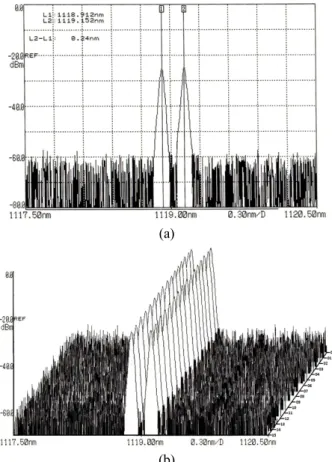
FIG. 2. Output spectra of the YDF laser. (a) Dual-wavelength lasing operation. (b) sixteen times repeated scans with a 2 -min interval.
FIG. 3. Output laser powers of of dual-wavelength (line1) and single-wavelength at 1118.912 nm (line2) and 1119.152 nm (line3) vs. the launched LD pump, respectively. The insert displays the LD pump wavelength vs. the pump power. light scattered by the input face of the power meter.
III. EXPERIMENTAL RESULTS AND DISCUSSION
In a PM resonant cavity, because of the asymmetry in the refractive index of the PM-YDF, the light feedback from the PM-FBGs in the laser cavity results in two orthogonally polarized modes, which are separated both in polarization and wavelength with a spacing which is exclusively determined by the effective refractive index difference between the fast and slow axes of the PM-FBG. On one hand, the two orthogonal linearly polarized modes in the PM linear cavity result in the PHB effect. On the other hand, the two standing waves formed between the two cavity reflectors will extract different gains from YDF, which results in the spatial-hole burning (SHB) effect. The PHB aligning with the SHB greatly enhances the non-uniformity and restrains the modes’ competition in the YDF. Thereby, the laser can operate in a stable dual-and single-wavelength state at room temperature.
Dual-wavelength laser oscillation is observed when the polarization controller is relaxed. The spectrum of the laser emission is measured and shown in Fig. 2(a). The two
wavelengths center at 1118.912 nm and 1119.152 nm, respecti-vely with a wavelength interval of 0.24 nm. The OSNRs are both about 35 dB. Under the highest LD pump power, sixteen times repeated scans of output spectra with a 2 -min interval in nearly half an hour are shown in Fig. 2(b). The maximum power fluctuation of the two lasing wavelengths is less than 0.2 dB. This indicates fairly stable room-temperature operation of the laser.
The relationship between the output laser power vs. the launched pump power is measured and shown as line 1 in Fig. 3. The maximum output power is 14.67 W when the pump power is 24 W, corresponding to an optical efficiency of 61.1%. To the best of our knowledge, the optical efficiency obtained in this work is the second highest optical efficiency having been reported concerning dual-wavelength YDF lasers [11]. Such a result can be attributed to(Yes, it should be: can be attributed to) the gain asymmetry of YDF. Specifically, the peak gain regime of YDF is from 1030 -1080 nm, while the lasing lines around 1120nm in this work locate at the tail of the gain regime and are therefore much lower than that of the peak gain regime. Even so, the output power of 14.67 W is the highest power level having been achieved among the dual-wavelength YDF lasers, whose powers are almost all near the hundreds of mW level. Additionally, the output power difference between the two lasing lines is approximately 0.2 dB, which is suitable for applications requiring equal output powers. Besides, such a high power dual-wavelength fiber laser can be used to realize microwave generation with a frequency of 57.6 GHz [5, 6] (| | | 2 |
λ
λ
ν
= ΔΔ c ,where v = 57.6 GHz is the frequency of the microwave signal, λ8= 0.24 nm is
the measured wavelength separation, c = 1×10⁸ m/s is the light velocity, λ = 1118 nm (or 1119 nm) is the lasing line wavelength.).
FIG. 4. Schematic diagram of verifying the orthogonal polarization states.
(a) (b)
(c) (d)
FIG. 5. (a), (b) Single-wavelength lasing operations, (c), (d) sixteen times repeated scans with a 2-min interval. As shown in Fig. 4, by using a polarization controller
(PC2) and a polarizer spliced next to port1, the orthogonal property of the two wavelengths in dual-wavelength operation is verified. In the dual-wavelengths lasing state, the PC2 is originally adjusted to make output laser only in wavelength 1118.912 nm. After rotating the PC2 by 90°, the output spectrum measured by a spectrum analyzer becomes single -wavelength lasing in 1119.152 nm. It is obvious that the laser outputs in two wavelengths are orthogonal in polari-zation.
The switchover mechanism can be realized simply by adjusting the PC, which leads to perturbation-induced bire-fringence, and then the polarization states at different wavelengths are changed, the gain and loss of the laser cavity are balanced as well. During the adjustment of the PC, when one of two orthogonal linearly polarized modes is suppressed via the power mismatching between the PM -FBGs, single-wavelength oscillation can be realized. Fig.
5(a) and (b) show the single-wavelength operations at 1118.912 nm and 1119.152 nm with pump power of 24 W, respectively. While Fig. 5(c) and (d) display the sixteen times repeated scans of output spectra with a maximum power fluctuation less than 0.2 dB, respectively. The measured 3 dB linewidth of each lasing line is 0.076 nm and 0.07 nm. The laser powers are separately measured and the graphs are shown as line2 and line3. When the pump power is 24 W, The largest laser power is 7.68 W at 1118.912 nm and 8.64 W at 1119.152 nm, corresponding to optical efficiency of 32% and 36%, respectively. It can be found that each largest power is above half of that of the dual-wavelength operation, and the result aligns with the discussions in reference [8]. No matter in dual-or single-wavelength operation, the power of the line at 1119.152 nm is a little higher than that at 1118.912 nm. The laser output power does not saturate during the pump power increase, which indicates that higher output power is possible by upgrading the LD pump.
The slope efficiency of the laser, as shown in Fig. 3, is becoming larger with the increasing of the LD pump power, which contributes to the LD temperature tuning (corrected to: which can be attributed to the LD temperature tuning). The insert in Fig. 3 displays the LD pump wavelength vs. the LD pump power measured in the experiment, combining which, the reason why the slope efficiency becomes larger is apparently understood. Under low LD pump (or low LD
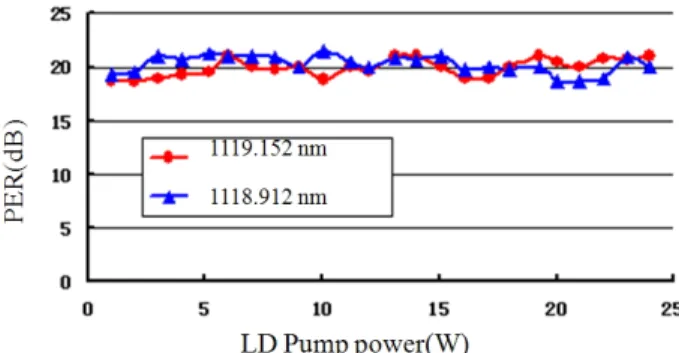
FIG. 6. The PER fluctuations vs. the LD pump.
temperature), the LD pumping wavelength is not matched well with the absorption peak of Yb ions, which induces a significant amount of pumping light leakage in the total spectra. When the pumping power increases, the mismatch between the LD pumping light and the Yb ions absorption peak becomes smaller. Then the pumping light is more efficiently converted to laser. Therefore, if the LD pump wavelength can be stabilized at the absorption peak wavelength of the Yb ions, the optical efficiency as well as the laser output power will be further increased.
When the laser operates at each single-wavelength state, a real-time detection of the PER is implemented from the port1 shown in Fig. 1, and the relationship between the PER vs. the pump power is presented in Fig. 6. When the laser wavelength centers at 1118.912 nm, the average numerical value of the PER is 20.3 dB with a fluctuation between 18.7 dB to 21.5 dB. While when the laser wave-length centers at 1119.152 nm, the average numerical value of the PER is 19.9 dB with a fluctuation between 18.7 dB to 21 dB, respectively.
IV. CONCLUSION
For the first time, a switchable dual-wavelength YDF laser working at a novel wavelength of 1120 nm is illustrated. The output power of 14.67 W is the highest power level having been achieved among the dual-wavelength YDF lasers. The device is highly flexible in view of wavelength switching capability. Additionally, the configuration is simple as it requires only adjusting PCs’ states for many kinds of wavelength oscillation operations. Furthermore, the dual-wavelength fiber laser with ultra-narrow dual-wavelength spacing and orthogonal polarization has potential applications in microwave signal generation and modulation of data on the microwave subcarrier. Through incorporating ultra-narrow dual -transmission-band fiber Bragg grating filter or using a saturable absorber in cavity, the linewidth of the lasing lines can be further decreased. Thus, the single-longitudinal-mode lasing in each wavelength is expected in our configuration.
ACKNOWLEDGMENT
This work is supported by the National Natural Science Funds, China (11304184), the science and technology plan project in colleges and universities in Shandong province (J13LN28), and the Natural Science Foundation of Shandong Province (ZR2013FM007).
REFERENCES
1. H. Ahmad, A. A. Latif, M. Z. Zulkifli, N. A. Awang, and S. W. Harun, “High power dual-wavelength tunable fiber laser in linear and ring cavity configurations,” Chin. Opt. Lett. 10(1), 010603-1-010603-4 (2012).
2. N. Jovanovic, G. D. Marshall, A. Fuerbach, G. E. Town, S. Bennetts, D. G. Lancaster, and M. J. Withford, “Highly narrow linewidth, CW, all-fiber oscillator with a switchable linear polarization,” IEEE Photon. Technol. Lett. 20(10), 809-811 (2008).
3. K. K. Qureshi, “Switchable dual-wavelength fiber ring laser featuring twin-core photonic crystal fiber-based filter,” Chin. Opt. Lett. 12(2), 020605-1-020605-3 (2014).
4. Z. Y. Liu, Y. G. Liu, J. B. Du, S. Z. Yuan, and X. Y. Dong, “Switchable triple-wavelength erbium-doped fiber laser using a single fiber Bragg grating in polarization-maintaining fiber,” Opt. Commun. 279, 168-172 (2007).
5. B. Xu, X. X. Huang, J. L. Lan, Z. Lin, Y. Wang, H. Y. Xu, Z. P. Cai, and R. Moncorge, “Single-and dual-wavelength laser operation of a diode-pumped Nd:LaF3 single crystal around 1.05 mm and 1.32 mm,” Opt. Mater. 57, 158-162 (2016).
6. H. Ahmad, A. A. Latif, J. M. Taib, and S. W. Harun, “Tunable, low frequency microwave generation from AWG based closely-spaced dual-wavelength single-longitudinal-mode fibre laser,” J. Europ. Opt. Soc. Rap. Public. 8, 13038-1-13038-5 (2013).
7. T. G. Sun, Y. B. Guo, T. S. Wang, J. Y. Huo, and L. Zhang, “Dual-wavelength single longitudinal mode fiber laser for microwave generation,” Opt. Laser Technol. 67, 143-145 (2015). 8. B. Yin, S. C. Feng, Z. B. Liu, Y. L. Bai, and S. S. Jian,
“Tunable and switchable dual-wavelength single polarization narrow linewidth SLM erbium-doped fiber laser based on a PM-CMFBG filter,” Opt. Express 22 (19), 22528-22533 (2014).
9. Z. Li, J. Zhou, B. He, H. K. Liu, C. Liu, Y. R. Wei, J. X. Dong, and Q. H. Lou, “Controllable Dual-Wavelength Fiber Laser,” Chin. Phys. Lett. 29(7), 074203-1-074203-3 (2012). 10. M. R. Quan, Y. Li, J. J. Tian, and Y. Yao, “Multifunctional
tunable multiwavelength erbium-doped fiber laser based on tunable comb filter and intensity-dependent loss modulation,” Opt. Commun. 340, 63-68 (2015).
11. X. Q. Mao, F. P. Yan, L. Wang, S. C. Feng, J. Peng, and S. S. Jian, “Incorporate, switchable dual-wavelength fiber laser with Bragg gratings written in a polarization-maintaining erbium-doped fiber,” Opt. Commun. 282, 93-96 (2009). 12. D. F. Liu and C. H. Wang, “Single linearly polarized, widely
and freely tunable two wavelengths Yb3+-doped fiber laser,” Opt. Commun. 283, 98-103 (2010).
13. D. Z. Yang, P. P. Jiang, Y. X. Wang, B. Wu, and Y. H. Shen, “Dual-wavelength high-power Yb-doped double-clad fiber laser based on a few-mode fiber Bragg grating,” Opt. Laser Technol. 42, 575-579 (2010).
14. D. E. Ceballos-Herrera, I. Torres-Gomez, A. Martinez- Rios, G. Anzueto-Sanchez, and Y. Barmenkov, “Single-to
three-wavelength switchable ytterbium-doped fiber laser based on intracavity induced loss by a long-period holey fiber grating,” Opt. Laser Technol. 43, 825-829 (2011).
15. G. X. Liu and D. J. Feng, “Single- and dual-wavelength switchable linear polarized Yb3+-doped double-clad fiber laser,” Appl. Optics. 54(14), 4309-4312 (2015).