대한마취과학회지 2005; 48: S 34∼7
□ 영문논문 □ Korean J Anesthesiol Vol. 48, No. 6, June, 2005
S 34 INTRODUCTION
Generally, the acute physiology and chronic health evaluation (APACHE) II score is regarded as a precise predictor of the mortality rate of severely ill patients and as a guideline for active treatment plans for critically ill patients.1) In addition, the APACHE II score has been used commonly as a basic re-search tool for treatment planning of the critically ill patients. Because a lower APACHE II score indicates a better prog-nosis, these patients are more likely to benefit from the impro-ved patient's management than those with a higher APACHE II score. Accordingly, these relatively low risk patients are
obvi-ous targets for decreasing the rate of intensive care unit (ICU) mortality. In the view of cost-effectiveness, the APACHE II score has played a major role in predicting the patient's prog-nosis and determining the degree of active treatment.2) So, it would be valuable to know the clinical characteristics of pati-ents who died despite of low APACHE II score after intensive care.
This study investigated the clinical characteristics of those patients who died despite having a low APACHE II score af-ter intensive care.
MATERIALS AND METHODS
This study reviewed the medical records of 729 patients, ad-mitted to the general ICU of the University Hospital from Jun 1, 2001 to May 31, 2002, whose admission APACHE II sco-res were 10 or less.
The patients were divided in two groups. The expired group Background: The acute physiology and chronic health evaluation (APACHE) II score is considered to be a precise predictor of mortality and a useful basic research tool. A lower APACHE II score means a better prognosis of patients, which means that these relatively low risk patients are more likely to benefit from the improved patient management than the higher predicted mortality admissions. Therefore, these patients are obvious targets for intensive care and for decreasing the level of intensive care unit (ICU) mortality.
Methods: This study reviewed the medical records of 729 patients, whose APACHE II scores on the ICU admission day were 10 or less, from June 1, 2001 to May 31, 2002 in University Hospital. The data of the patient's age, gender, disease category, first admission or readmission, APACHE II score, length of stay at the ICU and the hospital were reviewed.
Results: The average mortality rate of the patients who had an APACHE II score of 10 or less was 4.1%. The mortality of the cancer patients (8%) was significantly higher than the other disease groups. The mortality of the readmitted patients was significantly higher than the mortality of the patients who were admitted to the ICU for the first time.
Conclusions: Among the patients in the ICU with a low APACHE II score, the mortality of cancer patients was high. The mortality of the readmitted patients was significantly higher than in those on the first admission. (Korean J Anesthesiol 2005; 48: S 34∼7)
ꠏꠏꠏꠏꠏꠏꠏꠏꠏꠏꠏꠏꠏꠏꠏꠏꠏꠏꠏꠏꠏꠏꠏꠏꠏꠏꠏꠏꠏꠏꠏꠏꠏꠏꠏꠏꠏꠏꠏꠏꠏꠏꠏꠏꠏꠏꠏꠏꠏꠏꠏꠏꠏꠏꠏꠏꠏꠏꠏꠏꠏꠏꠏꠏꠏꠏꠏꠏꠏꠏꠏꠏꠏꠏꠏꠏꠏꠏꠏꠏꠏꠏꠏꠏꠏꠏꠏꠏꠏꠏꠏꠏꠏꠏꠏꠏꠏꠏꠏꠏꠏꠏꠏꠏꠏꠏꠏꠏ Key Words: APACHE II score, intensive care unit, mortality.
Clinical Characteristics of the Patients Who Died Despite of
Low APACHE II Score after Intensive Care
1
Department of Anesthesiology and Pain Medicine, 2Anesthesiology and Pain Research Institute, Yonsei University College of Medicine, Seoul, Korea
Chul Ho Chang, M.D.
1, Kee Young Lee, M.D.
1,2, Sang Beom Nam, M.D.
1,2, Jin Woo Bae, M.D.
1and Cheung Soo Shin, M.D.
1,2Received:January 16, 2005
Corresponding to:Cheung Soo Shin, Department of Anesthesiology and Pain Medicine, Yongdong Severance Hospital, 146-92 Dogok-dong, Gangnam-gu, Seoul 135-720, Korea. Tel: 82-2-3497-3522, Fax: 82- 2-3463-0940, E-mail: [email protected]
Chul Ho Chang, et al:Clinical Characteristics of Low APACHE II Score
S 35 was comprised of 30 patients who died at the ICU or general ward after discharge from the ICU, and the survival group comprised of 699 patients who were discharged from the hos-pital after intensive care. The data on the patients' age, gen-der, main disease category of patients, APACHE II score upon admission to the ICU, the length of stay at the ICU, the leng-th of stay at leng-the hospital after discharge from leng-the ICU and leng-the first admission to the ICU or readmission were reviewed. The data except for age, length of stay at the ICU and length of stay at the hospital were analyzed using a Chi-square test (for 2 × 2 tables containing a value less than five, Fish-er's Exact Test). The age, ICU day, hospital day of the two groups were compared using a student t-test. A p value <
0.05 was considered statistically significant. RESULTS
The mortality of the patients who had an APACHE II score of 10 or less at the time of ICU admission was 4.1%. The mean age of the survival and expired group was 59 and 58 years, respectively. The number of ICU days of the survival and expired group was 2.5 ± 3.9 days and 8.5 ± 12.5 days, respectively. Age, gender, the length of stay at the ICU and the length of stay at the hospital of the two groups were not significantly different (Table 1).
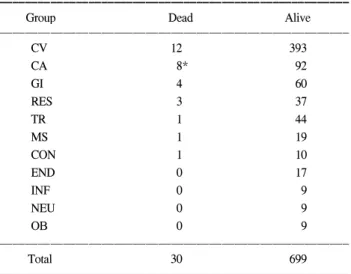
The main disease of these patients was cardiovascular disease (n = 405), cancer (n = 100), gastrointestinal disease (n = 64), trauma (n = 45), and respiratory disease (n = 40). In the can-cer patients 8 out of 100 patients were died, which was a sig-nificantly higher mortality than with the other diseases (Table 2). The number of patients who expired at the ICU, in the gene-ral ward and those of hopeless discharge was 6, 21 and 3, re-spectively. Three among the 30 expired patients and 14 patients among 699 survival patients were readmission cases (Fig. 1).
DISCUSSION
In our hospital, the decision for ICU admission was made under the guidelines for intensive care unit admission, dischar-ge, and triage suggested by the Task Force of the American College of Critical Care Medicine, Society of Critical Care Medicine.3) This system defines those who will most benefit from the ICU (Priority 1) and those who will not benefit at
Table 1. Demographic Data
ꠚꠚꠚꠚꠚꠚꠚꠚꠚꠚꠚꠚꠚꠚꠚꠚꠚꠚꠚꠚꠚꠚꠚꠚꠚꠚꠚꠚꠚꠚꠚꠚꠚꠚꠚꠚꠚꠚꠚꠚꠚꠚꠚꠚꠚꠚꠚꠚꠚꠚꠚꠚꠚꠚꠚ
Group Expired Survival
ꠏꠏꠏꠏꠏꠏꠏꠏꠏꠏꠏꠏꠏꠏꠏꠏꠏꠏꠏꠏꠏꠏꠏꠏꠏꠏꠏꠏꠏꠏꠏꠏꠏꠏꠏꠏꠏꠏꠏꠏꠏꠏꠏꠏꠏꠏꠏꠏꠏꠏꠏꠏꠏꠏꠏ Sex (M/F) 16/14 447/252 Age (yr) 59.5 ± 18.1 58.5 ± 14.8 LOSICU (d) 8.5 ± 12.5 2.5 ± 3.9 LOSH (d) 32 ± 50 6.4 ± 2.3 APACHE II score 6.4 ± 2.3 p7.8 ± 1.8 ꠏꠏꠏꠏꠏꠏꠏꠏꠏꠏꠏꠏꠏꠏꠏꠏꠏꠏꠏꠏꠏꠏꠏꠏꠏꠏꠏꠏꠏꠏꠏꠏꠏꠏꠏꠏꠏꠏꠏꠏꠏꠏꠏꠏꠏꠏꠏꠏꠏꠏꠏꠏꠏꠏꠏ Values are expressed as a mean ± SD. LOSICU: length of stay at the intensive care unit, LOSH: length of stay at the hospital.
Table 2. Disease Distribution of Patients
ꠚꠚꠚꠚꠚꠚꠚꠚꠚꠚꠚꠚꠚꠚꠚꠚꠚꠚꠚꠚꠚꠚꠚꠚꠚꠚꠚꠚꠚꠚꠚꠚꠚꠚꠚꠚꠚꠚꠚꠚꠚꠚꠚꠚꠚꠚꠚꠚꠚꠚꠚꠚꠚꠚꠚ
Group Dead Alive
ꠏꠏꠏꠏꠏꠏꠏꠏꠏꠏꠏꠏꠏꠏꠏꠏꠏꠏꠏꠏꠏꠏꠏꠏꠏꠏꠏꠏꠏꠏꠏꠏꠏꠏꠏꠏꠏꠏꠏꠏꠏꠏꠏꠏꠏꠏꠏꠏꠏꠏꠏꠏꠏꠏꠏ CV 12 393 CA 8* 92 GI 4 60 RES 3 37 TR 1 44 MS 1 19 CON 1 10 END 0 17 INF 0 9 NEU 0 9 OB 0 9 ꠏꠏꠏꠏꠏꠏꠏꠏꠏꠏꠏꠏꠏꠏꠏꠏꠏꠏꠏꠏꠏꠏꠏꠏꠏꠏꠏꠏꠏꠏꠏꠏꠏꠏꠏꠏꠏꠏꠏꠏꠏꠏꠏꠏꠏꠏꠏꠏꠏꠏꠏꠏꠏꠏꠏ Total 30 699 ꠏꠏꠏꠏꠏꠏꠏꠏꠏꠏꠏꠏꠏꠏꠏꠏꠏꠏꠏꠏꠏꠏꠏꠏꠏꠏꠏꠏꠏꠏꠏꠏꠏꠏꠏꠏꠏꠏꠏꠏꠏꠏꠏꠏꠏꠏꠏꠏꠏꠏꠏꠏꠏꠏꠏ CV: cardiovascular disease, CA: cancer, GI: gastrointestinal disease, RES: respiratory disease, TR: trauma, MS: musculoskeletal disease, CON: congenital disease, END: endocrine disease, INF: infectious disease, NEU: nervous system disease, OB: obstetric disease. *: P < 0.05 compared to the other disease groups.
Fig. 1. Mortality of patients admitted for the first time or readmitted to the ICU with an APACHE II score 10 or less. *: P < 0.05 compared with the first admission group.
Korean J Anesthesiol:Vol. 48, No. 6, 2005
S 36 all (Priority 4). Patients with a terminal or irreversible illness are generally not suitable candidates for ICU admission. It is believed that the majority of cancer patients in this study be-longed to Priority 3 or 4. However, if patients with a me-tastatic malignancy and an acute infection or pulmonary edema are admitted to the ICU to relieve the acute illness, the best therapeutic efforts such as intubation and mechanical ventilation are usually made to reverse the acute exacerbated condition. In this study one of the major findings is that the mortality of the cancer patients was significantly higher than that with the other disease.
Among the patients of low APACHE II score, why the mortality of the cancer patients was significantly high can be explained as follows:
First, some investigators have suggested that the duration of the physiological derangements can influence on the outcome independent of the degree.4) This may be an explanation for the illness-severity difference in that cancer patients who are admitted hospital for a long time generally have unmeasured clinical and laboratory abnormalities.
Another explanation may be that there might be a desire for these patients to be transferred to the ICU. This is despite the fact that prior therapy in general ward is a marker for patients who are likely to respond poorly to further therapy. In many cases, the decision to transfer patients to ICU results from the poor response to therapy in a non intensive care setting. Such patients are more likely to respond poorly to therapy in an ICU and have a higher risk of death. A failure to respond to prior therapy has been found to be associated with a poor re-sponse to a subsequent treatment in another clinical setting.5) In addition, all the cancer patients who died were transferred to ICU from a general ward.
Although the mortality rate was not significantly high, cardi-ovascular disease was the most common in expired group. The predictive accuracy of the APACHE II system in cardiovas-cular disease was relatively poor. This can be explained as follows:
First, comparing the patient outcomes in intensive care unit require an accurate assessment of and an adjustment for co- morbid disease. The co-morbid conditions with various diseases were AIDS, hepatic failure, lymphoma, solid tumor with a me-tastasis rather than cardiovascular disease.
Second, the poor predictive accuracy of the admission score can be influenced by this lead time bias, resulting in an un-derestimation of the mortality in patients with an incorrectly
low score.4,6) An explanation for these unmeasured illness-seve-rity differences may be that the therapy, which was received prior to admission to the ICU, affects the relationship between the physiological abnormalities measured in the intensive care unit and patients' risk of death. The APACHE II score that is based on the data obtained within 24 hours of transfer to the ICU are reasonably independent of the treatment in the ICU, but are not independent of the treatment before transfer. This means that when patients with acute ischemic heart disease are admitted to the ICU via emergency room after stabilizing their vital signs, their APACHE II score at the ICU admission time might be low.
Therapy administered to hospital inpatients prior to transfer to the ICU could mask the physiological manifestations of their severe illness by improving the preexisting clinical and laboratory abnormalities more than the underlying disease pro-cess or by blunting the abnormalities associated with an acute condition that necessitated the transfer. This phenomenon is called the lead time bias, because it results from measuring the APACHE II score not at the time when the therapy is ini-tiated, but later in the patient's course of medical care when the physiological variables have changed in response to treat-ment.7)
This study found that the mortality of the readmitted pati-ents was significantly higher than that of the patipati-ents who were admitted ICU for the first time. Both the admission and discharge criteria of the ICUs are critical issues in the allo-cation of limited health care resources. Cullen8) and Jennett9) examined the ICU admission policies, describing the inappro-priate utilization of intensive care facilities. Much less empha-sis has been placed on the discharge criteria.
In hospital readmission is a frequent problem. It has been previously reported that readmissions have a mortality rate 2-3 times that of other MICU patients.10) The major reasons for the high mortality rate appear to be related to the initial pri-mary diagnosis and to the severity of their illness upon read-mission. More than one half of the patients who were charged and readmitted had a recurrence of their original dis-ease. Almost 30% of those patients readmitted to the ICU re-turned due to a complication that was not a direct recurrence of the patient's original disease. These complications were gen-erally not predictable, but ordinary. It is believed that an inter-mediate care unit might be an effective alternative to an early ICU discharge by reducing the likelihood of a premature ICU discharge and hence, reducing the number of readmissions to
Chul Ho Chang, et al:Clinical Characteristics of Low APACHE II Score
S 37 the ICU.
It is apparent that the effective utilization of the intensive care resources depends not only on rational admission policies but also on the appropriate discharge policies.
REFERENCES
1. Knaus WA, Draper EA, Wagner DP, Zimmerman JE: APACH II: A severity of disease classification system. Crit Care Med 1985; 13: 818-29.
2. Glance LG, Osler T, Shinozaki T: Intensive care unit prognostic scoring systems to predict death: A cost-effectiveness analysis. Crit Care Med 1998; 26: 1842-9.
3. Task Force of the American College of Critical Medicine, Society of Critical Care Medicine: Guidelines for intensive care unit ad-mission, discharge, and triage: Crit Care Med 1999; 27: 633-8. 4. Escarce JJ, Kelly MA: Admission source to the medical intensive
care unit predicts hospital death independent of APACHE II score.
JAMA 1990; 264: 2389-94.
5. Rose CC, Murphy JG, Schwartz JS: Performance of an index pre-dicting the response of patients with acute bronchial asthma to in-tensive emergency department treatment. N Engl J Med 1984; 310: 573-7.
6. Dragsted L, Jorgensen J, Jensen NH, Bonsing E, Jacobsen E, Kna-us WA, et al: Interhospital comparisons of patient outcome from intensive care: Importance of lead time bias. Crit Care Med 1989; 17: 418-22.
7. Wagner D, Knaus W, Bergner M: APACHE III study design: an-alytic plan for evaluation of severity and outcome in intensive care unit patients. Statistical methods. Crit Care Med 1989; 17: S194-8. 8. Cullen DJ: Results and costs of intensive care. Anesthesiology
1977; 47: 203.
9. Jennett B: Resource allocation for the severely brain damaged. Arch Neurol 1976; 33: 595-7.
10. Franklin C, Jackson D: Discharge decision-making in a medical ICU: Characteristics of unexpected readmissions. Crit Care Med 1983; 11: 61-6.