Evaluation of Antioxidant and Antimicrobial Activities of Ethanol
Extracts of Three Kinds of Strawberries
Semeneh Seleshe1, Jong Seok Lee2, Sarah Lee2, Hye Jin Lee2, Ga Ryun Kim2, Joohong Yeo2, Jong Yea Kim3, and Suk Nam Kang1
1
Department of Animal Resource, Daegu University, Gyeongbuk 38453, Korea
2National Institute of Biological Resources, Incheon 22689, Korea
3Department of Food Science and Biotechnology, Kangwon National University, Gangwon 24341, Korea
pISSN 2287-1098ㆍeISSN 2287-8602
Received 7 July 2017; Accepted 17 August 2017; Published online 30 September 2017 Correspondence to Suk Nam Kang, Tel: +82-53-850-6726, E-mail: [email protected]
Copyright © 2017 by The Korean Society of Food Science and Nutrition. All rights Reserved.
This is an Open Access article distributed under the terms of the Creative Commons Attribution Non-Commercial License (http://creativecommons.org/licenses/by-nc/4.0) which permits unrestricted non-commercial use, distribution, and reproduction in any medium, provided the original work is properly cited.
ABSTRACT: The antioxidant and antimicrobial activities of three kinds of strawberry ethanol extracts from Robus corchori-folius L. f. (RCL), Rubus parvicorchori-folius L. var. parvicorchori-folius (RPL), and Duchesnea chrysantha Miq. (DCM) were investigated. The RPL was highest (P<0.05) in phenolic, flavonoid, and anthocyanin contents. 2,2-Diphenyl-1-picrylhydrazyl and 2,2’-azi-no-bis(3-ethylbenzothiazoline-6-sulphonic acid) radical scavenging activities of RPL and DCM extracts were higher than that of RCL (P<0.05). Hydrogen peroxide scavenging activity of RPL was high compared to DCM and RCL (P<0.05). RCL exhibited a significant (P<0.05) potent antioxidant activity in nitric oxide radical inhibition. Inhibition diameter zone (nearest mm) of extracts against the test bacteria ranged from 11.5 in RCL to 12.5 in DCM against Staphylococcus aureus, from 10.5 in RCL to 13.5 in DCM against Streptococcus pneumoniae, from 8.5 in DCM to 10.5 in RCL against Escherichia coli, and the same inhibition of 10 mm in three of the extracts against Klebsiella pneumoniae. However, there was no inhibition against fungi Aspergillus niger and Candida albicans. Three of the extracts had the same minimum inhibitory concentration values of 12.50, 12.50, and 6.25 µg/mL against S. aureus, K. pneumoniae, and S. pneumoniae, respectively. On the other hand, MIC values of 12.50, 12.50, and 6.50 µg/mL were recorded for RPL, DCM, and RCL against E. coli, respectively. The result of present study revealed that extracts from three kinds of strawberries could be potential candidates as antioxidant and antimicrobial sources for functional food industries.
Keywords: strawberry, antioxidant, antimicrobial, NO inhibition, minimum inhibitory concentration
INTRODUCTION
Oxidation is one of the major causes of chemical spoil-age, resulting in rancidity and/or deterioration of the nu-tritional quality, color, flavor, texture, and safety of foods (1). Hence, antioxidants have been widely used as food additives to provide protection against oxidative degra-dation of foods (2). The main characteristics of an antiox-idant is its ability to trap free radicals (3). Antioxantiox-idants retard the progress of many chronic diseases as well as lipid peroxidation (4). A number of synthetic antioxi-dants have been added to foodstuffs but, because of tox-icity issues (5) and their adverse reaction such as carci-nogenicity (6), their use is being restricted (5). Attention has therefore been directed toward the development/iso-lation of natural antioxidants from botanical sources, es-pecially edible plants that replace synthetic antioxidants. The spoilage and poisoning of foods by microorganisms
is also a problem that has not yet been brought under adequate control despite the range of robust preservation techniques available. Alike the application of synthetic antioxidants in foods, consumers are increasingly avoid-ing foods prepared with preservatives of chemical origin, and natural alternatives are therefore needed to achieve sufficiently long shelf-life of foods and a high degree of safety with respect to foodborne pathogenic microorgan-isms (7). As a result, there has been an increasing inter-est in different medicinal and dietary plants for their an-tioxidant and antimicrobial potential because the antiox-idant compounds are related to human health, as well as to pharmaceutical and food industries. It has been sug-gested that fruits, vegetables, and plants are the main source of antioxidants in the diet (8). Antioxidant com-pounds of plant sources like phenolic acids, polyphenols, and flavonoids scavenge free radicals such as peroxide, hydroperoxide, or lipid peroxyl and thus inhibit
oxida-tive mechanisms (3). Moreover, the use of plant extracts, with known antimicrobial properties, can be of great sig-nificance in therapeutic treatments. Many plants have been used because of their antimicrobial traits, which are due to compounds synthesized in the secondary metabo-lism of the plant (9). These products are known as the active substances part of essential oils, for example phe-nolic compounds and tannins (10,11). Strawberries are popular due to their desirable sweet taste and attractive aroma, with smooth texture and red color. There were more than 600,000 acres and 3.9 million tons of straw-berries produced worldwide in 2005 (12). Strawstraw-berries are a very good source of dietary fiber, iodine, and folate and are a good source of copper, potassium, biotin, phos-phorus, magnesium, vitamin B6, and omega-3 fatty acids (13). Moreover, they are a rich source for ascorbic acid and contain a diverse range of polyphenols (14,15). Oliveira et al. (16) indicated that strawberries could be beneficial for pharmaceutical applications or food sup-plements. According to Katherine et al. (17), the func-tionality of strawberries is highly associated with their cultivars. The aim of this research was to determine the antioxidant and antimicrobial potential of extracts from three kinds of strawberries: Robus corchorifolius L. f. (RCL), Rubus parvifolius L. var. parvifolius (RPL), and Duchesnea chrysantha Miq. (DCM).
MATERIALS AND METHODS
Extract preparation
Dried samples of three kinds of strawberries were sup-plied by the National Institute of Biological Resources (Incheon, Korea). Each sample (100 g) was extracted with 1,000 mL of 70% ethanol at room temperature for 24 h. The extraction process was repeated three times. The extracted materials were filtered with Whatman No. 3 filter paper (Whatman International Ltd., Kent, UK), concentrated with a rotary evaporator (N-3000, Eyela, Tokyo, Japan), and freeze-dried using a freeze dryer (Biotron, Bucheon, Korea). The extracts were dissolved in dimethyl sulfoxide (DMSO) for analysis.
Measurement of total phenolic content
Total phenolic content was determined with the Folin- Ciocalteu reagent according to a procedure described by Singleton and Rossi (18). Briefly, 0.5 mL of the diluted sample was reacted with 2.5 mL of 0.2 mol/L Folin-Cio-calteu reagent for 4 min, and then 2 mL saturated sodi-um carbonate solution (about 75 g/L) was added into the reaction mixture. The absorbance readings were taken at 760 nm after incubation at room temperature for 2 h. Gallic acid was used as a reference standard, and the re-sults were expressed as milligram gallic acid equivalent
(mg GAE)/g dry weight.
Measurement of total flavonoid content
Total flavonoid was determined using the method of Meda et al. (19) with minor modifications. In brief, 0.25 mL of sample (1 mg/mL) was added to a tube contain-ing 1 mL of double-distilled water. Next, 0.075 mL of 5% NaNO2, 0.075 mL of 10% AlCl3, and 0.5 mL of 1 M NaOH were added at 0, 5, and 6 min, sequentially. Fi-nally, the volume of the reacting solution was adjusted to 2.5 mL with double-distilled water. The absorbance of the solution at a wavelength of 410 nm was detected us-ing spectrophotometer (Ultrospec 2100 pro, Amersham Pharmacia Biotech Co., Piscataway, NJ, USA). Quercetin was used as standard to quantify the total flavonoid con-tent. Results were expressed in milligram quercetin equiv-alents (mg QE)/g dry weight.
Measurement of total anthocyanins
Total anthocyanin was measured using the pH differen-tial method indicated by Giusti and Wrolstad (20). Two flasks were filled with 1 mL of extract each. The first flask was diluted with 4 mL of pH 1.0 buffer (potassium chlo-ride, 0.025 M) and the second one diluted with pH 4.5 buffer (sodium acetate, 0.4 M), separately. Absorbance was measured at 520 and 700 nm in pH 1.0 and 4.5 buf-fers. A molar extinction coefficient of 26,900 L/cm/mol and a molecular weight of 449.2 were used for anthocya-nin calculations. Results were expressed as mg of cyani-din 3-glucoside equivalents (mg CE) per g dry weight. 2,2-Diphenyl-1-picrylhydrazyl (DPPH) radical scavenging activity
The free radical scavenging activity of samples (0.05 to 1 mg/mL in DMSO) was measured using the method of Brand-Williams et al. (21) with some modifications. L- ascorbic acid was used as a standard. The inhibition per-centage was calculated from the following equation:
% Inhibition=A0−A1×100 A0
where A0 is the absorbance of the control and A1 is the absorbance of the sample and the standard compound.
The radical scavenging activity of the tested samples is expressed as the IC50 value. The absorbance was meas-ured by a spectrophotometer at 517 nm.
2,2’-Azino-bis(3-ethylbenzothiazoline-6-sulphonic acid) (ABTS) radical scavenging assay
The ABTS radical scavenging was conducted using the method indicated by Re et al. (22). Briefly, the ABTS rad-ical cation (ABTS+) was produced by reacting 7 mM stock solution of ABTS with 2.45 mM potassium persulfate
and allowing the mixture to stand in the dark, at room temperature, for 12 h before use. The ABTS+ solution was diluted with methanol to an absorbance of 0.70±0.02 at 734 nm. Next, 2.85 mL of this ABTS+ solution was added to 0.15 mL of different concentrations of the sam-ples, and the decrease in absorbance at 734 nm was ob-served after mixing for up to 10 min. The radical scav-enging activity of the tested samples is expressed as the IC50 value. The percentage inhibition of ABTS+ was cal-culated using the formula:
% Inhibition=A0−A1×100 A0
where A0 is the absorbance of the control and A1 is the absorbance of the sample and the standard compound. Nitric oxide (NO) scavenging assay
NO radical inhibition was estimated by the Griess Ilosvay reaction according to Hyoung (23) with slight modifica-tions. Briefly, Griess Ilosvay reagent was modified using naphthyl ethylene diamine dihydrochloride (0.1% w/v) instead of 1-naphthylamine (5%). The reaction mixture (3 mL) containing sodium nitroprusside (10 mM, 2 mL), phosphate buffer saline (0.5 mL), and the extract (0.2∼1.0 mg/mL) were incubated at 25oC for 150 min. After incubation, 0.5 mL of the reaction mixture was mixed with 1 mL sulfanilic acid reagent (0.33% in 20% glacial acetic acid) and allowed to stand for 5 min for completion of the reaction process of diazotization. Then, 1 mL of naphthyl ethylene diamine dihydrochoride was added, mixed and was allowed to stand for 30 min at 25oC. The absorbance was measured at 546 nm. Butylated hydroxyanisole was used as a standard. The percent in-hibition was calculated using the formula:
Scavenging effect (%)=A0−A1×100 A0
where A0 is the absorbance of the control and A1 is the absorbance of the sample and the standard compound. Antimicrobial test using the disc diffusion method
The samples were dissolved in DMSO and filtered through 0.45 μm Millipore membrane filters. The micro-bial strains used in the experiment were purchased as lyophilized samples from the Microbial Resource Center, Korea Research Institute of Bioscience and Biotechnolo-gy, Daejeon, Korea. Gram-positive bacteria [Staphylococcus aureus subsp. aureus (KCTC 1929) and Streptococcus pneu-moniae (KCTC 5412)], Gram-negative bacteria [Klebsiella pneumoniae subsp. pneumoniae (KCTC 2208) and Escherichia coli (KCTC 1682)], and fungi [Aspergillus niger (KCTC 6971) and Candida albicans (KCTC 7007)] were used for
antimicrobial tests of the extracts. The obtained strains were inoculated with trypticase soy broth and incubated at 37oC for 24 h. The antimicrobial test was then carried out using the disc diffusion method by Bauer et al. (24). One hundred μL of each bacterial suspension contained 108 CFU/mL, and each fungal culture was standardized to 105 CFU/mL and was spread on nutrient agar medi-um. Then, 10 to 80 μL (with 10 mg/mL stock samples) per disk was impregnated into 8 mm diameter sterile discs (Toyo Roshi Kaisha, Ltd., Tokyo, Japan), and the disks were allowed to dry for 24 h in the dark at room temperature. The impregnated discs were placed on the inoculated agar and incubated at 37oC for 24 h for clini-cal bacterial strains and 96 h for fungal strains. Antimi-crobial activity was evaluated by measuring the zone of inhibition against the tested organisms. Each assay in this experiment was repeated two times.
Determination of the minimum inhibitory concentration (MIC)
The MIC values were defined as the lowest concentra-tion of the extracts that inhibited the growth of the mi-cro-organism. MIC of extracts was evaluated with resa-zurin based microtiter dilution assay as follow: under aseptic conditions, 96 well microtitre plates (Tarsons Products Pvt. Ltd., Kolkata, India) were used, and the first wells of the microtiter plate were filled with 100 μL of test materials (from 1,000 μg/mL extract stock sol-ution). The 2nd to 10th wells of the microtitre plates were filled with 50 μL of sterile water. Two fold serial dilution (throughout 2nd to 10th wells) was achieved by transferring 50 μL test material from the first wells to the subsequent wells (the next well) of the same row so that each well had 50 μL of test material in serially de-scending concentrations. From the 10th wells, 50 μL was removed. The working solution of extracts (100 μg/mL) was diluted out across a 96-well in a two-fold serial dilu-tion to give final testing concentradilu-tions of 50, 25, 12.5, 6.25, 3.12, 1.56, 0.78, 0.39, 0.195, and 0.098 μg/mL. Each microtiter plate had a set of 2 controls: (a) a con-trol with test organism without test extract as positive control (11th wells) and (b) a control with all solutions except test organism (12th wells) to confirm that no con-tamination occurred while preparing the plate. Then, a volume of 20 μL was taken from bacterial and fungal suspensions (test organisms) and added to each well. The plates were incubated in a temperature controlled in-cubator at 37oC for 24 h for bacteria and 48 h for fungi. After the period of incubation, 80 μL resazurin dyes was added and re-incubated for 2 h for color development. Finally, the color change in the well was observed visu-ally. The inhibitory concentration was indicated by the blue coloration of the wells following the addition of re-sazurin. A change of color from blue to red indicated the
Table 1. Total polyphenol, flavonoid, and anthocyanin contents of ethanol extracts from different kinds of strawberries
RCL RPL DCM
Total polyphenol (mg GAE/g) 123.95±3.24b 177.11±3.94a 118.91±3.20c
Total flavonoid (mg QE/g) 11.44±0.42c 26.09±2.36a 20.47±0.14b
Total anthocyanin (mg CE/g) 24.56±4.02b 66.00±5.31a 36.44±3.80b
Data represent mean±standard deviation.
Different letters (a-c) within the row indicate significant differences at P <0.05.
RCL, Robus corchorifolius L. f.; RPL, Rubus parvifolius L. var. parvifolius; DCM, Duchesnea chrysantha Miq. GAE, gallic acid equivalent; QE, quercentin equivalent; CE, cyanidin-3-glucoside equivalent.
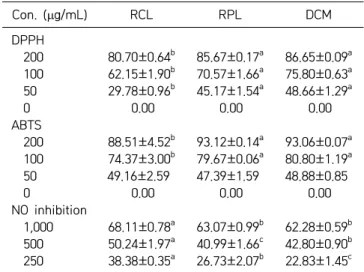
Table 2. Antioxidant capacities and nitric oxide (NO) inhibition of ethanol extracts from different kinds of strawberries
(unit: %) Con. (µg/mL) RCL RPL DCM DPPH 200 80.70±0.64b 85.67±0.17a 86.65±0.09a 100 62.15±1.90b 70.57±1.66a 75.80±0.63a 50 29.78±0.96b 45.17±1.54a 48.66±1.29a 0 0.00 0.00 0.00 ABTS 200 88.51±4.52b 93.12±0.14a 93.06±0.07a 100 74.37±3.00b 79.67±0.06a 80.80±1.19a 50 49.16±2.59 47.39±1.59 48.88±0.85 0 0.00 0.00 0.00 NO inhibition 1,000 68.11±0.78a 63.07±0.99b 62.28±0.59b 500 50.24±1.97a 40.99±1.66c 42.80±0.90b 250 38.38±0.35a 26.73±2.07b 22.83±1.45c Data represent mean±standard deviation.
Different letters (a-c) within the row indicate significant differ-ences at P <0.05.
DPPH, 2,2-diphenyl-1-picrylhydrazyl radical scavenging activity; ABTS, 2,2’-azino-bis(3-ethylbenzothiazoline-6-sulphonic acid) radical scavenging activity.
RCL, RPL, and DCM are described in Table 1.
presence of live micro-organisms. All the experiments were performed in triplicates. The average values were calculated for the MIC of test material.
Statistical analysis
The data were analyzed using the General Linear Model’s procedure using SAS version 8.1 (SAS Institute, Cary, NC, USA). The significance of differences among means of treatments was determined. Duncan’s multiple range test (P<0.05) was done to compare variations between samples.
RESULTS AND DISCUSSION
Total phenolic, total flavonoid, and total anthocyanin con-tents of extracts
The health benefits attributed to polyphenols in the diet have stimulated research to investigate the total antioxi-dant activity of different fruits and vegetables. Strawber-ries are a good source of dietary antioxidants (25). In this research, as shown in Table 1, the ethanolic extracts from three different kinds of strawberries showed signif-icant differences in their total phenolic, total flavonoid, and total anthocyanin contents (P<0.05). It is known that phenolic compounds are important plant constitu-ents because of their free radicals scavenging ability fa-cilitated by their hydroxyl group, and the total phenolic concentration could be used as basis for rapid screening of antioxidant activity (26). Of the three different kinds of strawberries extracts, a significant (P<0.05) total phenolic content was found in RPL extract; in their total phenolic content, extracts were ranked as follows: RPL (177.11 mg GAE/g)> RCL (123.95 mg GAE/g)> DCM (118.91 mg GAE/g). Flavonoids are one of the most di-verse and widespread group of compounds and are prob-ably the most important natural phenolics. These com-pounds possess a broad spectrum of chemical and biolog-ical activities including radbiolog-ical scavenging properties (27). The investigation for total flavonoid content of three dif-ferent kinds of strawberries extracts showed a signifi-cant (P<0.05) content in the RPL extract (26.09 mg QE/ g) as compared to both DCM and RCL extracts (11.44 and 20.47 mg QE/g, respectively) (Table 1). The order of
total anthocyanin content of the three extracts were ranked as follows: RPL (66.00 mg CE/g)> DCM (36.44 mg CE/g)> RCL (24.56 mg CE/g). The extract from RPL had the highest (P<0.05) amount of antioxidants com-pared to RCL and DCM (Table 1).
Antioxidant activity of extracts
The DPPH radical and ABTS radical cation scavenging assays are widely used to determine the radical scaveng-ing ability of samples (21,22). Therefore, the radical scav-enging activities of ethanol extracts of strawberries were determined by these assays. Extracts had a similar trend of antioxidant activities under three concentrations levels (200, 100, and 50 μg/mL) used. Ethanolic extracts from three kinds of strawberries were significantly (P<0.05) different in their DPPH radical scavenging activities (Ta-ble 2). In the presence of 200 μg/mL concentration, the free DPPH radical inhibitions of extracts were ranked as follows: DCM (86.65%)> RPL (85.67%)> RCL (80.70 %). The IC50, the concentration of extract required to
Table 3. IC50 of antioxidant capacities of ethanol extracts from
different kinds of strawberries (unit: µg/mL)
RCL RPL DCM Standard (Ascorbic acid) DPPH 52.80±3.23b 46.69±4.21c 67.85±1.32a 1.64±0.38d ABTS 53.86±5.13a 51.38±1.11a 49.73±1.12b 8.84±0.67c Data represent mean±standard deviation.
Different letters (a-d) within the row indicate significant differ-ences at P <0.05.
DPPH, 2,2-diphenyl-1-picrylhydrazyl radical scavenging activity; ABTS, 2,2’-azino-bis(3-ethylbenzothiazoline-6-sulphonic acid) radical scavenging activity.
RCL, RPL, and DCM are described in Table 1.
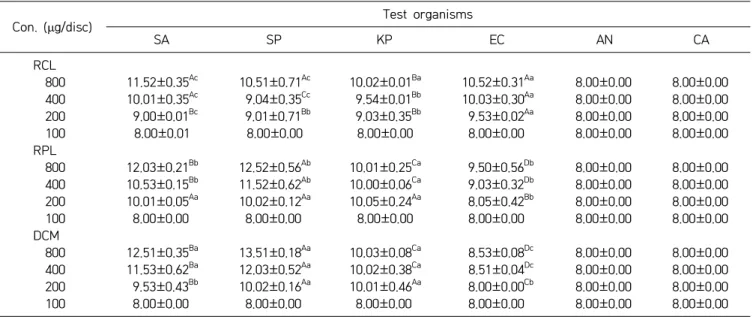
Table 4. The antimicrobial activities of ethanol extracts from different kinds of strawberries against 6 microorganisms Con. (µg/disc) Test organisms SA SP KP EC AN CA RCL 800 11.52±0.35Ac 10.51±0.71Ac 10.02±0.01Ba 10.52±0.31Aa 8.00±0.00 8.00±0.00 400 10.01±0.35Ac 9.04±0.35Cc 9.54±0.01Bb 10.03±0.30Aa 8.00±0.00 8.00±0.00 200 9.00±0.01Bc 9.01±0.71Bb 9.03±0.35Bb 9.53±0.02Aa 8.00±0.00 8.00±0.00 100 8.00±0.01 8.00±0.00 8.00±0.00 8.00±0.00 8.00±0.00 8.00±0.00 RPL 800 12.03±0.21Bb 12.52±0.56Ab 10.01±0.25Ca 9.50±0.56Db 8.00±0.00 8.00±0.00 400 10.53±0.15Bb 11.52±0.62Ab 10.00±0.06Ca 9.03±0.32Db 8.00±0.00 8.00±0.00 200 10.01±0.05Aa 10.02±0.12Aa 10.05±0.24Aa 8.05±0.42Bb 8.00±0.00 8.00±0.00 100 8.00±0.00 8.00±0.00 8.00±0.00 8.00±0.00 8.00±0.00 8.00±0.00 DCM 800 12.51±0.35Ba 13.51±0.18Aa 10.03±0.08Ca 8.53±0.08Dc 8.00±0.00 8.00±0.00 400 11.53±0.62Ba 12.03±0.52Aa 10.02±0.38Ca 8.51±0.04Dc 8.00±0.00 8.00±0.00 200 9.53±0.43Bb 10.02±0.16Aa 10.01±0.46Aa 8.00±0.00Cb 8.00±0.00 8.00±0.00 100 8.00±0.00 8.00±0.00 8.00±0.00 8.00±0.00 8.00±0.00 8.00±0.00
Data represent mean±standard deviation.
Means in column (a-c) are significant different within the same concentration and microorganism.
Means in row (A-D) are significant different with the different microorganisms within the same concentration. RCL, RPL, and DCM are described in Table 1.
SA, Staphylococcus aureus; SP, Streptococcus pneumoniae; KP, Klebsiella pneumoniae; EC, Escherichia coli; AN, Aspergillus niger; CA, Candida albicans.
quench 50% of test radical, is inversely proportional to the scavenging activities of the extracts. In their increas-ing DPPH IC50, extracts were order as follow: ascorbic acid (1.64 μg/mL)< RPL (46.69 μg/mL)< RCL (52.80 μg/mL)< DCM (67.85 μg/mL) (Table 3). In the ABTS assay, radicals are deactivated by single electron transfer. This method is common and simple for fast assessment of antioxidant activity of various plants extracts (28). The ethanolic extracts of three kinds of strawberries exhib-ited strong ABTS radicals scavenging activities as shown in Table 2. Extracts from RPL and DCM had a significant higher (P<0.05) scavenging activity than RCL. The de-scending order of ABTS radical scavenging activity of ex-tracts was as follows: RPL (93.12%), DCM (93.06%)> RCL (88.51%). The IC50 of ABTS values of the standard (ascorbic acid), and ethanol extracts of DCM, RPL, and RCL were 8.84, 49.73, 51.38, and 53.86 μg/mL,
respec-tively (Table 3). NO is a diffusible free radical, which plays many important roles as an effector molecule in di-verse biological systems including vasodilation, neuronal messenger, and antimicrobial and antitumor activities (29). The result for NO radical scavenging activity of three kinds of strawberries is presented in Table 2. Ex-tracts had significant differences (P<0.05) in their NO radical scavenging activity; among the three types of ex-tracts, RCL had the highest scavenging activity at 1 mg/ mL sample concentration. The NO radical scavenging ability (percentage) of extracts were ranked in descending order as follows: RCL (68.11%)> RPL (63.07%)> DCM (62.28%).
Disc diffusion antimicrobial activity of extracts
In present study, the antibacterial activity of extracts from three kinds of strawberries against four strains of bacteria; two Gram-positive (S. aureus and S. pneumoniae) and two Gram-negative (K. pneumoniae and E. coli) were evaluated using the disc diffusion assay. The inhibitory activity examined was at four concentration levels of samples: 800, 400, 200, and 100 μg/disc as shown in Ta-ble 4. The inhibitory activity of extracts showed a similar trend at different concentrations for the same test organ-isms, and their effectiveness increased as the sample concentration increased from 200 μg/disc. At the lowest concentration of 100 μg/disc, the extracts exhibited no inhibition for all test organisms. A comparison of the in-hibitory effect among samples was done with 800 μg/mL concentration. Extracts from three kinds of strawberries exhibited potent antimicrobial activity against
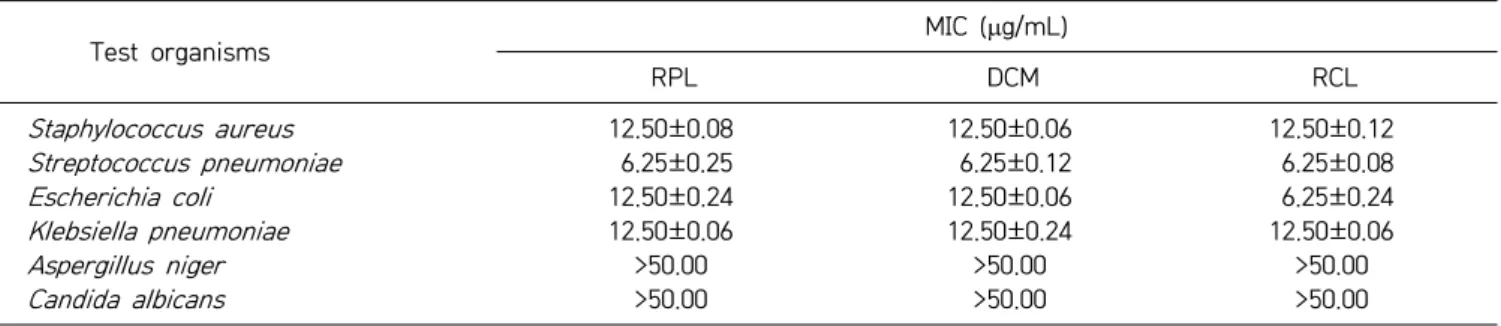
Gram-pos-Table 5. Minimum inhibitory concentration (MIC) values of ethanol extracts from different kinds of strawberries against 6 micro-organisms
Test organisms MIC (µg/mL)
RPL DCM RCL Staphylococcus aureus 12.50±0.08 12.50±0.06 12.50±0.12 Streptococcus pneumoniae 6.25±0.25 6.25±0.12 6.25±0.08 Escherichia coli 12.50±0.24 12.50±0.06 6.25±0.24 Klebsiella pneumoniae 12.50±0.06 12.50±0.24 12.50±0.06 Aspergillus niger >50.00 >50.00 >50.00 Candida albicans >50.00 >50.00 >50.00
Data represent mean±standard deviation. RCL, RPL, and DCM are described in Table 1. >50: Inhibition is not found until up to 50 µg/mL.
itive bacteria, S. aureus, and the inhibitory activity was significantly different (P<0.05) from other bacteria. It is known that S. aureus is one of the most common Gram- positive bacteria causing food poisoning. Its source is not food itself but humans who contaminate foods after they have been processed (7). Extracts from three kinds of strawberries affected this bacterium. Based on their effectiveness, they can be ranked as DCM> RPL> RCL with zone of inhibition of 12.5, 12.0, and 11.5 mm, re-spectively. Similarly, the extracts were found to possess high antimicrobial activity against Gram-positive S. pneu-moniae and were significantly (P<0.05) varying in their antimicrobial activities. From three kinds of strawberry extracts, DCM and RPL had a significant (P<0.05) pow-erful inhibitory activity against S. pneumoniae compared to RCL with 13.5, 12.5, and 10.5 mm zone of inhibition, respectively. S. pneumonia or Streptococcus pneumoniacoccus, is a member of the genus Streptococcus. This Gram-posi-tive bacteria is α-hemolytic and a bile soluble aerotolerant anaerobe (30). Extracts significantly differed (P<0.05) in the inhibitory effect against the two Gram-negative bac-teria tested. Three kinds of strawberry extracts had the same inhibitory effect against K. pneumoniae with 10 mm zone of inhibition. The inhibition effect of extracts against E. coli was also significantly varying (P<0.05) from one to another. Based on their inhibitory effect, extracts can be ranked as RCL> RPL> DCM having the zone of in-hibition of 10.5, 9.5, and 8.5 mm, respectively. In the present study, extracts were observed to have a more potent inhibitory activity against Gram-positive bacteria than Gram-negative and were inactive against fungi. This finding is agreement with previous studies conducted on different plants for antimicrobial activity (31,32). The reason for the difference in sensitivity between Gram- positive and Gram-negative bacteria may be related to their cell wall structure. The resistance of Gram-negative bacteria towards antibacterial substances may be due to the outer phospholipidic membrane carrying structural lipopolysaccharide components of a selective barrier to the hydrophilic solution (33). The antifungal effect of
ex-tracts was tested against two fungi strains, A. niger and C. albicans, and the results are shown in Table 4. Extracts from three kinds of strawberries did not have inhibitory activity against the tested fungi; this calls for further study using concentrations above 800 μg/disc which was used in the present study. Based on the antimicrobial ac-tivity results of the present study, it can be suggested that extracts from RCL, RPL, and DCM can be beneficial candidates as antibacterial sources for functional food in-dustries. Moreover, their inhibitory activity was specially promising for potential against Gram-positive bacteria, S. pneumoniae and S. aureus.
MIC of extracts
In microbiology, the MIC is the lowest concentration of an antimicrobial (like an antifungal, antibiotic, or bacter-iostatic) drug that will inhibit the viable growth of a mi-croorganism after overnight incubation (34). The MICs for strawberry extracts against the examined bacterial strains and fungi are presented in Table 5. All three kinds of strawberry extracts (RPL, DCM, and RCL) exhibited marked antimicrobial potential after determining their MIC against the tested bacteria. The results showed that MIC of different extracts of strawberry against bacterial strains ranged from 6.25 μg/mL to 12.5 μg/mL and no inhibition was observed for fungi up to the highest con-centration, 50 μg/mL. In this study, the extracts from RPL, DCM, and RCL had the same growth inhibitory ac-tivity for the two Gram-positive bacteria, S. pneumoniae and S. aureus, with MIC values of 6.25 and 12.5 μg/mL, respectively. MICs are defined as the lowest concentra-tion of antimicrobial that will inhibit the visible growth of a micro-organism after overnight incubation. S. pneu-moniae was found to be more susceptible to the action of all three kinds of strawberries; this bacterium can be in-hibited with RPL, DCM, and RCL extracts at the same MIC values of 6.25 μg/mL concentration. Comparing the MIC values of extracts, the lowest value for the Gram- negative bacteria, E. coli, was exhibited by the RCL sam-ple at 6.25 μg/mL concentration. Extracts from RPL and
DCM had the same MIC of 12.5 μg/mL for E. coli. For the other Gram-negative bacteria, K. pneumoniae, all three kinds of strawberries exhibited the same MIC val-ues of 12.5 μg/mL of extracts. In the present study, the MIC values at 6.25 μg/mL concentration could be ach-ieved against S. pneumoniae by the three extracts and against E. coli from RCL extract. For two bacteria strains, S. aureus and K. pneumoniae, the three extracts could ex-hibit the same MIC values at 12.5 μg/mL concentrations. The difference in MIC of extracts against different strains of bacteria is indicative of the importance of selecting specific kinds of strawberry extracts for target bacteria. For fungi, it was not possible to determine MIC values, due to the absence of, or only weak, antifungal activities up to 50 μg/mL samples concentration used in the cur-rent study. However, extracts could have MIC values as the concentrations get stronger.
ACKNOWLEDGEMENTS
This work was supported by a grant from the National Institute of Biological Resources (NIBR), funded by the Ministry of Environment (MOE) of the Republic of Korea (NIBR201628101).
AUTHOR DISCLOSURE STATEMENT
The authors declare no conflict of interest.
REFERENCES
1. Antolovich M, Prenzler PD, Patsalides E, McDonald S, Robards K. 2002. Methods for testing antioxidant activity. Analyst 127: 183-198.
2. Gülçin I, Berashvili D, Gepdiremen A. 2005. Antiradical and antioxidant activity of total anthocyanins from Perilla panki-nensis decne. J Ethnopharmacol 101: 287-293.
3. Wu YY, Li W, Xu Y, Jin EH, Tu YY. 2011. Evaluation of the antioxidant effects of four main theaflavin derivatives through chemiluminescence and DNA damage analyses. J Zhejiang Univ Sci B 12: 744-751.
4. Kinsella JE, Frankel E, German B, Kanner J. 1993. Possible mechanisms for the protective role of antioxidants in wine and plant foods. Food Technol 47: 85-89.
5. Valentão P, Fernandes E, Carvalho F, Andrade PB, Seabra RM, Bastos ML. 2002. Antioxidative properties of cardoon (Cyna-ra cardunculus L.) infusion against superoxide (Cyna-radical, hydrox-yl radical, and hypochlorous acid. J Agric Food Chem 50: 4989- 4993.
6. Anbudhasan P, Surendraraj A, Karkuzhali S, Sathishkumaran S. 2014. Natural antioxidants and its benefits. Int J Food Nutr Sci 3: 225-232.
7. Rauha JP, Remes S, Heinonen M, Hopia A, Kähkönen M, Kujala T, Pihlaja K, Vuorela H, Vuorela P. 2000. Antimicro-bial effects of Finnish plant extracts containing flavonoids and other phenolic compounds. Int J Food Microbiol 56: 3-12.
8. Sravani T, Paarakh PM. 2012. Antioxidant activity of Hedychi-um spicatHedychi-um Buch.-Ham rhizomes. Indian J Nat Prod Resour 3: 354-358.
9. Nascimento GGF, Locatelli J, Freitas PC, Silva GL. 2000. An-tibacterial activity of plant extracts and phytochemicals on antibiotic-resistant bacteria. Braz J Microbiol 31: 247-256. 10. Janssen AM, Scheffer JJ, Baerheim Svendsen A. 1987.
Anti-microbial activity of essential oils: a 1976-1986 literature re-view. Aspects of the test methods. Planta Med 40: 395-398. 11. Saxena G, McCutcheon AR, Farmer S, Towers GHN, Hancock REW. 1994. Antimicrobial constituents of Rhus glabra. J Ethnopharmacol 42: 95-99.
12. Skrovankova S, Sumczynski D, Mlcek J, Jurikova T, Sochor J. 2015. Bioactive compounds and antioxidant activity in dif-ferent types of berries. Int J Mol Sci 16: 24673-24706. 13. The World’s Healthiest Foods. 2017. Strawberries. http://
whfoods.org/genpage.php?tname=foodspice&dbid=32 (accessed Jan 2017).
14. Aaby K, Ekeberg D, Skrede G. 2007. Characterization of phe-nolic compounds in strawberry (Fragaria×ananassa) fruits by different HPLC detectors and contribution of individual com-pounds to total antioxidant capacity. J Agric Food Chem 55: 4395-4406.
15. Buendía B, Gil MI, Tudela JA, Gady AL, Medina JJ, Soria C, López JM, Tomás-Barberán FA. 2010. HPLC-MS analysis of proanthocyanidin oligomers and other phenolics in 15 straw-berry cultivars. J Agric Food Chem 58: 3916-3926.
16. Oliveira I, Coelho V, Baltasar R, Pereira JA, Baptista P. 2009. Scavenging capacity of strawberry tree (Arbutus unedo L.) leaves on free radicals. Food Chem Toxicol 47: 1507-1511. 17. Meyers KJ, Watkins CB, Pritts MP, Liu RH. 2003. Antioxidant
and antiproliferative activities of strawberries. J Agric Food Chem 51: 6887-6892.
18. Singleton VL, Rossi JR. 1965. Colorimetry of total phenolics with phosphomolybdic-phosphotungstic acid reagents. Am J Enol Vitic 16: 144-158.
19. Meda A, Lamien CE, Romito M, Millogo J, Nacoulma OG. 2005. Determination of the total phenolic, flavonoid and pro-line contents in Burkina Fasan honey, as well as their radical scavenging activity. Food Chem 91: 571-577.
20. Giusti MM, Wrolstad RE. 2001. Characterization and meas-urement of anthocyanins by UV-visible spectroscopy. In Cur-rent Protocols in Food Analytical Chemistry. Wrolstad RE, Acree TE, Decker EA, Penner MH, Reid DS, Schwartz SJ, Shoemaker CF, Smith DM, Sporns P, eds. John Wiley & Sons, New York, NY, USA. p 1-13.
21. Brand-Williams W, Cuvelier ME, Berset C. 1995. Use of a free radical method to evaluate antioxidant activity. LWT-Food Sci Technol 28: 25-30.
22. Re R, Pellegrini N, Proteggente A, Pannala A, Yang M, Rice- Evans C. 1999. Antioxidant activity applying an improved ABTS radical cation decolorization assay. Free Radic Biol Med 26: 1231-1237.
23. Lee HS. 1992. Antioxidative activity of browning reaction products isolated from storage-aged orange juice. J Agric Food Chem 40: 550-552.
24. Bauer AW, Kirby WM, Sherris JC, Turck M. 1996. Antibiotic susceptibility testing by a standardized single disk method. Am J Clin Pathol 45: 493-496.
25. Sun J, Chu YF, Wu X, Liu RH. 2002. Antioxidant and anti-proliferative activities of common fruits. J Agric Food Chem 50: 7449-7454.
26. Yi O, Jovel EM, Towers GH, Wahbe TR, Cho D. 2007. Anti-oxidant and antimicrobial activities of native Rosa sp. from British Columbia, Canada. Int J Food Sci Nutr 58: 178-189. 27. Miliauskas G, Venskutonis PR, van Beek TA. 2004. Screening
plant extracts. Food Chem 85: 231-237.
28. Prior RL, Wu X, Schaich K. 2005. Standardized methods for the determination of antioxidant capacity and phenolics in foods and dietary supplements. J Agric Food Chem 53: 4290- 4302.
29. Kalola J, Sha MB. 2006. Free radical scavenging activity of Inula cappa. Ars Pharmaceutica 47: 385-401.
30. Dagan R. 2000. Treatment of acute otitis media-challenges in the era of antibiotic resistance. Vaccine 19: S9-S16. 31. Rabanal RM, Arias A, Prado B, Hernández-Pérez M, Sánchez-
Mateo CC. 2002. Antimicrobial studies on three species of Hypericum from the Canary Islands. J Ethnopharmacol 40: 287- 292.
32. Pereira JA, Oliveira I, Sousa A, Valentão P, Andrade PB, Ferreira IC, Ferreres F, Bento A, Seabra R, Estevinho L. 2007. Walnut (Juglans regia L.) leaves: phenolic compounds, anti-bacterial activity and antioxidant potential of different culti-vars. Food Chem Toxicol 45: 2287-2295.
33. Nikaido H, Vaara M. 1985. Molecular basis of bacterial outer membrane permeability. Microbiol Rev 49: 1-32.
34. Boundless Microbiology. 2016. Measuring Drug Susceptibil-ity. https://www.boundless.com/microbiology/textbooks/ boundless-microbiology-textbook/antimicrobial-drugs-13/ measuring-drug-susceptibility-157/minimal-inhibitory-co ncentration-mic-790-10813/ (accessed Dec 2016).