1. Introduction
Company transparency in disclosing the information is very important for building trust, managing risk, and enhancing and maintaining the company’s reputation. Stakeholders think company transparency will help understand the business and make the right decisions. Mironiuc et al., (2013) suggest that information that flows and often becomes society’s demand from companies is information about Print ISSN: 2288-4637 / Online ISSN 2288-4645
doi:10.13106/jafeb.2021.vol8.no6.0889
Company Characteristics, Disclosure of Social Responsibility, and Its
Impact on Company Performance: An Empirical Study in Indonesia
Nurul HIDAYAH1, Lucky NUGROHO2, Hendi PRIHANTO3, Dwi PRIHANTINI4 Received: March 10, 2021 Revised: May 08, 2021 Accepted: May 15, 2021
Abstract
Corporate Social Responsibility (CSR) is the obligations that the company must carry out. It follows Law no. 40 of 2007 concerning limited liability company article 74, which regulates the obligation to carry out social and environmental responsibility. CSR is needed so that stakeholders, including the community, know all forms of corporate responsibility to society and the environment. Company characteristics such as company size, company type, and leverage are factors why a company must disclose its CSR. CSR will gain the community’s trust so that it will have an impact on improving company performance. The purpose of this study is to obtain evidence and to draw conclusions on whether the factors of company size, leverage, and type of company affect CSR disclosure. The data in this study uses multiple regression analysis with secondary data and purposive sampling. The results suggest that type and leverage significantly affect CSR disclosure; the size variable does not affect CSR disclosure. The CSR variable does not affect return on assets (ROA). Company characteristics variables (type, leverage, and size) do not affect ROA. This research is expected to contribute both academically and practically to increasing the academic community’s expertise, competence, and knowledge.
Keywords: Company Characteristics, CSR Disclosure, Financial Performance JEL Classification Code: G34, O16, G23, G32
corporate social and environmental responsibility (Deegan, 2013). Social responsibility or corporate social responsibility (CSR) is a concept that discusses how companies are given various forms of responsibility to all stakeholders (Agustia et al., 2019). Stakeholders will be aware and concerned about the impact of the company’s strategy and operating activities on them and the wider community (Iatridis, 2018). This has led to increased pressure to provide more in-depth information about how the company deals with community demands. Companies are required to provide information through disclosure of their CSR following the provisions for implementing corporate social responsibility as stipulated in Law Number 40 of 2007 concerning Limited Liability Companies, the provisions referred to in article 74 (1), which reads: “Companies that carry out their business activities in the field and related to with natural resources are obliged to carry out social and environmental responsibility”. World Business Council for Sustainable Development (WBCSD) defines CSR as a continuing commitment from companies with ethics and contributes to economic development by improving employees’ quality of life and local communities and wider social life and legitimizing company actions to attract investors (Furqoni & Rosyadi, 2019).
1 First Author and Corresponding Author. Faculty of Economics and Business, Mercu Buana University, Indonesia [Postal Address: Raya, RT.4/RW.1, Meruya Sel., Kec. Kembangan, Jakarta, Daerah Khusus Ibukota Jakarta 11650, Indonesia]
Email: [email protected]
2 Faculty of Economics and Business, Universitas Mercu Buana, Indonesia.
3 Faculty of Economics and Business, Moestopo Beragama University, Indonesia.
4 Faculty of Economics and Business, Moestopo Beragama University, Indonesia.
© Copyright: The Author(s)
This is an Open Access article distributed under the terms of the Creative Commons Attribution Non-Commercial License (https://creativecommons.org/licenses/by-nc/4.0/) which permits unrestricted non-commercial use, distribution, and reproduction in any medium, provided the original work is properly cited.
Corporate social responsibility has charisma in supporting company performance. An online survey conducted by Carnahan et al., (2010) shows that 55% of consumers prefer to buy products and services from companies that are committed to social and environmental issues. Company activities not only determine what products and services will circulate in the market, but also affect the quality of the air we breathe, the water we drink, and even the social quality in which we live (Atmadja et al., 2021). CSR is the obligation of entrepreneurs to make policies and make decisions related to stakeholders and to achieve community and environmental values in the context of sustainable development (Lee, 2020). CSR is the responsibility of the company to all interested parties such as shareholders, employees, consumers, suppliers, society, government, banks or even competitors (Axjonow et al., 2018).
CSR has been known before 1990, but has been better known since the emergence of the term triple bottom line (TBL), which emphasizes three main points of the sustainable development of the company, namely the company must pay attention to three main focuses, namely, profit, planet, and people (Triyuwono, 2016). Profit is a measure of a company’s profit and loss. People are a measure in some form or form of a company’s social responsibility throughout its operations. The planet is a measure of how much a company is responsible for the environment. The TBL concept implies that the company must prioritize stakeholders’ interests (all parties involved and affected by the activities carried out by the company) rather than the interests of shareholders (shareholders). In sustainable development, the business world is no longer only faced with the responsibility of a single bottom line or corporate value as seen from its economic (financial) condition (Hasan et al., 2019). But it is more based on TBL, namely, the synergy of three elements: economic, social, and environmental. In Indonesia, many companies have expressed their social responsibility, but this is still voluntary. Corporate social responsibility disclosures are prepared using items that focus on the CSR concept. The number of cases of CSR violations that have occurred in Indonesia includes the Lapindo case, environmental impact pollution that occurred at PT RUM in 2018. Even in 2019, 90 companies had exhaust flues that did not meet the environmental service requirements, including PT Mahkota Indonesia. Not meeting the main standards is sanctioned. Companies sometimes ignore the social and environmental impacts caused by the company’s own activities. For this reason, companies must disclose information that can describe the conditions and activities of the company. Companies must get rid of the previous paradigm, which only focused on how the company could achieve the maximum profit regardless of the impact arising from the company’s activities (Bandiyono, 2020; Gray et al., 2002).
The company’s characteristics are measured by the company size, the type of company, and the company age, which are the reasons why the company must disclose its CSR. Companies that have been operating for a long time and have become large-scale companies are required to be more concerned and pay attention to their environment by creating programs that positively impact the community and the surrounding environment (Deegan, 2013). Likewise, the riskier type will be more transparent to the environment and accountable for its performance. Williams and Siegel (2018) concluded that company characteristics affect CSR disclosure; Axjonow et al. (2018) concluded that there is an effect of company characteristics on CSR disclosure, and CSR disclosure will have a positive impact on company performance, but Reverte (2009) stated that company characteristics in the form of company type do not affect CSR disclosure. With the implementation of CSR programs, and the company is increasingly concerned about its environment, investors will assess its performance as good. When companies disclose and implement their CSR with various social responsibility programs, their performance will increase (Ahmad et al., 2020). From the research that discusses the effect of characteristics and CSR on performance, there are still differences in research results so that researchers are interested in conducting further studies. This research is important because companies must be open with information in the current era of globalization to reveal the company’s condition and establish good relationships with their environment.
2. Literature Review
2.1. Legitimacy Theory and Stakeholder Theory
Legitimacy is important for social norms and values to emphasize organizations, the boundaries, and the reaction to these boundaries, which underline the importance of analyzing organizational behavior concerning the environment (O’Dwyer, 2002). Legitimacy theory states that the legitimacy of a business entity to operate in society implicitly depends on the social contract between the business entity and society. Legitimacy theory explains that organizations and society are very close to each other, and their relationship is based on a social contract (Laplane & Mazzucato, 2020). Ng (2018) states that the legitimacy theory is a combination of reactive and proactive strategies to anticipate demands from stakeholders and take quick action by presenting environmental reports that can be used to reduce these pressures (Reverte, 2009). Organizations, in general, will receive internal and external pressure from various stakeholders related to social and economic functions (O’Dwyer, 2002).
Stakeholders are groups or individuals with specific interests or regulators who influence the activities and
objectives of the company. Company activities are aimed at meeting stakeholder satisfaction. Axjonow et al. (2018) state that the company has the goal of maximizing shareholder prosperity. Stakeholder theory explains that the activities carried out by the company aim to contribute to stakeholders as a form of responsibility by disclosing information about their financial and non-financial performance (environmental, social, and other performance) (Uzun & Kilis, 2020).
2.2. Disclosure of Corporate Social Responsibility (CSR)
Law No. 40 of 2007 states that social and environmental responsibility is a form of corporate social responsibility to the environment and the condition of the community around the company’s place of business (Axjonow et al., 2018). CSR disclosure can be interpreted as a form of corporate responsibility for the existence of social and environmental problems around the firm. Companies that disclose CSR optimally and sustainably are able to trigger an increase in firm value. Therefore, the application of CSR in the firm is very important (Werastuti et al., 2018; Machmuddah et al., 2020; Fitriani & Setiany, 2014). This provision is not comprehensive in nature, but has certain limitations and circumstances in which government regulations will further regulate the implementing regulations. The obligation to carry out social and environmental responsibility is a company that carries out its business activities in the field of and related to natural resources (Gray, 2010; Saputra, 2020; Yusuf & Mulyani, 2020). Social and environmental responsibility is a company obligation that is budgeted and calculated as company costs, whose implementation is carried out with due observance of compliance and fairness. For Rupp et al. (2006), CSR is a form of corporate responsibility toward its environment for social care and environmental responsibility without neglecting its capabilities. The implementation of this obligation must pay attention to and respect the community’s cultural traditions around the location of the business activities (Gunawan et al., 2019). CSR is a concept that a company has a responsibility to consumers, employees, shareholders, communities, and the environment in all aspects of the company’s operations. Based on ISO 26000 (2016), CSR is the responsibility of organizations to impact decisions and activities on society and the environment transparently and ethically, contributing to sustainable development. CSR is measured using the GRI G4 index.
2.3. Company Characteristics
Characteristics are inherent in a company, which can be seen from various factors, including the type of business, ownership structure, liquidity, profitability, company
size, etc. (Stefan-Duicu & Stefan-Duicu, 2015). Company characteristics in this study will be viewed and measured using three factors, namely, company type, company size, and leverage (Castanheira et al., 2010).
A. Company type. The industry is divided into two types, namely, high profile and low profile. Companies included in the high profile industry have high sensitivity to intense competition, environmental changes, or high political risks. On the other hand, a low profile company is a company that has little influence on political risk, the level of competition, or environmental changes.
B. Company size. Company size is a value that shows the Size of the company. Company size is usually measured using total assets. The greater the total asset value, the greater the Size of the company. In more detail, the bigger the total assets, the more capital invested, the more sales, the more money turns, and the bigger the market capitalization, the bigger the company is known to the public. Total assets are a relatively more stable measure than other measures in measuring company size.
C. Leverage. The level of leverage is the company’s ability to settle all of its obligations to other parties. Companies with high leverage have more obligations to provide information to creditors, including disclosure of social responsibility. The higher the level of leverage, the more likely it will violate the credit agreement. Leverage is a measure of the number of assets financed with debt used to finance assets originating from outside parties (creditors) with the company’s capabilities as described by capital. The debt can measure the financial leverage ratio to Equity Ratio. DER is the proportion of total debt to shareholder equity. DER is used because this ratio describes the balance between the debt owed by the company and its own capital.
2.4. Company Performance
Profitability is a ratio to assess the company’s ability to seek profit or profit in a certain period (Paino et al., 2015; Verhees & Meulenberg, 2004). On the other hand, it can be interpreted as the company’s ability to generate profits or profits to increase shareholder value. The relationship between financial performance and corporate social responsibility, according to Lee (2020), is best expressed in terms of profitability; this is due to the view that the social response requested from management is the same as the ability required to make a company make a profit. The profitability achieved by the company is the impact of better company performance; with good performance and
increased profitability, management will be able to make CSR programs and implement and disclose information according to company characteristics (Kim et al., 2019). So that in measuring the performance variable using profitability (Izzalqurny et al., 2019).
3. Research Methodology
This study uses descriptive and explanatory causal research methods by testing one or more variables that cause changes in other variables or not. This study uses a quantitative approach, meaning that the data and analysis are based on numbers that are then calculated statistically. The meaning and conclusion of the results are also based on the results of statistical analysis. The type of data used in this study are secondary data obtained from the Indonesia Stock Exchange website. To produce research results that follow the objectives and represent the circumstances and the number of samples available, the researchers used a purposive sampling technique, namely companies that are members of the LQ45, consistently listed on the LQ45 always make a profit. Observed data are from 2017 to 2019. To be able to measure the variables used in this study, operationalization of the variables in this study consisted of four variables, as follows:
A. Company size is a scale or measure used to describe how big or small a company uses several criteria, such as total assets, or total sales. In this study, company size is specified.
Company size = Ln Total Assets.
B. Company type describes the type of business run by the company, including the type of industry, service, and trade. In this study, the measurement used for industrial types uses dummy variables with a nominal scale. Dummy variables are used to classify high- and low-profile industries. A score of 2 is given to the high profile industry, and a score of 1 is given to the low profile industry.
C. Company characteristics are characteristics inherent in a business entity. One of the characteristics of a company is to look at its leverage. Leverage is a measure of how much the company is financed with debt. The leverage variable in this study is measured using a formula:
DER = Total Liabilities divided by Total Equity. D. CSR disclosure in this study uses a standard CSR
index, which consists of 90 items. The value of CSR is determined by giving a value of 1 for disclosed items and a value of 0 for undisclosed items divided by the total items. The CSR formula is as follows:
CSRDi Xi
n
100%
The performance variable in this study is measured using the profitability measure, namely, by measuring the return on assets (ROA), which describes how much the use of company assets can generate returns. The formula for calculating profitability or ROA is as follows:
ROA = (Profit for the Year) / (Total Assets).
4. Results and Discussion
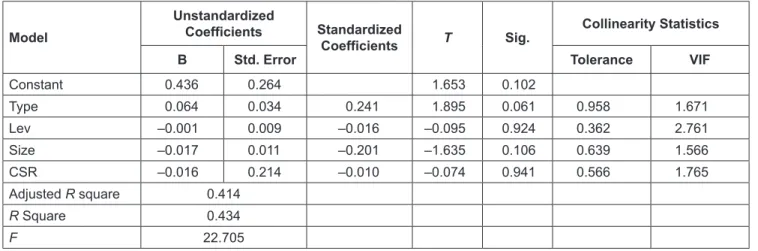
Equation test one (Capital Requirements) presents the test results for the influence of the independent variable on the intervening variable. Table 1 shows that for the variable type of company has a relationship of 23.2 and sig at a value of 13% with the CSR variable, the leverage variable has a significance relationship of 61.8% with CSR, and the variable company size (Size) has a relationship of 46.5%. With the CSR variable, the test of the coefficient of determination in Table 1 shows an adjusted R-square value of 41.4%, which states that variations in the value of CSR can be explained by the type, leverage, and size variables. The remaining 48.6% is influenced by other variables not examined. The results of the F-test show that the simultaneous effect of the independent variable on the dependent variable is significant with a value of 0.000. The T-test results show the effect of the independent variables (type, leverage, and size) on the dependent variable of CSR; only the type and leverage variables have a significant effect, while the size variable does not affect CSR the significance value is above 0.005. The variable type of company has a relationship of 23.2 and sig at a value of 13% with the CSR variable, the leverage variable has a significant relationship of 61.8% with CSR, the variable company size (Size) has a relationship of 46.5%. With the CSR variable, the test of the coefficient of determination shows that adjusted R-square value of 41.4%, which states that variations in the value of CSR can be explained by the type, leverage, and size variables. The remaining 48.6% is influenced by other variables not examined. The F-test results, which show the simultaneous influence of the independent variable on the dependent variable, are significant with a value of 0.006.
4.1. The Influence of Company Type, Leverage and Size on CSR
The results showed that the variable company type and leverage had a significant effect, while the size variable did not affect CSR. The type of company that affects CSR can be explained following the concept of legitimacy theory, which explains that companies that are sensitive to the environment tend to disclose higher quality social responsibility reports to legitimize company operations (Johnson, 2020). The type of company that can negatively impact the surrounding community requires information on its condition in its
Table 1: The Results of Multiple Linear Regression Analysis Model Unstandardized Coefficients Standardized Coefficients T Sig. Collinearity Statistics
B Std. Error Tolerance VIF
Constant 0.436 0.264 1.653 0.102 Type 0.064 0.034 0.241 1.895 0.061 0.958 1.671 Lev –0.001 0.009 –0.016 –0.095 0.924 0.362 2.761 Size –0.017 0.011 –0.201 –1.635 0.106 0.639 1.566 CSR –0.016 0.214 –0.010 –0.074 0.941 0.566 1.765 Adjusted R square 0.414 R Square 0.434 F 22.705
accountability report. Research in line with O’Dwyer (2002) explains that environmentally-sensitive industry, investor-oriented industry, return on assets, return on equity, net profit margin have a positive effect on the transparency of sustainability reports (Perdana et al., 2020). Also, Istianingsih et al. (2020) state that the practice of social disclosure of high-profile industrial groups is higher than low-profile industrial groups.
Furthermore, leverage on CSR has a significant effect because leverage is defined as debt to external parties, which the company must be able to pay off (Lee, 2020; Sunani et al., 2015). The greater the company’s debt, the greater the risk will be; therefore, companies with much debt must provide the information. This research is in line with Kim et al., (2019), which concluded that leverage affects CSR disclosure. Meanwhile, company size does not affect CSR, it can be explained that company size is widely used to explain corporate responsibility to external parties because large companies will have many risks compared to small companies, but in this study, it is the opposite, both large and large-scale companies (Liu & Zhang, 2017). Small companies are required to present an accountability report, but they are still voluntary in their disclosures, so that this reason is assumed to have no effect on company size on CSR disclosure. The results of this study do not support (Axjonow et al., 2018) that Size affects CSR disclosure.
4.2. The Influence of Company Type, Leverage and Size on ROA
The influence of company type, leverage, and size on ROA does not have any of these variables that affect (Ardiyanti & Supriadi, 2018). Whether it is a big risk or not, the type of company must maintain its good performance to increase its profit. However, the type of company, large and
small, does not affect its performance. It can be caused by the fact that the company does not pay attention to conditions and the environment that endanger the community and can cause conflict. This study supports the results of Ardiyanti and Supriadi (2018). Leverage in this study does not affect ROA, leverage is a measure of the company’s dependence on creditors who provide financing related to company assets, but it does not affect company performance, meaning whether high leverage or not, the company’s performance must increase. This study does not support Izzalqurny et al. (2019) findings. Size does not affect company performance; this can be due to the use of company assets not optimized for profit. The results of this study do not support Iqbal et al. (2019) research.
4.3. The Influence of CSR on ROA
The results of the study concluded that there was no effect of CSR on ROA. CSR disclosure does not improve company performance as assessed by ROA (Farimani & Yazdi, 2015). The community demands companies to be able to hold CSR activities, but many companies do not care and have awareness about the sustainability of the company, which is implemented with CSR activities. By carrying out CSR activities, it will directly have an impact on reputation and increase performance. This study does not support Lee (2020) that CSR increases the company’s social value and reputation and increases the company’s profitability and performance.
5. Conclusion
The results of the research, which aims to analyze the effect of company characteristics on CSR disclosure that have an impact on company performance, using multiple
regression analysis, shows that the company characteristics are proxied by company type, leverage, and company size; there are only two variables that affect CSR disclosure, namely, the type of company. Company size does not affect CSR disclosure, and CSR disclosure variable does not affect company performance as proxied by ROA. Firm characteristic variables consisting of firm type, leverage, and firm size do not affect company performance.
References
Agustia, D., Dianawati, W., & Indah, D. R. A. (2019). Managerial Ownership, Corporate Social Responsibility Disclosure and Corporate Performance. Management of Sustainable
Development, 10(2), 67–71.
https://doi.org/10.2478/msd-2019-0011
Ahmad, W. W., Manurung, D. T. H., Saputra, K. A. K., & Mustafa, S. G. (2020). Corporate Social Responsibility And Firm Financial Performance: A Case of SME’s Sector In Pakistan.
International Journal of Environmental, Sustainability, and Social Science, 1(2), 62–74.
Ardiyanti, A., & Supriadi, Y. N. (2018). The Effectiveness Of Internal Control, And The Competency Of Human Resources, On Good Governance Implementation And Its Impact On Fraud Prevention In Village Financial Management In Tangerang District. Journal of Business Management, 8(1), 1–15.
Atmadja, A. T., Saputra, K. A. K., Tama, G. M., & Paranoan, S. (2021). Influence of Human Resources, Financial Attitudes, and Coordination on Cooperative Financial Management.
Journal of Asian Finance, Economics and Business, 8(2),
563–570. https://doi.org/10.13106/jafeb.2021.vol8.no2.0563 Axjonow, A., Ernstberger, J., & Pott, C. (2018). The Impact of
Corporate Social Responsibility Disclosure on Corporate Reputation: A Non-professional Stakeholder Perspective.
Journal of Business Ethics, 151(2), 429–450. https://doi.org/
10.1007/s10551-016-3225-4
Bandiyono, A. (2020). The Effect of Good Corporate Governance and Political Connection on Value Firm. Jurnal Akuntansi,
23(3), 333. https://doi.org/10.24912/ja.v23i3.599
Carnahan, S., Agarwal, R., & Campbell, B. (2010). The Effect of Firm Compensation Structures on the Mobility and Entrepreneurship of Extreme Performers. Business, 490(September 2009), 1–43. https://doi.org/10.1002/smj
Castanheira, N., Rodrigues, L. L., & Craig, R. (2010). Factors associated with the adoption of risk-based internal auditing.
Managerial Auditing Journal, 25(1), 79–98. https://doi.
org/10.1108/02686901011007315
Deegan, C. (2013). The accountant will have a central role in saving the planet really? A reflection on “green accounting and green eyeshades twenty years later.” Critical Perspectives
on Accounting, 24(6), 448–458. https://doi.org/10.1016/
j.cpa.2013.04.004
Farimani, A., & Yazdi, A. F. (2015). Impact of institutional ownership persistence on corporate performance of firms listed on the Tehran stock exchange. Advances in Environmental
Biology, 9(4), 541–554. https://doi.org/10.6007/IJARAFMS/
v5-3/1821
Furqoni, I., & Rosyadi, S. (2019). Collaborative Governance in Corporate Social Responsibility Forum in Banyumas Regency.
Jurnal Bina Praja, 21, 209–217. https://doi.org/10.21787/
jbp.11.2019.209-217
Fitriani, H., & Setiany, E. (2014). The Effect Of Voluntary Disclosure Of Financial Information And Csr Disclosure On Earning Response Coefficient. Journal of Accounting and
Business, 14. https://doi.org/10.20961/jab.v14i2.158
Gray, B. J., Matear, S., & Matheson, P. K. (2002). Improving service firm performance. Journal of Services Marketing, 16(3), 186–200. https://doi.org/10.1108/08876040210427191
Gray, R. (2010). Is accounting for sustainability actually accounting for sustainability...and how would we know? An exploration of narratives of organisations and the planet.
Accounting, Organizations and Society, 35(1), 47–64. https://
doi.org/10.1016/j.aos.2009.04.006
Gunawan, H., Sinaga, B. L., & Sigit Purnomo, W. P. (2019). Assessment of the readiness of micro, small and medium enterprises in using E-money using the unified theory of acceptance and use of technology (UTAUT) method. Procedia
Computer Science, 161, 316–323. https://doi.org/10.1016/
j.procs.2019.11.129
Hasan, M. M., Nekmahmud, M., Yajuan, L., & Patwary, M. A. (2019). Green business value chain: a systematic review.
Sustainable Production and Consumption, 20, 326–339.
https://doi.org/10.1016/j.spc.2019.08.003
Iatridis, G. E. (2018). Accounting discretion and executive cash compensation: An empirical investigation of corporate governance, credit ratings and firm value. Journal of
International Financial Markets, Institutions and Money, 55,
29–49. https://doi.org/10.1016/j.intfin.2018.02.008
Iqbal, S., Nawaz, A., & Ehsan, S. (2019). Financial performance and corporate governance in microfinance: Evidence from Asia. Journal of Asian Economics, 60. https://doi.org/10.1016/ j.asieco.2018.10.002
Istianingsih, Trireksani, T., & Manurung, D. T. H. (2020). The impact of corporate social responsibility disclosure on the future earnings response coefficient (Asean banking analysis).
Sustainability (Switzerland), 12(22), 1–16. https://doi.org/
10.3390/su12229671
Izzalqurny, T. R., Subroto, B., & Ghofar, A. (2019). Research in Business and Social Science Relationship between Financial Ratio and Financial Statement Fraud Risk Moderated by.
International Journal of Research in Business and Social Science, 8(4), 34–43.
Johnson, T. (2020). Public participation in China’s EIA process and the regulation of environmental disputes. Environmental
Impact Assessment Review, 81(January), 106359. https://doi.
org/10.1016/j.eiar.2019.106359
Kim, H. D., Kim, T., Kim, Y., & Park, K. (2019). Do long-term institutional investors promote corporate social responsibility activities? Journal of Banking and Finance, 101, 256–269. https://doi.org/10.1016/j.jbankfin.2018.11.015
Laplane, A., & Mazzucato, M. (2020). Socializing the risks and rewards of public investments: Economic, policy, and legal issues. Research Policy: X, 2(March), 100008. https://doi. org/10.1016/j.repolx.2020.100008
Lee, J. W. (2020). CSR impact on the firm market value: Evidence from tour and travel companies listed on chinese stock markets.
Journal of Asian Finance, Economics and Business, 7(7),
159–167. https://doi.org/10.13106/jafeb.2020.vol7.no7.159 Liu, X., & Zhang, C. (2017). Corporate governance, social
responsibility information disclosure, and enterprise value in China. Journal of Cleaner Production, 142, 1075–1084. https://doi.org/10.1016/j.jclepro.2016.09.102
Machmuddah, Z., Sari, D. W., & Utomo, S. D. (2020). Corporate social responsibility, innovation and firm value. Journal of
Asian Finance, Economics and Business, 7(9), 631–638.
https://doi.org/10.13106/jafeb.2020.vol7.no9.631
Mc Williams, A., & Siegel, D. (2018). Corporate social responsibility: A theory of the firm perspective. Business Ethics
and Strategy, Volumes I and II, 26(1), 137–147. https://doi.org/
10.4324/9781315261102-8
Mironiuc, M., Chersan, I.-C., & Robu, I.-B. (2013). Ethics in Providing Non-Audit Services to Ensure Transparency in Financial Reporting. Procedia - Social and Behavioral Sciences,
81, 474–478. https://doi.org/10.1016/j.sbspro.2013.06.463
Ng, A. W. (2018). From sustainability accounting to a green financing system: Institutional legitimacy and market heterogeneity in a global financial centre. Journal of
Cleaner Production, 195, 585–592. https://doi.org/10.1016/
j.jclepro.2018.05.250
O’Dwyer, B. (2002). Managerial perceptions of corporate social disclosure: An Irish story. In Accounting, Auditing
& Accountability Journal, 15(3). https://doi.org/10.1108/
09513570210435898
Paino, H., Razali, F. M., & Jabar, F. A. (2015). The Influence of External Auditor’s Working Style, Communication Barriers and Enterprise Risk Management toward Reliance on Internal Auditor’s Work. Procedia Economics and Finance, 28(April), 151–155. https://doi.org/10.1016/s2212-5671(15)01094-1
Perdana, M. C., Hadisusanto, S., & Purnama, I. L. S. (2020). Implementation of a full-scale constructed wetland to treat greywater from tourism in Suluban Uluwatu Beach, Bali, Indonesia. Heliyon, 6(10), e05038. https://doi.org/10.1016/ j.heliyon.2020.e05038
Reverte, C. (2009). Determinants of corporate social responsibility disclosure ratings by Spanish listed firms. Journal of Business
Ethics, 88(2), 351–366.
https://doi.org/10.1007/s10551-008-9968-9
Rupp, D. E., Ganapathi, J., Aguilera, R. V., & Williams, C. A. (2006). Employee reactions to corporate social responsibility: An organizational justice framework. Journal of Organizational
Behavior, 27(4), 537–543. https://doi.org/10.1002/job.380
Saputra, K. A. K. (2020). The Performance of the Internal Auditors of the Village Rural Institution. International Journal of
Environmental, Sustainability, and Social Sciences, 1(2), 28–35.
Stefan-Duicu, V. M., & Stefan-Duicu, A. (2015). Global Analysis of the Financial Analyst’s Job within a Company. Procedia
Economics and Finance, 26(15), 261–267. https://doi.org/
10.1016/s2212-5671(15)00847-3
Sunani, A., Subroto, B., & Prihatiningtias, Y. W. (2015). Do Ethical Climate and Machiavellianism Affect Ethical Perceptions of Earnings Management? Evidence from Indonesia. Global
Journal of Business and Social Science Review, 3(01), 131–139.
Triyuwono, I. (2016). Taqwa: Deconstructing Triple Bottom Line (TBL) to Awake Human’s Divine Consciousness. Pertanika
Journal Social Sciences and Humanities, 24, 89–104.
Uzun, A. M., & Kilis, S. (2020). Investigating antecedents of plagiarism using extended theory of planned behavior.
Computers and Education, 144(January), 103700. https://doi.
org/10.1016/j.compedu.2019.103700
Verhees, F. J. H. M., & Meulenberg, M. T. G. (2004). Market Orientation, Innovativeness, Product Innovation, and Performance in Small Firms. Journal of Small Business
Management, 42(2), 134–154.
https://doi.org/10.1111/j.1540-627X.2004.00102.x
Werastuti, D. N. S., Sukoharsono, E. G., Saraswati, E., & Prihatiningsih, Y. W. (2018). Are Competitive Strategies and Strategic Alliances Role In Improving Sustainability Performance? Journal of Environmental Management and
Tourism, 9(7), 1498–1511
Yusuf, M., & Mulyani, S. D. (2020). Responsibility As a Predictor of Aggressiveness Tax on Issuers in. International Journal of