Maintenance Technology Status of Korean Nuclear Power Plants: A Questionnaire Survey
Jun Seok Lee(1), Poong Hyun Seong, Chang Heui Jang(2), Hyuk Soon Lim, Jang Hwan Na, and Seong Jong Oh(3)
(1)Center for Advanced Reactor Research (2)Department of Nuclear and Quantum Engineering
Korea Advanced Institute of Science and Technology
373-1, Guseong-dong, Yuseong-gu, Daejeon, 305-701, Republic of Korea
(3)Operation and Maintenance Support Group, Korea Hydro & Nuclear Power Co., LTD.
103-16, Munji-dong, Yuseong-gu, Daejeon, 305-380, Republic of Korea
[email protected], [email protected], [email protected], [email protected], [email protected], [email protected]
1. Introduction
Recently, most of nuclear power plants (NPP) companies are targeting several areas to improve electricity production. Improving availability of the plant, shorter outages and a significantly lower reactor trip are all contributed to higher output of the plant. However, there is a limit in the improvement to gain much higher output. For that reason, they are considering the improvement of maintenance work [1], [2].
The object of this research is to do the preliminary investigation of the NPP maintenance technology development. For the work, it is necessary to know the current maintenance environment in Korean NPPs. And, it is very important to get the plant operators and staffs’ opinions for the research. To get their opinion, we carried out the questionnaire survey.
2. Questionnaire Contents
The questionnaire for the survey is classified to 4 parts.
(1) Present status of the maintenance in Korean nuclear power plant
In this chapter, we survey on Korea Hydro & Nuclear Power Co., LTD. operators and staffs’ opinion of the current status of the maintenance. The maintenance technology items are classified into 5 technologies:
- Management technology: The technology related to the equipment failure prevention, and maintaining the equipment in optimum condition. For example, improvement of operating method, environment, etc.
- Prediction of the equipment failure and condition
monitoring technology: The testing, diagnosis, and evaluation technology for the equipment failure prediction and detection.
- Repair technology: Equipment assembly, disassembly, and replacement technology.
- System engineering technology: The technology to improve existing equipment’s performance, reliability, and safety.
- Integrated maintenance management technology: The management technology to reduce operation and maintenance cost and maximize its effect. (2) Present status of the preventive maintenance
In this chapter, we want to know the obstacle of the overhaul period reduction. In the analysis, we divided the questionnaire results into 2 cases; Pressurized water reactor (PWR) case and Pressurized heavy water reactor (PHWR) case.
(3) Development of maintenance technology
This chapter shows the technologies which are needed in the current maintenance work. The technologies are classified into 3 contents – maintenance planning, implementation, and equipment improvement. In the last part of this chapter, the degree of necessity of the predictive maintenance technology is inquired.
3. Questionnaire Target
We carried out a survey on 106 people including operators and staffs in all nuclear power plants; 26 in Kori 1&2, 32 in Ulchin 1~3, 23 in Wolsung 1&2, and 25 in Younggwang 1~3. The selected departments in one NPP are operational, electrical, mechanical, and instrumentation and control departments.
4. Result
4.1 Present status of the maintenance in Korean nuclear power plants
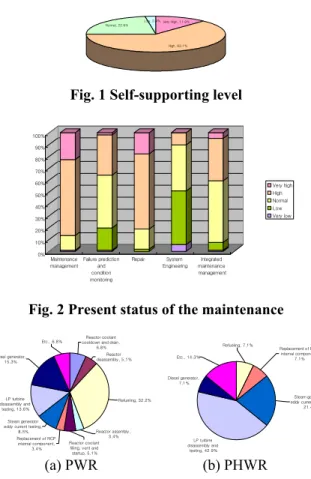
In Fig. 1, most of the respondents think that current self-supporting level of the maintenance technology in Korean NPPs is high.
Fig. 2 shows the present status of the maintenance in Korean NPPs. In this figure, most of the maintenance related technologies are in high levels, except the system engineering.
4.2 Present status of the preventive maintenance in Korean nuclear power plants
Transactions of the Korean Nuclear Society Autumn Meeting Busan, Korea, October 27-28, 2005
In PWR case, as shown in Fig. 3(a), about 32% of respondents replied that refueling is the greatest obstacle in reducing the overhaul period.
Fig. 3(b) shows PHWR case. In this figure, the low pressure turbine disassembly and testing, steam generator eddy current testing are greatest obstacles in reducing the overhaul period.
4.3 Maintenance technology development in Korean nuclear power plants
In Fig. 4(a), the respondents replied that database, policy, and management have to be developed for the maintenance planning.
In Fig. 4(b), most of the respondent replied that diagnosis and evaluation is important factors in the maintenance implementation.
Fig. 4(c) shows that what is the most important in the equipment improvement. In the replies, component localization is necessary for the improvement.
Fig. 5 shows that most of the respondents are aware of the importance of predictive maintenance technology.
3. Summary and Conclusion
In this study, we surveyed on the maintenance technology status of Korean NPPs. To survey on the status, a questionnaire method is employed for the research. The questionnaire consists of the present status of maintenance, the obstacles in overhaul period reduction, and the needs for development of advanced maintenance technology. The questionnaire results can be summarized as follows:
(1) Most of the respondents replied that current NPP maintenance technology is high except system engineering.
(2) In PWR case, the refueling is the greatest obstacle in the NPP overhaul period reduction. In PHWR case, LP turbine disassembly and testing is the greatest obstacles in the reduction.
(3) Diagnosis, component localization, aging management are required in the development of maintenance technology.
Acknowledgement
This work has been supported by Korea Hydro & Nuclear Power Co., LTD through research contract. Special thanks are given to Korea Hydro & Nuclear Power Co., LTD.
REFERENCES
[1] L. Whistlecroft, D.J. Mallaburn, “Business improvement and maintenance optimisation in Nuclear Electric”, Power Station Maintenance - Profitability Through Reliability, 1998. First IEE/IMechE
International Conference on (Conf. Publ. No. 452), 30 March-1 April 1998, pp. 179-183.
[2] S.S. Darling, D.A. Army, T. P. Mairs, “Improving plant capacity by redefining the processes by which maintenance is planned, scheduled, and accomplished”, Nuclear Science Symposium and Medical Imaging Conference, 1994 IEEE Conference Record Volume 3, 30 Oct.-5 Nov. 1994, pp. 1051-1055.
Very High, 11.9%
High, 63.1% Normal, 22.6%
Low, 2.4%
Fig. 1 Self-supporting level
0% 10% 20% 30% 40% 50% 60% 70% 80% 90% 100% Maintenance management Failure prediction and condition monitoring Repair System Engineering Integrated maintenance management Very high High Normal Low Very low
Fig. 2 Present status of the maintenance Reactor coolant
cooldown and drain, 6.8% Reactor disassembly, 5.1% Replacement of RCP internal component, 3.4% Steam generator eddy current testing,
8.5% LP turbine disassembly and
testing, 13.6%
Reactor coolant filling, vent and startup, 5.1% Reactor assembly, 3.4% Refueling, 32.2% Etc., 6.8% Diesel generator, 15.3% LP turbine disassembly and testing, 42.9% Diesel generator, 7.1% Etc., 14.3% Refueling, 7.1% Replacement of RCP internal component, 7.1% Steam genera eddy current tes 21.4%
(a) PWR (b) PHWR
Fig. 3 Present status of the preventive maintenance
Etc., 4.8% Performance Improvement, 17.9% Settlement of problem, 13.1% Counter-measurement of Aging, 26.2% Component localization, 38.1%
(a) Maintenance planning
Etc., 1.2% Management, 15.5% Monitoring, 14.3%Condition
Diagnosis/Evaluation , 69.0%
Cost analy sis, 7.1% Data base, 28.6% Etc., 2.4% Policy, 26.2% Plan, 13.1% Management, 22.6% (b) Maintenance
implementation (c) Equipment Improvement
Fig. 4 Maintenance technology development
Normal, 4.8%
High, 40.5%
Very High, 54.8%
Fig. 5 Necessity of the predictive maintenance technology