서 론
렌틸콩(Lens culinaris. L)은 고 기능성 영양성분을 함유하 며 8000년 이상 중요한 식량 자원으로 역할을 했다(Bhatty 1988; Shyam et al. 2007). 종자는 약 0.5cm 지름의 렌즈 모 양의 형태로 색은 갈색, 붉은색, 녹색, 흰색으로 다양하다. 이 중 붉은색의 렌틸콩이 전 세계 생산량의 70~80%를 차 지하며(Patterson 2006), 호주, 캐나다, 인도 등 주로 건조 기 후에서 재배되며 매년 생산량이 전 세계적으로 약 4.4M ton 에 이른다(Shyam et al. 2007). 렌틸콩은 단백질(20~30%),감마선 조사가 렌틸
(Lens culinaris L.)
의 감수성에 미치는 영향
이민규1· 류재혁1· 정상욱1· 김진백1· 강시용1· 권순재1,2,* 1한국원자력연구원 첨단방사선연구소, 2과학기술연합대학원대학교Radiosensitivity of Lentil Bean
(Lens culinaris L.) to
Gamma-irradiation
Min-kyu Lee
1, Jaihyunk Ryu
1, Sang Wook Jeong
1, Jin-Baek Kim
1,
Si-Yong Kang
1and Soon-Jae Kwon
1,2,*
1Advanced Radiation Technology Institute, Korea Atomic Energy Research Institute, 29,
Geumgu-gil, Jeongeup-si, Jeollabuk-do 56212, Republic of Korea
2University of Science and Technology, Radiation Biotechnology and Applied Radioisotope Science, 217,
Gajeong-ro, Yuseong-gu, Daejeon 34113, Republic of Korea
Abstract - We examined damages from irradiaion and determined the optimal gamma-ray dose for mutation breeding in lentil(Lens culinaris L.) bean. Four individual lines(L-C, L-2, L-8 and L-9), that have remarkable adaptability in South Korea were gamma-irradiated at doses of 50, 70, 100, 200, 300, 400, and 500Gy. The germination rate of seed decreased as the dose increased over 50Gy in all lines. However, LD50 and RD50 were different among lines. The median
lethal doses(LD50) were approximately 127(L-C), 74(L-2), 95(L-8), and 144(L-9)Gy. The median
reduction doses(RD50) for plant height, number of leaves, root length, and flash weight were 156,
176, 150, and 180Gy for L-C, 253, 198, 127, and 142Gy for L-2, 188, 175, 200, and 190Gy for L-8, and 162, 210, 224, and 184 for L-9, respectively. The growth characteristics of the M1 generation
decreased as the dose increased over 70Gy. The optimal doses of gamma irradiation for mutation breeding of lentil were determined to be 70Gy(L-2, L-8) and 100Gy(L-C, L-9). We performed the comet assay to observe nuclear DNA damage induced by gamma-irradiation. In comet assay, a clear difference was identified over 100Gy treatments. With increasing doses of gamma-ray in the range of 50 to 500Gy, the rate of head DNA was decreased significantly from 97.5% to 81.6%. Tail length was consecutively increased from 1.9μm to 17.4μm. Our result provides basic information for construction of mutant pools in lentils.
Key words : Growth characteristics, Radiation damage, Optimal dose, Comet assay
─ 211 ─
Technical Paper
* Corresponding author: Soon-Jae Kwon, Tel. +82-63-570-3312, Fax. +82-63-570-3814, E-mail. [email protected]
철, 인, 아연 성분을 다량 함유하고 있으며(Erskine 2009; Thavaraja et al. 2011), 종피 부분에 많은 식이섬유를 함유 한 것으로 알려져 있다(Han and Baik 2008). 임산부에게 필 요한 엽산 함량도 기타 두류에 비해 높은 수준을 보였으 며(Sen Gupta et al. 2013), phenolic acid, flavanol, flavanal, soyasaponins, phytic acid와 같은 유용성분도 다량 함유되어 있다(Zou et al. 2011). 이들 유용성분은 항산화 및 항암 활 성으로 만성질환에 효과가 있으며 혈중 지질 수준을 낮추어 심혈관계 질환에 효과가 있는 것으로 보고되었다(Shepherd et al. 1995; Duane 1997). 또한 렌틸콩은 다른 콩류에 비해 5~6배 높은 polyphenol을 함유하여 월등히 높은 항산화 활 성을 가지며(Han and Baik 2008), 고 식이섬유를 함유하여 Glycemic index가 낮은 식품으로 당뇨병에 효과가 있는 것 으로 보고되었다(Shams et al. 2010). 최근 국내에서는 기능성 곡물이 저칼로리와 단백질, 무기 질, 필수아미노산 등의 영양 성분의 고함유가 알려지면서 기 능성 수입 곡물의 수요가 증가하고 있으며, 이 중 렌틸콩은 곡물/종자 품목이 금액 성장률에서 상위 2위를 차지했다(성 정민 2015). 그러나 2015년 관세청 보도자료에 따르면 국내 렌틸콩 시장은 전량 수입에 의존하고 있으며 2014년 국내 렌틸콩 수입량은 2013년에 비해 33배 증가하였다. 따라서 국내 기후에서 재배 가능한 품종과 종자 수량의 향상이 요 구되고 있다. 돌연변이 육종법은 자연적인 돌연변이를 인위적으로 유도 하여 기존 품종의 우량 형질을 유지하면서 육종가가 원하는 일부 유전형질을 개량할 수 있는 장점이 있다(Kimura and Ohta 2014; Ryu et al. 2016). 돌연변이 육종에 이용되는 변이 유발원은 물리적 유발원인 x-ray, gamma-ray, ion beam 등과 화학적 돌연변이원인 EMS, EI, MNU 등이 있다(Chai et al. 2005; Ryu et al. 2012). 이 중 물리적 돌연변이원은 취급이 쉽고, 종자, 화분, 배양체, 식물체 등 다양한 종류의 식물조직
에 적용이 가능하다. 반면 화학적 돌연변이원은 대부분 유독
한 발암물질로 분류되어 취급이 어려우며, 폐액의 처리가 어
려운 단점이 있다. 물리적 돌연변이원 처리 시에는 감마선 적정 조사선량의 구명이 필요하며(Misra et al. 2003; Ryu et al. 2016), M1 세대에서 적정 선량의 결정에는 생존율과 생 장률이 주요 선발인자로 활용되고 있다(Cvejić et al. 2011; Kang et al. 2013).
코멧(Comet assay) 분석은 각각의 세포 수준에서 DNA 손상을 확인하기 위해 개발된 방법으로 세포로부터 핵을
분리하여 핵 DNA의 손상 및 회복 정도를 측정할 수 있다
(Dhawan et al. 2009). DNA 손상을 입은 세포는 밝은 형광 을 나타내는 머리 부분(head DNA)과 꼬리 부분(tail DNA) 이 나타나게 되고, 손상 정도는 꼬리의 비율 및 길이로 확인
하며, 저비용으로 간단하고도 신속한 확인이 가능한 이점을
지니고 있다(Delincée et al. 1993; Cerda et al. 1997). 특히
코멧 분석은 식물 세포의 돌연변이원에 의한 DNA 손상 정
도를 파악하는데 유용한 방법으로 활용되고 있으며(Kwon et al. 2009; Ryu et al. 2014), 이외에도 의학과 감마선조사식
품의 검역, 유독물질의 환경 피해 측정 등의 다양한 분야에
도 응용되고 있다(Delincée et al. 1993; Fairbairn et al. 1995; Cerda et al. 1997). 본 연구에서는 국내 기후에서 적응성이 우수하여 선발된 4개의 렌틸 계통의 종자에 감마선을 선량별로 조사한 후 M1 세대의 초기 생장특성을 조사하여 돌연변이 유도에 필요한 적정 감마선량을 구명하고, 감마선 조사 후 DNA 손상 정도 를 탐색하여, 렌틸콩 국산화를 위한 돌연변이 집단구축의 기초 연구자료로 활용하고자 하였다.
재료 및 방법
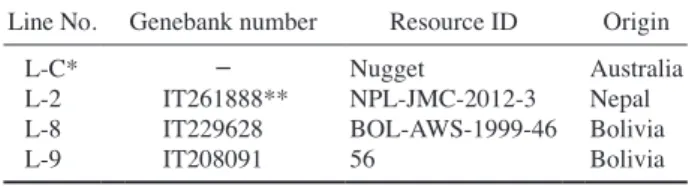
1. 공시재료 및 감마선조사 본 연구에 이용한 렌틸 계통은 농촌진흥청(Rural Develop-ment Administration, RDA) 유전자원센터에서 분양받은 종 자를 한국원자력연구원 감마선육종시험포장에서 1년간 증 식하여 감마선 조사에 사용하였다(Table 1). 감마선 조사는 한국원자력연구원의 감마선(60Co) 저준위 조사시설에서 24 시간 동안 0, 50, 70, 100, 200, 300, 400, 500, 700Gy의 조사 선량으로 처리하였다. 조사선량률 결정은 Fricke dosimeter (ES 200-2106/E2044562, Brunker Biospin, France)로 측정 하였다(Holm and Berry 1970).2. 생장조사 발아율과 초기 생장조사는 각 선량별로 감마선을 조사하 여 원예용 상토(흥농 1호)를 넣은 파종트레이(5×10)에 50 립씩 3반복으로 파종한 후, 발아율은 파종 14일 후 유모가 0.2cm 이상 돌출한 것을 발아로 간주하였다. 생장특성 조사 (초장, 엽수, 분얼 수, 생체중)는 파종 30일 후 선량별 20개 체를 무작위로 선정하여 측정하였다. 3. 코멧(comet assay)분석 코멧 분석은 Dhawan et al.(2009)의 연구를 변형하여 실 시하였다. 시료채취는 파종 30일 후에 각각 선량별 각 개체
Table 1. The origin of lentil bean lines used in this study
Line No. Genebank number Resource ID Origin
L-C* - Nugget Australia
L-2 IT261888** NPL-JMC-2012-3 Nepal
L-8 IT229628 BOL-AWS-1999-46 Bolivia
L-9 IT208091 56 Bolivia
의 뿌리 근단을 무작위로 3개체씩 채취하여 얼음 상의 페트 리디쉬에 PBS 용액(11.9mM Phosphates, 137mM Sodium chloride, and 2.7mM Potassium chloride, pH 7.5) 2ml를 넣 은 후 잘게 chopping 하여 원심분리 후 현탁액을 제조하였 다. 현미경 슬라이드는 하층으로 1% agarose를 도포한 후 완 전히 건조시키고 얼음 위에서 세포 현탁용액 20μl와 0.5% low melting point agarose 180μl를 혼합하여 하층 위에 도포 한 후 최상층을 0.5% low melting point agarose 200μl로 도
포하여 제작하였다. 제작된 슬라이드는 핵막과 단백질 용해
를 위해 ice-cold lysing solution(2.5M NaCl, 100mM EDTA, and 10mM Trizma base, pH 10.0)에 2시간 동안 침지한 후 TBE buffer(300mM NaOH and 1mM EDTA, pH 13.0)를 이 용하여 25Volt로 20분간 전기영동 하였다.
4. 통계처리
발아율, 초장, 엽수, 근장, 생체중, 코멧(comet assay) 분석, 결과의 유의성 검정은 Duncan’s multiple range test(P<0.05) 로 하였다. Median lethal dose(LD50)와 median reduction dose(RD50) 선량은 발아율과 생장 값의 단순선형회귀분석 (simple linear regression analysis)으로 추정하였다. 선량과 생육형질, 코멧 분석 간의 상관분석은 Pearson의 상관계수 를 이용하였다. 모든 통계처리는 SPSS Ver. 22(SPSS Inc., USA)를 이용하였다.
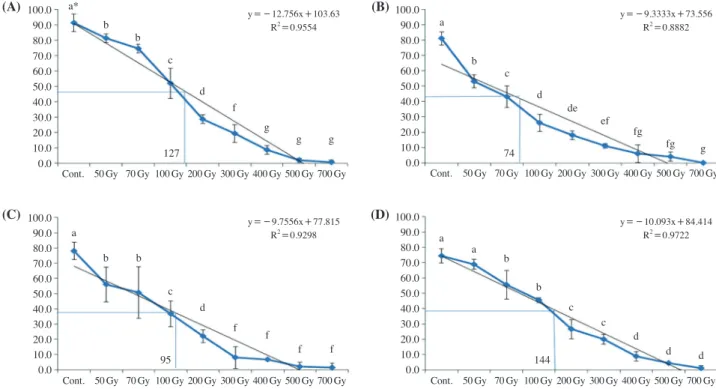
결 과
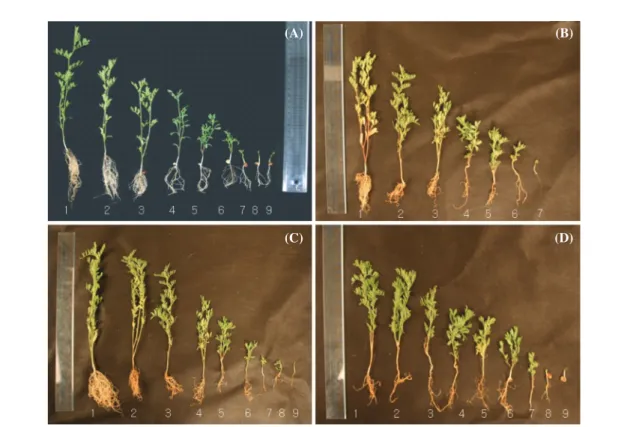
1. M1 세대 초기 생육특성 및 적정 조사선량 결정 렌틸의 돌연변이 유도에 적합한 감마선 조사선량 범위를 구명하고자 감마선 조사 후 발아율 및 초기생육(초장, 엽수, 분얼 수 생체중)을 조사하였다. 발아율을 조사한 결과(Fig. 1), 모든 계통의 발아율은 감마선 선량 증가에 비례하여 감 소하였다. 발아율의 계통간 차이는 3개 계통(L-C, L-2, L-8) 에서 50Gy 이상 처리구에서 대조구와 비교하여 유의적인 감소(P<0.05)를 나타냈다. L-9 계통의 발아율은 타 계통보 다 높은 선량인 100Gy 이상 처리구에서 대조구와 비교하 여 유의적으로 감소되었다(P<0.05). 발아율을 기준으로 추 정한 L-C, L-2, L-8 계통의 LD50 선량은 각각 127Gy, 74Gy, 95Gy이며, L-9 계통에서 144Gy로 가장 높게 나타내었다. 감마선 조사 30일 후 각 계통별 초기 생육특성을 조사 한 결과, 모든 계통에서 감마선 조사선량의 증가에 따라 생 육이 감소하였다(Fig. 2). 생장 요소별 측정된 값을 단순선 형회귀분석으로 각각에 대한 대조구 생장과 비교하여 50% 가 저해된 선량(RD50)을 추정한 결과(Fig. 3, Table 2), 초장 은 156Gy(L-C)에서 253Gy(L-2) 사이로 4개 계통의 평균 RD50 값은 189.8Gy였다. 엽수의 계통별 RD50 값은 175Gy (L-8)에서 210Gy(L-9) 사이로 평균 190Gy였다. 근장은 최 저 150Gy(L-C), 최고 224Gy(L-9), 평균 175Gy였다. 생체Fig. 1. Germination rate and LD50 of lentil seeds under different radiation doses. A: L-C, B: L-2, C: L-8, D: L-9. *Duncan’s multiple range
test at 5% level. Error bars indicate±S.E.(n=3).
(A) (B) (C) (D) 100.0 90.0 80.0 70.0 60.0 50.0 40.0 30.0 20.0 10.0 0.0 a* a a a b a c b d b de c ef c fg d fg d g d b b b b c c d d f f g f g f g f y= -12.756x+103.63 R2=0.9554 y= -9.7556x+77.815 R2=0.9298 y= -9.3333x+73.556 R2=0.8882 y= -10.093x+84.414 R2=0.9722 Cont. 50Gy 70Gy 100Gy 200Gy 300Gy 400Gy 500Gy 700Gy Cont. 50Gy 70Gy 100Gy 200Gy 300Gy 400Gy 500Gy 700Gy Cont. 50Gy 70Gy 100Gy 200Gy 300Gy 400Gy 500Gy 700Gy Cont. 50Gy 70Gy 100Gy 200Gy 300Gy 400Gy 500Gy 700Gy 100.0 90.0 80.0 70.0 60.0 50.0 40.0 30.0 20.0 10.0 0.0 100.0 90.0 80.0 70.0 60.0 50.0 40.0 30.0 20.0 10.0 0.0 100.0 90.0 80.0 70.0 60.0 50.0 40.0 30.0 20.0 10.0 0.0 127 95 74 144
중의 RD50 값은 최저 142Gy(L-2)에서 최고 190Gy(L-8) 사이로 4개 계통의 평균은 174Gy였다.
2. 코멧(comet assay) 분석을 통한 세포손상의 확인
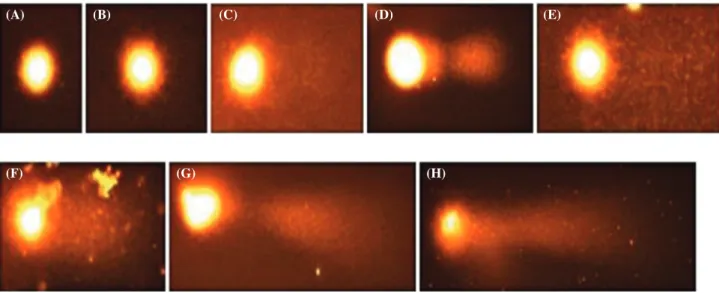
감마선을 조사한 종자를 파종 4주 후 각 처리구별 무작 위로 선택한 100개 세포의 Head DNA와 Tail DNA 비율, Tail의 길이를 측정하여 조사선량과의 유의성을 검정하였다 (Table 3; Fig. 4). 감마선 처리구의 Head DNA 비율은 선량 증가에 따라서 감소하는 경향이었으나, 대조구와 200Gy 처 리까지 유의적인 차이가 없었다. 감마선 처리구 간 유의성은 Head DNA 비율은 300Gy 이상 처리에서 선량의 증가에 따 라 뚜렷하게 감소하는 경향으로 500Gy에서는 대조구와 비 교하여 15.9% 감소되었다. Tail DNA 비율과 길이는 선량의 증가에 따라 증가하였고, 대조구와 감마선 처리구 간에 유 의적인 차이를 나타내어 tail 길이가 500Gy 처리구에서 대 조구의 약 9배 증가하였다. 감마선 처리구 간 Tail DNA의 길이는 100Gy에서 300Gy 사이의 선량에서 유의적 차이가 없었다. 3. 상관분석
감마선 조사선량과 초기생육 특성 및 comet assay(head DNA, tail DNA, tail length) 간에 상관관계를 분석한 결과 (Table 4), 발아율, 생존율, 초장, 엽수, 근장, 생체중과 head DNA(%)는 유의성(P<0.01) 있는 음의 상관관계, tail DNA (%)와 tail length는 유의성(P<0.01) 있는 정의 상관이 인 정되었다. 각 형질의 선량과 상관계수(R2)는 L-2의 근장이 0.92로 가장 낮았고 L-9의 초장이 0.98로 가장 높게 나타났
Fig. 2. Whole plants of 4-week-old lentils after gamma-irradiation at different doses. A: L-C, B: L-2, C: L-8, D: L-9. The number(1~9) un-der the plants indicate doses irradiated.
(A) (B)
(C) (D)
Table 2. RD50 values for plant traits of lentil bean four weeks after
gamma-irradiation
Traits RD50(Gy) of lines Mean
L-C L-2 L-8 L-9
Plant height 156 253 188 162 190
Number of leaves 176 198 175 210 190
Root length 150 127 200 224 175
Fresh weight 180 142 190 184 174
Table 3. Comet assay results under gamma-irradiation at different
doses
Dose(GY) Head DNA(%) Tail DNA(%) Tail length(μm)
Control 97.5±3.5a* 2.5±3.5a 1.9±1.0a
50 95.9±4.6ab 4.1±4.6b 2.8±1.9b 70 93.6±6.6ab 6.5±6.6bc 4.3±4.1b 100 92.5±6.8ab 7.5±6.8bcd 7.8±4.5c 200 92.0±8.3ab 8.0±8.3bcd 8.1±5.6c 300 89.1±11.9b 10.9±11.9bcd 12.6±6.4d 400 88.0±14.0bc 12.0±14.0cd 14.9±7.3d 500 81.6±16.8c 18.4±16.8d 17.4±8.9d
*a,b,c,d: Duncan’s multiple range test at 5% level. Values in each column
Fig. 4. Comet assay images of nuclei of lentil after gamma- irradiation. A to H: four week after gamma-irradiation at doses of 0, 50, 70, 100,
200, 300, and 500Gy, respectively.
(A) (B) (C) (D) (E)
(F) (G) (H)
Table 4. Correlation coefficients between dose, traits, and comet assay parameters in lentil beans
Dose Head DNA Tail length Plant height Number of leafs Root length Fresh weight
Dose 1 Head DNA -.964** 1 Tail length .982** -.962** 1 Plant height -.965** .919** -.975** 1 Number of leafs -.972** .939** -.980** .995** 1 Root length -.911** .886** -.919** .971** .960** 1 Fresh weight -.965** .912** -.984** .991** .984** .950** 1 **P<0.01
Fig. 3. Growth characteristics of lentils irradiated with different doses of gamma-rays. A: Plant height, B: Root length, C: Number of leaves, D:
Fresh weight. (A) (B) (C) (D) Cont. 50Gy 70Gy 100Gy 200Gy 300Gy 400Gy 500Gy 700Gy Cont. 50Gy 70Gy 100Gy 200Gy 300Gy 400Gy 500Gy 700Gy Cont. 50Gy 70Gy 100Gy 200Gy 300Gy 400Gy 500Gy 700Gy Cont. 50Gy 70Gy 100Gy 200Gy 300Gy 400Gy 500Gy 700Gy 12.0 10.0 8.0 6.0 4.0 2.0 0.0 2.5 2.0 1.5 1.0 0.5 0.0 25.0 20.0 15.0 10.0 5.0 0.0 200.0 180.0 160.0 140.0 120.0 100.0 80.0 60.0 40.0 20.0 0.0 Root length (cm) Fresh weight (plant g -1 ) Plant height (cm) Number of leaves (ea) L-C L-2 L-8 L-9 L-C L-2 L-8 L-9
다. RD50과 LD50 선량을 비교하면 모든 특징에서 RD50 선량 이 높게 나타났다.
고 찰
렌틸의 발아율을 기준으로 추정한 L-C, L-2, L-8, L-9 계통 의 LD50 선량은 각각 127Gy, 74Gy, 95Gy, 144Gy로 이는 기존 렌틸의 감마선 LD50 선량으로 보고된 250Gy와 비교하 여 낮은 수준이며, 콩과 작물 중 잠두(Vicia faba)에서 보고 된 150Gy와 유사하였다(Saif et al. 2004; Mejri et al. 2012).
식물의 감마선에 대한 감수성은 종과 계통 간에 다르며, 손
상된 DNA의 회복능력, 과산화수소를 제거하는 능력, 염색 체의 부피가 다르기 때문에 차이가 나타난다(Wada et al. 1998; Irfaq and Nawab 2001). 돌연변이 유도를 위한 감마 선의 적정 조사선량의 결정 방법 중 M1 세대에서는 단순 히 발아율을 조사하는 것보다 생육감소가 30~50%, 생존율 40~60% 정도가 이상적인 조사선량으로 보고되었으며(Ryu et al. 2012), 이러한 기준에서 렌틸의 적정 조사선량은 L-C, L-11 라인은 100Gy, L-2, L-8 라인은 70Gy로 판단되었다. RD50을 추정한 결과, 4개 계통의 평균 RD50 값은 초장 189.8Gy, 엽수 190Gy, 근장 175Gy, 생체중 174Gy였다. 이 는 Eun 등(2007)은 유채 3개 품종에 각각 양성자빔과 감마 선을 처리하여 감수성을 분석한 결과, 품종 간, 조직별로 상 이한 반응을 나타내어 본 연구 결과와 유사하였다. 코멧 분석은 식물 세포의 돌연변이원에 의한 DNA 손상 정도를 파악하는데 유용하며(Ryu et al. 2014), 본 연구결과 Tail DNA 비율과 길이가 대조구와 유의적인 차이를 나타내 어 렌틸의 감마선 조사식품 검지에도 활용이 가능할 것으로 판단된다(Fairbairn et al. 1995; Cerda et al. 1997).
조사선량과 초기생육 특성 및 comet assay 간에 상관관계 분석 결과 DNA 손상의 척도인 DNA tail의 길이와 모든 생 육특성간에는 음의 상관(P<0.01)이 인정되어 DNA의 손 상 정도가 생육형질에 상당한 영향을 미치는 것을 시사한 다. 이는 감초와 귀리를 대상으로 생육 형질과 comet assay
결과, 선량 간에 높은 상관관계를 나타낸 결과와 일치한다
(Ryu et al. 2014; Ryu et al. 2016).
결 론
본 연구에서는 국내 적응성이 우수한 렌틸(Lens culinaris L.) 유전자원을 대상으로 감마선에 대한 적정선량을 구명하 였다. 연구 결과, 4개 계통의 LD50과 RD50선량을 바탕으로 결정한 렌틸의 각 계통의 적정 조사선량은 L-C, L-11 라인 은 100Gy, L-2, L-8 라인은 70Gy로 판단되었다. 코멧 분석 결과, 감마선 처리구의 Head DNA 비율은 대조구와 200Gy 처리까지 유의적인 차이가 없었고, 500Gy에서는 대조구와 비교하여 15.9% 감소되었다. Tail DNA 비율과 길이는 대조 구와 감마선 처리구 간에 유의적인 차이를 나타내어 500Gy 처리구에서 tail 길이가 대조구의 약 9배 증가하였다. 선량과 생육특성, comet assay 간에 상관관계를 분석한 결과 초장, 엽수, 근장, 생체중, head DNA(%) 간에는 음의 상관을 나타 내었고, tail DNA(%)와 tail의 길이 간에는 양의 상관관계를 나타내어 조사선량의 증가에 따라 생육은 저해되고, DNA 손상 정도는 증가함을 확인하였다. 위 결과를 바탕으로 방 사선육종을 통한 고 기능성 및 우수 수량성 렌틸 신품종의 개발로 기능성 소재활용이 가능한 렌틸 국산화를 기대한다.사 사
이 논문은 2016년도 한국원자력연구원의 연구개발 프로 그램과 정부(미래창조과학부)의 재원으로 한국연구재단의 지원을 받아 수행된 연구임(과제번호: MSIP;2012M2A2A 6003).참 고 문 헌
성정민. 2015. 기능성 수입곡물의 특성 및 연구 동향. 식품과 학과 산업 48(2):35-41.Bhatty R. 1988. Composition and quality of lentil(Lens culi-naris Medik): a review. Food Res. Int. 21(2):144-160. Cerda H, Delincee H, Haine H and Rupp H. 1997. The DNA
comet assay as a rapid screening technique to control irra-diated food. Mutat. Res. 375(2):167-181.
Chai JS, Kim JH, Yang TG, Lyu JI, Lee HY, Yang DC and Bae CH. 2005. Characteristics of tobacco and rice plants irra-diated with neutron beam. Korean J. Plant Res. 18(3):359-366.
Cvejić S, Afza R, Jocić S, Prodanović S, Miklić V, Škorić D and Dragin S. 2011. Radiosensitivity of sunflower inbred lines to mutagenesis. Helia 34(54):99-106.
Delincée H, Marchioni E and Hasselmann C. 1993. Changes in DNA for the detection of irradiated food. Commission of the European Communities, Luxembourg, EUR 15012:1. Dhawan A, Bajpayee M and Parmar D. 2009. Comet assay: a
reliable tool for the assessment of DNA damage in different models. Cell Biol. Toxicol. 25(1):5-32.
Duane W. 1997. Effects of legume consumption on serum cho-lesterol, biliary lipids, and sterol metabolism in humans. J. Lipid Res. 38(6):1120-1128.
CABI.
Eun JS, Kim JS, Lim SK, Han SR, Choi YS and Jang YS. 2007. Effect of proton ion and gamma-ray irradiation on radiosensitivity of M1 seedlings in Brassica napus. Korean J. Hortic. Sci. Technol. 25(1):17-23.
Fairbairn DW, Olive PL, O’Nell KL and Kim L. 1995. The comet assay: a comprehensive review. Mutat. Res. Rev. Mutat. Res. 339(1):37-59.
Han H and Baik BK. 2008. Antioxidant activity and phenolic content of lentils(Lens culinaris), chickpeas(Cicer ariet-inum L.), peas(Pisum sativum L.) and soybeans(Glycine max), and their quantitative changes during processing. Int. J. Food Sci. Technol. 43(11):1971-1978.
Holm W and Berry J. 1970. Manual on radiation dosimetry. Irfaq M and Nawab K. 2001. Effect of gamma irradiation on
some morphological characteristics of three wheat(Triticum aestivum L.) cultivars. J. Biol. Sci. 1(10):935-945.
Kang EJ, Lee YM, Sung SY, Ha BK, Kim SH, Kim DS, Kim JB and Kang SY. 2013. Analysis of the genetic relationship of gamma-irradiated in vitro mutants derived from standard- type chrysanthemum cv. Migok. Hortic. Environ. Biotech-nol. 54(1):76-81.
Kimura M and Ohta T. 2014. Protein polymorphism as a phase of molecular evolution. Essent. Read. Evol. Biol. 229:234. Kwon ST, Kwun IS and Park YM. 2009. Effects of Yam
(Dio-scorea batatas Dence) Extracts on the Growth and Nucleus- DNA Damage of the Plant Cells Treated with gamma-Radi-ation. Korean J. Plant Res. 22(5):461-466.
Mejri S, Mabrouk Y, Voisin M, Delavault P, Simier P, Saidi M and Belhadj O. 2012. Variation in quantitative characters of faba bean after seed irradiation and associated molecular changes. Afr. J. Biotechnol. 11(33):8383-8390.
Misra P, Datta S and Chakrabarty D. 2003. Mutation in flower colour and shape of Chrysanthemum morifolium induced by γ-radiation. Biol. Plant. 47(1):153-156.
Patterson G. 2006. Shift from green to red lentils: the right thing to do. PulsePoint: 30.
Ryu JH, Kwon SJ, Im SB, Jeong SW, Ahn JW, Kim JB, Choi KC, Kim WH and Kang SY. 2016. Effects of Gamma-ray Irradiation on Radio Sensitivity in Oat(Avena sativa). Ko-rean J. Plant Res. 29(1):128-135.
Ryu JH, So HS, Lyu JI, Kwon OD, Lee YI, Jin ID, Lee HY and Bae CH. 2012. Genetic Variation Analysis of Early-head-ing Plant(Oryza sativa L.) Lines Derived from Gamma-ray Irradiation. Korean J. Plant Res. 25(1):142-151.
Ryu JH, So HS, Ryu JI, Kwon OD, Lee YI, Jin ID, Lee HY and Bae CH. 2014. Effects of Gamma-ray irradiation on growth characteristics and DNA damage in licorice(Gly cyrrhiza uralensis). Radiation. Indust. 8(2):89-95.
Saif AA, Zaid NM, Malek NM, Kaid AH and Almaktari A. 2004. Study of radiosensitivity to gamma irradiation for some important crops in Yemen. Arab J. Nucl. Sci. Appl. 37 (3):279-285.
Sen Gupta D, Thavarajah D, Knutson P, Thavarajah P, McGee RJ, Coyne CJ and Kumar S. 2013. Lentils(Lens culinaris L.), a rich source of folates. J. Agric. Food Chem. 61(32): 7794-7799.
Shams H, Tahbaz F and Abadi A. 2010. Effects of cooked len-tils on glycemic control and blood lipids of patients with type 2 diabetes. ARYA Atheroscler 4(1).
Shepherd J, Cobbe SM, Ford I, Isles CG, Lorimer AR, Macfar-lane PW, McKillop JH and Packard CJ. 1995. Prevention of coronary heart disease with pravastatin in men with hyper-cholesterolemia. N. Engl. J. Med. 333(20):1301-1308. Shyam SY, David L and Philip C. 2007. Lentil an ancient crop
for modern times, Springer, India.
Sidrak G and Suess A. 1973. Effects of low doses of gamma radiation on the growth and yield of two varieties of tomato. Radiat. Bot. 13(6):309-314.
Thavarajah P, Wejesuriya A, Rutzke M, Glahn RP, Combs GF Jr and Vandenberg A. 2011. The potential of lentil(Lens culinaris L.) as a whole food for increased selenium, iron, and zinc intake: preliminary results from a 3 year study. Euphytica 180(1):123-128.
Wada H, Koshiba T, Matsui T and Satô M. 1998. Involvement of peroxidase in differential sensitivity to γ-radiation in seedlings of two Nicotiana species. Plant Sci. 132(2):109-119.
Yamaguchi H, Hase Y, Tanaka A, Shikazono N, Degi K, Shi-mizu A and Morishita T. 2009. Mutagenic effects of ion beam irradiation on rice. Breeding Sci. 59(2):169-177. Zou Y, Chang SK, Gu Y and Qian SY. 2011. Antioxidant
activ-ity and phenolic compositions of lentil(Lens culinaris var. Morton) extract and its fractions. J. Agric. Food Chem.
59(6):2268-2276.
Received: 23 September 2016 Revised: 15 November 2016 Revision accepted: 1 December 2016