서
론
오래 전부터 폐쇄성 수면 무호흡증이 비만이나 심혈관
문제와 강력한 연관성이 있다는 인식에도 불구하고 폐쇄성
수면 무호흡증
(obstructive sleep apnea; OSA)
은
‘전신 질
환’이라기보다는 호흡 통로의 ‘국소적인 이상’으로 간주되
어왔다
. OSA
는 정확하게 정의되지는 않은 병리생리적인
상태를 지칭하는 대사성 증후군
(metabolic syndrome)
과
밀접한 연관성이 있어 대사성 증후군의 하나의 양상이라고
간주될 수 있는 증거들이 요약될 것이다.
Adult Treatment Panel(ATP) III(2001)
1의 권고에 의해
대사성 증후군은 다음 다섯 가지 기준에서 세 가지 이상이
있을 때 진단 되어진다
; 1)
복부 미만 허리 둘레의 증가
(
;
남자는
102 cm,
여자는
88 cm
이상
), 2) triglycerides
의
증가
(150 mg/dL
이상
), 3) high-density lipoprotein
의 감소 남자는
여자는
(HDL) cholesterol
(
40 mg/dL,
50
이하
혈압의 증가 수축기 혈압
혹은 이완기
mg/dL
, 4)
(
135
혈압
85 mmHg
이상
), 5)
공복시 혈당의 증가
(110 mg/dL
이상
).
그 밖에 대사성 증후군을 가진 사람에게서 전신 염
증 내피의 기능부전
,
, oxidative stress,
과응고성 등의 이
상소견들이 관찰된다 전향적인 인구 연구에서 대사성 증
.
후군은 심혈관 질환 발생 위험을 대략 배 당뇨병의 발생
2 ,
위험을 배 증가시킨다고 알려져 있다
5
.
2당뇨병이 없이도
과인슐린혈증
(hyperinsulinemia)
그 자체가 포도당 불내
성
(glucose intolerance)
과 앞서 열거한 대사성 증후군의
수면 무호흡과 대사성 기능 부전 대사성 증후군
(
)
허
경
연세대학교 의과대학 신경과학교실Sleep Apnea and Metabolic Dysfunction(Metabolic Syndrome)
Kyoung Heo, M.D.
Department of Neurology, Yonsei University College of Medicine
The metabolic syndrome represents a clustering of several interrelated risk factors of metabolic origin that are thought to increase cardiovascular risk. One metabolic abnormality that may underlie several clinical characteristics of the metabolic syndrome is insulin resistance. The evidence that obstructive sleep apnea may independently lead to the development of both insulin resistance and individual clinical components of the metabolic syndrome, has been accumulated. Continuous positive airway pressure treatment for sleep apnea may be helpful for improvement of metabolic syndrome although the evidence is still insufficient. Intermittent hypoxemia and sleep fragmentation in sleep apnea can trigger a cascade of pathophysiological events, including autonomic activation, alterations in neuroendocrine function, and release of potent proinflammatory mediators such as tumor necrosis factor- and interleukin-6. The converseα may also be true, in that metabolic abnormalities associated with the metabolic syndrome and insulin resistance may potentially exacerbate sleep apnea and daytime sleepiness. The notion that sleep apnea exert detrimental metabolic effects may help explain the increasing prevalence of the metabolic syndrome and insulin resistance in the general population, and may have important therapeutic implications to combat the metabolic and cardiovascular disease.
Key Words : Obstructive sleep apnea, Metabolic syndrome, Insulin resistance
* Address of correspondence Kyoung Heo, M.D.
Department of Neurology, Yonsei University College of Medicine, Severance Hospital, Shinchon-dong 134, Seodaemoon-ku, Seoul 120-752, Korea
Tel: +82-2-2228-1607 Fax: +82-2-393-0705 E-mail: [email protected]
양상들과 연관성을 가지고 있기 때문에 인슐린 저항성
이 대사성 증후군을 정의하는 위험인
(insulin resistance)
자의 핵심이라고 여겨지고 있다.
비
만
비만은 잘 알려진
OSA
의 위험인자이다 체중
.
, body
지방 분포 모두
밀접한 연관성을
mass index(BMI),
OSA
가지고 있다 체중이나
.
BMI
의 증가에 따라
OSA
의 위험도
는 증가하고 무호흡 및 저호흡 지수(apnea/hypopnea
와 비례한다 전향적인 연구의 결과를 토대로
index; AHI)
.
의 체중 증가는 경도의
를 가진 사람에서 중 혹은
10%
OSA
고등도의
OSA
로의 발전 가능성을 배 증가시키고
6
, 1%
의
체중 변화는
AHI
의
3%
의 변화를 일으킨다
.
3BMI
와 목 둘
레의
1
표준 편차의 증가는
15
이상의
AHI
의 가능성에 대한
가
과
이었다
odd ratios
1.6
1.5
.
4OSA
진단에 앞서 체중 증
가가 빠르게 일어날 가능성이 높아,
5OSA
가 반대로 비만을
조장시킬 수 있다는 의견도 제시되고 있다
. OSA
의 발생 위
험 및
AHI
는 전체 및 피하 지방보다 대사성 합병증과 연관
성이 높은 내장 지방
(visceral fat)
과 밀접한 연관성이 있는
데
6,7지속적 기도 양압(continuous positive airway
pres-치료는 전체 체중의 감소 없이도 내장 지방을
sure; CPAP)
감소 시킬 수 있다고 알려져 있다.
8지질 이상
지질 이상과
OSA
와 관계에 대해서는 광범위하게 연구되
어 지지 않았지만 몇몇 연구에서 지질 이상이 관찰되었다.
대규모의 연구에서 전체
cholesterol
수치는 등분한 대상
4
사람 수에 의거한
AHI
와 연관성이 없었지만
65
세 미만에
서는 특히
HDL cholesterol
와 역 관계로
triglyceride
와는
정관계로
AHI
와 연관성이 있었다
.
9OSA
환자를 정상군과
비교한 소규모의 연구에서
OSA
군에서
triglyceride
가 높
았고
5
이상의
total cholesterol/HDL cholesterol ratio
를 가진 비율이 높았다.
10다른 연구에서도 HDL
chole-이 더 낮고
sterol
, total cholesterol/HDL cholesterol
와
가 더 높았다 다른 인자의 조정에도
ratio
triglyceride
.
불구하고
OSA
는 낮은
HDL cholesterol
과 높은
total
와 독립적으로 연관성
cholesterol/HDL cholesterol ratio
이 있었다.
11흥미로운 사실은
OSA
환자에서 양적인 지질
이상 뿐만 아니라
HDL
기능 부전 생체외에서
(
HDL
이
low-을 억제하는 능력 과
의
density lipoprotein
)
oxidized LDL
증가 즉 질적인 지질 이상이 관찰되었다는 연구가 있었
,
다.
12OSA
와 지질 이상과의 연관성이 인과 관계인지 다른
인자에 독립적인지에 대한 더 많은 연구가 필요하나 CPAP
치료 후에 체중 등의 인자와 관계 없이 지질의 호전이 관찰
되었다는 몇몇 연구 결과들은 인과 관계가 있다는 점을 시
사한다.
8,13,14고혈압
고혈압과
OSA
에 있어서는 그 인과 관계가 보다 확실하
다 많은 연구를 통해 고혈압의 유병률이
.
OSA
환자에서 높
고
CPAP
치료로 혈압의 감소를 일으킬 수 있음이 증명되었
다
. OSA
와 고혈압과의 밀접한 관계를 제시하였던 유명한
대규모의 전향적인 연구 결과만 소개한다면
AHI
의 정도에
따라 고혈압의 발생 위험도의 증가가 비례하였는데
, 5
미
만
, 5
에서
15, 15
가 넘는
AHI
를 가진 사람이 년 추적 조사
4
를 통해 고혈압을 가지는
odd ratios
는 각각
1.42, 2.03,
이었다
2.89
.
15이런 연관성은 알려진 다른 위험 인자의 영
향을 받지 않았다.
포도당 불내성과 인슐린 저항성
대사성 증후군의 여러 임상적 특징들의 기저에 있는 대
사성 이상은 인슐린 저항이라 할 수 있다 인슐린 저항성
.
및 포도당 불내성은 부분적으로 체중과 내장 지방 증가가
기여하겠지만
OSA
가 직접적으로 인슐린 저항과 관련되어
있다는 연구 결과들이 축적되고 있다.
역학 연구들에서 습관적인 코골이가 독립적으로 포도당
의 내성 인슐린 수치 당뇨병과 연관성이 있다는 것이 밝
,
,
혀졌다.
16-18스웨덴에서
2,668
명의 남자를 대상으로 시행
된
10
년간의 전향적인 역학 연구에서 습관적인 코골이는
다른 인자에 독립적으로 자가 보고된 당뇨병의 위험 인자
이었고,
1969,852
명의 여자를 대상으로 미국에서 실시된
10
년간의 전향적인 연구에서 규칙적인 코골이는 코골이가 없
는 경우에 비해 임상 밀 실험실 소견에 근거한 당뇨병의 발
생의 다른 인자를 고려한 조정된 상대 위험도는
2.03
이었
다.
20이러한 결과는 코골이를 무호흡의 지표로 삼았다는 한
계점 객관적인 수면 자료가 없는 점에서 비판 받아야 하지
,
만
OSA
와 당뇨병과의 인과적인 관계성을 시사하고 있다
.
이러한 간접적인 증거에 덧붙여 수면다원검사를 통해 대
사성 이상과 수면
OSA
의 지표들과의 관계를 조명한 연구
들이 있다 초기 연구들은 여러 한계점으로 기인된다고 생
.
각되는바
OSA
의 대사성 연관성이 확실치 않았다
. 185
명의
환자가 포함된
명의 수면다원검사 자료에서 비만
OSA
270
이 중요한 결정 인자이었지만
AHI
와 최저 산소 포화도도
역시 인슐린 저항성의 독립적인 인자이었다.
21경도의 비만
을 가진 건강한
150
명의 남
자를 대상으로 한 연구에서도
와 산소포화도의 정도는 비만에 독립적으로 포도당 불
AHI
내성과 인슐린 저항성과 연관성이 있었다.
22그러나 중심
비만에 대한 측정이 없고 남성이 연구 대상자의 대부분이
,
거나 전부였다는 점이 한계로 작용하였다 가장 확실한 증
.
거는
2,656
명의 많은 연구 대상자에서 시행된 연구에서 밝
혀졌다
. Respiratory disturbance index(RDI)
와 평균 산
소 포화도는 경구 포도당 내성 검사에서 공복 시와 시간
2
후 증가된 혈당과 연관성이 있었다 또한
.
RDI
의 정도는 다
른 인자에 독립적으로 인슐린 저항성과 연관성이 있었다.
23이상의 중 및 고등도의
는 인슐린 저항성의 대
RDI 15
OSA
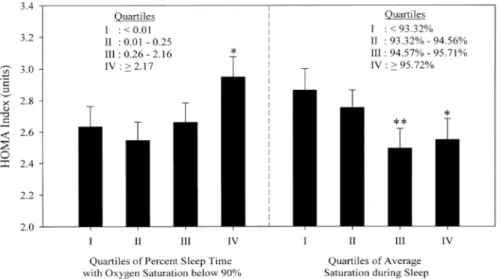
리 수치인 homeostasis model assessment(HOMA) index
가 더 높았고
(Figure 1),
평균 산소 포화도와 산소 포화도
이하의 수면 시간도 독립적으로
와 연관
90%
HOMA index
성이 있었다(Figure 2).
또한
CPAP
치료를 통하여 이러한 대사 이상의 호전이
있었다는 결과가 발표되었다
. CPAP
치료의 효과를 증명한
가장 큰 연구에서는
hyperinsulemic euglycemic clamp
에
의해 측정된 인슐린 감수성이
CPAP
치료 개월에 걸쳐 호
3
전되었다.
24흥미롭게도 치료 일 내에 인슐린 감수성이 호
2
전되었고 개월에 더 호전됨이 관찰되었다
3
(Figure 3).
비
Figure 2. Adjusted mean value of the homeostasis model assessment (HOMA) index according to two different indices of sleep-related hypoxemia
(12-month time window; n = 1,067), Sleep Heart Health Study, 1994-1999. *p = 0.04 and **p = 0.01 for comparisons with the first quartile. From Punjabi et al, 2004.
Figure 1. Adjusted mean value of the homeostasis model assessment
(HOMA) index as a function of the respiratory disturbance index (RDI) for 12-month (n = 1,067) and 3-month (n = 405) time windows, Sleep Heart Health Study, 1994-1999. Data were adjusted for age, gender, smoking status, body mass index, waist circumference, and self-reported sleep duration. Bars, standard error. From Punjabi et al, 2004.
만이 치료 효과의 중요한 변수였는데 비만이 없는 사람에
서 치료 효과가 두드러졌다 그러나
.
CPAP
치료의 포도당
대사에 있어 효과를 조사한 대다수의 연구에서 포도당 대
사의 변화가 관찰되지 않았고,
25최근에 발표된
34
명의 비
만을 가진
OSA
남자 환자에서 시행된 플라시보로 통제된
맹검 교차 시험에서
CPAP
치료 주 후에 혈압의 감소가
6
이루어졌고 압수용체
(baroreceptor)
민감도가 호전되었으
나 지질 공복시 혈당 인슐린 저항성 등의 대사 변화는 없
,
,
었다.
26따라서
CPAP
치료와 포도당 대사와의 관계에 있어
서는 비만 등의 특정한 군의 환자가
CPAP
치료에 반응하는
것인지 포도당 대상의 이상의 호전은
,
CPAP
치료만으로는
기대할 수 없는지 포도당 대사 이상이
(
OSA
에 영향을 주는
지 치료 효과를 보기 위해서는 장기간의 치료 많은 수의
),
,
환자 충분한
,
CPAP 치료의 보장이 필요한지 등에 대한 연
구 결과가 필요하다.
와 인슐린 저항성의 관계에 대한 정확한 기전은 아
OSA
직 확실히 밝혀지지 않았다 몇 가지 가능성 있는 설명이
.
제시되고 있다.
25,27,28우선 주간 졸리움과 관련된 신체적
활동 감소와 수면 분열에 의한 수면 박탈이 중요한 기여 인
자일 수 있다 인슐린 저항을 초래할 수 있는
.
pro-inflam-와
matory state
cytokine levels(tumor necrosis factor
등 의 증가가
환자에서 관
(TNF)- , interleukin-6
α
)
OSA
찰된다 간헐적인 저산소증과 연관된
.
oxidative stress
의
증가
, hypoxia-inducible factor I
의 유발 교감 신경계의
,
활성
(catecholamines
의 상승 지방 분해의 증가
,
),
시상하
부 뇌하수체 부신 축의 활성화
-
-
(cortisol
의 증가 가 인슐린
)
저항성과 관련될 수 있다 또한
.
OSA
환자에서 증가되어 있
는
leptin
등의 지방세포에서 유래된 호르몬의 변화가 인슐
린 저항성과 관련되어 있다고 생각된다 수면 무호흡이 체
.
세포 친화성
(somatotrophic)
기능에 부정적인 영향을 주
어 인슐린양 성장 인자
I(insulin-like growth factor I)
의
간에서의 생성이 감소되어 포도당 불내성을 일으킬 수 있다.
포도당의 항상성의 조절에 관여하는 monocyte
chemoat-이 소규모의 연구의
환자에서 증
tractant protein-1
OSA
가되어 있다
. OSA
환자의 적지 않은 수에서 동반되는 고혈압
에서 일어나는 골격근에서의 미세혈관의
희박성(microva-과 혈관 확장 장애
산화성 근섬
scular rarefaction)
, type 1
유의 감소 급속 연축 섬유 지름의 증가가 인슐린이 작용
,
장소로의 확산 거리를 증가시키거나
, OSA
에 동반되는 어
느 정도의 심부전이 골격근으로의 혈류를 감소시켜 말초성
인슐린 저항성에 기여할 수 있다.
의 대사성 증후군의 기준에 들어 있지 않지만 다른
ATP III
대사성 장애 전신 염증
,
(C-reactive protein,
29,30amyloid
A,
31여러
adhesion molecule
들의 증가
32-34), oxidative
의 증가
stress
,
33,35내피의 기능 부전 내피 세포 의존상 혈
(
관 확장 장애,
36nitric oxide
의 감소
,
37,38endothelin
의 증
가
39,40),
과응고성
(platelet aggregability, hematocrit,
의 증가
fibrinogen, blood viscosity
)
41-44이
OSA
환자에서
관찰된다 이러한 대사성 장애의 상당수는
.
CPAP
치료에
의해 개선된다.
32,34,38,40,45,46앞서 기술되었듯이
OSA
가 대사성 증후군의 발전에 관련
되어 있다는 실험적 및 임상적 증거가 있으나 아직 충분하
지는 않다 최근에 오히려 대사성 증후군이
.
OSA
를 유도할
수 있다는 의견이 제시 되었다.
47이러한 가정은 다음 전제
들을 근거로 이루어졌는데 대부분의
,
OSA
환자에서 상기
도의 해부학적인 이상 구조를 가지고 있지 않다는 점 반대
(
로 해부학적 이상으로 좁은 상기도 통로를 가지고 있는 많
은 환자가
OSA
를 가지지 않는다는 점 더 많은 수의 연구
),
들은
CPAP
치료가 대사성 이상의 호전에 도움을 주지 못한
다는 점 대사성 증후군의 하나인 비만이
,
OSA
의 위험도를
증가 시킨다는 점 인슐린 저항성이 주요 특징인 다낭종 난
,
소 증후군
(polycystic ovary syndrome)
에서 보듯이 비만
과 관계 없이
OSA
가 자주 발견되고 주간졸리움을 가지고
있다는 점 인슐린 저항성은 성장 인자의 분비를 촉진시켜
,
목의 연부 조직 부종 및 조직 증식을 일으킬 수 있다는 점 비
,
만 당뇨병 인슐린 저항성
,
,
, pro-inflammatory mediators
Figure 3. Improvement in the insulin sensitivity index (ISI) at baseline,2 days, and 3 months after onset of CPAP treatment in 31 patients. The insulin sensitivity index is given in mol/kg min. From Harsch etμ ・ al, 2004.
그 자체가 과도한 주간 졸리움과 연관되어 있다는 점 동물
,
실험에서 당뇨는 호흡 조절 기전에 현저한 억제를 일으켰
다는 점 등이 있다.
다낭종 난소 증후군을 가진
53
명의 환자의 명
9 (17%)
에
서
OSA
가 발견되었는데
452
명의 대조군에서는 명
3 (0.6%)
만이
OSA
를 가지고 있었고 대조군의
,
27%
에 비해 환자군
의
80%
가 주간 졸리움을 가지고 있었다
.
48TNF-α
를 중성
화시키는
entanercept
를 명의 비만을 가진
8
OSA
환자에
투여하여 졸리움과
AHI
의 의미 있는 감소가 관찰되었다
.
49예비적인 연구이고 실제의 임상에서 사용되기는 어렵지만
항염증 중재가
OSA
에 효과적일 수 있다는 증거가 제시되
었다 동물 실험에서 당뇨병은 호흡 조절 기전 과탄산증에
.
(
대한 호흡 반응 에 현저한 억제를 일으키고
)
, meformin
이
무호흡 수치를 회복시켰다는 연구 결과 있다.
50,51인간에서
당뇨병이 호흡 조절에 대한 미치는 영향에 대해서는 확실
치 않지만 자율신병증을 가지고 있는 당뇨병이
,
OSA
의 위
험 가능성을 증가시킨다고 알려져 있다.
52대사성 증후군 특히 인슐린 저항성과
,
OSA
와 관계
, OSA
의 여러 지표 및 증상에 따른 대사성 증후군의 관계 대사
,
성 증후군이
OSA
의 원인일 수 있다는 주장
, OSA
에 대한
치료가 대사성 기능 부전에 미칠 수 있는 효과 정도, OSA
에 있어서 대사성 기능 부전과 심혈관 질환의 위험 정도의
관계 등에 대한 더 많은 연구가 필요하다 아직까지 그 관
.
련성의 정확한 성격은 확실치 않지만
OSA
와 대사성 기능
부전의 연관성의 인식은 바람직한 치료 방향을 모색하는데
임상적으로 매우 중요할 것이다.
REFERENCES
1. Expert Panel on Detection, Evaluation, and Treatment of High Blood Cholesterol In Adults. Executive Summary of The Third Report of The National Cholesterol Education Program (NCEP) Expert Panel on Detection, Evaluation, and Treatment of High Blood Cholesterol In Adults (Adult Treatment Panel III). JAMA 2001;285:2486-2497.
2. Grundy SM, Cleeman JI, Daniels SR, et al. Diagnosis and mana-gement of the metabolic syndrome: an American Heart Associ-ation/National Heart, Lung, and Blood Institute scientific state-ment. Curr Opin Cardiol 2006;21:1-6.
3. Peppard PE, Young T, Palta M, Dempsey J, Skatrud J. Longi-tudinal study of moderate weight change and sleep-disordered breathing. JAMA 2000;284:3015-3021.
4. Young T, Shahar E, Nieto FJ, et al. Predictors of sleep-disordered breathing in community-dwelling adults: the Sleep Heart Health Study. Arch Intern Med 2002;162:893-900.
5. Phillips BG, Hisel TM, Kato M, et al. Recent weight gain in
patients with newly diagnosed obstructive sleep apnea. J Hypertens 1999;17:1297-1300.
6. Shinohara E, Kihara S, Yamashita S, et al. Visceral fat accu-mulation as an important risk factor for obstructive sleep apnoea syndrome in obese subjects. J Intern Med 1997;241:11-18. 7. Vgontzas AN, Papanicolaou DA, Bixler EO, et al. Sleep apnea
and daytime sleepiness and fatigue: relation to visceral obesity, insulin resistance, and hypercytokinemia. J Clin Endocrinol Metab 2000;85:1151-1158.
8. Chin K, Shimizu K, Nakamura T, et al. Changes in intra-abdominal visceral fat and serum leptin levels in patients with obstructive sleep apnea syndrome following nasal continuous positive airway pressure therapy. Circulation 1999;100:706-712. 9. Newman AB, Nieto FJ, Guidry U, et al. Relation of
sleep-disordered breathing to cardiovascular disease risk factors: the Sleep Heart Health Study. Am J Epidemiol 2001;154:50-59. 10. Ip MS, Lam KS, Ho C, Tsang KW, Lam W. Serum leptin and
vascular risk factors in obstructive sleep apnea. Chest 2000;118: 580-586.
11. Coughlin SR, Mawdsley L, Mugarza JA, Calverley PM, Wilding JP. Obstructive sleep apnoea is independently associated with an increased prevalence of metabolic syndrome. Eur Heart J 2004; 25:735-741.
12. Tan KC, Chow WS, Lam JC, et al. HDL dysfunction in obstruc-tive sleep apnea. Atherosclerosis 2006;184:377-382.
13. Robinson GV, Pepperell JC, Segal HC, Davies RJ, Stradling JR. Circulating cardiovascular risk factors in obstructive sleep apnoea: data from randomised controlled trials. Thorax 2004;59:777-782. 14. Chin K, Nakamura T, Shimizu K, et al. Effects of nasal continuous positive airway pressure on soluble cell adhesion molecules in patients with obstructive sleep apnea syndrome. Am J Med 2000; 109:562-567.
15. Peppard PE, Young T, Palta M, Skatrud J. Prospective study of the association between sleep-disordered breathing and hyperten-sion. N Engl J Med 2000;342:1378-1384.
16. Jennum P, Schultz-Larsen K, Christensen N. Snoring, sympathetic activity and cardiovascular risk factors in a 70 year old population. Eur J Epidemiol 1993;9:477-482.
17. Grunstein RR, Stenlof K, Hedner J, Sjostrom L. Impact of obstruc-tive sleep apnea and sleepiness on metabolic and cardiovascular risk factors in the Swedish Obese Subjects (SOS) Study. Int J Obes Relat Metab Disord 1995;19:410-418.
18. Enright PL, Newman AB, Wahl PW, Manolio TA, Haponik EF, Boyle PJ. Prevalence and correlates of snoring and observed apneas in 5,201 older adults. Sleep 1996;19:531-538.
19. Elmasry A, Janson C, Lindberg E, Gislason T, Tageldin MA, Boman G. The role of habitual snoring and obesity in the develop-ment of diabetes: a 10-year follow-up study in a male population. J Intern Med 2000;248:13-20.
20. Al Delaimy WK, Manson JE, Willett WC, Stampfer MJ, Hu FB. Snoring as a risk factor for type II diabetes mellitus: a prospective study. Am J Epidemiol 2002;155:387-393.
21. Ip MS, Lam B, Ng MM, Lam WK, Tsang KW, Lam KS. Obstruc-tive sleep apnea is independently associated with insulin resistance. Am J Respir Crit Care Med 2002;165:670-676.
22. Punjabi NM, Sorkin JD, Katzel LI, Goldberg AP, Schwartz AR, Smith PL. Sleep-disordered breathing and insulin resistance in middleaged and overweight men. Am J Respir Crit Care Med 2002;165:677-682.
23. Punjabi NM, Shahar E, Redline S, Gottlieb DJ, Givelber R, Resnick HE. Sleep-disordered breathing, glucose intolerance, and insulin resistance: the Sleep Heart Health Study. Am J Epidemiol 2004;160:521-530.
24. Harsch IA, Schahin SP, Radespiel-Troger M, et al. Continuous positive airway pressure treatment rapidly improves insulin sen-sitivity in patients with obstructive sleep apnea syndrome. Am J Respir Crit Care Med 2004;169:156-162.
25. Punjabi NM, Polotsky VY. Disorders of glucose metabolism in sleep apnea. J Appl Physiol 2005;99:1998-2007.
26. Coughlin SR, Mawdsley L, Mugarza JA, Wilding JP, Calverley PM. Cardiovascular and metabolic effects of CPAP in obese males with OSA. Eur Respir J 2007;29:720-727.
27. Wolk R, Somers VK. Sleep and the metabolic syndrome. Exp Physiol 2007;92;67-78.
28. Wiernsperger N, Nivoit P, Bouskela E. Obstructive sleep apnea and insulin resistance: a role for microcirculation? Clinics 2006; 61:253-266.
29. Shamsuzzaman AS, Winnicki M, Lanfranchi P, et al. Elevated C-reactive protein in patients with obstructive sleep apnea. Cir-culation 2002;105:2462-2464.
30. Yokoe T, Minoguchi K, Matsuo H, et al. Elevated levels of C-reactive protein and interleukin-6 in patients with obstructive sleep apnea syndrome are decreased by nasal continuous positive airway pressure. Circulation 2003;107:1129-1134.
31. Svatikova A, Wolk R, Shamsuzzaman AS, Kara T, Olson EJ, Somers VK. Serum amyloid A in obstructive sleep apnea. Cir-culation 2003;108:1451-1454.
32. Chin K, Nakamura T, Shimizu K, et al. Effects of nasal continuous positive airway pressure on soluble cell adhesion molecules in patients with obstructive sleep apnea syndrome. Am J Med 2000; 109:562-567.
33. Dyugovskaya L, Lavie P, Lavie L. Increased adhesion molecules expression and production of reactive oxygen species in leukocytes of sleep apnea patients. Am J Respir Crit Care Med 2002;165: 934-939.
34. El-Solh AA, Mador MJ, Sikka P, Dhillon RS, Amsterdam D, Grant BJ. Adhesion molecules in patients with coronary artery disease and moderate-to-severe obstructive sleep apnea. Chest 2002;121:1541-1547.
35. Schulz R, Mahmoudi S, Hattar K, et al. Enhanced release of superoxide from polymorphonuclear neutrophils in obstructive sleep apnea. Impact of continuous positive airway pressure therapy. Am J Respir Crit Care Med 2000;162:566-570.
36. Kato M, Roberts-Thomson P, Phillips BG, et al. Impairment of endothelium-dependent vasodilation of resistance vessels in patients with obstructive sleep apnea. Circulation 2000;102:2607-2610. 37. Ip MS, Lam B, Chan LY, et al. Circulating nitric oxide is
sup-pressed in obstructive sleep apnea and is reversed by nasal con-tinuous positive airway pressure. Am J Respir Crit Care Med 2000;162:2166-2171.
38. Schulz R, Schmidt D, Blum A, et al. Decreased plasma levels of nitric oxide derivatives in obstructive sleep apnoea: response to CPAP therapy. Thorax 2000;55:1046-1051.
39. Saarelainen S, Seppala E, Laasonen K, Hasan J. Circulating endothelin-1 in obstructive sleep apnea. Endothelium 1997;5:115-118.
40. Phillips BG, Narkiewicz K, Pesek CA, Haynes WG, Dyken ME, Somers VK. Effects of obstructive sleep apnea on endothelin-1 and blood pressure. J Hypertens 1999;17:61-66.
41. Chin K, Ohi M, Kita H, et al. Effects of NCPAP therapy on fibrinogen levels in obstructive sleep apnea syndrome. Am J Respir Crit Care Med 1996;153:1972-1976.
42. Sanner BM, Konermann M, Tepel M, Groetz J, Mummenhoff C, Zidek W. Platelet function in patients with obstructive sleep apnoea syndrome. Eur Respir J 2000;16:648-652.
43. Wessendorf TE, Thilmann AF, Wang YM, Schreiber A, Konietzko N, Teschler H. Fibrinogen levels and obstructive sleep apnea in ischemic stroke. Am J Respir Crit Care Med 2000;162:2039-2042. 44. Guardiola JJ, Matheson PJ, Clavijo LC, Wilson MA, Fletcher EC. Hypercoagulability in patients with obstructive sleep apnea. Sleep Med 2001;2:517-523.
45. Ohga E, Tomita T, Wada H, Yamamoto H, Nagase T, Ouchi Y. Effects of obstructive sleep apnea on circulating ICAM-1, IL-8, and MCP-1. J Appl Physiol 2003;94:179-184.
46. Ohike Y, Kozaki K, Iijima K, et al. Amelioration of vascular endothelial dysfunction in obstructive sleep apnea syndrome by nasal continuous positive airway pressure? possible involvement of nitric oxide and asymmetric NG, NG-dimethylarginine. Circ J 2005;69:221-226.
47. Vgontzas AN, Bixler EO, Chrousos GP. Sleep apnea is a mani-festation of the metabolic syndrome. Sleep Med Rev 2005;9: 211-224.
48. Vgontzas AN, Legro RS, Bixler EO, Grayev A, Kales A, Chrousos GP. Polycystic ovary syndrome is associated with obstructive sleep apnea and daytime sleepiness: role of insulin resistance. J Clin Endocrinol Metab 2001;86:517-20.
49. Vgontzas AN, Zoumakis E, Lin HM, Bixler EO, Trakada G, Chrousos GP. Marked decrease in sleepiness in patients with sleep apnea by etanercept, a tumor necrosis factor- antagonist. J Clinα Endocrinol Metab 2004;89:4409-4413.
50. Polotsky VY, Wilson JA, Haines AS, et al. The impact of insulin-dependent diabetes on ventilatory control in the mouse. Am J Respir Crit Care Med 2001;163:624-632.
51. Ramadan W, Petitjean M, Loos N, et al. Effect of high-fat diet and metformin treatment on ventilation and sleep apnea in non-obese rats. Respir Physiol Neurobiol 2006;150:52-65. 52. Bottini P, Dottorini ML, Cristina Cordoni M, Casucci G, Tantucci
C. Sleep-disordered breathing in nonobese diabetic subjects with autonomic neuropathy. Eur Respir J 2003;22:654-60.