Analysis of surface second-harmonic generation by orientational distribution function
in a chiral polymer film
N. Y. Ha,1S. H. Han,2D. W. Jeon,3C.-S. Jung,4Byoungchoo Park,5 Hideo Takezoe,6and J. W. Wu1,*
1Department of Physics, Ewha Womans University, Seoul 120-750, Korea 2Advanced Photonics Research Institute, GIST, Gwangju 500-712, Korea 3
Department of Clothing & Textiles, Ewha Womans University, Seoul 120-750, Korea
4
Department of Optical Engineering, Chongju University, Chongju 360-764, Korea
5
Department of Electrophysics, Kwangwoon University, Seoul 139-701, Korea
6Department of Organic and Polymeric Materials, Tokyo Institute of Technology, O-okayama, Meguro-ku, Tokyo 152-8552, Japan 共Received 9 December 2004; published 7 September 2005兲
By adopting classical models of molecular chirality, contributions of the coupled-oscillator and helix natures to the chiral surface second-order susceptibilities are identified through introduction of a molecular orienta-tional distribution. Experimentally, surface orientaorienta-tional distribution functions at interfaces of an isotropic chiral chitosan polymer film are determined from second harmonic generation measurement. The largest chiral component of surface nonlinear optical susceptibility is from the electric-magnetic coupling with dominant contribution from the helix nature of chitosan.
DOI:10.1103/PhysRevE.72.036601 PACS number共s兲: 42.70.Jk, 33.55.Ad, 68.47.Mn, 42.65.Ky
I. INTRODUCTION
Second harmonic generation共SHG兲 from surfaces of an isotropic chiral bulk has been studied in various material systems with the main interest lying in the clarification of the contributing second order nonlinear optical共NLO兲 processes. In analyzing the chiral surface SHG signals, it has been lack-ing to relate the NLO susceptibility with the microscopic hyperpolarizability of chiral molecules in a quantitative way, mainly because an appropriate microscopic description of NLO processes in chiral molecules is not well established. The difficulty lies in the drastic difference between the linear and second-order NLO responses of isotropic chiral material system. In contrast to the linear optical properties such as circular dichroism共CD兲 or optical rotatory dispersion 共ORD兲 where magnetic interaction is essential, surface SHG from chiral surface is electric-dipole 共E1兲 as well as magnetic-dipole 共M1兲 and electric-quadrupole 共E2兲 allowed 关1,2兴. In other words, while the CD and ORD are always from a non-local interaction of light field with a spatially dispersed elec-tronic structure of chiral molecules, chiral surface SHG can be from a purely local interaction involving only E1 pro-cesses as well as nonlocal interactions.
When compared with E1 process, M1 and E2 processes are usually assumed to be negligible at chiral surface关3,4兴 for a dimerlike molecular structure such as binaphthol in solution. However, it has been reported that E1 process is not sufficient for explaining the surface SHG from chiral sur-faces of polythiophene 关5兴 and Langmuir-Blodgett mono-layer of chiral poly共isocyanide兲 关6兴, as well as SHG from centrosymmetric crystal of chiral molecules关7兴. Also Flytza-nis et al. reported that M1 can be of the same order as E1 in giving rise to the surface SHG from spin-coated film of a pentamethinium salt substituted by an optically active
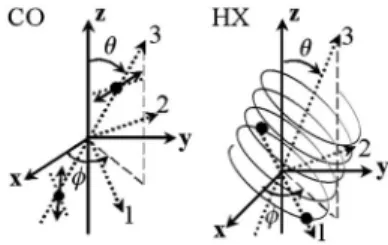
mo-lecular group关8兴. In an attempt to relate the chiral molecular structure with the chiral surface SHG and to identify the importance of each multipolar process in generating SHG, Hache et al. extended two classical models for the linear optical activity, namely, a coupled-oscillator and a helix关9兴, to calculate SHG response of an isotropic chiral layer关10兴. See Fig. 1 for the coupled-oscillator 共CO兲 and the helix 共HX兲. In fact, by restricting the surface sum frequency gen-eration共SFG兲 to the E1 process, Shen et al. reported a the-oretical calculation of the dispersion of the quantum me-chanical hyperpolarizability of a dimerlike chiral molecule such as binaphthol, which was based on a CO model. The observed SFG signal near electronic resonance fares well with the theoretical analysis 关3,11兴. According to Hache et al., the optical activity in binaphthol structure originates from excitonic coupling, correctly described by a CO, the molecular NLO response of which is E1 dominant 关10,12,13兴.
Considering that the magnetic interaction is as important as electric interaction in giving rise to a chiral surface SHG in general, it is important to identify the contributions of CO and HX natures of chiral electronic structure to the macro-scopic SHG signal. Except for an SFG spectroscopy
experi-*Electronic address: [email protected]
FIG. 1. Two classical models for chirality, coupled oscillator 共CO兲 and helix 共HX兲. 共1,2,3兲 and 共x,y,z兲 refer to the molecular and the surface frames, respectively. is the polar angle between z and 3 axes with z axis along the surface normal and is the azimuthal angle between x and 3 axes.
ment near the electronic resonance on a chiral surface mono-layer of binaphthol关14兴, where only E1 process is taken into account, no work has been reported on the rigorous determi-nation of orientational distribution functions共ODF兲 of chiral molecules at a surface when both E1 and M1 processes are important in contributing to the surface SHG signals. In this work, we employ the surface SHG measurement of a chiral chitosan polymer film spin coated on a substrate to determine ODFs at both air-film and film-substrate interfaces through the classical models of chirality, a CO and a HX, which is extended to describe SHG process in terms of the molecular hyperpolarizabilty.
II. CHIRAL PROPERTIES OF HYPERPOLARIZABILITY AND NONLINEAR OPTICAL SUSCEPTIBILITY
TENSORS
In general, the chiral property of molecular hyperpolariz-abilityijkis determined based on the consideration how the
induced dipole moment changes sign under the mirror-symmetry operation of the two incident electric or magnetic fields. For example, p12=123eeeE2E3will be nonvanishing for a chiral structure which lacks a mirror symmetry, while it will be vanishing for an achiral structure possessing a mirror symmetry. Hence we term 123eee a chiral component. Evi-dently,123eemwill be an achiral component, since it involves a magnetic field which is an axial vector. From this, we find that the chirality property of ijk is an intrinsic property
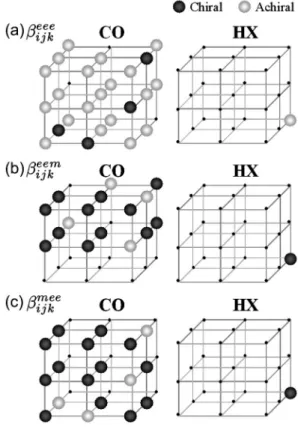
which is independent of the point group symmetry of the molecular structure. In Fig. 2 we plot the chiral property of 27 independent tensor components ofijkof a molecule
pos-sessing the lowest symmetry point group of C1, which is expressed in a lattice form. Black circle indicates that the tensor component is chiral, while white circle indicates that the tensor component is achiral. We note that the chiral prop-erty of tensor components indicated Fig. 2 holds irrespective of the energies of lights involved in the SHG processes, i.e., whether resonant or off-resonant with the chiral electronic
resonance. In other words, the chiral property holds even in the resonant regime where the Kleinman symmetry of ijk
breaks down.
Now we examine the chiral property of ijk’s when the
molecular chiral structure is modeled as CO or HX shown in Fig. 1. By solving the optical response of CO and HX non-linear oscillators in a nonresonant regime and expressing
ijk’s in terms of structural parameters, Hache et al. 关10兴
identified the CO and HX origins ofijk’s, which are shown
in Fig. 3. The relevant structural parameters are the coupling strength between two oscillators and the magnitude of non-linearity in each oscillator for CO, and the radius/pitch of helice and the magnitude of nonlinearity for HX. We note that the number of the nonvanishingijk’s with CO and HX
origins is less than 27, and the actual number depends on the multipolar process involved. This indicates that CO or HX is a model that describes a spatially dispersed electronic struc-ture but is not as complete as C1. As an example, we find that
333
eee 关Fig. 3共a兲兴 is achiral and from HX origin, while 
123
eee
关Fig. 3共b兲兴 and 113
mee 关Fig. 3共c兲兴 are chiral and from CO
origin, etc.
In general, chiral molecules can belong to a point group with a symmetry higher than C1, still lacking the mirror symmetry, in which case the number of the nonvanishing tensor components ijk’s is far below 27, and we need to
consider only thoseijkthat satisfy the molecular symmetry
requirement.
Hache et al. expressed the NLO susceptibility of a
FIG. 2. Chiral and achiral components of hyperpolarizability tensorsijkeee,ijkeem, andijkmee.
FIG. 3. Tensor properties of hyperpolarizability 共a兲 ijkeee, 共b兲 ijk
eem, and共c兲 ijk
meefrom CO and HX origins. For SHG, while the indices j and k can be permuted as long as the fundamental fields are all electric fields such as共a兲 and 共c兲, cannot be permuted under the different fundamental fields condition such as共b兲.
chiral surface possessing C⬁ symmetry which is also com-posed of C⬁symmetric chiral molecules关10兴. As a concrete example and for a later use, we look at an isotropic chiral surface共C⬁兲 which is composed of C2symmetric chi-ral molecules. By use of directional cosines between the mo-lecular frame i , j , k共=1,2,3兲 and the laboratory frame I , J , K共=x,y,z兲, the major chiral IJK共2兲’s can be expressed in terms ofijk’s through the orientational average.
xyz eee = N/2具cos2典共 123 eee −213eee兲 + N/2具sin2典共 213 eee −321eee兲, zzz eem = N具cos3典 333 eem + N具sin2cos典共 113 eem +131eem+311eem兲, zzz mee= N具cos3典 333
mee+ N具sin2cos典共 113 mee +131 mee +311 mee兲, 共1兲 where N is the surface number density of molecules,is the polar angle between z and 3 axes, is the azimuthal angle between x and 3 axes, and 具 典 represents the orientational average. In the case of azimuthal isotropy 共C⬁ symmetry兲 具cosn典=0 when n is odd and 具cos2典=具sin2典=1/2.
In the classical models of chirality for SHG, the hyperpo-larzability tensor components ijk’s are determined by
ex-panding the induced dipole moment in terms of the electric field for the given model, namely, CO or HX, with the non-linearity taken into account. That is, in the expansion, the quantum mechanical transition moments are not introduced and the energy dispersion of  is taken care of separately. Then, the hyperpolarizability has the energy dependence as
=共D2, D兲 with D=共02−2+ 2i␥兲, where
0and de-note the electronic resonant energy and the incident light energy, respectively. Because of relevance with our experi-mental measurement, we assume that the fundaexperi-mental fre-quencyis far from the electronic resonance while the SHG
frequency 2 is near resonant. In other words, for0⬃2, Dis a real value and D2becomes a complex value, giving the resonant effect in. Dmay be considered as a constant independent of the molecular axis共Kleinmann symmetry al-lowed兲, while D2 is molecular-axis dependent共Kleinmann symmetry disallowed兲. Then, one can derive relations among
ijk’s such as311=322, and get relations betweenand. Now assuming that the NLO response originates either from the CO or HX nature of the chiral molecule and taking the energy dispersion into account, Eq.共1兲 can be rewritten with CO and HX contributions explicitly identified,
xyz
eee= N/2关具cos2典共 123
eee
−213eee兲 + 具sin2典213eee兴CO,
zzz eem = N关具cos3典 333 eem兴HX + N关具sin2cos典 131 eem兴CO , zzz mee= N关具cos3典 333
mee兴HX+ N关具sin2cos典2 113
mee兴CO
, 共2兲 where the subscripts CO and HX denote the nature of chiral-ity origins.
We find thatxyz eee
is composed entirely ofijk’s with CO
origin, whilezzz eem
andzzz mee
have a mixed contribution from HX and CO. Furthermore,xyz
eee
depends on the axial ordering of molecules 共具cos2典兲, while zzz
eem
and zzz mee
depend on the polar ordering of molecules 共具cos3典 and 具cos典兲. This is in a strong contrast with the relation holding for a 1D rodlike molecule, where only polar orders of molecules can give rise to a nonvanishing macroscopic second order NLO susceptibility关15兴.
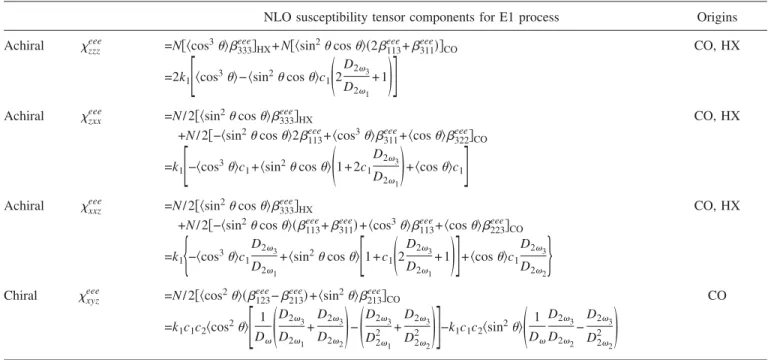
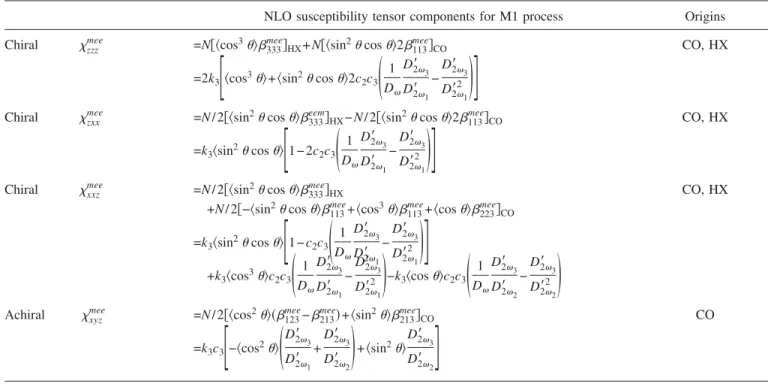
Next, we express NLO susceptibilities in terms of struc-tural parameters of CO and HX to relate the macroscopically observed quantities with the molecular structures as shown in Tables I–III. We have the following relevant structural
TABLE I. NLO macrosopic and microscopic relations between ijkeee’s and ijkeee’s for C⬁ symmetric film surface composed of C2 symmetric polymers.
NLO susceptibility tensor components for E1 process Origins
Achiral zzzeee =N关具cos3典 333 eee兴
HX+ N关具sin2 cos 典共2113eee+311eee兲兴CO CO, HX
=2k1
关
具cos3典−具sin2 cos 典c 1共
2D2
3
D21
+ 1
兲兴
Achiral zxxeee =N / 2关具sin2 cos 典333 eee兴
HX CO, HX
+N / 2关−具sin2 cos 典2113eee+具cos3典311eee+具cos典322eee兴CO =k1
关
−具cos3典c1+具sin2 cos 典共
1 + 2c1D23
D2
1
兲
+具cos典c1
兴
Achiral xxzeee =N / 2关具sin2 cos 典333eee兴HX CO, HX
+N / 2关−具sin2 cos 典共 113 eee+ 311 eee兲+具cos3典 113 eee+具cos典 223 eee兴 CO =k1
兵
−具cos3典c 1 D2 3 D2 1 +具sin2 cos 典关
1 + c 1共
2 D2 3 D2 1 + 1兲兴
+具cos典c1D23 D2 2其
Chiral xyzeee =N / 2关具cos2典共 123 eee− 213 eee兲+具sin2典 213 eee兴 CO CO =k1c1c2具cos2典
关
1 D共
D23 D2 1 + D23 D2 2兲
−共
D23 D2 1 2 + D23 D2 2 2兲兴
−k1c1c2具sin2典共
1 D D23 D2 2 − D23 D2 2 2兲
parameters: For CO,共1兲 the distance between two oscillators, d, and 共2兲 the tilt angle of oscillators ␣. For HX, 共1兲 the radius of the helix a, and共2兲 its pitch 2b. The microscopic
expressions ofijk eee
’s in terms of the CO and HX structural parameters can be found in Ref.关10兴, and those ofijkeemand
ijk mee
can be derived without much difficulty. By introducing
TABLE II. NLO macrosopic and microscopic relations between ijkeem’s and ijkeem’s for C⬁ symmetric film surface composed of C2 symmetric polymers.
NLO susceptibility tensor components for E1-M1 process Origins
Chiral zzzeem =N关具cos3典
333 eem兴
HX+ N关具sin2 cos 典131eem兴CO CO, HX
=2k2
关
具cos3典−具sin2 cos 典c 2c3共
1 D D2 3 D21 − D2 3 D2 1 2兲兴
Chiral zxxeem =N / 2关具cos sin2典333 eem兴 HX− N / 2关具sin2 cos 典131 eem兴 CO CO, HX =k2具sin2 cos 典
关
1 + c2c3共
1 D D2 3 D2 1 − D23 D2 1 2兲兴
Chiral xzxeem =N / 2关具cos sin2典333 eem兴 HX+ N / 2关具cos3典131 eem+具cos典 232 eem兴 CO CO, HX
=k2
关
具cos sin2典−具cos3典c2c3共
1 D D23 D2 1 − D23 D2 1 2兲兴
+k2具cos典c2c3共
1 D D23 D2 2 − D23 D2 2 2兲
Chiral xxzeem =zxxeem CO, HX
Achiral xyzeem
=N / 2关具sin2典共 231 eem− 321 eem兲兴 CO= k2具sin2典c2
共
1 − D2 3 D2 2兲
COAchiral xzyeem =N / 2关具cos2典共 132 eem− 231 eem兲−具sin2典 312 eem兴 CO CO =k2c3
关
具cos2典共
D23 D2 1 + D23 D2 2兲
+具sin2典兴
Achiral zxyeem=−N / 2关具sin2典 132 eem兴 CO= −k2具sin2典c3 D2 3 D21 CO
TABLE III. NLO macrosopic and microscopic relations betweenijkmee’s and ijkmee’s for C⬁ symmetric film surface composed of C2 symmetric polymers.
NLO susceptibility tensor components for M1 process Origins
Chiral zzzmee =N关具cos3典
333 mee兴
HX+ N关具sin2 cos 典2113 mee兴
CO CO, HX
=2k3
关
具cos3典+具sin2 cos 典2c2c3共
1 D D2 3 ⬘ D2 1 ⬘ − D2 3 ⬘ D2 1 ⬘2兲兴
Chiral zxxmee =N / 2关具sin2 cos 典333eem兴HX− N / 2关具sin2 cos 典2113mee兴 CO CO, HX =k3具sin2 cos 典
关
1 − 2c2c3共
1 D D2 3 ⬘ D2 1 ⬘ − D2 3 ⬘ D2 1 ⬘2兲兴
Chiral xxzmee =N / 2关具sin2 cos 典333mee兴HX CO, HX
+N / 2关−具sin2 cos 典 113 mee+具cos3典 113 mee+具cos典 223 mee兴 CO =k3具sin2 cos 典
关
1 − c 2c3共
1 D D2 3 ⬘ D2 1 ⬘ − D2 3 ⬘ D2 1 ⬘2兲兴
+k3具cos3典c2c3共
1 D D2 3 ⬘ D2 1 ⬘ − D2 3 ⬘ D2 1 ⬘2兲
−k3具cos典c2c3共
1 D D2 3 ⬘ D2 2 ⬘ − D2 3 ⬘ D2 2 ⬘2兲
Achiral xyzmee =N / 2关具cos2典共123mee−213mee兲+具sin2典213mee兴CO CO
=k3c3
关
−具cos2典共
D2 3 ⬘ D2 1 ⬘ + D2 3 ⬘ D2 2 ⬘兲
+具sin2典 D2 3 ⬘ D2 2 ⬘兴
three parameters c1, c2, and c3, defined as c1=共a2 + b2兲2cos2␣sin␣/ 2b3, c
2 as the coupling strength between two oscillators, and c3=共a2+ b2兲2d cos2␣sin␣/ 4a2b2, the achiral and chiral NLO susceptibilities for each multipolar processes are expressed in terms of c1, c2, and c3. In Tables I–III, the hyperpolarizability along the molecular axis 3,
333, is factored out as an overall multiplicative coefficient in k = N333/ 2 in order to facilitate an easy comparison, i.e., k1= N333 eee / 2, k2= N333 eem / 2, and k3= N333 mee / 2. D2stands for that the relevant light frequency 2is that of electric field in Table I and II, while D2
⬘
stands for that the relevant light frequency 2is that of magnetic field in Table III.Through these macroscopic and microscopic expressions between 共2兲’s and ’s such as Tables I–III, the resonant behaviors of NLO susceptibilities are fully taken into ac-count. Thus, total 30 real and imaginary parts of NLO sus-ceptibility tensor components ijk共2兲, responsible for surface SHG signals from one C⬁ chiral surface, are expressed in terms of the structural parameters of C2 chiral molecule within the classical models of CO and HX in Tables I–III by use of the orientational averages of directional cosines. That is, four E1 processes 共three achiral and one chiral兲, seven E1-M1 couplings共four chiral and three achiral兲, and four M1 processes 共three chiral and one achiral兲 constitute 15 com-plex NLO susceptibilities, totaling 30 real and imaginary parts of NLO susceptibility tensor components. In a chiral polymeric film fabricated on a transparent substrate, how-ever, there exist two NLO active interfaces, namely, air-film interface and film-substrate interface, from which surface SHG can be generated. Hence total 60 real and imaginary parts of NLO susceptibility tensor componentsijk共2兲. In con-trast, from Tables I–III, we note that there are 28 unknown parameters, among which the 22 unknowns are for the mi-croscopic description of the molecular hyperpolarizability, for instance, such as c1, k1, D, D21, D2
⬘
1, and the sixunknowns are the orientational averages of the three mo-ments of directional cosines at both interfaces. In other words, the introduction of classical models of chirality en-abled to express 60 real and imaginary parts of tensor com-ponents in terms of 28 unknown parameters, which are sub-sequently determined from the 32 independent experimental data, as will be explained in Sec. III.
Before we proceed further, we examine how CO and HX natures of the chiral molecular structure contribute to the macroscopic SHG signal by assuming a simple ODF, f共兲, of the molecules on the surface. When a delta-function like ODF is assumed, i.e., f共兲=␦共−0兲 with the magnitudes of all’s being equal to 1, the magnitude of major chiral共2兲 can be obtained for each E1, E1-M1, and M1 processes, which are plotted in Figs. 4共a兲–4共c兲, respectively. As shown in Fig. 4, CO contribution共solid line兲 toxyz
eee
increases from 0 continuously reaching to the maximum while HX contri-bution共dashed line兲 tozzzeem andzzzmee is maximum at0= 0° and decreases to 0 continuously, as0 increases to 90°. On the other hand, CO contribution共solid line兲 tozzz
eem
andzzz mee
increases from 0 as 0 increases from 0°, and reaches the maximum at a certain angle and decreases back to 0 as 0 increases further. We find that CO is the dominant chiral nonlinearity for E1 process when chiral molecules lie-down
parallel to the surface, while HX is a major contribution in E1-M1 and M1 processes when molecules stand-up along the surface normal.
III. SURFACE SECOND HARMONIC GENERATION MEASUREMENTS
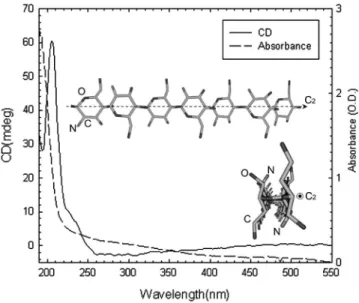
In order to identify the nature of microscopic chiral NLO processes in the surface SHG signals, we carried out an SHG measurement on a chiral chitosan polymer film. Chitosan共1, 4--D-glucosaminoglycan, polysaccharide兲 is one of the rep-resentative chiral biopolymers. It is easily derived by N-deacetylation process from chitin, abundantly found in na-ture as a major component of the cell wall of various fungi and in the shells of insects and crustaceans关16兴. As shown in Fig. 5, chitosan has a primary amino group at the C-2 posi-tion of the glucosamine residue and forms a rigid helical structure along the molecular axis. Because of its character-istic properties related to the amino groups, chitosan has re-ceived much attention for applications such as industry关17兴, biology关18兴, and photonics 关19,20兴.
FIG. 4. Magnitude of chiral second-order susceptibility is plot-ted as a function of0 with the ODF f共兲=␦共−0兲 for 共a兲 xyz eee 共E1兲, 共b兲zzz
eem共E1-M1兲, and 共c兲 zzz
mee共M1兲, with CO 共solid line兲 and HX共dashed line兲 contributions separated out.
FIG. 5. The linear absorption spectrum and circular dichroism 共CD兲 are shown with the molecular structure of a chitosan polymer possessing the C2symmetry axis.
In order to fabricate an optical quality film, we synthe-sized the chitosan from the chitin of Alaska King crab shell by heating at 150 ° C – 160 ° C in 50% NaOH solution. The degree of deacetylation of the chitosan polymer was 97% and the molecular weight of the polymer was ⬃32 100. The chitosan thin film was easily obtained by spin coating the chitosan solution onto a fused quartz substrate. The CD peak at 210 nm positioned near the linear absorption peak confirms the inherent chirality of the chitosan film. See Fig. 5. The thickness d and the dielectric constant ⑀
of the chitosan film were measured by an ellipsometry as d = 2.2m and ⑀共532 nm兲=2.410, ⑀共266 nm兲=2.578 + i0.004 at room temperature.
The surface SHG signals at=266 nm were generated by use of a frequency-doubled output at a wavelength of 532 nm from a Q-switched Nd:YAG pulsed laser共10 ns du-ration, 10 Hz repetition rate兲 as fundamental at the incidence angle of 45° for the sample film. The polarization state of the fundamental beam was controlled by rotating a quarter-wave plate共QWP兲 after selecting p or s polarization of the incident
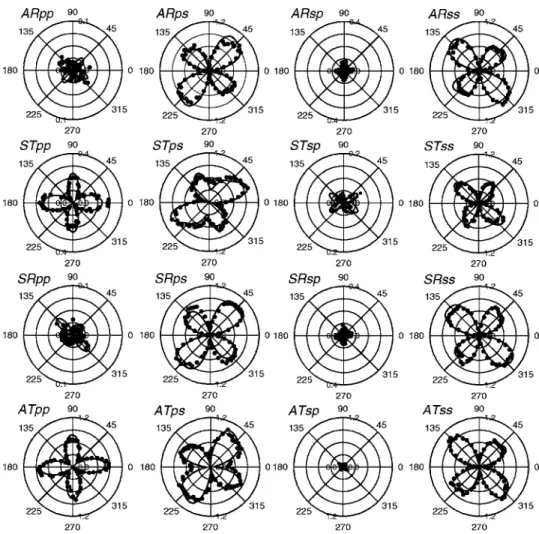
FIG. 6. Experimental surface SHG intensities 共closed circles兲 from the chitosan film as a func-tion of the rotafunc-tion angle 共in de-grees兲 of QWP. The four-letter la-bels indicate the interfaced medium 共A for air-film or S for substrate-film兲, the optical geom-etry 共R for reflection or T for transmission兲, the polarization state of the fundamental field共p or
s兲, and the polarization state of the
analyzer 共s or p兲. The least-squared-fit results are shown by solid curves.
FIG. 7. The ODFs of the chi-tosan polymers derived through the maximum entropy method:共a兲 the distribution fa at the air-film interface and 共b兲 the distribution
beam. The rotation angle of the QWP is defined as the angle between the fast axis of the QWP and the s-polarization direction. The reflected or transmitted surface SHG of 266 nm was selected through a polarizer for p or s polarization. From the chitosan film, a total of 16 surface SHG profiles are measured as a function of rotation angle of QWP. However, the number of the independent SHG data are 32, as can be counted from the combination of the four input polarizations共p or s at= 0 ° , 90° or left-handed circular or right-handed circular polarizations at= ± 45°兲 ⫻2 polariza-tions of SHG output共p or s兲 ⫻4 kinds of sample geometries of substrate-reflection, substrate-transmission, air-reflection, and air-transmission. As discussed in Sec. II, the number of unknowns in the expression of surface SHG from two inter-faces is 28, while the number of independent measurement data are 32, which means that the structural parameters of CO and HX as well as the orientational averages of three moments of directional cosine can be determined through a least-squared-fit in a straightforward way.
Figure 6 shows a total of 16 sets of polar-plotted SHG intensity profiles as a function of the rotation angle. The four-letter labels of data in the figure such as ‘ARps’ stands for the interfaced medium共A for air-film or S for substrate-film兲, the optical geometry 共R for reflection or T for trans-mission兲, the polarization state of the fundamental field 共p or s兲, and the polarization state of the analyzer 共s or p兲. As can be seen in Fig. 6, the surface SHG intensities strongly de-pend on the polarization state of the fundamental light. The estimated SHG circular dichroism 共SHG-CD兲 asymmetries 关1兴 for ARps and ARss were 31.0% and 30.9%, respectively.
IV. RESULTS AND DISCUSSION
In order to relate the observed chiral surface SHG signals with microscopic processes, we solve for the wave 共funda-mental and second harmonic兲 propagation for E1, E1-M1, and M1 processes in the chitosan film by introducing five different optical layers composed of共1兲 air, 共2兲 a SHG-active interface of air side共1 nm兲, 共3兲 a polymer film 共2.2m兲, 共4兲 a SHG-active interface of substrate side 共1 nm兲, and 共5兲 a substrate共3 mm兲, known as a five-layered system 关21兴. The SHG active interfaces共2兲 and 共4兲 are described in terms of microscopic hyperpolarizability and ODFs as discussed in Sec. II, since the chitosan polymer possesses a C2symmetric molecular geometry and the chirality of chitosan polymer can be modeled as a sum of a CO and a HX along the rigid molecular axis 3.
In order to determine 28 parameters from 32 experimental data set, we adopted the maximum entropy method关21–23兴 with three constraint functions, f1= cos, f2= cos2, and f3= cos3, which allows to determine the unbiased ODFs from the orientational averages as well as molecular structural parameters of CO and HX. The calculation was carried out using Lagrange’s method of undetermined multipliers共i’s, i = 1 – 3兲. The least-squared fits are shown in
Fig. 6 as solid curves. It is clear that the theoretical SHG intensity profiles fit very well with experimental results within the experimental errors.
The ODFs of both chitosan interfaces are plotted in Fig. 7, which shows that the C2 symmetry axis of chitosan are
al-most toward the surface normal at both interfaces. This indi-cates that chitosan molecules tend to stand up at the inter-faces, which suggests that the interactions between primary amino groups at the C-2 position of the glucosamine residue should play an important role in the molecular orderings at the interfaces as shown in Fig. 5. Furthermore, the polar order at substrate-film interface is higher than that at the air-film interface, which can be understood from the fact that the fused quartz substrate is known to be a polar substrate providing dipolar interactions at the interface, differing from the air关24兴.
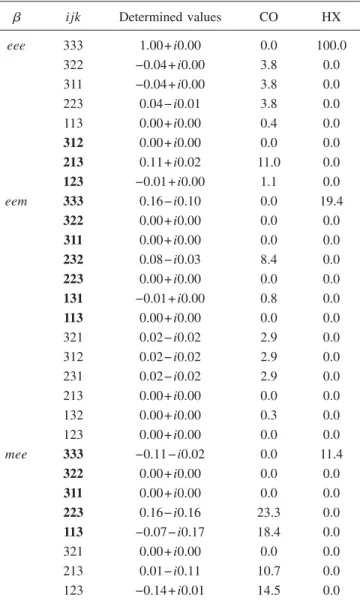
The magnitudes of hyperpolarizability ijk’s obtained
from theoretical simulations in Fig. 6 are summarized in Table IV, normalized with the respect to333eee= 1. Consider-ing that our experiments were conducted in the resonant re-gime of the chitosan film, the determined’s are all complex values and we also represented relative magnitudes ofijk’s
in percent. As seen in Table IV, we find that two chiral com-ponents are pronounced, namely, 333eem 共19.4%, HX origin兲
TABLE IV. NLO hyperpolarizbilies of the chitosan molecule possessing a C2symmetry. Boldface indicates a chiral component. Each values are normalized with respect to333eee= 1. The relative contributions of CO and HX are shown in %.
 ijk Determined values CO HX
eee 333 1.00+ i0.00 0.0 100.0 322 −0.04+ i0.00 3.8 0.0 311 −0.04+ i0.00 3.8 0.0 223 0.04− i0.01 3.8 0.0 113 0.00+ i0.00 0.4 0.0 312 0.00+ i0.00 0.0 0.0 213 0.11+ i0.02 11.0 0.0 123 −0.01+ i0.00 1.1 0.0 eem 333 0.16− i0.10 0.0 19.4 322 0.00+ i0.00 0.0 0.0 311 0.00+ i0.00 0.0 0.0 232 0.08− i0.03 8.4 0.0 223 0.00+ i0.00 0.0 0.0 131 −0.01+ i0.00 0.8 0.0 113 0.00+ i0.00 0.0 0.0 321 0.02− i0.02 2.9 0.0 312 0.02− i0.02 2.9 0.0 231 0.02− i0.02 2.9 0.0 213 0.00+ i0.00 0.0 0.0 132 0.00+ i0.00 0.3 0.0 123 0.00+ i0.00 0.0 0.0 mee 333 −0.11− i0.02 0.0 11.4 322 0.00+ i0.00 0.0 0.0 311 0.00+ i0.00 0.0 0.0 223 0.16− i0.16 23.3 0.0 113 −0.07− i0.17 18.4 0.0 321 0.00+ i0.00 0.0 0.0 213 0.01− i0.11 10.7 0.0 123 −0.14+ i0.01 14.5 0.0
from E1-M1 interaction and 223mee 共23.3%, CO origin兲 from M1 interaction, which shows that CO nature of chitosan mol-ecules is dominant in contributing to the NLO molecular chirality.
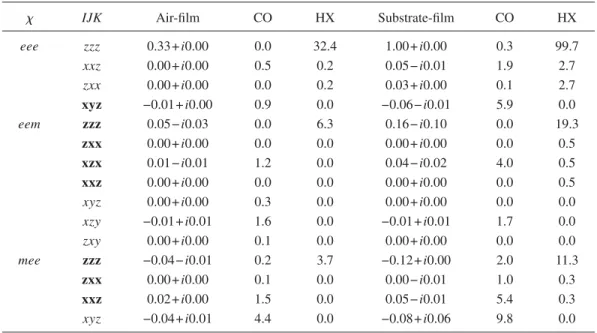
Finally, the macroscopic NLO coefficients determined are summarized in Table V, normalized with respect tozzz
eee
= 1 of the substrate-film interface within an arbitrary overall con-stant phase. It was found that the imaginary parts of the NLO coefficient are comparable in size to the real parts as seen in
zzz eem
, for example, which should be true near the resonant regime. Interestingly, the largest chiral contribution is from E1-M1 interactionzzz
eem共19.3%, HX dominant兲, not from E1
interactionxyzeee 共5.9%, CO only兲, indicating that HX nature of the chitosan is mainly responsible for the SHG-CD. Com-paring with the microscopic chirality as shown in Table IV, where the CO origin 共223mee, M1 interaction兲 contributes dominantly to the chitosan molecular chirality, the chirality in the macroscopic system of the chitosan polymeric film is dominantly of HX origin共zzz
eem, E1-M1 interaction兲.
Further-more, we find that the magnitudes of surface NLO coeffi-cients of the substrate-film interface are about three times larger than those of the air-film interface, for all components, which is evident from the difference in ODFs as shown in Fig. 7. The fact that HX contribution to zzz
eem
is more than three times larger than CO contribution to xyz
eee
in the substrate-film interface is easily understood when referring to Fig. 4, since the ODF is highly polar ordered. We find that the difference in contributions is not that pronounced in the less polar ordered air-film interface.
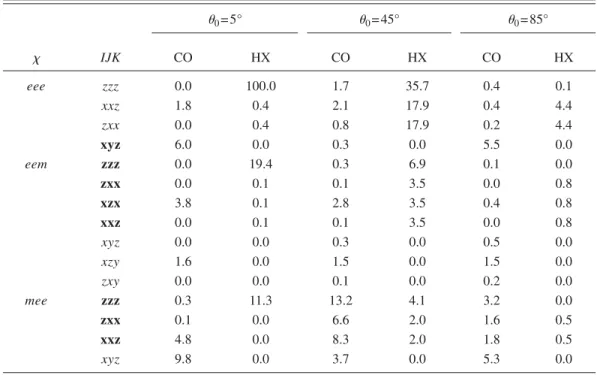
As an interesting example, we also assumed that f共兲=␦共−0兲 with the magnitudes of ’s of the chitosan molecule as shown in Table IV. The calculated magnitudes of surface NLO susceptibilities for the polar angle 0= 5°,
0= 45°, and 0= 85° are represented in Table VI, respec-tively. Each value is normalized with respect tozzz
eee
= 1 for
0= 5°. As shown in Table VI, for 0= 5°, the largest chiral contribution is from E1-M1 interaction zzz
eem 共19.4%, HX
dominant兲, which is similar to the result of 共2兲’s at the substrate-film interface in Table V. However, for0= 45°, the largest chiral contribution is from M1 interaction zzz
mee
共13.2%, CO dominant兲, where CO contribution increases from 0.3% to 13.2% while HX contribution decreases from 11.3% to 4.1% as 0 increases from 5° to 45°. When the polar angle 0 is 85°, where chitosan molecules are nearly parallel to a surface, HX contributions decrease further back to 0% than the results for0= 45° and then the largest chiral contribution is from M1 interactionxyzeee共5.5%, CO only兲. It was in good agreement with the fact, referring to Fig. 4, that CO is the dominant chiral nonlinearity when chiral molecules lie-down parallel to the surface, while HX is a major contribution when molecules stand-up along the surface normal.
This study can be generalized for the various chiral sur-faces to study the molecular orientation and origin of mo-lecular hyperpolarizability. As an interesting example, a chi-ral surface with C2 symmetry covered by C⬁ chiral molecules such as LB film of helicenbisquinone, has been studied by Elshocht and co-workers关25,26兴. They found that the dominant chiral component is xyz
eee
−yxz eee
and increases after thermal treatment of the LB film, which is attributed to an increase of ansiotropy in the film surface plane. Now, we are ready to analyze their results based on our study. The relevant chiral component is expressed in terms of the mo-lecular hyperpolarizability 123eee which is entirely from CO origin as follows: xyz eee −yxz eee= N关 123
eee兵− 1 + 2具cos2典 + 具cos2cos2典其兴CO, 共3兲 whereis the azimuthal angle andis the polar angle in the molecular共1,2,3兲 and the surface 共x,y,z兲 frames. The above
TABLE V. Surface NLO susceptibilities of the chitosan film. Boldface indicates a chiral component. Each determined values for two interfaces are normalized with respect tozzzeee= 1 of the substrate-film interface. The relative contributions of CO and HX are shown in %.
IJK Air-film CO HX Substrate-film CO HX
eee zzz 0.33+ i0.00 0.0 32.4 1.00+ i0.00 0.3 99.7
xxz 0.00+ i0.00 0.5 0.2 0.05− i0.01 1.9 2.7
zxx 0.00+ i0.00 0.0 0.2 0.03+ i0.00 0.1 2.7
xyz −0.01+ i0.00 0.9 0.0 −0.06− i0.01 5.9 0.0
eem zzz 0.05− i0.03 0.0 6.3 0.16− i0.10 0.0 19.3
zxx 0.00+ i0.00 0.0 0.0 0.00+ i0.00 0.0 0.5
xzx 0.01− i0.01 1.2 0.0 0.04− i0.02 4.0 0.5
xxz 0.00+ i0.00 0.0 0.0 0.00+ i0.00 0.0 0.5
xyz 0.00+ i0.00 0.3 0.0 0.00+ i0.00 0.0 0.0
xzy −0.01+ i0.01 1.6 0.0 −0.01+ i0.01 1.7 0.0
zxy 0.00+ i0.00 0.1 0.0 0.00+ i0.00 0.0 0.0
mee zzz −0.04− i0.01 0.2 3.7 −0.12+ i0.00 2.0 11.3
zxx 0.00+ i0.00 0.1 0.0 0.00− i0.01 1.0 0.3
xxz 0.02+ i0.00 1.5 0.0 0.05− i0.01 5.4 0.3
equation also indicates that for the well-aligned molecules along= 90° 共parallel to the surface兲 with= 0°,xyzeee−yxzeee = −N关123
eee兴CO
, while for the random molecules, xyz eee
−yxz eee
= −1 / 6N关123eee兴CO. It means that the chiral SHG intensity from the well-aligned surface is 36 times larger than that from the random surface. These analyses are in good agreement with their observations.
V. CONCLUSIONS
In summary, we studied chiral surface SHG by employing classical models of molecular chirality. It was found that the microscopic chiral origins of molecules as well as the mo-lecular orientation is important in determining macroscopic chiral NLO coefficients. As an experimental example, the surface SHG measurements from the chiral chitosan film en-abled to determine unambiguously all the complex NLO
co-efficients and ODFs at both interfaces from the analysis em-ploying the relation between  and共2兲. The largest chiral tensor component is associated with the electric-magnetic coupling originating from HX nature of the chitosan poly-mer. The obtained ODFs showed that highly polar orienta-tions are formed at both air-film and substrate-film inter-faces. Theoretical analysis, proposed in this study, can be easily generalized to the study of various chiral interfaces of biomaterials such as DNA or protein solid films.
ACKNOWLEDGMENTS
J.W.W. acknowledges the support through the ABRL pro-gram at Ewha Womans University and the Korean Research Foundation Grant 共KRF-2004-C00057兲. B.P. acknowledges support from the Research Grant of Kwangwoon University 共2005兲.
关1兴 T. Petralli-Mallow, T. M. Wong, J. D. Byers, H. I. Yee, and J. M. Hicks, J. Phys. Chem. 97, 1383共1993兲.
关2兴 Y. R. Shen, The Principles of Nonlinear Optics 共Wiley, New York, 1984兲, Chap. 2.
关3兴 M. A. Belkin, S. H. Han, X. Wei, and Y. R. Shen, Phys. Rev. Lett. 87, 113001共2001兲.
关4兴 J. D. Byers, H. I. Yee, T. Petralli-Mallow, and J. M. Hicks, Phys. Rev. B 49, 14643共1994兲.
关5兴 S. V. Elshocht, T. Verbiest, M. Kauranen, A. Persoons, B. M. W. Langeveld-Voss, and E. W. Meijer, J. Chem. Phys. 107, 8201共1997兲.
关6兴 M. Kauranen, T. Verbiest, J. J. Maki, and A. Persoons, J.
Chem. Phys. 101, 8193共1994兲.
关7兴 E. W. Meijer, E. E. Havinga, and G. L. J. A. Rikken, Phys. Rev. Lett. 65, 37共1990兲.
关8兴 M. C. Schanne-Klein, F. Hache, A. Roy, C. Flytzanis, and C. Payrastre, J. Chem. Phys. 108, 9436共1998兲.
关9兴 E. U. Condon, Rev. Mod. Phys. 9, 432 共1937兲.
关10兴 F. Hache, H. Mesnil, and M. C. Schanne-Klein, J. Chem. Phys.
115, 6707共2001兲.
关11兴 M. A. Belkin, Y. R. Shen, and C. Flytzanis, Chem. Phys. Lett.
363, 479共2002兲.
关12兴 J. D. Byers, H. I. Yee, and J. M. Hicks, J. Chem. Phys. 101, 6233共1994兲.
TABLE VI. Surface NLO susceptibilities of the chitosan film as a function of 0with the ODF f共兲 =␦共−0兲. Boldface indicates a chiral component. The relative contributions of CO and HX are shown in %.
IJK 0= 5° 0= 45° 0= 85° CO HX CO HX CO HX eee zzz 0.0 100.0 1.7 35.7 0.4 0.1 xxz 1.8 0.4 2.1 17.9 0.4 4.4 zxx 0.0 0.4 0.8 17.9 0.2 4.4 xyz 6.0 0.0 0.3 0.0 5.5 0.0 eem zzz 0.0 19.4 0.3 6.9 0.1 0.0 zxx 0.0 0.1 0.1 3.5 0.0 0.8 xzx 3.8 0.1 2.8 3.5 0.4 0.8 xxz 0.0 0.1 0.1 3.5 0.0 0.8 xyz 0.0 0.0 0.3 0.0 0.5 0.0 xzy 1.6 0.0 1.5 0.0 1.5 0.0 zxy 0.0 0.0 0.1 0.0 0.2 0.0 mee zzz 0.3 11.3 13.2 4.1 3.2 0.0 zxx 0.1 0.0 6.6 2.0 1.6 0.5 xxz 4.8 0.0 8.3 2.0 1.8 0.5 xyz 9.8 0.0 3.7 0.0 5.3 0.0
关13兴 S. V. Elshocht, T. Verbiest, M. Kauranen, L. Ma, H. Cheng, K. Y. Musick, L. Pu, and A. Persoons, Chem. Phys. Lett. 309, 315共1999兲.
关14兴 S. H. Han, N. Ji, M. A. Belkin, and Y. R. Shen, Phys. Rev. B
66, 165415共2002兲.
关15兴 J. W. Wu, J. Opt. Soc. Am. B 8, 142 共1991兲.
关16兴 M. McCarthy, T. Pratum, J. Hedges, and R. Benner, Nature 共London兲 390, 150 共1997兲.
关17兴 F. S. Ligler, B. M. Lingerfelt, R. P. Price, and P. E. Schoen, Langmuir 17, 5082共2001兲.
关18兴 P. J. Barnes, Nature 共London兲 402, 31 共1999兲.
关19兴 H. Jiang, W. Su, S. Caracci, T. J. Bunning, T. Cooper, and W. W. Adams, J. Appl. Polym. Sci. 61, 1163共1996兲.
关20兴 L.-Q. Wu, H. Yi, S. Li, G. W. Rubloff, W. E. Bentley, R.
Ghodssi, and G. F. Payne, Langmuir 19, 519共2003兲. 关21兴 J.-G. Yoo, H. Hoshi, T. Sakai, B. Park, K. Ishikawa, H.
Tak-ezoe, and Y. S. Lee, J. Appl. Phys. 84, 4079共1998兲. 关22兴 B. Jerome and Y. R. Shen, Phys. Rev. E 48, 4556 共1993兲. 关23兴 B. Park, Y. Kinoshita, T. Sakai, J.-G. Yoo, H. Hoshi, K.
Ish-ikawa, and H. Takezoe, Phys. Rev. E 57, 6717共1998兲. 关24兴 X. Zhuang, D. Wilk, L. Marrucci, and Y. R. Shen, Phys. Rev.
Lett. 75, 2144共1995兲.
关25兴 T. Verbiest, S. V. Elshocht, M. Kauramen, L. Hellemans, J. Snauwaert, C. Nuckolls, T. J. Katz, and A. Persoons, Science
282, 913共1998兲.
关26兴 S. V. Elshocht, T. Verbiest, G. d Schaetzen, L. Hellemans, K. E. S. Philips, C. Nuckolls, T. J. Katz, and A. Persoons, Chem. Phys. Lett. 323, 340共2000兲.