Effects of Vibrant Soundbridge on tinnitus
accompanied by sensorineural hearing loss
Jeon Mi LeeID1, Hyun Jin LeeID2, In Seok MoonID3*, Jae Young Choi31 Department of Otorhinolaryngology, Ilsan Paik Hospital, Inje University College of Medicine, Goyang, Korea, 2 Department of Otorhinolaryngology, Incheon St. Mary’s Hospital, The Catholic University of Korea, Bupyeong, Incheon, Korea, 3 Department of Otorhinolaryngology, Yonsei University College of Medicine, Seoul, Korea
Abstract
Objectives
Tinnitus is a common symptom among patients with hearing loss, and many studies have reported successful tinnitus suppression with hearing devices. Active middle ear implanta-tion of the Vibrant Soundbridge (VSB) is a good alternative to existing hearing devices. This study evaluated the effects of VSB implantation on tinnitus and sought to identify the main audiological factor that affects tinnitus suppression.
Methods
The study participants were 16 adults who had tinnitus with sensorineural hearing loss, and who underwent VSB implantations. Pure-tone audiometry; word recognition test; tinnitus handicap inventory (THI); and visual analog scale (VAS) assessment of loudness, aware-ness, and annoyance were performed before and 12 months after surgery. Changes in hearing threshold, word recognition scores (WRS), THI scores, and VAS scores were analyzed.
Results
VAS scores for loudness (mean difference: 1.9, 95% CI: 0.6, 3.1), awareness (mean differ-ence: 1.6, 95% CI: 0.4, 2.8), and annoyance (mean differdiffer-ence: 1.7, 95% CI: 0.7, 2.8) showed significant improvements from baseline to 12 months after surgery. In addition, THI scores showed a significant decrease (mean difference: 13.8, 95% CI: 2.9, 24.9). The aver-age hearing threshold level, WRS, and most comfortable level (MCL) also showed signifi-cant improvements at 12 months after surgery (mean difference: 17.3, 95% CI: 13.3, 21.3; mean difference:−7.6, 95% CI:−15.1,−0.1; mean difference: 26.3, 95% CI: 22.9, 29.6, respectively). Among the aforementioned factors, changes in MCL were best correlated with those in THI scores (mean difference: 2.55, 95% CI: 0.90, 4.21).
Conclusion
A VSB implant is beneficial to subjects with tinnitus accompanied by sensorineural hearing loss. The changes in THI scores best correlated with those in MCL. This improvement may
a1111111111 a1111111111 a1111111111 a1111111111 a1111111111 OPEN ACCESS
Citation: Lee JM, Lee HJ, Moon IS, Choi JY (2020) Effects of Vibrant Soundbridge on tinnitus accompanied by sensorineural hearing loss. PLoS ONE 15(2): e0228498.https://doi.org/10.1371/ journal.pone.0228498
Editor: Vinaya Manchaiah, Lamar University, UNITED STATES
Received: August 19, 2019 Accepted: January 16, 2020 Published: February 4, 2020
Peer Review History: PLOS recognizes the benefits of transparency in the peer review process; therefore, we enable the publication of all of the content of peer review and author responses alongside final, published articles. The editorial history of this article is available here:
https://doi.org/10.1371/journal.pone.0228498 Copyright:© 2020 Lee et al. This is an open access article distributed under the terms of theCreative Commons Attribution License, which permits unrestricted use, distribution, and reproduction in any medium, provided the original author and source are credited.
Data Availability Statement: All relevant data are within the manuscript and its Supporting Information files.
Funding: This study was supported by a grant from the National Research Foundation of Korea
represent a masking effect that contributes to tinnitus suppression in patients with VSB implants.
Introduction
Tinnitus is the perception of sound in the absence of sound stimuli, and affects approximately 10–15% of the adult population [1], with 20% of those affected experiencing a significant decrease in quality of life [2]. Traditionally, tinnitus was considered an otological disorder, but recent advances in neuroimaging have shifted the perspective toward the neural correlates underlying different forms of tinnitus [3,4]. Increased pathophysiological understanding of tinnitus has contributed to various treatment attempts, including pharmacological treatments, auditory stimulation, psychological treatments, and brain stimulations.
Many studies have reported tinnitus suppression following auditory stimulation with hear-ing devices, such as hearhear-ing aids (HAs), cochlear implants, and more recently, middle ear implants. As early as 1947, Saltzman and Ersner reported that patients with tinnitus benefited from the use of HAs [5], and the efficacy of this approach has been confirmed by other studies. Surr et al. reported that approximately 50% of patients with HAs experienced relief from
tinni-tus [6], and Folmer and Caroll reported the improvement of tinnitus with HAs in 70% of
par-ticipants [7]. In 2008, Trotter et al. reported a 25-year study examining the effects of HAs on
tinnitus [8], in which 350 of 826 patients with HAs (42.4%) reportedly showed effective
sup-pression of tinnitus. Since Van de Heyning, in 2008 [9], reported that patients with tinnitus resulting from single-sided deafness benefited from the use of cochlear implants, many studies have supported the beneficial effects of cochlear implants on tinnitus accompanied by sensori-neural hearing loss. Amoodi and colleagues reported a suppressive effect on tinnitus in 66% of implant users in their retrospective study [10], and Bovo et al. reported loudness and annoy-ance suppression in 36.1% and 30.6%, respectively, of 36 patients with cochlear implants in their prospective study [11]. Other prospective studies have reported a reduction in tinnitus
intensity in 92% of implant users [12], and a reduction of tinnitus handicap inventory (THI)
scores in 65% of implant users [13]. Thus far, only one paper has reported the effects of the
VSB on tinnitus [14]; in that study, VAS assessments of patients showed 55%, 45%, and 55%
improvements in loudness, awareness, and annoyance, respectively after VSB implantation. Although these studies used different methods to assess tinnitus reduction, it is apparent that use of hearing devices have some therapeutic effects on tinnitus.
Several possible mechanisms can explain tinnitus suppression by means of hearing devices. One possible mechanism involves hearing gain. Recent neuroimaging studies have revealed that tinnitus brain networks include not only sensory auditory areas, but also cortical regions involved in perceptual, emotional, memory, attentional, and salient functions [15,16]. Emo-tional stress caused by hearing loss also affects the severity of tinnitus, and hearing gain by means of hearing devices can help overcome this emotional stress. Another proposed mecha-nism is the creation of a masking effect. The use of hearing devices reduces patients’ awareness of their tinnitus by directing their attention to external auditory stimuli [7,8]. As the level of external sounds increases with hearing devices, the patients’ perception of tinnitus would decrease. Lastly, secondary plastic reorganization in the central auditory system reduces tinni-tus. Auditory input is decreased in subjects with hearing impairment, and consequently neural firing rate and neural synchrony increases, resulting in the plastic reorganization of the audi-tory cortex, with subsequently sustained awareness of tinnitus [3,15]. Increasing the external (NRF), funded by the Ministry of Education
(2018R1D1A1A02085472) to I.S.M.
Competing interests: The authors have declared that no competing interests exist.
auditory input with hearing devices can induce secondary plasticity and decrease the patients’ perception of tinnitus [17–19].
The Vibrant Soundbridge (VSB, Med-El, Innsbruck, Austria) is a partially implanted, active middle ear device. It directly delivers mechanical vibrations to the middle ear by placing the floating mass transducer (FMT) on the middle ear structures. Previous studies have confirmed that it confers superior, more usable amplification, as well as easier communication in daily
lis-tening environments than conventional amplification via HAs [20]. Accordingly, we
hypothe-sized that the use of VSB as a hearing device would have a positive association on tinnitus in patients with sensorineural hearing loss.
The purpose of the present study was to investigate the effects of VSB on tinnitus and to identify the main audiological factor involved in the changes in tinnitus, with a view to improving the treatment of tinnitus in patients with sensorineural hearing loss.
Materials and methods
Subjects
This study involved a retrospective chart review of patients who had sensorineural hearing loss with tinnitus, and who underwent VSB implantation at the Severance Hospital in Seoul, Korea, during January 2016 to July 2019. Inclusion criteria were 1) sensorineural hearing loss accompanied by ipsilateral tinnitus, 2) VSB implantations performed in the affected ears, 3) stable chronic tinnitus that did not respond to any previous treatments, and 4) follow-up for more than 1 year after VSB implantation and completion of audiological tests and self-assess-ment questionnaires preoperatively and at 1 year postoperatively. Exclusion criteria were 1) chronically disabled middle ears or previous ear surgeries, 2) fluctuating hearing and/or tinni-tus, and 3) known conditions that could cause hearing loss and/or tinnitus (e.g., Meniere’s dis-ease or vestibular schwannomas).
In total, 47 patients underwent VSB implantation between January 2016 and July 2019. From these, 3 patients were excluded because they had mixed hearing loss. In addition, 16 patients who did not experience tinnitus, 4 who were followed up for less than 1 year, 7 who did not complete the questionnaires, and 1 foreigner for whom a speech discrimination test was not available were excluded. Finally, 16 subjects (7 males, 9 females) were enrolled in this
study. The mean age at operation of the 16 patients was 66.0± 8.2 (53–76) years. All patients
had moderate to severe sensorineural hearing loss (58.9± 6.9 dB HL) accompanied by
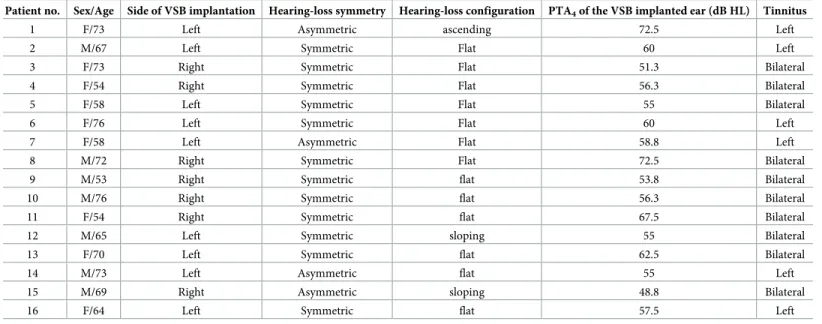
subjec-tive tinnitus on the same side. Hearing loss was bilaterally symmetric in 12 patients, and asym-metric in 4 patients. Those 4 patients had not recovered from previous sudden unilateral hearing loss, and the implantations were performed in the worse ears. The configuration of hearing loss in the implanted ears was flat in most patients (13, 81.3%), followed by sloping (2,
12.5%) and ascending (1, 6.2%). The patients’ demographic data are listed inTable 1.
All procedures were performed in accordance with the 1975 Declaration of Helsinki. The study was approved by the institutional review board of the Severance Hospital in Seoul, Korea (4-2017-0847). All of the subjects provided informed consent to participate in the study.
Audiological assessment
All patients were assessed by using pure-tone audiometry and word recognition tests (word recognition score; WRS) at preoperative and 12-months postoperative time points. The pure-tone air (250–8000 Hz) and bone conduction (250–4000 Hz) thresholds were measured using clinical audiometers in a double-walled audio booth. The pure-tone average (PTA) was defined as the mean value of the measurements taken at frequencies of 500 Hz, 1 kHz, 2 kHz, and 4 kHz. A word recognition test was performed to obtain the maximal WRS, which was
measured at the most comfortable hearing level (MCL) using 50 monosyllabic Korean words that are commonly heard during everyday life. The Korean words were from a validated and
standardized resource [21] and were phonetically balanced. The sound was set to a constant
intensity through the microphone. The MCL was defined as the sound level at which patients best heard and understood non-emotional sentences in Korean. Measurements of MCL with respect to loudness were obtained using the forced choice method, in which the experimenter manipulated the 5-dB-step attenuator dial until subjects chose the MCL.
Patients were reassessed 12 months after surgery, and the assessments consisted of aided pure-tone audiometry and a word recognition test. Aided pure-tone audiometry was performed after switching on the VSB alone using sound field (air conduction) testing through speakers with contralateral masking noise, which was achieved via a calibrated headphone. The masking procedure was the plateau method, also known as Hood’s tech-nique [22].
Functional hearing gain (FHG) was determined as the difference between preoperative and postoperative free-field audiometry data.
Tinnitus assessment
To assess pre-operative and postoperative tinnitus severity, all patients completed 2 self-administered questionnaires: a visual analog scale (VAS) for loudness, awareness, and annoy-ance, with ratings from 0 to 10, and the tinnitus handicap inventory (THI) developed by
Newman et al. [23]. The questionnaires were conducted at preoperative and 12-months
post-operative time points, and involved the same tests and full compliance. During this period, patients were followed up without any tinnitus retaining therapy, and/or any further treat-ments for tinnitus. We characterized an “improvement” as a decrease of more than 20% in the postoperative scores compared with the preoperative scores, and “worsened” as an increase of more than 20% in postoperative scores compared with the preoperative scores [24].
Table 1. Subject demographic data (N = 16).
Patient no. Sex/Age Side of VSB implantation Hearing-loss symmetry Hearing-loss configuration PTA4of the VSB implanted ear (dB HL) Tinnitus
1 F/73 Left Asymmetric ascending 72.5 Left
2 M/67 Left Symmetric Flat 60 Left
3 F/73 Right Symmetric Flat 51.3 Bilateral
4 F/54 Right Symmetric Flat 56.3 Bilateral
5 F/58 Left Symmetric Flat 55 Bilateral
6 F/76 Left Symmetric Flat 60 Left
7 F/58 Left Asymmetric Flat 58.8 Left
8 M/72 Right Symmetric Flat 72.5 Bilateral
9 M/53 Right Symmetric flat 53.8 Bilateral
10 M/76 Right Symmetric flat 56.3 Bilateral
11 F/54 Right Symmetric flat 67.5 Bilateral
12 M/65 Left Symmetric sloping 55 Bilateral
13 F/70 Left Symmetric flat 62.5 Bilateral
14 M/73 Left Asymmetric flat 55 Left
15 M/69 Right Asymmetric sloping 48.8 Bilateral
16 F/64 Left Symmetric flat 57.5 Left
PTA4= pure-tone average of four frequency thresholds (0.5, 1, 2, and 4 kHz), VSB = Vibrant Soundbridge
Statistical analyses
Statistical analysis was performed with SPSS for Windows, version 21 (SPSS Inc., Chicago, IL,
USA). The results of multiple experiments are presented as the mean± standard deviation.
Comparisons were performed between continuous variables using Student’st-test or the
pairedt-test for evaluating differences between 2 groups if the data exhibited a normal
distri-bution. Multiple regression analysis was performed to identify which audiological factors affected the improvement of tinnitus using a general linear model. Values ofp < 0.05 were
considered to be statistically significant.
Results
Changes in tinnitus
The therapeutic effects of VSB on tinnitus were encouraging (Table 2). The initial average THI
score was 55.6± 17.2, which decreased to 41.8 ± 24.7 at 12 months after surgery; the decrease
was statistically significant (t = 2.7, p < 0.05). Considering the criterion of a 20% decrease in
THI score, 7 patients (43.8%) reported improvement of tinnitus; however, 8 patients (50.0%) reported no change, and 1 patient (6.2%) reported worsening of tinnitus.
The patients were also questioned regarding how tinnitus, in terms of loudness, awareness, and annoyance, affected their lifestyle and emotions, using a symptom-rating scale based on a visual analogue scale (VAS) self-reported questionnaire. The questionnaire results demon-strated statistically significant improvements after VSB implantation. VAS scores for loudness decreased from 6.8± 2.3 to 4.9 ± 1.5 (t = 3.3, p < 0.01). VAS scores for awareness and annoy-ance also decreased from 6.3± 2.1 to 4.7 ± 1.9 (t = 2.9, p < 0.05) and from 6.3 ± 2.0 to 4.6 ± 1.8 (t = 3.4, p < 0.01), respectively. Based on the 20% criterion, 7 patients (43.8%) reported
improvement in tinnitus loudness, 8 patients (50.0%) reported no change, and 1 patient Table 2. Comparing means of preoperative unaided and postoperative aided ear condition (N = 16).
Variable Preoperative unaided ear (A) Postoperative aided ear (B) Paired differences t-value 95% CI of the difference
(Lower, Upper)
p-value
Tinnitus assessment THI M 55.6 41.8 13.8 2.7 2.9 24.9 < 0.05
SD (17.2) (24.7) (20.6)
VAS for loudness M 6.8 4.9 1.9 3.3 0.6 3.1 < 0.01
SD (2.3) (1.5) (2.3)
VAS for awareness M 6.3 4.7 1.6 2.9 0.4 2.8 < 0.05
SD (2.1) (1.9) (2.2)
VAS for annoyance M 6.3 4.6 1.8 3.4 0.7 2.8 < 0.01
SD (2.0) (1.8) (2.0)
Audiological assessment PTA (dB HL) M 58.9 41.6 17.3 9.2 13.3 21.3 < 0.001
SD (6.9) (6.7) (7.5)
WRS (%) M 62.1 69.8 -7.6 -2.2 -15.1 -0.1 < 0.05
SD (10.6) (13.9) (14.1)
MCL (dB HL) M 83.5 57.3 26.3 16.6 22.9 29.6 < 0.001
SD (5.9) (3.5) (6.3)
THI = tinnitus handicap inventory, VAS = visual analogue scale, PTA = pure-tone average, WRS = word recognition scores, MCL = most comfortable level, M = mean, SD = standard deviation, CI = confidence interval
(6.2%) reported louder tinnitus after implantation. The proportions were similar in the other 2 questionnaires. For awareness, 8 patients (50.0%) reported improvement, 6 patients (37.5%) found no change, and 2 patients (12.5%) reported worsening. For annoyance, 8 patients (50.0%) reported improvement, while 7 (43.8%) were stable and 1 (6.2%) was more annoyed
after implantation than under the unaided condition (seeS1 Datasetfor all relevant data).
Audiological assessment
Table 2shows the changes in audiological factors. Preoperative PTA was 58.9± 6.9 dB. After 12 months with the fine-fitting condition, the PTA improved to 41.6± 6.7 dB (t = 9.2, p < 0.001),
and the FHG was 17.3± 11.9 dB. Word recognition tests were performed under the
preopera-tive unaided condition, and under the VSB-aided condition at 12-months postoperapreopera-tively. The patients’ WRS improved from 62.1± 10.6% to 69.8 ± 13.9% (t = -2.2, p < 0.05,), and their MCL decreased from 83.5± 5.9 dB to 57.3 ± 3.5 dB (t = 16.6, p < 0.001, seeS1 Datasetfor all relevant data).
Influencing factors
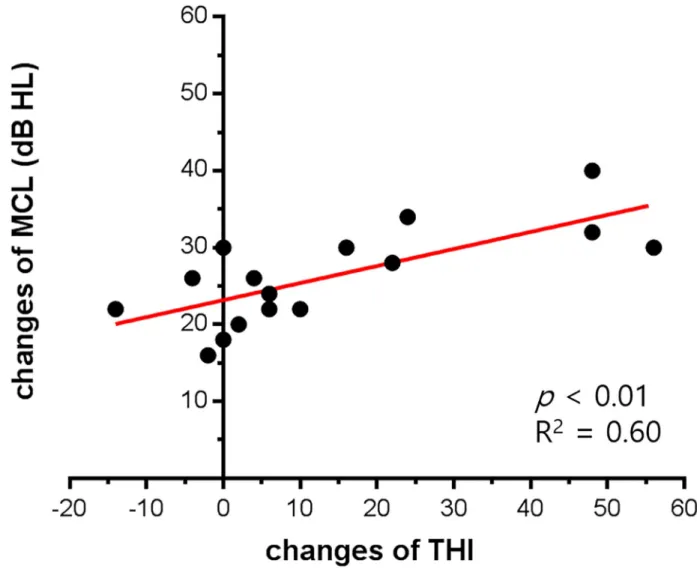
To identify the audiological factors that improved tinnitus, we performed multiple regression analysis. The 3 audiological factors included were as follows: 1) average FHG, 2) changes in MCL, and 3) changes in WRS. The improvement of tinnitus was measured as 1) changes in THI, 2) changes in VAS for loudness, 3) changes in VAS for awareness, and 4) changes in VAS for annoyance. When we performed multiple regression analysis, only decreased MCL was sig-nificantly and positively related to the improvement of THI. Improvement of MCL (unstan-dardized regression coefficient = 2.55 with standard error = 0.76) explained 60.0% of the THI improvement (p < 0.01,Fig 1,Table 3). Changes in VAS scores were also analyzed, but none of the 3 audiological factors showed a significant relationship with changes in VAS scores.
Discussion
In this study, we demonstrate that the effects of VSBs on tinnitus accompanied by sensorineu-ral hearing loss were beneficial. Within 1 year of VSB fine-fitting, the THI scores and VAS scores for loudness, awareness, and annoyance were significantly decreased. The mechanism underlying the beneficial effect of VSB on tinnitus remains unclear, although it may be similar to that of other hearing devices. In the present study, we also specifically sought to identify the main factor affecting the improvement of tinnitus in our study subjects and found that changes in THI scores were best correlated with the changes in MCLs. As MCL decreased with VSB, THI scores significantly decreased in the subjects.
Lowering MCL is critical in auditory rehabilitation of patients with sensorineural hearing loss, because maximum speech intelligibility is achieved at levels higher than the MCL [25,26]. Thus, patients with a high MCL have difficulty in understanding routine conversation at mod-erate sound levels. In the present study, patients showed a significant reduction in MCL, with a significant improvement in WRS. However, the changes in tinnitus were better correlated with the changes in MCL than with changes in WRS. For example, a patient in the present study showed a 34-dB improvement in MCL, but a 12% decrease in WRS. Her THI scores had improved from 52 to 28. Interpretation of these results suggest that the mechanism best explaining the effects of VSB on tinnitus is a masking effect, involving increased external sound perception.
A masking effect is a good rationale for sound therapy, and is a vital component of effective tinnitus management [7]. Its role is to reduce the contrast between the tinnitus signal and background activity in the auditory system, thereby forming a mask that is not limited to
human conversation. Background music, environmental sounds, or even meaningless white noise can be used as a mask, but Accuracy of speech reception is not the most important crite-rion for an effective mask, which explains the better correlation of tinnitus suppression with changes in MCL than with changes in WRS.
Table 3. Multiple regression analysis for the association between audiological improvement and tinnitus improvement (N = 16).
Variables ΔTHI ΔVAS for loudness ΔVAS for awareness ΔVAS for annoyance
ΔPTA -0.41 (-1.88, 1.05) -0.09 (-0.33, 0.15) -0.11 (-0.33, 0.12) -0.13 (-0.33, 0.08)
ΔWRS 0.28 (-0.37, 0.94) 0.03 (-0.14, 0.08) 0.02 (-0.13, 0.08) 0.02 (-0.12, 0.07)
ΔMCL 2.55��(0.90, 4.21) 0.16 (-0.12, 0.43) 0.19 (-0.06, 0.45) 0.17 (-0.07, 0.40)
R-squared 0.60 0.12 0.18 0.18
THI = tinnitus handicap inventory, VAS = visual analogue scale, PTA = pure-tone average, WRS = word recognition scores, MCL = most comfortable level, M = mean, SD = standard deviation
Unstandardized regression coefficients are shown, and 95% confidence intervals are given in parentheses. 2-tailed test; ��p < 0.01
https://doi.org/10.1371/journal.pone.0228498.t003
Fig 1. Correlations between changes in THI and changes in MCL. Multiple regression analysis revealed that only increased MCL was significantly associated with improvements of THI. Changes in THI was well correlated with changes in MCL (p < 0.01, R2
= 0.60).
Assuming that reducing the MCL is an important factor for suppressing tinnitus, the VSB might have an advantage over other HAs used for tinnitus suppression. A recent report
com-pared the MCL in HA-aided and VSB-aided conditions [26] and found that hearing gains
were similar under both aided conditions, but that the VSB-aided condition showed better improvement in MCL, to a value comparable to that of the normal hearing population. This phenomenon is explained by a mass effect. A loaded FMT provides system stiffness, and it results in increased hearing gain at mid to high frequencies, and decreased hearing gain at low
frequencies [27]. Lowering the MCL is attributable to robust amplifications of the mid to high
frequencies [26]; thus, VSB is superior to conventional Has in terms of lowering the MCL.
Fur-ther studies on tinnitus suppression, comparing HA-aided and VSB-aided conditions could verify the importance of lowering MCL in tinnitus management.
However, in this study, the correlation was found only when the factors were analyzed with THI scores, but not with VAS scores. Several factors can explain these discrepancies. First, the differences in the applied scales could affect the results. The VAS is composed of simple 11-point numeric scales, whereas the THI is composed of 25 questions, which can be answered in 3 ways: Yes, Sometimes, and No. Second, while the VAS only estimates the severity of tinni-tus perception, THI assesses its psychological aspects, which are particularly important in tin-nitus treatment. Finally, a sample size compromises the power for the detection of treatment effects and increases the possibility of false-negative results. Thus, the small sample size in this study may be a reason behind some of the insignificant results.
In the present study, we attempted to identify the main factors that affect the improvement of tinnitus within patients with VSB implants. We found that reduction of MCL, which increases the masking effect, is an important factor in the reduction of tinnitus, and that improvement of MCL could explain 60.0% of THI improvement. The remaining 47.6% could be explained by non-audiological factors. The pathophysiology of tinnitus includes audiologi-cal factors, as well as central mechanisms and psychologiaudiologi-cal factors. A previous meta-analysis reported that combined management of audiological and non-audiological factors, rather than sole masking, is more effective in reducing tinnitus [28]. This emphasizes the heterogeneity of tinnitus, and the importance of non-audiological factors in its treatment. Although tinnitus retraining therapy or direct counseling for tinnitus were not performed in the present study, a frequent fitting schedule with counseling and stress reduction as a consequence of hearing gain would qualify as combined management.
The limitations of this study included those inherent to retrospective designs and analyses. Thus, a prospective study comparing the extent of tinnitus suppression and changes in MCL between VSB and other HAs is necessary to validate the present findings. Furthermore, the sam-ple size was small and may have resulted in type II errors, as discussed earlier. Future studies should also include larger samples to overcome this limitation. A 1-year follow-up period was sufficient to prove the beneficial effects of VSB on tinnitus; however, a longer-term follow-up period may be needed. If hearing restoration is not achieved with the VSB because of long-term aggravation of hearing loss, tinnitus reduction accompanied by sufficient hearing gain would not be achieved. Additional acoustic amplification via conventional HA or replacement with a cochlear implant could be helpful in overcoming possible long-term aggravation of hearing loss and tinnitus with VSB implants. Finally, evaluation of secondary plastic reorganization in the central auditory system might be helpful in elucidating the therapeutic effects of VSB on tinnitus.
Conclusion
VSB showed beneficial effects on tinnitus, and its efficacy was comparable to that previously reported for other hearing devices. The changes in tinnitus were best correlated to the changes
in MCL, rather than with the amount of FHG or improvement in WRS, suggesting the impor-tance of masking effects on tinnitus suppression.
Supporting information
S1 Dataset. Detailed information and results for the included patients (n = 16).
(XLSX)
Author Contributions
Conceptualization: Jeon Mi Lee.
Data curation: Jeon Mi Lee, Hyun Jin Lee. Formal analysis: Jeon Mi Lee, Hyun Jin Lee. Funding acquisition: In Seok Moon. Methodology: Hyun Jin Lee.
Supervision: In Seok Moon, Jae Young Choi. Writing – original draft: Jeon Mi Lee.
Writing – review & editing: In Seok Moon, Jae Young Choi.
References
1. Henry JA, Dennis KC, Schechter MA. General review of tinnitus: prevalence, mechanisms, effects, and management. J Speech Lang Hear Res. 2005; 48(5):1204–35.https://doi.org/10.1044/1092-4388 (2005/084)PMID:16411806
2. Axelsson A, Ringdahl A. Tinnitus—a study of its prevalence and characteristics. Br J Audiol. 1989; 23 (1):53–62.https://doi.org/10.3109/03005368909077819PMID:2784987
3. Roberts LE, Eggermont JJ, Caspary DM, Shore SE, Melcher JR, Kaltenbach JA. Ringing ears: the neu-roscience of tinnitus. The Journal of neuneu-roscience: the official journal of the Society for Neuneu-roscience. 2010; 30(45):14972–9.
4. Jastreboff PJ. Phantom auditory perception (tinnitus): mechanisms of generation and perception. Neu-roscience research. 1990; 8(4):221–54.https://doi.org/10.1016/0168-0102(90)90031-9PMID:2175858 5. Saltzman M, Ersner MS. A hearing aid for the relief of tinnitus aurium. The Laryngoscope. 1947; 57
(5):358–66.https://doi.org/10.1288/00005537-194705000-00005PMID:20241853
6. Surr RK, Montgomery AA, Mueller HG. Effect of amplification on tinnitus among new hearing aid users. Ear and hearing. 1985; 6(2):71–5.https://doi.org/10.1097/00003446-198503000-00002PMID: 3996787
7. Folmer RL, Carroll JR. Long-term effectiveness of ear-level devices for tinnitus. Otolaryngology—head and neck surgery: official journal of American Academy of Otolaryngology-Head and Neck Surgery. 2006; 134(1):132–7.
8. Trotter MI, Donaldson I. Hearing aids and tinnitus therapy: a 25-year experience. The Journal of laryn-gology and otology. 2008; 122(10):1052–6.https://doi.org/10.1017/S002221510800203XPMID: 18353195
9. Van de Heyning P, Vermeire K, Diebl M, Nopp P, Anderson I, De Ridder D. Incapacitating unilateral tin-nitus in single-sided deafness treated by cochlear implantation. The Annals of otology, rhinology, and laryngology. 2008; 117(9):645–52.https://doi.org/10.1177/000348940811700903PMID:18834065 10. Amoodi HA, Mick PT, Shipp DB, Friesen LM, Nedzelski JM, Chen JM, et al. The effects of unilateral cochlear implantation on the tinnitus handicap inventory and the influence on quality of life. The Laryn-goscope. 2011; 121(7):1536–40.https://doi.org/10.1002/lary.21851PMID:21647911
11. Bovo R, Ciorba A, Martini A. Tinnitus and cochlear implants. Auris, nasus, larynx. 2011; 38(1):14–20. https://doi.org/10.1016/j.anl.2010.05.003PMID:20580171
12. Ruckenstein MJ, Hedgepeth C, Rafter KO, Montes ML, Bigelow DC. Tinnitus suppression in patients with cochlear implants. Otology & neurotology: official publication of the American Otological
Society, American Neurotology Society [and] European Academy of Otology and Neurotology. 2001; 22(2):200–4.
13. Di Nardo W, Cantore I, Cianfrone F, Melillo P, Scorpecci A, Paludetti G. Tinnitus modifications after cochlear implantation. European archives of oto-rhino-laryngology: official journal of the European Fed-eration of Rhino-Laryngological Societies (EUFOS): affiliated with the German Society for Oto-Rhino-Laryngology—Head and Neck Surgery. 2007; 264(10):1145–9.
14. Seo YJ, Kim HJ, Moon IS, Choi JY. Changes in Tinnitus After Middle Ear Implant Surgery: Comparisons With the Cochlear Implant. Ear and hearing. 2015; 36(6):705–9.https://doi.org/10.1097/AUD.
0000000000000187PMID:26107004
15. Langguth B, Kreuzer PM, Kleinjung T, De Ridder D. Tinnitus: causes and clinical management. The Lancet Neurology. 2013; 12(9):920–30.https://doi.org/10.1016/S1474-4422(13)70160-1PMID: 23948178
16. De Ridder D, Elgoyhen AB, Romo R, Langguth B. Phantom percepts: tinnitus and pain as persisting aversive memory networks. Proceedings of the National Academy of Sciences of the United States of America. 2011; 108(20):8075–80.https://doi.org/10.1073/pnas.1018466108PMID:21502503 17. Del Bo L, Ambrosetti U. Hearing aids for the treatment of tinnitus. Progress in brain research. 2007;
166:341–5.https://doi.org/10.1016/S0079-6123(07)66032-4PMID:17956798
18. Moller AR. The role of neural plasticity in tinnitus. Progress in brain research. 2007; 166:37–45.https:// doi.org/10.1016/S0079-6123(07)66003-8PMID:17956769
19. Nava E, Roder B. Adaptation and maladaptation insights from brain plasticity. Progress in brain research. 2011; 191:177–94.https://doi.org/10.1016/B978-0-444-53752-2.00005-9PMID:21741552 20. Bruchhage KL, Leichtle A, Schonweiler R, Todt I, Baumgartner WD, Frenzel H, et al. Systematic review
to evaluate the safety, efficacy and economical outcomes of the Vibrant Soundbridge for the treatment of sensorineural hearing loss. European archives of oto-rhino-laryngology: official journal of the Euro-pean Federation of Oto-Rhino-Laryngological Societies (EUFOS): affiliated with the German Society for Oto-Rhino-Laryngology—Head and Neck Surgery. 2017; 274(4):1797–806.
21. A Study on Standardization of Korean PB Word List for Speech Audiometry. Korean J Otorhinolaryngol-Head Neck Surg. 1981; 24(3):265–72.
22. Hood JD. The principles and practice of bone conduction audiometry: a review of the present position. Proceedings of the Royal Society of Medicine. 1957; 50(9):689–97. PMID:13484973
23. Newman CW, Jacobson GP, Spitzer JB. Development of the Tinnitus Handicap Inventory. Archives of otolaryngology—head & neck surgery. 1996; 122(2):143–8.
24. Khedr EM, Rothwell JC, Ahmed MA, El-Atar A. Effect of daily repetitive transcranial magnetic stimula-tion for treatment of tinnitus: comparison of different stimulus frequencies. Journal of neurology, neuro-surgery, and psychiatry. 2008; 79(2):212–5.https://doi.org/10.1136/jnnp.2007.127712PMID: 18202212
25. Ullrich K, Grimm D. Most comfortable listening level presentation versus maximum discrimination for word discrimination material. Audiology: official organ of the International Society of Audiology. 1976; 15(4):338–47.
26. Jung J, Kim JW, Moon IS, Kim SH, Choi JY. Vibrant Soundbridge can improve the most comfortable lis-tening level in sensorineural hearing loss: Our experience with 61 patients. Clinical otolaryngology: offi-cial journal of ENT-UK; offioffi-cial journal of Netherlands Society for Oto-Rhino-Laryngology & Cervico-Facial Surgery. 2018; 43(1):369–73.
27. Lee JM, Jung J, Moon IS, Kim SH, Choi JY. Benefits of active middle ear implants in mixed hearing loss: Stapes versus round window. The Laryngoscope. 2017; 127(6):1435–41.https://doi.org/10.1002/ lary.26244PMID:27560038
28. Hobson J, Chisholm E, El Refaie A. Sound therapy (masking) in the management of tinnitus in adults. The Cochrane database of systematic reviews. 2012; 11:Cd006371. PMID:23152235