I
I
n
n
t
t
e
e
r
r
n
n
a
a
t
t
i
i
o
o
n
n
a
a
l
l
J
J
o
o
u
u
r
r
n
n
a
a
l
l
o
o
f
f
M
M
e
e
d
d
i
i
c
c
a
a
l
l
S
S
c
c
i
i
e
e
n
n
c
c
e
e
s
s
2015; 12(10): 797-804. doi: 10.7150/ijms.12831Research Paper
A Randomized, Double-blind, Non-inferiority Trial of
Magnesium Sulphate versus Dexamethasone for
Pre-vention of Postoperative Sore Throat after Lumbar
Spinal Surgery in the Prone Position
Jin Ha Park1, Jae-Kwang Shim2,Jong-Wook Song2, Jaewon Jang1, Ji Hoon Kim1, Young-Lan Kwak2
1. Department of Anesthesiology and Pain Medicine, Yonsei University College of Medicine
2. Department of Anesthesiology and Pain Medicine and Anesthesia and Pain Research Institute, Yonsei Cardiovascular Research Institute, Yonsei University College of Medicine, Seoul, Republic of Korea.
Corresponding author: Young-Lan Kwak, M.D., Ph.D., Department of Anesthesiology and Pain Medicine and Anesthesia and Pain Research Institute, Yonsei Cardiovascular Research Institute, Yonsei University College of Medicine, 50 Yonsei-ro, Seodaemun-gu, Seoul, 03722, Republic of Korea. Phone: 82-2-2228-2420; Fax: 82-2-312-7185; E-mail: [email protected]
© 2015 Ivyspring International Publisher. Reproduction is permitted for personal, noncommercial use, provided that the article is in whole, unmodified, and properly cited. See http://ivyspring.com/terms for terms and conditions.
Received: 2015.05.31; Accepted: 2015.09.02; Published: 2015.09.20
Abstract
Background: Postoperative sore throat (POST) is a frequent complication of tracheal intubation,
particularly after surgery in the prone position. We designed this study to validate the non-inferiority of magnesium sulphate against dexamethasone for prevention of POST after lumbar spinal surgery.
Methods: One hundred and forty-six patients were randomly allocated to receive either
mag-nesium or dexamethasone. Before anesthetic induction, the magmag-nesium group (n = 73) received magnesium sulphate 30 mg/kg followed by 10 mg/kg/h by continuous infusion until the end of surgery. The dexamethasone group (n = 73) received dexamethasone 8 mg. The primary endpoint was the overall incidence of POST, which was assessed serially over 48 hr postoperatively. The predefined margin of non-inferiority for magnesium against dexamethasone was 15%.
Results: Overall incidences of POST at rest (50.7% versus 49.3% in the magnesium and
dexa-methasone group, respectively, p = 0.869) and swallowing (65.8% versus 61.6% in the magnesium and dexamethasone group, respectively, p = 0.606) were not different between the groups. The upper limit of the 90% confidence interval, which must be lower than the predefined margin of non-inferiority to prove the non-inferiority of magnesium sulphate against dexamethasone, for at rest and swallowing were 14.97% (p = 0.0496) and 17.19% (p = 0.0854), respectively. The inci-dences and severities of POST and hoarseness were also not different between the groups throughout the study period.
Conclusions: Prophylactic magnesium sulphate appears to be non-inferior to dexamethasone for
the prevention of POST at rest in patients undergoing lumbar spinal surgery in the prone position.
Key words: Dexamethasone; Magnesium; Postoperative sore throat; Prone position
Introduction
Despite being perceived as a minor complica-tion, postoperative sore throat (POST) is common after general anesthesia, occurring in 30% to 65% of patients [1,2]. POST contributes to patient dissatisfac-tion and physical discomfort during the recovery phase [3]. POST is attributed to multiple perioperative
conditions, including local irritation and inflamma-tion of airway [4], large size of the tracheal tube [5], increased duration of surgery [6], movement of tra-cheal tube and cuff during position change [1], airway damage after intubation using rigid stylet [1,7], and prone position [8].
Ivyspring
In lumbar spinal surgery performed in the prone position, the incidence and severity of POST is ex-pected to be high and of great magnitude as it man-dates the use of wire-reinforced tracheal tube having larger outer diameter [9] requiring concomitant use of a rigid stylet, and two times of position change while being intubated. Thus, efforts to reduce the occur-rence of POST would be of high priority in this subset of patients while evidence is scarce in that regard.
Numerous pharmacological and non-pharmaco-logical approaches to prevent or minimize the inci-dence and severity of POST have been tried with con-flicting results [4,10,11]. Among them, dexamethasone possessing pluripotent action mechanisms has been proposed as a relatively well-proven preventive measure for POST [2,12], although possible inherent complications such as gastric ulcer, infection and hy-perglycemia limit its widespread use [13].
Magnesium, an N-methyl-D-aspartate (NMDA) receptor antagonist, has potential advantages to play a beneficial role in reducing POST through multiple mechanisms as well, such as anti-nociceptive and an-ti-inflammatory effects by inhibiting NMDA recep-tor-mediated calcium influx [14,15]. Indeed, there are evidences to suggest that magnesium can be used for reducing the incidence of POST [16,17]. The effect of magnesium on POST, however, has rarely been com-pared with other agents shown to have efficacies in that regard, especially in patients undergoing lumbar spinal surgery in the prone position who are at in-creased risk of developing POST.
Therefore, we designed a non-inferior random-ized controlled trial to compare the efficacy of mag-nesium sulphate with dexamethasone for reducing POST in patients undergoing lumbar spinal surgery in the prone position.
Methods
Ethics
This prospective, randomized, double-blind non-inferiority study was conducted at Yonsei Uni-versity Health System, Seoul, Republic of Korea. Eth-ical approval for this study (IRB number, 4-2013-0385) was provided by the Institutional Review Board of Yonsei University Health System, Seoul, Republic of Korea. This study was registered at www.ClinicalTrials.gov (identified: NCT01923831). Informed consents were obtained from all patients before enrollment in the study.
Patient selection
After obtaining informed written consent from all patients, 146 patients requiring general anesthesia with tracheal intubation in the prone position for elective lumbar spinal surgery, using standard
poste-rior approach, were enrolled. Inclusion criteria were 20 to 65 year old patients with ASA physical status I-II. Exclusion criteria were pre-existing hoarseness or sore throat, upper respiratory tract infection, use of corticosteroids and calcium channel blockers, allergy to magnesium sulphate, Cormack-Lehane grade 3 or 4, anticipated difficult intubation (a Mallampati score III or IV, underlying facial anomaly or a mouth opening less than 40mm), more than two attempts at intubation, impaired renal function, diabetes mellitus or immunocompromized patients.
Study design
Patients were randomly allocated into either magnesium group (n=73) or dexamethasone group (n=73) using a computerized randomization table the day before operation by an investigator (J.J), not in-volved with patient care. For each patient, group as-signments were kept in sequentially numbered opaque, sealed envelopes that were opened by an investigator (J.H.K) not involved with patient care.
In the magnesium group, magnesium sulphate 30 mg/kg in a total of 100 ml normal saline was given for 10 min before the induction of anesthesia, fol-lowed by continuous infusion of magnesium sulphate at 10 mg/kg/h until the end of operation. The chosen dose of magnesium sulphate in this study was de-termined according to a previous study reporting efficacy of magnesium for pain control with minimal hemodynamic derangement [18]. In the dexame-thasone group, dexamedexame-thasone 8 mg in 100 ml normal saline was given for 10 min before the induction of anesthesia, followed by continuous infusion of equivalent volume of 0.9% saline as in the magnesium group. Infusion of magnesium sulphate or normal saline was discontinued at skin closure. Study drugs were prepared in syringes labelled ‘study drug’ by an anesthesiologist, not involved in the study.
Perioperative management
Anesthesia was provided by an anesthesiologist (J.K.S), blinded to the patients' group allocation. Upon arrival at the operating room, standard monitoring devices were applied. General anesthesia was in-duced with propofol 1.5 mg/kg and remifentanil 0.3-0.5 μg/kg/min, and rocuronium 0.6 mg/kg was used for neuromuscular blockade. After loss of all four twitches from train-of-four (TOF) stimulation of the ulnar nerve, direct laryngoscopy was performed using either a Macintosh 3 or 4 laryngoscope blade.
Wire-reinforced tracheal tubes (MallinckrodtTM
Lo-Contour cuffed reinforced oral/nasal tracheal tube, CovidienTM, Mansfield, OH, USA) of size 8.0
mm and 7.0 mm internal diameter were inserted for male and female patients, respectively, with the aid of
a rigid stylet. Application of external laryngeal pres-sure to aid tracheal intubation, and Cormack and Le-hane grade were recorded. All intubation procedures were performed by an anesthesiologist with an at least 2 years of experience, not involved in this study. The intra-cuff pressure was monitored with a nonin-vasive manometer every 15 min and adjusted be-tween 20-25 cmH2O during operation.
Anesthesia was maintained with sevoflurane 1.5-2.5% in an air-oxygen mixture (fraction of inspired
oxygen = 0.5) and 0.1-0.3 μg/kg/min remifentanil
infusion. Neuromuscular blockade was monitored using TOF stimulation of ulnar nerve. If hypotension occurred, reduction in mean arterial pressure below 20% of preanesthetic value, 200 ml of either Hart-mann’s solution or normal saline was given. If hypo-tension persisted for more than 10 minutes, ephedrine bolus (4mg, repeated) was administered and record-ed. If hypotension could not be treated by incremental doses of ephedrine, either phenylephrine or nora-drenaline infusion was started. In all patients, prone positioning was done using the Wilson frame with the subject's face resting on a foam cushion (Gentle Touch Headrest Pillow with Intubation Slot, Mizuho OSI, Tokyo, Japan) without rotation of the head.
At the beginning of the skin closure, an i.v. pa-tient-controlled analgesia (PCA) device (Accufuser plus ®, P2015M, Woo Young Medical Co. Ltd, Korea)
containing fentanyl 20 μg/kgand ramosetron 0.3 mg
in normal saline with a total volume of 100 ml was connected. This was programmed to deliver 2 mL/h as background infusion with a 0.5 ml bolus at 15 min lockout period. At the end of the surgery, oxygen 100% was administered and residual neuromuscular blockade was antagonized with pyridostigmine 0.3 mg/kg and glycopyrrolate 0.004 mg/kg when the four responses were detected in TOF stimulation. Tracheal tube was removed after patients were fully awake. Duration from anesthetic discontinuation to response to verbal command and tracheal extubation were recorded. The patients were allowed to receive tramadol 1mg/kgi.v. if they complained of pain >5 cm on visual analog scale (VAS) score in recovery room and ward. Total number of additional rescue analgesics on recovery room and ward for postopera-tive analgesia was recorded.
Outcomes
Assessed primary efficacy variables were the overall incidence and severity of POST during the study period. The variables were assessed by an an-esthesiologist (J.W.S), blinded to the group allocation, using Harding’s direct questionnaire [19]. The inten-sity of sore throat was assessed at rest and on swal-lowing using a 0-10 cm VAS where a score of 0 meant
no pain and a score of 10 represented the worst pain imaginable.
Assessed secondary efficacy variables were in-tensity of hoarseness using a 4-graded scale [0 = no hoarseness, 1 = mild hoarseness (noticed by the pa-tient only), 2 = severe hoarseness (noticed at the time of the interview by the personnel), 3 = aphonia (ina-bility to speak)], and the following variables: VAS scores of wound pain at rest and upon moving, addi-tional requirement of rescue analgesics, episodes of postoperative nausea and vomiting (PONV). These variables were also assessed by an anesthesiologist (J.W.S).
All above mentioned variables were assessed serially at 4 periods: 0 to 1, 1 to 6, 6 to 24, and 24 to 48 hours after operation. Any complication associated with magnesium sulphate (e.g., diarrhea, hypoten-sion) and dexamethasone (e.g., poor glycemic control) was also assessed.
This study was conducted without any changes of methods or trial outcomes after trial commence-ment. An anesthesiologist (J.H.P) blinded to group allocation was responsible for collecting data except primary and secondary efficacy variables.
Sample size calculation
The institutional review board highly recom-mended not designating a control group in this study design, for it would be unethical to neglect the in-creased risk of POST in the control group. Therefore, this study was performed as a non-inferiority trial, designating dexamethasone, the commonly used drug for preventing POST, as the comparison for the effects of magnesium toward POST. As POST had not been addressed in this studied patients, we used the high-est published incidence of POST for sample size cal-culation. Previous studies have demonstrated that the highest incidence of POST with magnesium and dexamethasone were 23% and 27%, respectively [2,16]. The number of patients required for each group was determined on the basis of the non-inferiority hypothesis. For non-inferiority of the magnesium group versus dexamethasone group, a maximum difference of 15 % (margin of non-inferiority) on the incidence of POST was considered as acceptable. Therefore, we calculated that a study with 65 patients per group would have at least 95% power, with one-sided type I error of 0.025. Taking into considera-tion of the 10 percent dropout rate, we decided to enroll 73 patients in each group.
Statistical analysis
Statistical analyzes were performed using SAS version 9.3 (SAS Institute Inc., Cary NC, USA). Cate-gorical variables were analyzed using chi-square test
or Fisher’s exact test and defined as number and per-centage. Continuous variables were expressed as mean ± SD or median [interquartile range] according to the normality, using Student’s t-test or Mann-Whitney U test, as appropriate. P values of <0.05 were considered significant. As secondary analysis, we used Bonferroni correction to compare all pairs of four evaluation time-points, 0 to 1, 1 to 6, 6 to 24, 24 to 48 hours after operation, for multiple com-parisons between the groups and adjusted P value of <0.0125 were considered significant.
Results
Baseline demographic data
Among the 180 patients assessed for eligibility, 146 patients who met the inclusion criteria and agreed to participate in this study were enrolled between Aug 2013 and Sep 2014 (Figure 1). Of the 146 patients, study could be completed in all patients and thus, no patient was excluded from statistical analysis.
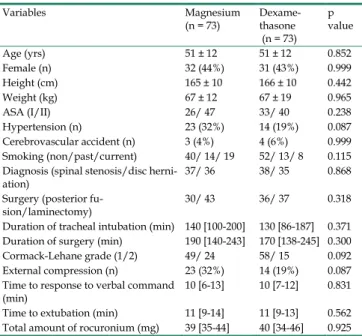
The patients' characteristics and operative data were not different between the groups (Table 1). Du-ration from anesthetic discontinuation to response to verbal command and tracheal extubation, and the amount of remifentanil infused were similar between the groups. None of the patients in the magnesium
group demonstrated signs of prolonged neuromus-cular blockade.
Table 1. Baseline characteristics of surgical and operative data of patients Variables Magnesium (n = 73) Dexame-thasone (n = 73) p value Age (yrs) 51 ± 12 51 ± 12 0.852 Female (n) 32 (44%) 31 (43%) 0.999 Height (cm) 165 ± 10 166 ± 10 0.442 Weight (kg) 67 ± 12 67 ± 19 0.965 ASA (I/II) 26/ 47 33/ 40 0.238 Hypertension (n) 23 (32%) 14 (19%) 0.087 Cerebrovascular accident (n) 3 (4%) 4 (6%) 0.999 Smoking (non/past/current) 40/ 14/ 19 52/ 13/ 8 0.115 Diagnosis (spinal stenosis/disc
herni-ation) 37/ 36 38/ 35 0.868 Surgery (posterior
fu-sion/laminectomy) 30/ 43 36/ 37 0.318 Duration of tracheal intubation (min) 140 [100-200] 130 [86-187] 0.371 Duration of surgery (min) 190 [140-243] 170 [138-245] 0.300 Cormack-Lehane grade (1/2) 49/ 24 58/ 15 0.092 External compression (n) 23 (32%) 14 (19%) 0.087 Time to response to verbal command
(min) 10 [6-13] 10 [7-12] 0.831 Time to extubation (min) 11 [9-14] 11 [9-13] 0.562 Total amount of rocuronium (mg) 39 [35-44] 40 [34-46] 0.925
Values are number of patients (percentage), mean ± standard deviation or median [interquartile range].
ASA, American Society of Anesthesiologists Physical Status Classification.
Efficacy data Primary outcome
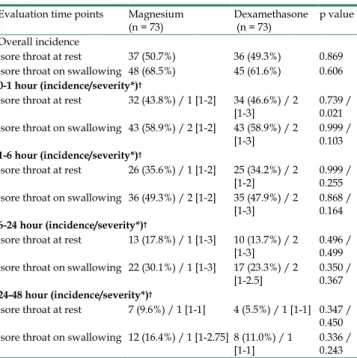
The incidence and severity of POST are shown in Table 2. Overall incidences of POST at rest (50.7% versus 49.3% in the magnesium group and dexame-thasone group, respectively, p = 0.869) and swallow-ing (65.8% versus 61.6% in the magnesium group and dexamethasone group, respectively, p = 0.606) were not significantly different between the groups. Re-spective incidences of POST, which were serially as-sessed at various predefined time points were also all similar between the groups. Overall, the upper limit of the 90% confidence interval for overall incidence, which must be lower than the predefined margin of non-inferiority (15%) to prove the non-inferiority of magnesium sulphate against dexamethasone, were 14.97% (p = 0.0496) and 17.19% (p = 0.0854) at rest and swallowing, respectively. The upper limits of the 90% confidence interval of the serially assessed time points of assessment were all below 15% (all p values <0.05) except at 6-24 h on swallowing, which was 18.86% (p = 0.13) (Figure 2). The VAS scores for the severity of POST were all similar between the groups with me-dian values ranging from 1 to 2 at all time points of assessment. The number of patients who experienced POST VAS score of higher than 4 during the study period was 11 (15.1%) and 12 (16.4%) in the magne-sium and dexamethasone group, respectively (p = 0.820). The number of patients who indicated POST
VAS score 1 at least once during the study period was 39 (53.4%) and 38 (52.1%) in the magnesium group and dexamethasone group, respectively (p = 0.868).
Table 2. Incidence and severity of postoperative sore throat Evaluation time points Magnesium
(n = 73) Dexamethasone (n = 73) p value Overall incidence
sore throat at rest 37 (50.7%) 36 (49.3%) 0.869 sore throat on swallowing 48 (68.5%) 45 (61.6%) 0.606
0-1 hour (incidence/severity*)†
sore throat at rest 32 (43.8%) / 1 [1-2] 34 (46.6%) / 2
[1-3] 0.739 / 0.021 sore throat on swallowing 43 (58.9%) / 2 [1-2] 43 (58.9%) / 2
[1-3] 0.999 / 0.103
1-6 hour (incidence/severity*)†
sore throat at rest 26 (35.6%) / 1 [1-2] 25 (34.2%) / 2
[1-2] 0.999 / 0.255 sore throat on swallowing 36 (49.3%) / 2 [1-2] 35 (47.9%) / 2
[1-3] 0.868 / 0.164
6-24 hour (incidence/severity*)†
sore throat at rest 13 (17.8%) / 1 [1-3] 10 (13.7%) / 2
[1-3] 0.496 / 0.499 sore throat on swallowing 22 (30.1%) / 1 [1-3] 17 (23.3%) / 2
[1-2.5] 0.350 / 0.367
24-48 hour (incidence/severity*)†
sore throat at rest 7 (9.6%) / 1 [1-1] 4 (5.5%) / 1 [1-1] 0.347 / 0.450 sore throat on swallowing 12 (16.4%) / 1 [1-2.75] 8 (11.0%) / 1
[1-1] 0.336 / 0.243
Values are number of patients (percentage) or median [interquartile range]. *Severity of postoperative sore throat is expressed as visual analog scale from 0 to 10.
†P value was corrected with Bonferroni method for multiple comparisons and <0.0125 was considered to be statistically significant.
Figure 2. Difference in the incidence of postoperative sore throat. *Against the hypothesis of 15% difference between the magnesium group and
Secondary outcomes
Postoperative hoarseness occurred in more than half of patient in both group. The incidence and in-tensity of hoarseness were not statistically signifi-cantly different during the study period (Table 3).
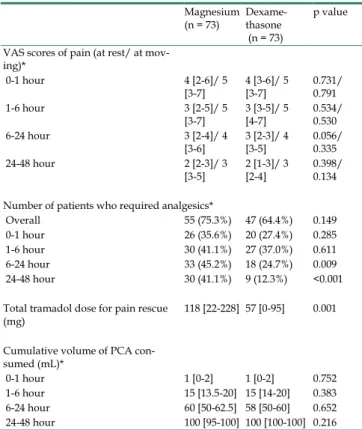
The VAS scores for postoperative pain were similar between the groups throughout the study pe-riod, whereas more patients in the magnesium group required additional rescue analgesics at time periods of 6 to 24 hours [33 (45.2%) versus 18 (24.7%), p = 0.009], and 24 to 48 hours [30 (41.1%) versus 9 (12.3%), p <0.001)] after operation. Total dose of tramadol for postoperative analgesia was significantly higher in the magnesium group (118 [22-228] mg) than in the dexamethasone group (57 [0-95] mg) (p=0.001). The cumulative volumes of consumed opioid-based PCA were not different between the groups throughout the study period (Table 4).
Table 3. Incidence and severity of hoarseness and the number of patients who required vasoactive drugs
Magnesium
(n = 73) Dexamethasone (n = 73) p value Patients with hoarseness*
Overall incidence 43 (58.9%) 42 (57.5%) 0.867 0-1 hour 35 (47.9%) 36 (49.3%) 0.868 1-6 hour 36 (49.3%) 30 (41.1%) 0.318 6-24 hour 19 (26.0%) 15 (20.5%) 0.433 24-48 hour 12 (16.4%) 6 (8.2%) 0.131 Hoarseness severity† (0/1/2/3)* 0-1 hour 38/31/4/0 37/35/1/0 0.398 1-6 hour 37/33/3/0 43/26/4/0 0.484 6-24 hour 54/18/0/1 58/8/5/2 0.014 24-48 hour 61/10/0/2 67/5/0/1 0.384 Number of patients who required vasoactive drugs
Ephedrine 48 (65.8%) 38 (52.1%) 0.093 Phenylephrine 4 (5.5%) 5 (6.8%) 0.731 Noradrenaline 11 (15.1%) 8 (11.0%) 0.461
Values are number of patients (percentage) or median [interquartile range]. *The adjusted p value <0.0125 was considered significant after Bonferroni correc-tion. †Hoarseness severity, 0 = no hoarseness, 1 = mild hoarseness (noticed by the patient only), 2 = severe hoarseness (noticed at the time of the interview by the personnel), 3 = aphonia (inability to speak).
Blood glucose level after operation was signifi-cantly higher in dexamethasone group (136.3 ± 32.92 mg/dL versus 116.1 ± 21.17 mg/dL, p <0.001) while preoperative glucose level was similar between the groups. Level of maximal blood magnesium concen-tration was 1.85 [1.745-2.015] mg/dL in the magne-sium group and 1.33 [1.290-1.430] mg/dL in the dexamethasone group (p <0.001). The number of pa-tients who experienced at least one hypotensive event was 53 (72.6%) and 40 (54.8%) in the magnesium group and dexamethasone group, respectively (p = 0.003). In all hypotensive events, blood pressure could be easily restored by predefined measures alone.
Overall incidence of PONV was 35.6% in the magne-sium group and 31.5% in the dexamethasone group (p = 0.599). Eleven patients were treated with antibiotics for postoperative wound infection; 5 patients in the magnesium group and 6 patients in the dexame-thasone group (p = 0.754). Diarrhea was present in one patient in the magnesium group at the second postoperative day, which was spontaneously resolved without any intervention (Table 5).
Table 4. Postoperative analgesic profiles Magnesium (n = 73) Dexame-thasone
(n = 73)
p value VAS scores of pain (at rest/ at
mov-ing)* 0-1 hour 4 [2-6]/ 5 [3-7] 4 [3-6]/ 5 [3-7] 0.731/ 0.791 1-6 hour 3 [2-5]/ 5 [3-7] 3 [3-5]/ 5 [4-7] 0.534/ 0.530 6-24 hour 3 [2-4]/ 4 [3-6] 3 [2-3]/ 4 [3-5] 0.056/ 0.335 24-48 hour 2 [2-3]/ 3 [3-5] 2 [1-3]/ 3 [2-4] 0.398/ 0.134 Number of patients who required analgesics*
Overall 55 (75.3%) 47 (64.4%) 0.149 0-1 hour 26 (35.6%) 20 (27.4%) 0.285 1-6 hour 30 (41.1%) 27 (37.0%) 0.611 6-24 hour 33 (45.2%) 18 (24.7%) 0.009 24-48 hour 30 (41.1%) 9 (12.3%) <0.001 Total tramadol dose for pain rescue
(mg) 118 [22-228] 57 [0-95] 0.001 Cumulative volume of PCA
con-sumed (mL)*
0-1 hour 1 [0-2] 1 [0-2] 0.752 1-6 hour 15 [13.5-20] 15 [14-20] 0.383 6-24 hour 60 [50-62.5] 58 [50-60] 0.652 24-48 hour 100 [95-100] 100 [100-100] 0.216
Values are number of patients (percentage) or median [interquartile range]. VAS, visual analog scale; PCA, patient-controlled analgesia.
*The adjusted p value <0.0125 was considered significant after Bonferroni correc-tion.
Table 5. Complications associated with the studied drugs Magnesium (n = 73) Dexamethasone (n = 73) p value Preoperative glucose (mg/dL) 98.3 ± 13.89 102.0 ± 14.91 0.122 Postoperative glucose (mg/dL) 116.1 ± 21.17 136.3 ± 32.92 <0.001 Maximal magnesium (mg/dL) 1.85 [1.745-2.015] 1.33 [1.290-1.430] <0.001 Perioperative hypotension 53 (72.6%) 40 (54.8%) 0.003 Vasopressor use 49 (67.1%) 38 (52.1%) 0.064 Postoperative nausea and
vomit-ing 26 (35.6%) 23 (31.5%) 0.599 Postoperative wound infection 5 (6.8%) 6 (8.2%) 0.754 Diarrhea 1 (1.4%) 0 (0.0%) >0.999
Values are number of patients (percentage), mean ± standard deviation or median [interquartile range].
Discussion
In this prospective, double-blind, randomized, and non-inferiority trial, we could not observe any statistically significant differences in the incidence and severity of POST between the magnesium and dexamethasone group in patients undergoing lumbar spinal surgery in the prone position. The majority of patients in both groups presented POST VAS scores of less than 3. In addition, the incidence and severity of hoarseness were also not different between the groups. Non-inferiority analysis using the upper limit of the 90% confidence interval revealed that magne-sium sulphate appears to be non-inferior to dexame-thasone for the prevention of POST at rest in this subset of patients.
Albeit the clinicians have perceived POST as a natural consequence of tracheal intubation rather than complication [20], it may significantly affect the qual-ity of life and satisfaction of patients during the re-covery period [21]. Consequently, increasing efforts for preventing or minimizing the occurrence of POST during the postoperative recovery period have been attempted [1], while no conclusive measures were elucidated yet, especially in patients undergoing lumbar spinal surgery.
Since POST is mainly mediated by an inflam-matory response causing airway mucosal trauma or tissue damage [1], and is a sort of postoperative pain frequently aggravated with PONV [6], pharmacologic agents possessing anti-inflammatory, an-ti-nociceptive, and anti-emetic effects would be ideal for the prevention and treatment of POST. Various agents have been examined for POST such as dexa-methasone [2], inhaled beclodexa-methasone [11], benzy-damine hydrochloride spray [22], or transdermal ke-toprofen with controversial results [23]. Among them, dexamethasone showed promising results [24], which might be attributable to its multidisciplinary mecha-nisms. Magnesium also has a theoretical potential to reduce POST in terms of anti-inflammatory [25] and anti-nociceptive effect [16], though the effect on PONV was controversial. Recently, magnesium showed a beneficial effect on POST at a clinically rel-evant dose without complications [16]. Therefore, we compared the effects of magnesium and dexame-thasone on POST in patients undergoing lumbar spi-nal surgery in the prone position, who are at increased risk of developing POST, which has not been ad-dressed heretofore. Since the studied patients were at increased risk of developing POST, we designed a non-inferiority trial to avoid establishment of place-bo-control group.
As our results indicate, the incidence and sever-ity of POST were all similar between the groups at all time points of assessment. Non-inferiority analysis
revealed that magnesium sulphate was non-inferior to dexamethasone for the prevention of POST in terms of the overall incidence at rest, whereas it only showed a trend towards being non-inferior in terms of the overall incidence on swallowing (p = 0.0854). How-ever, detailed analysis revealed that magnesium sul-phate was non-inferior to dexamethasone at all seri-ally assessed time points of measurement except at 6-24 h on swallowing, which implicates the non-inferiority of magnesium sulphate to dexame-thasone regarding the prevention of POST.
Of note, the overall incidence of POST during study period was more than 60% in both groups de-spite the use of potentially preventive medications, whereas the majority of patients in this study pre-sented very low VAS scores for POST in comparison with previous studies [2,6,12]. The median VAS score of 1 for POST implies that the patient did not perceive POST until they were interviewed. Nonetheless, pa-tients were considered as having POST as long as the VAS score was ≥1 in the current study. Therefore, the high incidence of POST in this study should not dis-courage the use of both studied drugs as most of the patients had a VAS score of less than 3. Indeed, the overall incidence of patients with POST VAS score of higher than 4 was only 15.1% and 16.4% in the mag-nesium group and dexamethasone group, respec-tively (p = 0.820). Thus, these results implicate that both magnesium sulphate and dexamethasone could effectively mitigate the development of clinically sig-nificant POST in this high-risk group of patients.
Notably, patients treated with dexamethasone required less rescue analgesics during 6 to 24 hours, and 24 to 48 hours after operation with comparable cumulative infused volume of PCA and VAS scores for pain compared with the patients in the magnesi-um group. Beneficial effect of dexamethasone to re-duce postoperative pain and analgesic requirement in various surgical patients [26] including lumbar spinal surgical patients [27] have been well documented. On the contrary, the effect of magnesium sulphate on postoperative pain is still controversial [28,29], while some studies reported better pain relief with in-traoperative magnesium sulphate compared to pla-cebo [15,30]. Direct comparison between the magne-sium sulphate and dexamethasone against postoper-ative pain has not been addressed yet, and the result of this study demonstrated superior efficacy of dex-amethasone over magnesium sulphate in reducing postoperative pain.
The PONV is known to increase the susceptibil-ity of pain [31,32], and is frequently accompanied with POST [6]. Among the available anti-emetics, dexamethasone has been extensively studied and widely used for the reduction of PONV [33]. The
ef-ficacy of magnesium on antiemetic prophylaxis for PONV is not quite satisfactory heretofore [30]. In this study, however, both drugs exerted comparable effi-cacy on the severity as well as the incidence of PONV throughout the study period.
One of the concerns of using dexamethasone is the potential for poor glycemic control. In this study, postoperative glucose level measured at immediate postoperative period was higher in the dexame-thasone group. The clinical significance of this minor increase in blood glucose level in the dexamethasone group is beyond the scope of this study to discuss and remains to be proven. Considering the results of the current trial, magnesium sulphate could be a valuable option for the prevention of POST when the use of dexamethasone may not be appropriate for its poten-tial side-effects.
This study is subject to following limitations. Since we excluded patients with expected difficult intubation to control confounding variables, general-ization of this result should be exercised with caution. While the dose of magnesium sulphate was deter-mined based on the estimated safe dose without he-modynamic consequences, the dose of magnesium used in this study might not be an optimal dose for POST, which merits further studies in that regard. Likewise, same limitation applies to the chosen dose of dexamethasone in this study.
In conclusion, prophylactic magnesium sulphate appears to be non-inferior to dexamethasone for pre-vention of POST at rest in patients undergoing lumbar spinal surgery in the prone position.
Acknowledgements
We would like to thank our statistical assistant Jinae Lee, Instructor (Senior Biostatistician) of Biosta-tistics Collaboration Unit in Yonsei University College of Medicine, for her help with data analysis.
Competing Interests
The authors have declared that no competing interest exists.
References
1. McHardy FE, Chung F. Postoperative sore throat: cause, prevention and treatment. Anaesthesia 1999; 54(5):444-53.
2. Park SH, Han SH, Do SH, Kim JW, Rhee KY, Kim JH. Prophylactic dexame-thasone decreases the incidence of sore throat and hoarseness after tracheal extubation with a double-lumen endobronchial tube. Anesth Analg 2008; 107(6):1814-8.
3. Mokhtar AM, Choy CY. Postoperative sore throat in children: comparison between proseal LMA and classic LMA. Middle East J Anaesthesiol 2013; 22(1):65-70.
4. Ayoub CM, Ghobashy A, Koch ME, McGrimley L, Pascale V, Qadir S, et al. Widespread application of topical steroids to decrease sore throat, hoarseness, and cough after tracheal intubation. Anesth Analg 1998; 87(3):714-6. 5. Stout DM, Bishop MJ, Dwersteg JF, Cullen BF. Correlation of endotracheal
tube size with sore throat and hoarseness following general anesthesia. An-esthesiology 1987; 67(3):419-21.
6. Biro P, Seifert B, Pasch T. Complaints of sore throat after tracheal intubation: a
7. Hari Kumar S, Saravanan D, Ranganathan S, Sumathi K. Post-operative sore throat–Incidence and contributory factors. Journal of pharmaceutical and bi-omedical sciences 2013; 26(26):286-92.
8. Koshy E, Curcin V, Bottle A, Sharland M, Saxena S. Sore throat consultations in general practice prior to tonsillectomy among eight hundred and sixty-three children in England: is this in accordance with the SIGN guidelines? Clin Otolaryngol 2013; 38(3):266-70.
9. Dimitriou VK, Zogogiannis ID, Douma AK, Pentilas ND, Liotiri DG, Wachtel MS, et al. Comparison of standard polyvinyl chloride tracheal tubes and straight reinforced tracheal tubes for tracheal intubation through different sizes of the Airtraq laryngoscope in anesthetized and paralyzed patients: a randomized prospective study. Anesthesiology 2009; 111(6):1265-70. 10. Loeser EA, Bennett GM, Orr DL, Stanley TH. Reduction of postoperative sore
throat with new endotracheal tube cuffs. Anesthesiology 1980; 52(3):257-9. 11. el Hakim M. Beclomethasone prevents postoperative sore throat. Acta
An-aesthesiol Scand 1993; 37(3):250-2.
12. Thomas S, Beevi S. Dexamethasone reduces the severity of postoperative sore throat. Can J Anaesth 2007; 54(11):897-901.
13. Nicholson G, Burrin JM, Hall GM. Peri-operative steroid supplementation. Anaesthesia 1998; 53(11):1091-104.
14. Koinig H, Wallner T, Marhofer P, Andel H, Horauf K, Mayer N. Magnesium sulfate reduces intra- and postoperative analgesic requirements. Anesth Analg 1998; 87(1):206-10.
15. Tramer MR, Schneider J, Marti RA, Rifat K. Role of magnesium sulfate in postoperative analgesia. Anesthesiology 1996; 84(2):340-7.
16. Borazan H, Kececioglu A, Okesli S, Otelcioglu S. Oral magnesium lozenge reduces postoperative sore throat: a randomized, prospective, place-bo-controlled study. Anesthesiology 2012; 117(3):512-8.
17. Gupta SK, Tharwani S, Singh DK, Yadav G. Nebulized magnesium for pre-vention of postoperative sore throat. Br J Anaesth 2012; 108(1):168-9. 18. Oguzhan N, Gunday I, Turan A. Effect of magnesium sulfate infusion on
sevoflurane consumption, hemodynamics, and perioperative opioid con-sumption in lumbar disc surgery. J Opioid Manag 2008; 4(2):105-10. 19. Harding CJ, McVey FK. Interview method affects incidence of postoperative
sore throat. Anaesthesia 1987; 42(10):1104-7.
20. Beebe DS. Complications of Tracheal Intubation. Seminars in Anesthesia, Periaperative Medicine and Pain 2001; 20(3):166-72.
21. Macario A, Weinger M, Carney S, Kim A. Which clinical anesthesia outcomes are important to avoid? The perspective of patients. Anesth Analg 1999; 89(3):652-8.
22. Huang YS, Hung NK, Lee MS, Kuo CP, Yu JC, Huang GS, et al. The effec-tiveness of benzydamine hydrochloride spraying on the endotracheal tube cuff or oral mucosa for postoperative sore throat. Anesth Analg 2010; 111(4):887-91.
23. Ozaki M, Minami K, Sata T, Shigematsu A. Transdermal ketoprofen mitigates the severity of postoperative sore throat : [Le ketoprofene transdermique re-duit le mal de gorge postoperatoire]. Can J Anaesth 2001; 48(11):1080-3. 24. Wei JL, Kasperbauer JL, Weaver AL, Boggust AJ. Efficacy of single-dose
dexamethasone as adjuvant therapy for acute pharyngitis. Laryngoscope 2002; 112(1):87-93.
25. Mazur A, Maier JA, Rock E, Gueux E, Nowacki W, Rayssiguier Y. Magnesium and the inflammatory response: potential physiopathological implications. Arch Biochem Biophys 2007; 458(1):48-56.
26. De Oliveira GS, Jr., Almeida MD, Benzon HT, McCarthy RJ. Perioperative single dose systemic dexamethasone for postoperative pain: a meta-analysis of randomized controlled trials. Anesthesiology 2011; 115(3):575-88.
27. Watters WC, 3rd, Temple AP, Granberry M. The use of dexamethasone in primary lumbar disc surgery. A prospective, randomized, double-blind study. Spine (Phila Pa 1976) 1989; 14(4):440-2.
28. Bhatia A, Kashyap L, Pawar DK, Trikha A. Effect of intraoperative magnesium infusion on perioperative analgesia in open cholecystectomy. J Clin Anesth 2004; 16(4):262-5.
29. Ko SH, Lim HR, Kim DC, Han YJ, Choe H, Song HS. Magnesium sulfate does not reduce postoperative analgesic requirements. Anesthesiology 2001; 95(3):640-6.
30. Albrecht E, Kirkham KR, Liu SS, Brull R. Peri-operative intravenous admin-istration of magnesium sulphate and postoperative pain: a meta-analysis. Anaesthesia 2013; 68(1):79-90.
31. Rabasseda X. Ramosetron, a 5-HT3 receptor antagonist for the control of nausea and vomiting. Drugs Today (Barc) 2002; 38(2):75-89.
32. Lu K-z, Shen H, Chen Y, Li M-g, Tian G-p, Chen J. Ondansetron does not attenuate the analgesic efficacy of nefopam. International journal of medical sciences 2013; 10(12):1790.
33. Henzi I, Walder B, Tramer MR. Dexamethasone for the prevention of postop-erative nausea and vomiting: a quantitative systematic review. Anesth Analg 2000; 90(1):186-94.