서론
심혈관계 고위험 환자에서 위험도 경감을 위한 약물치료
(혈압강하제, 지질강하제 등)는 효과의 증거가 많고, 장기적
인 약제 복용이 중요하다. 하지만 이런 환자들에서 필요한
약제의 숫자가 많고 장기적인 약물 순응도가 낮을 수 있어
서, 순응도를 높게 유지하여 심혈관 위험도를 낮추는 것이
현대 예방심장학 분야에서 중요한 사안 중 하나다.
고정용량 복합제는 심혈관질환 이차예방(그리고 최근 일
차예방에서도)에서 십수 년 전부터 치료간극을 줄이려는 한
가지 수단으로 거론되어 왔다. 상당수 의사들은 복합제가 환
자 순응도를 높이고 경제적으로 유리하지만, 용량과 성분 조
절이 불편하다고 생각한다. 이 논문에서는 고정용량 복합제
의 유용성에 대한 학술적 배경, 최근 임상시험 결과, 문제점
등을 짚어보려고 한다. 주로 혈압강하제와 지질강하제에 초
점을 맞추었다.
혈압강하제로 구성된 고정용량 복합제
고혈압 치료도중 치료목표에 도달하지 못하면 쓰던 약제의
용량을 올리거나 병합요법을 고려하게 된다. 또한 병합요법
은 심한 고혈압 환자에서는 초기치료 때부터 쓰이기도 한다.
단일약제 증량과 병합요법은 유효성과 안전성에 약간의 차이
심혈관질환 예방을 위한 고정용량 복합제 치료
이 상 학 | 연세대학교 의과대학 세브란스병원 심장내과Fixed-dose combination therapy for
cardiovascular prevention
Sang-Hak Lee, MD
Division of Cardiology, Department of Internal Medicine, Severance Hospital, Yonsei University College of Medicine, Seoul, Korea
Received: September 1, 2016 Accepted: September 20, 2016 Corresponding author: Sang-Hak Lee
E-mail: [email protected] © Korean Medical Association
This is an Open Access article distributed under the terms of the Creative Commons Attribution Non-Commercial License (http://creativecommons. org/licenses/by-nc/3.0) which permits unrestricted non-commercial use, distribution, and reproduction in any medium, provided the original work is properly cited.
In patients with high cardiovascular risk, the number of drugs needed is often high, and this may decrease long-term adherence. Therefore, maintaining good adherence and reducing cardiovascular risk is currently an important issue in preventive cardiology. The combination of two different antihypertensive agents is reported to reduce blood pressure more than the doubling of a single agent. In addition, the prevalence of adverse events with two drugs is less than the sum of the number of events associated with each drug. The combination of renin-angiotensin system blockers with statins is a widely used regimen in cardiovascular prevention. Recent clinical trials using a fixed-dose combination of aspirin, statins, and angiotensin-converting enzyme inhibitors has revealed better adherence in the combination group than in the group with separately administered drugs. Interestingly, this benefit was more prominent in patients who were under-treated (less adherent) at baseline.
Key Words: Antihypertensive agents; Hydroxymethylglutaryl-CoA reductase inhibitors; Patient compliance; Cardiology
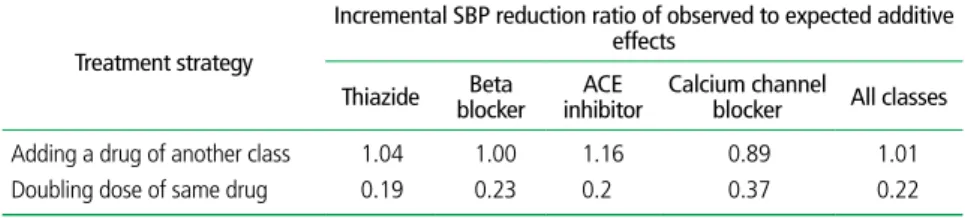
가 있다. Wald 등[1]에 의한 메타분석에 따르면, 초기용량의
두 배를 사용했을 때 수축기혈압 강하효과는 초기용량 효과
보다 19%에서 37% 정도(평균 22%) 증가하며, 칼슘채널 차
단제가 두 배의 용량에서 추가강하 효과가 37%로 제일 높게
보고되었다. 한편 다른 계열 약제를 병합할 경우, 추가 혈압
강하 폭은 86%에서 116%로서, 안지오텐신 전환효소 억제제
에 의한 추가강하 효과가 가장 높았다(Table 1).
단일 혈압강하제 증량과 다른 약제와의 병합요법에서 생
길 수 있는 부작용 빈도에도 다소 차이가 있다. Thiazide계
약제, 베타 차단제, 칼슘채널 차단제는 부작용 발생과 약제
용량에 강한 상관관계가 있으나, 기침으로 대표되는 안지오
텐신 전환효소 억제제 부작용은 용량의존적이지 않다고 보
고된다. 한편 두 가지 약제의 병합요법 때는 부작용 빈도가
단일제제 사용 시 나타나는 빈도의 합보다 적다[2].
심한 고혈압 환자에서 치료 시 단일약제로 시작-증량법을
쓰는 것과 처음부터 병합요법을 쓰는 것에는 일장일단이 있
으며, 2013년 유럽심장학회 지침에서 IIB-C의 수준으로 권
고되고 있다. 단일약제 시작-증량법은 효과와 부작용이 어
느 약제 때문에 나타나는지 알기에 좋은 장점이 있는 반면,
효과가 약할 수 있고, 효과가 불충분한 경우 적절한 처방을
찾을 때까지 시간과 노력이 들며 이 과정에서 치료에 대한
환자의 치료 순응도를 저해할 수 있다.
한편 처음부터 병합요법을 사용하면 혈
압강하 반응이 빠르고 환자의 순응도가
약화될 가능성이 적다. 또한 약리학적인
상승작용이라는 장점도 있으나, 병합약
제 중 일부 약제의 효과가 좋지 않더라
도 드러나지 않을 수 있는 것이 단점이
다(Table 2) [3].
혈압강하제와 스타틴
고정용량 복합제
고혈압과 고콜레스테롤혈증은 관상동
맥질환과 뇌졸중을 포함한 심혈관질환
에서 중심이 되는 위험인자기 때문에 이 두 가지를 잘 조절
하는 것이 중요하다는 것은 두말할 필요가 없다. 최근 콜레
스테롤 조절 지침에 사용되는 환자 심혈관위험도 계산 공식
에 고혈압은 필수적으로 포함되는 것을 보더라도, 지질치료
대상자의 상당수가 고혈압이 있다는 것도 추측할 수 있다.
따라서 스타틴과 혈압강하제 병합요법은 매우 흔히 고려되
는 실정인데, 이 중 많이 선택되는 방법 중 하나가 레닌-안
지오텐신 체계(renin-angiotensin system, RAS) 차단제이
다. 허혈성심질환이 이미 있는 이차예방 대상 환자에서 고혈
압, 당뇨병, 수축기 심부전, 만성신질환, 또는 다른 혈관질
환이 있는 경우, RAS 차단제(특히 안지오텐신 전환효소 억
제제)는 class I 혹은 IIa로 권고되고 있다[4]. 이 사항은 심
부전이 없는 혈관질환 환자에서 시행되고, 안지오텐신 전환
효소 억제제가 예후를 호전시킨 HOPE (Heart Outcomes
revention Evaluation) 연구와 EUROPA (EURopean trial
On reduction of cardiac events with Perindopril in stable
coronary Artery disease) 연구 결과에 크게 기반한다.
한편 스타틴은 용량의존적으로 당뇨병 신규발생을 높이는
데, RAS 차단제는 당뇨병 신규발생 억제효과가 보고되어 있
어서 두 가지 약물의 병합요법은 상호보완적인 측면이 있다.
스타틴과 RAS 차단제 병합요법에서 스타틴 병합이 추가적
Table 1. Ratio of observed to expected incremental blood pressure reduction effects of adding a drug ofanother class or doubling of the same drug
Treatment strategy
Incremental SBP reduction ratio of observed to expected additive effects
Thiazide blockerBeta inhibitorACE Calcium channel blocker All classes Adding a drug of another class 1.04 1.00 1.16 0.89 1.01 Doubling dose of same drug 0.19 0.23 0.2 0.37 0.22
ACE: angiotensin-converting enzyme; SBP: systolic blood pressure
Table 2. Advantages and disadvantages of two different initial anti-hypertensive regimens: monotherapy
and dosing-up vs. combination therapy
Treatment strategy Advantage Disadvantage Monotherapy and dosing-up Able to ascribe effect and
adverse events When effect is insufficient, finding alternative regimen may be painstaking and discouraging adherence; Less efficacy Combination Prompt response and low chance
of discouraging adherence; Pharmacologic synergy
인 혈압강하 효과가 있었다는 보고도 있으나[5], 연구 간에
결과가 달라서 효과에 대해 확실하게 이야기하기는 어렵다.
고정용량 복합제를 이용한 대규모 임상시험
지질강하제, 혈압강하제, 항혈소판 약제 등이 모두 필요한
고위험 환자들에서 고정용량 복합제가 유용할 것이라는 데는
반론이 적을 것이다. 하지만 이런 환자들에서, 순응도 향상이
라는 고정용량 복합제의 장점이 용량, 성분 조합이 덜 자유롭
다는 단점보다 예후에 미치는 효과가 강할지가 중요하다. 이
에 대해서 지금까지 네 가지 대규모 임상시험이 이루어졌다.
이 중 Use of Multi-drug Pill in Reducing Cardiovascular
Events (UMPIRE) 연구[6], IMProving Adherence using
Combination Therapy (IMPACT) 연구[7], Kanyini
Guidelines Adherence with the Polypill (Kanyini-GAP)
연구[8]는 심혈관질환 환자 혹은 위험인자 보유자를 대상으
로 했으며, Fixed Dose Combination Drug for Secondary
Cardiovascular Prevention (FOCUS) 연구[9]는 급성심근경
색증을 대상으로 하였다. 모두 아스피린, 심바스타틴, 리시
노프릴 혹은 라미프릴, 아테놀롤 혹
은 hydrocholorothiazide의 고정용량
복합제와 각각 약제를 분리 복용과 비
교하였다. 9-18개월 뒤 순응도, 수축
기혈압, 총 혹은
저밀도지단백(low-density lipoprotein, LDL) 콜레스테
롤을 비교하였으며, FOCUS 연구는
안전성도 비교하였다. 대조군 대비 순
응도는 UMPIRE, FOCUS, IMPACT,
Kanyini-GAP 연구에서 각각 1.33,
1.21, 1.75, 1.49였다. 흥미로운 점은
치료 전 시점에 약제를 충분히 복용하
지 않던 환자군을 분석한 결과 대조군
대비 순응도가 3.35-5.09로서, 치료
전 시점에 약제를 충분히 복용하던 환
자군의 대조군 대비 순응도 1.04-1.08
보다 높았던 점이다. 유효성 면에서는 UMPIRE 연구에서만
고정용량 복합제 군에서 수축기혈압과 LDL-콜레스테롤이 대
조군에 비해 작지만 유의하게 더 감소하였다(Table 3).
최근 위의 네 연구 중 UMPIRE, IMPACT, Kanyini-GAP
연구자료를 메타분석한 결과, 고정용량 복합제군에서 환
자 순응도는 평균 1.58배 높았고(P<0.001), 수축기혈압은
2.46 mmHg 낮았으며(P=0.02), LDL-콜레스테롤은 0.09
mmol/L 낮았다(P=0.04) (Figure 1) [10]. 흥미로운 것은 고
정용량 복합제군과 대조군의 순응도 차이를 자세히 보면, 연
구 초기에 약제에 대한 순응도가 낮은 환자(순응도가 좋은
약제수가 적은 환자)에서 추적기간 동안 두 군 사이의 순응
도의 차이가 큰 것을 알 수 있었다. 즉 고정용량 복합제를 사
용했을 때 순응도 향상은 초기 순응도가 낮은 환자에서 크
고, 초기 순응도가 높은 환자에서 작았다[10].
고위험군과 저위험군 환자에서 고정용량
복합제 관련 쟁점
고위험군 환자에서는 고정용량 복합제 사용에 의한 임상
Table 3. Long-term trials of fixed-dose combinations in high-risk patientsUMPIRE, 2013 FOCUS, 2014 IMPACT, 2014 Kanyini-GAP, 2015 Patients CVD or RFs AMI CVD or RFs CVD or RFs Drugs Aspirin, simvastatin, lisinopril, atenolol or HCT vs. separate drugs Aspirin, simvastatin, ramipril vs. 3 separate drugs Aspirin, simvastatin, lisinopril, atenolol or HCT vs. separate drugs Aspirin, simvastatin, lisinopril, atenolol or HCT vs. separate drugs Outcomes Adherence, SBP,
LDL-C at 15mo Adherence, BP, LDL-C, safety at 9mo
Adherence, BP,
LDL-C at 12mo Adherence, SBP, TC at 18mo Adherence in who
were taking all drugs, HR
1.04 (1.33 in total
patients) (1.22 in total patients) (1.75 in total patients) 1.08 (1.49 in total patients) Adherence in who
were under-treated, HR
3.35 - 5.09 3.7
Other findings Significant, small improve in SBP,
LDL-C
No difference in
effect, safety No difference in effect, safety No difference in effect
UMPIRE, Use of Multi-drug Pill in Reducing Cardiovascular Events; FOCUS, Fixed Dose Combination Drug for Second-ary Prevention; IMPACT, IMProving Adherence using Combination Therapy; Kanyini-GAP, Kanyini Guidelines Adher-ence with the Polypill; CVD, cardiovascular disease; RF, risk factor; AMI, acute myocardial infarction; HCT, hydrochloro-thizide; SBP, systolic blood pressure; LDL-C, low-density lipoprotein-cholesterol; BP, blood pressure; TC, total cholesterol; HR, hazard ratio.
적 이득(순응도 향상, 위험인자 조절)이 보고되고 있는 것이
장점인데 반해, 보건의료 종사자들이 이같은 이득에 대한 인
식이 아직 확실치 않다는 것이 한계로 꼽힌다. 한편 저위험
군 환자는 환자의 숫자가 훨씬 많아서 대상자가 많고, 이들
에 대한 일차적인 치료인 생활습관 교정이 지속가능성과 비
용면에 한계가 있다는 점에서 고정용량 복합제 사용의 여지
가 있다. 그러나 저위험군 환자에서는 아직 임상효과의 증거
가 매우 적다는 것이 한계인데, 현재 외국에서 임상시험이
진행 중이므로 그 결과가 주목된다.
결론
혈압강하제의 병합요법은 유효성, 안전성, 순응도 측면에
장점이 있다. RAS 차단제와 스타틴 복합제는 위험인자가 여
러 개 있는 고위험 환자에서 흔히 사용
되는 병합요법 중 하나이다. 고정용량
복합제는 대규모 임상시험에서 순응도
의 우위가 알려졌는데, 구성된 개별 약
제의 투여 필요성이 있지만 이를 제대로
복용하지 않고 있는 환자에서 특히 이득
이 많다. 고정용량 복합제의 추가적인
사용 확대에는 몇 가지 장애물이 남아있
는 실정이다.
Acknowledgement
This article was supported by the
Basic Science Research Program
through the National Research
Foundation of Korea (NRF) funded by
the Ministry of Education, Science,
and Technology (2012R1A4A1029061
and 2014R1A1A2056104), the Bio &
Medical Technology Development
Program of the NRF funded by the Korean government,
MSIP (2015M3A9B6029138), and the National Research
Council of Science & Technology (NST) grant by the
Korean government (MSIP) (CAP-12-2-KBSI).
찾아보기말:
혈압강하제; HMG-CoA 환원효소 억제제; 환자 순응도; 심장학ORCID
Sang-Hak Lee, http://orcid.org/0000-0002-4535-3745
REFERENCES
1. Wald DS, Law M, Morris JK, Bestwick JP, Wald NJ. Combination therapy versus monotherapy in reducing blood pressure: meta-analysis on 11,000 participants from 42 trials. Am J Med 2009;122:290-300.
Figure 1. Primary outcomes at 12 months by trials of fixed-dose combination therapy (Reproduced from
Webster R, et al. Int J Cardiol 2016;205:147-156, with permission from Elsevier) [10]. SBP, systolic blood pressure; SD, standard deviation; CI, confidence interval; IMPACT, IMProving Adherence using Combination Therapy; Kanyini-GAP, Kanyini Guidelines Adherence with the Polypill; UMPIRE, Use of Multi-drug Pill in Re-ducing Cardiovascular Events; LDL, low-density lipoprotein.
Impact 96/249 (38.6%) 196/249 (78.7%) Kanyni-GAP 106/218 (48.6%) 172/233 (73.8%) Umpire 602/925 (65.1%) 827/935 (88.4%) Overall effect 2.04 (1.72,2.42) <.001 1.52 (1.30,1.78) <.001 1.36 (1.29,1.43) <.001 1.58 (1.32,1.90) <.001 Favours
Usual care FavoursPolypill Risk ratio(95%CI) treatment effectp-value n/N (%)
Adherence
Usual care Polypill
1/4 1 4 Risk ratio Impact 141.9 (16.9) 138.3 (16.9) Kanyini-GAP 139.7 (17.0) 139.9 (17.0) Umpire 133.4 (15.9) 130.0 (15.9) Overall effect -3.52 (-6.50,-0.54) 0.021 0.15 (-3.05, 3.36) 0.93 -3.40 (-4.86, -1.94) <.001 -2.46 (-4.55,-0.37) 0.021 Favours
Usual care FavoursPolypill Mean difference(95%CI) p-value treatment effect Mean SBP (SD) mmHg
SBP
Usual care Polypill
7 0 -7 Mean difference (mmHg) Impact 2.35 (0.63) 2.32 (0.63) Kanyini-GAP 2.25 (0.71) 2.20 (0.71) Umpire 2.36 (0.64) 2.21 (0.64) Overall effect -0.02 (-0.14,-0.09) 0.67 -0.05 (-0.20, 0.09) 0.47 -0.16 (-0.22, -0.10) <.001 -0.09 (-0.18, 0.00) 0.04 Favours
Usual care FavoursPolypill Mean difference(95%CI) p-value treatment effect LDL cholesterol
Usual care Polypill Mean cholesterol (SD) mmol/L
1 0 -1
2. Law MR, Wald NJ, Morris JK, Jordan RE. Value of low dose combination treatment with blood pressure lowering drugs: analysis of 354 randomised trials. BMJ 2003;326:1427. 3. Mancia G, Fagard R, Narkiewicz K, Redon J, Zanchetti A,
Bohm M, Christiaens T, Cifkova R, De Backer G, Dominiczak A, Galderisi M, Grobbee DE, Jaarsma T, Kirchhof P, Kjeldsen SE, Laurent S, Manolis AJ, Nilsson PM, Ruilope LM, Schmieder RE, Sirnes PA, Sleight P, Viigimaa M, Waeber B, Zannad F, Redon J, Dominiczak A, Narkiewicz K, Nilsson PM, Burnier M, Viigimaa M, Ambrosioni E, Caufield M, Coca A, Olsen MH, Schmieder RE, Tsioufis C, van de Borne P, Zamorano JL, Achenbach S, Baumgartner H, Bax JJ, Bueno H, Dean V, Deaton C, Erol C, Fagard R, Ferrari R, Hasdai D, Hoes AW, Kirchhof P, Knuuti J, Kolh P, Lancellotti P, Linhart A, Nihoyannopoulos P, Piepoli MF, Ponikowski P, Sirnes PA, Tamargo JL, Tendera M, Torbicki A, Wijns W, Windecker S, Clement DL, Coca A, Gillebert TC, Tendera M, Rosei EA, Ambrosioni E, Anker SD, Bauersachs J, Hitij JB, Caulfield M, De Buyzere M, De Geest S, Derumeaux GA, Erdine S, Farsang C, Funck-Brentano C, Gerc V, Germano G, Gielen S, Haller H, Hoes AW, Jordan J, Kahan T, Komajda M, Lovic D, Mahrholdt H, Olsen MH, Ostergren J, Parati G, Perk J, Polonia J, Popescu BA, Reiner Z, Ryden L, Sirenko Y, Stanton A, Struijker-Boudier H, Tsioufis C, van de Borne P, Vlachopoulos C, Volpe M, Wood DA. 2013 ESH/ESC guidelines for the management of arterial hypertension: the task force for the Management of Arterial Hypertension of the European Society of Hypertension (ESH) and of the European Society of Cardiology (ESC). Eur Heart J 2013;34:2159-2219. 4. Fihn SD, Gardin JM, Abrams J, Berra K, Blankenship JC,
Dallas AP, Douglas PS, Foody JM, Gerber TC, Hinderliter AL, King SB 3rd, Kligfield PD, Krumholz HM, Kwong RY, Lim MJ, Linderbaum JA, Mack MJ, Munger MA, Prager RL, Sabik JF, Shaw LJ, Sikkema JD, Smith CR Jr, Smith SC Jr, Spertus JA, Williams SV; American College of Cardiology Foundation. 2012 ACCF/AHA/ACP/AATS/PCNA/SCAI/STS guideline for the diagnosis and management of patients with stable ischemic heart disease: executive summary: a report of the American College of Cardiology Foundation/American Heart Association task force on practice guidelines, and the Ameri-can College of Physicians, AmeriAmeri-can Association for Thoracic Surgery, Preventive Cardiovascular Nurses Association, Society for Cardiovascular Angiography and Interventions, and Society of Thoracic Surgeons. Circulation 2012;126:3097-3137. 5. Jang JY, Lee SH, Kim BS, Seo HS, Kim WS, Ahn Y, Lee NH,
Koh KK, Kang TS, Jo SH, Hong BK, Bae JH, Yang HM, Cha KS, Kim BS, Kwak CH, Cho DK, Kim U, Zo JH, Kang DH, Pyun WB, Chun KJ, Namgung J, Cha TJ, Juhn JH, Jung Y, Jang Y. Additive beneficial effects of valsartan combined with rosuvastatin in the treatment of hypercholesterolemic hyper-tensive patients. Korean Circ J 2015;45:225-233.
6. Thom S, Poulter N, Field J, Patel A, Prabhakaran D, Stanton A, Grobbee DE, Bots ML, Reddy KS, Cidambi R, Bompoint S, Billot L, Rodgers A; UMPIRE Collaborative Group. Effects of a fixed-dose combination strategy on adherence and risk factors in patients with or at high risk of CVD: the UMPIRE randomized clinical trial. JAMA 2013;310:918-929.
7. Selak V, Elley CR, Bullen C, Crengle S, Wadham A, Rafter
N, Parag V, Harwood M, Doughty RN, Arroll B, Milne RJ, Bramley D, Bryant L, Jackson R, Rodgers A. Effect of fixed dose combination treatment on adherence and risk factor control among patients at high risk of cardiovascular disease: randomised controlled trial in primary care. BMJ 2014;348: g3318.
8. Patel A, Cass A, Peiris D, Usherwood T, Brown A, Jan S, Neal B, Hillis GS, Rafter N, Tonkin A, Webster R, Billot L, Bompoint S, Burch C, Burke H, Hayman N, Molanus B, Reid CM, Shiel L, Togni S, Rodgers A; Kanyini Guidelines Adherence with the Polypill (Kanyini GAP) Collaboration. A pragmatic randomized trial of a Polypill-based strategy to improve use of indicated preventive treatments in people at high cardiovascular disease risk. Eur J Prev Cardiol 2015;22: 920-930.
9. Castellano JM, Sanz G, Penalvo JL, Bansilal S, Fernandez-Ortiz A, Alvarez L, Guzman L, Linares JC, Garcia F, D'Aniello F, Arnaiz JA, Varea S, Martinez F, Lorenzatti A, Imaz I, Sanchez-Gomez LM, Roncaglioni MC, Baviera M, Smith SC Jr, Taubert K, Pocock S, Brotons C, Farkouh ME, Fuster V. A Polypill strategy to improve adherence: results from the FOCUS project. J Am Coll Cardiol 2014;64:2071-2082. 10. Webster R, Patel A, Selak V, Billot L, Bots ML, Brown A,
Bullen C, Cass A, Crengle S, Raina Elley C, Grobbee DE, Neal B, Peiris D, Poulter N, Prabhakaran D, Rafter N, Stanton A, Stepien S, Thom S, Usherwood T, Wadham A, Rodgers A; SPACE Collaboration. Effectiveness of fixed dose combination medication ('Polypills') compared with usual care in patients with cardiovascular disease or at high risk: a prospective, indi- vidual patient data meta-analysis of 3140 patients in six coun-tries. Int J Cardiol 2016;205:147-156.
Peer Reviewers’ Commentary
본 논문은 고정복합약제 처방으로 인한 환자의 순응도 증가가 심 혈관 사고 예방에 기여하는 정도를 여러 대규모 연구결과와 관 련된 메타 분석을 인용하면서 기술하였으며, 각각 고정복합약제 의 종류에 따른 효과를 표와 그림으로 정리하여 독자들의 이해를 돕고 있다. 서로 다른 작용기전의 혈압강하제들간 복합제뿐 아니 라, 혈압강하제-지질강하제, 혈압강하제-지질강하제-항혈소판 제와 같은 심혈관질환에 꼭 쓰이는 약들의 복합제가 소개되어 있 다. 이들 복합제 사용의 장단점과 임상시험 결과 및 그에 근거한 진료지침 권고사항 등도 잘 정리되어 있어 유용하게 참고할 수 있을 것이다. 특히 복약 순응도가 안 좋은 환자들에서 복합제를 통한 복약 순응도의 향상 효과가 더욱 두드러졌다는 내용은 새 겨둘 만한 대목이다. 두 종류 이상의 혈압강하제간, 혈압강하제 와 지질강하제 고정복합제 출시가 급격하게 증가하고 있는 상황 에서, 의료인에게 좋은 이해를 제공해 줄 수 있을 것으로 보인다. [정리: 편집위원회]