1330
ⓒ The Korean Society of Food Science and Technology
Effect of Marine Protein Supplementation on Lipid Profile of
Growing Rats Compared to Soybean Protein and Casein
Bhasakar Narayan1#, Kohei Yamaguchi, Masashi Hosokawa, Kenji Fukunaga2, Toshimasa Nishiyama3, and Kazuo Miyashita*
Laboratory of Biofunctional Material Chemistry, Division of Marine Bioscience, Faculty of Fisheries Sciences, Hokkaido University, Hakodate 041 8611, Japan
1Department of Meat, Fish & Poultry Technology Central Food Technological Research Institute (CFTRI), Mysore 570 020, India 2Faculty of Engineering, Kansai University, Suita 564-8680, Japan
3Department of Public Health, Kansai Medical University, Moriguchi 570-8506, Japan
Abstract Although beneficial effects of dietary plant proteins on lipid metabolism are well documented, not much
information exists on the influence of different seafood proteins on the lipid metabolism. The present study evaluated the effect of 2 marine proteins (tuna protein and scallop ovary proteins) in comparison to casein and soy protein in male Wistar rats. The concentration of total lipids in the plasma of rats fed experimental diets was significantly lower from that of control (278.2 mg/dL) group (p<0.05); and, the liver lipid content was not significantly different (p>0.05). Fecal excretion of cholesterol and bile acids was significantly higher in marine proteins and soy protein fed groups compared to casein only fed control (6.1 and 6.4 mg/day, respectively) group (p<0.05). No significant differences were observed in the mRNA concentrations of different transcriptional factors (p>0.05).
Keywords: tuna protein, scallop ovary protein, hypocholesterolemic, Wistar rat
Introduction
Seafoods from fish and marine invertebrates constitute an important food source globally. They are sources of proteins and lipids of high nutritional value in addition to being good sources of vitamins, minerals (1), and other bioactive materials (2). As the availability of traditional seafood products is decreasing due to dwindling catches caused by over fishing in recent decades, interest is being increase to identification of non-traditional sources as well as utilization of fish industry byproducts as nutritious sources (3). Scallops are extensively harvested and consumed in Japan as well as in some of the Western countries. Generally, internal organs including gonads and shells resulting from scallop processing discarded as industrial wastes. However, little quantity of gonads goes for human consumption. Although these internal organs are high in protein content and contain several bioactive molecules (4), their complete utilization is yet to be established. Similarly, tuna is an important commercial species sold in many forms such as canned, filleted, flakes, etc. Global tuna catches are about 4.2 million metric tones (5) and tuna processing, including canning and filleting, can result in solid wastes as high as 50-70% (6) that contain high quality proteins. It has been reported that tuna protein has a positive effect in the enhancement of dietary bioavailability of zinc and iron (7,8). There are also several reports about the bioactive
peptides that can be obtained from tuna waste proteins (9). It has been well documented that dietary proteins influence lipid metabolism in humans as well as animals (10-12). Most research works dealing with the effect of dietary protein on lipid metabolism have evaluated the effect of plant proteins compared to that of casein as the animal protein source (10). The hypocholesterimic effect of soy proteins has been attributed to reduced intestinal absorption of cholesterol and enhancement of fecal cholesterol excretion (12). Furthermore, its hypocholesterimic and hypotriglyceridemic is believed to be due to modification of lipid composition of microsomal membrane, alterations in fatty acid composition of membrane phospholipids, reduced activity of ∆-6 desaturase and fatty acid synthase
when compared to casein (13,14).
It is very important to note that besides casein and soy proteins, animal proteins in the form of beef, pork, mutton, poultry, and fish play an indispensable role in human nutrition. There are only a few reports regarding the effect of animal proteins (15) such as marine proteins (16,17) on lipid metabolism compared to soy protein or casein. Animal proteins including beef, pork, and turkey meat did not differ from casein in their effects on cholesterol metabolism (15). Furthermore, it was also observed that most of these animal proteins did not alter concentration of cholesterol in plasma, lipoproteins, and liver including the hepatic ratio of esterified to free cholesterol in liver compared to casein. However, proteins from marine invertebrate Anemonia viridis and Echinus esculentus showed hypocholesterimic effect as compared to casein and the same was attributed to alterations in intestinal enzyme activity (1,17).
The present study assessed whether dietary marine proteins obtained from tuna fillets and scallop ovary influence cholesterol levels and lipid profile in growing Wistar rats.
#Presently a JSPS-Invitation Fellow at Hokkaido University *Corresponding author: Tel/Fax: +81-138-40-8804
E-mail: [email protected]
Received March 17, 2009; Revised September 16, 2009; Accepted September 16, 2009
The concentrations of cholesterol in liver and plasma in addition to profiling other lipid parameters were determined. To test whether the influence on cholesterol metabolism is by hepatic lipogenesis, we determined the relative hepatic mRNA concentrations of several transcriptional factors (SREBP-2, CYP7A1, ACAT, and PPAR-α) primarily
responsible for the regulation of genes involved in fatty acid biosynthesis. As a whole the results of this study would help assess the effects of marine proteins on lipid metabolism in comparison with soy protein and casein, which are the classical plant and animal proteins used to investigate the effect of proteins on lipid metabolism.
Materials and Methods
Materials Tuna fillets were procured from the local market. Scallop ovary and soybean protein were obtained from Marine Tech Kamaishi (Kamaishi, Japan) and Toyo Reizo Company (Tokyo, Japan), respectively. The soybean protein had a protein content of 80.7% as determined by Kjeldahl method. Soybean oil and L-cystein were purchased
from Wako Pure Chemical Ind. (Osaka, Japan) while choline bitartrate was from Kanto Chemical Co. (Tokyo, Japan). All other dietary components were obtained from Oriental East Co. (Tokyo, Japan). Male Wistar rats (3 weeks of age) were purchased from Japan CREA Co., Tokyo, Japan.
RNeasy Lipid Tissue Mini kit was purchased from Qiagen (Tokyo, Japan) and the High-Capacity cDNA Archive kit was from Applied Biosystems Japan Ltd. (Tokyo, Japan). All the solvents used for lipid extraction were of analytical grade, unless otherwise mentioned.
Methods Protein estimation in samples was accomplished by Kjeldahl method. Lipid extraction from different samples was carried out according to the method of Folch
et al. (18) while plasma lipid levels were determined using
with analytical kits (Wako Pure Chemicals) as in manufacturers protocol. Gas chromatographic (GC) analysis of fatty acid methyl esters (FAME) was performed on a Shimadzu GC-14B (Shimadzu Seisakusho, Kyoto, Japan) equipped with a flame-ionization detector and a capillary column [Omegawax 320 (30m×0.32mm i.d.); Supelco, Bellefonte, PA, USA].
Amino acid composition of proteins used in the study was determined using an amino acid analyzer (JLC/500V; Jeol Ltd., Tokyo, Japan) by employing nihydrin method (19).
All the diets used in the study were prepared according to the diet for rodents (AIN-93G) prescribed by the American Institute of Nutrition (AIN) (20). The test materials were incorporated into the diets at the expense of the related material in the diet.
Preparation of fat free scallop ovary and tuna proteins
Scallop ovaries were homogenized in 4 volumes (v/w) of ethanol and allowed to stand in dark in a refrigerator (4 ±1oC). The homogenate was separated by filtration to collect the filtrate and the residue was subjected to one more extraction with ethanol (1:4; w/v) as mentioned earlier. Both the filtrates were combined and concentrated under vacuum using a rotary evaporator (Eyela N1000; Tokyo Rikakikai Ltd., Tokyo, Japan) at 30±1oC. The residue obtained after ethanol extraction was subjected to
overnight extraction (at 4±1oC) with 4 volumes of chloroform/methanol (2:1, v/v). The extraction process was repeated again after filtration of solvents. The white residue obtained after these extractions was dried at 35±2oC. The dried white residue had very negligible fat content (<0.05%) and was rich in protein (79.2%). This white powder was designated as scallop ovary proteins.
Similarly, in case of tuna fillets, the raw material was homogenized in 4 volumes (v/w) of ethanol and allowed to stand overnight in dark in a refrigerator (4±1oC). The solvent was filtered and the residue was further extracted (overnight; 4±1oC) with chloroform/methanol (2:1, v/v). The solvents were removed by filtration and extraction with chloroform-methanol was repeated again. The white residue obtained after these extractions was dried at 35±2oC. This fat free-protein rich (>81% protein; lipids <0.05%) residue was referred to as tuna proteins. As mentioned in the introduction, a large amount of tuna waste matters are discarded. Thus, the waster matters are a good tuna protein source. In this experiment, however, tuna fillets were used as tuna protein source as no more purification step was needed in this case except for organic solvent extraction of lipid, while other process should be asked to prepare tuna protein from tuna waste matters.
Amino acid composition Amino acid analysis of different proteins used in the study was done after hydrolyzing the fat free samples with 6 N hydrochloric acid for 24 hr at 110±2oC in vials under nitrogen. Amino acid compositions (except tryptophan) of hydrolyzed samples were determined using an amino acid analyzer by employing ninhydrin method (19). Tryptophan content was determined by hydrolyzing (110±2oC; 24 hr) the sample with mercaptoethane-sulfonic acid as in the method of Penke et al. (21).
Animals and diets Animal experiments were carried out by using 3 weeks of age male. The Ethical Committee of Kansai Medical University approved all the animal experiment protocols prior to the study. The animals were housed at a constant humidity (55%) and temperature (23±1oC) with a 12 hr light/dark cycle throughout the experiment. They had free access to water and the experimental diets through out the study. Animals were acclimatized for 1 week by feeding control diets and divided randomly into 4 groups (n=6). As mentioned earlier AIN 93-G diet was used as the
control diet. In case of experimental diets wherever protein material was used, casein was the protein in the control diet.
Sample collection and analysis Animal feeding studies were conducted for 3 weeks with control or experimental diets. At the end of 3 weeks of feeding, animals in all the groups were starved overnight and anesthetized with diethyl ether. Rats were sacrificed by exsanguination and their blood withdrawn at the abdominal artery. The livers from the experimental animals were removed rapidly in their entirety, weighed and frozen in liquid nitrogen. They were stored at −80oC until further analysis. Samples of liver were perfused with 0.9% NaCl and lipids extracted by Folch method, as mentioned earlier. Plasma lipid levels were measured with analytical kits. These lipids were used for preparation of FAMEs for fatty acid analysis.
Fatty acid composition The fatty acid composition of oils used in the study (soybean oil, fish oil, and scallop ovary lipids) and other lipid samples obtained during this study was determined analyzing FAMEs obtained from these lipids using GC. The FAMEs from various lipid samples were obtained by the method of Prevot and Mordret (22). Briefly, to a sample lipid (ca. 20 mg) 1 mL n-hexane and 0.2 mL 2 N NaOH in methanol were added
followed by incubating at 50oC for 30 min. Post incubation, 0.2 mL 2 N HCl in methanol solution was added to the solution and upper hexane layer containing FAMEs was recovered.
Analysis of cholesterol Total cholesterol (23), high density lipoprotein (HDL)-cholesterol (24), low density lipoprotein (LDL)-cholesterol (24), triglycerides (25), and phospholipids (26) were determined by standard enzymatic assay methods. Cholesterol (23) and bile acids in feces were analysed by enzymatic procedures. Atherogenic index was calculated as ratio of total cholesterol to HDL-cholesterol in plasma (1).
mRNA analysis Total RNA was extracted from liver using the RNeasy Lipid Tissue Mini kit according to the manufacturer’s protocol followed by the synthesis of cDNA using the High-Capacity cDNA Archive kit. Real time quantitative reverse transcriptase-polymerase chain reaction (RT-PCR) analysis was performed with an automated sequence detection system. PCR cycling conditions were 40 cycles of 95oC for 15 sec, 60oC for 1 min. CYP7A1, HMGCR, SREEBP-2, CYP51, ACAT, PPARα, and GAPDH
mRNA expression were used Taqman® Gene Expression
Assays inventory (Applied Biosystems Japan Ltd.).
Statistical analysis The results were expressed as means ±SD (standard deviation). Significance between tests groups was accomplished by analysis of variance (ANOVA). In cases of significance, mean separation was done using Scheffe’s F-test. Differences with p<0.05 were considered
significant. All the statistical analyses were done using Microsoft-Excel software.
Results and Discussion
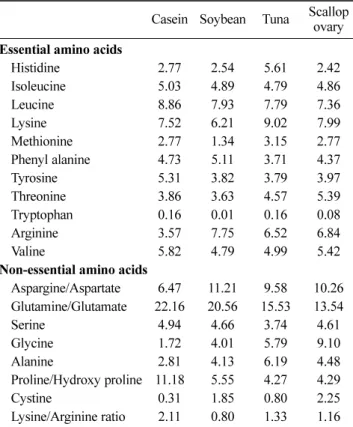
The effect of marine proteins from tuna and scallop ovary on concentrations of plasma cholesterol and lipids in rats fed experimental diets was investigated vis-à-vis casein and soy protein. Amino acid composition of different dietary proteins used in the study is presented in Table 1. Marine proteins had relatively similar essential amino acid pattern as that of casein except for the higher content of arginine and lysine in marine proteins. Furthermore, contents of glycine, aspargine, alanine, and cystine were higher in marine proteins as compared to casein (Table 1). Composition of experimental diets used in the study is presented in Table 2. Proteins evaluated in the study were used at the expense of casein in the diet and all other ingredients remained constant in the diets. Rats fed diet containing casein alone formed the control group. To avoid interfering effects of marine lipids that are known to influence hepatic/blood lipid profile and expression of genes involved in lipid metabolism (27), fat free proteins from marine sources were used in the study. This is confirmed by the fact that fatty acid composition in the livers of different diet fed animals is not significantly different from each other (p<0.05) (Table 3). The main
source of lipid in all the diets was soybean oil and as expected there is not much change in the liver fatty acid composition.
Initial average body weights of all the groups was 40±2
Table 1. Amino acid composition (weight%) of different proteins used in this study
Casein Soybean Tuna Scallop ovary Essential amino acids
Histidine 2.77 2.54 5.61 2.42 Isoleucine 5.03 4.89 4.79 4.86 Leucine 8.86 7.93 7.79 7.36 Lysine 7.52 6.21 9.02 7.99 Methionine 2.77 1.34 3.15 2.77 Phenyl alanine 4.73 5.11 3.71 4.37 Tyrosine 5.31 3.82 3.79 3.97 Threonine 3.86 3.63 4.57 5.39 Tryptophan 0.16 0.01 0.16 0.08 Arginine 3.57 7.75 6.52 6.84 Valine 5.82 4.79 4.99 5.42
Non-essential amino acids
Aspargine/Aspartate 6.47 11.21 9.58 10.26 Glutamine/Glutamate 22.16 20.56 15.53 13.54 Serine 4.94 4.66 3.74 4.61 Glycine 1.72 4.01 5.79 9.10 Alanine 2.81 4.13 6.19 4.48 Proline/Hydroxy proline 11.18 5.55 4.27 4.29 Cystine 0.31 1.85 0.80 2.25 Lysine/Arginine ratio 2.11 0.80 1.33 1.16
Table 2. Composition (g/kg diet) of various experimental diets evaluated in this study
Ingredients Control1) Dietary protein group 2) Soy
protein proteinTuna Scallop protein
Casein 200.0 150.0 150.0 150.0 Soy protein 0.0 50.0 0.0 0.0 Tuna protein 0.0 0.0 50.0 0.0 Scallop protein 0.0 0.0 0.0 50.0 Cystein 3.0 3.0 3.0 3.0 Corn starch 397.5 397.5 397.5 397.5
Dextrinized corn starch 132.0 132.0 132.0 132.0
Cellulose 50.0 50.0 50.0 50.0 Sucrose 100.0 100.0 100.0 100.0 Soybean oil 70.0 70.0 70.0 70.0 Mineral mix 35.0 35.0 35.0 35.0 Vitamin mix 10.0 10.0 10.0 10.0 Choline bitartrate 2.5 2.5 2.5 2.5
1)Diet formulation as per AIN-93G.
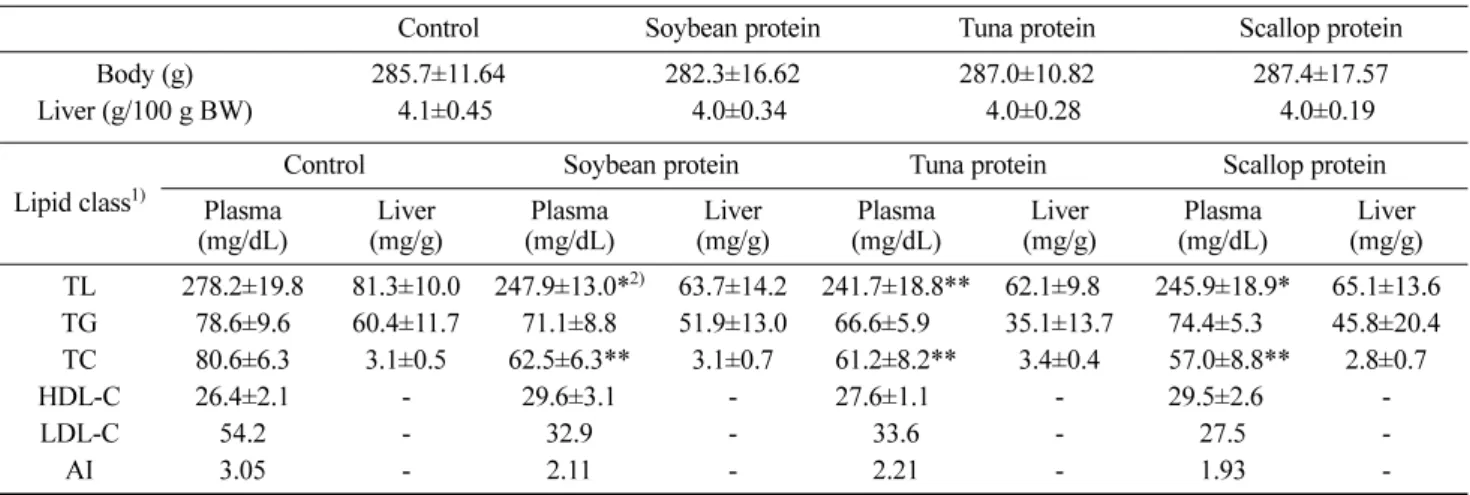
g and food intake through out the feeding period was the same for each rat (data not shown). Body and liver weights of rats fed on different experimental diets and the control group at the end of experimental study was almost the same in all groups (Table 4). A short period of 3 weeks was employed in our study as previous studies have proven that effects of dietary proteins on lipid metabolism manifest within 2 weeks or earlier (15,28).
The concentration of total lipids in the plasma of rats fed experimental diets (Table 4) was significantly different from that of control group (p<0.05); however, the liver
lipid content on the contrary was not significantly different (p>0.05). Most effects of soy proteins observed in this
study corroborate well with other such studies that include lipid-lowering effects (14,15,29). Similarly marine proteins used in this study had a hypotriglyceridemic effect as can be seen from TG levels in liver of different test protein fed groups, with the highest effect seen in the group for fed tuna protein. However, TG levels in plasma were not significantly different between groups. Furthermore, marine
proteins had hypocholesterimic effect as evidenced by the significantly decreased plasma cholesterol levels in respective groups (p<0.01); however, total cholesterol in
livers of all the groups was not significantly different (p>0.05). The LDL cholesterol and atherogenic index (AI)
were the least in rats fed scallop proteins. AI in all other groups was significantly different from that of control (p<0.01). Between the 3 test protein sources evaluated (soy
protein, tuna protein, and scallop protein) AI was not significantly different. This is indicative of the lower risk of coronary and atherosclerotic diseases (30) with dietary marine proteins and soy protein as compared to casein.
The TG lowering effect of marine proteins could possibly be due to their influence on metabolism of triacylglycerols (31) and concentration of TG in the liver and plasma essentially depends on the rate of hepatic lipogenesis (32). The hypotriacylglycerolemic/hypolipidemic effect of marine proteins could possibly be due to marine protein mediated decrease in the synthesis of TG in liver (15) and stimulation of plasma triacylglycerol clearance (28), although the exact mechanism is to be established through further studies.
Furthermore, the hypolipidemic effects of marine proteins may possibly be due to alteration of intestinal absorption of cholesterol and enhancement of fecal cholesterol excretion by marine proteins like soy protein (12). Excretion of cholesterol and bile acids through feces in different experimental diet fed groups is presented in Table 5. Fecal excretion of both cholesterol and bile acids was significantly higher in marine proteins and soy protein fed
Table 4. Body and liver weights and content of different liver lipid classes in plasma and liver of rats fed various experimental diets (n=6/group)
Control Soybean protein Tuna protein Scallop protein
Body (g) 285.7±11.64 282.3±16.62 287.0±10.82 287.4±17.57
Liver (g/100 g BW) 04.1±0.45 04.0±0.34 04.0±0.28 04.0±0.19
Lipid class1) Control Soybean protein Tuna protein Scallop protein
Plasma
(mg/dL) (mg/g)Liver (mg/dL)Plasma (mg/g)Liver (mg/dL)Plasma (mg/g)Liver (mg/dL)Plasma (mg/g)Liver TL 278.2±19.8 81.3±10.0 247.9±13.0*2) 63.7±14.2 241.7±18.8** 62.1±9.80 245.9±18.9* 65.1±13.6 TG 78.6±9.6 60.4±11.7 71.1±8.8 51.9±13.0 66.6±5.920) 35.1±13.7 74.4±5.32) 45.8±20.4 TC 80.6±6.3 3.1±0.5 62.5±6.3** 3.1±0.7 61.2±8.2** 3.4±0.4 057.0±8.8** 2.8±0.7 HDL-C 26.4±2.1 - 29.6±3.1 - 27.6±1.100 - 29.5±2.62) -LDL-C 54.2 - 32.9 - 33.6 - 27.5 -AI 3.05 - 2.11 - 2.21 - 1.93
-1)TL, total lipids; TG, triglycerides; TC, total cholestrol; HDL-C, high density lipoprotein-cholesterol; LDL-C, low density lipoprotein-choles-terol; and AI, atherogenic index.
2)Significantly different from the levels in plasma of control group at *p<0.05, **p<0.01.
Table 3. Fatty acid composition (% of total) of liver lipids of various experimental diet fed rats
Fatty acid Control1) Dietary protein group 2) Soy
protein proteinTuna Scallop protein 16:0 22.4±2.073) 20.1±1.87 22.8±2.63 22.4±3.25 16:1 n-7 1.8±0.53 1.5±0.62 1.9±0.70 2.3±1.19 18:0 10.6±2.76 12.1±3.04 13.6±2.95 11.2±3.37 18:1 n-9 16.1±2.24 14.1±3.29 12.9±2.36 15.8±4.11 18:1 n-7 3.6±0.08 3.4±0.41 4.0±0.35 3.7±0.68 18:2 n-6 22.9±3.07 22.7±3.25 18.9±2.18 20.4±2.81 20:4 n-6 13.5±3.03 15.9±4.02 17.7±3.78 14.5±4.74 20:5 n-3 0.2±0.11 0.2±0.03 ND 0.2±0.11 22:6 n-3 3.3±1.07 3.8±1.85 3.9±0.51 3.6±0.87
1)Diet formulation as per AIN-93G.
2)Part of the casein is replaced with the test protein. 3)Mean±SD (n=6/group); ND, not detected.
Table 5. Daily fecal excretion (mg/day) of cholesterol and bile acids in rats fed experimental diets
Group Cholesterol Bile acid
Control 6.1±0.71) 6.4±0.9
Soybean protein 13.8±4.4* 12.0±0.8*
Tuna protein 13.2±4.5* 11.6±3.5*
Scallop protein 12.5±4.7* 11.2±6.1*
1)Mean±SD (n=6/group); *Significantly different from control at
groups compared to the control group that were fed casein only diet (p<0.05).
The serum cholesterol lowering effect of marine proteins can primarily be attributed to the difference in their amino acid composition as compared to casein. Several researchers have reported the influence of specific amino acids on lipid metabolism (33). Dietary proteins rich in glycine, arginine, aspartic acid, and cysteine have a hypocholesterolemic effect (29); while, those rich in proline, valine, leucine (17), and lysine (34) exhibit a hypercholesterolemic effect. Although ratios of these hypo- and hyper-cholesterolemic amino acids have been used (17) for determining their influence on cholesterol metabolism, it has recently been shown that lysine to arginine ratio is more important for such effects (35). Further, lower the ratio of lysine to arginine in a protein, better is its hypocholesterolemic effect (36). In the present study, the lysine to arginine ration was significantly lower in case of test proteins (0.80, 1.33, and 1.16 respectively for soy, tuna, and scallop proteins) as compared to casein (2.11). The hypocholesterolemic effects of marine proteins along with soy proteins in comparison to casein, might be mediated by the concentrations of arginine and lysine in the respective diets.
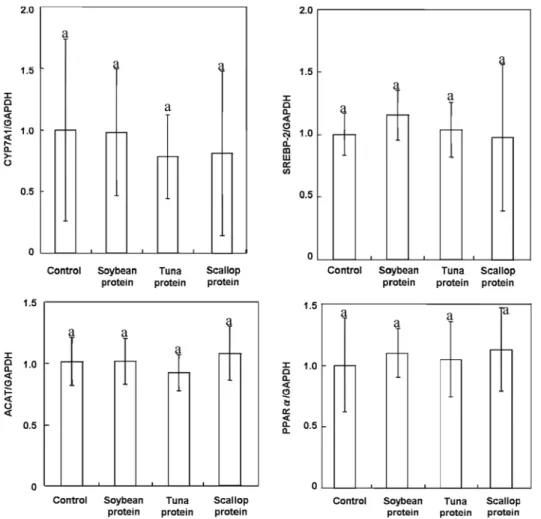
Furthermore, significant reduction in mRNA concentration of transcriptional factors involved in fatty acid synthesis was not observed in our study unlike other studies (15,36). Rats fed on marine protein, soy protein, or casein had no
significant difference in of mRNA concentrations of different transcriptional factors (CYP7A1, HMGCR, SREBP-2, CYP51, ACAT, and PPARα) responsible for fatty acid
biosynthesis (p>0.05). As a typical example mRNA
concentrations of CYP7A1, SREBP-2, ACAT, and PPAR-a in livers of rPPAR-ats fed different experimentPPAR-al diets is presented in Fig. 1. This could possibly be due to the fact that in our study rats were faster overnight at the end of experimental study and it is reported that such fasting leads to downregulation of the genes involved in cholesterol and fatty acid metabolism (28,36).
In conclusion, the present study suggests that marine proteins like soy protein possibly decrease the intestinal absorption of cholesterol and elevate the fecal cholesterol excretion thereby exhibiting a hypocholesterolemic effect as compared to casein. Amino acid pattern of marine protein might be the major contributing factor for their influence on lipid metabolism. However, the influence on lipid metabolism by marine proteins may not necessarily be noticed in the expression of mRNA transcriptional factors involved in fatty acid synthesis. The exact mechanism needs to be established by further studies.
Acknowledgments
This work was partly supported by a National Project ‘Knowledge Cluster Initiative’ (The 2nd stage, ‘Sapporo
Fig. 1. Relative m-RNA concentrations of CYP7A1, SREBP-2, ACAT, and PPAR-α in livers of rats fed various experimental
Biocluster Bio-S’ and ‘Hakodate Marine Biocluster’), Ministry of Education, Culture, Sports, Science and Tecnology, Japan (MEXT).
References
1. Gonzalez M, Caride B, Lamas MA, Taboada C. Nutritional value of the marine invertebrates Anemonia viridis and Haliothis tuberculata
and effects on serum cholesterol concentration in rats. J. Nutr. Biochem. 12: 512-517 (2001)
2. Kim SK, Mendis E. Bioactive compounds from marine processing byproducts-A review. Food Res. Int. 39: 383-393 (2006)
3. Kim SK, Mendis E, Shahidi F. Marine Fisheries By-products as Potential Nutraceuticals: An Overview. CRC Press, Boca Raton, FL, USA. pp. 1-22 (2008)
4. Chikai O, Masaki K, Koji E, Masakazu M, Kenji I. Mycosporine-like amino acids extracted from scallop (Patinopecten yessoensis) ovaries: UV protection and growth stimulation activities on human cells. Mar. Biotechnol. 10: 141-150 (2000)
5. FAO. Year Book of Fishery Statistics 2005. Vol. 100-1/2. Food & Agricultural Organization, Rome, Italy (2008)
6. Guerard F, Guimas L, Binet A. Production of tuna waste hydrolysates by a commercial neutral protease preparation. J. Mol. Cat. B-Enzym. 19/20: 489-498 (2002)
7. Garcia-Arias MT, Castrillon MP, Navarro MP. Bioavailability of zinc in rats fed tuna as a protein source in the diet. J. Trace Elem. Electr. H. 7: 29-36 (1993)
8. Garcia-Arias MT, Castrillon MP, Navarro MP. Influence of the comsumption of casein, or tuna in the raw, cooked, or canned form, on the utilization of iron in the diet of weanling rats. Z. Ernahrungswiss. 33: 51-60 (1994)
9. Guerard F, Duffose L, De La Broise D, Binet A. Enzymatic hydrolysis of proteins from yellowfin tuna (Thunnus albacares) wastes using alcalase. J. Mol. Cat. B-Enzym. 11: 1051-1059 (2001) 10. Tomotake H, Yamamoto N, Yanaka N, Ohinata H, Yamazaki R, Kayashita J, Kato N. High protein buckwheat flour suppresses hypercholesterolemia in rats and gall stone formation in mice by hypercholesterolemic diet and body fat in rats because of its low protein digestibility. Nutrition 22: 166-173 (2006)
11. Halton LT, Hu FB. The effects of high protein diets on thermogenesis, satiety, and weight loss: A critical review. J. Am. Coll. Nutr. 23: 373-385 (2004)
12. Jones PJH. Dietary agents that target gastrointestinal and hepatic handling of bile acids and cholesterol. J. Clin. Lipidol. 2: S4-S10 (2008)
13. Osada K, Inoue T, Nakamura S, Sugano M. Dietary soybean protein moderates the deleterious disturbance of lipid metabolism caused by exogenous oxidized cholesterol in rats. Biochim. Biophys. Acta 1427: 337-350 (1999)
14. Madani S, Prost J, Narce M, Belleville J. VLDL metabolism in rats is affected by the concentration and source of dietary protein. J. Nutr. 133: 4102-4106 (2003)
15. Brandsch C, Shukla A, Hirche F, Stangl GI, Eder K. Effect of proteins from beef, pork, and turkey meat on plasma and liver lipids of rats compared with casein and soy protein. Nutrition 22: 1162-1170 (2006)
16. Ait-Yahia D, Madani S, Savelli JL, Prost J, Bouchenak M, Belleville J. Dietary fish protein lowers blood pressure and alters tissue polyunsaturated fatty acid composition in spontaneously hypertensive rats. Nutrition 19: 342-346 (2003)
17. Gonzalez M, Caride B, Lamas MA, Taboada C. Effects of sea urchin-based diets on serum lipid composition and on intestinal enzymes in rats. J. Physiol. Biochem. 56: 347-352 (2000) 18. Folch J, LEES M, Sloane Stanley GH. A simple method for the
isolation and purification of total lipides from animal tissues. J. Biol.
Chem. 226: 497-509 (1957)
19. Spackman DH, Stein WH, Moore S. Automatic recording apparatus for use in the chromatography of amino acids. Anal. Chem. 30: 1190-1206 (1958)
20. Reeves PG, Nielsen FH, Fahey GC Jr. AIN-93 purified diets for laboratory rodents: Final report of the American Institute of Nutrition Ad Hoc Writing Committee on the reformulation of the AIN-76A rodent diet. J. Nutr. 123: 1939-1951 (1993)
21. Penke B, Ferenczi R, Kovacs K. A new acid hydrolysis method for determining tryptophan in peptides and proteins. Anal. Biochem. 60: 45-50 (1974)
22. Prevot AF, Mordret FX. Utilization of glass capillary column for gas chromatographic analysis of fatty acid. Rev. Fse. Corps Gras. 23: 409-423 (1976)
23. Richmond W. Preparation and properties of a cholesterol oxidase from Nocardia sp. and its application to the enzymatic assay of total cholesterol in serum. Clin. Chem. 19: 1350-1356 (1973)
24. Steele BW, Koehler DF, Kuba K, Azar MM. An enzymatic approach to lipoprotein quantification. Am. J. Clin. Pathol. 73: 75-78 (1980)
25. Hinsch W, Ebersbach WD, Sundaram PV. Fully enzymic method of plasma triglyceride determination using an immobilized glycerol dehydrogenase nylon-tube reactor. Clin. Chim. Acta 104: 95-100 (1980)
26. Takayama M, Itoh S, Nagasaki T, Tanimizu I. A new enzymatic method for determination of serum choline-containing phospholipids. Clin. Chim. Acta 79: 93-98 (1977)
27. Fernandez ML, West KL. Mechanisms by which dietary fatty acids modulate plasma lipids. J. Nutr. 135: 2075-2078 (2005)
28. Shukla A, Bettzieche A, Hirsche F, Brandsch C, Stangl GI, Eder K. Dietary fish protein alters blood lipid concentrations and hepatic genes involved in cholesterol homeostasis in the rat model. Brit. J. Nutr. 96: 674-682 (2006)
29. Koba K, Liu J-W, Bobik E Jr, Mills DE, Sugano M, Huang Y-S. Effect of phytate in soy protein on the serum and liver cholesterol levels and fatty acid profile in rats. Biosci. Biotech. Bioch. 67: 15-22 (2003)
30. Ando K, Nagata K, Beppu M, Kikugawa K. Effect of n-3 fatty acid supplementation on lipid peroxidation and protein aggregation in rat erythrocyte membranes. Lipids 33: 505-512 (1998)
31. Sugiyama K, Kanamori H, Akachi T, Yamakawa A. Amino acid composition of dietary proteins affects plasma cholesterol concentration through alteration of hepatic phospholipid metabolism in rats fed a cholesterol-free diet. J. Nutr. Biochem. 7: 40-48 (1996)
32. Foufelle F, Girard J, Ferre P. Regulation of lipogenic enzyme expression by glucose in liver and adipose tissue: A review of the potential cellular and molecular mechanisms. Adv. Enzyme Regul. 36: 199-226 (1996)
33. Wergedahl H, Liaset B, Gudbrandsen OA, Lied E, Espe M, Muna Z, Mork S, Berge RK. Fish protein hydrolysate reduces plasma total cholesterol, increases the proportion of HDL cholesterol, and lowers acyl-CoA:cholesterol acyltransferase activity in liver of Zucker rats. J. Nutr. 134: 1320-1327 (2004)
34. Jacques H, Gascon A, Bergeron N, Lavigne C, Hurley C, Deshaies Y, Moorjani S, Julien P. Role of dietary fish protein in the regulation of plasma lipids. Can. J. Cardiol. 11: G63-G71 (1995)
35. Gudbrandsen OA, Wergedahl H, Liaset B, Espe M, Berge RK. Dietary proteins with high isoflavone content or low methionine-glycine and lysine–arginine ratios are hypocholesterolaemic and lower the plasma homocysteine level in male Zucker fa/fa rats. Brit. J. Nutr. 94: 321-330 (2005)
36. Shukla A, Brandsch C, Bettzieche A, Hirsche F, Stangl GI, Eder K. Isoflavone poor soy protein alters lipid metabolism of rats by SREBP-mediated down regulation of hepatic genes. J. Nutr. Biochem. 18: 313-321 (2007)