J Korean Acad Community Health Nurs 지역사회간호학회지( ) http://dx.doi.org/10.12799/jkachn.2015.26.2.150
INTRODUCTION
1. Necessities of Research
In Korea, the prevalence of diabetes mellitus in the population aged over 65 is 24.3% among men and 19.3 % among women, and the rate is steadily increasing ev-ery year[1]. Cardiovascular complications are what dia-betes mellitus patients should consider most seriously, and it has been reported that 19.5% of deaths in Korea are caused by cardiovascular diseases and the percent-age is higher among the percent-aged[2]. Hypertension and dys-lipidemia induced by diabetes mellitus are major risk factors that increase macrovascular and microvascular complications, and consequently raise the incidence and
mortality of cardiovascular diseases[3]. What is more, the prevalence of cardiovascular diseases is 2~4 times higher among patients with diabetes mellitus than among those without, and cardiovascular diseases have been reported to be the biggest cause of Type II diabetes mellitus patients' death and function loss and 65% of diabetes mellitus patients die of a cardiovascular dis-ease[4]. Because of the desensitization of pain sense, what is more, it is not easy to detect vascular complica-tions early in elderly diabetes mellitus patients and the severity of the diseases is often higher than the symp-toms that they complain of. Accordingly, it is necessary to develop active solutions to reduce the incidence of vascular complications among diabetes mellitus pa-tients, and for this, it is urgently required to identify risk factors related to the onset of vascular complications in
The Effects of Elderly Diabetes Mellitus Patients' Self-care Behavior
and Health Conservation on Cardiovascular Risk Factors
Sung, Kiwol
College of Nursing, Catholic University of Daegu, Daegu, Korea
Purpose: This study was performed in order to identify the relationships among self-care behavior, health
con-servation, and cardiovascular risk factors and to examine the influence of self-care behavior and health conservation on cardiovascular risk factors among Korean elders with diabetes mellitus. Methods: The participants were 105 eld-ers with diabetes mellitus using senior welfare centeld-ers and elderly leisure houses in Daegu. Data were collected through interviews during the period from April to May in 2014. Self-care behavior was measured with Kim's (1997) Self-care Behavior Scale, health conservation with Sung's (2005) Health Conservation Scale, and cardiovascular risk factors with the Arizona Heart Institute Cardiovascular Risk Factor Questionnaire. Collected data were analyzed through one-way ANOVA, independent t-test, Pearson's correlation, and stepwise multiple regression using the SPSS/WIN 19.0 program. Results: A negative correlation was found between self-care behavior and cardiovascular risk factors, and between health conservation and cardiovascular risk factors. Self-care behavior explained 6% and health conservation did 49% of variance in elderly diabetes mellitus patients' cardiovascular risk. Conclusion: The results indicate that, in order to reduce cardiovascular risk factors among Korean elders with diabetes mellitus, we need nursing interventions for increasing health conservation and self-care behavior.
Key Words: Health conservation, Cardiovascular risk, Diabetes mellitus, Aged
Corresponding author: Sung, Kiwol
College of Nursing, Catholic University of Daegu, 33 Duryugongwon-ro 17-gil, Nam-gu, Daegu 705-718, Korea. Tel: +82-53-650-4391, Fax: +82-53-650-4392, E-mail: [email protected]
- This work was supported by research grants from the Catholic University of Daegu in 2014. Received: Mar 17, 2015 | Revised: Jun 5, 2015 | Accepted: Jun 24, 2015
This is an open access article distributed under the terms of the Creative Commons Attribution Non-Commercial License (http://creativecommons.org/licenses/ by-nc/3.0), which permits unrestricted non-commercial use, distribution, and reproduction in any medium, provided the original work is properly cited.
diabetes mellitus patients.
What previous studies reported as risk factors of car-diovascular complications in diabetes mellitus patients are general characteristics including gender and age[5], monthly income, and education level[6], characteristics related to diabetes mellitus including the duration of diabetes mellitus and the family history of diabetes mel-litus[7], clinical characteristics including glucose, LDL, HDL, blood and pressure[8-10], and other such as diet [9-12], physical activities[13-16], smoking[17-19], self-care behavior, and self-efficacy[20,21]. In particular, self-care behavior was found to be in a negative correla-tion with the index of cardiovascular disease risk[20], and was reported to be the variable predicting best the level of cardiovascular risk[21]. Nevertheless, factors af-fecting the risk of cardiovascular disease in diabetes mellitus patients have not been studied from diverse perspectives.
Because it is difficult to prevent the complications of diabetes mellitus through the doctor's instructions or drugs alone, there must be the patient's efforts for self-management and change in life habits. In consideration that the disease duration is likely to be prolonged due to extended life expectancy and medical support, diabetes mellitus patients' adequate self-care behavior is essen-tial for preventing complications caused by various car-diovascular risk factors and maintaining the quality of life[22]. Therefore, diabetes mellitus patients' self-care behavior has been perceived to be very important. How-ever, the disease recognition rate was higher in diabetes mellitus patients than in other disease patients, but the disease control rate was about 30% in them, lower than that in other disease patients[23]. Particularly in case of elderly diabetes mellitus, physiological changes result-ing from agresult-ing prompt inadequate blood glucose re-sponses and accelerate the occurrence of complications. Elders have various troubles as their abilities to perform self-management are limited by functional changes caused by aging, and psychological and social prob-lems in old ages[24].
Elderly diabetes mellitus patients' health management should aim less at the treatment of disease than at the prevention of complications and the maximum preser-vation of functions for improving and maintaining health, and it requires a comprehensive approach integrating physical, psychosocial, and functional health[25]. Elders' health conservation is a physical, social, and psycho-logical cointegrate, maintaining well-being and balance, and the conservation of human health means the in-tegration of the person's structural, personal, social, and
energy states. Thus, the integrated conservation of all these elements is very important for elders' health man-agement[25]. In elderly diabetes mellitus patients, the self-management of the disease is affected significantly by their physical functions, psychological conditions, and family, economic, and social factors[26].
As an effort to prevent cardiovascular complications in elderly diabetes mellitus patients, accordingly, this study purposed to examine the influence of self-care behavior and health conservation on cardiovascular risk factors among elders with diabetes mellitus.
2. Objectives
The objectives of this study were to examine the re-lationships among elderly diabetes mellitus patients' self-care behavior, health conservation, and cardiovascular risk factors, and to examine the influence of self-care behavior and health conservation on cardiovascular risk factors among elders with diabetes mellitus, and specific goals were as follows.
To survey elderly diabetes mellitus patients' self-care behavior, health conservation, and cardiovas-cular risk factors.
To test differences in cardiovascular risk factors ac-cording to elderly diabetes mellitus patients' general characteristics and health characteristics.
To examine the correlations among elderly diabetes mellitus patients' self-care behavior, health conser-vation, and cardiovascular risk factors.
To examine the influence of self-care behavior and health conservation on cardiovascular risk factors among elders with diabetes mellitus.
METHODS
1. Research Design
This study is a correlation survey for understanding the association among elderly diabetes mellitus patients' self-care behavior, health conservation, and cardiovas-cular risk factors, and for assessing the explanatory po-wer of self-care behavior and health conservation for car-diovascular risk factors through a questionnaire survey. 2. Subjects
The subjects of this study were elders aged over 65, living in Daegu City, using one of three senior welfare centers and seven senior centers, and diagnosed with
diabetes mellitus by a doctor. Those included in sam-pling were elders who had never been diagnosed by a doctor with any of major cardiovascular diseases such as ischemic heart disease, coronary artery disease, angina, myocardial infarction, atherosclerosis (arteriosclerosis), cerebrovascular disease, stroke, and arrhythmia, who did not have severe retinosis or nephrosis as a complica-tion of diabetes mellitus, who were able to communi-cate, and whose MMSE-K was normal as higher than 24 (range 0~30). In addition, the subjects were limited to those who understood the purposes of this study and gave a written consent to participation voluntarily.
The number of subjects was estimated using G*Power 3.1, and the minimum number required for regression analysis was 99 when significance level was .05, power of test 90%, effect size .15, which is a medium level for regression analysis. In consideration of the recovery rate and inadequate answers, 110 subjects were sam-pled through convenient sampling.
3. Ethical Considerations
This study was conducted after obtaining the approval of the Institutional Review Board of D University (CUIRB-2014-0027), and the guidelines of the Institutional Review Board were observed during the period of research. The subjects were informed of the purposes of the study and that they were able to withdraw from participation at any time. In addition, a written consent was sought, which guaranteed the subjects' anonymity and autonomy. Each participant was given a 10,000-won umbrella as a gift. 4. Tools
1) Cardiovascular risk factors
Cardiovascular risk was measured using the Arizona Heart Institute Cardiovascular Risk Factor Questionnaire [27] developed based on cardiovascular risk factors sug-gested by the American Heart Association/American College of Cardiology (AHA/ACC). The questionnaire consists of 12 questions on personal factors (age, gen-der, family history, clinical history, and diabetes melli-tus history), physical factors (cholesterol, systolic blood pressure, and obesity index), and life habits (smoking, eating habit, exercise habit, and stress factors) among cardiovascular risk factors reported in literature. Its total score is calculated as the sum of the scores of fixed fac-tors assessed based on personal facfac-tors, and the scores of variable factors assessed based on physical factors and life habits, and each item is given a weight in scoring.
The possible highest score is 94, and a high score means a high cardiovascular risk. A cardiovascular risk of 19 or lower is categorized into level 1 (low risk), between 20~ 39 into level 2 (moderate risk), and of 40 or higher into level 3 (high risk). The reliability (test-retest reliability) of the tool was .83 in the study of Sung & Lee[13], and .87 in this study.
2) Self-care behavior
Self-care behavior was measured with the Self-care Behavior Scale developed by Kim[28], and this scale consists of 20 questions including 5 about general health management, 7 about diet practice, 3 about drug admin-istration, 3 about physical exercise, and 3 about blood glucose test. Each question is on a 5-point scale, and the score range is from 20 to 100. A high score means a high level of self-care behavior, and the reliability (Cron-bach's⍺) of the tool was .85 on its development, and .97 in this study.
3) Health conservation
Health conservation was measured with the Health Conservation Scale developed by Sung[25], and this tool consists of 37 questions including 14 about personal in-tegrity, 8 about energy conservation, 8 about structural integrity, and 7 about social integrity. Each question is on a 4-point scale, and 6 reverse questions were re-versely converted, and the score range is from 37 to 148. A high score means a high level of health conservation, and the reliability (Cronbach's⍺) of the tool was .94 on its development, and .97 in this study.
5. Data Collection Methods
After the approval of the IRB, the researcher obtain-ed prior permission from the responsible persons of three senior welfare centers and seven senior centers in Daegu, and the researcher and research assistants trained for the questionnaire survey visited the institutions and collected data during the period from September 7 to November 30 in 2014. The questionnaires were distri-buted to subjects who understood the purposes of this study and consented to participate, and they answered the questions by themselves. For those who were not able to write down the answers due to visual impairment, the researcher or a research assistant read the questions and wrote down their answers for them. The survey took about 20~30 minutes per person. A total of 110 questionnaires were distributed, and with five excluded for insufficient or omitted answers, 105 questionnaires
(95.5%) were used in the final analysis. 6. Data Analysis
Collected data were analyzed using IBM SPSS/WIN 19.0 through the ways as follows.
The subjects' general characteristics, health charac-teristics, self-care behavior, health conservation, and cardiovascular risk factors were analyzed through frequencies, percentages, means, standard devia-tions, and ranges.
Difference in cardiovascular risk factors according to the subjects' general characteristics and health characteristics was tested through one-way ANOVA and independent t-test.
The correlations among the subjects' self-care be-havior, health conservation, and cardiovascular risk factors were analyzed through Pearson's correla-tion coefficients.
The explanatory power of self-care behavior and health conservation for the subjects' cardiovascular risk factors was assessed through stepwise multiple linear regressions.
RESULTS
1. The subjects' General Characteristics and Health Characteristics
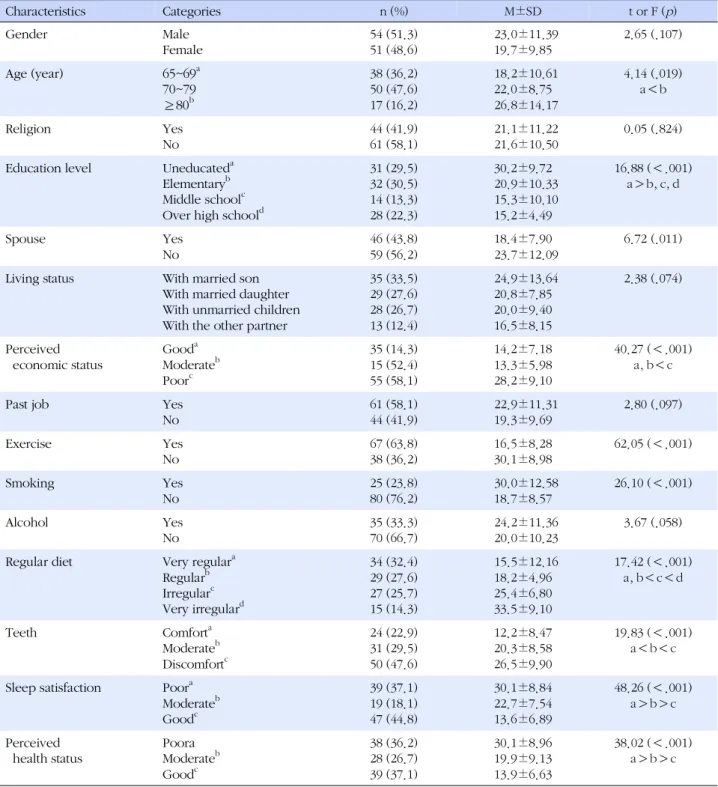
Of 105 subjects of this study, 54 (51.3%) were male, and 51 (48.6%) were female. As to age, 50 (47.6%) were in their 70s, and 38 (36.2%) were in their 60s. As to reli-gion, 61 (58.1%) were believers, and 44 (41.9%) were non-believers, and as to education level, 32 (30.5%) were elementary school graduates, and 31 (29.5%) were unschooled. In addition, 59 (56.2%) were without a spouse, and as to cohabitation type, 35 (33.5%) were living with a married son, and 29 (27.6%) were living with a married daughter. As to subjective economic sta-tus, 55 (52.4%) perceived that their economic status was poor, and 35 (33.3%) did that it was good. Of the sub-jects, 61 (58.1%) had been employed in the past.
As to health characteristics, 67 (63.8%) of the sub-jects did exercise and 38 (36.2%) did not, 80 (76.2%) did not smoke and 25 (23.8%) did, 70 (66.7%) did not drink and 35 (33.3%) did, 61 (60.0%) ate meals regularly and 32 (40.0%) did irregularly, 50 (47.6%) had dental dis-comfort and 24 (22.9%) did not. Sleep satisfaction was high in 47 (44.8%), average in 19 (18.1%), and poor in 39 (37.1%), and perceived health status was good in 39
(37.1%), average in 28 (26.7%), and poor in 38 (36.2%) (Table 2).
2. The subjects' self-care behavior, health con-servation, and cardiovascular risk factors
The elderly diabetes mellitus patients' mean level of self-care behavior was 61.2±20.84 out of 100, above the average, and their level of health conservation was 90.3±25.45 out of 148, above the average. Their mean cardiovascular risk was 21.4±10.76 out of 94, which was level 2 or moderately high. According to cardiovascular risk, 23 (21.9%) of the subjects were in level 1, 63 (60.0%) in level 2, and 19 (18.1%) in level 3 (Table 1).
3. Differences in Cardiovascular Risk Factors accord-ing to General Characteristics and Health Charac-teristics
In the results of testing differences according to eld-erly diabetes mellitus patients' general characteristics and health characteristics, significant difference was ob-served according to age (F=4.14, p =.019), education level (F=16.88,p <.001), whether to have a spouse (t= 6.72,p=.011), subjective economic status (F=40.27, p < .001), whether to do exercise (t=62.05,p<.001), wheth-er to smoke (t=26.10,p<.001), meal regularity (F=17.42, p<.001), dental condition (F=19.83, p <.001), sleep satisfaction (F=48.26, p <.001), and subjective health status (F=38.02,p <.001).
According to general characteristics, the score of car-diovascular risk was higher in elders aged over 80 (26.8 ±14.17) than in those aged 65~69 (18.2±10.61), and in unschooled elders (30.2±9.72) than in elementary grad-uates (20.9±10.33), middle school gradgrad-uates (15.3±10.10), and high school graduates or higher (15.2±4.49). In ad-dition, the score was higher in elders without a spouse (23.7±12.09) than in those with (18.4±7.90), and in Table 1. The Degrees of Self-care Behaviors, Health Con-servation and Cardiovascular Risk Factors in Elderly with
Diabetes Mellitus (N=105) Variables M±SD Possible range Observed range Self-care behaviors 61.2±20.84 20~100 28~94 Health conservation 90.3±25.45 37~148 52~134 Cardiovascular risk factors 21.4±10.76 0~94
those whose subjective economic status was poor (28.2 ±9.10) than in those whose subjective economic status was good (14.2±7.18) or average (13.3±5.98) (Table 2). According to health characteristics, the score of car-diovascular risk was higher in those who did not do ex-ercise (30.1±8.98) than in those who did (16.5±8.28),
and in those who smoked than in those who did not (18.7±8.57). The score was higher in those who had meals very irregularly than in those who had meals ir-regularly (25.4±6.80), and higher in those who had meals irregularly than in those who had meals very reg-ularly (15.5±12.16) or regreg-ularly (18.2±4.96). The score
Table 2. The Difference of the Cardiovascular Risk Factors according to General Characteristics and Health Condition of Subjects
in Elderly with Diabetes Mellitus (N=105)
Characteristics Categories n (%) M±SD t or F (p) Gender Male Female 54 (51.3) 51 (48.6) 23.0±11.39 19.7±9.85 2.65 (.107) Age (year) 65~69a 70~79 80 ≥ b 38 (36.2) 50 (47.6) 17 (16.2) 18.2±10.61 22.0±8.75 26.8±14.17 4.14 (.019) a b< Religion Yes No 44 (41.9) 61 (58.1) 21.1±11.22 21.6±10.50 0.05 (.824) Education level Uneducateda
Elementaryb Middle schoolc Over high schoold
31 (29.5) 32 (30.5) 14 (13.3) 28 (22.3) 30.2±9.72 20.9±10.33 15.3±10.10 15.2±4.49 16.88 ( .001)< a b,> c, d Spouse Yes No 46 (43.8) 59 (56.2) 18.4±7.90 23.7±12.09 6.72 (.011) Living status With married son
With married daughter With unmarried children With the other partner
35 (33.5) 29 (27.6) 28 (26.7) 13 (12.4) 24.9±13.64 20.8±7.85 20.0±9.40 16.5±8.15 2.38 (.074) Perceived economic status Gooda Moderateb Poorc 35 (14.3) 15 (52.4) 55 (58.1) 14.2±7.18 13.3±5.98 28.2±9.10 40.27 ( .001)< a, b c<
Past job Yes
No 61 (58.1) 44 (41.9) 22.9±11.31 19.3±9.69 2.80 (.097) Exercise Yes No 67 (63.8) 38 (36.2) 16.5±8.28 30.1±8.98 62.05 ( .001)< Smoking Yes No 25 (23.8) 80 (76.2) 30.0±12.58 18.7±8.57 26.10 ( .001)< Alcohol Yes No 35 (33.3) 70 (66.7) 24.2±11.36 20.0±10.23 3.67 (.058) Regular diet Very regulara
Regularb Irregularc Very irregulard 34 (32.4) 29 (27.6) 27 (25.7) 15 (14.3) 15.5±12.16 18.2±4.96 25.4±6.80 33.5±9.10 17.42 ( .001)< a, b c d< < Teeth Comforta Moderateb Discomfortc 24 (22.9) 31 (29.5) 50 (47.6) 12.2±8.47 20.3±8.58 26.5±9.90 19.83 ( .001)< a b c< < Sleep satisfaction Poora
Moderateb Goodc 39 (37.1) 19 (18.1) 47 (44.8) 30.1±8.84 22.7±7.54 13.6±6.89 48.26 ( .001)< a b c> > Perceived health status Poora Moderateb Goodc 38 (36.2) 28 (26.7) 39 (37.1) 30.1±8.96 19.9±9.13 13.9±6.63 38.02 ( .001)< a b c> >
of cardiovascular risk was higher in those with severe dental discomfort (26.5±9.90) than in those with mod-erate dental discomfort (20.3±8.58) and those without (12.2±8.47). The score was higher in those whose per-ceived sleep satisfaction was low (30.1±8.84) or aver-age (22.7±7.54) than in those whose perceived sleep satisfaction was high (13.6±6.89). It was higher in those whose subjective health status was poor (30.1±8.96) than in those whose subjective health status was aver-age (19.9±9.13), and in those whose subjective health status was average than in those whose subjective health status was good (13.9±6.63) (Table 2).
4. Correlations among the Subjects' Self-care Beha-vior, Health Conservation, and Cardiovascular Risk Factors
Elderly diabetes mellitus patients' cardiovascular risk was in a significant negative correlation with their self-care behavior (r=-.67, p <.001) and with their health conservation (r=-.70, p <.001). That is, cardiovascular risk was higher when the level of self-care behavior and health conservation was low (Table 3).
5. The Explanatory Power of Self-care Behavior and Health Conservation for the Subjects' Cardiovas-cular Risk Factors
Table 4 shows the results of stepwise multiple linear regressions for assessing the explanatory power of self-care behavior and health conservation for elderly dia-betes mellitus patients' cardiovascular risk factors.
Self-care behavior and health conservation were used as input variables in the first model, and among the sub-jects' general characteristics and health characteristics, those found to make significant difference in cardio-vascular risk factors were used as input variables in the second model. Whether to have a spouse, whether to do exercise, whether to smoke, meal regularity, and dental condition variable were converted to dummy variables in the analysis.
According to the results of testing multicollinearity before multiple regression analysis, tolerance limit was
0.321~0.893, higher than 0.1, and the variance inflation factor (VIF) was 1.120~3.118, not exceeding 10. In addi-tion, Durbin-Watson statistic was 1.852, close to 2, show-ing that there was not a systematic correlation between error terms, and the goodness-of-fit of the regression model was confirmed because the normal distribution of residuals was verified (F=36.55,p<.001).
According to the results of stepwise multiple regres-sion analysis, self-care behavior explained 6% (β=-.46) and health conservation did 49% (β=-.22) of variance in elderly diabetes mellitus patients' cardiovascular risk. Be-sides, age explained 5% (β=.28), smoking 4% (β=-.28), perceived economic status 2% (β=-.21), and whether to have a spouse 3% (β=-.21), and these variables ex-plained a total of 67% of variance in elderly diabetes mellitus patients' cardiovascular risk (Table 4).
DISCUSSION
In this study, the subjects' mean score of cardio-vascular risk was 21.4 out of 94, which is level 2 or mod-erately high. The general characteristics found to affect elderly diabetes mellitus patients' cardiovascular risk were age, education level, whether to have a spouse, and subjective economic status, and among health char-acteristics, exercise, eating habit, smoking, sleep satis-faction, and subjective health status were found to be influential factors. This is similar to the results of Kim & Hwang[5] and Choiniere et al.,[6] who reported age and education level, respectively, as general characteristic affecting the risk of cardiovascular complications in dia-betes mellitus patients. Similarly to this study, more-over, exercise[13-16], eating habit[9-12], and smoking [17-19] were reported to be major health characteristics influencing the risk of cardiovascular complications.
The Framingham Risk Score, which was invented to predict the onset of cardiovascular diseases, assesses the risk of cardiovascular disease using age, total cho-lesterol, HDL chocho-lesterol, treatment of hypertension, systolic blood pressure, etc.[29]. Korean researchers al-so estimate the risk of cardiovascular disease using age, total cholesterol, etc., and body mass index and systolic hypertension affect the prognosis of cardiovascular dis-Table 3. Correlations among Self-care Behaviors, Health Conservation and Cardiovascular Risk Factors in Elderly Diabetic
Patients (N=105)
Variables Self-care behaviors Health conservation
r (p) r (p)
eases[30]. Accordingly, age, dyslipidemia, hyperten-sion, obesity, etc. are common cardiovascular risk fac-tors. In this way, age has been proved a general charac-teristic affecting the risk of cardiovascular complica-tions, but for other general characteristics, further repli-cation studies are required.
In this study, age was, along with family history, is an uncontrollable cardiovascular risk factor. The mean age that induces cardiovascular diseases is 60 or older[5], and in this way, age influences cardiovascular diseases. In this study, low education level, absence of a spouse, and poor economic status were found to increase the risk of cardiovascular risk, and this is similar to the re-port of Choiniere et al., [6] that monthly income and ed-ucation level were related to cardiovascular risk. This suggests that these elders may have difficulty in access-ing information about cardiovascular risk factors related to diabetes mellitus or in developing desirable health habits.
Next, health characteristics found in this study to in-fluence cardiovascular risk are related to weight gain and dyslipidemia resulting from unacceptable health habits. In the results of this study, the dyslipidemia group was heavier in weight than the other group and abdominal obesity increased the risk of dyslipidemia, suggesting that obesity is associated with the onset of dyslipidemia[8].
On the other hand, regular exercise is known to be an effective way of controlling blood pressure by in-creasing the release of nitric oxide that induces vaso-dilation[14]. Regular exercise is effective in reducing weight, body mass index, and body fat percentage[15], and particularly for diabetes mellitus patients, increased physical activities can prevent cardiovascular diseases
by reducing total cholesterol and low-density lipopro-tein[16]. Therefore, regular exercise should be encour-aged in order to lower the risk of cardiovascular compli-cations in diabetes mellitus elders.
As to the relation between eating habit and obesity and between blood lipid and blood pressure, fat meal is a factor increasing LDL cholesterol[9], and excessive cal-orie intake is converted to neutral fat in the body, is stor-ed as subcutaneous fat, and causes dyslipidemia[10]. When DASH (Dietary Approaches to Stop Hypertension) diet consisting of rich fruit and vegetable and low con-tent of saturated fat and cholesterol was applied to Type II diabetes mellitus patients for eight weeks, it reduced their weight and waist circumference, and lowered LDL cholesterol and blood pressure[12]. Therefore, diabetes mellitus elders' eating habit is a factor that can control the risk of cardiovascular complications, and thus it is very important for nurses to guide diabetes mellitus eld-ers in their meal eating.
On the other hand, smoking brings forth dyslipide-mia by increasing total cholesterol and neutral fat[17], and the increase of smoking quantity raises systolic and diastolic blood pressure significantly[18]. In contrast, smoking cessation was found to have a positive effect in preventing the occurrence and recurrence of cardio-vascular diseases[19]. Compared to those without, eld-ers with diabetes mellitus show higher morbidity of dis-eases related to diabetes mellitus such as cardiovascular disease, hypertension, overweight, and obesity[3,4].
As presented above, it was found that the major factors causing cardiovascular diseases were smoking, deficient activity, obesity, hypertension, blood cholesterol concen-tration, etc. Because obesity, dyslipidemia, and hyper-tension are closely interconnected, it is important for eld-Table 4. Influencing Factors of Self-Care Behavior and Health Conservation on Cardiovascular Risk (N=105)
Variables B SE β t p Adj. R2 (Constant) 28.42 8.25 3.44 .001 Health conservation -0.09 0.04 -.22 -2.33 .022 .49 Self-care behaviors -0.24 0.05 -.46 -4.68 <.001 .06 Age (year) 0.50 0.11 .28 4.67 <.001 .05 Smoking d1† -7.03 1.61 -.28 -4.37 <.001 .04
Perceived economic status d1‡ -6.50 2.00 -.21 -3.25 .002 .02
Spouse d1§ -4.56 1.49 -.21 -3.07 .003 .03
Adj. R2=.67, F=36.55, p .001<
†Dummy variables (Smoking: Yes=0, No=d1);‡Dummy variables (Perceived economic status: Good=0, Moderate=d1, Poor=d2)§Dummy variables
erly diabetes mellitus patients to practice healthy life hab-its in order to prevent cardiovascular diseases, and it is necessary to make composite approaches instead of a sin-gle intervention for preventing cardiovascular diseases.
In the pathogenesis of diabetes mellitus in elders, the incidence of diabetes mellitus increases with aging, obe-sity, low quantity of activity, reduced muscle mass, in-adequate eating, inter-current disease, increased drug use, etc.[3,4]. Moreover, pancreatic insufficiency resulting from aging reduces the secretion of insulin and, at the same time, glucose utilization is reduced due to insulin dysfunction caused by reduced muscle mass, and con-sequently, the insulin suppression function for glucose production in the liver is weakened and the resultant ab-normal glucose intolerance causes diabetes mellitus. Therefore, as an effort to prevent cardiovascular diseases in elderly diabetes mellitus patients, education and coun-seling should be given to them on obesity prevention, increased quantity of activities, adequate meal eating, control of drug use and inter-current diseases, etc.
In this study, on the other hand, health conservation showed the highest explanatory power (49%) for eld-erly diabetes mellitus patients' cardiovascular risk fac-tors, and self-care behavior showed explanatory power of 6%. The importance of diabetes mellitus patients' self-care has been emphasized in several previous stud-ies[20,21]. If relevant factors supported in previous stu-dies are examined in connection to positive changes in self-care behavior among elderly diabetes mellitus pa-tients, we may be able to establish efficient interven-tions for lowering cardiovascular risk. Therefore, dia-betes mellitus elders' cardiovascular diseases should be prevented by the reduction of obesity, dyslipidemia, and hypertension through exercise, diet control, and peri-odical medication management. What is more, we need to develop nursing interventions for promoting health behavior as an effort to prevent elderly diabetes mellitus patients' cardiovascular diseases, and the basic approa-ch should be integrated health conservation.
Elders' health conservation is maintaining physical., mental., and social well-being and sustaining balance as a physical., mental and psychosocial cointegrate[25]. Factors influencing elders' health conservation have not been studied from diverse perspectives. Moreover, there have been few studies on elderly diabetes mellitus pa-tients' health conservation directly comparable with the present study. Because elderly diabetes mellitus is close-ly associated with long-lasting inadequate daiclose-ly habits, however, it is emphasized to practice desirable health behavior for integrated health conservation.
A strength of this study is that it confirmed the con-cept of health conservation in explaining elderly dia-betes mellitus patients' cardiovascular risk factors, and its limitation is that the subjects were not sampled ran-domly and therefore the results may not be generalized to the whole population.
What is more, the Health Conservation Scale was originally developed for institutionalized elders but the subjects of this study were community-dwelling elders. Thus, this tool may have a limitation in its reliability and validity.
CONCLUSION
Compared to those without, elders with diabetes mel-litus show higher morbidity of cardiovascular diseases, and major factors causing cardiovascular diseases in-clude health behaviors such as smoking, deficient activ-ity and diet, and clinical factors such as obesactiv-ity, hyper-tension, and blood cholesterol concentration. In this study, elderly diabetes mellitus patients' cardiovascular risk was level 2 or moderately high, and the score of risk was higher in those of old age, lowly educated ones, those without a spouse, and those whose subjective economic status was poor. What is more, the score was higher in elders who did not do exercise, those who smoked, those who ate meals irregularly, those with dental discomfort, those whose perceived sleep sat-isfaction was low, and those whose subjective health status was poor.
In addition, elderly diabetes mellitus patients' health conservation explained 49% of variance in cardiovas-cular risk factors, and their self-care behavior explained 6%.
Based on these results were made suggestions as follows.
It is suggested to make replication studies with ran-domly sampled subjects.
It is suggested to analyze the relationship between self-care behavior and health conservation accord-ing to the level of cardiovascular risk.
It is suggested to develop intervention programs for reducing elderly diabetes mellitus patients' car-diovascular risk factors by applying the concept of health conservation.
REFERENCES
1. World Health Organization. Diabetes [Internet]. Geneva: World Health Organization. 2013 [cited 2014 January 15].
Available from: www.who.int/mediacentre/en/
2. Statistics Korea. 2012 Korea health statistics [Internet]. Seoul: Ministry of Health and Welfare & Korea Centers for Disease Control &Prevention. 2013 [cited 2014 January 20]. Available from: http://www.index.go.kr/egams/stts/jsp/ potal/stts/PO _STTS_IdxMain.jsp?idx_cd=1438&bbs=INDX_001
3. Boo SJ. Glucose, blood pressure, and lipid control in Korean adults with diagnosed diabetes. Korean Journal of Adult Nurs-ing. 2012;24(4):406-416.
http://dx.doi.org/ 10.7475/kjan.2012.24.4.406
4. The American Heart Association. Cardiovascular disease & diabetes [Internet]. Dallas: The American Heart Association. 2012 [cited 2014 January 20]. Available from:
http://www.heart.org/HEARTORG/Conditions/Diabetes/W hyDiabetesMatters/%20 Cardiovascular-Disease-Diabetes_U CM_313865_Article.jsp
5. Kim EY, Hwang SY. Predicting factors of smoking and emo-tional stress among male patients with acute coronary synd-rome. The Journal of Korean Academic Society of Adult Nurs-ing, 2011;23(1):100-109.
6. Choiniere R, Lafontaine P, Edwards AC. Distribution of cardio-vascular disease risk factors by socioeconomic status among Canadian adults. Canadian Medical Association Journal. 2000; 162(9):S13-24.
7. Lee HJ, Park KY. Predictors of cardiovascular risk factors among type 2 diabetic patients. The Journal of Korean Aca-demic Society of Adult Nursing. 2006;18(3):426-435. 8. Nam SM, Ha EH, Suh YJ, Park HS, Chang MH, Seo JH, et al.
Effect of obesity and blood lipid profiles on hyperlipidemia in adults aged over 40 years. Journal of Korean Society for the Study of Obesity. 2008;17(1):20-28.
9. Seo JB, Jung WY. The importance of treatment of low HDL cholesterolemia in cardiovascular disease. Korean Journal of Lipidology. 2008;18(2):270-276.
10. Kim JS. Effects of the weight control program on body com-position, blood lipids, insulin sensitivity and IGF-1 in obese juveniles. Journal of Sport and Leisure Studies. 2010;40:719-730.
11. Yu SY, Hong HS, Lee HS, Choi YJ, Huh KB, Kim WY. The as-sociation of insulin resistance with cardiovascular disease risk and dietary factors in Korean type 2 DM patients. The Korean Journal of Nutrition. 2007;40(1):31-40.
12. Azadbakht L, Fard NRP, Karimi M, Baghaei MH, Surkan PJ, Rahimi M, et al. Effects of the Dietary Approaches to Stop Hy-pertension (DASH) eating plan on cardiovascular risks among type 2 diabetic patients: A randomized crossover clinical trial. Diabetes Care. 2011;34(1):55-57.
http://dx.doi.org/10.2337/dc10-0676
13. Sung KW, Lee JH. The effects of regular walking exercise on metabolic syndrome, cardiovascular risk factors, and
depres-sive symptoms in the elderly with diabetic mellitus. Journal of Korean Academy of Community Health Nursing. 2010;21 (4):409-418.
14. Sung DJ, So WY, Park HM, Cha KS. Exercise and hyperten-sion: Review of nitric oxide production and vasodilation by exercise. The Korean Society of Living Environmental System. 2010;17(2):181-190.
15. Joo KC, Lee HJ. The relationship between regular exercise and both Framingham risk score and determinant of meta-bolic syndrome in middle-aged men. Exercise Science. 2006; 15(3):181-191.
16. Jeoung BJ, Hong YJ, Sin C, Lim EJ. Physical activity, body mass index and risk factors for coronary heart disease in mid-dle and old-aged Korean. The Journal of Korean Society of Aerobic Exercise. 2005;9(1):37-44.
17. Bjorvatn B, Sagen IM, øyane N, Waage S, Fetneit A, Pallesen S, et al. The association between sleep duration, body mass index and metabolic measures in the Hordaland health study. Journal of Sleep Research. 2007;16(1):66-76.
18. Kim CG. Effect of health behavior and obesity indices on blood pressure in 20s man. Journal of Korea Contents Asso-ciation. 2011;11(8):231-238.
19. Chow CK, Jolly S, Rao-Melacini P, Fox KA, Anand SS, Yusuf S. Association of diet, exercise, and smoking modification with risk of early cardiovascular events after acute coronary syndromes. Circulation. 2010;121(6):750-758.
http://dx.doi.org/10.1161/CIRCULATIONAHA.109.891523 20. Lee HJ, Kim MS. The relationship of diet, physical activities,
self-efficacy, and self-care with cardiovascular risk factors among clients with type II diabetes. Korean Journal of Adult Nursing. 2007;19(2):283-294.
21. Lee HJ, Park KY. Predictors of cardiovascular risk factors among type 2 diabetic patients. Korean Journal of Adult Nurs-ing. 2006;18(3):426-435.
22. Kang KJ, Yu SJ, Seo HM, Yu M, Park MS, Jang HC. Factors in-fluencing self-management behavior for patients with type 2 diabetes: Comparison of difference between the elderly and adults. Society of Biological Nursing Science. 2012;14(2): 112-121. http://dx.doi.org/10.7586/jkbns.2012.14.2.112 23. Lee SJ. Analysis of awareness and control rate of
hyperten-sion, diabetes mellitus and hypercholesterolemia in Korean adult patients: 2007-2010 Korea national health and nutrition examination survey [master's thesis]. [Seoul]: Seoul National University: 2012. 36 p.
24. Choi GA, Jang SM, Nam HW. Current status of self-manage-ment and barriers in elderly diabetic patient. Diabetes and Metabolism Journal. 2008;(32):280-289.
http:// dx.doi.org/10.4093/kdj.2008.32.3.280
25. Sung KW. Scale development on health conservation of the institutionalized elderly. Journal of Korean Academic of
Nurs-ing. 2005;35(1):113-124.
26. Lim SC. Intervention strategies for older adults with diabetes. The Journal of Korean Diabetes. 2012;13(1):52-55.
http://dx.doi.org/10.4093/jkd.2012.13.1.52
27. Krus DJ, Diethrich EB. Validity of the Arizona Heart Institute Cardiovascular Risk Factor Questionnaire. Educational and Psychological Measurement. 1982;42(4):1189-1196. http://dx.doi.org/10.1177/001316448204200427
28. Kim YO. A hypothesized model for self-care behavior in dia-betic patients: Based on stress-coping model [dissertation].
[Seoul]: Yonsei University; 1997. 170 p.
29. D'Agodtino RB, Vasan RS, Pencina MJ, Wolf PA, Cobain M, Massaro JM, et al. General cardiovascular risk profile for use in primary care: The Framingham heart study. Circulation. 2008;117(6):743-753.
http://dx.doi.org/10.1161/CIRCULATIONAHA.107.699579 30. Ko MJ, Han JT. The relative risk of major risk factors of
ische-mic heart disease. Journal of the Korean Data & Information Science Society. 2010;21(2):201-209.