Compatibility of Tin with Graphite as a Gap-Filler in a Prismatic VHTR
Yongsun Yi, Yonghee Kim, Chungho Cho, Hongpyo Kim, and Wonseok ParkKorea Atomic Energy Research Institute, 150 Deokjin-dong, Yuseoung-gu, Daejeon, 305-353, South Korea [email protected]
1. Introduction
In the Nuclear Hydrogen Development and Demonstration (NHDD) project, two types of VHTRs (Very High Temperature Reactors), prismatic or pebble bed, are under investigation as the nuclear heat source for a hydrogen production. In general, the targeted coolant outlet temperature of the VHTR is 950~1000°C and the maximum allowable fuel temperature is 1250°C during a normal operation. In the case of the prismatic reactor (PMR), conventional fuel designs result in a small margin in the maximum fuel temperature [1]. This is one of the biggest demerits of the prismatic type.
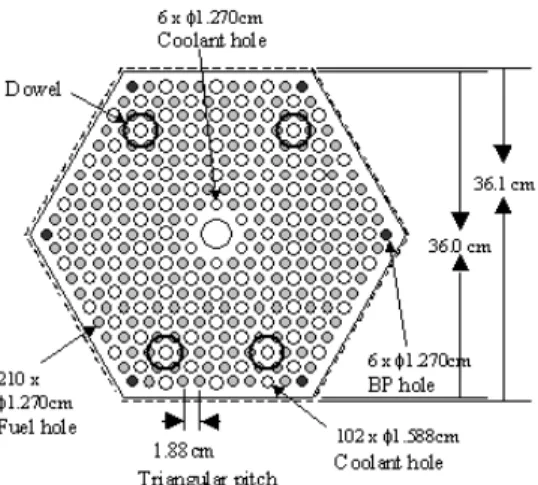
In this study, a technique for lowering the maximum fuel temperature is suggested. The PMR fuel assembly is comprised of many coolant holes and fuel channels as shown in Fig. 1. Cylindrical fuel compacts are stacked inside the fuel channel. Consequently, there should be a physical gap between the fuel compact and graphite block, which is filled with He gas in the conventional design. The heat transfer coefficient of the He gap is very poor, and this increases the fuel temperature substantially. In the proposed design measurement, the gap is filled with a liquid metal, tin (Sn) which has a very high thermal conductivity. The effects of tin in the gap on the fuel temperature and the core reactivity are quantitatively discussed and the material compatibility is experimentally studied.
Figure 1. Cross sectional view of the PMR fuel assembly.
2. Results and Discussion 2.1 Effect of tin on the fuel temperature
The effect of tin as a filler in the gap on the fuel temperature was evaluated using the CFX 5.7 code for a representative unit cell of the fuel assembly depicted in Fig. 2. All the geometry and dimensions used in the calculation were based on the standard design of the PMR fuel assembly.
Figure 2. Unit coolant channel model in the PMR assembly.
Figure 3 shows an example of the results calculated for a 125 µm thick gap. By filling the gap with tin, the temperatures at the compact surface and center decreased by about 24°C, implying that the tin filler can lower the fuel temperature and thus enhance the fuel integrity. It is worthwhile to note that the temperature decrease is larger for a larger gap size.
Figure 3. Temperature distributions in the coolant channel. 2.2 Effect of tin on the reactivity
In the typical annular core, the peak power density occurs in the boundary region between the active core and the inner reflector. In order to minimize the detrimental impact of tin on the reactivity, it is assumed that the tin filler is only applied to the fuel channels in the boundary region.
Transactions of the Korean Nuclear Society Autumn Meeting Busan, Korea, October 27-28, 2005
The impact of the tin on the core reactivity was analyzed with a Monte Carlo code, MCCARD, for the fuel assembly in Fig. 1, in which tin is used only in the outer-most fuel channels. The U-235 enrichment is10% and the TRISO packing fraction is 29 vol. %.
In Table 1, the resulting values of the effective multiplication factors for natural tin and isotope Sn-116 are compared with the reference case. The calculation indicates that there is no significant effect of tin on the core reactivity.
Table 1. The effect of tin on the core reactivity.
Filler He* Sn-nat Sn-116
Effective multiplication factor (Enrichment =10%) 1.487 1.472 1.478 * reference
2.3 Compatibility of tin with graphite
To fill the gaps with liquid tin it should be verified whether or not liquid tin is compatible with the graphite blocks and the fuel compacts which are fabricated with TRISO particles and a graphite powder. A high-temperature high-pressure test apparatus was fabricated for the compatibility study. Since fuel compacts were not available, the tests were performed only for graphite. Test samples were made of IG-11 from Toyo Tanso.
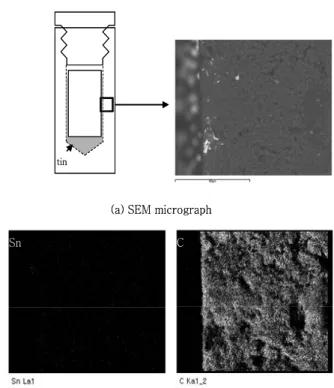
A sample shown in Figure 4 was exposed to 1250°C, 10 bar helium environment for 168 hr, and it was analyzed by SEM-EDX analysis. Figure 5 shows the SEM EDX results of the sample along with its SEM micrograph. In the SEM-EDX analysis no tin was detected in the graphite with the detection limit of 0.1 atomic %. The results showed that no macroscopic penetration of tin into the graphite and no chemical interaction occurred, suggesting that tin is compatible with graphite at the test condition.
Figure 4. Shape and dimensions of the sample used for the compatibility study.
Figure 5. SEM micrograph and SEM-EDX results for the sample exposed to 1250°C helium for 168 hr
These results are consistent with the literature [2] reporting that, by being exposed to a circulating liquid tin for 60 hr at temperatures ranging from 850 to 1000°C, graphite was found to be completely intact. Based on the test results and the literature, it can be concluded that liquid tin is compatible with graphite at the normal condition expected for the prismatic type VHTRs.
3. Conclusion
The maximum fuel temperature in the prismatic core can be lowered by filling the gap between the graphite block and the fuel compact with liquid tin. No undesirable effects of tin as the gap filler were identified from the standpoints of the compatibility of tin with graphite and the core reactivity.
4. Further studies
Liquid tin may be evaporated and released by a diffusion through the graphite even though its vapor pressure is very small at the normal condition of the VHTR. A further study should address this issue quantitatively.
REFERENCES
[1] P.E. MacDonald, et al., INEEL/EXT-03-00870, Sep. 2003. [2] R.E. Nightingale (ed.), Nuclear Graphite, Academic Press, pp. 450-452, 1962. 20.7 mm 50 m m Graphite Tin Graphite 20.7 mm 50 m m Graphite Tin Graphite
(a) SEM micrograph
(b) SEM-EDX analysis result
Sn C
tin
(a) SEM micrograph
(b) SEM-EDX analysis result
Sn C