https://doi.org/10.9721/KJFST.2021.53.2.121
121
©The Korean Society of Food Science and Technology
Structural and gelling properties of very low methoxyl pectin
produced by an alkali-treatment
Byung-Hoo Lee1, Ho-Tak Jung1, Hyun-Seok Kim2, and Sang-Ho Yoo3,*
1Department of Food Science and Biotechnology, Gachon University 2Department of Food Science and Biotechnology, Kyonggi University 3Department of Food Science & Biotechnology, Sejong University
Abstract Very low methoxyl pectin (VLMP) has different physical and rheological properties compared to high and low methoxyl pectins (HMP and LMP). In this study, we produced LMP and VLMP by alkaline de-esterification, and investigated the structural and textural properties. Apple peel pectin was kept at pH 12 using 5.0 M NaOH solution for 3 and 24 h to produce LMP and VLMP, respectively. The molecular weight was decreased due to the removal of an esterified group in the pectin backbones by the alkali treatment, and the VLMP showed a higher calcium ion sensitivity which leads to the production of the gel with increased hardness. The result clearly showed that VLMP has the potential to improve the texture and stability in food products depending on their degree of esterification, and this result can be applied as a functional ingredient in food industrial area application to enhance the current commercial pectins.
Keywords: de-esterification, very low methoxyl pectin, calcium ion sensitivity, pectin gel, alkali-treatment
Introduction
Pectins are major components in the primary cell wall of plants, and mainly consist of more than 65% of galacturonic acids (GalUA) and neutral sugars such as rhamnose, arabinose, glucose, and xylose which are glycosidic-linked in GalUA backbone (Kravtchenko et al., 1992). Pectins have been widely used as food ingredients such as stabilizers in dairy foods, emulsifiers in oily foods, thickeners in sauces, and gelling agents in jams (Laurent and Boulenguer, 2003; Leroux et al., 2003). Furthermore, applications of pectin in cosmetic, pharmaceutial and food industrial areas steadily increased as the health functionalities have been identified such as prevention of gastrointestinal diseases, skin anti-aging, and anti-tumor activity (Hayashi et al., 2000; Lebreton-Decoster et al., 2011). Pectins can be classified into two groups by the degree of their esterification (DE) values, high-methoxyl pectin (HMP) and low-methoxyl pectin (LMP) based on the degree of methyl esterified GalUA groups in the pectin molecules (El-Nawawi and Heikal, 1995). The ratio of methyl esterified GalUA is higher than 50% in HMP, while LMP contains less than the half of methyl ester groups. In general, commercial LMP is obtained by a de-esterification processing of HMP with acidic, alkaline, and enzymatic treatments (Hotchkiss et al., 2002; Ralet et al., 2001).
As HMP and LMP have different gelation properties, there are different applications in the food industry: HMP requires large
amounts of sucrose at low pH condition (<3.5) for gel production, whereas LMP can produce gels without additional sugars in the presence of divalent cations (Gadalla et al., 2016). LMP is less sensitive to pH compared to HMP during the gelling process (Hotchkiss et al., 2002), and thus the LMP production is an important process to enhance the pectin applications as a functional ingredient for low-calorie and low-sugar foods (Broomes and Badrie, 2010; Sila et al., 2009). Especially, the very low methoxyl pectin (VLMP) with lower DE values (<20) has different physical characteristics compared to typical LMPs such as the enhanced properties of gel formation by calcium ion (Ström et al., 2007) or difference in released aroma constituents (Kim et al., 2016).
To produce VLMP, previous researchers widely used the pectin methylesterase (PME) to produce LMPs (Kim et al., 2014). However, some pectin structures have been destroyed depending on the type of PME or it was difficult to commercially producing by PME treatment because they mainly used directly refined PME or using reagent grade PME (Hua et al., 2018). Therefore, we attempted an alkaline de-esterification that can be relatively decreased structural damage and increased the possibility of industrial use. Furthermore, as the alkali processing time was adjusted to create VLMP, we analyzed physical properties and identified the food applicability of VLMP as a food stabilizer, which is differentiated from the existing commercial LMPs.
Materials and Methods
Materials
Commercial HM and LM pectins were purchased from Sigma-Aldrich Co. (St. Louis, MO, USA) and CP Kelco (Chicago, IL, USA), respectively. The pectin from apple peel waste was extracted based on the previous research (Cho et al., 2019), and *Corresponding author: Sang-Ho Yoo, Department of Food Science
& Biotechnology and Carbohydrate Bioproduct Research Center, Sejong University, Seoul 05006, Republic of Korea
Tel: +82 2 3408 3221 E-mail: [email protected]
Received December 17, 2020; revised February 8, 2021; accepted February 8, 2021
applied as a source of raw pectins for de-esterification in the current research. The pectin sample was dialyzed against distilled water for 24 h using a dialysis membrane (MWCO: 3,500 Spectrum Laboratories Inc., Rancho Dominguez, CA, USA). All other chemical reagents used in the experiments were analytical grade.
Alkaline de-esterification using sodium hydroxide
Pectin solutions (1.0%, w/v) were adjusted to alkaline conditions (pH 11, 12 and 13) using 5.0 M sodium hydroxide (NaOH). The pH changes in pectin solutions were measured every 3 h, and adjusted by NaOH solution with stirring. After 24 h, the pH level of pectin solutions was decreased to 5.5 using 0.1 N hydrochloric acid solution (HCl) for finishing de-esterficiation process by alkaline treatment. Then, three times the volume of isopropyl alcohol (95%, v/v) was added to precipitate the de-esterified pectin, and the precipitation was dialyzed. Dialyzed pectins solutions were lyophilized for further experiments (Hotchkiss et al., 2002).
Determination of degree of estirification value
For determination of GalUA, 0.4 mL of the pectin solution (0.01%, w/v), 40 μL of 4 M sulfamate solution, and 2.5 mL of 75 mM sodium tetraborate in concentrated sulfuric acid were mixed. Then, the solution was heated for 15 min and immediately cool downed to room temperature. Finally, 80 μL of m-hydroxydiphenyl dissolved in 0.5% NaOH solution (0.15%, w/v) was added into the mixture, and the change of absorbance was read at 520 nm within 5 min (Filisetti-Cozzi and Carpita, 1991). Potassium hydroxide solution (1.0 N, 25 mL) was added to the prepared pectin solutions (0.1%, w/v, 25 mL) to measure the amount of released methanol content. Alcohol oxidase (1 unit/mL, Sigma-Aldrich Chemical Co.) was added to 1 mL of prepared mixture and incubated at 25oC for 15 min. Then, 2,4-pectanedione in 2.0 M ammonium acetate and 0.05 M acetic acid reagent (2 mL) was added, followed by incubation at 60oC for 15 min. The absorbance of reactants was measured at 412 nm, and the DE value was calculated by the amount of methanol content (%, w/v) was divided by the sum of GalUA (%, w/v) and methanol content (%, w/v) (Klavons and Bennett, 1986).
DE value (%)= ×100
Measurement of molecular weight distribution after the de-esterification
To determine the molecular weight of de-esterified pectin samples, the high-performance size-exclusion chromatography connected with multiple-angle laser light scattering (MALS) and refractive index (RI) detectors (Wyatt Technology Corp., Santa Barbara, CA, USA) were used. Individual pectin samples were dissolved in 50 mM sodium nitrate (0.2%, w/v), and the filtered-pectin sample (100 μL) was injected into Shodex OH-806 and 804 HQ coupled columns (Showa Denko, Tokyo, Japan). For the mobile phase, a 50 mM sodium nitrate solution was used at 50oC with a flow rate of 0.4 mL/min. The weight-average molecular
weight (Mw) of de-esterified pectins was calculated using ASTRATM software (Version 5.3.4, Wyatt Technology Corp.) with Zimm plots (dn/dc value: 0.146) (Fishman et al., 2006).
Viscosity measurement of alkali-modified pectin solution The prepared pectin solutions (0.5 mL, 1%, w/v) were placed on the center of a Peltier plate of a dynamic rheometer (DHR1, TA Instruments, New Castle, DE), and the steady shear was measured by a plate and plate geometry system (4 cm diameter and 500 μm) over a shear rate of 0.1 to 100 s−1 at 25oC. The consistency index (K), flow behavior index (n), and apparent viscosity (at 100 s−1) were calculated using the Power-Law model (Doi, 1981).
Calcium ion sensitivity analysis of de-esterified pectins To determine the calcium ion sensitivity of de-esterified pectin, the previous method was slightly modified (Gerrish, 1998). Pectin solutions (0.2 g/10 mL) were heated in the water bath at 70oC until completely dissolved. Then, the pH was adjusted to 4.0 and chilled isopropyl alcohol (IPA; 80%, v/v, 20 mL) was added. The precipitant was collected by centrifugation at 8000×g for 30 min at 10oC and it was washed twice with 60% IPA. The washed tubes were then dried under a vacuum and weighed. The weight of the pectin precipitant was divided by the initial weight of pectin added to the tube, and this value was designated A. CaCl2 (30 mM) in 8% IPA (10 mL) was added to the second of the duplicate tubes. These tubes were incubated for 24 h at 25oC with occasional vortexing. The produced gel was collected and weighed in same way as the above method (designated B). The calcium ion sensitivity was determined by dividing B value by A value.
Analysis of pectin gel properties
Sucrose was added into the pectin solution (final conc.: 15%, w/ v), and then calcium phosphate (0.1%, w/v) and glucono-δ-lactone (GDL; 0.45%, w/v) were added into the solution after complete dissolution of the pectin gel production. To measure the hardness of the pectin gels, they were kept at room temperature before the hardness analysis. A hardness analysis was performed using TA-XT2 Texture Analyzer (Stable Micro systems, Surrey, UK). A sample of pectin gel was laid on a plate and was compressed at 1 mm/s with a 50 mm diameter cylinder aluminum probe and until compression was 40% of the initial height of samples.
Statistical analysis
All experiment data were statistically analyzed using SAS software system (version 9.4, SAS Institute, Cary, NC). The significant differences (p<0.05) between means were determined using analysis of variance (ANOVA) with Tukey tests.
Results and Discussion
The change of degree of esterification by alkaline treatment The DE values of the apple pectin with de-esterification at pH 12 were calculated after 3 and 24 h (Table 1). The DE values of 3 h- and 24 h-treated apple pectins were showed 23.8% and 17.3%, respectively. The result confirmed that the pectin structure Methanol ( )%
GalUA ( ) Methanol %% + ( )
---can be changed from HMP to LMP by alkali treatment, and VLMP was produced at 24 h that has the longest alkali reaction time with the lowest DE value. Furthermore, VLMP with much lower DE value than commercial LM pectin can be effectively produced by the alkali treatment. A previous study described that the VLMP has different physiochemical characteristics such as calcium ion sensitivity and gelation properties compared to HMP and LMP (Kim et al., 2016). Thus, it is expected that the VLMP from apple in this study is worth proving with different physical properties compared to commercial pectins.
Molecular weights and fluid properties of alkali-treated pectins
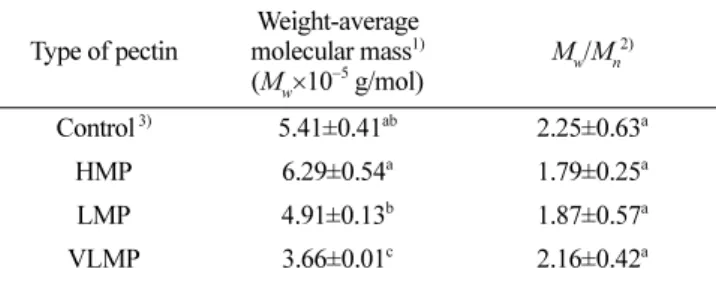
The molecular averages of commercial pectin, apple-peel pectin which is classified as a HMP, and alkaline modified LMP and VLMP were shown with polydispersity in Table 2. The apple-peel HMP extracted by citric acid has a higher molecular weight
compared to commercial pectin (6.29×10⁻⁵ g/mol). On the other
hand, two alkali-treated LMP and VLMP (Mw 4.91×10⁻⁵ g/mol
and 3.66×10⁻⁵ g/mol, respectively) had lower Mw than HMP. These results can explain that the homogalacturonan backbone α-(1,4)-glycosidic linkage was degraded by β-elimination with alkali de-esterification of pectins, and this property lead to decrease of molecular weight (Selvendran et al., 1985). Polydispersity index (=Mw/Mn) refers molecular weight distribution of polymers, thus smaller polydispersity index polymer has narrow molecular weight distribution (Peebles, 1971). As shown in Table 2, the polydispersity index of all pectin samples showed no significant difference after alkali de-esterification (1.79-2.25). This result clearly demonstrated that the depolymerization of pectin structures that were caused by alkali treatment took place in both the low and high molecular areas (Yapo et al., 2007).
Table 3 shows the fluid properties of pectins that have different DE values using Power-Law model parameters, and the calculation of the apparent viscosities was performed at the shear rate of 100 s−1 in the same way. The higher molecular weight pectin has significantly higher flow consistency and apparent viscosity. The flow consistency of HMP was 18.77 mPa · s and the apparent viscosity was 12.81 mPa · s which has higher values compared to commercial pectin as a control. On the other hand, the flow consistency and the apparent viscosity of the alkali-treated pectins with low DE values were decreased which can be explained by their molecular weight and viscosity (Kar and Arslan, 1999). As the alkali exposure time increased, the β-elimination of pectin structures occured more frequently. Thus, the hydrophobic interaction of the pectin was weakened in aqueous pectin solutions (Yoo et al., 2012). In general, the β-elimination of pectin is an ordinary phenomenon during the chemical de-esterification such as acid and alkali treatments (Renard and Thibault, 1996). Therefore, the LMPs in this study also could not avoid a reduction in molecular weight and viscosity. Nevertheless, LMPs have higher calcium ion sensitivity than HMP and flexible gel producing condition (Hotchkiss et al., 2002). Thus, the depolymerized LMPs still can be applied to other applications compared to HMPs. In the flow behavior index (n) values, all pectin samples exhibited ranging from 0.92 to 0.99. Fluids with a flow behavior value of less than 1.0 is called a pseudoplastic fluid (0.4≤n≤1.0), which decreased in shear stress as the shear rate increase (Boger, 1977).
Table 3. Power-Law-model1) parameters and apparent viscosities of pectin at differential degree of esterification
K2) (mPa · sn) n r2 η (mPa · s)
Control3) 12.37±0.00b 0.97±0.02ab 1.00 10.66±0.36b
HMP 18.77±0.00a 0.92±0.00b 1.00 12.81±0.20a
LMP 4.87±0.00c 0.99±0.01a 1.00 4.58±0.04c
VLMP 4.27±0.00c 0.98±0.01a 1.00 3.91±0.11d
1)Means of triplicate, Values with different letters of a given pectins were significantly different from each other (p<0.05) based on ANOVA and
Tukey’s tests.
2)K, flow consistency index; n, flow behavior index; η, apparent viscosity at 25oC and 100 s−1.
3)Control, commercial high methoxyl pectin from apple (Sigma-Aldrich); HMP, high methoxyl pectin; LMP, low methoxyl pectin; and VLMP, very
low methoxyl pectin.
Table 1. The degree of esterification (DE) valuesof alkali-treated apple pectin according to the treatment time
0 h 3 h 24 h
DE values 58.6±1.1a1) 23.8±3.2b 17.3±6.5bc
1)Mean values of duplicate measurements; values in row with different
letters in superscripts for each petin sample are significantly different (p<0.05)
Table 2. Average molecular mass of alkaline modified pectin by HPSEC-MALS-RI analysis Type of pectin Weight-average molecular mass1) (Mw×10−5 g/mol) Mw/Mn2) Control 3) 5.41±0.41ab 2.25±0.63a HMP 6.29±0.54a 1.79±0.25a LMP 4.91±0.13b 1.87±0.57a VLMP 3.66±0.01c 2.16±0.42a
1)Values with different letters in each column were significantly
different (p<0.05) based on ANOVA and Tukey’s tests
2)Polydispersity index
3)Control. commercial high methoxyl pectin from apple
(Sigma-Aldrich); HMP, high methoxyl pectin; LMP. low methoxyl pectin; and VLMP, very low methoxyl pectin
Calcium ion sensitivity of alkali de-esterified pectins The calcium ion sensitivity is a relative measurement for the gel production whether or not it can be produced without the addition of sucrose by blocking of de-esterified GalUA groups in pectin (Joye and Luzio, 2000). Pectins with higher calcium ion sensitivity showed more gelation property because of the calcium ion and free carboxyl groups in the pectins’ structure by ionic interactions of polyvalent cations (Rinaudo, 1996). Thus, the pectin with the higher calcium ion sensitivity can be applied in dairy drinks, low-sugar jams or jellies (Joye and Luzio, 2000). Figure 1 shows the calcium ion sensitivity of the pectins depending on their DE values. As the DE value of alkali-treated pectin decreased, it clearly had higher calcium ion sensitivity. Especially, the VLMP had the highest calcium ion sensitivity (8.66) among other pectin samples. The significance of these results suggested that the VLMP has a potential to apply to dairy food products containing calcium as a gelling agent or a stabilizer.
Characteristic effects of alkaline modified pectins on gel texture
The texture properties of pectin gel such as hardness and syneresis were greatly influenced by GDL concentration in the presence of calcium ions. Therefore, all the differential DE values
of pectin gel samples were produced under the same GDL conditions based on a previous study (Yoo et al., 2009). Figure 2 showed the shape of pectin gels with different DE values made with sucrose, calcium ion, and GDL. LMP and VLMP were formed in the shape of hard gels, however the HMP showed only high viscosity fluid with no formatting gel due to their different gelling mechanism compared to LMP. It is expected that a higher amount of sucrose is required for the gelation of HMP (Oakenfull, 1991). However, a moderate amount (about 10-30%) of sucrose can increase the stability of LMP during gelling production as additional hydroxyl groups from sucrose promote the structuralization of cross-linking junction zones (egg-box model) with a hydrogen bond (Fu and Rao, 2001). But excessive amounts of sucrose is unnecessary in the formation of gel in LMPs which may lead to a decrease in the gel quality (Padival et al., 1979). Therefore, further studies were able to accurately compare gel characteristics depending on the DE value by controlling the conditions of gel production for the LMPs.
When the pectin gels were made of the same constituent, the lower DE values of the pectins produced harder gels (Fig. 3). The hardness of VLMP was 0.81 N, which was almost two times higher than LMP (0.39 N). Also, the hardness and calcium ion sensitivity of individual pectins clearly showed the proportional relationship (Fig. 1), which is corresponding to previous research (Kim et al., 2008). However, the hardness of alkali treat LMPs was lower than the commercial LMP as a control (3.08 N). The reason may be explained by a standardized process of commercial pectin production to manufacture highly purified extracted pectins with stabilizers (e.g., sucrose) in food industries (Rolin, 2002).
Conclusions
In this research, LMP and VLMP were produced from HMP by the alkali treatment via the de-esterification process, and the LMPs have the potential to improve the texture and stability in food Fig. 3. The gel hardness of low methoxyl pectins produced by alkali treatment from apple peel. LMP control, low methoxyl commercial pectin; LMP, low methoxyl pectin; and VLMP, very low methoxyl pectin. Values with different letters in each graph were significantly different (p<0.05) based on ANOVA and Tukey’s tests. Fig. 1. Calcium ion sensitivity of differential DE value pectins.
Means of duplicate. Values with different letters of a given pectins were significantly different from each other (p<0.05) based on ANOVA and Tukey’s tests. HMP control, high methoxyl commercial pectin; LMP control, low methoxyl commercial pectin; HMP, high methoxyl pectin; LMP, low methoxyl pectin; and VLMP, very low methoxyl pectin.
Fig. 2. Shapes of pectin gel made under the same condition. (A) high methoxyl pectin; (B) low methoxyl pectin; and (C) very low methoxyl pectin.
products depending on their DE values. Thus, DE value-controlled pectins can be applied as a functional ingredient in food industrial areas (e.g., acidic drinks and yogurt products) to enhance the rheological properties such as viscosity or thickening agents as compared to commercial pectins.
Acknowledgment
This research was supported by High Value-added Food Technology Development Program (# 315063-3) of IPET (Korea Institute of Planning & Evaluation for Technology in Food, Agricultural, Forestry and Fisheries) in Ministry for Food, Agriculture, Forestry and Fisheries (MAFRA), Republic of Korea.
References
Boger DV. Demonstration of upper and lower Newtonian fluid behaviour in a pseudoplastic fluid. Nature. 265: 126 (1977) Broomes J, Badrie N. Effects of low-methoxyl pectin on
physico-chemical and sensory properties of reduced-calorie sorrel/roselle (Hibiscus sabdariffa L.) jams. Open Food Sci. J. 4: 48-55 (2010) Cho EH, Jung HT, Lee BH, Kim HS, Rhee JK, Yoo SH. Green
pro-cess development for apple-peel pectin production by organic acid extraction. Carbohydr. Polym. 204: 97-103 (2019)
Doi M. Explanation for the 3.4 power law of viscosity of polymeric liquids on the basis of the tube model. J. Polym. Sci., Polym. Lett. Ed. 19: 265-273 (1981)
El-Nawawi S, Heikal Y. Factors affecting the production of low-ester pectin gels. Carbohydr. Polym. 26: 189-193 (1995)
Filisetti-Cozzi TM, Carpita NC. Measurement of uronic acids without interference from neutral sugars. Anal. Biochem. 197: 157-162 (1991)
Fishman ML, Chau HK, Hoagland PD, Hotchkiss AT. Microwave-assisted extraction of lime pectin. Food Hydrocoll. 20: 1170-1177 (2006)
Fu JT, Rao MA. Rheology and structure development during gelation of low-methoxyl pectin gels: the effect of sucrose. Food Hydro-coll. 15: 93-100 (2001)
Gadalla HH, El-Gibaly I, Soliman GM, Mohamed FA, El-Sayed AM. Amidated pectin/sodium carboxymethylcellulose microspheres as a new carrier for colonic drug targeting: Development and opti-mization by factorial design. Carbohydr. Polym. 153: 526-534 (2016)
Gerrish TC. Pectin for stabilizing proteins. WO2000027888A1 (1998).
Hayashi A, Gillen AC, Lott JR. Effects of daily oral administration of quercetin chalcone and modified citrus pectin on implanted colon-25 tumor growth in Balb-c mice. Altern. Med. Rev. 5: 546-552 (2000)
Hotchkiss AT, Savary BJ, Cameron RG, Chau HK, Brouillette J, Luzio GA, Fishman ML. Enzymatic modification of pectin to increase its calcium sensitivity while preserving its molecular weight. J. Agric. Food Chem. 50: 2931-2937 (2002)
Hua X, Yang H, Din P, Chi K, Yang R. Rheological properties of deesterified pectin with different methoxylation degree. Food Biosci. 23: 91-99 (2018)
Joye D, Luzio G. Process for selective extraction of pectins from plant material by differential pH. Carbohydr. Polym. 43: 337-342 (2000)
Kar F, Arslan N. Effect of temperature and concentration on viscos-ity of orange peel pectin solutions and intrinsic viscosviscos-ity–molecu- viscosity–molecu-lar weight relationship. Carbohydr. Polym. 40: 277-284 (1999) Kim MJ, Ju HK, Kim Y, Yoo SH, Kim YS. Effects of amidation
and/or methylesterification of pectin on aroma release at different calcium concentration. Food Hydrocoll. 52: 343-349 (2016) Kim Y, Kim YS, Yoo SH, Kim KO. Molecular structural differences
between low methoxy pectins induced by pectin methyl esterase II: Effects on texture, release and perception of aroma in gels of similar modulus of elasticity. Food Chem. 145: 950-955 (2014) Kim Y, Yoo YH, Kim KO, Park JB, Yoo SH. Textural properties of
gelling system of low-methoxy pectins produced by demethoxyl-ating reaction of pectin methyl esterase. J. Food Sci. 73: 367-372 (2008)
Klavons JA, Bennett RD. Determination of methanol using alcohol oxidase and its application to methyl ester content of pectins. J. Agric. Food Chem. 34: 597-599 (1986)
Kravtchenko T, Voragen A, Pilnik W. Analytical comparison of three industrial pectin preparations. Carbohydr. Polym. 18: 17-25 (1992)
Laurent M, Boulenguer P. Stabilization mechanism of acid dairy drinks (ADD) induced by pectin. Food Hydrocoll. 17: 445-454 (2003)
Lebreton-Decoster C, Rousselle P, Laperdrix C, Lubrano C, Robin JR, Coulomb B. Oligogalacturonides improve tissue organization of in vitro reconstructed skin. Int. J. Cosmet. Sci. 33: 455-461 (2011)
Leroux J, Langendorff V, Schick G, Vaishnav V, Mazoyer J. Emul-sion stabilizing properties of pectin. Food Hydrocoll. 17: 455-462 (2003)
Oakenfull DG. The chemistry of high-methoxyl pectins. pp. 87-108. In: The chemistry and technology of pectin. Walter RH (ed). Academic Press, Cambridge, MA, USA (1991)
Padival RA, Ranganna S, Manjrekar S. Mechanism of gel formation by low methoxyl pectins. Int. J. Food Sci. 14: 277-287 (1979) Peebles LH. Molecular Weight Distributions in Polymers (Polymer
reviews). Interscience Publishers, Inc., Hoboken, NJ, USA (1971) Ralet MC, Dronnet V, Buchholt HC, Thibault JF. Enzymatically and
chemically de-esterified lime pectins: characterisation, polyelectro-lyte behaviour and calcium binding properties. Carbohydr. Res. 336: 117-125 (2001)
Renard CM, Thibault JF. Degradation of pectins in alkaline condi-tions: kinetics of demethylation. Carbohydr. Res. 286: 139-150 (1996)
Rinaudo M. Physicochemical properties of pectins in solution and gel states. Prog. Biotechnol. 14: 21-33 (1996)
Rolin C. Commercial pectin preparations. pp. 222-241. In: Pectins and their manipulation. Seymour GB & Knox JP (ed). Wiley-Blackwell, Hoboken, NJ, USA (2002)
Selvendran R, Stevens B, O'neill M. Developments in the isolation and analysis of cell walls from edible plants. pp. 39-78. In: Bio-chemistry of plant cell walls. Brett C & Hillman J (ed). Cam-bridge University Press, London, UK (1985)
Sila D, Van Buggenhout S, Duvetter T, Fraeye I, De Roeck A, Van Loey A, Hendrickx M. Pectins in processed fruits and vegetables: Part II-Structure-function relationships. Compr. Rev. Food Sci. Food Saf. 8: 86-104 (2009)
Ström A, Ribelles P, Lundin L, Norton I, Morris ER, Williams MA. Influence of pectin fine structure on the mechanical properties of calcium-pectin and acid-pectin gels. Biomacromolecules 8: 2668-2674 (2007)
Yapo BM, Lerouge P, Thibault JF, Ralet MC. Pectins from citrus peel cell walls contain homogalacturonans homogenous with respect to molar mass, rhamnogalacturonan I and rhamnogalac-turonan II. Carbohydr. Polym. 69: 426-435 (2007)
Yoo SH, Lee BH, Lee H, Lee S, Bae IY, Lee HG, Fishman ML, Chau HK, Savary BJ, Hotchkiss AT. Structural characteristics of pumpkin pectin extracted by microwave heating. J. Food Sci. 77: C1169-C1173 (2012)
Yoo YH, Lee S, Kim Y, Kim KO, Kim YS, Yoo SH. Functional characterization of the gels prepared with pectin methylesterase (PME)-treated pectins. Int. J. Biol. Macromol. 45: 226-230 (2009)