Weight Change Is a Characteristic
Non-Motor Symptom in Drug-Naïve Parkinson’s
Disease Patients with Non-Tremor Dominant
Subtype: A Nation-Wide Observational Study
Jun Kyu Mun
1,2, Jinyoung Youn
1,2*
, Jin Whan Cho
1,2, Eung-Seok Oh
3, Ji Sun Kim
4,
Suyeon Park
5, Wooyoung Jang
6, Jin Se Park
7, Seong-Beom Koh
8, Jae Hyeok Lee
9, Hee
Kyung Park
10, Han-Joon Kim
11, Beom S. Jeon
11, Hae-Won Shin
12, Sun-Ah Choi
13, Sang
Jin Kim
14, Seong-Min Choi
15, Ji-Yun Park
16, Ji Young Kim
17, Sun Ju Chung
18, Chong
Sik Lee
18, Tae-Beom Ahn
19, Won Chan Kim
20, Hyun Sook Kim
20, Sang Myung Cheon
21,
Jae Woo Kim
21, Hee-Tae Kim
22, Jee-Young Lee
23, Ji Sun Kim
24, Eun-Joo Kim
25,
Jong-Min Kim
26, Kwang Soo Lee
27, Joong-Seok Kim
27, Min-Jeong Kim
28, Jong Sam Baik
29,
Ki-Jong Park
30, Hee Jin Kim
31, Mee Young Park
32, Ji Hoon Kang
33, Sook Kun Song
33, Yong
Duk Kim
34, Ji Young Yun
35, Ho-Won Lee
36, In-Uk Song
37, Young H. Sohn
38, Phil Hyu Lee
38,
Jeong-Ho Park
39, Hyung Geun Oh
40, Kun Woo Park
41, Do-Young Kwon
421 Department of Neurology, Samsung Medical Center, Sungkyunkwan University School of Medicine, Seoul, Republic of Korea, 2 Neuroscience Center, Samsung Medical Center, Seoul, Republic of Korea,
3 Department of Neurology, Chungnam National University Hospital, Chungnam National University School of Medicine, Daejeon, Republic of Korea, 4 Department of Neurology, Soonchunhyang University Seoul Hospital, Soonchunhyang University College of Medicine, Seoul, Republic of Korea, 5 Department of Biostatistics, Soonchunhyang University Seoul Hospital, Soonchunhyang University College of Medicine, Seoul, Republic of Korea, 6 Department of Neurology, Gangneung Asan Hospital, College of Medicine, University of Ulsan, Gangneung, Republic of Korea, 7 Department of Neurology, Haeundae Paik Hospital, Inje University College of Medicine, Busan, Republic of Korea, 8 Department of Neurology, Korea University Guro Hospital, Korea University College of Medicine, Seoul, Republic of Korea, 9 Department of Neurology, Pusan National University Yangsan Hospital, Yangsan, Republic of Korea, 10 Department of Neurology, College of Medicine, Inje University, Ilsan-Paik Hospital, Ilsan, Republic of Korea, 11 Department of Neurology, College of Medicine, Seoul National University, Seoul, Republic of Korea, 12 Department of Neurology, Chung-Ang University College of Medicine, Seoul, Republic of Korea, 13 Department of Neurology, National Health, Insurance Corporation Ilsan Hospital, Ilsan, Republic of Korea, 14 Department of Neurology, Inje University, Busan Paik Hospital, Busan, Republic of Korea, 15 Department of Neurology, Chonnam National University Medical School, Gwangju, Republic of Korea, 16 Department of Neurology, Presbyterian Medical Center, Jeonju, Republic of Korea, 17 Department of Neurology, College of Medicine, Inje University Seoul Paik Hospital, Seoul, Republic of Korea, 18 Department of Neurology, College of Medicine, University of Ulsan, Seoul, Republic of Korea, 19 Department of Neurology, Kyung Hee University College of Medicine, Seoul, Republic of Korea, 20 Department of Neurology, CHA University College of Medicine, Bundang, Republic of Korea, 21 Department of Neurology, Dong-A University College of Medicine, Busan, Republic of Korea, 22 Department of Neurology, College of Medicine, Hanyang University, Seoul, Republic of Korea, 23 Department of Neurology, Seoul National University Boramae Hospital, Seoul, Republic of Korea, 24 Department of Neurology, College of Medicine, Chungbuk National University Hospital, Jeonju, Republic of Korea, 25 Department of Neurology, Pusan National University School of Medicine and Medical Research Institute, Busan, Republic of Korea, 26 Department of Neurology, Seoul National University Bundang Hospital, Bundang, Republic of Korea, 27 Department of Neurology, College of Medicine, the Catholic University of Korea, Seoul, Republic of Korea, 28 Department of Neurology, Kosin University College of Medicine, Busan, Republic of Korea, 29 Department of Neurology, College of Medicine, Inje University, Sanggye Paik Hospital, Seoul, Republic of Korea, 30 Department of Neurology, Gyeongsang National University School of Medicine, Jinju, Republic of Korea, 31 Department of Neurology, Konkuk University School of Medicine, Seoul, Republic of Korea, 32 Department of Neurology, Yeungnam University College of Medicine, Daegu, Republic of Korea, 33 Department of Neurology, Jeju National University Hospital, Jeju, Republic of Korea, 34 Department of Neurology, Konyang University Hospital, Daejeon, Republic of Korea, 35 Department of Neurology, Ewha Womans University Mokdong Hospital, Seoul, Republic of Korea, 36 Department of Neurology, School of Medicine, Kyungpook National University, Daegu,
a11111
OPEN ACCESS
Citation: Mun JK, Youn J, Cho JW, Oh E-S, Kim JS,
Park S, et al. (2016) Weight Change Is a Characteristic Non-Motor Symptom in Drug-Naïve Parkinson’s Disease Patients with Non-Tremor Dominant Subtype: A Nation-Wide Observational Study. PLoS ONE 11(9): e0162254. doi:10.1371/ journal.pone.0162254
Editor: Mathias Toft, Oslo Universitetssykehus,
NORWAY
Received: February 25, 2016 Accepted: August 21, 2016 Published: September 13, 2016
Copyright: © 2016 Mun et al. This is an open access
article distributed under the terms of theCreative Commons Attribution License, which permits unrestricted use, distribution, and reproduction in any medium, provided the original author and source are credited.
Data Availability Statement: All relevant data are
within the paper. Additional data are available upon request, as these data are regulated by the IRBs in each hospital involved in the study. To obtain access to these data, please contact the Korean Movement Disorders Society ([email protected]).
Funding: The authors received no specific funding
for this work.
Competing Interests: The authors have declared
Republic of Korea, 37 Department of Neurology, College of Medicine, the Catholic University of Korea, Incheon, Republic of Korea, 38 Department of Neurology, Yonsei University, College of Medicine, Seoul, Republic of Korea, 39 Department of Neurology, Soonchunhyang University Bucheon Hospital,
Soonchunhyang University College of Medicine, Bucheon, Republic of Korea, 40 Department of Neurology, Soonchunhyang University Cheonan Hospital, Soonchunhyang University College of Medicine, Cheonan, Republic of Korea, 41 Department of Neurology, Korea University Anam Hospital, Korea University College of Medicine, Seoul, Republic of Korea, 42 Department of Neurology, Korea University Ansan Hospital, Korea University College of Medicine, Ansan, Republic of Korea
Abstract
Despite the clinical impact of non-motor symptoms (NMS) in Parkinson’s disease (PD), the
characteristic NMS in relation to the motor subtypes of PD is not well elucidated. In this
study, we enrolled drug-na
ï
ve PD patients and compared NMS between PD subtypes. We
enrolled 136 drug-na
ï
ve, early PD patients and 50 normal controls. All the enrolled PD
patients were divided into tremor dominant (TD) and non-tremor dominant (NTD) subtypes.
The Non-Motor Symptom Scale and scales for each NMS were completed. We compared
NMS and the relationship of NMS with quality of life between normal controls and PD
patients, and between the PD subtypes. Comparing with normal controls, PD patients
com-plained of more NMS, especially mood/cognitive symptoms, gastrointestinal symptoms,
unexplained pain, weight change, and change in taste or smell. Between the PD subtypes,
the NTD subtype showed higher total NMS scale score and sub-score about weight change.
Weight change was the characteristic NMS related to NTD subtype even after controlled
other variables with logistic regression analysis. Even from the early stage, PD patients
suf-fer from various NMS regardless of dopaminergic medication. Among the various NMS,
weight change is the characteristic NMS associated with NTD subtype in PD patients.
Introduction
From early stage, Parkinson’s disease (PD) patients suffer from various non-motor symptoms
(NMS) as well as classic motor symptoms, and NMS can impact the quality of life even more
than motor symptoms as the disease progresses [
1
–
3
]. Usually subtypes of PD are determined
by main motor symptoms [
4
], and it is well-known that PD patients with non-tremor
domi-nant (NTD) subtype show more severe motor symptoms and aggressive disease progression
than those with tremor-dominant (TD) subtype [
5
,
6
]. Similarly, NMS could be regarded to be
more severe in PD patients with NTD subtype than those with TD subtype. Although previous
studies already reported the difference in some NMS among PD subtypes, but these previous
studies focused only few specific NMS among PD subtypes, not the whole spectrum of
non-motor involvement [
7
–
10
]. Recently, there was only one study with systematic assessment of
whole spectrum of NMS among PD subtypes, but this study investigated only the number of
involved NMS among the PD subtypes, not the severity of NMS [
11
].
Furthermore, most of previous studies enrolled PD patients irrespective of PD medication,
and failed to eliminate the confounding effects from medications [
7
–
11
]. Considering that
dopaminergic medications have various effects on NMS in PD patients [
12
], confounding
effects from medications should be considered during the investigation of motor or NMS in PD
patients. Only few studies enrolled drug-naïve PD patients, but these studies mainly focused on
premotor NMS, not the whole pattern of non-motor involvement in relation to the PD subtypes
[
13
,
14
].
In this study, to elucidate the characteristic non-motor features of each PD subtype, we
investigated the whole pattern of NMS in drug-naïve PD patients, and compared between
subtypes.
Methods
Subjects
This study was approved by the Institutional Review Board of each involved hospital, and all
enrolled subjects provided written informed consent. We conducted nation-wide observational
study to compare NMS between PD subtypes in drug-naïve PD patients.
We enrolled drug-naïve, early PD patients (disease duration of less than 4 years) and
age-and sex-matched normal controls at movement disorders clinics in 40 community-based
hos-pitals in Korea from May 2012 to December 2012. All PD patients were diagnosed with the
United Kingdom Parkinson’s Disease Society Brain Bank criteria [
15
], and divided into two
subgroups based on the PD subtype for the main motor symptoms: tremor dominant (TD)
subtype and non-tremor dominant (NTD) subtype (indeterminate subtype and postural
insta-bility and gait disturbance subtype) [
4
].
Subjects with structural brain lesions, other known neurodegenerative disease, cognitive
impairment (mini-mental state examination score of < 20 or fulfillment of DSM-IV criteria for
dementia), psychiatric disorders needing medication, malignancy, or joint problems
mimick-ing parkinsonism were excluded.
Clinical assessment
Demographic and clinical data, including scales, were collected by interview and examination
with movement disorder specialists at each hospital. Motor symptoms were evaluated with the
Unified Parkinson Disease Rating Scale (UPDRS) part 3 and the Hoehn and Yahr (HY) scale
[
16
]. Whole pattern of non-motor involvements were assessed by the Non-Motor Symptom
Assessment Scale (NMSS) for Parkinson’s disease [
17
], and each NMS was also assessed with
symptom-specific scales, including the Korean version of the Montreal Cognitive Assessment
(MoCA-K) and Frontal Assessment Battery for cognitive evaluation [
18
,
19
]; the
Neuropsychi-atric Inventory, Beck Depression Inventory (BDI) and Beck’s Anxiety Inventory (BAI) for
neu-ropsychiatric assessment [
20
–
22
]; and the PD sleep scale (PDSS) and Parkinson Fatigue Scale
(PFS) for sleep and fatigue evaluation [
23
,
24
].
Statistical analysis
All data were presented as mean and standard deviation. Demographic and clinical data were
compared between groups (normal controls and PD patients; TD and non-TD subtypes) by
using independent t-test or Mann-Whitney U-test for continuous variables, and Pearson’s χ
2or Fisher’s exact test for categorical variables. To investigate characteristic NMS related to PD
subtype, multivariate analysis was carried out with logistic regression model with demographic
and clinical variables including motor and NMS. The results of logistic regression were
pre-sented using 95% confidence intervals (CIs). p-values < 0.05 were considered statistically
sig-nificant. Statistical analyses were performed with a commercially available software package
(PASW version 18.0; SPSS Inc., Chicago, IL, USA).
Results
Comparison of non-motor symptoms between PD patients and normal
controls
We enrolled 136 drug-naïve patients with early stage PD and 50 normal control subjects.
Demographic and clinical data of all subjects were shown in
Table 1
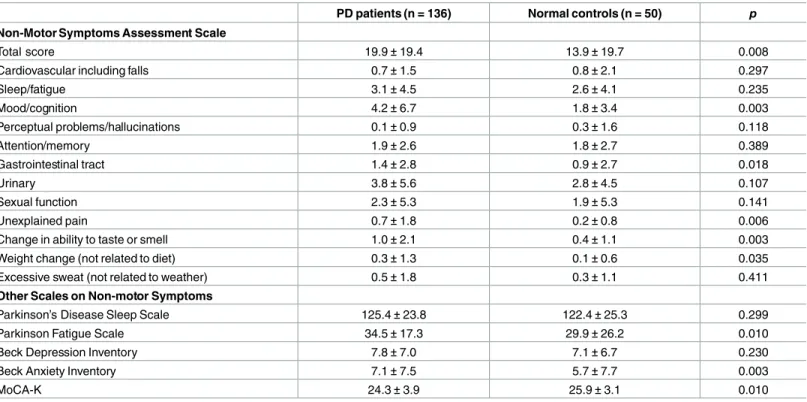
. Compared with normal
controls, PD patients reported higher total NMSS score, and subscores of mood/cognition,
gas-trointestinal tract, unexplained pain, change in ability to taste or smell, and weight change
(
Table 2
). Similarly, PD patients also complained of more mood/cognitive symptoms (higher
scores on the BAI, and lower MoCA-K scores) than normal controls.
Comparison of non-motor symptoms between PD subtypes
Of 136 enrolled PD patients, 68 subjects were PD patients with the TD subtype and 68 were
those with the NTD subtype. Although the demographic and clinical data did not differ
signifi-cantly between two PD subtypes, PD patients with NTD subtype patients showed higher total
NMSS score and the only subscore of weight change domain comparing with those with TD
subtype (
Table 3
). In addition, there were no significant differences in PDSS, PFS, BDI, BAI,
MoCA-K score.
Characteristic non-motor symptom associated with PD subtype
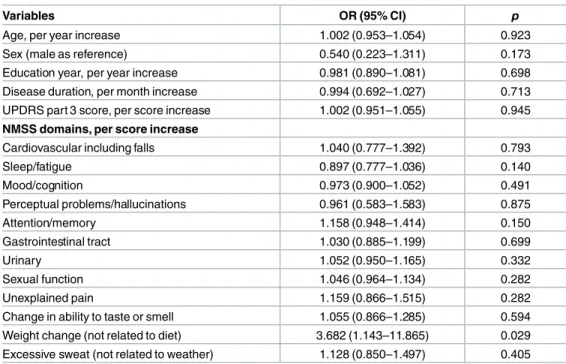
To elucidate the characteristic NMS in PD subtype, multivariate logistic regression analysis
was done with PD subtype as the dependent variable. Included in the model were demographic
and clinical data (age, sex, education year, disease duration), UPDRS part 3 score and subscores
of each NMSS domain. The only predictor for NTD subtype was subscore of weight change
domain in NMSS (
Table 4
).
Discussion
This is the first study with systematic investigation of non-motor involvement between PD
motor subtypes in drug-naïve PD patients. In our study, with multivariate regression analysis
we demonstrated weight change was the only characteristic NMS in PD patients with NTD,
and suggested weight change should be concerned even from early stage of PD. Considering
that PD is a broad-spectrum disorder with clinical heterogeneity, each NMS can be easily
affected by other motor and non-motor parkinsonian symptoms. Therefore, it is important to
Table 1. Demographic characteristics of enrolled subjects.
Parkinson’s disease patients Normal Control (n = 50) pa pb Total (n = 136) TD (n = 68) NTD (n = 68)
Age, years 65.1±8.7 65.1±8.6 65.2±8.9 65.4±8.0 0.941 0.963
Sex, male, n (%) 58 (42.6) 32 (47.1) 26 (38.2) 17 (34) 0.315 0.386
BMI, UD/NR/OW/OB, n 8/41/35/52 5/20/18/25 3/21/17/27 0.913
Education, years 10.5±4.6 10.7±4.7 9.4±4.8 10.3±3.4 0.829 0.225
Disease duration, month 14.8±11.7 15.4±11.6 14.2±11.9 0.500
HY stage 1/2/3, n (%) 57/76/3 (41.9/55.9/2.2) 29/38/1 (42.6/55.9/1.5) 28/38/2 (41.2/55.9/2.9) 0.642
UPDRS part 3 16.6±8.0 16.3±8.7 16.7±7.4 1.0±2.1 <0.001 0.476
PD, Parkinson’s disease; BMI, body mass index; UD, underweight; NR, normal range; OW, overweight; OB, obese; HY, Hoehn and Yahr; UPDRS, Unified Parkinson’s Disease Rating Scale.
acomparison between PD and normal control.
Table 2. Comparisons of non-motor symptoms between Parkinson’s disease patients and normal controls.
PD patients (n = 136) Normal controls (n = 50) p
Non-Motor Symptoms Assessment Scale
Total score 19.9±19.4 13.9±19.7 0.008
Cardiovascular including falls 0.7±1.5 0.8±2.1 0.297
Sleep/fatigue 3.1±4.5 2.6±4.1 0.235 Mood/cognition 4.2±6.7 1.8±3.4 0.003 Perceptual problems/hallucinations 0.1±0.9 0.3±1.6 0.118 Attention/memory 1.9±2.6 1.8±2.7 0.389 Gastrointestinal tract 1.4±2.8 0.9±2.7 0.018 Urinary 3.8±5.6 2.8±4.5 0.107 Sexual function 2.3±5.3 1.9±5.3 0.141 Unexplained pain 0.7±1.8 0.2±0.8 0.006
Change in ability to taste or smell 1.0±2.1 0.4±1.1 0.003
Weight change (not related to diet) 0.3±1.3 0.1±0.6 0.035
Excessive sweat (not related to weather) 0.5±1.8 0.3±1.1 0.411
Other Scales on Non-motor Symptoms
Parkinson’s Disease Sleep Scale 125.4±23.8 122.4±25.3 0.299
Parkinson Fatigue Scale 34.5±17.3 29.9±26.2 0.010
Beck Depression Inventory 7.8±7.0 7.1±6.7 0.230
Beck Anxiety Inventory 7.1±7.5 5.7±7.7 0.003
MoCA-K 24.3±3.9 25.9±3.1 0.010
PD, Parkinson’s disease; TD, tremor dominant subtype; NTD, non-tremor dominant subtype; MoCA-K, Korean version of the Montreal Cognitive Assessment.
doi:10.1371/journal.pone.0162254.t002
Table 3. Comparison of non-motor symptoms between subtypes of drug naïve Parkinson’s disease.
TD (n = 68) NTD (n = 68) p
Non-motor Symptom Scale
Total score 17.0±20.8 23.0±17.7 0.003
Cardiovascular including falls 0.7±1.7 0.7±1.4 0.600
Sleep/fatigue 2.8±4.6 3.3±4.5 0.300 Mood/cognition 4.1±8.0 4.4±5.2 0.179 Perceptual problems/hallucinations 0.2±1.2 0.1±0.6 0.493 Attention/memory 1.4±2.2 2.3±2.8 0.057 Gastrointestinal tract 1.3±2.8 1.6±2.7 0.107 Urinary 3.3±4.2 4.4±6.7 0.384 Sexual function 1.7±4.6 2.9±6.0 0.189 Unexplained pain 0.5±1.4 0.9±2.2 0.246
Change in ability to taste or smell 0.7±1.7 1.3±2.5 0.059
Weight change (not related to diet) 0.1±0.3 0.5±1.8 0.031
Excessive sweat (not related to weather) 0.3±1.1 0.7±2.3 0.300
Other Scales on Non-motor Symptoms
Parkinson’s Disease Sleep Scale 122.0±27.7 128.8±18.9 0.303
Parkinson Fatigue Scale 32.5±16.7 36.3±17.7 0.288
Beck Depression Inventory 6.9±6.8 8.6±7.2 0.122
Beck Anxiety Inventory 6.4±6.8 7.8±8.2 0.333
MoCA-K 24.4±4.0 24.3±3.9 0.873
evaluate whole pattern of non-motor involvement in PD patients. Moreover, we enrolled
drug-naïve PD patients, and eliminated the confounding effect from dopaminergic medications.
Additionally, we also minimized possible confounding effect from the interrelation among
each motor and non-motor parkinsonian symptoms by logistic regression analysis.
It is well-known that NMS are widely involved in PD patients from an early stage and some
of NMS can even precede parkinsonian motor symptoms [
1
,
14
]. We also demonstrated
vari-ous NMS in PD patients, including pre-motor symptoms. When we compared between two
subtypes, there was more non-motor involvements in PD patients with NTD subtype than
those with NTD, even from early stage of PD. Among the various NMS, weight change was the
characteristic NMS related with NTD subtype in PD patients.
Most of previous studies demonstrated weight loss in PD patients [
10
,
25
,
26
], while one
study reported weight gain in early stage of PD [
27
]. Weight loss is known to be prominent
with disease progression, but can be shown from early stage, and even several years before
diag-nosis [
10
,
25
,
26
]. In accordance with previous studies, we also found more weight change in
early stage of PD patients, compared with normal controls.
The weight loss in PD is regarded as heterogeneous and multi-factorial symptom, and the
pathophysiology of weight loss in PD patients is not clearly elucidated yet. In previous studies,
various clinical features were known to contribute to weight loss, including poor appetite,
hyposmia, intestinal hypomotility, depression, gastrointestinal side effects from medications,
parkinsonism, dyskinesia, dementia and hallucination [
26
,
28
,
29
]. Considering we enrolled
drug-naïve, early stage PD patients, our results suggest that parkinsonism of early or
pre-motor stage, such as hyposmia, poor appetite or gastrointestinal hypomotility, can be closely
associated with weight loss rather than those of advanced stage or medication side effects.
Path-ologic involvements in olfactory nerve, salivary glands and gastrointestinal tracts were already
reported in pre-motor stage of PD patients, and also support our suggestion [
30
].
Table 4. Multiple logistic regression analysis; predictors for PD patients with non-tremor dominant subtype.
Variables OR (95% CI) p
Age, per year increase 1.002 (0.953–1.054) 0.923
Sex (male as reference) 0.540 (0.223–1.311) 0.173
Education year, per year increase 0.981 (0.890–1.081) 0.698
Disease duration, per month increase 0.994 (0.692–1.027) 0.713
UPDRS part 3 score, per score increase 1.002 (0.951–1.055) 0.945 NMSS domains, per score increase
Cardiovascular including falls 1.040 (0.777–1.392) 0.793
Sleep/fatigue 0.897 (0.777–1.036) 0.140 Mood/cognition 0.973 (0.900–1.052) 0.491 Perceptual problems/hallucinations 0.961 (0.583–1.583) 0.875 Attention/memory 1.158 (0.948–1.414) 0.150 Gastrointestinal tract 1.030 (0.885–1.199) 0.699 Urinary 1.052 (0.950–1.165) 0.332 Sexual function 1.046 (0.964–1.134) 0.282 Unexplained pain 1.159 (0.866–1.515) 0.282
Change in ability to taste or smell 1.055 (0.866–1.285) 0.594
Weight change (not related to diet) 3.682 (1.143–11.865) 0.029
Excessive sweat (not related to weather) 1.128 (0.850–1.497) 0.405 PD, Parkinson’s disease; NMSS, Non-motor symptoms assessment scale.
When we compared NMS between two PD subtypes, PD patients with NTD showed higher
total NMSS score. In terms of each NMSS domains, there was significant difference only in
subscore of weight loss domain. Previous study showed marginal significance in presence of
tremor between PD patients with and without weight loss, although this study did not rule out
medication effects [
10
]. In our study, to eliminate possible confounding effects from various
interactions between weight change and other clinical factors [
26
,
28
,
29
], logistic regression
analysis was done, and weight change was still the characteristic NMS in PD patients with
NTD subtype. Therefore, weight change is characteristic NMS in PD patients with NTD
regardless of other motor and NMS.
Interestingly, weight loss is known to be related with dementia, hallucination, and falling,
which are common in PD patients with NTD subtype [
26
]. As already mentioned earlier, we
suggest weight loss is regraded to be associated with early parkinsonian symptoms rather than
late symptoms. Thus, characteristic non-motor involvement of NTD subtype starts from
weight change, and evolves into diverse symptoms including perceptual and cognitive
prob-lems with disease progression.
Considering more severe motor symptoms in NTD subtype [
5
], PD patients with the NTD
subtype show more both motor and non-motor involvement. Previous studies reported PD
patients with NTD subtype have more degeneration of non-dopaminergic system as well as
dopaminergic system [
31
,
32
]. Further, more pathologic involvements were shown in NTD
subtype patients [
6
]. Our results also support more clinical progression in PD patients with
NTD subtype compared with those with TD subtype, even from early stage. In accordance
with our results, recent study also reported weight loss is related with more severe
neurodegen-eration [
33
].
This study has some limitations. We designed to investigate whole NMS in drug-naïve PD
patients, and did not check objective parameters for weight change, such as body mass index.
However, unlike previous studies focusing on weight loss itself, we checked other NMS and
minimized the interactions between weight loss and other motor and NMS. Second, we
enrolled early stage PD patients, and we could not find any difference in NMS which is usually
common in advanced stage of PD, such as cognitive or perceptual problems. In our study, PD
patients with NTD subtype reported higher score of BDI and BAI than those with TD subtype,
but there was no statistical significance. Considering NMS were reported to be prominent even
from early stage of PD [
1
,
14
], we focused on the early feature of non-motor involvement
between PD subtypes, and we were able to avoid possible confounding effects by drug-naïve
patients. Further study with follow-up data could be helpful to cover all these NMS. Lastly, we
recruited a small number of subjects, especially for the normal control group. However, the
primary objective of this study was to elucidate the non-motor involvement related with PD
subtype, and enrolled sufficient number of drug-naïve, early PD patients. Additionally, we
precisely evaluated non-motor involvements using the NMSS and other NMS-specific scales,
and even with the small sample size, we were able to identify differences in NMS between PD
patients and normal controls, and between PD subtypes.
In conclusion, our study demonstrated more non-motor involvement in PD patients with
NTD subtype, and weight change as the characteristic NMS related with NTD subtype. Based
on our results, we suggest that NTD subtype is associated with more widespread and severe
clinico-pathologic involvement related to both motor and NMS even at an early stage.
Author Contributions
Conceived and designed the experiments: Jinyoung Youn JWC ESO Ji Sun Kim WYJ JSP
WCK HSK Sang Myung Cheon JWK HTK JYL Ji Sun Kim EJK JMK KSL Joong-Seok Kim
MJK JSB KJP Hee Jin Kim MYP JHK SKS YDK Ji Young Yun HWL IUS YHS PHL JHP
HGO KWP DYK.
Performed the experiments: Jinyoung Youn JWC ESO Ji Sun Kim WYJ JSP SBK JHL HKP
Han-Joon Kim BSJ HWS SAC SJK Seong-Min Choi JYP JYK SJC CSL TBA WCK HSK
Sang Myung Cheon JWK HTK JYL Ji Sun Kim EJK JMK KSL Joong-Seok Kim MJK JSB
KJP Hee Jin Kim MYP JHK SKS YDK Ji Young Yun HWL IUS YHS PHL JHP HGO KWP
DYK.
Analyzed the data: JKM Jinyoung Youn JWC ESO Ji Sun Kim SYP WYJ JSP.
Contributed reagents/materials/analysis tools: SYP.
Wrote the paper: JKM Jinyoung Youn JWC ESO Ji Sun Kim SYP WYJ JSP.
References
1. Duncan GW, Khoo TK, Yarnall AJ, O'Brien JT, Coleman SY, Brooks DJ, et al. Health-related quality of life in early Parkinson's disease: The impact of nonmotor symptoms. Movement Disorders. 2014; 29 (2):195–202. doi:10.1002/mds.25664PMID:24123307
2. Zis P, Martinez-Martin P, Sauerbier A, Rizos A, Sharma JC, Worth PF, et al. Non-motor symptoms bur-den in treated and untreated early Parkinson's disease patients: argument for non-motor subtypes. European journal of neurology: the official journal of the European Federation of Neurological Societies. 2015; 22(8):1145–50. doi:10.1111/ene.12733PMID:25981492.
3. Zis P, Rizos A, Martinez-Martin P, Pal S, Silverdale M, Sharma JC, et al. Non-motor symptoms profile and burden in drug naive versus long-term Parkinson's disease patients. J Parkinsons Dis. 2014; 4 (3):541–7. doi:10.3233/JPD-140372PMID:24927755.
4. Jankovic J, McDermott M, Carter J, Gauthier S, Goetz C, Golbe L, et al. Variable expression of Parkin-son's disease A base-line analysis of the DAT ATOP cohort. Neurology. 1990; 40(10):1529-. PMID:
2215943
5. Reinoso G, Allen JC Jr, Au WL, Seah SH, Tay KY, Tan LC. Clinical evolution of Parkinson's disease and prognostic factors affecting motor progression: 9-year follow-up study. European journal of neurol-ogy: the official journal of the European Federation of Neurological Societies. 2015; 22(3):457–63. doi:
10.1111/ene.12476PMID:24888502.
6. van de Berg WD, Hepp DH, Dijkstra AA, Rozemuller JAM, Berendse HW, Foncke E. Patterns of alpha-synuclein pathology in incidental cases and clinical subtypes of Parkinson's disease. Parkinsonism & related disorders. 2012; 18:S28–S30.
7. Alves G, Larsen JP, Emre M, Wentzel-Larsen T, Aarsland D. Changes in motor subtype and risk for incident dementia in Parkinson's disease. Movement Disorders. 2006; 21(8):1123–30. PMID:
16637023
8. Burn DJ, Landau S, Hindle JV, Samuel M, Wilson KC, Hurt CS, et al. Parkinson's disease motor sub-types and mood. Movement Disorders. 2012; 27(3):379–86. doi:10.1002/mds.24041PMID:22162098
9. Brown RG, Landau S, Hindle JV, Playfer J, Samuel M, Wilson KC, et al. Depression and anxiety related subtypes in Parkinson's disease. Journal of neurology, neurosurgery, and psychiatry. 2011; 82(7):803– 9. doi:10.1136/jnnp.2010.213652PMID:21217155.
10. Akbar U, He Y, Dai Y, Hack N, Malaty I, McFarland NR, et al. Weight loss and impact on quality of life in Parkinson's disease. PloS one. 2015; 10(5):e0124541. doi:10.1371/journal.pone.0124541PMID:
25938478; PubMed Central PMCID: PMC4418600.
11. Khoo TK, Yarnall AJ, Duncan GW, Coleman S, O’Brien JT, Brooks DJ, et al. The spectrum of nonmotor symptoms in early Parkinson disease. Neurology. 2013; 80(3):276–81. doi:10.1212/WNL.
0b013e31827deb74PMID:23319473
12. Chaudhuri K, Schapira AH. Non-motor symptoms of Parkinson's disease: dopaminergic pathophysiol-ogy and treatment. The Lancet Neurolpathophysiol-ogy. 2009; 8(5):464–74. doi:10.1016/S1474-4422(09)70068-7
PMID:19375664
13. Mollenhauer B, Trautmann E, Sixel-Döring F, Wicke T, Ebentheuer J, Schaumburg M, et al. Nonmotor and diagnostic findings in subjects with de novo Parkinson disease of the DeNoPa cohort. Neurology. 2013; 81(14):1226–34. doi:10.1212/WNL.0b013e3182a6cbd5PMID:23997153
14. Pont-Sunyer C, Hotter A, Gaig C, Seppi K, Compta Y, Katzenschlager R, et al. The Onset of Nonmotor Symptoms in Parkinson's disease (The ONSET PD Study). Movement disorders: official journal of the Movement Disorder Society. 2015; 30(2):229–37. doi:10.1002/mds.26077PMID:25449044. 15. Hughes AJ, Daniel SE, Kilford L, Lees AJ. Accuracy of clinical diagnosis of idiopathic Parkinson's
dis-ease: a clinico-pathological study of 100 cases. Journal of Neurology, Neurosurgery & Psychiatry. 1992; 55(3):181–4.
16. Hoehn MM, Yahr MD. Parkinsonism: onset, progression, and mortality. Neurology. 1998; 50(2):318-. PMID:9484345
17. Koh S-B, Kim JW, Ma H-I, Ahn T-B, Cho JW, Lee PH, et al. Validation of the Korean-Version of the Non-motor Symptoms Scale for Parkinson's Disease. Journal of Clinical Neurology. 2012; 8(4):276–83. doi:
10.3988/jcn.2012.8.4.276PMID:23323136
18. Lee J-Y, Lee DW, Cho S-J, Na DL, Jeon HJ, Kim S-K, et al. Brief screening for mild cognitive impairment in elderly outpatient clinic: validation of the Korean version of the Montreal Cognitive Assessment. Journal of Geriatric Psychiatry and Neurology. 2008; 21(2):104–10. doi:10.1177/ 0891988708316855PMID:18474719
19. Kim TH, Huh Y, Choe JY, Jeong JW, Park JH, Lee SB, et al. Korean version of frontal assessment bat-tery: psychometric properties and normative data. Dement Geriatr Cogn Disord. 2010; 29(4):363–70. doi:10.1159/000297523PMID:20424455.
20. Beck AT, Epstein N, Brown G, Steer RA. An inventory for measuring clinical anxiety: psychometric properties. Journal of consulting and clinical psychology. 1988; 56(6):893. PMID:3204199
21. Cummings JL, Mega M, Gray K, Rosenberg-Thompson S, Carusi DA, Gornbein J. The Neuropsychiat-ric Inventory comprehensive assessment of psychopathology in dementia. Neurology. 1994; 44 (12):2308-. PMID:7991117
22. Jo SA, Park MH, Jo I, Ryu SH, Han C. Usefulness of Beck Depression Inventory (BDI) in the Korean elderly population. Int J Geriatr Psychiatry. 2007; 22(3):218–23. doi:10.1002/gps.1664PMID:
17044132.
23. Brown R, Dittner A, Findley L, Wessely S. The Parkinson fatigue scale. Parkinsonism & related disor-ders. 2005; 11(1):49–55.
24. Chaudhuri K, Pal S, DiMarco A, Whately-Smith C, Bridgman K, Mathew R, et al. The Parkinson’s dis-ease sleep scale: a new instrument for assessing sleep and nocturnal disability in Parkinson’s disdis-ease. Journal of Neurology, Neurosurgery & Psychiatry. 2002; 73(6):629–35.
25. Chen H, Zhang SM, Hernan MA, Willett WC, Ascherio A. Weight loss in Parkinson's disease. Ann Neu-rol. 2003; 53(5):676–9. doi:10.1002/ana.10577PMID:12731005.
26. Uc EY, Struck LK, Rodnitzky RL, Zimmerman B, Dobson J, Evans WJ. Predictors of weight loss in Par-kinson's disease. Movement disorders: official journal of the Movement Disorder Society. 2006; 21 (7):930–6. doi:10.1002/mds.20837PMID:16534756.
27. Vikdahl M, Carlsson M, Linder J, Forsgren L, Haglin L. Weight gain and increased central obesity in the early phase of Parkinson's disease. Clin Nutr. 2014; 33(6):1132–9. doi:10.1016/j.clnu.2013.12.012
PMID:24423747.
28. Kashihara K. Weight loss in Parkinson's disease. J Neurol. 2006; 253 Suppl 7:VII38–41. doi:10.1007/ s00415-006-7009-0PMID:17131227.
29. Pfeiffer RF. Gastrointestinal dysfunction in Parkinson's disease. Lancet Neurol. 2003; 2(2):107–16. PMID:12849267.
30. Klingelhoefer L, Reichmann H. Pathogenesis of Parkinson disease—the gut-brain axis and environ-mental factors. Nat Rev Neurol. 2015; 11(11):625–36. doi:10.1038/nrneurol.2015.197PMID:
26503923.
31. Bohnen NI, Frey KA, Studenski S, Kotagal V, Koeppe RA, Scott PJ, et al. Gait speed in Parkinson dis-ease correlates with cholinergic degeneration. Neurology. 2013; 81(18):1611–6. doi:10.1212/WNL. 0b013e3182a9f558PMID:24078735; PubMed Central PMCID: PMC3806920.
32. Yuan YS, Zhou XJ, Tong Q, Zhang L, Zhang L, Qi ZQ, et al. Change in plasma levels of amino acid neu-rotransmitters and its correlation with clinical heterogeneity in early Parkinson's disease patients. CNS neuroscience & therapeutics. 2013; 19(11):889–96. doi:10.1111/cns.12165PMID:23981689. 33. Sauerbier A, Jenner P, Todorova A, Chaudhuri KR. Non motor subtypes and Parkinson's disease.
Par-kinsonism Relat Disord. 2016; 22 Suppl 1:S41–6. doi:10.1016/j.parkreldis.2015.09.027PMID: