Unmet Needs of Breast Cancer Patients Relative to Survival Duration
Byeong Woo Park
1and Sook Yeon Hwang
21Department of Surgery, Yonsei University College of Medicine, Seoul;
2Depatment of Social Welfare, Duksung Women’s University College of Social Sciences, Seoul, Korea.
Received: August 11, 2011 Revised: September 23, 2011 Accepted: September 23, 2011
Corresponding author: Dr. Sook Yeon Hwang, Department of Social Welfare,
Duksung Women’s University College of Social Sciences, 33 Samyang-ro 144-gil, Dobong-gu, Seoul 132-714, Korea.
Tel: 82-2-901-8287, Fax: 82-2-901-8581 E-mail: [email protected] ∙ The authors have no financial conflicts of interest.
© Copyright:
Yonsei University College of Medicine 2012
This is an Open Access article distributed under the terms of the Creative Commons Attribution Non-Commercial License (http://creativecommons.org/ licenses/by-nc/3.0) which permits unrestricted non-commercial use, distribution, and reproduction in any medium, provided the original work is properly cited.
Purpose: The present study aims to evaluate the prevalence of unmet needs among breast cancer survivors, to assess the relationships between unmet needs and de-pression and quality of life, and to explore the extent to which unmet needs of breast cancer patients relate to the time elapsed since surgery. Materials and Methods:
Among 1,250 eligible patients who participated in the study, 1,084 cases (86.7%) were used for analysis. Clinicopathological and social parameters were reviewed and the Supportive Care Needs Survey, Functional Assessment of Cancer Thera-py-Breast cancer instrument, and Beck Depression Inventory were administered. The frequency of unmet needs, the association between unmet needs and depres-sion and/or quality of life (QOL) and the impact of the time elapsed since surgery on the patients’ unmet needs were analyzed. Results: The highest levels of unmet needs were found to be in the health system and information domain. Patients with a survival duration of less than 1 year since surgery showed significantly higher unmet needs in all need domains except the sexuality domain (p<0.001) than par-ticipants in the other groups. Patients with a survival duration of 1-3 years also ex-perienced significantly higher psychological and information needs than long-term survivors (>5 years). In addition, unmet needs were significantly associated with depression (p<0.001) and QOL (p<0.001). Conclusion: The present study demon-strated that long-term breast cancer survivors had a significantly lower level of un-met needs than patients with survival duration of less than 3 years after surgery and patients with survival duration of less than 1 year since surgery suffered the greatest unmet needs. QOL might be enhanced if interventions are made for spe-cific unmet needs of each patient group.
Key Words: Breast carcinoma, unmet needs, quality of life, depression
INTRODUCTION
The 5-year relative survival rate of breast cancer patients was as high as 89.5% be-tween 2003 and 2007 in Korea1 and cancer survivorship issues have become a
new concern for delivering quality cancer care.2
Because of early detection and advances in treatment, disease-free survival rate is increasing and quality of life (QOL) among breast cancer patients is a growing area of research and clinical considerations. Even though there is debate about the degree
regular follow-up medical appointments after surgery. The el-igibility criteria for inclusion in the study were as follows: 1) between 20 and 80 years old, 2) stage I, II, and III cancers, 3) no evidence of systemic metastasis, 4) no evidence of psy-chosis, dementia, or suicidal behavior, and 5) no recurrence. After informed consent had been obtained, the patients were asked to complete the questionnaires. Among 1,250 eligible patients who consented to participate in the study, 1,084 (86.7%) returned completed surveys. No significant differ-ences in demographic characteristics between those who re-turned the surveys and those who did not were observed. To explore the extent to which the unmet needs of breast cancer survivors relates to the time elapsed since surgery, we divided patients into four groups relative to the time since surgery: group I, less than 1 year; group II, 1-3 years; group III, 3-5 years; and group IV, more than 5 years. This division was based on the treatment and follow-up-care schedules after surgery. Most of the breast cancer patients received adjuvant therapy including chemotherapy. Adjuvant chemotherapy causes additional physical and psychological distress to the breast cancer patients. Adjuvant chemotherapy usually takes place 3-6 months after surgery and carryover effects can con-tinue for a while. Recurrences mostly occur at 2 to 3 years af-ter surgery, and most adjuvant endocrine therapies are recom-mended for 5 years. Five-year disease-free survival can predict long-term survival or cure, though not in all cases. This study was approved by the Institutional Review Board of Yonsei University Severance Hospital (4-2009-0269).
Measurements
Socio-demographic and medical background
Socio-demographic background including a patient’s age, marital status, job, education, and economic status were in-cluded in the survey. Subjective economic status was as-sessed by asking respondents to circle what they considered an accurate reflection of their economic status from the lowest, lower, middle, upper-middle, to upper status. Medi-cal/treatment variables were collected by reviewing the pa-tients’ medical records.
The supportive care needs survey
The supportive care needs survey (SCNS), a modified ver-sion of the Cancer Needs Questionnaire6 was used to assess
the unmet supportive care needs of breast cancer patients. It was designed to provide a direct and comprehensive assess-ment of the multidimensional impact of cancer on the lives to which cancer patients experience psychopathology, some
research has shown that severe psychopathology among can-cer patients is no more prevalent than in the general popula-tion.3 According to the literature, the majority of cancer
pa-tients experience more psychological, interpersonal, health policy and system difficulties and other problems of living rather than psychiatric symptoms.3,4 Therefore, it is important
to assess the magnitude and prevalence of these difficulities and problems among cancer patients systematically.
Psychological adaptation to breast cancer could be mea-sured in many ways including quality of life, satisfaction with care and needs assessment. Needs assessment differs from other assessment constructs in that it directly identifies patients with higher levels of need and suggests specific in-terventions for them.5,6 It provides direct index of what
pa-tients perceive they need help with and also measures the perceived efficacy of a health services by its users.6
There-fore, evaluating patients’ needs is important to offer timely, effective interventions.7 On the other hand, previous studies
showed that time elapsed since diagnosis is a significant predictor of QOL and unmet needs.8,9 Many studies
sug-gested that QOL of long-term, disease-free breast cancer survivors improve over time.10,11 They showed long-term,
disease-free breast cancer survivors reported high levels of functioning on several dimensions of QOL and most of the limitations imposed by therapy and poor health improved with time.10,12 Other research reported that long-term
survi-vors of breast cancer continue to experience psychological morbidities including increased depression and lower QOL.13,14 However, there is little research available
regard-ing the needs of breast cancer survivors over time. Under-standing the changing psychosocial needs of cancer pa-tients across time is needed in order to provide interventions that reflect personal needs in their illness trajectory.
Thus, the present study aims to evaluate the prevalence of unmet needs among breast cancer survivors, to assess the relationships between unmet needs and depression and quality of life, and to explore the extent to which unmet needs relate to the time elapsed since surgery.
MATERIALS AND METHODS
Patients
The subjects in this cross-sectional study were outpatients with breast cancer at Yonsei University Severance Hospital Breast Cancer Clinic. They were all Koreans and attended
the Eastern Cooperative Oncology Group Performance Sta-tus (ECOG-PS) scale. ECOG-PS assesses the level of func-tioning based on activity, ambulatory status, and need for care. The performance status grade 0 means normal activi-ty; grade 1 means some symptoms but nearly fully ambula-tory; grade 2 means less than 50% of daytime in bed; grade 3 means more than 50% of daytime in bed; and grade 4 means completely bedridden. ECOG-PS is widely used and well validated.20
Statistical analysis
For comparisons of socio-demographic and clinical charac-teristics in the four groups (less than 1 year, within 1-3 years, within 3-5 years, and more than 5 years since surgery), chi-square tests were employed for the statistical significance of categorical variables and a one-way analysis of variance was used to compare means of continuous variables. Multi-variate regression analysis was used to examine the rela-tionship between the patients’ perceived needs and depres-sion and/or QOL.
Analysis of covariance was performed for comparing the four groups regarding SCNS subscales. We adjusted for the following covariates: age, education, economic status, meno-pause, operation method, radiation therapy, hormone thera-py, chemotherathera-py, and performance status. The p-values for pairwise group comparisons are based on F-tests for the simple contrasts (adjusting for all of the above-mentioned covariates).
Data analyses were conducted using the SPSS software version 17.0 (SPSS Inc., Chicago, IL, USA). p-values less than 0.05 were considered statistically significant.
RESULTS
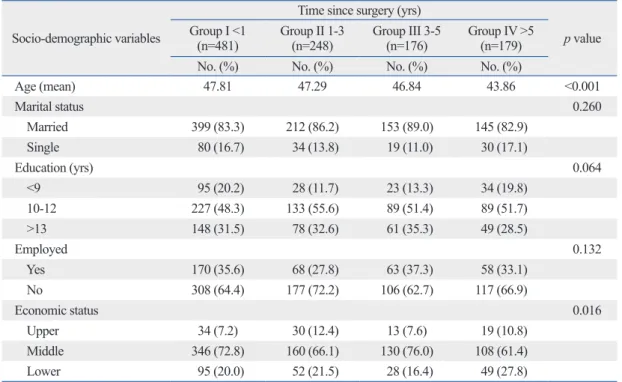
Patient characteristicsSocio-demographic and medical data are presented in Table 1 and Table 2. Patients in group IV were significantly young-er than those in the othyoung-er groups (p<0.001) and patients in group III were slightly higher in economic status than other groups (p<0.016). No significant differences among the four groups were observed for any of the other demograph-ic variables.
Medical characteristics are shown in Table 2. There were significant differences among the four groups concerning medical characteristics including menopause (p<0.001), operation method (p<0.001), radiation therapy (p<0.001), of cancer patients.15 It consists of 59 items covering five
do-mains of needs and additional items: psychological (22 items), health system and information (15 items), physical and daily living (7 items), patient care and support (8 items), sexuality (3 items) and an additional 4 items. The study participants were asked to indicate their level of the need for help over the last month in relation to having can-cer, ranging from 1, ‘no need (not applicable)’; 2, ‘no need (satisfied)’; 3, ’low need’; 4, ‘moderate need’; to 5 ‘high need’. Domain scores were calculated by summing the re-sponses to each of the items of need within each domain and dividing the total by the number of items in the domain. A higher score indicated a higher perceived need. The sur-vey’s psychometric properties and the reliability as well as the validity of this measurement have been well document-ed.5,9 We used the SCNS-LF59 survey in Korean, which had
been translated and back-translated by Hwang and Park.9
The reliability coefficient was 0.968 in the psychological needs domain, 0.902 in the physical and daily activity do-main, 0.906 in the sexuality dodo-main, 0.946 in the health sys-tem and information domain, 0.930 in the patient care and support domain, and 0.795 in the additional items domain. The Beck Depression Inventory
The Beck Depression Inventory (BDI) is a 21-item inven-tory that describes symptoms and attitudes. Each item de-scribes a particular aspect of depression and has four self-evaluative statements. Subjects are instructed to circle the items that best describe how they have been feeling in the last week. The Korean version of the BDI was standard-ized,16 and its validity and reliability have been established.17
The reliability coefficient for BDI was 0.895 in this study. Functional Assessment of Cancer Therapy-Breast
The Functional Assessment of Cancer Therapy-Breast (FACT-B) version 4 was used to assess health-related QOL. The FACT-B is composed of the FACT-General plus the Breast Cancer subscale, which complements the general scale with items specific to QOL in patients with breast car-cinoma. The psychometric properties of the FACT-B are well documented,18 and the survey was validated in
Kore-an.19 The α coefficients for the FACT-B total score was
0.855 in this study.
The Eastern Cooperative Oncology Group Performance Status
Table 1. Socio-Demographic Characteristics of the Sample Socio-demographic variables
Time since surgery (yrs)
p value
Group I <1
(n=481) Group II 1-3 (n=248) Group III 3-5 (n=176) Group IV >5 (n=179)
No. (%) No. (%) No. (%) No. (%)
Age (mean) 47.81 47.29 46.84 43.86 <0.001 Marital status 0.260 Married 399 (83.3) 212 (86.2) 153 (89.0) 145 (82.9) Single 80 (16.7) 34 (13.8) 19 (11.0) 30 (17.1) Education (yrs) 0.064 <9 95 (20.2) 28 (11.7) 23 (13.3) 34 (19.8) 10-12 227 (48.3) 133 (55.6) 89 (51.4) 89 (51.7) >13 148 (31.5) 78 (32.6) 61 (35.3) 49 (28.5) Employed 0.132 Yes 170 (35.6) 68 (27.8) 63 (37.3) 58 (33.1) No 308 (64.4) 177 (72.2) 106 (62.7) 117 (66.9) Economic status 0.016 Upper 34 (7.2) 30 (12.4) 13 (7.6) 19 (10.8) Middle 346 (72.8) 160 (66.1) 130 (76.0) 108 (61.4) Lower 95 (20.0) 52 (21.5) 28 (16.4) 49 (27.8) Table 2. Medical Characteristics of the Sample
Clinical variables
Time since surgery (yrs)
p value
<1 (n=481) 1-3 (n=248) 3-5 (n=176) ≥5 (n=179)
No. (%) No. (%) No. (%) No. (%)
Menopause <0.001 Yes 254 (55.7) 192 (78.4) 134 (77.9) 128 (72.7) No 202 (44.3) 53 (21.6) 38 (22.1) 48 (27.3) Operation method <0.001 BCS 236 (49.3) 85 (34.4) 64 (36.4) 53 (29.6) MRM 243 (50.7) 162 (65.6) 112 (63.6) 126 (70.4) Stage 0.425 I (0+1) 219 (45.7) 122 (49.4) 89 (50.9) 77 (44.3) II 204 (42.6) 93 (37.7) 71 (40.6) 70 (40.2) III 56 (11.7) 32 (13.0) 15 (8.6) 27 (15.5) Radiation therapy <0.001 No 169 (35.3) 116 (46.8) 90 (51.1) 89 (50.6) Yes 310 (64.7) 132 (53.2) 86 (48.9) 87 (49.4) Hormone therapy <0.001 No 110 (23.0) 77 (31.2) 55 (31.3) 71 (40.3) Yes 369 (77.0) 170 (68.8) 121 (68.8) 105 (59.7) Chemotherapy <0.001 No 167 (34.7) 64 (25.9) 32 (18.9) 43 (25.0) Yes 314 (65.3) 183 (74.1) 137 (81.1) 129 (75.0) ECOG-PS <0.001 0 188 (39.7) 178 (72.7) 130 (73.9) 133 (75.1) 1 239 (50.5) 64 (26.1) 43 (24.4) 37 (20.9) ≥2 46 (9.7) 3 (1.2) 3 (1.7) 7 (4.0)
BCS, breast conservation surgery; MRM, modified radical mastectomy; ECOG-PS, Eastern Cooperative Oncology Group-Performance Status.
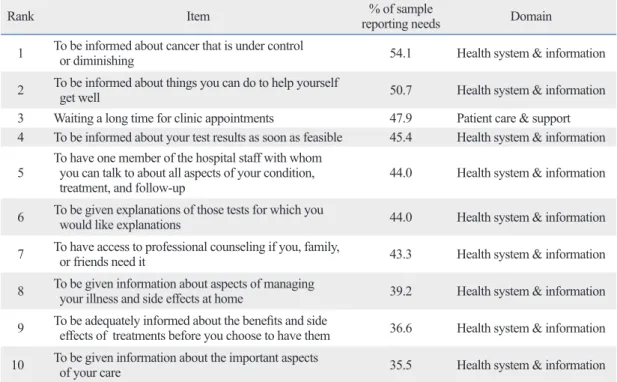
staff with whom you can talk to about all aspects of your condition, treatment, and follow-up’. The prevalence of the ten most frequent unmet needs was over 35.3%.
Relationship between patients’ perceived needs and depression and/or QOL
Multivariate analysis revealed that unmet needs were sig-nificantly related with both QOL and depression as mea-sured by BDI and FACT-B, respectively. Table 4 represents the results of the multivariate regression analyses. After ad-justing for confounding variables including age, economic status, education, time since surgery, menopause, operation method, radiation therapy, hormone therapy, chemotherapy and performance status, SCNS was found to be a signifi-cant predictor of depression (t=-15.854, p<0.001) and QOL (t=16.187, p<0.001). Patients who reported higher unmet needs were more likely to be depressed and to have a lower QOL.
hormone therapy (p<0.001), chemotherapy (p<0.001), and level of daily activity (p<0.001).
Prevalence of unmet needs
In order to identify specific issues or areas where patients required the most help, the 59 individual items of need were examined to assess the frequency of reports in each of the response categories. The 10 items with the highest frequen-cy of moderate-to-high (3 or more on the 5-point Likert scale) are shown in Table 3. Of the 10 highest needs items, nine items were related to the health system and informa-tion domain and one item was related to the patient care and support domain. Specifically, ‘To be informed about cancer that is under control or diminishing’ was the com-monest, followed by ‘To be informed about things you can do to help yourself get well’, ‘Waiting a long time for a clinic appointment’ ‘To be informed about your test results as soon as feasible’, and ‘To have one member of the hospital
Table 3. Items of the Ten Highest Moderate-to- High Unmet Needs Responses
Rank Item reporting needs % of sample Domain
1 To be informed about cancer that is under control or diminishing 54.1 Health system & information 2 To be informed about things you can do to help yourself get well 50.7 Health system & information 3 Waiting a long time for clinic appointments 47.9 Patient care & support 4 To be informed about your test results as soon as feasible 45.4 Health system & information 5 To have one member of the hospital staff with whom you can talk to about all aspects of your condition,
treatment, and follow-up 44.0 Health system & information 6 To be given explanations of those tests for which you would like explanations 44.0 Health system & information 7 To have access to professional counseling if you, family, or friends need it 43.3 Health system & information 8 To be given information about aspects of managing your illness and side effects at home 39.2 Health system & information 9 To be adequately informed about the benefits and side effects of treatments before you choose to have them 36.6 Health system & information 10 To be given information about the important aspects of your care 35.5 Health system & information Table 4. Regression Model with BDI and FACT-B as the Dependent Variables*
FACT-B total BDI
Beta t Beta t
SCNS (n=974) -0.444 -15.854† 0.464 16.187†
Constant 120.382 2.831
R-square 0.367 0.337
SCNS, Supportive Cancer Needs Survey; FACT-B, Functional Assessment of Cancer Therapy-Breast; BDI, Beck Depression Inventory. *ß coefficients from multiple regression are adjusted for age, economic status, education, time since surgery, menopause, operation method, radiation therapy, hormone therapy, chemotherapy and performance status.
formation domain, which accounted for 9 out of the top 10 unmet needs items, with 1 item in the patient care and sup-port domain. Also, unmet needs were found to be signifi-cantly related with depression and QOL.
The prevalence of the ten highest moderate-to-high un-met needs among patients with breast cancer in this study was between 35.5% and 54.1%, which is higher than an Australian study,14 but lower than a Japanese study.8 An
Australian study using SCNS found that the prevalence of the ten highest needs was between 30% and 40%,15
where-as it wwhere-as between 40% and 63% in a Japanese study.8 In
ad-dition, the prevalence of unmet needs in this study was lower than that reported in our previous study with a different study sample.9 This finding may reflect improvement in the care
of patients for the past few years.
Nine out of ten highest needs were found in the health system and information domain in our study. This is consis-tent with the results of studies assessing the unmet needs of breast cancer survivors,21,22 where they reported the greatest
unmet needs in the information and medical communica-tion domain. This could be an indicacommunica-tion of dissatisfaccommunica-tion with information received at follow-up care. Research has shown that cancer patients were found to be less satisfied with information and support than clinical aspects of care they receive,15,23,24 which our study partly confirms.
However, considering that increased levels of depression, anxiety, and concern about future health predicted signifi-cantly increased needs of information and medical commu-nication,21 patients in our study could have expressed their
psychological anxiety in the form of practical information
Assessment of unmet needs by survival duration
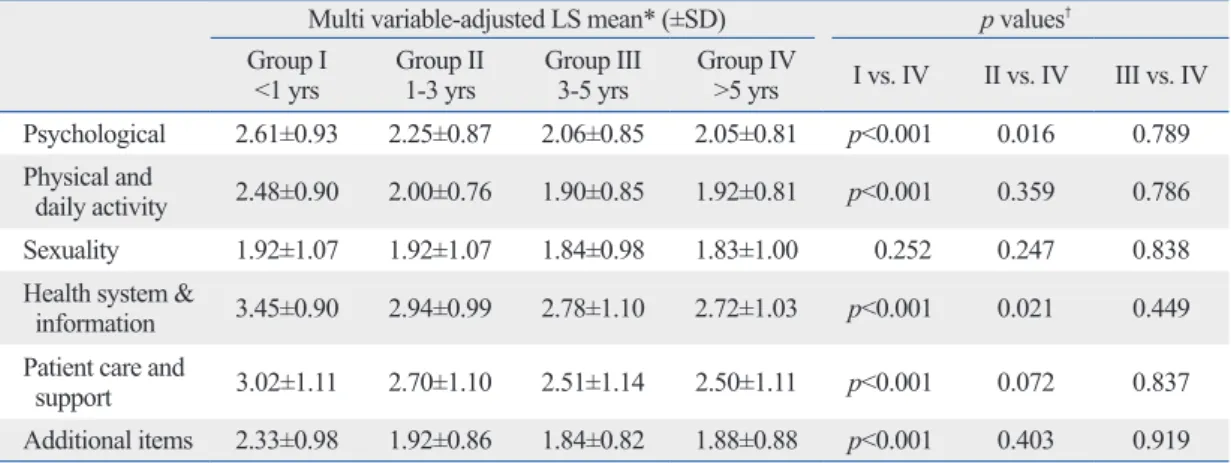
The results of the unmet needs subscales in the four groups are summarized in Table 5. Patients with a survival dura-tion of less than 1 year since surgery (group I) exhibited a significantly greater level of unmet needs in the psychologi-cal domain (p<0.001), physipsychologi-cal and daily living domain (p<0.001), health system and information domain (p<0.001) and the patient care and support domain (p<0.001), as well as the additional items domain (p<0.001) than patients whose survival duration was longer than 5 years since sur-gery (group IV). Patients with a survival duration of 1-3 years since surgery (group II) still exhibited significantly greater unmet needs than group IV in the psychological (p=0.016), and health system and information needs domain (p=0.021). Although it was not statistically significant, the adjusted mean of group II was higher than group IV (p=0.072). group III did not show a significant difference from group IV in any of the SCNS subscales. No significant difference in the sexuality domain was found relative to sur-vival time.
DISCUSSION
The present study showed that patients with a survival du-ration less than 1 year had a significantly higher level of needs than the other groups of patients, and those with a survival duration of 1-3 years still had higher needs than long-term survivors over 5 years since surgery. The highest levels of need were found to be in the health system and
in-Table 5. Supportive Care Needs Survey (SCNS) Subscales for Time since Surgery
Multi variable-adjusted LS mean* (±SD) p values† Group I
<1 yrs Group II 1-3 yrs Group III 3-5 yrs Group IV >5 yrs I vs. IV II vs. IV III vs. IV Psychological 2.61±0.93 2.25±0.87 2.06±0.85 2.05±0.81 p<0.001 0.016 0.789 Physical and
daily activity 2.48±0.90 2.00±0.76 1.90±0.85 1.92±0.81 p<0.001 0.359 0.786 Sexuality 1.92±1.07 1.92±1.07 1.84±0.98 1.83±1.00 0.252 0.247 0.838 Health system &
information 3.45±0.90 2.94±0.99 2.78±1.10 2.72±1.03 p<0.001 0.021 0.449 Patient care and
support 3.02±1.11 2.70±1.10 2.51±1.14 2.50±1.11 p<0.001 0.072 0.837 Additional items 2.33±0.98 1.92±0.86 1.84±0.82 1.88±0.88 p<0.001 0.403 0.919 SD, standard deviation; ANCOVA, analysis of covariance.
*LS mean values from ANCOVA analyses are adjusted for age, economic status, education, time since surgery, menopause, operation method, radiation therapy, hormone therapy, chemotherapy and performance status.
†p-value represents the significance of group comparisons and is adjusted for age (at surgery), economic status, education, menopause, operation method, radiation therapy, hormone therapy, chemotherapy and performance status.
then psychosocial interventions and services could be de-signed to focus on improving health system and informa-tion services and should target patients with a survival dura-tion of less than 3 years since surgery. Especially, considering that patients reported high needs for counseling or to have someone to talk with concerning all aspects of their condi-tion, treatment, and follow-up, a greater multidisciplinary oncologic care approach including mental health profes-sionals and social workers as well as oncologic surgeons is suggested. Breast cancer survivors should discuss their needs and concerns with their cancer specialists during fol-low-up. However, many studies have reported the difficul-ties health professionals face in identifying and satisfying the informational and emotional needs of patients in cancer settings.30 That being so, they could simply ask patients to
complete unmet needs assessment tools such as SCNS-Short Form31 at follow-up visits. This could help the
profes-sionals tailor psychosocial services to meet the needs of the patients.
This study has several limitations. First, as our study was of a cross-sectional design, we cannot be sure of cause-ef-fect relationships. Distress may create unmet needs, or un-met needs may generate distress. In addition, changes in unmet needs over time could only be determined indirectly. Third, because the study sample represents only one urban university hospital, the study results cannot be generalized to all breast cancer survivors over the country.
In conclusion, the present study demonstrated that pa-tients with a survival duration of less than 1 year had a sig-nificantly higher level of needs than the other groups of pa-tients and those with survival duration of 1-3 years still had higher needs than long-term survivors over 5 years since surgery. In addition, the current study result that the health system and information needs were found to be the highest suggests various strategies are needed, such as systemic changes to the multidisciplinary provision of care, improve-ment of the interactional skills of health professionals, or providing feedback to clinicians by simple needs assess-ment. Consequently, psychosocial interventions aimed at meeting specific unmet needs may improve QOL of breast cancer patients.
ACKNOWLEDGEMENTS
This work was supported by the Duksung Women’s Uni-versity Research Grant 3000001085.
and support needs instead of psychological needs. The fact that patient education programs are regularly provided and cyber information is so easily accessible these days indi-cates they might need not just information but direct, face-to face explanation and psychological assurance from clini-cians. Also, this could be explained by cultural differences, as Asian depressive people are generally more likely to be somatized.22 It is known that Caucasian cancer patients
re-port more unmet psychological needs,22,25,26 reflecting desire
for psychological support than Asian patients. In addition, the current study results showed lower mean scores on the sexuality needs across time, which could be another aspect of cultural differences. This warrants further exploration.
Unmet needs were found to have a significantly negative effect on QOL of breast cancer patients, which confirms a Japanese study27 and another study with brain tumor
pa-tients.28 Our findings suggest that interventions based on
specific unmet needs could result in ameliorating depres-sion of breast cancer survivors and enhancing their QOL.
Time since surgery was found to be a strong predictor of unmet needs of breast cancer survivors. Patients in the group with a survival duration of less than 1 year since sur-gery reported significantly higher mean scores in the psy-chological, physical and daily living, health system and in-formation, patient care and support, and additional items domains than other patient groups. This result is under-standable, considering that patients in the early phase after surgery are known to have reduced QOL14 and therefore,
they might have more needs to be met because of treat-ment-related impairments. However, patients in the group with a survival duration between 1-3 years since surgery also reported significantly higher needs in the psychologi-cal domain and health system and information domain than those over 5 years since surgery. This might reflect that pa-tients with a survival time of 1-3 years after surgery are still under the influence of psychosocial morbidities. This result suggests that oncologic professionals should pay more at-tention to psychological and information needs of patients even after 1 year since surgery. On the other hand, the mean scores of unmet needs of patients with a survival duration between 3-5 years did not significantly differ from those of long-term survivors of over 5 years since surgery. This re-sult confirms other research, which showed long-term breast cancer survivors reported high levels of functioning on sev-eral dimensions of QOL,10-12 and shorter time elapsed since
surgery was associated with low QOL.29 This suggests that
Korean Neuropsychiatr Assoc 1986;25:487-501.
17. Lee YH, Song JY. A study of reliability and the validity of the BDI, SDS, and MMPI-D scale. Korean J Clin Psychol 1991;10: 98-113.
18. Brady MJ, Cella DF, Mo F, Bonomi AE, Tulsky DS, Lloyd SR, et al. Reliability and validity of the Functional Assessment of Cancer Therapy-Breast quality-of-life instrument. J Clin Oncol 1997;15: 974-86.
19. Yoo HJ, Ahn SH, Eremenco S, Kim H, Kim WK, Kim SB, et al. Korean translation and validation of the functional assessment of cancer therapy-breast (FACT-B) scale version 4. Qual Life Res 2005;14:1627-32.
20. Sørensen JB, Klee M, Palshof T, Hansen HH. Performance status assessment in cancer patients. An inter-observer variability study. Br J Cancer 1993;67:773-5.
21. Thewes B, Butow P, Girgis A, Pendlebury S. Assessment of Un-met Needs among Survivors of Breast Cancer. J Psychosocial On-col 2004;22:51-73.
22. Lam WW, Au AH, Wong JH, Lehmann C, Koch U, Fielding R, et al. Unmet supportive care needs: a cross-cultural comparison be-tween Hong Kong Chinese and German Caucasian women with breast cancer. Breast Cancer Res Treat 2011;130:531-41. 23. Wiggers JH, Donovan KO, Redman S, Sanson-Fisher RW. Cancer
patient satisfaction with care. Cancer 1990;66:610-6.
24. Tierney AJ, Taylor J, Closs SJ. Knowledge, expectations and ex-periences of patients receiving chemotherapy for breast cancer. Scand J Caring Sci 1992;6:75-80.
25. Beesley V, Eakin E, Steginga S, Aitken J, Dunn J, Battistutta D. Unmet needs of gynaecological cancer survivors: implications for developing community support services. Psychooncology 2008; 17:392-400.
26. Harrison JD, Young JM, Price MA, Butow PN, Solomon MJ. What are the unmet supportive care needs of people with cancer? A systematic review. Support Care Cancer 2009. [Epub ahead of print]
27. Uchida M, Akechi T, Okuyama T, Sagawa R, Nakaguchi T, Endo C, et al. Patients’ supportive care needs and psychological distress in advanced breast cancer patients in Japan. Jpn J Clin Oncol 2011;41:530-6.
28. Bunston T, Mings D, Laperriere N, Malcolm J, Williams D. The impact of psychosocial need and needs resolution on quality of life in patients with brain tumors. Neurosurg Focus 1998;4:e7. 29. Park BW, Lee S, Lee AR, Lee KH, Hwang SY. Quality of life
dif-ferences between younger and older breast cancer patients. J Breast Cancer 2011;14:112-8.
30. Maguire P, Booth K, Elliott C, Jones B. Helping health profes-sionals involved in cancer care acquire key interviewing skills--the impact of workshops. Eur J Cancer 1996;32A:1486-9. 31. Boyes A, Girgis A, Lecathelinais C. Brief assessment of adult
can-cer patients’ perceived needs: development and validation of the 34-item Supportive Care Needs Survey (SCNS-SF34). J Eval Clin Pract 2009;15:602-6.
REFERENCES
1. Ministry of Health, Welfare & Family Affairs. Annual Report of Cancer Incidence (2007), Cancer Prevalence (2007) and Survival (1993-2007) in Korea. Seoul: Ministry of Health, Welfare & Fam-ily Affairs; 2009.
2. Rowland JH, Hewitt M, Ganz PA. Cancer survivorship: a new challenge in delivering quality cancer care. J Clin Oncol 2006; 24:5101-4.
3. Cella DF. Cancer survival: psychosocial and public issues. Cancer Invest 1987;5:59-67.
4. Welch-McCaffrey D, Hoffman B, Leigh SA, Loescher LJ, Meyskens FL Jr. Surviving adult cancers. Part 2: psychosocial im-plications. Ann Intern Med 1989;111:517-24.
5. Bonevski B, Sanson-Fisher R, Girgis A, Burton L, Cook P, Boyes A. Evaluation of an instrument to assess the needs of patients with cancer. Supportive Care Review Group. Cancer 2000;88:217-25. 6. Foot G, Sanson-Fisher R. Measuring the unmet needs of people
living with cancer. Cancer Forum 1995;19:131-5.
7. Yang HC, Thornton LM, Shapiro CL, Andersen BL. Surviving re-currence: psychological and quality-of-life recovery. Cancer 2008; 112:1178-87.
8. Akechi T, Okuyama T, Endo C, Sagawa R, Uchida M, Nakaguchi T, et al. Patient’s perceived need and psychological distress and/or quality of life in ambulatory breast cancer patients in Japan. Psy-chooncology 2011;20:497-505.
9. Hwang SY, Park BW. The perceived care needs of breast cancer patients in Korea. Yonsei Med J 2006;47:524-33.
10. Ganz PA, Desmond KA, Leedham B, Rowland JH, Meyerowitz BE, Belin TR. Quality of life in long-term, disease-free survivors of breast cancer: a follow-up study. J Natl Cancer Inst 2002;94: 39-49.
11. Ahn SH, Park BW, Noh DY, Nam SJ, Lee ES, Lee MK, et al. Health-related quality of life in disease-free survivors of breast cancer with the general population. Ann Oncol 2007;18:173-82. 12. Cui Y, Shu XO, Gao Y, Cai H, Wen W, Ruan ZX, et al. The
long-term impact of medical and socio-demographic factors on the quality of life of breast cancer survivors among Chinese women. Breast Cancer Res Treat 2004;87:135-47.
13. Weitzner MA, Meyers CA, Stuebing KK, Saleeba AK. Relation-ship between quality of life and mood in long-term survivors of breast cancer treated with mastectomy. Support Care Cancer 1997;5:241-8.
14. Holzner B, Kemmler G, Kopp M, Moschen R, Schweigkofler H, Dünser M, et al. Quality of life in breast cancer patients--not enough attention for long-term survivors? Psychosomatics 2001; 42:117-23.
15. Sanson-Fisher R, Girgis A, Boyes A, Bonevski B, Burton L, Cook P. The unmet supportive care needs of patients with cancer. Sup-portive Care Review Group. Cancer 2000;88:226-37.
16. Hahn HM, Yum TH, Shin YW, Kim KU, Yoon DJ, Chung KJ. A standardization study of Beck Depression Inventory in Korea. J