Study on Characteristic of CdZnTe Semiconductor Detectors for Alpha Particle
Measurement
Sang Mook Kang*, Jang Ho Ha, Yong Kyun Kim, Se Hwan Park, Han Soo Kim, Chong Eun Chung Korea Atomic Energy Research Institute, Daejeon, Korea, [email protected]
1. Introduction
The last 2-3 years have seen continued effort in the development of a wide band gap room-temperature compound semiconductor devices aimed principally at photon imaging—covering hard X-rays, synchrotrons, and low to medium energy gamma rays. Especially, among the semiconductor materials of a wide band gap, CdZnTe(CZT) has commonly used X-ray and gamma-ray detection applications because of the opportunity to achieve and excellent spectral and spatial resolution. It has recently been demonstrated [1] that CZT can be used as an ancillary detector with the ability to detect both alpha particles and X-ray at room temperature. CZT detectors are relatively inexpensive compared with some silicon detectors, and are priced about the same as amorphous silicon and photodiodes which are routinely used for charged particle detection [2]. In this paper, we investigated the use of the CZT semiconductor material as an alpha particles detector.
2. Experimental
We used two 5×5×2 mm CdZnTe detectors supplied by eV Products Inc and Saint-Gobain. The CZT detector were made at both sides with Pt. The CZT detectors were directly connected on anode of BNC connector to measure the current-voltage curve and alpha response. To measure the current at various voltage levels, we used a voltage-current sourcing measurement instrument, Keithley 6517A. This instrument has test function that can measure the current for a diode. By sourcing a positive voltage, the leakage current through the CZT detector be measured. Alpha response was evaluated by a Pu-238 source with 5.5 MeV at room temperature and in an atmospheric pressure.
Figure1. Photo and diagram of the experiment system
Pulse height spectra were obtained by eV-Product’s preamplifier, ORTEC’s shaping amplifier, and a multi-channel analyzer.
3. Results and Discussion
The forward and reverse current-voltage characteristic was measured in the range from -100 to 100V at room temperature and in an atmospheric pressure. All measurements were taken at a steady state current condition. Because of the large number of deep traps in the CZT material[3], it can take several minutes to reach equilibrium between free and trapped charge. The I-V curve of the devices usually show symmetric pattern. From pattern of the I-V curve, we could find the formation of Ohmic contact or Schottky contact. In case of Ohmic contact, the shape of the current-voltage curves has linear slope as the voltage increases.
0 200 400 600 800 1000 0 5 10 15 20 25 30 C o u n ts Channel Number Detector A Detector B
Figure2. The alpha spectrum as a function of the bias voltage 20V
The alpha particles were normally incident through the cathode, and signal was extracted to the preamplifier via the anode. Fig. 2 shows the pulse height spectrums of the 2-mm-thick Pt-CZT-Pt detectors using 5.5 MeV alpha particles from the Pu-238 source. The spectrums were acquired with the bias voltage 20V, 3 ㎲ shaping time and 120s collection time in an air condition and at room temperature. The source was placed approximately 3mm from the surface of the CZT detectors. Clearly, there are full-energy peaks in the bias voltage 20V, although the intrinsic energy resolution is not especially good. There are several reasons for the Transactions of the Korean Nuclear Society Autumn Meeting
relatively poor energy resolution. These include the fact that irradiation was performed in air not vacuum and that the front contact to the CZT detectors are 2mm thickness[4]. Also, the charge collection is not sufficient because of the low bias voltage.
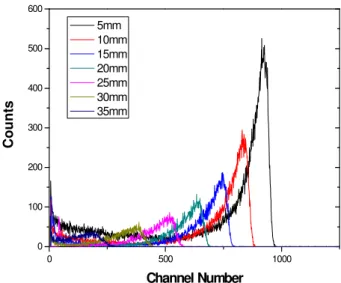
We measured alpha particles response for the CZT detector, the detector B, as a function of the distance between the Pu-238 alpha source and the device. To adjust the distance, we used the chamber controlled the height of the bottom plate. The Pu-238 alpha source was placed on the bottom plate of the chamber. The spectrums were acquired with various distances, 150V bias voltage, 2 ㎲ shaping time and 1800s collection time in an air condition and at room temperature.
Fig. 3 shows the pulse height spectrums of the CZT detector, the detector B, in the distance range from 5mm to 35mm. As the distance between the device and the Pu-238 alpha source is decreased, the position of the full-energy peak is shifted toward upper channel and the
0 500 1000 0 100 200 300 400 500 600 C o u n ts Channel Number 5mm 10mm 15mm 20mm 25mm 30mm 35mm
Figure3. The alpha particles response as a function of the distance between the Pu-238 and the CZT detector
0 5 10 15 20 25 30 35 0 20 40 60 80 100 R e la ti v e V a lu e Source Distance[mm]
Figure4. The collected total charge counts for eack peak as a function of the distance
height of the alpha peak is increased. This is influenced by moderation of the alpha particle energy in air gap between the Pu-238 source and the detector. From the obtained alpha spectrums, we could confirm that the range of the alpha particle is about 3.5mm in air at normal temperature and pressure.
Fig. 4. shows the collected total counts for each peak as a function of the distance. As the distance between the device and the Pu-238 alpha source is increased, the total counts are exponentially decreased and is also influenced by moderation of the alpha article energy.
4. Conclusion
We constructed the forward and reverse current-voltage(I/V) curves and acquired pulse height spectra for the bias voltage 20V. The energy moderations in air were measured by adjusting the distance between the Pu-238 source and the CZT detector. As a result, the CZT semiconductor detectors show a good response for an alpha source and are promising as an alpha particles detector in an air condition and at room temperature.
Acknowledgement
The authors would like to thanks the long and mid term plan of the Ministry of Science and Technology in Korea for financial support of this work.
REFERENCES
[1] C.J. Pearson et al., “The application of CdZnTe detectors for coincident a-γ spectroscopy”, Nucl. Instr. And Meth. A 462(2001) 393
[2] S.M. Vincent et al., “In-beam performance of CdZnTe detectors for proton and alpha-particle measurement”, Nucl. Instr. And Meth. A 483(2002) 758
[3] E.J. Morton et al., “The charged particle response of CdZnTe radiation detectors”, Nucl. Instr. And Meth A 422(1999) 169
[4] Aleksey E. Bolotnikov et al., “Properties of Pt Schottky Type Contacts On High-Resistivity CdZnTe detectors”, http://arxiv.org/ftp/physics/papers/0103/0103005.pdf