Korean J. Environ. Biol. 38(3) : 388-391(2020)
388 ⓒ2020. Korean Society of Environmental Biology.
species is vague. However, several taxonomists have pro-vided an important overview of the systematic identifica-tion and imparted a major contribuidentifica-tion to the complex morphological variations of Henricia species(Clark and Downey 1992).
MATERIALS AND METHODS
The Henricia specimens were collected from the waters
near Jukbyeon and Jumunjin, Korea, using fishing nets on May 25, 2013, and August 29, 2014, respectively. The collected specimens were preserved in 95% ethanol, and the morphological characteristics were examined, such as the size of the disk, the upper and proximal portions of the arms, the number of abactinal spines, the shape of the abactinal and actinal skeleton, and the number of adambu-lacral spines. The morphological features of the specimens
https://doi.org/10.11626/KJEB.2020.38.3.388
INTRODUCTION
The family Echinasteridae is traditionally considered to have eight genera: Aleutihenricia Clark and Jewett 2010; Dictyaster Wood-Mason and Alcock 1891; Echinaster
Müller and Troschel 1840; Henricia Gray 1840; Metrodi-ra GMetrodi-ray 1840; Odontohenricia Rowe and Albertson 1988; Plectaster Sladen 1889; Rhopiella Fisher 1940. The genus Henricia has a complex taxonomic history as many species
have now been assigned to this genus(Fisher 1911; Ha-yashi 1940; D’yakonov 1950). Currently, the world fauna record of genus Henricia which include 94 valid species
(Wakita et al. 2019), 11 of which are present in Korean
fauna. However, this is considered as an underestimation of the real number of species in this diverse genus and it is likely that more species remain unidentified. Some of the previously recognized species within this genus are poorly described, and the identification of the present group of
Note
New record of a sea star, Henricia perforata
(Asteroidea: Spinulosida:
Echinasteridae), in the East Sea, Korea
Michael Dadole Ubagan and Sook Shin*
Department of Animal Biotechnology & Resource and Marine Biological Resource Institute, Sahmyook University, Seoul 01795, Republic of Korea
Korean J. Environ. Biol.
38(3) : 388-391(2020) ISSN 1226-9999(print) ISSN 2287-7851(online)
Korean Journal of Environmental Biology
* Corresponding author Sook Shin Tel. 02-3399-1717 E-mail. [email protected] Received: 9 July 2020 Revised: 25 August 2020
Revision accepted: 27 August 2020
Abstract: Sea stars were collected from the adjacent waters of Jukbyeon and Jumunjin, Korea, using fishing nets at depths of 70-100m. The specimens were identified as Henricia perforata(O.F. Müller, 1776) in the family Echinasteridae and order Spinulosida, with worldwide species distribution. H. perforata can be distinguished from some morphologically related Henricia species by its long, slender, and pointed adambulacral spines. The abactinal skeleton of H. perforata has wide papular areas resembling those of H. pachyderma, but the former has more papulae(two to seven). Previously, two genera of Echinasteridae, Aleutihenricia and Henricia, with a total of 12 echinasterid species, have been reported in Korea. The morphological characteristics of H. perforata are described and photographs are provided.
389
http://www.koseb.org
Henricia perforata from East Sea, Korea
were photographed using a scanning electron microscope (JSM-6510; JEOL Ltd., Tokyo, Japan), stereomicroscope (Nikon SMZ1000; Nikon Co., Tokyo, Japan), and digital camera(Nikon D7000). The abbreviations for the mea-surements were those used by Ubagan and Shin(2019).
SYSTEMATIC ACCOUNT
Class Asteroidea de Blainville, 1830 Order Spinulosida Perrier, 1884 Family Echinasteridae Verrill, 1870
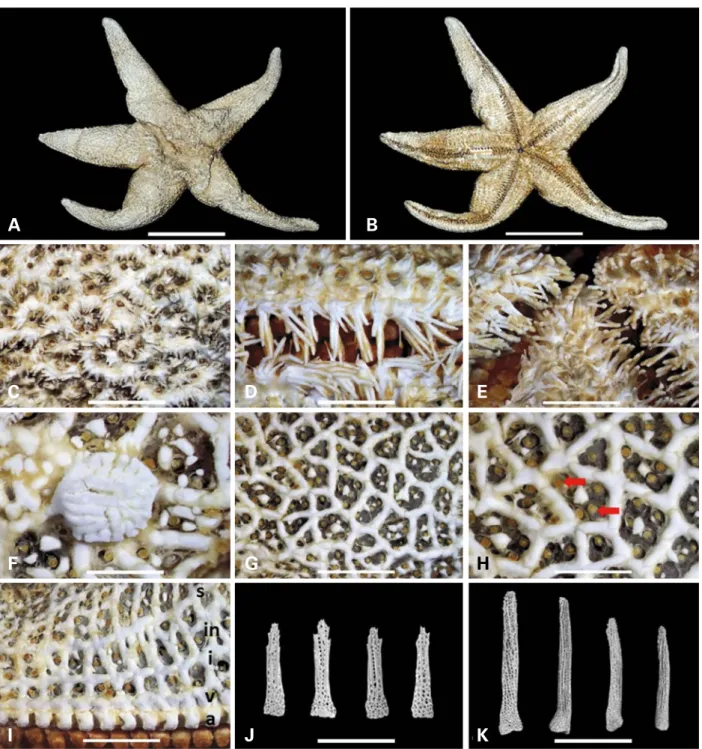
Fig. 1. Henricia perforata. A. abactinal side; B. actinal side; C. abactinal paxillae; D, K. adambulacral spines; E. oral part; F. madreporite; G. abactinal skeleton; H. papulae(arrows); I. actinal skeleton: superomarginal plates(s), intermarginal plates(in), inferomarginal plates(i), ven-trolateral plates(v), adambulacral plates(a); and J. abactinal spines. Scale bars: A, B=1cm, C-I=1mm, J=100μm, K=500μm.
A B
C D E
F G
H
Korean J. Environ. Biol. 38(3) : 388-391(2020)
390 ⓒ2020. Korean Society of Environmental Biology.
Genus Henricia Gray, 1840
Henricia perforata(O.F. Müller, 1776)
구멍애기불가사리(신칭)(Fig. 1A-K)
Henricia perforata: Madsen, 1987: pp. 243-254, figs. 3a,
31-43; Bratova and Paskerova, 2017: pp. 347-348, figs. 4a-4g; Mah, 2020: 123971.
Material examined. Two specimens, Jukbyeon, 25 May 2013, fishing net, Shin and Lee; one specimen, Jumunjin, 29 Aug. 2014, fishing net, Shin and Lee.
Description. Arms five; slightly broad arm base, gradually tapering to tips(Fig. 1A, B). Abactinal paxillae scattered, containing two to six small, delicate spinelets covered with thin integument. Wide papular areas, containing two to seven papulae in an area(Fig. 1C). Abactinal skeleton, open meshed, reticulated, composed of rod-like plates, small ossicles present within papular areas(Fig. 1H). Madreporite small, situated near center of disc, circular in form and bearing spines, same as abactinal spines(Fig. 1F). Both superomarginal and inferomarginal plates dis-tinguishable, reaching tip of arm. Intermarginal plates con-tains wide spaces between inferomarginal and ventrolateral plates. Ventrolateral plates reaching three-quarters of arm length(Fig. 1I). Adambulacral armature comprising five to seven long(1.3-2.2mm), slender spinelets, with inner spine being longer than outer spines arranged in two trans-verse or in zigzag rows(Fig. 1D). An oral plate bearing two slender spines(Fig. 1E). Furrow spine single.
Size. R=54-72mm, r=13-16mm, R/r=4.1-4.5. Habitat. Hard substrates(rocks).
Color. Body color was light brown in alcohol. Korea. East Sea(Jukbyeon, Jumunjin).
Distribution. Korea(East Sea), NE Atlantic: Greenland Sea, North Sea(from northern British Coast, Kattegat, Skagerrak to Norwegian Coast), Norwegian Sea. NW At-lantic: Baffin Sea, Hudson Bay, Labrador Coast. Arctic: Barents Sea, Kara Sea, Laptev Sea, East Siberian Sea. Deposition. The collected specimens have been depos-ited in the Marine Echinoderm Resource Bank of Korea, Sahmyook University, Seoul, Korea.
Remarks. This species has been recorded in the region of Skagerrak/Kattegat between southern Norway and Den-mark and adjacent waters of Northern Atlantic(Madsen 1987; Bratova and Paskerova 2017). We compared our specimens to previously reported broad arms H. pachyder-ma in Korea and found the following differences: 1) the
presence of slender to pointed tip adambulacral spines in H. perforata while stout shape in H. pachyderma; 2) by having
more papulae in H. perforata(two to seven) compared with one to three in H. pachyderma; 3) the body of H. perforata
was covered by thin skin, whereas the body H. pachyderma
was covered by thick skin including spines. Our specimens
H. perforata have some morphological differences
com-pared to the North Atlantic H. perforata. In previous
stud-ies recorded that H. perforata had blunt tip adambulacral
spines(Madsen 1987), but our specimens have slender to pointed tip. Furthermore, many Henricia species have
broad geographic distributions; it is feasible that different populations might experience different environmental conditions that could result in morphological variations (Knott et al. 2018). Moreover, even though our specimens
were found far from the region of origin(North Atlantic), we consider that Korean H. perforata is the same species as
the Northern Atlantic H. perforata. This is the first report
of H. perforata in the marine fauna of Korea.
ACKNOWLEDGEMENTS
This study was supported by a grant from the National Institute of Biological Resources(NIBR), funded by the Ministry of Environment(MOE)(NIBR201902204), and was a part of the project titled “Improvement of manage-ment strategies on marine disturbing and harmful organ-isms(20190518)” funded by the Ministry of Oceans and Fisheries, Korea.
REFERENCES
Bratova O and GG Paskerova. 2017. Henricia spp.(Echinodermata: Asteroidea: Echinasteridae) of the White Sea: morphology, morphometry, and synonymy. Can. J. Zool. 96:341-355. Clark AM and ME Downey. 1992. Starfishes of the Atlantic.
Chapman & Hall Identification Guides 3. Chapman & Hall, London. pp. 1-794.
D’yakonov AM. 1950. Keys to the fauna of the USSR. Sea Stars (Asteroids) of the USSR Seas. Zoological Institute of the Academy of Sciences of the USSR(translated 1968 by Israel Program for Scientific Translations, Jerusalem). 34:1-183. Fisher WK. 1911. Asteroidea of the North Pacific and adjacent
waters. Part. 1. Phanerozonia and Spinulosa. Bull. U. S. Nat. Mus. 76:1-420.
Sea-391
http://www.koseb.org
Henricia perforata from East Sea, Korea
stars of Japan I. Spinulosa. J. Fac. Imp. Sci. Hokkaido Univ. Serial 7:107-204.
Knott KE, H Ringvold and ME Blicher. 2018. Morphological and molecular analysis of Henricia Gray, 1840(Asteroidea: Echi-nodermata) from the Northern Atlantic Ocean. Zool. J. Linn. Soc. 182:791-807.
Madsen FJ. 1987. The Henricia sanguinolenta complex (Echino-dermata, Asteroidea) of the Norwegian Sea and adjacent waters. A re -evaluation, with notes on related species. Steenstrupia 13:201-268.
Mah C. 2020. Henricia perforata (O.F. Müller, 1776). World
As-teroidea database. World Register of Marine Species at http://www.marinespecies.org/aphia.php?p=tax details& id=123971(accessed 06 June 2020).
Ubagan MD and S Shin. 2019. New record of a sea star of genus Henricia(Asteroidea: Spinulosida: Echinasteridae) from Jeju Island, Korea. Korean J. Environ. Biol. 37:68-71.
Wakita D, T Fujita and H Kajihara. 2019. Molecular systematics and morphological analyses of the subgenus Setihenricia (Echinodermata: Asteroidea: Henricia) from Japan. Spec. Div-ers. 24:119-135.