서
론
무궁화는 나라꽃이며 아욱과에 속하는 낙엽 활엽 관목 으로 7월부터 꽃이 피기 시작하여 늦가을까지 계속적으 로 꽃이 피며 한국, 인도, 중국 및 시베리아 등지에 널리 분포한다. 높이는 2~3 m이며 잎은 난형으로 밑은 쐐기 모양이고 세 갈래로 갈라지며 가장자리는 톱니 모양이 다. 무궁화는 재배면적이 많이 필요하고 육종연한이 5~7 년 정도 소요되는 점이 신품종 육성의 장애가 되고 있 기 때문에 광범위하고 새로운 연구가 필요하다. 현재까 지의 무궁화 육종은 국내 자생종의 수집, 품종 간 교잡방 법, 도입 육종, 콜히친 처리에 의한 배수체 육종이 주를 이루었다 (Kim 1962; Kim 1979; Yu et al. 1979). 또한 무궁 화의 자가불화합성 특성과 유전적 이형성은 교배육종을 시도할 경우 분리가 불규칙적으로 나타나는 특성이 있다 ─ ─ 231 ──왜성 변이 품종 ‘꼬마’ 무궁화의 캘러스 유도 및 지상부 형성에
식물생장조절물질이 미치는 영향
이지연∙강은정∙김상훈∙김동섭∙김진백∙하보근∙강시용* 한국원자력연구원 정읍방사선과학연구소The Effect of Plant Growth Regulators on Callus Induction and
Shoot Regeneration from the Dwarf Type Variety,
Hibiscus syriacus L.var. Ggoma
Ji Yeon Lee, Eun Jeong Kang, Sang Hoon Kim, Dong Sub Kim, Jin-Baek Kim, Bo-Keun Ha and Si-Yong Kang*
Advanced Radiation Technology Institute, Korea Atomic Energy Research Institute, Jeongeup 580-185, Korea
Abstract -- ‘Ggoma’ is a new Hibiscus dwarf type variety developed by gamma irradiation at the Korea Atomic Energy Research Institute (KAERI). This study was conducted to determine the best optimum cultural callus formation and shoot regeneration condition. Sterilized leaf tissues were cultured on MS (Marashige and skoog’s) medium containing 3% sucrose, 0.8% agar with different concentration and combination of TDZ, 2, 4-D, KT, BA, and 2iP for 4 weeks in vitro cul-ture. MS medium containing 2,4-D 0.1 mg l--1and BA 0.5 mg l--1were most effective on callus formation and growth. After 4 weeks, callus was transferred on BA (0.5, 1, 1.5 mg l--1) and TDZ (0.1, 0.2, 0.3 mg l--1) for shoot formation. The best condition for inducing the shoot from callus was BA 1.5 mg l--1and TDZ 0.3 mg l--1. This result will be useful for the rapid multiplication of Hibiscus syriacus L.var. Ggoma.
Key words : Callus formation, Dwarf, Hibiscus syriacus, Radiation, Shoot formation
* Corresponding author: Si-Yong Kang, Tel. +82-63-570-3310, Fax. +82-63-570-3329, E-mail. [email protected]
(Song 2006). 이러한 교배 육종방법의 제약을 극복할 수 있는 방안 으로 방사선을 이용한 돌연변이 육종방법이 있다. Staller (1928)는 방사선을 보리에 처리하면 인위적으로 돌연변 이를 일으킬 수 있는 사실을 밝혀내었고 다양한 작물로 부터 방사선을 이용하여 육종기술에 적용한 연구를 보고 하였다. 또한 방사선을 이용한 돌연변이 연구로는 품종별 방사선 감수성, 급조사 및 완조사에 따른 방사선 감수성 의 선량별 비교, 변이율 증대를 위한 방사선 처리시기와 재료선정 및 키메라 생성 등에 관한 연구가 있다 (Van
Harten et al. 1981; Shin et al. 1998). 타 작물의 경우 국화 에서 방사선을 이용하여 화색, 화형, 꽃 색깔 등의 형질을 개선한 보고가 있다 (Broertjes 1996). 그러나 무궁화의 방 사선 돌연변이 육종 연구는 현재까지 미비한 실정이다. 국내에서는 1991년 한국원자력연구원에서 화색, 화형 등의 형질 개선 및 관상 가치가 향상된 무궁화 신품종 개발을 위해 홍단심-2종자에 120 Gy 처리하여 2006년 극왜성으로 선발된 개체 ‘꼬마’ 품종을 육성하였다 (Song 2006). ‘꼬마’의 특징으로 일반 무궁화 잎의 크기는 1/2 ~1/3에 불과하며 꽃의 색은 보라색에 자단심 계통이며 꽃의 크기는 일반 무궁화 꽃 지름보다 훨씬 작은 4~5 cm로 매우 작은 꽃으로 앙증스럽다(Song 2006). 꼬마는 불임성으로 종자번식이 곤란하다. 또한, 왜성이 기 때문에 마디길이가 짧아 삽수체에 의한 번식율도 다 른 품종에 비교하여 떨어진다. 기내 조직배양은 신품종을 개발했을 때 대량증식과 품종유지를 가능하게 하는 방법 중 하나이다. 조직배양 에 사용되는 방법으로는 캘러스를 유도하여 재분화시키 는 방법과 바로 신초를 형성시키는 방법 등이 있다. 무 궁화 조직배양은 배배양, 원형질체배양, 삽수배양, 잎배양 등이 있다 (Chung and Jo 1986; An and park 1992; Kim
1998a; Brian 2008). 조직배양시 식물생장조절제로는 BA,
NAA, Kinetin, 2, 4-D 등이 이용되고 있다. 특히, 하와이 무궁화 삽수에서는 0μm~5 μm BA 호르몬 처리가 최적 의 지상부를 유도시켰다 (Sunil 2009). ‘홍화랑’ 잎 배양에 서는 TDZ 0.01 mg l-1호르몬 처리시 높은 캘러스 형성 률을 보였고 TDZ와 BA의 조합으로 신초를 형성시켰다 (Yoo 1996). 또한 캘러스 유도 후 NAA를 사용하여 지 상부를 발생시켰고 IBA 0.5 mg l-1이용하여 재분화를 유 도한 바 있다(Yang 1995). 본 연구는 왜성품종 ‘꼬마’의 대량증식 시스템을 구축 하기 위해 어린잎을 이용하여 식물생장조절제의 농도 및 조합이 캘러스 형성과 신초 형성에 미치는 영향을 알아보고 이를 통해 무궁화의 산업적 가치를 증대시키 는 목적으로 연구가 수행되었다.
재료 및 방법
1. 실험 재료유리 온실에서 재배중인 ‘꼬마’ (Hibiscus syriacus L.var. Ggoma)의 어린잎을 채취하여 70% 에탄올에서 20초, Tween 20을 첨가한 차아염소산나트륨 (NaOCl) 0.8%에서 20분 소독 후 멸균수로 4회 세척하였다. 잎은 가운데 엽 맥을 중심으로 0.5 cm×0.5 cm 크기로 잘라 사용하였다. 2. 캘러스 배양조건 배지 조성은 MS 기본배지에 3% sucrose 및 0.8% agar 를 사용하였다. 식물생장조절제가 캘러스 형성에 미치는 영향을 알아보기 위해 MS 기본배지에 TDZ, 2, 4-D, BA 를 각각 0.1, 0.5, 1, 1.5, 2 mg l-1의 농도로 조합한 배지를 사용하였다. 또한 2, 4-D 0.1 mg l-1에 KT, BA, 2iP를 각각 0.1, 0.3, 0.5, 1, 1.5 mg l-1의 농도로 조합하였고 TDZ 0.5 mg l-1에 KT, BA, 2iP를 각각 0.1, 0.3, 0.5, 1, 1.5 mg l-1의 농도로 조합한 배지를 사용하였다. 치상한 배지는 90 mm ×15 mm 일회용 petri-dish에 40 ml씩 분주하였으며 어 린잎 절편체는 petri-dish당 16개씩 5반복으로 수행하여 4주간 배양하였다. 배양 4주 후에 캘러스 형성률과 색깔 및 성장 정도를 조사하였다. 기내 배양 환경은 온도 24 ±1�C, 일장주기 16시간, 광도는 27μmol m-2sec-1형광 조명을 사용하여 실험을 수행하였다. 3. 지상부 배양조건 캘러스가 유도된 후 잎의 재분화 조건을 탐색하기 위 해 MS 기본배지에 BA (0.5, 1, 1.5 mg l-1)와 TDZ (0.1, 0.2, 0.3 mg l-1)를 조합한 배지를 사용하였다. 진녹색을 띄는 단단한 배양체 캘러스를 선택하여 배지는 90 mm ×15 mm petri-dish당 20개씩 3반복 수행 후 4주간 배양 하였다. 캘러스 배양 4주 후에 신초 형성률과 성장 정도 를 조사하였고, 캘러스에 잎이 1개 이상 나온 것을 조사 하였으며 하나의 캘러스에 여러 개의 신초가 형성된 것 도 하나로 간주하였다. 기내 배양 환경은 온도 24±1�C, 일장주기 16시간, 광도는 27μmol m-2sec-1형광조명을 사용하여 실험을 수행하였다.
결과 및 논의
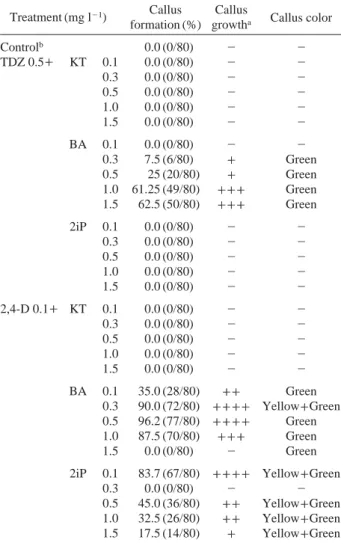
‘꼬마’의 잎으로부터 callus 형성을 유도하기 위하여 TDZ, 2, 4-D, BA 단일 호르몬 처리를 한 결과 BA 0.5 mgl-1에서 85.0%의 비교적 높은 캘러스 형성률을 보였고 TDZ 0.5 mg l-1에서 51.3%의 캘러스 형성률을 보였으며 (Table 1), 캘러스 색이 노란색과 녹색이 혼합된 것을 확 인하였다 (Fig. 1B). 2, 4-D의 경우 캘러스 형성률이 가장 낮았으며 캘러스 색은 흰색을 나타냈다 (Table 1, Fig. 1A). 단일 호르몬 처리를 한 결과 캘러스 형성은 되었으 나 재분화에 적합한 녹색 캘러스를 얻지 못하였다. 이와 같은 결과는 ‘홍화랑’ 품종이 TDZ 0.01 mg l-1에서 100% 의 캘러스 형성률을 나타냈고 (Kim 1998a), 4주 동안 어 린잎 배양 결과 TDZ 0.1 mg l-1에서 캘러스 형성률이 높 Table 1. Effect of three different plant growth regulators at five
combinations on callus formation rate from leaf disc cul-ture of Hibiscus syriacus L.var. Ggoma at 4 weeks after culture
Treatment Callus Callus
(mg l-1) formation (%) growtha Callus color
Controlb 0.0 (0/80) - -TDZ 0.1 38.8 (31/80) ++++ Yellow++Green 0.5 51.3 (41/80) ++++++ Yellow++Green 1.0 42.5 (34/80) ++++ Yellow++Green 1.5 23.8 (19/80) ++ Yellow 2.0 12.5 (2/80) ++ Yellow 2,4-D 0.1 0.0 (0/80) - -0.5 1.3 (1/80) ++ White++Yellow 1.0 2.5 (2/80) ++ White++Yellow 1.5 16.3 (13/80) ++++ White++Yellow 2.0 35.0 (28/80) ++++ White++Yellow BA 0.1 10.0 (8/80) ++ Yellow++Green 0.5 85.0 (68/80) ++++++++ Yellow++Green 1.0 57.5 (46/80) ++++++ Yellow++Green 1.5 0.0 (0/80) - -2.0 0.0 (0/80) -
-a-: none; ++: low; ++++: medium; ++++++: high; ++++++++: very high
bControl: only MS
Table 2. Combined effect of two different growth regulators at
five combinations on callus formation rate from leaf disc culture of Hibiscus syriacus L.var. Ggoma at 4 weeks after culture
Treatment (mg l-1) Callus Callus
formation (%) growtha Callus color
Controlb 0.0 (0/80) - -TDZ 0.5++ KT 0.1 0.0 (0/80) - -0.3 0.0 (0/80) - -0.5 0.0 (0/80) - -1.0 0.0 (0/80) - -1.5 0.0 (0/80) - -BA 0.1 0.0 (0/80) - -0.3 7.5 (6/80) ++ Green 0.5 25 (20/80) ++ Green 1.0 61.25 (49/80) ++++++ Green 1.5 62.5 (50/80) ++++++ Green 2iP 0.1 0.0 (0/80) - -0.3 0.0 (0/80) - -0.5 0.0 (0/80) - -1.0 0.0 (0/80) - -1.5 0.0 (0/80) - -2,4-D 0.1++ KT 0.1 0.0 (0/80) - -0.3 0.0 (0/80) - -0.5 0.0 (0/80) - -1.0 0.0 (0/80) - -1.5 0.0 (0/80) - -BA 0.1 35.0 (28/80) ++++ Green 0.3 90.0 (72/80) ++++++++ Yellow++Green 0.5 96.2 (77/80) ++++++++ Green 1.0 87.5 (70/80) ++++++ Green 1.5 0.0 (0/80) - Green
2iP 0.1 83.7 (67/80) ++++++++ Yellow++Green
0.3 0.0 (0/80) -
-0.5 45.0 (36/80) ++++ Yellow++Green 1.0 32.5 (26/80) ++++ Yellow++Green 1.5 17.5 (14/80) ++ Yellow++Green
a -: none; ++: low; ++++: medium; ++++++: high; ++++++++: very high
b Control: only MS
Fig. 1. Two different callus types on the treatments of single plant growth regulator. A: White++Yellow callus, B: Yellow++Green callus.
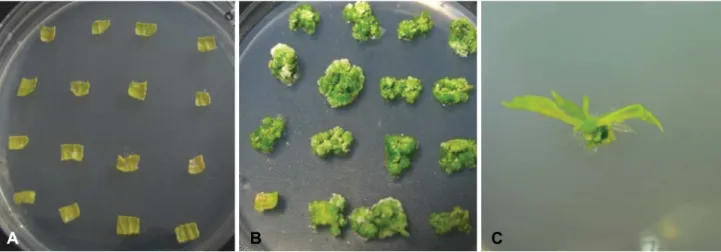
은 것으로 보고된 (Yoo 1996) 기존 연구결과와는 차이가 있다. 이 경우 방사선을 이용하여 만든 돌연변이 품종으 로 기존 연구에서 사용된 무궁화와는 다르게 극왜성의 특징을 가지기 때문인 것으로 사료된다. 이렇듯 단일 호르몬 처리만으로는 캘러스 형성의 어 려움이 있기 때문에 캘러스 형성률이 더 좋은 호르몬 조합을 찾기 위하여 TDZ 0.5 mg l-1에 KT, BA, 2iP (0.1, 0.3, 0.5, 1, 1.5 mg l-1) 조합을 사용하였으며 2, 4-D 0.1 mg l-1와 KT, BA, 2iP (0.1, 0.3, 0.5, 1, 1.5 mg l-1)의 조합을 사용하였다. 그 결과 잎 배양 2주 후 2, 4-D 0.1 mg l-1와 BA 0.5 mg l-1를 조합한 배지에서 96.25%로 높은 캘러 스 형성률을 보였으며, 캘러스의 색은 진녹색을 띄고 캘 러스 성장 정도도 가장 높았다 (Table 2). 잎 배양 2주 후 녹색의 캘러스가 잎 앞면에서 형성되었고 4주 후에는 캘러스가 더 성장한 것을 볼 수 있었으며 신초 유기에 적합한 캘러스를 얻을 수 있었다(Fig. 2). 재분화 유도를 위한 캘러스의 상태는 단단하며 녹색 을 띄는 것을 선택하여 배양해야 한다고 보고된 바 있 다(Kim 2000). 잎 배양 후 유도된 캘러스를 재분화 배지 에 옮길 때 잎 배양 2주 경과된 녹색 캘러스가 4주 경 과된 캘러스보다 잎과 분리가 잘되어 온전한 캘러스만 배양하는 데 더 효과적인 방법이라고 할 수 있다(Fig. 2).
Fig. 2. Callus induction and callus formation from leaf disc of Hibiscus syriacus L.var. Ggoma on 2,4D 0.1++BA 0.5 mg l-1medium. A: Callus induction from the leaf disc for 2 weeks; B: Development of a callus formation for 4 weeks.
Fig. 3. Callus induction and development formation from leaf disc of Hibiscus syriacus L.var. Ggoma on 2,4 D 0.1++BA 0.5 mg l-1medium at 2 and 4 weeks after culture. A: Callus induction from the leaf disc at 2 weeks after culture; B: Development of the callus at 4 weeks after culture; C: Shoot development from callus.
A
B
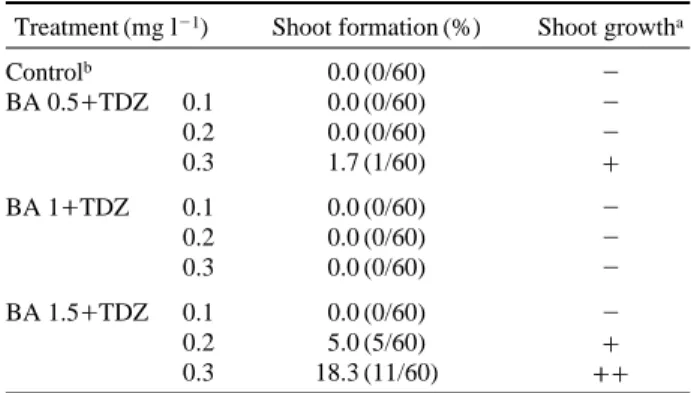
Agarwal (1992)은 목본류의 경우 캘러스에서 신초를 유 도하는 데 BA와 TDZ가 효과적임을 보고하였다. 따라서 본 연구에서도 신초를 유도하기 위하여 BA (0.5, 1, 1.5 mg l-1)와 TDZ (0.1, 0.2, 0.3 mg l-1) 조합을 사용하였다. 그 결과 BA 1.5 mg l-1와 TDZ 0.3 mg l-1에서 18.3%의 신초가 형성되었다 (Table 3, Fig. 3). 본 연구결과에서 ‘꼬 마’의 신초 형성률이 높은 수치는 아니지만 Preece and Huetteman (1991)는 목본류에서는 재분화가 어렵다고 보고하였으며 기존 무궁화 연구에서도 잎 배양을 이용 하여 캘러스 유도 후의 신초 형성률이 낮은 것으로 보 고되어 있다 (Kim 1998b). 그리고 NAA 0.1 mg l-1와 IBA
0.5 mg l-1를 이용하여 재분화를 유도한 연구결과 (Yang 1995)를 바탕으로 본 연구에서도 유도된 캘러스에서 신 초 형성을 위해 IBA, NAA를 추가 실험하였으나 지상부 가 유도되지 않았으며 캘러스 색이 갈색으로 변하며 고 사하는 것을 확인할 수 있었다 (자료 미제시). 이러한 결 과는 기존 연구에서 사용된 품종과의 차이뿐만 아니라 ‘꼬마’의 주요 특성인 극대성이 배양조건의 차이를 야기 시키는 것으로 사료된다.
결
론
본 연구에서는 왜성 무궁화품종 ‘꼬마’의 대량증식 시 스템을 구축하기 위해 잎을 이용하여 식물생장조절제의 농도 및 조합이 캘러스 형성과 신초 형성에 미치는 영 향을 알아보고자 하였다. 캘러스 형성을 위해 TDZ, 2, 4-D, BA 단일 호르몬 처리, TDZ와 KT, BA, 2iP를 조합 및 2, 4-D와 KT, BA, 2iP를 조합한 결과, 단일 호르몬 처리 에서의 캘러스 형성률은 TDZ 0.5 mg l-1에서 51.3%를 나타냈으나 2, 4-D 0.1 mg l-1와 BA 0.5 mg l-1의 조합한 배지에서는 96.25%로 높은 캘러스 형성률을 보였다. 캘 러스가 형성된 지 4주 후 신초를 유도하기 위해 BA와 TDZ를 조합하여 배양한 결과 BA 1.5 mg l-1와 TDZ 0.3 mg l-1에서 18.3%의 신초가 형성되었다. 이러한 실험결 과는 기존의 무궁화 캘러스 및 신초 형성 조건과는 차 이가 나는 것을 확인하였다. 본 연구의 결과는 기내배양 을 통한 ‘꼬마’의 대량증식 시스템을 구축하는 데 중요 한 정보로 활용될 수 있을 것이며 추후 유도된 캘러스 에 방사선 조사를 통하여 돌연변이 신품종을 얻을 수 있는 기초 자료로 활용될 것으로 기대된다.사
사
본 연구는 교육과학기술부 지원 한국원자력연구원 기 본사업에 의해 수행되었으며 이에 감사드립니다.참 고 문 헌
Agarwal B, Singh U and Banerjee M. 1992. In vitro clonal propagation of tea [Camelia sinensis (L) O. Kuntze]. Plant
Cell Tissue. Org. Cult. 30:1-5.
An YK and Park HG. 1992. Studies on vitro shoot regeneration from hypocotyl and cotyledon in Hibiscus syriacus L. Kor.
Soc. Hort. Sci. 33:458-465.
Brian C, Sridevy S, Margrethe S and Renate M. 2008. In vitro culture of Hibiscus rosa-sinensis L.: Influence of iron, cal-cium and BAP on establishment and multiplication. Plant
Cell Tissue. Org. Cult. 93:151-161.
Broertjes C. 1996. Mutation breeding of Chrysanthemum.
Eu-phytica 15:156-162.
Chung JD and Jo JD. 1986. Isolation and culture of protoplast of Hibiscus syriacus and Hibiscus rosa sinensis. Kor. J
Plant Tissue Culture 13:71-83.
Kim CS. 1962. Some characterstics of tetraploid Hibiscus
syri-acus for. purpureus induced by colchicine treatment. Ann. Rep. of Inst. of Forest Genetics 2:57-68.
Kim CS. 1979. Review of genetics and breeding in Hibiscus
genus. Kor. J. Forestry Sci. 43:64-73.
Kim EK, Yoo YK and Kim KS. 1998a. Thidiazuron-induced shoot formation of Hibiscus syriacus L. ‘Honghwarang’ by suspension culture. Kor. J. Hort. Sci. Technol. 16(4): 525-527.
Kim EK, Yoo YK and Kim KS. 1998b. Effect of thidiazuron on callus and multiple shoot formation in shoot-tip culture of Hibiscus syriacus L. ‘Honghwarang’. Kor. J. Hort. Sci.
Technol. 16(4): 520-524.
Table 3. Shoot formation from callus of Hibiscus syriacus L.var.
Ggoma on the BA and TDZ combination at 4 weeks after culture
Treatment (mg l-1) Shoot formation (%) Shoot growtha
Controlb 0.0 (0/60) -BA 0.5++TDZ 0.1 0.0 (0/60) -0.2 0.0 (0/60) -0.3 1.7 (1/60) ++ BA 1++TDZ 0.1 0.0 (0/60) -0.2 0.0 (0/60) -0.3 0.0 (0/60) -BA 1.5++TDZ 0.1 0.0 (0/60) -0.2 5.0 (5/60) ++ 0.3 18.3 (11/60) ++++ a-: none; ++: low; ++++: medium; ++++++: high; ++++++++: very high
Kim JH and Park SM. 2000. In vitro regeneration system nu-cellus of fertilized ovules in Hibiscus syriacus L. J. Agr. Sci.
11:28-38.
Preece JE and Huetteman CA. 1991. Micro and cutting propa-gation of Silver Maple. I. Results with adult and juvenile propagules. J. Amer. Soc. Hort. Sci. 116:142-148.
Shin YU, Kim WC, Moon JY and Chung KH. 1998. Induction of compact mutants in pear (Pyrus pyrifolia Nakai) by gamma irradiation. Res. Report RDA (H). 30:73-78. Song HS, Park IS, Lim YT, Kim JK, Lee GJ, Kim DS, Lee SJ
and Kang SY. 2006. A dwarf type new rose of sharon variety, “Ggoma”. Kor. J. Breed. 38(4):293-294.
Staller LJ. 1928. Mutation in barley induced by X-rays and radium. Science 69:186-187.
Sunil B, Abdullah JO, Sreeramanan S and Karuthan C. 2009. Shoots induction from Hibiscus Rosa-sinensis nodal ex-plant using N6-benzylaminopurine (BAP). Res. J. Agric &
Biol. Sci. 5(4):403-410.
Van Harten AM, Bouter H and Broerties C. 1981. In vitro acventitious bud techniques for vegetative propagation and mutation breeding of potato (Solanum tuberosum L.). II. Significance for mutation breeding. Euphytica 30:1-8. Yang LJ, Makoto H, Haruhiko M and Takeshi U. 1995. In vitro
plant regeneration from leaf and petiole explants of Hibiscus
syriacus L. Plant Tissue Culture Letters 12(2):173-177.
Yoo EH, Yoo YK and Kim KS. 1996. Induction of shoot pri-mordia of Hibiscus syriacus L. ‘Honghwarang’ by suspen-sion culture. J. Kor. Soc. Hort. Sci. 37(4):607-610. Yu TY, Kim CS, Chung HP, Chan SK and Lee YN. 1979. A
report of scientific researches in new cultivated varieties of
Hibiscus syriacus L. Kor. J. Breed. 11:222-231.
Manuscript Received: August 23, 2011 Revised: August 26, 2011 Revision Accepted: August 29, 2011