INTRODUCTION
Paramphicteis Caullery, 1944 is a small genus of the family Ampharetidae Malmgren, 1866 comprised of four species (Reuscher et al., 2015). The members of the genus are charac terized by the following diagnostic features: the prostomium with paired longitudinal glandular ridges, presence of the paired nuchal ridges, pinnate buccal tentacles, and at least one pair of foliose branchiae(Jirkov, 2011; Reuscher et al., 2015). In East Asia, three Paramphicteis species, P. angustifolia(Gru be, 1878), P. sinensis(Sui and Li, 2014), and P. weberi(Caul lery, 1944), have been reported from China and Japan(Sui and Li, 2014; Reuscher et al., 2015). Among them, P. weberi was originally described as Amphicteis weberi from Indonesia, and later transferred to the genus Paramphicteis by the pre sence of the pinnate buccal tentacles based on an examination of Japanese specimens(Reuscher et al., 2015). The specimens previously considered Amphicteis angustifolia by von Maren zeller(1884) from southern Japan were identified as P. weberi by the presence of the paleae on segment II(Reuscher et al., 2015).
The sequences of mitochondrial DNA cytochrome c oxi dase subunit I(COI), 16S ribosomal DNA(16S rDNA), and nuclear 18S ribosomal DNA(18S rDNA) are useful tools to
identify ampharetid polychaetes(Stiller et al., 2020). Because DNA barcoding information for the genus Paramphicteis is lacking, several Amphicteis polychaetes available in GenBank were used in this study. The Amphicteis species used were as follows: A. dalmatica Hutchings & Rainer, 1979, A. gunneri (M. Sars, 1835), A. ninonae Jirkov, 1985, A. obscurior Cham berlin, 1919, and Amphicteis sp.(Colgan et al., 2001; Eilert sen et al., 2017; Kongsrud et al., 2017; Stiller et al., 2020).
In this study, P. weberi is reported from Korean waters for the first time with its three partial DNA barcoding sequences. Based on the Korean specimens, the morphological descrip tion, illustrations, and photographs of the species are provided.
RESULTS AND DISCUSSION
The specimens were collected from muddy sand in the intertid al zone using 500μm mesh sieves. The morphological obser - vation was carried out on live specimens anesthetized with a 10% magnesium chloride solution under a stereomicro scope (SZX12; Olympus, Japan). Dissected appendages were moun ted onto temporary slides using glycerol and observed un der an optical microscope(DM2500; Leica, Germany). The speci mens were fixed in 4% formaldehyde for the morpho
https://doi.org/10.5635/ASED.2021.37.2.008
This is an Open Access article distributed under the terms of the Creative Commons Attribution NonCommercial License(http://creativecommons.org/ licenses/bync/3.0/) which permits unrestricted noncommercial use, distribution, and reproduction in any medium, provided the original work is properly cited.
*To whom correspondence should be addressed Tel: 82-32-860-7692, Fax: 82-32-874-6737 E-mail: [email protected]
A New Record of Paramphicteis weberi
(Polychaeta:
Terebellida: Ampharetidae) in Korean Fauna
Geon Hyeok Lee1, Seong Myeong Yoon2, Gi-Sik Min1,*
1Department of Biological Sciences, Inha University, Incheon 22212, Korea
2Department of Biology, College of Natural Sciences, Chosun University, Gwangju 61452, Korea
ABSTRACT
An ampharetid polychaete, Paramphicteis weberi(Caullery, 1944), originally described from Indonesia, is newly reported from Korean waters. Paramphicteis weberi is characterized by the presence of the prostomial glandular ridges, nuchal ridges, pinnate buccal tentacles, four pairs of the foliose branchiae, and paleae in segment II. The mitochondrial cytochrome c oxidase subunit I(COI), 16S ribosomal DNA(16S rDNA), and nuclear 18S ribosomal DNA(18S rDNA) sequences from the Korean specimens of P. weberi were determined. The intraspecific genetic distance was 0.0-0.2% in COI and no variation was detected in 16S rDNA and 18S rDNA. The inter-specific genetic distances between several Amphicteis species were 20.0-22.0% in COI, 15.3-20.4% in 16S rDNA, and 1.3-3.1% in 18S rDNA. This is the first record of the genus Paramphicteis Caullery, 1944 in Korean fauna.
Keywords: Paramphicteis weberi, COI, 16S rDNA, 18S rDNA, Korea
logical study and 95% ethanol for genetic study. All voucher speci mens were deposited at the National Institute of Biologi cal Res ources in Korea.
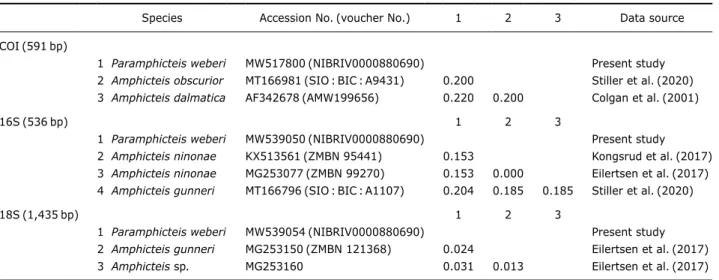
Genomic DNA was extracted from the ethanolpreserved P. weberi specimens(from branchia) using a DNeasy Blood & Tissue Kit(Qiagen, Hilden, Germany) according to the manu facture’s protocol. The sequences of three gene regions were amplified by polymerase chain reaction according to the meth ods described by Kongsrud et al.(2017) using the following primer sets: LCO1490 and HCO2198 for COI(Folmer et al., 1994), 16Sar and 16Sbr for 16S rDNA(Kessing et al., 1989), and 18E/18R1843, 18F997(internal) for 18S rDNA(Kongsrud et al., 2017). The newly determined sequences were regis tered in the GenBank under accession numbers MW517799-801 for COI, MW539049-51 for 16S rDNA, and MW539054 for 18S rDNA. The sequences of P. weberi were aligned with those of other Amphicteis species using Geneious v.8.1.9 (Biomatters, Auckland, New Zealand) and pairwise genetic distances(pdistance) were calculated by MEGA X(Kumar et al., 2018). The intraspecific genetic distances of Korean P. weberi ranged from 0.0 to 0.2% in COI, and no variation in 16S rDNA and 18S rDNA. The inter-specific genetic dis tances among several Amphicteis species available from Gen Bank were 20.0-22.0% in COI, 15.3-20.4% in 16S rDNA, and 1.3-3.1% in 18S rDNA(Table 1). The determined DNA sequences of P. weberi will be useful in future studies of am pharetid taxonomy.
Order Terebellida sensu Rouse & Fauchald, 1997 Family Ampharetidae Malmgren, 1866
1*Genus Paramphicteis Caullery, 1944
2*Paramphicteis weberi(Caullery, 1944)(Figs. 1-3)
Amphicteis angustifolia: von Marenzeller, 1884: 198, Pl. 2, fig. 5.
Amphicteis weberi Caullery, 1944: 76, fig. 62.
Paramphicteis weberi: Reuscher et al., 2015: 936, fig. 6. Material examined. Korea: 4 inds., Jeollabukdo: Buangun, Byeonsanmyeon, Mapori(35°39′32″N, 126°29′22″E), 14 Aug 2018, intertidal, muddy sand(NIBRIV0000880692-4); 3 inds., same locality(35°39′34.5″N, 126°29′21.2″E), 19 Sep 2020, intertidal, muddy sand(NIBRIV0000879442, NIBRIV 0000880690-1).
Diagnosis. Prostomium with paired longitudinal glandular ridges slightly curved anteriorly. Paired nuchal ridges separ ated by wide median gap, arranged at narrowangle to each other. Eyespots absent. Buccal tentacles pinnate with digitiform fila ments arranged in 2 vertical rows. Branchiae foliose, 4 pairs, arranged in 2 transverse rows separated by wide median gap on segments III and IV; first(inner) and second(outer) ones on anterior row, and third(inner) and fourth(outer) ones on posterior row(Figs. 1A-C, 2A, B, 3A, B). Paleae of segment II as long as following notochaetae but slightly thicker, num bering up to 9 per fascicle(Figs. 1A, G, 2A). Notopodia from segment III, with limbate capillaries arranged in 2 rows and tuberculate ventral cirri, present on 17 chaetigers. Neuropodial tori from segment IV with uncini and dorsal lobe, present on 14 chaetigers; thoracic uncini with 4-5 teeth above rostral tooth arranged in single row(Figs. 1D, H, I, 2C, F). Ventral Korean name: 1*깃사슴갯지렁이속(신칭), 2*깃사슴갯지렁이(신칭)
Table 1. Pairwise genetic distances of three gene regions(COI, 16S rDNA, 18S rDNA) between Korean specimens of Paramphicteis
weberi and several Amphicteis species mind from GenBank
Species Accession No.(voucher No.) 1 2 3 Data source COI(591bp)
1 Paramphicteis weberi MW517800(NIBRIV0000880690) Present study 2 Amphicteis obscurior MT166981(SIO : BIC : A9431) 0.200 Stiller et al.(2020) 3 Amphicteis dalmatica AF342678(AMW199656) 0.220 0.200 Colgan et al.(2001)
16S(536bp) 1 2 3
1 Paramphicteis weberi MW539050(NIBRIV0000880690) Present study 2 Amphicteis ninonae KX513561(ZMBN 95441) 0.153 Kongsrud et al.(2017) 3 Amphicteis ninonae MG253077(ZMBN 99270) 0.153 0.000 Eilertsen et al.(2017) 4 Amphicteis gunneri MT166796(SIO : BIC : A1107) 0.204 0.185 0.185 Stiller et al.(2020)
18S(1,435bp) 1 2 3
1 Paramphicteis weberi MW539054(NIBRIV0000880690) Present study 2 Amphicteis gunneri MG253150(ZMBN 121368) 0.024 Eilertsen et al.(2017) 3 Amphicteis sp. MG253160 0.031 0.013 Eilertsen et al.(2017)
shields distinct to thoracic unciniger 10, becoming faint from thoracic uncinigers 11. Modified notopodia and intermediate uncinigers absent. Abdominal uncinigers present on 15 chae
tigers; pinnules each with digitiform dorsal cirrus(Figs. 1E, 2D). Pygidium with terminal anus and a pair of lateral cirri form anal cirri(Figs. 1F, 2E).
Fig. 1. Paramphicteis weberi(Caullery, 1944)(NIBRIV0000880692). A, Anterior end without branchiae; B, Branchia; C, Buccal
ten-tacles; D, Thoracic parapodia; E, Abdominal parapodia; F, Posterior end; G, Palea; H, Limbate notochaeta; I, Thoracic uncinus. Scale bars: A, B, F=1.0mm, C=0.3mm, D, E=0.5mm, G, H=0.8mm, I=0.03mm.
D
G
H
I
F
E
C
A
B
A B C D, E G, H I FRemarks. Paramphicteis weberi is characterized by the fol low ing characteristics combined: (1) presence of the prosto mial glandular ridges and nuchal ridges, (2) pinnate buccal ten tacles, (3) four pairs of foliose branchiae, (4) presence of the paleae on segment II, and (5) similar paleae length to the fol lowing notochaetae(Reuscher et al., 2015). A morphological difference between Indonesian(type locality) and East Asian
(Korean and Japanese) specimens of P. weberi is observed in the number of the abdominal uncinigers: 14 uncinigers in the Indonesian vs. 15 in East Asian specimens(Reuscher et al., 2015). Paramphicteis weberi is similar to P. angustifolia in having four pairs of foliose branchiae. However, the former can be distinguished from the latter by the presence of paleae on segment II which are as long as the following notochaetae
Fig. 2. Paramphicteis weberi(Caullery, 1944)(NIBRIV0000880692), specimen fixed in alcohol. A, Anterior end without branchiae;
B, Buccal tentacles; C, Thoracic parapodia; D, Abdominal parapodia; E, Posterior end; F, Thoracic uncini. Scale bars: A=1.0mm, B=0.28mm, C, E=0.5mm, D=0.3mm, F=0.04mm.
A
C
E
B
D
F
(Reuscher et al., 2015).
Habitat. From intertidal to subtidal zones at 185m depth (Reuscher et al., 2015). In this study, Korean specimens were collected from the muddy sand in the intertidal zone.
Distribution. Indonesia(type locality), Japan, Korea.
ORCID
Geon Hyeok Lee: https://orcid.org/0000000175173086 Seong Myeong Yoon: https://orcid.org/0000000232463021 GiSik Min: https://orcid.org/0000000327393978
CONFLICTS OF INTEREST
Seong Myeong Yoon and GiSik Min, contributing editors of the Animal Systematics, Evolution and Diversity, were not involved in the editorial evaluation or decision to publish this article. The remaining author has declared no conflicts of interest.
ACKNOWLEDGMENTS
This study was supported by the National Institute of Bio logical Resources(NIBR), funded by the Ministry of Environ ment(MOE) of the Republic of Korea(NIBR202002204).
REFERENCES
Caullery M, 1944. Polychètes sédentaires de l’expedition du Sibo ga. Ariciidae, Spionidae, Chaetopteridae, Chlorhaemi dae, Opheliidae, Oweniidae, Sabellariidae, Sternaspidae, Amphictenidae, Ampharetidae, Terebellidae. SibogaExpedi tie, 24:1204.
Colgan DJ, Hutchings PA, Brown S, 2001. Phylogenetic rela tionships within the Terebellomorpha. Journal of the Marine Biological Association of the United Kingdom, 81:765773. https://doi.org/10.1017/S002531540100457X
Eilertsen MH, Kongsrud JA, Alvestad T, Stiller J, Rouse GW, Rapp HT, 2017. Do ampharetids take sedimented steps between vents and seeps? Phylogeny and habitatuse of Amphareti dae(Annelida, Terebelliformia) in chemosynthesisbased ecosystems. BMC Evolutionary Biology, 17:222. https://doi. org/10.1186/s1286201710651
Folmer O, Black M, Hoeh W, Lutz R, Vrijenhoek R, 1994. DNA primers for amplification of mitochondrial cytochrome c oxi dase subunit I from diverse metazoan invertebrates. Molecu lar Marine Biology and Biotechnology, 3:294299.
Jirkov IA, 2011. Discussion of taxonomic characters and classifi cation of Ampharetidae(Polychaeta). Italian Journal of Zoo logy, 78:7894. https://doi.org/10.1080/11250003.2011.6172 16
Kessing B, Croom H, Martin A, McIntosh C, Owen McMillian W, Palumbi S, 1989. The simple fool’s guide to PCR. Depart ment of Zoology, University of Hawaii, Honolulu, HI, pp. 147.
Kongsrud JA, Eilertsen MH, Alvestad T, Kongshavn K, Rapp HT, 2017. New species of Ampharetidae(Annelida: Poly
Fig. 3. Paramphicteis weberi(Caullery, 1944)(NIBRIV0000879442), specimen alive in seawater. A, Lateral view; B, Anterior end
with branchiae, dorsal view. Scale bars: A=5.0mm, B=1.0mm.
chaeta) from the Arctic Loki Castle vent field. Deep-Sea Res-earch Part II: Tropical Studies in Oceanography, 137:232 245. https://doi.org/10.1016/j.dsr2.2016.08.015
Kumar S, Stecher G, Li M, Knyaz C, Tamura K, 2018. MEGA X: Molecular evolutionary genetics analysis across computing platforms. Molecular Biology and Evolution, 35:15471549. https://doi.org/10.1093/molbev/msy096
Reuscher MG, Fiege D, Imajima M, 2015. Ampharetidae(Annel ida: Polychaeta) from Japan. Part III: The genus Amphicteis Grube, 1850 and closely related genera. Journal of the Mar ine Biological Association of the United Kingdom, 95:929 940. https://doi.org/10.1017/S0025315414001623
Stiller J, Tilic E, Rousset V, Pleijel F, Rouse GW, 2020. Spaghetti to a tree: a robust phylogeny for Terebelliformia(Annelida)
based on transcriptomes, molecular and morphological data. Biology, 9:73. https://doi.org/10.3390/biology9040073 Sui J, Li X, 2014. Pseudoamphicteis sinensis sp. nov., a new
species of Ampharetidae(Polychaeta) from China. Zootaxa, 3872:376380. https://doi.org/10.11646/zootaxa.3872.4.4 von Marenzeller E, 1884. Südjapanische Anneliden II. Amphare
tea, Terebellacea, Sabellacea, Serpulacea. Denkschriften der MathematischNaturwissenschaftlichen Classe der Kaiserli chen Akademie der Wissenschaften, 49:197224.
Received March 2, 2021 Revised April 13, 2021 Accepted April 13, 2021