J Korean Acad Community Health Nurs (지역사회간호학회지) https://doi.org/10.12799/jkachn.2018.29.4.467
Adherence to the Clean Intermittent Catheterization Following a Customized
Intensive Education Program for Patients with Emptying Failure
Lee, Sang Rim
1· Lee, In Sook
2· Oh, Seung-June
3· Kim, Sung Hwa
4· Chin, Young Ran
51Registered Nurse, Clean Intermittent Catheterization Center of Department of Urology, Seoul National University Hospital, Seoul
Doctoral Student, Community Health Nursing & Nursing Care Systems, Graduate School, College of Nursing, Seoul National University, Seoul
2Professor, College of Nursing, Seoul National University, Seoul 3Professor, Department of Urology, Seoul National University Hospital, Seoul
4Registered Nurse, Clean Intermittent Catheterization Center of Department of Urology, Seoul National University Hospital, Seoul 5Professor, Department of Nursing, Chungwoon University, Hongseong, Korea
Purpose: The purpose of this study is to investigate adherence to the clean intermittent catheterization (CIC) and influencing factors on the adherence following a customized intensive education program (CIEP). Methods: This work is a retrospective descriptive study. The subjects were 226 emptying failure patients who learned in a CIEP from January 2012 to July 2014. The program developed in 2011 and consisted of 1) customized theoretical educa-tion; based on the results of urologic tests, underlying disease, or surgery of the patients, 2) hands-on practice until the trainees were able to master the techniques, 3) questions about the process of catheterization and what he/she needs to know. 4) at follow-up, the survey about adherence and barrier to CIC. Clinical characteristics; the level of satisfaction, understanding, and self-confidence; the barrier in medical records were reviewed. Results: The short-term adherence rate (median 22 days) is 87.6% and the long-term adherence rate (median 112 days) is 50.4%. The biggest obstacle is time management. The levels of satisfaction, understanding, and self-confidence are very high. The variable of Income is the only factor that has influence on adherence. Conclusion: Despite the CIEP, the adherence rate is relatively low. In addition to the education, emotional and psychological supports and regular fol-low-up are needed to improve long-term adherence.
Key Words: Intermittent urethral catheterization; Education; Patient compliance
Corresponding author: Lee, In Sook
College of Nursing, Seoul National University, 103 Daehak-ro, Jongno-gu, Seoul 03080, Korea. Tel: +82-2-740-8828, Fax: +82-2-741-1574, E-mail: [email protected]
Received: Apr 6, 2018 / Revised: Aug 31, 2018 / Accepted: Oct 7, 2018
This is an open access article distributed under the terms of the Creative Commons Attribution Non-Commercial License (http://creativecommons.org/licenses/ by-nc/3.0), which permits unrestricted non-commercial use, distribution, and reproduction in any medium, provided the original work is properly cited.
INTRODUCTION
A complex mechanism of the bladder, urethra, and nervous system is involved in the storage of urine and micturition [1]. Therefore, incomplete bladder emptying can result from a wide variety of neurological and uro-logical disorders [2,3]. In the event of bladder emptying failure, catheterization, bladder expression, reflex void-ing, and clean intermittent catheterization (CIC) can be utilized to eliminate urine [4]. Among them, it is known that CIC introduced by Lapides et al. [5] is the gold stand-ard treatment due to a markedly lower incidence of com-plications such as urinary tract infections and kidney dam-age compared to all the other treatments [6-8]. Moreover, CIC is known to be so easy that anyone can perform [9].
However, in spite of benefits, the adherence rate isn’t high, variously reported from 20~81% [10-13]. Hence, many studies have been conducted to improve adherence. Some researchers tried to make use of a new catheter, but neither a compact catheter to reduce the burden of carrying nor a lubricated catheter to reduce pain made any differences in the compliance [14,15]. Other researchers recommended educational contents and teaching methods [16-20]. Some of them argued that CIC instructor should evaluate pa-tients’ conditions and provide customized education [21]. However, previous studies have only reported the adher-ence rate related to a disease without mentioning the edu-cation contents or methods [10,13,22] or satisfaction with the education program, or whether the patients could per-form CIC shortly after the education [16,17]. There has
been little research about the adherence following the edu-cation which contained suggestions and recommenda-tions mentioned above. In the present study, we inves-tigated the adherence to CIC following a CIEP for patients with emptying failure.
METHODS
1. Study Design
This study was a retrospective descriptive study. The purpose of this study was to investigate the adherence to CIC following a CIEP and influencing factors on com-pliance.
2. Study Participants
We retrospectively reviewed the data in November 2016. The inclusion criteria were as follows: (1) patients aged over 15 years with emptying failure. Emptying fail-ure patients were defined as those who couldn’t void at all or could partially void with a large amount (>100 cc) of re-sidual urine. (2) All patients who revisited the CIC clinic for follow up betweenJanuary 2012 and July 2014. This study was undertaken in a tertiary referral center, and all patients in need of CIC were referred to the CIC clinic in the hospital.
3. Study Protocol
The CIEP on CIC was created at the research hospital in 2011. Since then, all patients who were prescribed CIC have learnt the procedure through the program. It was based on previous protocol [16]. Some of the protocol has been modified on the basis of many research findings. It was made up of theoretical knowledges and hands-on practice. Total education time was approximately one hour, and the education was provided one-on-one in a separate space.
The nurse in charge of education completed a Ph.D. program and had more than 15 years of clinical experien-ce. She has attended a conference with peer group and of physicians every month; and lectured as an expert in the urology academic society every year.
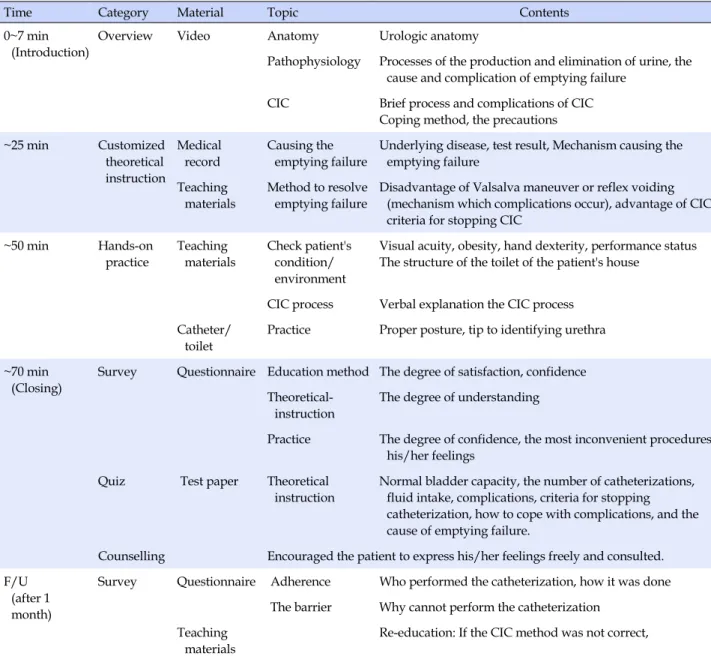
The program consisted of watching video, customized theoretical knowledges instruction, and hands-on practice (Table 1). Before education, the nurse checked a medical record such as results of urodynamic study, ultrasonogra-phy, and underlying disease or surgery record.
At first, a patient watched a video for an overview of
CIC. The video lasted for 7 minutes.
After watching the video, customized theoretical know-ledges instruction was provided based on the disease sta-tes and sta-test results individually. The nurse explained the patient's underlying disease and how the underlying dis-ease cause the emptying failure in detail. In addition, the nurse stressed the advantage of CIC and disadvantage of other methods including the mechanism which complica-tions occur. The patient was educated about the CIC thor-oughly.
The next course was a hands-on practice. Before prac-tice education, the nurse checked the patient’s physical condition and the structure of the toilet of the patient's house. The nurse explained the process as simply as possi-ble in order not to make it strike the patients as a cumber-some technique. They were taught differently depending on the sex: man in the standing position and a woman in the sitting position on a toilet, respectively. The nurse found the most appropriate posture for the catheterization with the patient and taught various ways to locate the urethra. If the patient had poor vision, she taught the ways to locate the urethra by touch. Except for the patients who were bed-ridden and quadriplegic, she encouraged them to catheterize themselves. The practice session continued until the trainee was able to master the technique.
When the education was over, each patient received a questionnaire about the degree of understanding, satisfac-tion with the educasatisfac-tion, and degree of confidence that he/she could catheterize alone; and the most inconvenient procedures. Additionally, the nurse asked the patient about the process of catheterization and what he/she needs to know using short answer questions; if the patient answered incorrectly, the nurse explained it again. At the end of the program, the nurse encouraged the patient to express his/her feelings freely and consulted. If the pa-tient wanted additional counselling after returning home, the patient could call the nurse during office hours.
To check the patients’ voiding conditions and compli-ance, the urologist advised them to revisit the urology clinic no later than one month after the completion of the education. When they revisited, the interview was done via a questionnaire. It included questions about who per-formed the catheterization, how it was done, or what made the subjects compliant or noncompliant. If the CIC method was not correct, re-education was provided.
4. Data Collection
We collected clinical characteristics of patients such as age, sex, income, education level, occupation, hand
dex-Table 1. Contents of Customized Intensive Education Program
Time Category Material Topic Contents
0~7 min (Introduction)
Overview Video Anatomy Urologic anatomy
Pathophysiology Processes of the production and elimination of urine, the cause and complication of emptying failure
CIC Brief process and complications of CIC Coping method, the precautions ~25 min Customized theoretical instruction Medical record Causing the emptying failure
Underlying disease, test result, Mechanism causing the emptying failure
Teaching materials
Method to resolve emptying failure
Disadvantage of Valsalva maneuver or reflex voiding (mechanism which complications occur), advantage of CIC, criteria for stopping CIC
~50 min Hands-on practice Teaching materials Check patient's condition/ environment
Visual acuity, obesity, hand dexterity, performance status The structure of the toilet of the patient's house
CIC process Verbal explanation the CIC process Catheter/
toilet
Practice Proper posture, tip to identifying urethra ~70 min
(Closing)
Survey Questionnaire Education method The degree of satisfaction, confidence Theoretical-
instruction
The degree of understanding
Practice The degree of confidence, the most inconvenient procedures, his/her feelings
Quiz Test paper Theoretical instruction
Normal bladder capacity, the number of catheterizations, fluid intake, complications, criteria for stopping catheterization, how to cope with complications, and the cause of emptying failure.
Counselling Encouraged the patient to express his/her feelings freely and consulted. F/U
(after 1 month)
Survey Questionnaire Adherence Who performed the catheterization, how it was done The barrier Why cannot perform the catheterization
Teaching materials
Re-education: If the CIC method was not correct,
CIC=clean intermittent catheterization; F/U=follow up.
terity, performance status, primary reasons for emptying failure and voiding status. Among the primary reasons for emptying failure, hysterectomy and low anterior resection was categorized as peripheral nerve injury, and diabetes and peripheral neuropathy were categorized as systemic disease. The voiding status was divided into partial emp-tying failure and complete empemp-tying failure.
For the short-term adherence rate, answers to the ques-tionnaire and voiding diary in medical records on the sec-ond visit were analyzed. The question of questionnaire was “Did you perform CIC as the doctor ordered?” Of the 6 scale answer to the question, ‘somewhat yes’, ‘almost yes’, ‘completely yes’ were categorized as adherent. The
medical records and voiding diary in medical record on the last follow-up day were analyzed for the long-term ad-herence rate. We reviewed the medical record in Novem-ber 2016. The case that self- voiding was restored and reg-ular catheterizing was performed until the last visit were categorized as adherent. If the last follow-up day was over 6 months, they are categorized follow-up loss and non-ad-herent.
The level of understanding, satisfaction, and confidence after first education and barrier to CIC were also collected. Finally, we investigated the influencing factor on adhe-rence.
of Seoul National University Hospital (No: H-1408-002- 596). This study was exempted from receiving consent be-cause it is unlikely to be-cause harm to subjects
5. Data Analysis
Descriptive analysis was conducted for description. For the difference in urologic anatomy and urination process by sex, we classified the subjects into male and female groups. Chi-sure or Fisher’s exact test for categorical vari-able and student’s t-test for continuous varivari-able were used to compare differences between groups. We evaluated po-tential influencing factors on the adherence: adherent and non-adherent. These variables were sex, age, the level of education, income, occupation, primary reason for empty-ing failure, the level of understandempty-ing, the level of sat-isfaction, the level of confidence. Statistical analyses were done with the SPSS software (Statistical Package for the Social Sciences, version 21.0, SPSS Inc.), and a p-value of < 0.05 with a 95% confidence level was considered statisti-cally significant.
RESULTS
1. Characteristics of Patients
The average age was 65.25±14.18 years and the man was older (p=.002). 62.4 % of patients were men. Unem-ployment (51.1%) in male and housewives (68.2%) in fe-male were the most common. About 72% of the fe-male and 64.7% of the female patients had a good dexterity of the hand. 56.6 % of patients could walk without help. 77.0% of patients could perform self-catheterization after the first session of education. The most common primary reasons for emptying failure were urologic disease (32.6%) in male and spinal cord lesions (30.6%) in female. Most of the pa-tients with unknown etiologies were in a bedridden state. Demographic and clinical characteristics of the patients are presented in Table 2.
2. Response to Initial CIC Education
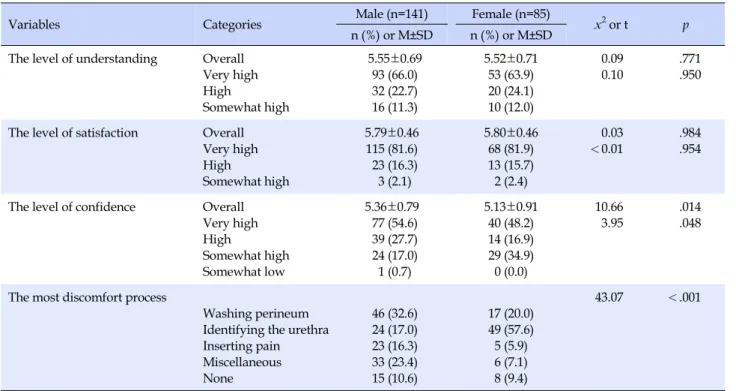
Most of the patients showed a high level of understand-ing, satisfaction, and confidence. The level of confidence of male was higher than female (p=. 014). The most uncom-fortable process was significantly different depending on the gender (p<.001). The male patients thought cleaning the perineum caused the most discomfort while the female patients thought identifying the urethra caused the most discomfort. The male patients complained about a sense of
discomfort during the insertion of the catheter much more than the female patients (Table 3).
3. Adherence Rate and Barrier
At the second visit, the median duration was 22days, adherence rate was 87.6%(198 of the 226). 28 patients were non-adherent and 16 of 28 did not performed CIC at all. The degree of short term adherence was different by gen-der (p=.031). The major barrier was time management (44.7 %), followed by none (24.8%). Although the number de-creased, male still had difficulty inserting the catheter and female patients had difficulty identifying the urethra. The number of people who said there was no difficulty has grown from 23 to 56.
The long-term, the median time was 112 days, adher-ence rate was 50.4%. Ten of the 30 patients who stopped catheterization on their own authority were too seriously ill to perform CIC and had to switch to indwelling cathe-terization. And nine of the 51 follow-up loss patients were stable, so referred to the primary clinic where the patient lived (Table 4).
4. The Influencing Factor on Compliance
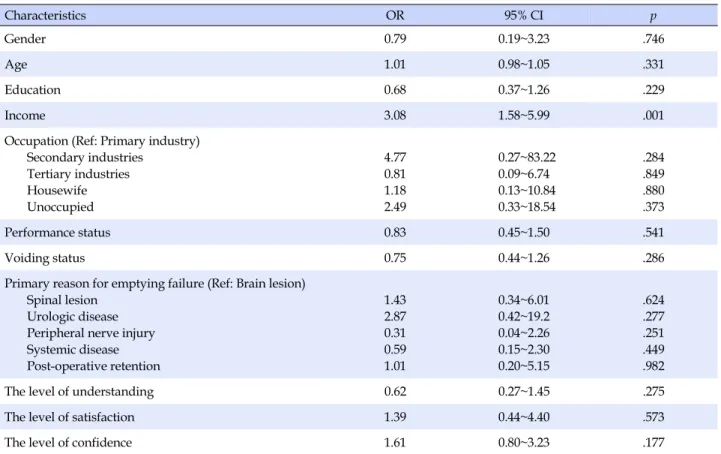
According to univariate logistic regression analysis, on-ly income variable was associated with adherence (OR: 3.08 [95% CI=1.58~5.99], p=.001), so we couldn’t perform multivariable logistic regression analysis. The other varia-ble did not show any significant difference between the two groups (Table 5).
DISCUSSION
We evaluated the adherence to the CIC following the CIEP and influencing factors on the adherence. The short- term adherence rate (median 22 days) was 87.6% and the long-term adherence rate (median 112 days) was 50.4%. The biggest obstacle was the time management. Only in-come variable differed significantly between the two groups.
The ongoing CIEP of our clinic were devised by adopt-ing the recommendations suggested by other studies [18- 20]: providing an overview of the anatomy using educa-tional materials, voiding symptoms, underlying disease and identification of psychological issues, physical prob-lems and consult about them. Additionally, we tried to provide education in a silent and low stress setting and not to give up teaching disabled patients. We spent sufficient time trying to educate the subjects completely. Plain
ex-Table 2. Characteristics of Patients (N=226)
Characteristics Categories Male (n=141) Female (n=85) x2 or t p
n (%) or M±SD n (%) or M±SD Age (year) Overall
23~50 51~65 66~85 86~100 67.53±13.47 15 (10.6) 38 (27.0) 81 (57.4) 7 (5.0) 61.47±14.60 18 (21.2) 30 (35.3) 34 (40.0) 3 (3.5) 10.08 8.68 .002 .034
Education level Uneducated
Elementary/middle school High school ≥College No response 9 (6.4) 28 (19.8) 45 (31.9) 58 (41.1) 1 (0.8) 4 (4.7) 27 (31.8) 26 (30.6) 27 (31.8) 1 (1.1) 4.62 .202
Occupation Primary industries Secondary industries Tertiary industries Housewife Unoccupied 9 (6.4) 21 (14.9) 35 (24.8) 4 (2.8) 72 (51.1) 2 (2.4) 4 (4.7) 15 (17.6) 58 (68.2) 6 (7.1) 120.41 <.001
Income per month (10,000 won) <100 100~300 301~500 >500 No response 41 (29.1) 53 (37.6) 27 (19.1) 16 (11.3) 4 (2.9) 19 (22.4) 32 (37.6) 15 (17.6) 14 (16.5) 5 (5.9) 1.98 .576
Hand dexterity Good Poor Incapable 102 (72.3) 20 (14.2) 19 (13.5) 55 (64.7) 3 (3.5) 27 (31.8) 14.97 .001 Performance status Normal gait Gait disturbance Paraplegia Bedridden 81 (57.4) 49 (34.8) 7 (5.0) 4 (2.8) 47 (55.3) 28 (32.9) 4 (4.7) 6 (7.1) 2.24 .525 Primary reason for emptying failure Brain lesion Spinal lesion
Peripheral nerve injury Systemic disease Urologic disease Others 39 (27.7) 26 (18.4) 10 (7.1) 9 (6.4) 46 (32.6) 11 (7.8) 18 (21.2) 26 (30.6) 22 (25.9) 5 (5.9) 5 (5.9) 9 (10.5) 34.80 <.001
Voiding status Partial emptying failure Complete emptying failure
66 (46.8) 75 (53.2)
40 (47.1) 45 (52.9)
<0.01 .971
planations for information on emptying failure and the CIC process that fits the intellectual level of each patient using various audiovisual aids may be helpful. Using vari-ous methods to teach how to resolve difficulties in finding the urethra enabled patients to perform the catheteriza-tion. Consequently, the level of understanding, satisfac-tion, and confidence was very high.
Parsons et al.[23] reported that the short term (6 weeks) adherence rate of 309 patients with non-neurogenic blad-der was 84%. This is similar to the result of this research. The long-term adherence rate of existing studies was var-ied [6,24-26]. The research of Bolinger & Engberg [24]
re-ported that after 60 months, the compliance rate was 76.9 %. However, only 10.2 % of the patients performed CIC ac-cording to the doctor’s prescription, the remainder cathe-terized relying on their perception. In presenting study, 50.4% patients performed CIC according to the doctor’s prescription. In another study which the study partic-ipants were children (60 boys), the long term adherence (9.9 years) was 82%. They claimed that their high adher-ence rate was due to the constant involvement of an expe-rienced nurse [25]. In this study setting, tertiary hospitals, referral to the primary clinic where the patient lived was common. These feature may influence the low long-term
Table 3. Patient's Response to Initial CIC Education (N=226)
Variables Categories Male (n=141) Female (n=85) x2 or t p
n (%) or M±SD n (%) or M±SD The level of understanding Overall
Very high High Somewhat high 5.55±0.69 93 (66.0) 32 (22.7) 16 (11.3) 5.52±0.71 53 (63.9) 20 (24.1) 10 (12.0) 0.09 0.10 .771 .950
The level of satisfaction Overall Very high High Somewhat high 5.79±0.46 115 (81.6) 23 (16.3) 3 (2.1) 5.80±0.46 68 (81.9) 13 (15.7) 2 (2.4) 0.03 <0.01 .984 .954
The level of confidence Overall Very high High Somewhat high Somewhat low 5.36±0.79 77 (54.6) 39 (27.7) 24 (17.0) 1 (0.7) 5.13±0.91 40 (48.2) 14 (16.9) 29 (34.9) 0 (0.0) 10.66 3.95 .014 .048
The most discomfort process
Washing perineum Identifying the urethra Inserting pain Miscellaneous None 46 (32.6) 24 (17.0) 23 (16.3) 33 (23.4) 15 (10.6) 17 (20.0) 49 (57.6) 5 (5.9) 6 (7.1) 8 (9.4) 43.07 <.001
Table 4. Patient's Adherence and Barrier
Variables Categories Male (n=141) Female (n=85) x2 p
n (%) n (%)
Long term adherence Self-voiding Completely Intermittent Not at all Follow-up loss 49 (34.8) 21 (14.9) 20 (14.2) 17 (12.1) 34 (24.1) 36 (42.3) 8 (74.6) 11 (12.9) 13 (15.3) 17 (20.0) 2.93 .569
Short term adherence Completely Almost Somewhat Intermittent Rarely Not at all 81 (57.4) 23 (16.3) 21 (14.9) 2 (1.4) 7 (5.0) 7 (5.0) 51 (60.0) 19 (22.4) 3 (3.5) 2 (2.4) 1 (1.2) 9 (10.6) 12.33 .031
Barrier Equipment preparation
Washing perineum Identifying the urethra Time management Inserting pain Disability None
Do not know (never try) Worry 2 (1.4) 4 (2.8) 2 (1.4) 67 (47.5) 17 (12.1) 7 (5.0) 33 (23.4) 7 (5.0) 2 (1.4) 0 (0.0) 3 (3.5) 11 (12.9) 34 (40.0) 5 (5.9) 3 (3.5) 23 (27.1) 6 (7.1) 0 (0.0) 18.42 .018
adherence rate. Motavasseli et al.[26] reported the adher-ence rate (median 42 weeks) of 35 patients with multiple sclerosis was only 29%. The median Expanded Disability Status Scale, EDSS is a method of quantifying disability in
multiple sclerosis, of the participants was 6.0. The score 6.0 means the condition that the patients requires a walking aid - cane, crutch, etc. - to walk about 100m with or with-out resting [27]. The performance state of the study
partic-Table 5. The Influencing Factor on Compliance Characteristics OR 95% CI p Gender 0.79 0.19~3.23 .746 Age 1.01 0.98~1.05 .331 Education 0.68 0.37~1.26 .229 Income 3.08 1.58~5.99 .001
Occupation (Ref: Primary industry) Secondary industries Tertiary industries Housewife Unoccupied 4.77 0.81 1.18 2.49 0.27~83.22 0.09~6.74 0.13~10.84 0.33~18.54 .284 .849 .880 .373 Performance status 0.83 0.45~1.50 .541 Voiding status 0.75 0.44~1.26 .286
Primary reason for emptying failure (Ref: Brain lesion) Spinal lesion
Urologic disease Peripheral nerve injury Systemic disease Post-operative retention 1.43 2.87 0.31 0.59 1.01 0.34~6.01 0.42~19.2 0.04~2.26 0.15~2.30 0.20~5.15 .624 .277 .251 .449 .982
The level of understanding 0.62 0.27~1.45 .275
The level of satisfaction 1.39 0.44~4.40 .573
The level of confidence 1.61 0.80~3.23 .177
OR=odds ratio; CI=confidence interval.
ipants was worse than this study participants, 56.6% pa-tients could walk without help, so their adherence may be lower than presenting study.
Discomfort due to CIC changed over time; from storage and irrigation of the catheter, washing the urethra and perineum, and identifying the urethral orifice to the time management. In other studies, the most common barriers associated with CIC were the difficulty of using a bath-room; positioning to insert the catheter [24,26]. This means that the vague anxiety about catheterization disappears over time, but having a social life with catheterization, in-corporating catheterization into daily routines and being able to perform the procedure properly both outside and inside home are continuous challenges [20,28,29]. So the instructors should provide realistic tips as well as other al-ternative tips for balancing the catheterization and social life.
The previous literature reported that cost was barrier for CIC [24]. These results are also found in other health behavior-related studies [30]. However, the impact is ex-pected to have been reduced with insurance coverage in 2017.
Girotti et al. [10] reported that the adherence rate (6 month) was 61.7% and higher in women and under the
age of 40; and Motavasseli et al. [26] reported more severe voiding dysfunction measured using the Urinary Symp-tom Profile was associated with adherence. However, there was no difference in sex, age, voiding status between adherents and non-adherents in this study. They also re-ported that emotional (depression), psychological status and social relationships were associated with adherence. However, the psychological and emotional factors were not analyzed in this study; this might be why we could not find influencing factor except income variable.
At the first follow-up, 10 patients did not perform cathe-terization; however, after consultation, they performed catheterization well. On the other hand, 29 patients who could catheterize at the clinic gave up self-catheterization at home and the adherence rate decreased over time. These phenomena are good examples that show the im-portance of continuing education and consultation [19,20]. Faure et al. [25] reported that contact with the patients and request to visit the clinic regular intervals was very im-portant in increasing adherence. In addition to the educa-tion, therefore, other methods such as emotional and psy-chological support [10,26], and regular follow-up [25] are needed to improve long-term adherence.
study is a retrospective study. However, the analysis data that were prospectively designed for patient education and information on CIC could decrease the limitation for this retrospective study. A prospective study needs con-ducting in a larger population to identify the overall ad-herence rate and barrier by periodic checks on the per-formance of catheterization, voiding status, and reasons for cessation.
CONCLUSION
Although satisfaction with the CIEP for CIC was high, the adherence rate was not high. And we couldn’t find the influencing factor on adherence except income. This could be because of the psychological reluctance concerning CIC which intrinsically differ from natural toileting practices. So, it is very necessary to provide constant emotional and psychological support and education until the patient can accept the CIC. For this, a policy to apply insurance to the CIC education must be established.
REFERENCES
1. MorrisonJ, Birder L, Craggs M, Groat WD, DownieJ, Drake M, et al. Neural control. In: Abrams P, Cardozo L, Khoury S, Wein A, editors. Incontinence. Paris: Health Publications Ltd; 2005. p. 363-422.
2. Harris CJ, Lemack GE. Neurourologic dysfunction: Evaluation, surveillance and therapy. Current Opinion in Urology. 2016; 26(4):290-294.
https://doi.org/10.1097/MOU.0000000000000290
3. Yoshimura N, Chancellor MB. Differential diagnosis and treat-ment of impaired bladder emptying. Reviews in urology. 2004; 6 Suppl 1:S24-S31.
4. Abrams P, Cardozo L, Fall M, Griffiths D, Rosier P, Ulmsten U, et al. The standardisation of terminology in lower urinary tract function: Report from the standardisation sub-committee of the International Continence Society. Neurourology and Uro-dynamics. 2002;21(1):167-178.
https://doi.org/10.1002/nau.10052
5. LapidesJ, Diokno AC, Silber SJ, Lowe BS. Clean, intermittent self-catheterization in the treatment of urinary tract disease. TheJournal of Urology. 1972;107(3):458-461.
https://doi.org/10.1016/S0022-5347(17)61055-3
6. Shen L, Zheng X, Zhang C, Zeng B, Hou C. Influence of differ-ent urination methods on the urinary systems of patidiffer-ents with spinal cord injury.Journal of International Medical Research. 2012;40(5):1949-1957.
https://doi.org/ 10.1177/030006051204000536
7. Kessler TM, Ryu G, Burkhard FC. Clean intermittent
self-cath-eterization: A burden for the patient? Neurourology and Uro-dynamics. 2009;28(1):18-21.
https://doi.org/10.1002/nau.20610
8. WyndaeleJJ, Maes D. Clean intermittent self-catheterization: A 12-year followup. TheJournal of Urology. 1990;143(5):906- 908. https://doi.org/10.1016/S0022-5347(17)40132-7
9. Bahnson E, Mahdy A. Clean intermittent catheterization in the elderly. Current Bladder Dysfunction Reports. 2015;10(4): 376-380. https://doi.org/10.1007/s11884-015-0340-5
10. Girotti ME, MacCornick S, Perissé H, Batezini NS, Almeida FG. Determining the variables associated to clean intermittent self- catheterization adherence rate: One-year follow-up study. Inter-national BrazilianJournal of Urology. 2011;37(6):766-772. https://doi.org/10.1590/S1677-55382011000600013
11. Cameron AP, Wallner LP, Tate DG, Sarma AV, Rodriguez GM, ClemensJQ. Bladder management after spinal cord injury in the United States 1972 to 2005. TheJournal of Urology. 2010; 184(1):213-217. https://doi.org/10.1016/j.juro.2010.03.008 12. Afsar SI, Yemisci OU, Cosar SN, Cetin N. Compliance with
CIC in spinal cord injury patients: A long-term follow-up study. Spinal Cord. 2013;51(8):645-649.
https://doi.org/10.1038/sc.2013.46
13. Perkash I, GirouxJ. Clean intermittent catheterization in spinal cord injury patients: A follow up study. TheJournal of Uro-logy. 1993;149(5):1068-1071.
https://doi.org/10.1016/S0022-5347(17)36298-5
14. Chartier-Kastler E, Amarenco G, Lindbo L, Soljanik I, Andersen HL, Bagi P, et al. A prospective, randomized, crossover, multi-center study comparing quality of life using compact versus standard catheters for intermittent self-catheterization. The Journal of Urology. 2013;190(3):942-947.
https://doi.org/10.1016/j.juro.2013.04.026
15. Bermingham SL, Hodgkinson S, Wright S, Hayter E, SpinksJ, Pellowe C. Intermittent self catheterisation with hydrophilic, gel reservoir, and non-coated catheters: A systematic review and cost effectiveness analysis. British MedicalJournal. 2013; 346:e8639. https://doi.org/10.1136/bmj.e8639
16. Oh SJ, KuJH, Lim SH,Jeon HG, Son H. Effect of a 'centralized intensive education system' for clean intermittent self-cathe-terization in patients with voiding dysfunction who start cath-eterization for the first time. InternationalJournal of Urology. 2006;13(7):905-909.
https://doi.org/10.1111/j.1442-2042.2006.01438.x
17. Cobussen-Boekhorst HJ, Kuppenveld Van JH, Verheij PP, Jong De LL, Gier De RR, Kortmann BB, et al. Teaching children clean intermittent self-catheterization (CISC) in a group setting. Journal of Pediatric Urology. 2010;6(3):288-293.
https://doi.org/10.1016/j.jpurol.2009.09.002
18. Newman DK, Willson MM. Review of intermittent catheteri-zation and current best practices. Urologic Nursing. 2011;31
(1):12-28. https://doi.org/10.7257/1053-816X.2012.31.1.12 19. Logan K, Shaw C, Webber I, Samuel S, Broome L. Patients'
ex-periences of learning clean intermittent self-catheterization: A qualitative study.Journal of Advanced Nursing. 2008;62(1): 32-40. https://doi.org/10.1111/j.1365-2648.2007.04536.x 20. Van Achterberg T, Holleman G, Cobussen-Boekhorst H, Arts
R, HeesakkersJ. Adherence to clean intermittent self-catheteri-zation procedures: Determinants explored.Journal of Clinical Nursing. 2008;17(3):394-402.
https://doi.org/10.1111/j.1365-2702.2006.01893.x
21. Le Breton F, Guinet A, Verollet D, Jousse M, Amarenco G. Therapeutic education and intermittent self-catheterization: Recommendations for an educational program and a literature review. Annals of Physical and Rehabilitation Medicine. 2012; 55(3):201-212. https://doi.org/10.1016/j.rehab.2012.01.006 22. Neel KF, Salem MA, Soliman SM, Al-Hazmi H, Gomha AB,
Khatab AA. Acceptance and compliance of clean intermittent catheterization among Saudi patients. Saudi MedicalJournal. 2008; 29(7):1014-1017.
23. Parsons BA, Narshi A, Drake MJ. Success rates for learning in-termittent self-catheterisation according to age and gender. International Urology and Nephrology. 2012;44(4):1127-1131. https://doi.org/10.1007/s11255-012-0136-x
24. Bolinger R, Engberg S. Barriers, complications, adherence, and self-reported quality of life for people using clean intermittent catheterization.Journal of Wound, Ostomy and Continence Nursing. 2013;40(1):83-89.
https://doi.org/10.1097/WON.0b013e3182750117.
25. Faure A, Peycelon M, Lallemant P, Audry G, Forin V. Pro and cons of transurethral self-catheterization in boys: A long-term teaching experience in a pediatric rehabilitation centre. Urology Journal. 2016;13(2):2622-2628.
26. Motavasseli D, Chesnel C, Charlanes A, Menoux D, Charoen-wong F, Le Breton F, et al. Adherence to anticholinergic therapy and clean intermittent self-catheterization in patients with mul-tiple sclerosis. International NeurourologyJournal. 2018;22(2): 133-141. https://doi.org/10.5213/inj.1836054.027
27. Kurtzke JF. Rating neurologic impairment in multiple scle-rosis: An expanded disability status scale (EDSS). Neurology. 1983;33(11):1444-1452.
28. Shaw C, Logan K, Webber I, Broome L, Samuel S. Effect of clean intermittent self-catheterization on quality of life: A qualitative study.Journal of Advanced Nursing. 2008;61(6):641-650. https://doi.org/10.1111/j.1365-2648.2007.04556.x
29. Wilde MH, BraschJ, Zhang Y. A qualitative descriptive study of self-management issues in people with long-term inter-mittent urinary catheters.Journal of Advanced Nursing. 2011; 67(6):1254-1263.
https://doi.org/10.1111/j.1365-2648.2010.05583.x
30. Katz D, Tengekyon AJ, Kahan NR, Calderon-Margalit R. Pati-ent and physician characteristics affect adherence to screening mammography: A population-based cohort study. PloS one. 2018;13(3):e0194409.