177 -P3-6
Chrysanthemum indicum Linn. extract inbhibits 1-methyl-4-phenylpridinium ion (MPP+)-induced apoptosis and lipopolysaccharide (LPS)-stimulated
inflammation
Department of Biotechnology, Konkuk University, Chungju 380-701, Republic of Korea In-su Kim, Seong-mook kang and Dong-kug Choi*
실험목적 (Objectives)
Chrysanthemum indicum Linn. (CI) has been used in Oriental medicine for several centuries. In the present study, the effect of CI extract was evaluated against 1-methyl-4-phenylpridinium ion (MPP+)-induced damage in SH-SY5Y cells and lipopolysaccharide (LPS)-stimulated BV-2 microglial cells.
재료 및 방법 (Materials and Methods) ◦ Materials
Chrysanthemum indicum Linne (CI) was purchased in a traditional herb market and was authenticated based on its microscopic and macroscopic characteristics. A voucher specimen (007–.003) was deposited at the Plant Extract Bank, Korea.
◦ Methods
- Cell culture and viability assay
- Isolation of total RNA and expression analysis - Immunoblot analysis
- Flow cytometry detection of apoptotic cells
- Measurement of intracellular reactive oxygen species and free radical scavenging activity
- Measurement of nitric oxide and PGE2
- Enzyme-linked immunosorbent assay (ELISA) Results
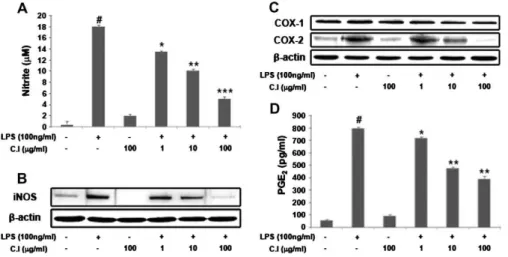
CI inhibited cell loss, decreased the reactive oxygen species production, regulated the Bax/Bcl-2 ratio and inhibited PARP proteolysis in MPP+-induced SH-SY5Y cells. Furthermore, CI suppressed the production of prostaglandin E2, expression of cyclooxygenase type-2 (COX-2), blocked IκB-α degradation and activation of NF-κB p65 in BV-2 cells in a dose-dependent manner. The molecular mechanisms involved by CI might involve its inhibitory actions both on neuronal apoptosis and neuroinflammatory NF-κB/IκB-α signaling pathway. The present investigation scientifically supports the long history and safe usage of CI as an important functional food with potential benefits in ameliorating deleterious conditions seen in PD.
178
-Fig. 1. Effect of CI on MPP+-induced neuronal cell death.
Fig. 2. Antioxidant effect of CI. Effect of CI on the free radical scavenging activity
Fig. 3. Inhibitory effect of CI on the production of NO, iNOS, COX-1, COX-2 and PGE2 in LPS-stimulated BV-2 cells.