47
-Abstract - As the power system develops rapidly into a smarter and more flexible state, so must the communication technologies that support it. Machine to machine (M2M) communication in Smart Grid environment has been discussed in European Telecommunications Standards Institute (ETSI). The power system is not easily replaceable, due to system replacement cost. The M2M gateway is required in other to improve interoperability in M2M environment. The Distributed Network Protocol 3.0 (DNP3.0) is the most important standard in the SCADA systems for the power. It has been used for device data collection/control in Substation Systems, Distribution Automation System. If the DNP3.0 data model is combined with a set of contemporary web protocols, it can result in a major shift. We selected Constrained Application Protocol (CoAP) based on RESTful as M2M protocol. It is a specialized web transfer protocol for use with constrained nodes and constrained networks. We have used the OPNET Modeler 17.1 in order to verity the SOAP versus CoAP. In this paper, we propose the CoAP-based M2M Gateway to Distribution Automation system using DNP3.0 in Smart Grid Environment.1. INTRODUCTION
The Smart Grid is one of the major policies for improving a power network’s reliability, stability, and efficiency. It involves extensive work on integrating state of the art technology into the current power network. These developments aim to optimize energy efficiency by circulating bidirectional information on the generation and consumption of power. Thus, distributed power systems, distribution automation systems, and digital substation systems require power services technology refinements as a matter of urgency. Network Protocol 3.0 (DNP3.0) is the most important standard in SCADA systems for power [1]; it is necessary to integrate a method in the Smart Grid environment.
Recently, machine to machine (M2M, also known as Device-to-Device [D2D]) communication has developed for a variety of services. The Internet of Things (IoT) is the resulting global interconnection of smart objects by means of extended internet technologies [2]. Power systems are built across geographically large areas; thus, they need to be connected with an internet network under a Smart Grid. “ETSI TS 102 690” recommended “M2M functional architecture,” which is made possible by a web service [3].
A web service gateway based on the Simple Object Access Protocol (SOAP) has been developed [4]. The SOAP has many constraints in M2M. It has heavy messages, complex structures and methods for each service because of using XML that has human readable results [5]. It is based on TCP. However, The Representational State Transfer (REST) is lightweight; it does not require a lot of extra XML, and is easy to build [6]. This allows rapidly mobile services, because it is lighter than the SOAP. The REST can replace SOAP. Constrained Application Protocol (CoAP) is a message transfer protocol based on RESTful. The CoAP messaging is based on the exchange of messages over UDP between endpoints. It is a specialized web transfer protocol for use with constrained nodes and constrained networks, and it has been standardized by the IETF working group “CoRE” [7]. The CoAP can increase interoperability and simplicity. Combining the data model of DNP3.0 with a set of contemporary web protocols can result in a major shift.
2. BACKGROUND
DNP3.0 is the standard communication protocol for electricity, oil, and gas systems. It collects and saves status information and analog and digital signals of the remote devices to a Feeder Remote Terminal Unit (FRTU). The IEEE adopted DNP3.0 as IEEE std 1815 in July 2010. It has been used for device data collection/control in Substation Systems, Distributed Energy Resources (DERs) and Distribution Automation System (DAS) in power systems.
CoAP is a specialized web transmission protocol for use with constrained nodes and constrained networks. It has characteristics that can be useful for small or low-cost devices, and it is a message transfer protocol based on RESTful. It is easy to connect to Hypertext Transfer Protocol (HTTP), since it follows the REST service and has the same status code as HTTP. In addition, it includes a concise expression of all requisite information in its URI. The REST service is based on the concept of SOA, it has evolved into a lightweight alternative to a SOAP service [9].
3. M2M Gateway Based on CoAP
<Fig 1> Apply ETSI M2M to Smart Grid systems using CoAP-based gateway
Figure 1 shows a scenario where ETSI M2M standards are applied to a Smart Grid system deployment [10]. The red dotted line represents communication for Distribution Automation System. We propose CoAP-based Gateway for Distribution Automation System using DNP3.0 in Smart Grid environment.
Protocol flow of between M2M Core Server and M2M Device using DNP3.0 in M2M environment is shown in figure 2.
<Fig 2> Protocol flow of between M2M Core Server and M2M Device using DNP3.0 in M2M environment
SG 환경에서 CoAP 기반 M2M 게이트웨이
신인재*, 박지원**, 이상훈**, 송병권** 고려대학교*, 서경대학교**
M2M Gateway based on CoAP in SG Environment
In-Jae Shin*, Jee-Won Park**, Sang-Hoon Lee**, Byung-Kwen Song** Korea University*, Seokyeong University**
2015년도 대한전기학회 하계학술대회 논문집 2015. 7. 15 - 17
This research was supported by the Energy Technology Development Project through Korea Institute of Energy Technology Evaluation and Planning (KETEP) funded Ministry of Trade Industry & Energy(MOTIE) (NO. : 20131020402080)
48
3.1 CoAP Mapping method for DNP3.0DNP3.0 and CoAP reference the OSI 7 layer communication standard. DNP3.0 uses a Pseudo Transport Layer in the transport layer, and a DNP3.0 Application Layer and DNP Data Object Library in the application layer. The Pseudo Transport Layer is made to use the TCP/IP transmission in the DNP that uses the data link protocol High-level Data Link Control (HDLC). However, CoAP uses UDP in the transport layer and CoAP is based on RESTful in the application layer. It needs a CoAP Cross Mapping layer, because DNP3.0 and CoAP have different transport and application layers. The CoAP Cross Mapping layer maps the FC of the DNP3.0 data model and CoAP Method. In addition, it maps the DNP3.0 data model and RESTful URI.
Mapping of the DNP3.0 data information and CoAP URI is shown in Figure 3. The DNP3.0 Data model is composed of an Object Group, Variation, and Qualifier, which simplifies the task of creating a RESTful interface for the DNP3.0 Data model. The CoAP URI can be represented in the order:
<Fig 3> Mapping of the DNP3.0 data information and CoAP URI
coap://(CoAPServerAddr)/ObjectGroup/Variation/Qualifier
As an example, the data attribute belonging to Object Group number “10,” variation number “01,” and Qualifier “01.”
coap://((CoAPServerAddr)/10/01/01
For reading data, as in the example above, a GET method would be used. For writing data, the same URL would be used, but with the PUT method in place of the GET method. The response information only transmits reply data.
3.2 The CoAP-Based M2M Gateway imprementation
<Fig 4> Example message sequence chart of between DNP3.0 and COAP
An example message sequence chart of between DNP3.0 and COAP is shown figure 4. The CoAP Client sends a CoAP message to DNP3.0 Slave via the CoAP-based M2M Gateway.
The CoAP-based M2M extracts DNP3.0 request type, object, variation, qualifies information by analyzing the received message. It maps the request type of the DNP3.0 data model and the CoAP Method. In addition, it maps the DNP3.0 information and CoAP URI and sends a DNP3.0 message to the DNP3.0 Slave. The response message contains object group number, object index number, and object data.
3.3 PerFormance evaluation results
In this section, we compared the CoAP and SOAP network performance using the OPNET Modeler 17.1, and real data size. We compared the data size of the CoAP and the SOAP containing the
same DNP3.0 information. The SOAP application developed using the gSOAP 2.8.16. The CoAP application developed using the libcoap 4.1.1. The CoAP data size (27 byte) is over 10 times smaller than SOAP data size (366 byte). Figure 5 shows OPNET Model of the CoAP Application. The experiment was performed in wireless 802.11a (OFDM), 54Mbps environment. The CoAP and SOAP application task are each ten. The scenario is sending continuously a packet (500) of the CoAP and SOAP in one-to-one.
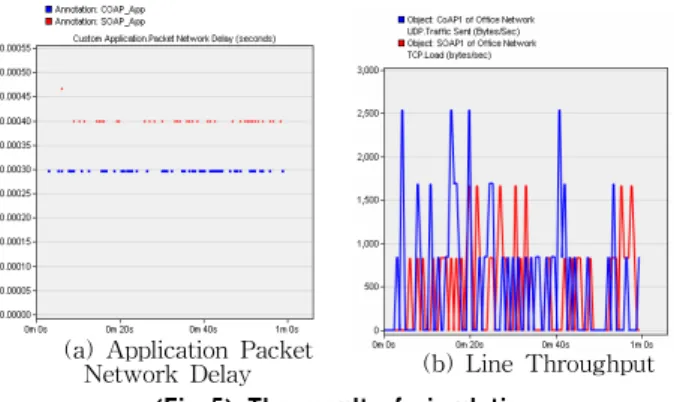
(a) Application Packet
Network Delay (b) Line Throughput
<Fig 5> The result of simulation
Figure 5 is shown Packet Network Delay and packet throughput in scenario. Packet Network Delay of the CoAP is about 0.1ms faster than that of SOAP. The CoAP throughput (Average 846bit/s) are occurred higher than the SOAP throughput (Average 694bit/s).
4. Conclusion
The main aim of this paper has been to demonstrate how CoAP based on RESTful services, in conjunction with the data information of DNP3.0 in Smart Grid Environment. We proposed the CoAP-based M2M Gateway to Distribution Automation system using DNP3.0 in Smart Grid Environment. This paper has shown that the object reference path of the DNP3.0 data information can easily be mapped to the URL format in the resource-oriented approach used by RESTful. We implemented the M2M Core Server and the CoAP-based M2M Gateway for managing power IT systems in an M2M environment. We demonstrated the advantages of the CoAP protocol using OPNET Modeler 17.1 in the M2M communication. The CoAP has faster, smaller packets, smaller data size than the SOAP. It is better in M2M environment because the capability of devices could be limited. This paper serves as an input to the identification of the ICTs capable of satisfying the communication requirements for the power system of the future.
[REFERENCES]
[1] Butterworth-Heinemann (2004) Practical Modern Scada Protocols,; ISBN 750657995
[2] The Internet of Things (2005) ITU Internet Reports, Retrieved from http://www.itu.int/internetofthings
[3] ETSI TS 102 690, (2011) Machine-to-Machine communications (M2M): Functional architecture
[4] Mitra, N. (2003) Simple Object Access Protocol (SOAP) 1.2 [5] Bary, T., Paoli, J. Speberg-McQueen, C.M. (1998) Extensible
Markup Language (XML) 1.0
[6] Fielding, R. T. (2000) Abstract of the dissertation: Architectural styles and the design of network-based software Architectures [7] CoRE Working Group (2013) Constrained Application Protocol
draft-ietf-core-coap-18
[8] IEEE 1815, (2010) IEEE Standard for Electric Power Systems Communications–Distributed Network Protocol (DNP3)
[9] Fielding, Roy T.; Taylor, Richard N. (2002) Principled Design of the Modern Web Architecture, ACM Transactions on Internet Technology (TOIT) (New York: Association for Computing Machinery) 2 (2): 115–150
[10] Guang Lu, Dale Seed, Michael Starsinic, Chonggang Wang, Paul Ressell (2012) Enabling Smart Grid with ETSI M2M Standards, Workshop on Internet of Things Enabling Technologies, Embracing Machine-to-Machine Communications and Beyond: 148-153
![Figure 1 shows a scenario where ETSI M2M standards are applied to a Smart Grid system deployment [10]](https://thumb-ap.123doks.com/thumbv2/123dokinfo/5013875.60775/1.892.487.786.610.819/figure-shows-scenario-etsi-standards-applied-smart-deployment.webp)