9
제 6 회 EDISON SW 활용 경진대회1
Development of CellML-based Simulation Platform for Cardiac
Electromechanics
Aroli Marcellinus*, Ki-Moo Lim† †Kumoh National Institute of Technology *E-mail: [email protected]
Abstract Cardiovascular disease is the leading cause of death in America [1]. This kind of situation leads researcher to find out how to analyze the disease without using a living human heart. Computer simulation is the solution. Based on the existed clinical data and mathematical formulas from the journals, we can simulate a human heart activity using a computer. Moreover, we can also use the existed biological data in our simulation program, such as CellML (Cell Markup Language) [2].
I
NTRODUCTIONThe CellML language was developed to represent and exchange mathematical models of biological process. CellML files can be used to simulate the biological phenomenons using the simulator program [2]. Moreover, the CellML files can be converted into other programming language source codes, and we can use the code for creating new simulator programs.
CellML can be used to create a cardiac simulator to simulate the complicated dynamic of hearts. The Physiome Model Repository (PMR) has a lot of CellML files describing the mathematical model of cardiovascular system, so we don't need to create the model from scratch [3].
However, there are some informations that is not described in the CellML cardiovascular system model, such as the arrythmia case and
cardiac mutation [4]. Those irregular cases are the main reason that researchers need to create a cardiac simulation. Because of this, we need to find a way how to create a cardiac simulator using the CellML featuring the way to simulate the irregular situtations of the cardiac system.
M
ETHODSThis research will use Courtemarche (CRN), Ten Tusscher 2006, and Luo-Rudy cell models for the single cell cardiac simulation. We can get their cell model informations in CellML format from hysiome Model Repository in Electrophysiology section.
OpenCOR will be used as a software to open the information from the CellML files [4]. Moreover, we can also use the software to convert the CellML files into our desired programming language using their default definition in XML. In this research, we will
10
제 6 회 EDISON SW 활용 경진대회2 convert the CellML files into the C++ programming language, using the customized XML format definition instead of the default one.
As for the arrythmia case or mutation, we will create the C++ class that defines the mutation based on the journals, and will use the CellML object as the class member of the mutation. All of the formulas in the CellML object will be override by the mutation formulas. We need to observe the normal case and the mutational case to see whether there is any differences or not.
CVODE will be used for solving the ODE that included in the CellML files. As for the alternatives, we will use Euler Method, and compare both of them in the terms of time performance.
R
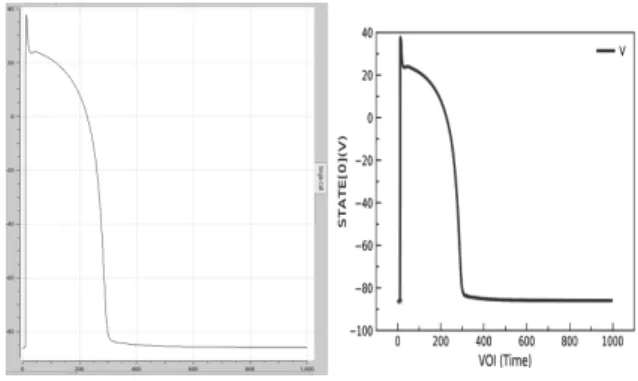
ESULTWe compared the simulation result from our code with the result from the OpenCOR built-in sbuilt-ingle cell simulator. As we can see built-in the Figure 1, the result of the Action Potential in simulator program at the right side is same as the result from the OpenCOR built-in simulator. As for the mutation result, we used the N588K and L532P mutations using the CRN cell model [5]. We can see the result at the Figure 2. It's similar with the result from the journal, but the differences are the steady state time. In the journal, the steady state happened around 200-300 milliseconds, while in the simulator, the steady state happens at 400-500 milliseconds.
Figure
1
. The Action Potential results of Ten Tuscher 2006 CellML files from OpenCOR (left)and the simulator code (right).
Figure
2
. The Ikr result from N588K and L532P mutation based on journal (left) and thesimulation result (right).
Conclusion
The CellML files are very useful for defining the cell models in the cardiac simulator. We just convert it into a source code using the OpenCOR software and we can use the source code with our simulator code. Moreover, we can use the source code for creating the mutation event to observe the impact of the mutation.
A
CKNOWLEDGEMENTThis research was supported by the EDISON
11
제 6 회 EDISON SW 활용 경진대회2 convert the CellML files into the C++ programming language, using the customized XML format definition instead of the default one.
As for the arrythmia case or mutation, we will create the C++ class that defines the mutation based on the journals, and will use the CellML object as the class member of the mutation. All of the formulas in the CellML object will be override by the mutation formulas. We need to observe the normal case and the mutational case to see whether there is any differences or not.
CVODE will be used for solving the ODE that included in the CellML files. As for the alternatives, we will use Euler Method, and compare both of them in the terms of time performance.
R
ESULTWe compared the simulation result from our code with the result from the OpenCOR built-in sbuilt-ingle cell simulator. As we can see built-in the Figure 1, the result of the Action Potential in simulator program at the right side is same as the result from the OpenCOR built-in simulator. As for the mutation result, we used the N588K and L532P mutations using the CRN cell model [5]. We can see the result at the Figure 2. It's similar with the result from the journal, but the differences are the steady state time. In the journal, the steady state happened around 200-300 milliseconds, while in the simulator, the steady state happens at 400-500 milliseconds.
Figure
1
. The Action Potential results of Ten Tuscher 2006 CellML files from OpenCOR (left)and the simulator code (right).
Figure
2
. The Ikr result from N588K and L532P mutation based on journal (left) and thesimulation result (right).
Conclusion
The CellML files are very useful for defining the cell models in the cardiac simulator. We just convert it into a source code using the OpenCOR software and we can use the source code with our simulator code. Moreover, we can use the source code for creating the mutation event to observe the impact of the mutation.
A
CKNOWLEDGEMENTThis research was supported by the EDISON
제 6 회 EDISON SW 활용 경진대회
3 Program through the National Research
Foundation of Korea(NRF) funded by the Ministry of Science, ICT & Future Planning (NRF-2016-936606).
R
EFERENCES[1] H. Xia, K. Wong, and X. Zhao, A Parallel
Computational Platform for Electromechanics of the Heart
(http://web.utk.edu/~xzhao9/research/cardiac_simul ation/cardiac.html)
[2] Miller et al.: An overview of the CellML API and its implementation. BMC Bioinformatics 2010 11:178.
[3] S. M. Wimalaratne, M. D. B. Halstead, C. M. Lloyd, M. T. Cooling, E. J. Crampin, P. F. Nielsen; A method for visualizing CellML models.
Bioinformatics 2009; 25 (22): 3012-3019.
[4] Garny, Alan, and Peter J. Hunter. “OpenCOR: A Modular and Interoperable Approach to Computational Biology.” Frontiers in Physiology 6 (2015): 26. PMC. Web. 23 Feb. 2017.
[5] Axel Loewe, Mathias Wilhelms, Fathima Fischer, Eberhard P. Scholz, Olaf Dössel, Gunnar Seemann; Arrhythmic potency of human ether-à-go-go-related gene mutations L532P and N588K in a computational model of human atrial myocytes.
Europace 2014; 16 (3): 435-443.