An Empirical Investigation of the Citizens’ Freedom of
Expression and Trust in Public Agency to use Social Media
in Post-Communist Countries: The Case of Mongolia*
Tumennast Erdenebolda, Suk-Kyoung Kimb, Jae-Jeung Rhoc, Yoon-Min Hwangd
aEndicott College of International Studies, Woosong University, South Korea
b,cSchool of Business and Technology Management, Korea Advanced Institute of Science and Technology(KAIST),
South Korea
dSchool of Business, Chungbuk National University, South Korea
Received 28 February 2021, Revised 18 March 2021, Accepted 25 March 2021
Abstract
Purpose - This empirical study examined the influence of post-communist countries sociol-political factor of freedom of expression preconditioning, and trust in agency, mediating performance expectancy of social media users representing the citizens’ behavioural intention to utilize social media in a post-communist country, the case of Mongolia.
Design/methodology/approach - This research collected 403 valid survey data from citizens those who use social media in Mongolia. The study used Partial Least Squire (PLS) analysis with the research conceptual model founded on the UTAUT model.
Findings The study shown that citizens in post-communist, they strongly willing freedom of expression, which driving as a positive precondition factor, and this has an indirect positive influence, and trust in agency mediates to enhance performance expectancy. Social influence, and effort expectancy factors have direct positive influence on the intention to use of social media systems in the public sector domain of Mongolia.
Research implications or Originality This research proposed a new model to test citizens’ intention to use social media as a communication tool to engage with public organizations in the pre-adoption stage of post-communist countries. Theoretically, this research builds up to the unique theoretical contribution with social media by examining a new social media-based third-party intercommunication medium, incorporating intent to utilize for citizens with government in post-communist countries. Practically, this article lays out the directions to aid social media usage for government sector with concerning citizens intentions in the post-communist situation.
Keywords: Social Media, Two-Way Communication, Freedom of Expression, Trust, Post-Communist JEL Classifications: C83, L86, O38, P21
Ⅰ. Introduction
Social media globally has emerged as an important third-party platform that acts as a commu-nication channel between customers, public sector organizations, and businesses. Social
net-* This research is was funded by Woosong University Academic Research in 2021
This paper is based on part of Ph.D. dissertation of Tumennast Erdenebold.
a First Author, E-mail: [email protected] b Co-Author, E-mail: [email protected] c Co-Author, E-mail: [email protected]
d Corresponding Author, E-mail: [email protected]
working sites (SNS): Twitter, Facebook, Instagram and Youtube constitute the most recent wave of digital communication tools. These social media sites have come to empower public sector organizations to leverage these new channels of communication for engaging with citizens and organizations (Mergel, 2013a). In the era of social media, many individuals, government organizations, and private companies are leveraging social media tools to transform their daily functions and become more open, innovative, and collaborative with their linked citizens and customers (Mergel, 2013a; Kim et al., 2013).
The emerging information and communication technologies’ wave of increased social media networking has opened up beneficial opportunities for government organizations to enhance their efficiency and effectiveness (Surya et al., 2015). However, the path toward this techno-logical transformation is not as easy and straightforward as expected (Surya et al., 2015). Early adopters and practitioners of social media platforms find the public organizations undertaking social media initiatives to face the challenges of needing to transform current organizational norms and daily operating processes toward more innovative procedures (Mergel, 2013a). There also exists an uncertainty in intention to use and adopt social media platforms among government organizations because of the lack of governmental control over these new tech-nologies and their dimensional changes (Mergel, 2013b).
Social media platforms can help government organizations to establish two-way communica-tion with citizens. In particular, social media platform able to adopt as a tool for interaccommunica-tion between government employees and citizens. In this regard, the adoption of social media by governments must concern challenges of data management, security, accessibility, privacy, and social insertion and governance (Mergel, 2013b). In addition, the emerging trends in the behav-ioral interest of citizens in the internet and social media platforms present government and public organization managers with high levels of uncertainty (Stenning and Horschelmann, 2008) while dealing with customers online. Furthermore, there are cultural, historical and socio-political differentiations are existing between the former communist countries and other coun-tries in the world (Stenning and Horschelman, 2008; Tumennast et al., 2020). This condition makes it more challenging for former communist countries than the rest of the country to adopt and leverage social media, alongside the ongoing transitions in their political, social, and economical system towards democracy (Tsygankov, 2007; Liebert et al., 2013).
There is a previous study conducted to check intentions of social media usage by government organizations from the point of view of public sector employees’ for communication side in post-communist country Mongolian case, focused on the censorship and organizational support (Tumennast et al., 2020). However, research gaps still persist pertaining the adoption and usage of social media by the other side for communication as citizens in post-communist countries. Therefore, the difference between this study with previous one is each of them investigated two sides of the participants’ aim for communication toward the use of Social media with its distinctive factors of former soviet footprints.
This study attempts to bring out some of the factors related to the intention to use social media for government communication systems from the citizens’ perspectives. In particular, the citizens’ freedom of expression is a preconditioning factor for utilizing social media as a new channel of communication with the government. In addition, the citizens’ trust in the agency as a mediating factor for communicating with the government through social media system is investigated in this paper.
The reason why we choose citizens’ freedom of expression and trust in agency factors in research is that the post-communist society is socio-politically, socio-culturally, and
social-psy-chologically different than the other world (Ferge, 1996; Matthew, 2017). According to social cognitive theory (Bandura, 1986; 2001), people’s nature is driven by self-generated and external environment situation, cognitive, psychological, and behavioral factors. These interrelated fac-tors determine and pattern an individual’s behavior, and it affects their external communication, social interaction, and environment. Due to the soviet authoritarian society censorship foot-prints still remained in former communist countries. However, their socialist system has col-lapsed and countries are transition towards democracy (Banalieva, et al., 2017; Tumennast et al., 2020). In post-communist nature, citizen’s belief and behavior on inter-communication are affected by this environmental situation, therefore we selected freedom of expression as a preconditioning factor, trust in government as a mediating factor in our research.
The importance of this study would be helpful in providing valuable insights to policy-makers from public sector organizations and officers engaged in an internal assessment that how the citizens’ intention toward the use of social media as a communication channel. In addition, scholars and policymakers will understand the degree of citizen’s expectancy of freedom of expression, and trust in agency in different sociopolitical situation, that’s how important as preconditioning and mediating. These factors are positively supporting the citizen’s willingness to communicate with the government through a social media system. The insights of this study would help them adopt a broader view of an integrated framework, right from the level of adoption to the level of maturity, to improve their utilization of social media towards more censorship-free third-party communication tools to support democracy, from the former com-munist country prospect.
Ⅱ. Theoretical Background
1. Social Media Use for Service of Government
Social media platforms investigated by many scholars to be useful for public organizations in various directions and fields of theories such as public relations, trust in Government, and Openness and accountability (Hong, 2013; Bertot et al., 2010; Kim et al., 2013). The benefits of social media platforms to government organizations can be categorized into five groups: openness, participation, sharing, mass collaboration, and two-way interactions (Mergel, 2013a). Citizens are using social media platforms to participate in government activities online, trans-form their relationship with the government, access government intrans-formation, communicate with the government efficiently, reach out to the government, enjoy the opportunity of engaging with the government with improved trust and democracy, and serve them as a communication channel (Chang and Kannan, 2008; Cromer 2010).
2. Social Media Use for Different Sociocultural Prospect
Communication in the online environment among countries’ social, ethnic, and social host groups are a significant factor that could assist or aggravate the adoption of technology (Chen, 2009). Within the social networking arena, cultural differences of users affect their communica-tion and behavior. These cultural differences between people exist based on their nacommunica-tional identity, national culture, political system, social-economic factors, and gender (Gong and
Stump, 2016). Within the arena of social media’s user adoption in different cultural and so-cial-economic settings, we have investigated a number of research articles on the utilization of social media in developed and developing countries, more specifically in post-communist countries. The research conducted on the usage of social media platform in Post-communist countries have focused on various areas. Articles are focused on how social networks and social media are played a significant role in spreading information for protest movements. Scholar Matthew investigated the use of SNS in fostering democratic justice in Eastern and Central Europe. And the study empirically validated that social media not only increases support for democracy, but also collects and provides news. Furthermore, the study found that social media has an affirmative effect on the people’s trust in legislature, military, government and zero affect on people’s trust in political parties and local government (Matthew, 2017). Another study found social media to have a significant influence on the transition of post-communist countries to democracy, for instance, SNS such as Facebook and Twitter played the role of catalysts in transitions of countries from autocratic regimes to democracies (Danju et al., 2013). The previous study on social media use as a new communication channel for public service from the public sector employee’s perspective in the former communist sphere case of Mongolia. This study investigated the intention to use the social media model including the effects of new factors with organizational support and censorship which identified still remain-ing former soviet footprint (Tumennast et al., 2020). Thus, it is necessary to investigate former communist countries in social media researches in an unexplored area of citizens’ perspective in cultural and socio-political transiting to the democratic situation.
3. Social Media Use for Government, and Post Communist Countries
There are various types of theories, frameworks and models used for the adoption of new innovation and technology at the individual level. With respect to the adoption of IS and IT, the well-known Technology Acceptance Model (TAM) was deemed as the most accepted theory prior to the formulation of the UTAUT model. However, Venkatesh (Venkatesh et al.,) found aspects of similar constructs among various technology acceptance theories, thus, they recog-nized that it is essential to design these constructs under a single model, which saw the for-mulation of the UTAUT model.
The UTAUT model has been widely applied in the area of adoption and use of social media (Curtis et al., 2010; Gruzd et al., 2005), citizen’s intention to use new technology and, the public sector and e-government service domain (Carter and Belanger, 2005; Alawadhi and Morris, 2008). Therefore, we found the UTAUT model to be adequate and thus, used it in our research context. Drawing from Venkatesh et al., the popular UTAUT model suggests four main constructs pertaining to the intention of a user to adopt an information technology and innovation system and subsequently the usage behavior: performance expectancy, effort ex-pectancy, social influence and other facilitating conditions. These factors have an influence on individuals’ willing to use and their subsequent behavior of actual use of the IT system. Further, the UTAUT model formulates age, gender, voluntariness, and experience as factors that moderate the effect of the key main constructs (Venkatesh et al., 2003).
Ⅲ. Research Model Development
The previous study investigated public sector’s employees’ side views for their intention with unique socio-political factors (Tumennast et al., 2020), but there is a research gap is existing, which are not specified theory to investigate citizens’ side view of their target to use social media for government communication in post-communist sphere. Therefore, it is necessary to develop a new and unique conceptual theoretical framework in order to assess the citizens’ perspective for the post-communist situation.
In our research, we constructed a conceptual research framework using UTAUT constructs and special behavioral constructs for the post-communist country sphere. To avoid complexity in our research model pertaining the aim and use of social media in existing the post-communist countries’ culture, we consider that society differences can influence the citizens’ common in-tentions, attitudes and behaviors (Van de and Tanzer, 2004). Especially, in the case of the post-communist countries cases, sociocultural values are different than other countries (Ardichvili and Gasparishvili, 2001), because of the economic and social transformations since the Soviet Union collapsed, thus we deduced some determinants from UTAUT, such as fascinat-ing conditions and the adoption use behavior. Moreover, we investigated the citizens’ intention to use based on behavior constructs without the consideration of the actual use constructs. We then considered that there is no need for the actual use of social media as an interactive channel in the mainstream area yet in our targeted study countries.
1. Freedom of Expression
Based our literature review on the post-communist world’s differentiated sociocultural setting, We are interested in investigating additional and special determinants of “freedom of ex-pression” of citizens toward government context. According to human rights by the constitution, Freedom of Expression is essential for all humans in a democratic society, and its disclose the abuse of human rights and empower citizens to participate in a democratic society (Yang et al., 2016). In element, freedom stands an individual’s free opinion, belief, and thoughts (DeVarennes, 1994), whereas expression is the common expectation that can explain and per-suade media, channel, and communication messages (Pingree, 2007). Moreover, freedom of expression is a person's word and view without any restrictions of an institution, medium, or policy in communication (Michael, 1983).
The explosion of the internet has improved individuals’ freedom of expression and helped people find space online to express their opinions easily (William et al., 2010). Social network-ing and social media is changnetwork-ing the anticipation of freedom of expression to the degree of an individual’s attitude to interconnect and mobilize. Moreover, it is leading towards a greater voice, political influence, and participation without difficulty for the citizens (William et al., 2010).
Socio-psychological communication point of view, the Uses and Gratification Theory (Katz et al., 1973) expects individual’s wish and needs towards their selection of communication and media (Papacharissi and Rubin, 2000), it involves an individual’s perception of media, influence on motivation, outcomes, and behaviors on media (Rubin, 1994). Theory of Reasoned Action (Fishbein, 1979; Fishbein and Ajzen, 1977) explained that an individual’s decision proc-ess starts from a behavioral belief, mindset, continued with the perception of probable
out-comes, towards intentional behavior to execute the action. In practice, Use and Gratification Theory broadly used in internet usage (Stafford et al., 2004), social media, and social network-ing services (Leung, 2001; Want et al., 2012) in behavioral research studies.
In our research, based on Theory of Reasoned Action, and the Uses and Gratification theoret-ical foundations, we defined ‘freedom of expression’ as a degree of individual’s belief and expectancy that expresses and communicates freely through intention to use third-party social media system will enable their needs for better expression to communicate with the government without any censorship and restriction.
Therefore, our research citizens’ freedom of expression preconditioning factor hypothesises are as follows:
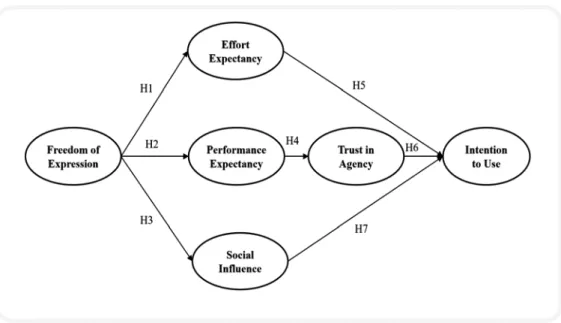
H1: Freedom of expression will positively relate to performance expectancy in post-com-munist countries
H2: Freedom of expression will positively relate to effort expectancy in post-communist countries
H3: Freedom of expression will positively relate to social influence in post-communist countries
2. Trust in Agency
In our research, the citizens’ trust is an important concern in the public sector, and political and government organizations, because leaders have paid attention to its decaying progress over the last several decades (Denhardt, R. and Denhardt, J., 2009). There are number of studies that have investigated on citizens’ trust in public sector agencies and government. The question of trust is an important issue in the public sector, more specifically concerning con-fidence on the public sector agencies using social media, relationship between Web 2.0 and e-Government, and the factor of trust in public sector agencies (Morgeson and Petrescu, 2009; Kim et al., 2013). The citizen’s trust in government and agency is an important construct in our research, for people in post-communist countries have distrust and skepticism in political organizations (Mishler and Rose, 1997). Thus, our study citizens’ trust in agency hypothesises are as follows:
H4: Trust in agency will positively relate to the intention to use social media for engage-ment with the public organizations in the post-communist countries
3. Performance Expectancy, and Effort Expectancy
Designing from the UTAUT model, Venkatesh et al. defined performance expectancy as ‘the degree to which an individual believes that using the system will help him or her to attain gains in job performance’ (Venkatesh et al., 2003). In our research investigations, we used performance expectancy as the degree to which an individual will rely on using social media to communicate with public organizations to help him/her achieve improvements in their job performance (Carter and Belanger, 2005). Furthermore, effort expectancy characterized as ‘the degree of ease associated with the use of the system’ (Venkatesh et al., 2003) by UTAUT. In our assumption, we adopted the degree of ease associated to citizens’ usage of social media
towards to new channel for communication with government institutions. Thus, our designed hypothesises are as follows:
H5: Performance expectancy will positively relate to trust in agency in post-communist countries
H6: Effort expectancy will positively relate to the intention to use social media engagement with public organizations in post-communist countries
4. Social Influence
Originally, Venkatesh et al., defined social influence as “the degree to which an individual perceives that important others believe he or she should use the new system” (Venkatesh et al., 2003). To examine the social influences of citizens from the perspective of post-communist states, it is necessary to understand the historical background, as users are people who live in the socialist country and society.
The reason why, under the socialist system, the citizens, individuals and communities in post-communist countries can be assumed of having lived in a very different social-cultural and political setting than compared to other countries in the world (Ardichvili and Gasparishvili, 2001). In Marxist ideology, the citizen, individual awareness, and self-identity must fall under the collective concept. Socialism prefers homogenized and anonymized society and socialist regimes in post-communist countries have destroyed cultural alternatives, preventing unique-ness and plurality in existing society communities (Markova, 1997).
As a result, in our research context, we applied social influence, the degree to which a citizen perceives that important others believe he or she should use social media systems to communicate with the public sector in post-communist countries. Therefore, our hypothesises assumption is:
H7: 0Social Influence will positively relate to the intention to use social media for engage-ment with public organization in post-communist countries
5. Behavioral Intention to Use Social Media
Followed by Venkatesh et al. definition on the UTAUT model, the behavioral intention to use social media as “the person’s subjective probability that he or she will perform the behavior in question” (Venkatesh et al., 2003). In our research context, we applied the citizens’ subjective intention that their willingness to use third-party platform: social media as a new channel of communication with government servant employees.
Through this study, we examined the citizens’ behavior and intention to use social media in the former communist world which differentiated by the cultural and sociopolitical situation, including special factors the freedom of expression and trust in the agency in the public sector context.
We designed and proposed a research model in this special former communist sphere, based on the UTAUT model some of the factors as shown in Figure 1. Moreover, we involved in special determinants: freedom of expression and trust in agency, those are based on the existing literatures in the former communist nature.
Fig 1. Research Model
3.1. Model measurement assessment
After designing the proposed model, we initially tested the model through an online pilot survey conducted. The survey was conducted using Google Document based questionnaire. We used Partial Least Squire (PLS) method for conducting the survey to analyze the proposed model of this study. The online pilot survey comprised of a sample of 51 Mongolian re-spondents, who were all social media users. Collection of data through online surveys have advantages such as speediness of conducting the survey and accuracy of data entry. Numerous studies have used such a model for collecting data (Topp and Pawloski, 2002). Based on the pilot test sample, we analyzed the validity, reliability, and internal consistency of model meas-urement items, before conducting a real sample survey. The real, sample model measmeas-urement items can be found in Table 2.
3.2. Data collection and analysis
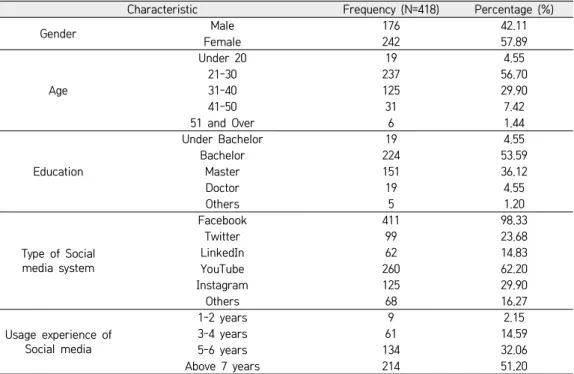
To test the conceptual framework, we conduct a survey of citizens from a post-communist country, namely Mongolia. Totally, 426 respondents, with 418 valid respondents, we conducted online survey by distributing questionnaires through social networking sites such as Facebook and Twitter. Since, we are investigating the social media system inter-communication of citizen users with government, the survey was needed to be conducted among social media users. Online and social media distributed questionnaires are not a new topic. Study has already been investigated by scholars like Ho (Ho, 2014). These online-distributed questionnaires can be widely used for both academic and non-academic purposes. We distributed our Google Document based questionnaire to the respondents in Mongolia, through Social media: Facebook and Twitter. The reason being that Facebook and Twitter are the highest rated social media platform in Mongolia. The sample result comprised of 42.11% men and 57.89% women,
mostly aged between 25 and 34. The survey respondent's other demographic more detailed information are shown in Table 1. We analyzed the collected data using structural equation model (SEM) techniques with partial least squares (PLS) and run the analysis by smart PLS 3.2.6 analysis software tools to evaluate the model. The Smart PLS software is used in empirical research to analyze data from the survey and hypothesized relationships (Ringle et al., 2015).
Table 1. Demographic Information
Characteristic Frequency (N=418) Percentage (%)
Gender FemaleMale 176242 42.1157.89
Age Under 20 19 4.55 21-30 237 56.70 31-40 125 29.90 41-50 31 7.42 51 and Over 6 1.44 Education Under Bachelor 19 4.55 Bachelor 224 53.59 Master 151 36.12 Doctor 19 4.55 Others 5 1.20 Type of Social media system Facebook 411 98.33 Twitter 99 23.68 LinkedIn 62 14.83 YouTube 260 62.20 Instagram 125 29.90 Others 68 16.27 Usage experience of Social media 1-2 years 9 2.15 3-4 years 61 14.59 5-6 years 134 32.06 Above 7 years 214 51.20
Ⅳ. Results and Discussion
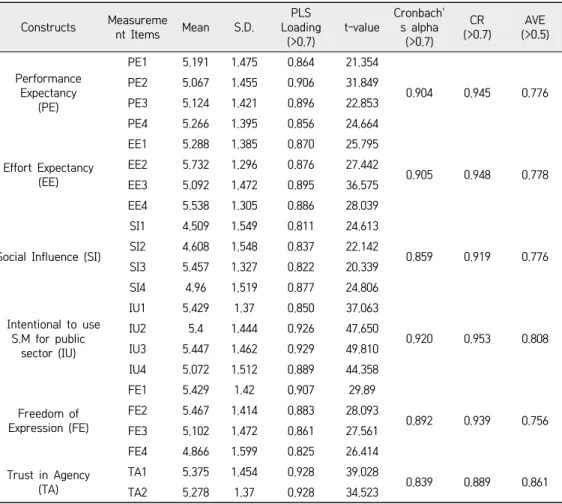
This study used the PLS is a structured equation modelling (SEM) method, which can analyze the complex relationship between multiple constructs. In general, smart PLS analysis software tools are widely used to statistically examine the proposed model. Firstly, we conducted a confirmatory factor analysis (CFA) for all six constructs. We investigated the following measure-ments, which are convergence validity, reliability, and discriminant validity of the proposed model. The reliability of the measurement items was verified as shown in Table 2, because the results of all loadings were higher than the recommended threshold level of 0.7. More specifically, the AVE results for all structures were higher than the recommended 0.5 thresholds presented in Table 2. Moreover, all indicator loadings and constructs results of our proposed model showed resulted that were higher than their corresponding thresholds. Finally, all the statistical measurement items and results were confirmed.
Table 2. CFA, Convergent Validity and Reliability Test Constructs Measurement Items Mean S.D. Loading PLS
(>0.7) t-value Cronbach' s alpha (>0.7) CR (>0.7) (>0.5)AVE Performance Expectancy (PE) PE1 5.191 1.475 0.864 21.354 0.904 0.945 0.776 PE2 5.067 1.455 0.906 31.849 PE3 5.124 1.421 0.896 22.853 PE4 5.266 1.395 0.856 24.664 Effort Expectancy (EE) EE1 5.288 1.385 0.870 25.795 0.905 0.948 0.778 EE2 5.732 1.296 0.876 27.442 EE3 5.092 1.472 0.895 36.575 EE4 5.538 1.305 0.886 28.039
Social Influence (SI)
SI1 4.509 1.549 0.811 24.613 0.859 0.919 0.776 SI2 4.608 1.548 0.837 22.142 SI3 5.457 1.327 0.822 20.339 SI4 4.96 1.519 0.877 24.806 Intentional to use S.M for public sector (IU) IU1 5.429 1.37 0.850 37.063 0.920 0.953 0.808 IU2 5.4 1.444 0.926 47.650 IU3 5.447 1.462 0.929 49.810 IU4 5.072 1.512 0.889 44.358 Freedom of Expression (FE) FE1 5.429 1.42 0.907 29.89 0.892 0.939 0.756 FE2 5.467 1.414 0.883 28.093 FE3 5.102 1.472 0.861 27.561 FE4 4.866 1.599 0.825 26.414 Trust in Agency (TA) TA1 5.375 1.454 0.928 39.028 0.839 0.889 0.861 TA2 5.278 1.37 0.928 34.523
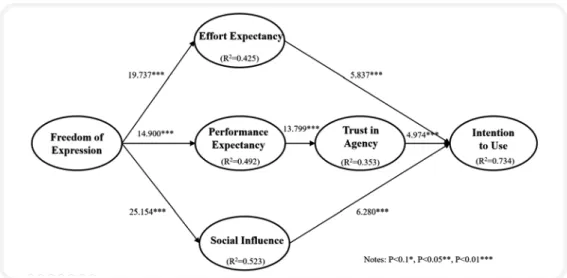
The statistical results of our model are presented in Figure 2. We investigate the model's explanatory power by statistically analyzing the R2 values. The results show that our structural model explanation was found to be at 73.4% variance for intention of citizens to use social media for an engagement with public sector organizations, respectively.
The model path of constructs are significant for each relationship in the hypotheses. As shown in Figure 2, we analyzed the variance described in each path of the study model and measured them. The freedom of expression remarkable influences the performance expect-ancy, effort expectexpect-ancy, and social influence (H1: β = 0.652 / p < 0.01, H2: β = 0.702 / p < 0.01, H3: β = 0.723 / p < 0.01). While the performance expectancy has a significant relation-ship to trust in agency (H4: β = 0.594 / p < 0.01,), the confirmation of trust in agency, the effort expectancy, and social influence has significant affiliation with the intention of citizens to use social media for public organization (H5: β = 0.230 / p < 0.01, H6: β = 0.378 / p < 0.01, H7: β = 0.345 / p < 0.01) for former communist countries. The research model hypoth-eses’ examination results are displayed in Table 3.
Fig 2. Model Analysis Results
Table 3. The Results of Hypothesises
Path Path Coefficient Remark
Freedom of Expression → Performance Expectancy 14.900*** Accepted 19.737*** Accepted Freedom of Expression → Effort Expectancy
Freedom of Expression → Social Influence 25.154*** Accepted Trust in Agency → Intention to Use Social media 4.974*** Accepted Performance Expectancy → Trust in Agency 13.799*** Accepted Effort expectancy → Intention to Use Social media 5.837*** Accepted Social influence → Intention to Use Social media 6.280*** Accepted Note: *p<.05, **p<.01, ***p<.001
From the citizens’ perspective, our analysis results validated that more of freedom of ex-pression is a critical and pre-conditional factor to increase the degree of citizens social influence, their effort expectancy, and performance expectancy towards the usage of social media system to communicate with public organizations in post-communist states. Furthermore, our study analysis results are showing that post-communist countries are transitioning towards democra-tization (Matthew, 2017), and citizens are more willing to express their views freely about government policies and leaders (Yang and Wang, 2016) on the social media platform. Thus, the higher freedom of expression is an important factor. In addition, freedom of expression influences an increase in the citizens’ task concentration of the performance expectancy and as well as an increase in the citizens’ ease of using social media systems associated with effort expectancy (Venkatesh et al., 2013; Tumennast et al., 2020). Moreover, to increase the citizens' perception about the importance of social media use from families, friends or other people's view, we need social influence towards the intention to use social media for engaging with public organizations as intercommunication purpose. Citizens are intending to adopt social media systems for communication purposes with the government, as it helps them better
ex-press their views on government activity. Social media helps citizens say more and connect more strongly with the government. Further, there are expectations among citizens that govern-ment officials can listen and communicate with them better if they have freedom of expression. Citizens’ higher performance expectancy to use social media tends to contribute to citizens’ higher trust in the agency, which is to use social media to intercommunicate with public organ-izations in the post-communist nations. In post-communist countries, citizens have common distrust and skepticism toward political and government institutions (Mishler and Rose, 1997). Thus, citizens' higher performance expectancy indirectly positively affects greater expectations of intention to use social media; for public sector highly depends on trust in an agency or institution factor in the post-communist cause. It means that the citizens having greater believes of using the social media system to interact with the public organizations will be bridged when they have higher Trust in the agency that communicates with the government in post-commu-nist countries. To put it in other words, without the trust of communicating the public agency through social media, no higher communication performance expectancy exists.
This study demonstrates that citizens’ higher trust in agency is positively connected to higher intention to use social media to interact with government in post-communist countries. It means that if a citizen has a greater trust in their government institution or agency, they intend to use social media for communication purposes. The effort expectancy concerns with the citizens’ belief of the worth and ease of using social media (Venkatesh et al., 2013; Tumennast et al., 2020). The higher effort expectancy positively relates to higher intention among citizens to use social media systems to communicate with government. This means that citizens who are willing to communicate with the government through SNS easily recognize the use of the system and expect greater efforts to use SNS. Further, the social influence determines that citizens expect other people such as friends, family or neighbors to encourage them in using social media (Venkatesh et al., 2013; Tumennast et al., 2020) to communicate with government. Our analysis results also found higher levels of social influence to positively affect higher levels of intention to adopt social media in the public organizations. It means there are remaining footprints of communism in post-communist countries still, and that social influence is highly continued even in the post-communist era (Banalieva et al., 2017).
Ⅴ. Conclusions
This research proposed a new model to test citizens’ intention to use of third-party platform: social media as a communication tool to engage with public organizations in the pre-adoption stage. We empirically investigated the model of citizens’ intention to examine the post-commu-nist countries’ civil society, particularly the cultural, the social-economic, and the political sys-tems that constitute an interesting environment. Triggered by different cultural and social be-havioral environment, and the limitations of the existing new information technology (IT) sys-tem adoption model, we added new constructs: “freedom of expression” and “trust in agency” factors to the already existing IT and innovation adoption UTAUT model to analyze the case of social media use in post-communist countries. Based on the analysis outcome of the our research model results, we recommend public sector officers and decision makers from post-communist countries to use social media to engage citizens. On a practical note, we hope that the recommendations made by this study will help government decision-makers and
offi-cials become aware and acquire insights about the importance of public sector’s point of view, as to how citizens are intending to use social media for interacting with public sector organ-izations in the post-communist countries. Thus, would help these decision-makers and officials make a better decision in this regard.
Theoretically, the use of social media systems enable an open, transparent and efficient channel of communication for public sector organizations and governments to interact with their citizens. However, there are challenges in the adoption path, which are not easy and straightforward (Surya et al., 2015). In addition, citizens' intercommunication of social media carries distinctions between countries’, cultural, social-political, and ethnic communication background, and their behavioral condition (Chen, 2009). There are few research studies that have been conducted previously with respect to the use and adoption of social media for public sector organizations’ engagement with citizens in developing countries. There is a sig-nificant research gap that exists in the domain of post-communist countries, exception being the cases of political activism/revolutions. Therefore, the importance this study is that if offers new theoretical model that has tested a new social media based third party communication channel, including intentions to use social media in the public service for post-communist countries, In addition, scholars and policymakers will understand the degree of citizen’s expect-ancy of freedom of expression, and trust in agency in different sociopolitical situation, that’s how important as preconditioning and mediating. These factors are positively supporting the citizen’s willingness to communicate with the government through a social media system.
The limitation of our study is that research survey focused only on the perspectives of citizens and limits to only the case of a post-communist country, Mongolia. Also, the study only consid-ered the use of Facebook and Twitter in engaging with the public organizations. We will need to conduct supplementary studies that include cases of other post-communist countries. In addition, further study needs to investigate comparative and gap analysis studies among on citizen and public sector’s point of view with their intention to use Social media in their daily life. In the face of these limitations, this paper expects of playing a role in encouraging the utilization of social media to seize with the government services in post-communist countries.
References
Alawadhi, S. and A. Morris, (2008), “The Use of the UTAUT Model in the Adoption of E-government Services in Kuwait”, In Hawaii International Conference on System Sciences, Proceedings of the 41st Annual, 219-219.
Ardichvili, A. and A. Gasparishvili, (2001), “Socio-cultural Values, Internal Work Culture and Leadership Styles in Four Post-communist Countries: Russia, Georgia, Kazakhstan and the Kyrgyz Republic”, International Journal of Cross Cultural Management, 1(2), 227–242.
Banalieva, E. R., C. M. Karam, D. A. Ralston, D. Elenkov, I. Naoumova, M. Dabic and A. Wallace(2017), “Communist Footprint and Subordinate Influence Behaviour in Post-communist Transition Economies”, Journal of World Business, 52, 209–229.
Bandura, A. (1986), “Social Foundations of Thought and Action”, Englewood Cliffs, NJ, 1986(23-28). Bandura, A. (2001), “Social Cognitive Theory of Mass Communication”, Media Psychology, 3(3), 265-299. Bertot, J. C., P. T. Jaeger and J. M. Grimes(2010), “Using ICTs to Create a Culture of Transparency:
E-government and Social Media as Openness and Anti-corruption Tools for Societies”, Government Information Quarterly, 27, 264–271.
Bogush, G. (2017), “Criminalisation of Free Speech in Russia”, EUROPE-ASIA STUDIES.
Carter, L. and F. Bélanger, (2005), “The Utilization of E-government Services: Citizen Trust, Innovation and Acceptance Factors”, Information Systems Journal, 15(1), 5–25.
Chang, A.M and P. K. Kannan(2008), “Leveraging Web 2.0 in Government”, IBM Center for The Business of Government.
Chen, W. (2009), “Internet Use and Intercultural Adaptation: A Case Study on Chinese Immigrants in Singapore”, In annual meeting of the International Communication Association, New York City, NY.
Cromer, C. (2010), “Understanding Web 2.0's Influences on Public E-services: A Protection Motivation Perspective”, Innovation: Management, Policy & Practice, 12, 192–205.
Curtis, L., C. Edwards, K. L. Fraser, S. Gudelsky, J. Holmquist, K. Thornton and K. D. Sweetser(2010), “Adoption of Social Media for Public Relations by Non-profit Organizations”, Public Relations Review, 36(1), 90-92.
Danju, I., Y. Maasoglu and N. Maasoglu(2013), “From Autocracy to Democracy: The Impact of Social Media on the Transformation Process in North Africa and Middle East”, Procedia – Social and Behavioural Sciences, 81, 678–681.
Denhardt, R. B. and J. V. Denhardt(2009), “Public Administration: An Action Orientation”, Boston, MA: Wadsworth
De Varennes, F. (1994), “Language and Freedom of Expression in International Law”, Hum. Rts. Q.16, 163.
Erdenebold, T., S. K. Kim, J. J. Rho and Y. M. Hwang(2020). “The Effects of Censorship and Organisational Support on the Use of Social Media for Public Organizations in Mongolia”. Asia-Pacific Journal of Business, 11(2), 61-79.
Ferge, Z. (1996), “Social Citizenship in the New Democracies. The Difficulties in Reviving Citizens’ Rights in Hungary.” International Journal of Urban and Regional Research, 20(1), 99–115.
Fishbein, M. and I. Ajzen(1977), “Belief, Attitude, Intention, and Behavior: An Introduction to Theory and Research”
Fishbein, M. (1979), “A Theory of Reasoned Action: Some Applications and Implications”
Gong, W. and R. L. Stump(2016), “Cultural Values Reflected in the Adoption of Social Networking Sites”, International Journal of Technology Marketing, 11(3), 360-378.
Gruzd, A., K. Staves and A. Wilk(2012), “Connected Scholars: Examining the Role of Social Media in Research Practices of Faculty Using the UTAUT Model”, Computers in Human Behaviour, 28(6), 2340-2350.
Ho, J. K. K. (2014), “A Research Note on Facebook-based Questionnaire Survey for Academic Research in Business Studies”, European Academic Research, 2(7), 9243-9257.
Hong, H. (2013), “Government Websites and Social Media’s Influence on Government-public Relationships”, Public Relations Review, 39, 346–356
Katz, E., J. G. Blumler and M. Gurevitch(1973), “Uses and Gratifications Research”, The Public Opinion Quarterly, 37(4), 509-523.
Kim, S. K., M. J. Park and J. J. Rho(2013), “Effect of the Government’s Use of Social Media on the Reliability of the Government: Focus on Twitter”, Public Management Review, (March 2015), 1–28. Leung, L. and R. Wei(2000), “More than Just Talk on the Move: Uses and Gratifications of the Cellular
Phone”, Journalism & Mass Communication Quarterly, 77(2), 308-320.
Liebert, S., S. E. Condrey and D. Goncharov(2013), “Public Administration in Post-Communist Countries”, Boca Raton, London, New York: CRC Press, Taylor & Francis Group.
Marková, I. (1997), “The Individual and the Community: A Post-socialist Perspective”, Journal of Community & Applied Social Psychology, 7, 3–17.
Eastern Europe”, Democratization, 24(4), 632–650
Mergel, I. (2013a), “A Framework for Interpreting Social Media Interactions in the Public Sector”, Government Information Quarterly, 30(4), 327–334
Mergel, I. (2013b). “Social Media Adoption and Resulting Tactics in the U.S. Federal Government”, Government Information Quarterly, 30(2), 123–130.
Mishler, W. and R. Rose(1997), “Trust, Distrust and Skepticism: Popular Evaluations of Civil and Political Institutions in Post-Communist Societies”, The Journal of Politics, 59(2), 418–451.
Morgeson, F. V. and C. Petrescu(2011), “Do They All Perform Alike? An Examination of Perceived Performance, Citizen Satisfaction and Trust with US Federal Agencies”, International Review of Administrative Sciences, 77(3), 451-479.
Papacharissi, Z. and A. M. Rubin(2000), “Predictors of Internet use.” Journal of Broadcasting & Electronic Media, 44(2), 175-196.
Perry, M. J. (1983), “Freedom of Expression: An Essay on Theory and Doctrine”, Nw. UL Rev., 78, 1137. Pingree, R. J. (2007), “How Messages Affect Their Senders: A More General Model of Message Effects
and Implications for Deliberation”, Communication Theory, 17(4), 439-461.
Ringle, C. M., S. Wende and J. M. Becker, (2015), “SmartPLS 3”, Bonningstedt: SmartPLS GmbH, Rubin, A. M. (1994), “Media Uses and Effects: A Uses-and-gratifications Perspective”
Siebert, F., F. T. Siebert, T. Peterson, T. B. Peterson and W. Schramm (1956), “Four Theories of the Press: The Authoritarian, Libertarian, Social Responsibility, and Soviet Communist Concepts of What the Press Should Be and Do (Vol. 10)”, University of Illinois press.
Stafford, T. F., Stafford, M. R. and Schkade, L. L. (2004), “Determining Uses and Gratifications for the Internet. Decision Sciences”, 35(2), 259-288.
Stenning, A. and K. Horschelmann(2008), “History, Geography and Difference in the Post-socialist World: Or, Do We Still Need Post-socialism?”, Antipode, 40(2), 312–335.
Surya Nepal, Cécile Paris and Dimitrios Georgakopoulos. (2015), “Social Media for Government Services”, Springer.
Topp, N. W. and B. Pawloski(2002), “Online Data Collection”, Journal of Science Education and Technology, 11(2).
Tsygankov, A. P. (2007), “Modern at Last? Variety of Weak States in the Post-Soviet World”, Communist and Post-Communist Studies, 40, 423–439
Van de Vijver, F. and N. K. anzer,(2004), “Bias and Equivalence in Cross-cultural Assessment: An Overview. Revue Européenne de Psychologie Appliquée”, European Review of Applied Psychology, 54(2), 119-135.
Venkatesh, V., M. Morris, G. Davis and F. Davis (2003), “User Acceptance of Information Technology: Toward a Unified View”. MIS Quarterly, 27, 425-478.
Wang, Z., J. M. Tchernev and T. Solloway(2012), “A Dynamic Longitudinal Examination of Social Media Use, Needs, and Gratifications among College Students”, Computers in Human Behavior, 28(5), 1829-1839.
William H. Dutton, Anna Dopatka, Hills Michael , Ginette Law and Nash. Victoria(2010), “ Freedom of Connection – Freedom of Expression: The Changing Legal and Regulatory Ecology Shaping the Internet”. Oxford Internet Institute, 19(4).
Yang, A. and R. Wang(2016), “The Value of Freedom of Expression and Information on Countries’ Human Rights Performance: A Cross-National Longitudinal Study”, Mass Communication and Society, 19(3), 352–376.
Zhang, Y. (2010), “The Right to Freedom of Expression Versus Media Censorship in China: Chinese Citizens and the Internet” (Master's thesis, Universitetet i Tromsø).
APPENDIX A. Measurement Items
Measurement Items Source
PE Performance Expectancy
PE_1 If I use the social media system to communicate with government, It will increase my chances of achieving better communication performance with government.
Venkatesh et al. 2003 PE_2 I would find the social media system useful, when communicating with government.
PE_3 Using the social media system increases my productivity when I am communicating with government. PE_4 Using the social media system when communicating with government enables me to accomplish tasks more quickly.
EE Effort Expectancy
EE_1 It would be easy for me to become skillful in using the social media systems to communicate with government.
Venkatesh et al. 2003 EE_2 I would find communicating with government through the social media system to be easy to use.
EE_3 My interaction via social media systems with government would be clear and understandable. EE_4 Learning to operate the social media systems to communicate with government will be easy for me.
SI Social Influence
SI_1 People who are important to me think I should use the social media system to communicate with government.
Venkatesh et al. 2003 SI_2 People who are important to me have been helpful in helping me use social media systems to communicate with government.
SI_3 I use social media when communicating with government because my friends, colleagues and relatives are using it. SI_4 I feel very proud of using social media when communicating with government.
IU Behavioral Intention to Use the System
IU_1 I predict, I will use the social media systems to communicate with government in the future. IU_2 I intend to use social media systems to communicate with government.
IU_4 I plan to use social media systems to communicate with government regularly FE Freedom of Expression
FE_1 I perceive that by using the social media, I can better express my government activity views.
Zhang, 2010 FE_2 I perceive that by using the social media, I have more to say in what the government does.
FE_3 I perceive that by using social media, I can better understand government activities. FE_4 I perceive that by using social media, government officials can listen to my views in a better way.
TA Trust in Agency
TA_1 I am confident that the government agencies will provide better services through social media for communication
Kim et al., 2013 TA_2 After receiving services from the government agencies through social media, my attitude toward government agencies will change positively
TA_3 I generally trust the government agencies to deliver government services TA_4 I generally trust government’s social media contents