이용자는 아래의 조건을 따르는 경우에 한하여 자유롭게 l 이 저작물을 복제, 배포, 전송, 전시, 공연 및 방송할 수 있습니다. 다음과 같은 조건을 따라야 합니다: l 귀하는, 이 저작물의 재이용이나 배포의 경우, 이 저작물에 적용된 이용허락조건 을 명확하게 나타내어야 합니다. l 저작권자로부터 별도의 허가를 받으면 이러한 조건들은 적용되지 않습니다. 저작권법에 따른 이용자의 권리는 위의 내용에 의하여 영향을 받지 않습니다. 이것은 이용허락규약(Legal Code)을 이해하기 쉽게 요약한 것입니다. Disclaimer 저작자표시. 귀하는 원저작자를 표시하여야 합니다. 비영리. 귀하는 이 저작물을 영리 목적으로 이용할 수 없습니다. 변경금지. 귀하는 이 저작물을 개작, 변형 또는 가공할 수 없습니다.
Molecular Phylogeny of Macrosiphini (Hemiptera:
Aphididae): Taxonomic Notes on the Two Genera Myzus
and Uroleucon in the Korean Peninsula
수염진딧물족의 분자계통 및 한반도산 혹진딧물속과
흰끝수염진딧물속의
분류학적 연구
By
Hwalran Choi
Department of Agricultural Biotechnology
Seoul National University
Molecular Phylogeny of Macrosiphini (Hemiptera:
Aphididae): Taxonomic Notes on the Two Genera Myzus
and Uroleucon in the Korean Peninsula
By
Hwalran Choi
Program in Entomology
Department of Agricultural Biotechnology
Seoul National University
February, 2019
CHAIRMAN Joon-Ho Lee
VICE CHAIRMAN Seunghwan Lee
MEMBER Si Hyeock Lee
MEMBER Hyojoong Kim
Molecular Phylogeny of Macrosiphini (Hemiptera: Aphididae):
Taxonomic Notes on the Two Genera Myzus and Uroleucon in
the Korean Peninsula
Program in EntomologyDepartment of Agricultural Biotechnology Seoul National University
Hwalran Choi Abstract
The aphid tribe Macrosiphini Wilson, 1910 (Hemiptera: Aphididae: Aphidinae) is one of the most controversial group within aphids systematics. In this study, I conducted taxonomy, phylogeny and evolutionary approaches of Macrosiphini by two chapters: 1. Molecular phylogeny of Macrosiphini: An evolutionary hypothesis for the Pterocomma-group habitat adaptation. 1-2-1. Taxonomic review of the genus Myzus (Hemiptera: Aphididae) in the Korean Peninsula. 2-2. Taxonomic review of the genus Uroleucon (Hemiptera: Aphididae) in the Korean Peninsula. To understand systematics and evolution of the Macrosiphini, I analysed 2,876 bp from one nuclear gene (EF-1α) and four mitochondrial genes (COI, tRNA + COII, 16S) from 107 terminal taxa representing 57 genera of Macrosiphini s.l. (the former Macrosiphini + genera in former Pterocommatini). Our findings support both the monophyly of Macrosiphini s.l., and of two subordinate groups (Macrosiphini s.str and the Pterocomma-group), as well as the transfer of
Capitophorus, Pleotrichophorus, Liosomaphis and Vesiculaphis to the Pterocomma-group—a result not previously suggested by analyses of
ecology are discussed. Furthermore, I analysed five mitochondrial (COI+COII, 12+16S, NADH1) and nuclear (EF-1α) genes from 29 terminal taxa representing three major subgenera of Uroleucon (Uroleucon,
Uromelan and Lambersius), including all of the species occurring on
different distributions. To reconstruct the phylogeny of Uroleucon,we used
maximum likelihood. Our results show that genus Uroleucon is monophyletic, and subgenera Uromelan s.str., Lambersium s.str., and
Uroleucon s.l., are paraphyletic in molecular data. Rather, distributions of
the species and host plant origins have influenced in Uroleucon phylogeny. For the Uroleucon phylogeny study, I discussed host associations, morphological characters and geographical relationships. The results of taxonomic review revealed that a total of 6 new records including 5 new species and 1 new record to Korea, which are Myzus pruni sp. nov., Myzus
asterale sp. nov., Myzus raphani sp. nov., Uroleucon chrysanthemicola sp.
nov., Uroleucon echinopsis sp. nov., and Uroleucon adenophora
(Matsumura, 1918). Twenty-one species of Myzus and twenty species of
Uroleucon are described in the taxonomic study.
Key words: Taxonomy, Myzus, Uroleucon, Macrosiphini, Pterocomma-group, habitat, evolution.
TABLES OF CONTENTS
ABSTRACT………...……...i
TABLE OF CONTENTS……….………...iii
LIST OF TABLES………...v
LIST OF FIGURES………...…...vi
CHAPTER 1. MOLECULAR PHYLOGENY OF MACROSIPHINI (HEMIPTERA: APHIDIDAE): AN EVOLUTIONARY HYPOTHESIS FOR THE PTEROCOMMA-GROUP HABITAT ADAPTATION ABSTRACT...2
INTRODUCTION...3
MATERIALS AND METHODS...……...8
RESULTS...16
DISCUSSION………...22
SUPPLEMENTARY DATA………...46
CHAPTER 2. TAXONOMIC REVIEW OF TWO GENERA OF MACROSIPHINI (HEMIPTERA: APHIDIDAE) ABSTRACT...63
2-1. TAXONOMIC REVIEW OF THE GENUS MYZUS (HEMIPTERA: APHIDIDAE) IN THE KOREAN PENINSULA ABSTRACT….………...65
MATERIALS AND METHODS………...68
SYSTEMATIC ACCOUNTS……….……...69
2-2. TAXONOMIC REVIEW OF THE GENUS UROLEUCON (HEMIPTERA: APHIDIDAE) IN THE KOREAN PENINSULA ABSTRACT….………...114
INTRODUCTION………...115
MATERIALS AND METHODS………...117
SYSTEMATIC ACCOUNTS…………...…………...118
LITERATURE CITED………...165
ABSTRACT IN KOREAN………..……...182
LIST OF TABLES
CHAPTER 1. MOLECULAR PHYLOGENY OF MACROSIPHINI
(HEMIPTERA: APHIDIDAE): AN EVOLUTIONARY
HYPOTHESIS FOR THE PTEROCOMMA-GROUP HABITAT ADAPTATION
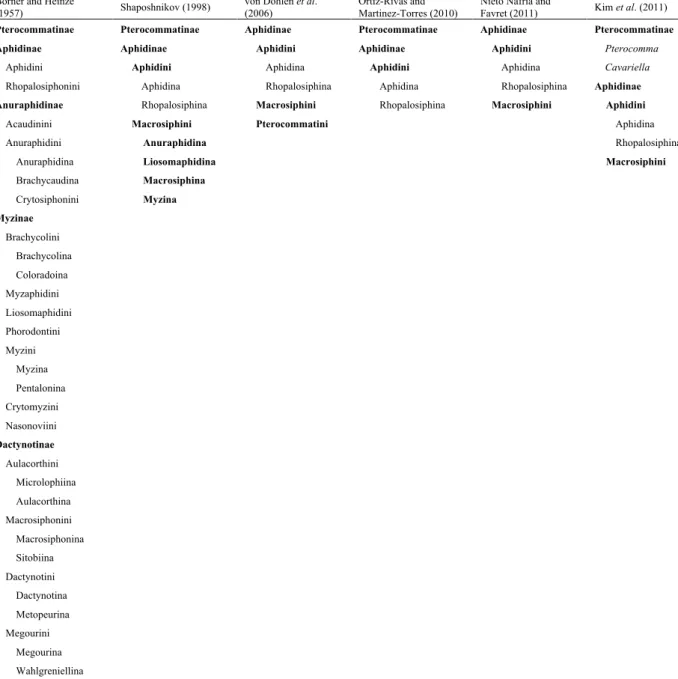
Table 1. Historical classifications of Aphidinae (Subfamily and tribe are marked by bold).
Table 2. Estimations of the marginal likelihood using stepping-stone sampling runs (SS) of three constrained hypotheses based on ML tree.
Table 3. Taxa used in this study with GenBank accession numbers.
CHAPTER 2.
2-1. TAXONOMIC REVIEW OF THE GENUS MYZUS (HEMIPTERA: APHIDIDAE) IN THE KOREAN PENINSULA Table 1-18. Biometric measurement of the alate and apterous viviparous females of Myzus in Appendix.
2-2. TAXONOMIC REVIEW OF THE GENUS UROLEUCON (HEMIPTERA: APHIDIDAE) IN THE KOREAN PENINSULA Table 19-36. Biometric measurement of the alate and apterous viviparous females of Uroleucon in Appendix.
LIST OF FIGURES
CHAPTER 1. MOLECULAR PHYLOGENY OF MACROSIPHINI
(HEMIPTERA: APHIDIDAE): AN EVOLUTIONARY
HYPOTHESIS FOR THE PTEROCOMMA-GROUP HABITAT ADAPTATION
Figure 1. Previous and current hypotheses about relationships with subfamily or tribal positions of Aphidini, Macrosiphini, and Pterocommatini (Pterocommatinae).
(A) Cladogram after Börner (1952) and Börner and Heinze (1957), (B) Cladogram after Shaposhnikov et al. (1998), who suggested that Liosomaphidina was an unstable group because of its irregular chromosome numbers, (C) Cladogram after von Dohlen et al. (2006), which contained the first results understanding relationships within Aphidinae using molecular data and suggested the possibility of a closer relationship between Macrosiphini and Pterocommatini, (D) Cladogram after Ortiz-Rivas and Martinez-Torres (2010), and (E) Cladogram after Nieto Nafría and Favret (2011). Registers of Family-group and Genus-group Taxa of Aphidoidea (Hemiptera Sternorrhyncha).
Figure 2. Maximum likelihood topology tree in Aphidinae with bootstrap support values. Numbers within the circles present representative nodes and support values. Maximum-likelihood bootstrap values (ML) (if >50, ★ = 100; Fig. S1) and parsimony bootstrap values (MP) (if >50; ★ = 100; Fig. S3) are shown above branches on the left and right sides, respectively. Bayesian posterior probabilities (PP) (if >0.50, ★ = 1.00; Fig. S2) are shown below
branches. All support values are indicated in Supplementary data 1 to 3. Results from analyses of ancestral state reconstruction for host preference as reported by BayesTraits MultiState analysis are indicated as pie charts showing the relative likelihoods of each host at the respective nodes. Red-highlighted names indicate genera formerly in Pterocommatini.
Figure 3. (A) Pterocomma pilosum living under the bark of Salix gracilistyla (Malphigiales), (B) Cryptosiphum sp. on Artemisia sp. (Asterales), (C) Myzus
persicae making pseudo-gall on leaves of Prunus persica (Rosales) and (D) Megoura crassicauda on the stems of Vicia sp. (Fabales). Photos by Hwalran
Choi.
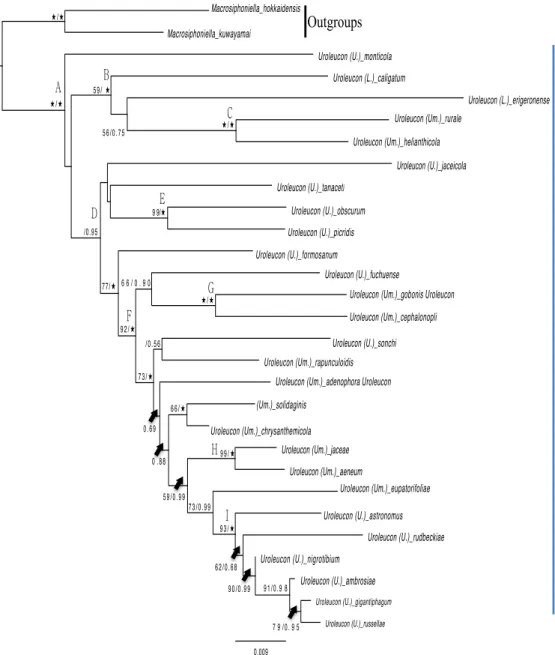
Figure 4. Maximum likelihood topology tree in Uroleucon with bootstrap supports value. Alphabets within the tree present representative nodes. Maximum-likelihood bootstrap values (ML) and Baysian Inference (BI) (If greater> 50) are shown above branches.
CHAPTER 2.
2-1. TAXONOMIC REVIEW OF THE GENUS MYZUS (HEMIPTERA: APHIDIDAE) IN THE KOREAN PENINSULA Plate 1-18. Micro slide specimens of Myzus in Appendix.
2-2. TAXONOMIC REVIEW OF UROLEUCON (HEMIPTERA: APHIDIDAE) IN THE KOREAN PENINSULA
Chapter 1.
Molecular phylogeny of Macrosiphini
(Hemiptera: Aphididae)
Abstract
Macrosiphine aphids are systematically controversial insects because of their complexed host associations and plesiomorphic characters. I reconstructed the phylogeny using maximum likelihood, maximum parsimony and Bayesian methods. Our findings support both the monophyly of Macrosiphini s.l., and of two subordinate groups (Macrosiphini s.str and the
Pterocomma-group). Furthermore, the Macrosiphini phylogeny indicates that
host associations are consistent also with host ecology, with a partitioning of aphid-host relationships into riparian and periaquatic habitats versus drier forest/shrubland habitats. Additionally, the largest Macrosiphine group, the genus Uroleucon is studied for their phylogeny. Our results show that genus
Uroleucon is monophyletic but taxonomic knowledge is incongruent in
subgeneric level. Rather, distributions of the species and host plant origins have influenced in Uroleucon phylogeny. Host associations, morphological characters and geographical regions are discussed.
Key words: Macrosiphini, Pterocomma-group, Uroleucon, host associations, habitat, evolution.
Introduction
Aphids (Family Aphididae) are one of the most important pests of agricultural crops, utilizing hosts from more than 40 plant families (Kim et
al., 2011). Since they are also generally small-bodied insects, with soft
cuticle and a generally high degree of host specificity, they are also very sensitive to environmental change (Blackman and Eastop, 2000; Kindlmann
et al., 2010). Thus, they have evolved to occupy various specialized habitats
and have well developed biological defense mechanisms including pseudo-gall construction (Sano and Akimoto, 2011) and adaptations for living both subcortically (under bark) and symbiotically with ants (Clark et al., 1999; Offenberg, 2001). Aphididae have diversified in association with environmental change since the Cretaceous (von Dohlen and Moran, 2000), and among the 24 subfamilies now recognized, Aphidinae contains close to half of the total number of described aphid species and genera (>2,400 species in 273 genera; Favret, C. Aphid Species File. Version 5.0/5.0. [17. Sep. 2014]). According to recent divergence dating, Aphidinae also originated in the late Cretaceous, with a rapid radiation ensuing in the early Tertiary (von Dohlen and Moran, 2000).
Like other aphids, reproduction in subfamily Aphidinae involves cyclical parthenogenesis, where growth and development of embryos occurs without fertilization, with either multiple generations or a single generation of asexual (female-only) reproduction. Although the life cycles of a few species involve polyphagy (multiple hosts), most species of Aphidinae are either host-specific (monoecious; Blackman and Eastop, 2006), living on the same host plant without migration, or they alternate between woody plants (primary hosts) used for sexual reproduction and herbaceous plants
(secondary hosts) used for the parthenogenetic part of the cycle (heteroecious; Dixon, 1987; Blackman and Eastop, 1994, 2000). Host alternation, the ability to switch hosts during different parts of the life cycle, is a successful way to optimize the nutrition derived from alternative host plants in the field, and could be the key to understanding the evolution of this phytophagous insect group (Guldemond, 1990; Moran, 1992; von Dohlen et al., 2006; Jousselin et al., 2010; Kim et al., 2011). As the angiosperm radiation proceeded through the Eocene (von Dohlen et al., 2006; Kim et al., 2011), the ability of aphids to alternate between different host plants (especially of taxonomically distinct plants) could have greatly promoted their simultaneous radiation alongside the diversifying angiosperms. Furthermore, host alternation has been suggested as a crucial factor in driving diversification of aphids in general (i.e., aphids have speciated by colonizing and then specializing on different host plant species) (e.g., Peccoud et al., 2010).
Aphidinae are divided among the tribes Aphidini and Macrosiphini. The worldwide-distributed Macrosiphini, with more than 1,700 described species in 239 genera, are one of the largest aphid groups, comprising more than half of all described species of Aphidinae (Favret, C. Aphid Species File. Version 5.0/5.0. [17. Sep. 2014]), most of which have been recorded from the Northern hemisphere (von Dohlen et al., 2006; Foottit et al., 2008). The broad host range of Macrosiphini includes more than 40 plant families (Blackman and Eastop, 1994, 2000, 2006) and, as such, many species are agricultural pests (e.g., on peaches, apples, napa cabbages, potatoes and other crops). For example, the peach-potato aphid (Myzus persicae) is globally important as a disease vector, affecting plants in numerous families
(Blackman and Eastop, 2000). Thus, both the host specificity and ecological importance of Macrosiphini have been studied extensively (Dixon, 1998).
The phylogenetic relationships within Macrosiphini s.l. (Macrosiphini + former Pterocommatini) have not been resolved due to the species richness, diverse host ranges and, most importantly, the indistinct characteristics relative to the formerly separated Pterocommatini (von Dohlen et al., 2006; Ortiz-Rivas and Martinez-Torres, 2010; Kim et al., 2011; Nieto Nafría and Favret, 2011; Nováková et al., 2013). Furthermore, previous taxonomic studies (Table 1, Fig. 1) have suggested that Macrosiphini s.l. are a problematic group because of the lack of morphological synapomorphies (Hille Ris Lambers, 1939, 1950; Heie, 1980). von Dohlen et al. (2006) confirmed the subdivision of Macrosiphini (into ‘anuraphidine’, ‘myzine’ and ‘dactynotine’ subgroups) with a phylogenetic analysis of tRNA + COII and EF-1α sequence data. They suggested monophyly of Macrosiphini s.str., excluding the genus Cavariella (reconstructed as the sister group of
Pterocomma). Ortiz-Rivas and Martinez-Torres (2010) treated Pterocomma
as the monotypic subfamily Pterocommatinae, which was recovered as the sister clade of the Aphidinae (Aphidini + Macrosiphini s.str.) but with only low support. Furthermore, they only sampled a single species of
Pterocomma. Kim et al. (2011) reconstructed the phylogeny of Aphidini
including a single species each of Pterocomma and Cavariella as sister taxa. They suggested that Cavariella should be transferred into Pterocommatinae because Pterocomma and Cavariella share Salicaceae hosts and have common morphological characters of the fundatrix (where mature wingless females hatch from over-wintering eggs). More recently, Nováková et al. (2013) reconstructed the phylogeny of aphids using DNA from the symbiont
Buchnera aphidicola. Although Macrosiphini s.l. were paraphyletic,
including Pterocommatini and Aphidini species, they recovered Aphidinae symbionts as monophyletic. Symbionts from three Macrosiphini species (Aspidophorodon longicaudus, Capitophorus hudsonicus, Muscaphis
stroyani) and Pterocomma formed a clade that was the sister group of
symbionts from the remaining Macrosiphini + Aphidini. However, further studies are needed to determine whether this symbiont phylogeny accurately reflects the phylogeny of their hosts.
Due to the uncertain relationships within Macrosiphini, and especially of the former Pterocommatini genera, the phylogeny of Macrosiphini s.l. is in need of re-analysis incorporating a variety of perspectives. In host preference studies, previous researchers considered the primary hosts of Macrosiphini to belong only to the plant family Rosaceae (Hille Ris Lambers, 1939, 1950; Heie, 1980). This became an ambiguous criterion, however, because previous morphology-based classifications have resulted in a broader range of hosts for the tribe, including genera in Salicaceae as well as Rosaceae. Additionally, the genus Cavariella, which prefers Salix hosts, shares morphological synapomorphies with other genera formerly in Macrosiphini that prefer Rosaceae (excluding Pterocommatini). Salicaceae (Salix and
Populus) are major host plants of not only Cavariella but also of genera in
the former Pterocommatini. Interestingly, these taxa share common habitats and host plant species. For the former Pterocommatini, recorded host plants mostly occur in riparian and generally periaquatic habitats such as riversides, lakesides and surrounding wetlands (Blackman and Eastop, 1994, 2006; Lichvar et al., 2014). The genus Cavariella also contains hygrophilic species, and both their primary and secondary hosts (Salix and species of Apiales,
respectively) live in periaquatic habitats. Cavariella and the former Pterocommatini are also interesting in being associated with ants on the knots or cracks of their host trees. During seasonal changes they are carried to the roots (near the ground) by their ant associates. Thus, we are interested in the correlation of host habitats and the evolution of Macrosiphini s.l. Although this phenomenon of host-habitat association has been observed in other host-specific insects such as tachinid flies parasitic on Lepidoptera and gall making cecid midges (e.g., Stireman et al., 2009, 2010), it has not yet been reported for aphids.
The main purpose of this study is to reconstruct the phylogeny of Macrosiphini s.l., adding molecular data for numerous previously unstudied genera. We increased sampling of the former Pterocommatini (to seven species in two genera, Plocamaphis and Pterocomma) and therefore evaluate the monophyly of included genera for the first time using molecular data. Our new phylogenetic hypothesis also includes ~40% of Macrosiphini s.l. genera and all subgroups of Börner and Heinze (1957), except ‘Acaudinini’ (Table 1). We tested the monophyly of Macrosiphini s.l. to determine whether it belongs in Aphidinae or is polyphyletic, with subgroups distributed in different aphid subfamilies. We statistically analyzed definitions of Macrosiphini s.l. using the most extensive sampling to date for this group. Additionally, to discuss the ancestral habitats and host evolution within Macrosiphini s.l., we evaluated the primary host preferences, host habitats and host alternation characters for the tribe. Furthermore, we analysed five mitochondrial (COI/COII, 12/16S, NADH1) and nuclear (EF-1α) genes from 29 terminal taxa representing three major subgenera of
species occurring on different distributions, and reconstructed the phylogeny using maximum likelihood method.
Materials and Methods Taxon sampling
For Macrosiphini molecular analyses, we selected a total of 107 species and 57 genera, including 12 genera not previously included in phylogenetic analyses of Macrosiphini s.l. (Cryptaphis, Cryptomyzus, Hyperomyzus,
Idiopterus, Illinoia, Matsumuraja, Neotoxoptera, Ovatus, Plocamaphis, Pleotrichophorus, Semiaphis, and Vesiculaphis) and 9 outgroup species
(Table S3). The tribes Aphidini and Macrosiphini and the former Pterocommatini were selected as Aphidinae ingroup taxa. The rank of Pterocommatini is controversial; in this study we followed the Aphidinae classification proposed by Blackman and Eastop (2000) and von Dohlen et al. (2006). Specifically, we sampled the 14 subunits of Macrosiphini, as divided by Börner and Heinze (1957), except Acaudini. Moreover, we included species from all of the genera included in Miyazaki’s (1971) ‘genera I to VIII’ and the four subtribes of Macrosiphini recognized by Shaposnikov (1998). This study includes two families, the ingroup taxa sampled from Aphidinae and outgroup taxa sampled from the subfamilies Calaphidinae, Chaitophorinae and Eriosomatinae (Aphididae), as well as an outgroup species from Adelgidae, representing the lineage closest to Aphididae (Kim
et al., 2011). For Uroleucon molecular analyses, A total of 29 species for
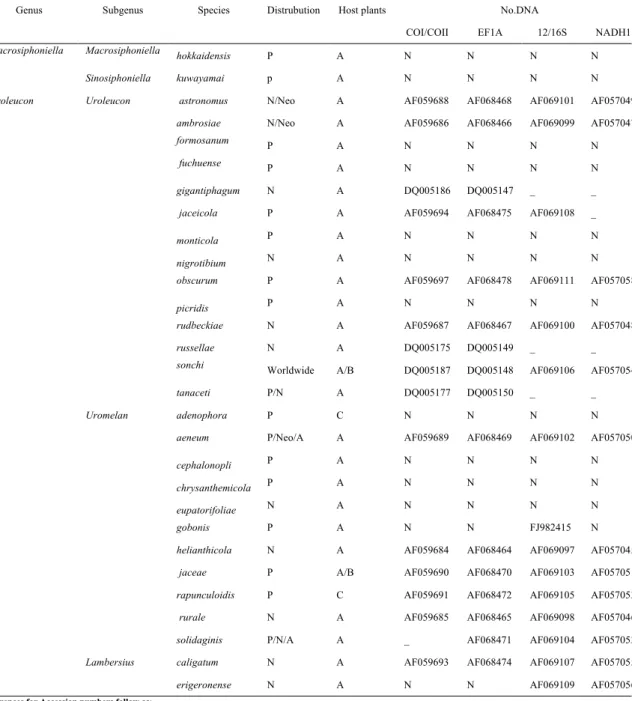
three main subgenera Uroleucon, Uromelan and Lambersius, including two outgroup species of Macrosiphoniella Del Guercio, 1911, were selected for molecular analysis (Table 3). Taxon sampling is followed by classification of
Blackman and Eastop (2006). Outgroup taxa, Macrosiphoniella were chosen due to closer lineage with Uroleucon (Moran et al., 2011). Newly uploaded species for this study is deposited in the College of Agriculture and Life Sciences (Seoul National University, Korea) as slide voucher samples. Abbreviations in Table 3 present following as: P, Palearctic; N, Nearctic; A, Africa; Neo, neotropical; A, Asteraceae; B, Boraginaceae; C, Campanulaceae. All DNA-extracted species are deposited in the College of Agriculture and Life Sciences (Seoul National University, Korea) as slide voucher samples.
DNA extraction, PCR amplification, and sequencing
Aphids were collected into 95–99% ethanol for DNA extraction. Genomic DNA was extracted from the same colonies and/or single individuals using the DNeasy Blood and Tissue Kit (QIAGEN, Inc.). After extraction, all genomic templates were stored in a -35°C freezer in the College of Agriculture and Life Sciences (Seoul National University, Korea). To make voucher specimens from the DNA-extracted samples, we used a nondestructive DNA extraction protocol, slightly modified from the method of Favret (2005). To extract DNA, whole bodies of individuals were put in the lysis buffer with proteinase K solution at 56°C for 4 h. Only DNA solids were used for PCR; remaining aphid cuticles were mounted on permanent microscope slides. PCR was performed using the TaKaRa Ex Taq system (Takara Bio, Inc., Japan) and the reactions were performed in 50 µL volumes containing 2 µL of each primer, (2.5 mM each), 10 mM dNTPs, 10× Ex Taq
Buffer (20 mM Mg2+ plus), 5 U/µL TaKaRa Ex Taq Polymerase and 3 µL
denaturation for 5 min at 94°C, followed by 38 cycles of 98°C for 10 s, 43– 50°C for 30 s, 72°C for 60 s, and a subsequent final extension at 72°C for 10 min. The PCR products were cleaned using a QIAquick PCR purification kit (QIAGEN, Inc.) and sequenced at Macrogen, Inc. (Geumcheon-Gu, Seoul, Republic of Korea). Partial sequences of the mitochondrial cytochrome c oxidase subunit I (COI) gene, the leucine tRNA plus cytochrome oxidase II (tRNA+COII) genes, the 16S ribosomal RNA gene and the nuclear elongation factor-1α (EF-1α) gene were chosen as molecular markers (Table S1). These genes are widely used in molecular phylogenetics (e.g., von Dohlen et al., 2006; Rindal et al., 2009; Kim et al., 2011; Shin et al., 2013). The primer-specific annealing temperatures of each primer set were 43°C for COI, 42–45°C for tRNA/COII, 48.5°C for 16S and 53–58°C for EF-1α. Alignment and characterization of gene fragments
The character sets used for the Macrosiphini phylogeny analyses were 605 bp of COI, 674 bp of tRNA+COII, 567 bp of 16S and 1,007 bp of EF-1α, for a total of 2,876 bp of sequences. Raw sequences were examined and corrected using SeqMan II (ver. 5.01, 2001: DNA-star). Alignments were constructed with MAFFT (Katoh et al., 2002, 2005; Katoh and Toh, 2008) partitioned by gene (COI, tRNA+COII, 16S, EF-1α) via the online server (ver. 6; http://mafft.cbrc.jp/alignment/software/). The Q-INS-I strategy was chosen for the tRNA+COII, 16S and EF-1α genes using default settings (gap opening penalty = 1.53 and offset value = 0.00), which has been recommended for RNA secondary structure and small data sets (<200 sequences; Katoh et al., 2005). COI sequences had no indels; thus, they were
aligned using the FFT-NS-I strategy implemented by the MAFFT online server with default settings.
The character sets used for the Uroleucon phylogeny analyses were 558 bp of COI/COII, 910 bp of 12/16S rRNA, 1,460 bp of NADH1, 1,070 bp of EF1α, for a total of 3,998 bp of sequences. Raw sequences were examined and corrected using SeqMan II (ver. 5.01, 2001: DNA-star). Alignments were conducted by MAFFT (Katoh et al., 2002, 2005; Katoh and Toh, 2008) separating by gene partitions (COI/COII, 12/16S rRNA, NADH1 and EF1α) via the online server (ver. 6; http://mafft.cbrc.jp/alignment /software/). The Q-INS-I strategy was chosen for the 12/16S rRNA, NADH1 and EF1α genes using the default setting (gap opening penalty=1.53 and offset value=0.00), which consider RNA secondary structure and small data sets (<200) (Katoh et al., 2005).
Phylogenetic analyses
A maximum-parsimony (MP) analysis was performed with PAUP*4.0b10 (Swofford, 2002) carrying out a heuristic search procedure, tree-bisection-reconnection (TBR) branch swapping, and 1,000 random sequence additions with 10 max trees held at each pseudoreplicate. All characters were treated as unordered and equally weighted for MP analysis. Then, 1,000 MP bootstrap replicates were performed using a heuristic search procedure, with a maximum tree setting of 200 trees. Finally, PAUP selected the 200 most parsimonious trees to generate a 50% majority-rule consensus tree (Fig. 2). We marked nodal support values on the consensus tree manually based on a bootstrap 50% majority-rule consensus tree (Fig. S3).
Maximum-likelihood analysis (ML) was conducted with RAxML 8.1.5 (Stamatakis, 2014). The resulting topology was used in the reconstruction of ancestral states for host preference, host habitat and host alternation. ModelTest 3.06 (Posada and Crandall, 1998) was used to select the best-fitting nucleotide substitution model; the GTR+I+G model was used for each gene partition. ML analyses of the combined data set were performed in CIPRES (Miller et al., 2010). The data were partitioned into COI, tRNA+COII, COI+COII, 16S, 12/16S and EF-1α sequences, and 1,000 bootstrap replicates were performed using the thorough bootstrap algorithm with 10 ML tree searches. Additionally, each genes and combined mitochondrial genes are analysed for constructing trees.
Bayesian phylogenetic analysis (BP) was implemented for the combined data set using MrBayes 3.1.2 (Ronquist and Huelsenbeck, 2003). We analyzed the combined data set using partitioned Bayesian analysis, in which the data were partitioned into COI, COI+COII, tRNA+COII, 16S, 12/16S and EF-1α segments, with BP performed using a partitioning scheme that maximized the likelihood based on the GTR+I+G model with specific model scores estimated with ModelTest 3.06 for each gene region. For the BP analyses, four chains (three heated and one cold) were run, starting from a random tree and proceeding for 10 million Markov-chain Monte Carlo
(MCMC) generations, sampling the chains every 100th cycle. Burn-in was set
at 10% of the sampled number of trees. Convergence was confirmed by monitoring likelihood values graphically. A 50% majority-rule consensus tree was constructed from the remaining trees to estimate posterior probabilities (PP).
Reconstruction of ancestral host preferences, host habitats and host alternation
To reconstruct ancestral host preferences, host plants for each species were coded as below. Primary woody hosts were coded for heteroecious aphids. Monoecious aphids use either a single herbaceous plant or woody plant species, if they feed on it for the whole life cycle. Host information was found mainly in Blackman and Eastop (Miyazaki, 1971; Blackman and Eastop, 1994, 2000, 2006; Lee et al., 2002). Host types were coded as follows: a, Rosales; b, Fabales; c, Sapindales; d, Dipsacales; e, Solanales; f, Brassicales; g, Malpighiales; h, Geraniales; i, Lamiales; j, Saxifragales; k, Asterales; l, Malvales; m, Ericales; n, Liliales; o, Ranunculales; p, Gornales; q, Myrtales; r, Fagales; s, Poales; t, Cryophyllales; u, Polypodiales; v, Pinales, w, Magnoliales; and x, Asparagales. Each type is presented in Fig. 2 in a different color (see also Table S3). To reconstruct ancestral host habitats for each species, these were coded as ‘Forest’, ‘Shrubland’ or ‘Wet area’; these are listed along with the host preference information for each species in Table S3. We also tested a dual-habitat type coding (‘Dry’ vs ‘Wet’), where ‘Forest’ and ‘Shrubland’ were combined and coded as ‘Dry’ host habitats. Host alternation characters were coded as ‘Monoecy on Shrubs’, ‘Heteroecy’ or ‘Monoecy on Trees’. To reconstruct ancestral transitions from heteroecy to monoecy, or vice versa, we also tested a dual-host alternation coding (‘Monoecy vs. Heteroecy’), where ‘Monoecy on Shrubs’ and ‘Monoecy on Trees’ were combined and coded as ‘Monoecy’.
The ancestral states for host preference, host habitat and host alternation were reconstructed for selected nodes on a reference tree, the ML phylogenetic consensus topology (Fig. 2, Table S2–S3). We used
BayesTraits (PC ver. 1.0.) (Pagel et al., 2004; Pagel and Meade, 2007), a Bayesian method of ancestral state reconstruction that uses multistate ML methods to derive posterior probabilities for trait values at internal nodes of the phylogeny (Pagel et al., 2004). BayesMultiState (implemented in BayesTraits) using MCMC with multiple character-state options was selected for evolutionary analysis because some taxa had more than one primary host. First, the phylogenetic trees were reconstructed by ML (Fig. 2), and a set of the most likely 1,000 trees, found by RAxML 8.1.5 in CIPRES, was used in the BayesMultiState analysis. The polytomies in each of the trees were resolved to adjust branch length to 0.0 in Mesquite (Maddison and Maddison, 2014). The rate deviation was set to 10. A hyper prior approach was used with an exponential prior seeded from a uniform prior in the interval 0–10; thus, acceptance rates in the preferred range of 20–40% were achieved, as recommended (Pagel et al., 2004; Pagel and Meade, 2007).
The host habitat and host alternation states were also visualized and mapped onto our ML chronogram using the parsimony ancestral state reconstruction algorithm implemented in Mesquite V2.75 (Maddison and Maddison, 2011). For host habitats we mapped the states ‘Forest’, ‘Shrubland’ and ‘Wet area’; for host alternation, we mapped the states ‘monoecy on shrubs’, ‘heteroecy’ and ‘monoecy on trees’.
Topology-based hypotheses testing
We specified three alternative hypotheses to assess using constraint-based topology tests: (1) (Aphidini + Macrosiphini) + Pterocommatini (AM). The ‘traditional’ classification treats Aphidini + Macrosiphini as a monophylum with Pterocommatini as the sister group (Börner, 1952; Heie, 1980;
Shaposhnikov, 1998), and recent molecular studies supports the monophyly of clade Aphidini + Macrosiphini (Ortiz-Rivas and Martinez-Torres, 2010; Kim et al., 2011); (2) (Pterocommatini + Macrosiphini) + Aphidini (PM). von Dohlen et al. (2006) and other taxonomic studies suggest that Pterocommatini + Macrosiphini is a monophylum; (3) (Aphidini + Pterocommatini) + Macrosiphini (AP). This hypothesis has not previously been suggested.
For the Bayes factor test, we constrained the topology based on the standard approach of Bergsten et al. (2013). In these analyses, we calculated the marginal likelihood of AM and AP using an absolute monophyly constraint for these two hypotheses as an informed topology prior, whereas the marginal likelihood of PM was calculated from an unconstrained analysis with an uninformative prior across topology space. This is an approach taken in many empirical studies (e.g., Lavoué et al., 2007; Marek and Bond, 2007; Parker et al., 2007; Azuma et al., 2008; Yamanoue et al., 2008; Pavlicev et
al., 2009; Tank and Olmstead, 2009; Makowsky et al., 2010; Yang et al.,
2010; Knight et al., 2011; Bergsten et al., 2013).
To calculate the marginal likelihood of the models, we used the stepping-stone sampling method of Xie et al. (2011) and Bergsten et al. (2013), using MrBayes 3.2 (Ronquist et al., 2012). Similar to Xie et al. (2011), we used 0.4 for the α-shape parameter of the beta distribution, which is within the range these authors found to be optimal. An initial 204,000 generations were discarded as burn-in, and then 204,000 MCMC steps were
sampled every 100th generation for each of 48 β-values between 1 (posterior)
and 0 (prior). The contribution to the marginal likelihood from each step was estimated from a sample size of 2,040. The same settings were used for four
independent runs for each tested model, each with one cold and one heated chain, and the arithmetic mean across runs of the estimated marginal likelihood for each model was used to calculate the Bayes factor.
Results
Macrosiphini Phylogenetic analyses of the combined dataset
The ML bootstrap (Fig. S1), MP bootstrap (Figs. S1, S3, respectively) and PP values (Fig. S2) are shown in Fig. 2, plotted on the ML phylogeny. Although the backbones of the trees from all three analyses are identical, Macrosiphini s.l. (Node 3 in Fig. 2) had only moderate support due to the polytomy in the MP analysis (Fig. S3). A monophyletic Aphidini was strongly supported in ML, MP and BP analyses (Node 1 in Fig. 2). Furthermore, the new Pterocomma-group (Node 4, Fig. 2) was strongly supported in all analyses that included five former Macrosiphini genera and
Pterocomma and Plocamaphis of the former Pterocommatini. Detailed
phylogenies for ML, BP and MP are presented in Fig. S2, S3, S6, S7, S8, S9 and S10.
The subfamily Aphidinae was strongly supported as monophyletic in all analyses (Node 1 in Fig. 2). The current Aphidinae includes two tribes, Aphidini and Macrosiphini s.l. (Node 2 and 3 in Fig. 2). A monophyletic Aphidini (Node 2 in Fig. 2) was strongly supported in all analyses whereas Macrosiphini s.l. was only moderately supported by ML (54) and BP (0.85) analyses (<50% bootstrap support in MP analysis). However, our phylogeny suggests that Macrosiphini s.l. comprises two separate sister groups—the ‘Pterocomma-group’ and ‘Macrosiphini s.str.’.
The Pterocomma-group (Node 4 in Fig. 2) was strongly supported in all three analyses and not only contains Pterocomma and Plocamaphis from the former Pterocommatini, but also includes some genera from Macrosiphini (Capitophorus, Cavariella, Liosomaphis, Pleotrichophorus, Plocamaphis,
Pterocomma and Vesiculaphis). Therefore, our results strongly suggest that
several genera previously classified as Macrosiphini s.str. in fact are more closely related to Pterocomma-group genera. The monophyly of four
Capitophorus species + Pleotrichophorus glandulosus was strongly
supported by all analyses; thus, the genus Capitophorus is paraphyletic.
Cavariella and Plocamaphis are each monophyletic, supported by very high
MP, ML and BP support values. Pterocomma, the type genus of Pterocommatini, was polyphyletic: Pterocomma jacksoni was strongly supported as the sister species of two Plocamaphis species in ML and BP analyses (Pterocomma jacksoni (Plocamaphis flocculosa, Plocamaphis
coreana)) (Figs. 2, S1, S2), but an alternative relationship was found in MP
analysis ((Pterocomma jacksoni, Liosomaphis atra) + (Plocamaphis
flocculosa, Plocamaphis coreana); Fig. S3). One clade (Vesiculaphis caricis + Liosomaphis atra) was the sister group of the former Pterocommatini (plus Cavariella), and another clade (Capitophorus + Pleotrichophorus) was the
sister group of all remaining Pterocomma-group genera (Nodes 4, 6, and 7 in Fig. 2).
Macrosiphini s.str. (Node 5 in Fig. 2) was strongly supported in the BP analysis, but only moderately supported in MP and ML analyses. Macrosiphini s.str. contains primarily Macrosiphini species, as has been suggested previously (Heie, 1980; Shaposhnikov, 1998; Blackman and Eastop, 2000), with no species from the Pterocomma-group needing to be
transferred there (Fig. 2). The topologies of the MP, ML and BP trees differ slightly in the relationships within this group (Fig. S1, S2 and S3). Node 12 represents two clusters largely equivalent to Börner and Heinze’s (1957) former subfamilies ‘Myzinae’ (Node 14 in Fig. 2) and ‘Dactynotinae’ (Node 16 in Fig. 2). The genera Megoura, Brachycaudus, Uroleucon and Sitobion are monophyletic (Nodes 17, 22, 23, 26 in Fig. 2), with strong support in all three analyses. The genera Hyadaphis, Diuraphis, Semiaphis,
Cryptosiphoum, Brevicoryne and Hayhurstia form a clade with strong
support in all three analyses (node 25;‘Anuraphidinae’ in Börner and Heinze, 1957). The genus Myzus wass polyphyletic, appearing in a mixed clade in the ML and BP trees along with the genera Eumyzus, Ovatus and
Tuberocephalus (with strong support; Node 15 in Fig. 2); furthermore, Myzus ornatus was completely separated from other Myzus in the MP
topology and placed close to Anuraphis pyrilaseri (Node 15 in Fig. 2, Fig. S2 and S3). The genus Macrosiphoniella was paraphyletic with respect to
Metopeurum fuscoviride (Node 21 in Fig. 2), and this relationship was
strongly supported in all three analyses. The genera Acyrthosiphon and
Macrosiphum were shown to be polyphyletic, but these relationships were
not strongly supported. Acyrthosiphon vandenboschi was separated from A.
pisum but placed rather close to Aulacorthum solani, with high ML bootstrap
and PP support values (Node 24 in Fig. 2). Macrosiphum species showed a polyphyletic relationship that suggests M. perillae is the sister group of the
clade ((Impatientinum + Metopolophium), Sitobion); remaining
Macrosiphum species were indicated as monophyletic by MP analysis, but
Macrosiphini Phylogenetic analyses of the combined dataset
For the combined dataset, ML analysis yielded with partitions 1,000 bootstraps. The ML bootstraps and BI are shown in Fig. 4 based on ML molecular phylogeny. For ML and BI analyses, the GTR+I+G model was used as the most appropriate for the combined dataset evaluated by ModelTest 3.06. Outgroup Macrosiphoniella is monophyletic with strong ML and BI support (Fig. 4). The genus Uroleucon is a monophyletic that is clearly divided from outgroups by strong ML and BI support value (A in Fig. 4). In the subgeneric level, three main subgenera denied monophyletic (B in Fig. 4). Lambersius showed paraphyletic with moderate support value (C in Fig. 4). Two subgenera, Uroleucon and Uromelan denied monophyletic (C, D in Fig. 4). Two Uromelan species, U. rurale and U. helianthicola made a clade with strong ML and BI support and it nested within Lambersius clade (B, C in Fig. 4). All nominotypical subgenus species were nested in node D (Fig. 4) and it mixed with Uromelan species with strong BI value. Among them, there were two groups constructed with strong ML and BI value (E, F in Fig. 4). First is two Uroleucon species, U. obscurum and U. picridis in Node E (Fig. 4). Second is two subgenera combined group, 9 Uroleucon species and 9 Uromelan (E, F in Fig. 4). In within node F, there were several clades with strong ML support values. Each of two Uromelan species, (U.
gobonis and U. cephalonopli) and (U. aeneum and U. jaceae) made a clade
in node G and H, respectively (Fig. 4). In node I, Six Uroleucon species made a clade with strong ML and BI values (Fig. 4).
Maximum likelihood ancestral character state reconstructions
The ancestral host preferences of Aphidinae were estimated for each tribe and for some important genera based on the preferred ML topology (Fig. 2). The Bayes MultiState analysis allowed for free rates of host preference-type transitions among the 24 types (Fig. 2, Table S3). A preference for Rosales hosts for Aphidinae (Node 1 in Fig. 2) was reconstructed with >95% probability (Rosales = 99%). A host preference for Rosales (type: a) for both Aphidini and Macrosiphini s.l. was also reconstructed with a probability >95% (Rosales 96% for both nodes; Nodes 2 and 3 in Fig. 2).The ancestral host preference for the Pterocomma-group (Node 4 in Fig. 2) was suggested to be a mixture of Malpighiales and Rosales (Malpighiales 49% and Rosales 29%). At the genus level, the ancestral state for the Capitophorus-group (Capitophorus + Pleotrichophorus) was predominantly Rosales with a probability of 99% (Node 6 in Fig. 2), whereas that for the remaining clade was Malpighiales with probability of 85% (Node 7 in Fig. 2). Thus, Rosales were the likely ancestral hosts for all the tribes of Aphidinae. Habitat transitions could have occurred more than once independently in Megoura and the clade ((Macrosiphoniella + Metopeurum), Uroleucon) within Macrosiphini s.str. (Node 5 in Fig. 2). Furthermore, habitat shifts between Rosales and Malpighiales may have occurred within the Pterocomma-group at least once. The ancestral host preference for Macrosiphini s.str. was reconstructed as completely Rosales with a probability >95% (Rosales 99%; Node 5 in Fig. 2). The ancestral host preference for the genus Megoura was reconstructed as predominantly Fabales, with a probability of 99% (Node 17 in Fig. 2), whereas that of the clade ((Macrosiphoniella + Metopeurum),
Uroleucon) was reconstructed as predominantly Asterales, with a probability
of 99% (Node 20 in Fig. 2).
The ancestral host habitat of Aphidinae, Macrosiphini s.l. and the
Pterocomma-group was reconstructed to be wet habitats with more than 80%
probability (Nodes 1, 3 and 4 in Table S2). Furthermore wet habitats were reconstructed as the ancestral habitat for all internal nodes as well as for the
Pterocomma-group with > 99% probability (except Node 7, 97% in the ‘Dry’
vs. ‘Wet’ analysis; Table S2). In contrast, the ancestral host habitat reconstructed for Macrosiphini s.str. and all internodes was reconstructed as dry habitats with more than 90% probability (Nodes 5, 11, 13, 14, 16, 17, 19, and 20 in Table S2).
In the ‘Monoecy’ vs. ‘Heteroecy’ host alternation ancestral state reconstruction analysis, heteroecy—the ability to utilize more than one host—was reconstructed as the ancestral state for most clades. This was also suggested by the other 3-state host alternation analysis performed with the Bayes MultiState method (Table S2) and ancestral state mapping (Fig. S5). The ancestral state for three nodes was reconstructed as monoecy with a probability of > 85% (Table S2). Mapping of host alternation onto the chronogram suggests that the ancestral state for Macrosiphini s.l. was heteroecy (Fig. S5). The ancestral state for the former Pterocommatini (genera Plocamaphis and Pterocomma) could have been reconstructed as monoecy on trees; however, as revealed by our analysis, the ancestral state of the new Pterocomma-group was reconstructed as heteroecy (Node 4 in Fig. 2), which is also congruent with the Bayes MultiState analyses for host alternation. Monoecy on shrubs is uncommon in the Pterocomma-group, but the Bayes MultiState analyses suggested this was the ancestral host
alternation state for the genera Macrosiphoniella, Macrosiphum (including closely related species), Megoura and Uroleucon (all within Macrosiphini
s.str.).
Topology-based hypothesis testing
We tested topological hypotheses using a Bayesian stepping-stone sampling approach. Three constrained hypotheses based on the ML tree were implemented. In the backbone-constrained analysis, Aphidini + Macrosiphini (AM), Aphidini + Pterocommatini (AP) and Pterocommatini + Macrosiphini (PM) were constrained to be monophyletic (Table 2). The estimate of the marginal likelihood was -37478.40 for AM, -37484.09 for AP and -37495.90 for PM. In the preferred Bayes factor test, AM vs. AP was 5.69, AP vs. PM was 11.81 and PM vs. AM was -17.50. Thus, the two hypothesis tests for AM and AP were positive evidence for rejection, and PM was denied in the model test (Table 2).
Discussion
Pterocomma-group
As suggested by Nieto Nafría and Favret (2011), the current concept of Macrosiphini incorporates all genera formerly in Pterocommatini because of the results of previous molecular studies. These studies also pointed out the lingering controversial status of Pterocommatini that had emerged from the variable placements it has had with respect to Macrosiphini and Aphidini (von Dohlen et al., 2006; Ortiz-Rivas and Martinez-Torres, 2010; Kim et al., 2011; Nováková et al., 2013) (Table 1). von Dohlen et al. (2006) suggested the possibility of a sister group relationship between Pterocomma (e.g., Fig.
3A) and Cavariella within Macrosiphini s.l., providing crucial initial evidence regarding the phylogenetic status of these two tribes. However, Ortiz-Rivas and Martinez-Torres (2010) and Kim et al. (2011) suggested a different relationship, that the Pterocomma + Cavariella clade may be the sister group of a monophyletic clade comprising Macrosiphini + Aphidini. More recently, Nováková et al. (2013) indicated that phylogenetic re-examination and further study of Macrosiphini and Pterocommatini could help resolve one of the most significant outstanding issues in aphid systematics and evolution. Hence, until now the phylogenetic relationships of Macrosiphini and Pterocommatini have remained controversial, with no consensus between taxonomic and phylogenetic approaches having yet been possible.
In this study, we inferred the phylogenetic relationships of the
Pterocomma-group using the most broadly sampled molecular data set yet
compiled for the former Pterocommatini and also for Macrosiphini. Five species of Pterocomma (Pterocommatini), two species of Plocamaphis (Pterocommatini), nine species of Cavariella (Macrosiphini) and
(unexpectedly) four genera of Macrosiphini (Capitophorus,
Pleotrichophorus, Liosomaphis, and Vesiculaphis) were nested within the Pterocomma-group (Node 4 in Fig. 2) as a clade separated from
Macrosiphini s.str. (Node 5 in Fig. 2). Furthermore, our current data didn’t support monophyly of former Pterocommatini genus Pterocomma relating with another former Pterocommatini genus Plocamaphis. Taxonomically, outside species of the genus Pterocomma clade, Pterocomma jacksoni has moderate siphunculus than other Pterocomma species (They have much swollen siphunculus) (Blackman and Eastop, 1994). It implicates
morphology of siphunculs is homoplastic characaters in Pterocomma genus, and further systematic studies are required
Macrosiphini s.str.
The taxon sample for Macrosiphini s.str. in our study is the most extensive to date (Node 5 in Fig. 2) and we found some similarities between our results and those of previous studies. In our study, the genera Brevicoryne,
Cryptosiphum, Diuraphis, Hayhurstia, Hyadaphis and Semiaphis all
accorded with the concepts of Anuraphidinae by Börner and Heinze (1957) and Shaposhnikov et al. (1998) (Node 25 in Fig. 2). The morphology of all of these genera is more similar to that of Aphidini than to other Macrosiphini, such as in the presence of vestigial appendages. In comparison with other Macrosiphini species, they did not evolve morphological structures used for communication, such as the long siphunculus or long antennae (Nault et al., 1973; Mondor et al., 2002). Instead of elongated appendages, for protection in life they have evolved, for example, the ability to produce a wax dust coating over their body or the ability to construct leaf rolls within which they can hide (Fig. 3B). Nodes 15 and 26 in Fig. 2 primarily include Myzus and
Brachycaudus species, respectively, and the more inclusive clade (Node 14)
containing these genera shows mixed relationships involving several genera
(Anuraphis, Dysaphis, Eumyzus, Longicaudinus, Ovatus and
Tuberocephalus). The morphologies of Myzus and Brachycaudus are similar,
both having medium-sized appendages and a developed antennal tubercle. Moreover, they alternate between using trees and herbaceous plants as hosts. Their host trees are commonly Prunoidea and Maloidea (Rosales) and their herbaceous host plants are from various families (e.g., Apiaceae, Asteraceae,
Campanulaceae, Plantaginaceae, Polygonaceae, Valerianaceae). Making pseudo-galls on leaves (Fig. 3C) is also a distinctive feature of the genera within Nodes 13 and 14 (but as yet unknown in Longicaudinus
corydalisicola). Interestingly, the genus Myzus are revealed paraphyly in
clade 15 showing mixed relationship with Myzus–like aphids such as
Eumyzus, Ovatus and Tuberocephalus (Favret, C. Aphid Species File.
Version 5.0/5.0. [17. Sep. 2014]). It implicates taxnomomic phylogeny are incongruent with molecular data within subgeneric level of the genus Myzus. Rather than morpholological similaritis, Myzus and Myzus-like genera seem to be involved in host alternating.
Based on taxonomic studies, the species in node 19 in Fig. 2 commonly have elongated appendages with long antennae, cauda and siphunculus (Fig. 3D) (Blackman and Eastop, 2000). Some species also alternate between host trees (Rosoidea [Rosales]) and herbaceous plants, but most species that live on herbaceous plants have only a simple life cycle. They might have evolved elongate appendages to search for various herbaceous plants (Mackenzie and Dixon, 1990; Mondor et al., 2002). Interestingly, the genera Megoura,
Uroleucon and Sitobion are each monophyletic (Fig. 2; nodes 17, 22 and 23,
respectively), prefer to feed on herbaceous plants and have a simple life cycle (no host alternation). For example, Megoura and Uroleucon are host specific on Fabaceae and Asteraceae, respectively. Indeed, the host “Asterales” is a key character for classifying Uroleucon together with the genera Macrosiphoniella and Metopeurum (Fig. 2, Node 20). These three genera could have rapidly adapted to Asteraceae and do share morphological similarities, including the ‘spotted line’ on the abdomen and the ‘reticulated siphunculus’. All genera except Cryptaphis in the Macrosiphum lineage
(Acyrthosiphon, Aulacorthum, Illinoia, Macrosiphum) share a narrow siphunculus and tongue-shaped antennal tubercle. Furthermore, the genus
Aulacorthum shows monophyly and it accords with previous study (Lee et al., 2013) Thus, our newly hypothesized generic groupings within
Macrosiphini s.str. are congruent with previous morphological hypotheses (Börner and Heinze, 1957; Shaposhnikov et al., 1998).
Uroleucon
The genus Uroleucon Mordvilko, 1914 is one of the species-rich aphids, including over 190 described species (Nieto Nafrìa et al., 2007; Favret et al., 2018), and is host specific (monoecious holocyclic aphids; Blackman and Eastop, 2006) on Asteraceae, although a few species are associated with Campanulaceae (ex; Uroleucon adenophora on Adenophora spp.) and other plant families (ex; Uroleucon jaceae on Boraginaceae) (Blackman and Eastop, 2006). Morever, they make serious damages to agricultural crops such as lettuce, safflower and variable Cirsium species. (Lee et al., 2002; Auad and Moraes, 2003; Blackman and Eastop, 2006). All species of
Uroleucon are subdivided into 6 subgenera: Uroleucon, Uromelan, Lambersius, Belochilum, Divium and Satula. (Nieto Nafrìa et al., 2007,
Favret et al., 2015). Among them, three major subgenera, Uroleucon,
Uromelan and Lambersius, are dominant groups with valid 187 species.
However, remaining three minor subgenera, Belochilum, Divium and Satula contain only 1 species, respectively.
Taxonomic study of Uroleucon has been extensively conducted by over the world. (Favret, C. Aphid Species File. Version 5.0/5.0. [17. Sep. 2014]). Like other Macrosiphini species, Uroleucon presents representative
characters such as developed antenna, appendages, cauda and siphunculus, and previous authors have divided nominotypical subgenus (Uroleucon),
Uromelan and Lambersius by pigmentation of cauda and color in live
following by: i) Nominotypical subgenus and Uromelan are reddish to dark in live. Lambersius is greenish in live with pale cauda and siphunculus. ii) Cauda’s pigmentation of nominotypical subgenus is pale, but Uromelan is dark. However, these typical morphological characters to distinguish three main subgenera are still controversial because of homoplasious characters and incongruent with molecular phylogeny by Moran (1999). So far, other morphological characters have been suggested to define at subgenus level (Carvalho et al., 1998) but it has been not acceptable due to inconsistent morphological characters (Blackman and Eastop 2006; Nieto Nafrìa et al., 2007). Furthermore, some species are defined by either continental isolations or dominant species distribution. For example, the species occurring on Palearctic region was named “Old World species”. In contrast, the species occurring on Nearctic region was named “New World species” (Moran et al., 1998, Blackman and Eastop 2006; Nieto Nafrìa et al., 2007).
Phylogenetic study in Uroleucon genus has been little known, although their subgeneral status and morphological keys are controversial. Moran et al., (1999) had conducted molecular phylogeny using European and North American species. The study discovered incongruent of molecular topology and taxonomic definition for main subgenera, and it discussed association of biogeographic and host relation. However, they included restricted sampling only; European, North American species and only one species, Uroleucon
Our data set presents that the genus Uroleucon is monophyletic but previous taxonomic concept is incongruent within subgeneric level. Thus, morphological characters such as cauda’s pigmentation or live body colors are insufficient to define three subgenera Uroleucon, Uromelan and
Lambersius, and it revealed homoplacious character. This view of
phylogenetic relationship of three main subgenera accorded with Moran et al. (1999)’s topology. However, reconstructed tree shows new relationship in node C (Fig. 4). Four species nested in C are from different subgenera, two
Lambersius species and two Uromelan species, respectively. Thus, those
species seems to fail monophyly based on subgeneric taxonomic concept. They, however, shared morphological similarities; less developed scleroties on abdomen, pale cauda, green body except U. helianthicola. Those chracters are more likey Lambersius morphology than Uromelan. In the other hands, node D comprises two subgenera, Uroleucon and Uromelan without Lambersius, and they have typically Uroleucon and Uromelan morphology such as well-developed scleroties, pale or dark cauda, reddish to blackish body colors.
Because of homoplacious chracters within subgenera, several studies suggested new modified classification. Carvalho et al., (1998) conducted classification the genus using geographic association, and it was divided by two geographic diffierences: Old world species (occurring on mostly Palearctic region) and New World species (occurring on mostly Nearctic region). Apparently, Our result supports monophyly of new World species in node B (Fig. 4). However, Some of new World species have been nested in Old word species in node D (Fig. 4). Thus, Nearctic region requires redefinition of the concept due to the separated Nearctic clade (C, I Fig. 4).
Uroleucon is thought to be host specific and intercontinental relationship in
genus (Moran et al., 1999; Blackman and Eastop, 2006). However, it has been insufficient to prove association of biogeography and host origin due to lack of sampling. Here, we extended geographic diversity to Nearctic, Neotropicals, Africa, Paleartic (Asia+Europe) in our analysis. Specially, seven species occurring on only Asia are added for the first time (U.
adenophora, U. chrysanthemicola, U. formosanum, U. fuchuense U. cephalognopli, U. gobonis, and U. monticola) in Uroleucon phylogenetic
study. And, two species, U. adenophora and U. rapunculodis occurring on Campanulaceae plants are discussed. Consequently, seven Asian species are nesed in node D (Fig. 4), and they have showed mixed clade with old World and new World species both. Morphologically, closed species such as U.
obscurum/ U. picridis and U. cephalonopli/ U. gobonis made a clade,
respectively. Furthermore, most of old World species in node D of Fig. 4) have been associated with host tribal level, Cynareae or Cichorieae (Table 3), but New World species have been closely associated with host tribe, Heliantheae (C in Fig. 4). Through the results, new World species seem to be more related with host association since plant tribe, Heliantheae is originally native of Nearctic region.
Implications of host preference and associated morphological traits The subfamily Aphidinae has two specific ecological characteristics: host alternation and host diversification. Host-alternating species move between trees and/or herbaceous plants in cold and warm seasons. In contrast, some species are monoecious on a wide variety of herbs and shrubs, such as the genus Uroleucon, species of which are each host specific on a single species
(Blackman and Eastop, 2000). Above all, the adaptation of Pterocomma-group species to their hosts is a crucial factor for separating this Pterocomma-group from Macrosiphini s.str. within Aphidinae, and morphological changes within this group may be linked to their host associations. We assumed that the evolution of Macrosiphini s.l. was most strongly influenced by the interactions between the aphids and their primary hosts, but that the evolution of specific adaptions, such as the evolution of communication characters like the siphunculus and elongate antennae, was promoted instead by the various secondary hosts utilized by these aphids. In previous taxonomic studies, Macrosiphini (s.str.) were classified as a separate group based largely on their primary hosts, various taxa in Rosaceae (Hille Ris Lambers, 1939, 1950; Heie, 1980). Our ancestral state reconstructions suggest that the ancestor of the Pterocomma-group could have occurred commonly on both Salicaceae (Malpighiales) and Elaeagnaceae (Rosales) (Node 4 in Fig. 2), whereas the ancestor of Macrosiphini s.str. primarily emerged only on Rosaceae (Node 5 in Fig. 2). That is, the Pterocomma-group could have shifted to Salicaceae hosts from an ancestral Rosaceae group (Node 3 in Fig. 2). In contrast, Macrosiphini s.str. could have adapted to host alternation and/or changed to use diverse hosts, such as in the genera
Macrosiphoniella (Node 21 in Fig. 2) and Hyperomyzus (Node 18 in Fig. 2).
The habitats of Salicaceae (Malpighiales) are generally very wet, and are usually at the waterside. However, the habitats of Rosales are most commonly found at the base of mountains, and are much drier than the habitats of Salicaceae (Table S3). Interestingly, Elaeagnaceae (the Rosales hosts of Pterocomma-group species in this study) are found in wet or periaquatic habitats. Furthermore, the secondary hosts of host-alternating
species are also found in these habitats. Thus, although it has been suggested that host plants diverged prior to their aphid herbivores (Karrenberg, 2002; Kim et al., 2011) we further suggest that different habitats (e.g., ‘wet’ vs. ‘dry’ environments), perhaps also in association with geographical isolation of both the Pterocomma-group and Macrosiphini s.str., may also be a critical factor in the evolution of this group.
Typically, Macrosiphoniella, Uroleucon and Pleotrichophorus species feeding on Asteraceae herbaceous plants have elongate antennae, cauda and siphunculus. We assume that there is a strong selective force favoring longer appendages in macrosiphine aphids that search for herbaceous plant hosts (e.g., see Blackman and Eastop, 2000). However, the genera Cavariella and
Semiaphis live on both trees and herbaceous plants, have medium-sized or
vestigial appendages and alternate between trees and herbaceous plant hosts. Shaposnikov (1998) mentioned that vestigial appendages were ancestral characters and evolved early in Macrosiphini. If this is correct, the subfamily Aphidinae could have adapted to environmental changes after the Eocene, with widespread cooling and associated shrubland expansion (Lear et al., 2008; Eberle and Greenwood, 2012). Consequently, the host preferences of Macrosiphini could correlate with their morphological characteristics, several of which may have been modified as adaptations to their environments.
Habitat divergence hypothesis
We propose a new phylogenetic hypothesis for the Pterocomma-group and Macrosiphini s.str. that is consistent both with patterns of host use and the distribution of host species in different habitats.The hypothesized
ancestral primary hosts of Macrosiphini s.str. (Rosales; node 5 in Fig. 2) and the Pterocomma-group (Malpighiales (Salix) + Rosales; node 4 in Fig. 2) diverged in the early to late Cretaceous (Wang et al., 2009), and these host differences also correspond to the different dominant habitats of these two aphid groups. Most species in the genus Salix are periaquatic plants, growing at river- and stream edges, lakesides and in wetlands (Lichvar et al., 2014). However, Rosales habitats are variable and these plants (except Elaeagnus) live mostly in forests. Comparing host habitats (Table S3) with our results (Fig. 2, Fig. S4, Table S2), Macrosiphini s.l. have diverged into these different broad habitat types—wet areas, where only Pteracomma-group species are found, and forest/shrubland habitats, where only Macrosiphini (and also two species from the Pteracomma-group) are found (Fig. 2, Fig. S4 and Table S2). Species in the Pterocomma-group occur on plants living in wet areas, such as Salix and Elaeagnus (Node 4 in Fig. 2). In contrast, species of Macrosiphini s.str. (Node 5 in Fig. 2) occur only in forests and/or shrublands (Table S3), where it is much drier than the habitats where
group hosts grow. The secondary hosts of the
Pterocomma-group are also found in wet habitats, but are restricted to sunny sites or areas with low moisture stress (e.g., Umbelliferae/Apiaceae, hosts of Cavariella; Cyperaceae, hosts of Vesiculaphis caricis) (Chandler et al., 2004; Leck et al., 2005). However, the ancestral state of node 6 is Rosales (Capitophorus spp.,
Pleotrichophorus glandulosus; Fig. 2). All Capitophorus live on wet-area
Rosales, e.g., ‘Elaeagnus’ (Table S3). Unlike other species in the
Pterocomma-group (Node 4 in Fig. 2), Pleotrichophorus glandulosus and Vesiculaphis caricis are the only species in this group that live in
species of Salix, whereas Pterocomma shows host specificity at the family level, using only hosts from two genera in Salicaceae (Populus and Salix; Blackman and Eastop, 1994). Additionally, our ancestral state reconstructions and Bayes MultiState analyses demonstrate that periaquatic habitats could be ancestral for the Pterocomma-group. Additionally, these host habitats could also have been ancestral for Macrosiphini s.l. (Table S2), with the host habitat preference subsequently shifting to drier forested habitats—now the dominant host habitat of Macrosiphini s.str.
Geographical isolation of host habitats appears to have resulted in different evolutionary traits in the Pterocomma-group and Macrosiphini
s.str., and this may have influenced the adaptation of these aphids to their
hosts as well as speciation within each group. Ultimately, different host habitats could be associated with morphological differences or the presence of monoecious species of herbaceous plants. The Pterocomma-group seems to be of low mobility, with little host alternation and lack of morphological divergence from the characters of other Macrosiphini (Moran, 1992). In contrast, Macrosiphini s.str. are optimized for host alternation and the higher mobility needed for seeking out complementary hosts (Mackenzie, 1990). Exceptionally, Capitophorus, nested within the Pterocomma-group (Node 6 in Fig. 2), has been included in Macrosiphini s.str. in morphological and host-preference studies (Blackman and Eastop, 2000). However, the primary host of Capitophorus is Elaeagnus, which occurs in wet habitats in comparison to other Rosaceae plants (Table S3). Furthermore, the genus
Elaeagnus was distantly related to other Rosaceae plants in a recent