http://dx.doi.org/10.5012/bkcs.2013.34.2.415
Chemical Substitution Effect on Energetic and Structural Differences between
Ground and First Electronically Excited States of Thiophenoxyl Radicals
Jun-Ho Yoon, Jeong Sik Lim,a Kyung Chul Woo, Myung Soo Kim,† and Sang Kyu Kim* Department of Chemistry, KAIST, Daejeon 305-701, Korea. *E-mail: [email protected]†School of Chemistry, Seoul National University, Seoul 151-742, Korea Received October 28, 2012, Accepted November 12, 2012
Effect of chemical substitution at the para-position of the thiophenoxyl radical has been theoretically investigated in terms of energetics, structures, charge densities and orbital shapes for the ground and first electronically excited states. It is found that the adiabatic energy gap increases when CH3 or F is substituted at the para-position. This change is attributed to the stabilization of the ground state of thiophenoxyl radical through the electron-donating effect of F or CH3 group as the charge or spin of the singly-occupied molecular orbital is delocalized over the entire molecule especially in the ground state whereas in the excited state it is rather localized on sulfur and little affected by chemical substitutions. Quantitative comparison of predictions based on four different quantum-mechanical calculation methods is presented.
Key Words : Substitution effect, Thiophenoxyl, Spin distribution, Chemical energetics
Introduction
Recent studies on the πσ* mediated photodissociation dynamics have revealed many interesting facets of multi-dimensional conical intersection seam through which non-adiabatic transitions become facilitated effectively. The first electronically excited state corresponding to the ππ* tran-sition is bound in nature whereas an upper-lying πσ* state is repulsive along a specific chemical bond. In this way, potential energy surfaces of the excited states are forced to be crossed at particular nuclear configurations, generating a multi-dimensional conical intersection seam along the photo-dissociation reaction pathway. This type of excited state dynamics is frequently met in a number of photochemical pathways as π conjugated systems coupled with a hetero-atom such as oxygen, nitrogen, or sulfur are quite ubiquitous in many fields of chemistry and biology. These include phenol,1-3 anisole,4,5 aniline,6,7 pyrrole,8-10 thiophenol,2,11-13 and thioanisole,14 giving rise to H or CH3 fragment upon UV excitation as the X-H(CH3) bond dissociation takes place (X = O, N, or S) along the repulsive πσ* state. Bond dis-sociation dynamics is very sensitive to the electronic/nuclear coupling mechanism at nuclear configurations constructing the reaction coordinate, and thus chemical substitutions on the aromatic ring moiety could induce significant effects on the whole chemical reaction dynamics as the π conjugation of the aromatic ring moiety which may be sensitive to the chemical substitution should modify potential energy surfaces in terms of energetics and morphology.
In this respect, we studied here chemical substitution effect on the thiophenoxyl radical in the ground and first electronically excited states. From the recent
photodissoci-ation dynamics studies on thiophenols2,11-13 and thioani-soles,14 it has been found that the thiophenoxyl radical is produced either in the ground state, C6H5S· ( ), or in the first electronically excited state, C6H5S· ( ). Relative yields of two competing reaction channels are governed by the nonadiabatic transition probability of the reactive flux at the conical intersection seam. Experimentally, using velocity-map ion imaging or Rydberg-tag technique, one could pre-cisely estimate the branching ratio between these two channels as the small but distinct energy gap between C6H5S· ( ) and C6H5S· ( ) allows separation of two adiabatic channels in the total translational distribution of products. The adiabatic energy gap between C6H5S· ( ) and C6H5S· ( ) was pre-cisely measured to be 0.3719 eV by the Neumark group,15 and this is quite consistent with theoretical predictions calculated by Lee et al. some time ago.16 The - energy gap of the thiophenoxyl radical is very small for the energy difference between two electronic states, which could be attributed to the poor conjugation of nonbonding orbital of sulfur (3p) with the π orbital (2p) of the benzene moiety.17 Therefore, it is a natural question how the energy gap between p-Y-C6H4S· ( ) and p-Y-C6H4S· ( ) will be changed as the electron donating or withdrawing Y group is substituted instead of H. Though the substitution effect on the S-H bond dissociation energy of thiophenols had been previously studied,18-23 those studies were naturally focused only on the ground state of the thiophenoxyl radical.
Computational Detail
State-averaged complete active space self-consistent field (SA-CASSCF) and density functional theory (DFT) methods were employed for the calculation of the electronically excited states of thiophenoxyl radicals. In the SA-CASSCF, active space of 9 electrons distributed over 8 molecular
X˜ A˜ X˜ A˜ X˜ A˜ A˜ X˜ X˜ A˜
aCurrent address: Center for Gas Analysis, Korea Research Institute of Standards and Science (KRISS), Daejeon 305-340, Korea
orbitals was considered whereas aug-cc-pVTZ24,25 basis set was used in order to depict partial Rydberg character of the excited state. Complete active space second-order perturba-tion (CASPT2) and cluster-corrected (Davidson correcperturba-tion) multireference configuration interaction (MRCI+Q) are also employed for further consideration of dynamic electron correlation. Geometries of the ground and first excited states were fully optimized by CASPT2 or DFT for the calcu-lations of vertical and adiabatic energy gap between two states and harmonic vibrational frequencies. SA-CASSCF, CASPT2, and MRCI+Q calculations were carried out using MOLPRO26 whereas Gaussian 09 program27 was used for DFT calculations and natural bonding orbital (NBO) ana-lyses.28
Results and Discussion
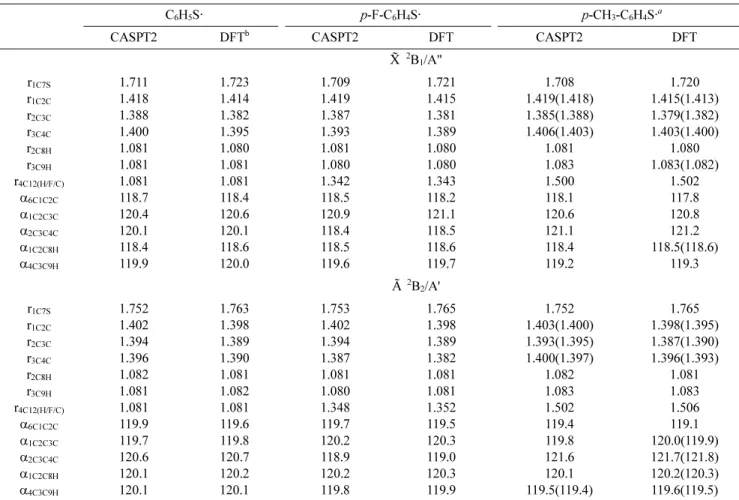
Optimized geometry parameters of thiophenoxyl radicals in the ground and excited states, calculated by CASPT2 and DFT, are given in Table 1 for C6H5S·, p-F-C6H4S·, and p-CH3-C6H4S· with corresponding atomic labels depicted in Figure 1. One of notable geometrical differences between ground and excited states of thiophenoxyl radicals is the C-S bond length change. For instance, the C-S bond length of
C6H5S· is lengthened by 0.041 (0.040) Å in the excited state compared to that in the ground state according to CASPT2 (DFT). Lengthening of C-S bond upon (symmetry-forbi-dden) electronic excitation also applies to the case of p-F-C6H4S· and p-CH3-C6H4S·. Interestingly, the C-S bond length remains more or less same as F and CH3 groups are para-substituted in the excited state whereas it is slightly shorten-ed in the ground state, Table 1. This already suggests that π-conjugation of thiophenoxyl radicals in the excited state is somewhat different from that in the ground state. Other geo-metrical parameters are little sensitive to the para-sub-stitution of F or CH3, indicating that electron donating effect of F or CH3 group is not significant enough for inducing structural changes in both excited and ground states of thiophenoxyl radicals.
The most accurate value for the adiabatic - energy gap of C6H5S· is calculated to be 0.367 eV by CASPT2/aug-cc-pVTZ, which is in good agreement with the most recent experimental value of 0.3719 eV.15 It should be noted that our theoretical result is slightly different from a previously reported value of 0.376 eV by Cheng et al.,16 and this seems to result from the use of two-state averaged reference func-tion for the considerafunc-tion of electron correlafunc-tion in this work whereas the single state wave function was used in Ref. 16.
A˜ X˜
Table 1. Calculated geometry parameters of and state of substituted thiophenoxyl radicals obtained at the level of CASPT2 and DFT. Units are angstroms for the bond length and degrees for the angle. See Figure 1 for the representative atom labels
C6H5S· p-F-C6H4S· p-CH3-C6H4S·a
CASPT2 DFTb CASPT2 DFT CASPT2 DFT
2B 1/A" r1C7S r1C2C r2C3C r3C4C r2C8H r3C9H r4C12(H/F/C) α6C1C2C α1C2C3C α2C3C4C α1C2C8H α4C3C9H 1.711 1.418 1.388 1.400 1.081 1.081 1.081 118.7 120.4 120.1 118.4 119.9 1.723 1.414 1.382 1.395 1.080 1.081 1.081 118.4 120.6 120.1 118.6 120.0 1.709 1.419 1.387 1.393 1.081 1.080 1.342 118.5 120.9 118.4 118.5 119.6 1.721 1.415 1.381 1.389 1.080 1.080 1.343 118.2 121.1 118.5 118.6 119.7 1.708 1.419(1.418) 1.385(1.388) 1.406(1.403) 1.081 1.083 1.500 118.1 120.6 121.1 118.4 119.2 1.720 1.415(1.413) 1.379(1.382) 1.403(1.400) 1.080 1.083(1.082) 1.502 117.8 120.8 121.2 118.5(118.6) 119.3 2B 2/A' r1C7S r1C2C r2C3C r3C4C r2C8H r3C9H r4C12(H/F/C) α6C1C2C α1C2C3C α2C3C4C α1C2C8H α4C3C9H 1.752 1.402 1.394 1.396 1.082 1.081 1.081 119.9 119.7 120.6 120.1 120.1 1.763 1.398 1.389 1.390 1.081 1.082 1.081 119.6 119.8 120.7 120.2 120.1 1.753 1.402 1.394 1.387 1.081 1.080 1.348 119.7 120.2 118.9 120.2 119.8 1.765 1.398 1.389 1.382 1.081 1.081 1.352 119.5 120.3 119.0 120.3 119.9 1.752 1.403(1.400) 1.393(1.395) 1.400(1.397) 1.082 1.083 1.502 119.4 119.8 121.6 120.1 119.5(119.4) 1.765 1.398(1.395) 1.387(1.390) 1.396(1.393) 1.081 1.083 1.506 119.1 120.0(119.9) 121.7(121.8) 120.2(120.3) 119.6(119.5) ap-CH
3-C6H4S· of molecular symmetry Cs can have two different values for each pair of bond lengths and angles in contrast with C2v symmetry. These values are shown in parentheses. bThe DFT calculation has been carried out using B3LYP functional
X˜ A˜
X˜
Vertical energy gap is calculated to be 0.400 eV by CASPT2 for C6H5S· which is 0.033 eV higher than the adiabatic energy gap, suggesting that the structural change of the aromatic ring moiety upon electronic excitation should be quite significant. Generally, it is found that SA-CASSCF (0.285 eV) and MRCI+Q (0.325 eV) predictions under-estimate the adiabatic - energy gap whereas it is over-estimated by a DFT value of 0.384 eV. Upon para-sub-stitution of F and CH3 on the aromatic ring moiety, the adiabatic - energy gap is calculated to be increased by 0.040 (323 cm−1) or 0.039 (315 cm−1) eV, respectively, accord-ing to the CASPT2/aug-cc-pVTZ calculation. Similarly, calculations with other methods also predict the larger -energy gap for p-F-C6H4S· and p-CH3-C6H4S· compared to that of C6H5S·, Table 2. SA-CASSCF (or MRCI+Q) gives 202 (282) or 177 (242) cm−1 for F and CH3 substitution, respectively, for the increase of the - energy gap, which is smaller than that predicted by CASPT2. On the other hand, DFT gives 492 or 444 cm−1 upon F or CH3 para-sub-stitution, respectively. The increase in the adiabatic -energy gap upon para-substitution is predicted to be slightly larger for F compared to CH3 from all of four calculation methods. This trend is somewhat less straightforward to
understand as the CH3 group is believed to be the stronger electron donor compared to F (vide infra). Though CASPT2 seems to be most consistent with the experiment for C6H5S·, it will be quite intriguing to investigate which method would be more appropriate for explaining the effect of para-substitution as different quantum mechanical methods have their own advantages in different circumstances.
Qualitative description for the origin of the structural and energetic changes of thiophenoxyl radicals upon chemical substitution can be given based on the charge and spin den-A˜ X˜
A˜ X˜
A˜ X˜
A˜ X˜
A˜ X˜
Figure 1. Molecular structures of the (a) C6H5S·, (b) p-F-C6H4S· and (c) p-CH3-C6H4S·.
Table 2. Theoretically obtained vertical excitation energies and adiabatic excitation energies for the 2B1/A" and 2B2/A' electronic states of the substituted thiophenoxyl radicals calculated using the SA-CASSCF, CASPT2, MRCI+Q, and DFT methods. Units are eV
2B
2/A' ← 2B1/A" Excitation energies
vertical adiabatic C6H5S· SA-CASSCF CASPT2 MRCI+Q DFT 0.354 0.400 0.376 0.416 0.285 0.367 0.325 0.384 Exp[15] 0.3719 p-F-C6H4S· SA-CASSCF CASPT2 MRCI+Q DFT 0.383 0.448 0.419 0.487 0.310 0.407 0.360 0.445 p-CH3-C6H4S· SA-CASSCF CASPT2 MRCI+Q DFT 0.388 0.446 0.415 0.477 0.307 0.406 0.355 0.439 X˜ A˜ A˜ X˜
Table 3. Mulliken and NBO charge densities for the and state of substituted thiophenoxyl radicals obtained from DFT calculation at the aug-cc-pVTZ basis level. See Figure 1 for the representative atom labels
C6H5S· p-F-C6H4S· p-CH3-C6H4S·
Mulliken NBO Mulliken NBO Mulliken NBO
2B1/A" 1C 2C 3C 4C 7S 8H 9H 12H/12F/12C 0.512 -0.696 -0.340 -0.272 -0.365 0.475 0.421 0.404 -0.242 -0.164 -0.209 -0.154 0.079 0.218 0.210 0.207 0.436 -0.505 -0.615 0.716 -0.371 0.552 0.403 -0.454 -0.255 -0.147 -0.269 0.439 0.074 0.222 0.227 -0.323 0.506 -0.545(-0.707) -0.749(-0.801) 1.340 -0.385 0.485(0.461) 0.218(0.377) -0.769 -0.245 -0.155(-0.157) -0.215(-0.213) 0.034 0.062 0.217 0.206 -0.606 2B 2/A' 1C 2C 3C 4C 7S 8H 9H 12H/12F/12C 0.666 -0.818 -0.272 -0.359 -0.289 0.480 0.398 0.405 -0.227 -0.229 -0.180 -0.220 0.229 0.209 0.206 0.206 0.576 -0.629 -0.549 0.662 -0.285 0.545 0.391 -0.470 -0.243 -0.208 -0.244 0.384 0.230 0.212 0.223 -0.337 0.704 -0.667(-0.805) -0.717(-0.786) 1.310 -0.303 0.470(0.451) 0.207(0.357) -0.776 -0.234 -0.220(-0.218) -0.185(-0.183) -0.035 0.222 0.208(0.207) 0.202 -0.596 X˜ A˜ X˜ A˜
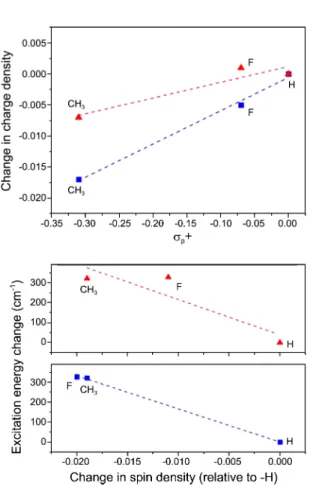
sity distributions calculated by Mulliken29 or NBO analysis, Tables 3 and 4. Absolute values are less reliable as those population analyses are not theoretically strict, and only qualitative trends should be taken to be meaningful. Accord-ing to the Mulliken analysis by DFT/aug-cc-pVTZ, the partial charge on the sulfur atom decreases as F or CH3 is being substituted on the para-position for the ground state. Even though NBO analysis gives the positive value for the charge density on sulfur, it also shows the decrease for the ground state thiophenoxyl radicals as electron donating groups are being substituted on the ring. This behavior is quite perceivable considering the Hammett-Brown polar substituent constant (σp+)30 of F and CH3 as the linear depen-dence is observed when the change of S charge density is plotted versus σp+, Figure 2. For excited states of thiophen-oxyl radicals, however, the charge density on sulfur by Mulliken or NBO is decreased by the CH3 substitution while it is slightly increased by the F substitution, suggesting that
Table 4. Mulliken and NBO spin densities for the and state of substituted thiophenoxyl radicals obtained from DFT calculation at the aug-cc-pVTZ basis level. See Figure 1 for the representative atom labels
C6H5S· p-F-C6H4S· p-CH3-C6H4S·
Mulliken NBO Mulliken NBO Mulliken NBO
2B 1/A" 1C 2C 3C 4C 7S 8H 9H 12H/12F/12C -0.071 0.127 -0.070 0.176 0.798 -0.008 0.002 -0.006 -0.072 0.145 -0.069 0.179 0.752 -0.005 0.002 -0.005 -0.060 0.125 -0.070 0.158 0.778 -0.005 0.002 0.021 -0.065 0.138 -0.062 0.157 0.741 -0.005 0.002 0.021 -0.067 0.134(0.114) -0.072(-0.071) 0.188 0.779 -0.008(-0.007) 0.005(0.004) -0.017 -0.065 0.146(0.134) -0.066 0.177 0.733 -0.005(-0.004) 0.002 -0.008 2B 2/A' 1C 2C 3C 4C 7S 8H 9H 12H/12F/12C -0.074 0.013 0.022 -0.003 1.069 -0.030 -0.001 -0.001 -0.022 0.013 0.003 -0.003 0.993 -0.001 0.001 0.000 -0.081 0.018 0.026 0.001 1.069 -0.037 -0.001 0.001 -0.022 0.013 0.003 -0.003 0.993 -0.001 0.001 0.000 -0.058 0.007(0.011) 0.027(0.029) -0.005 1.061 -0.034(-0.037) 0.001(-0.001) 0.000 -0.022 0.013(0.014) 0.003 -0.003 0.993 -0.001 0.001 0.000 X˜ A˜ X˜ A˜
Figure 2. (Left) Plot of the calculated change in NBO charge density of the sulfur atom as a function of the σp+ constant of the para-substituent for the ( ) and ( ) state. The more negative value of σp+, the stronger electron donating ability. The Mulliken charge is not shown for its similarity. (Right) Plot of the excitation energy change by para-substitution calculated using CASPT2 as a function of the change in spin density of the sulfur atom. The spin densities from the both NBO ( ) and Mulliken ( ) population analysis give good correlations.
X˜ A˜
Figure 3. DFT SOMOs generated by B3LYP and SA-CASSCF SOMOs associated with electronically ground states (upper panel) and excited states (lower panel) for (a) C6H5S·, (b) p-F-C6H4S· and (c) p-CH3-C6H4S·. The orbitals were visualized using Gauss View and MOLDEN respectively with an isovalue of 0.020.
the electron-donating effect of F or CH3 is not manifested for the excited state. The more consistent behavior could be found by the spin density calculations, Table 4. The spin density is calculated to be localized on sulfur for both ground and excited states of all thiophenoxyl radicals studied in this work from both Mulliken and NBO analyses. Especially, for excited states, the spin density is found to be localized solely on sulfur, and it is little changed by the F or CH3 para-substitution.
On the other hand, the S spin density of 0.798 (0.752) of C6H5S· decreases to 0.778 (0.741) and 0.779 (0.733), respec-tively, for p-F-C6H4S· and p-CH3-C6H4S· in the ground state
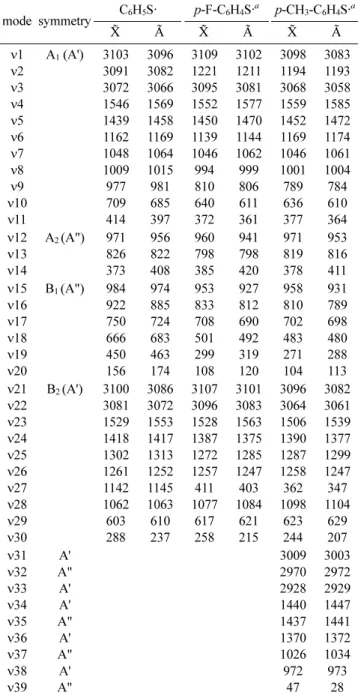
according to Mulliken (NBO) analysis. The decrease of the S spin density with F or CH3 substitution for the ground state of thiophenoxyl radical is quite similar, and this indeed correlates well with the behavior of the adiabatic -energy gap with chemical substitution, Figure 2. That is, the spin density on sulfur becomes delocalized with F or CH3 para-substitution by the same extent for the ground state of thiophenoxyl radicals, whereas it is little affected by the chemical substitution in the excited state. Therefore, the stabilization of the ground state through spin delocalization contributes to the increase of the adiabatic - energy gap with F or CH3 substitution. The importance of spin delocali-zation in energetics of substituted phenoxyl radicals had been reported by Fehir et al.,31 and our findings here are quite consistent. Orbital shapes of singly-occupied mole-cular orbitals (SOMO) for ground and excited states of C6H5S·, p-F-C6H4S·, and p-CH3-C6H4S· radicals calculated by DFT or SA-CASSCF strongly suggest that SOMO is localized on sulfur in the excited state and both charge and spin densities are little affected by the F or CH3 para-sub-stitution, Figure 3. Harmonic vibrational frequencies of ground and excited states of C6H5S·, p-F-C6H4S·, and p-CH3-C6H4S· radicals calculated by DFT-B3LYP/aug-cc-pVTZ are given in Table 5. A scale factor of 0.9687 was multiplied for all presented numbers, based on the com-parison of the experimental and theoretical values for ground state of C6H5S·.32 The zero-point energy differences between and states are calculated to be very small, giving 18, 34, and 30 cm-1 for C6H5S·, p-F-C6H4S·, and p-CH3-C6H4S· radicals, respectively.
Conclusion
We investigated here the chemical substitution effect on the energetics and structure of first electronically excited and ground states of thiophenoxyl radical. Para-substitution of F and CH3 groups certainly increases the adiabatic -energy gap by 323 or 315 cm−1, respectively, according to CASPT2 though other theoretical methods such as SA-CASSCF, MRCI+Q, or DFT give slightly different numbers. Our Mulliken or NBO analysis gives a hint that the spin density on sulfur, which becomes somewhat delocalized by the chemical substitution in the ground state, could be mainly responsible for the increase of the - energy gap as the spin density in the excited thiophenoxyl radical is solely localized on sulfur and little affected by para-sub-stitution whatsoever. Geometrical and vibrational changes upon F or CH3 para-substitution are less pronounced. Theoretical results presented here should be essential for the photodissociation studies of thiophenols or thioanisoles which are excellent chemical systems for interrogating conical intersection dynamics. Furthermore, because state of thiophenoxyl radical is quite unique in terms of energetics and spin property, it would be very exciting to investigate chemical reactivity of p-Y-C6H4S· ( ) to be compared with that of p-Y-C6H4S· ( ) of different Y groups. Photodissociation of thiophenols could certainly be A˜ X˜ A˜ X˜ A˜ X˜ A˜ X˜ A˜ X˜ A˜ A˜ X˜
Table 5. Harmonic vibrational frequencies for the and state of C6H5S·, p-F-C6H4S· and p-CH3-C6H4S· obtained using DFT. All units are cm−1 mode symmetry C6H5S· p-F-C6H4S· a p-CH 3-C6H4S·a ν1 ν2 ν3 ν4 ν5 ν6 ν7 ν8 ν9 ν10 ν11 A1 (A') 3103 3091 3072 1546 1439 1162 1048 1009 977 709 414 3096 3082 3066 1569 1458 1169 1064 1015 981 685 397 3109 1221 3095 1552 1450 1139 1046 994 810 640 372 3102 1211 3081 1577 1470 1144 1062 999 806 611 361 3098 1194 3068 1559 1452 1169 1046 1001 789 636 377 3083 1193 3058 1585 1472 1174 1061 1004 784 610 364 ν12 ν13 ν14 A2 (A") 971 826 373 956 822 408 960 798 385 941 798 420 971 819 378 953 816 411 ν15 ν16 ν17 ν18 ν19 ν20 B1 (A") 984 922 750 666 450 156 974 885 724 683 463 174 953 833 708 501 299 108 927 812 690 492 319 120 958 810 702 483 271 104 931 789 698 480 288 113 ν21 ν22 ν23 ν24 ν25 ν26 ν27 ν28 ν29 ν30 B2 (A') 3100 3081 1529 1418 1302 1261 1142 1062 603 288 3086 3072 1553 1417 1313 1252 1145 1063 610 237 3107 3096 1528 1387 1272 1257 411 1077 617 258 3101 3083 1563 1375 1285 1247 403 1084 621 215 3096 3064 1506 1390 1287 1258 362 1098 623 244 3082 3061 1539 1377 1299 1247 347 1104 629 207 ν31 ν32 ν33 ν34 ν35 ν36 ν37 ν38 ν39 A' A" A' A' A" A' A" A' A" 3009 2970 2928 1440 1437 1370 1026 972 47 3003 2972 2929 1447 1441 1372 1034 973 28 aThe numbering of p-F-C6H4S· and p-CH3-C6H4S· vibrational modes map
through from the corresponding normal modes of the C6H5S· radical.
X˜ A˜
used for the controlled generation of states of thiophen-oxyl radicals for further exciting stereo-specific chemical reaction studies.
Acknowledgments. We appreciate financial support from Grants of National Research Foundation (2012-0005607, SRC 2012-0000779).
References
1. Tseng, C.-M.; Lee, Y. T.; Ni, C.-K. The Journal of Chemical Physics 2004, 121, 2459.
2. Ashfold, M. N. R.; Devine, A. L.; Dixon, R. N.; King, G. A.; Nix, M. G. D.; Oliver, T. A. A. Proceedings of the National Academy of Sciences 2008, 105, 12701.
3. Roberts, G. M.; Chatterley, A. S.; Young, J. D.; Stavros, V. G. The Journal of Physical Chemistry Letters 2012, 3, 348.
4. Tseng, C.-M.; Lee, Y. T.; Ni, C.-K. The Journal of Physical Chemistry A 2009, 113, 3881.
5. Hadden, D. J.; Williams, C. A.; Roberts, G. M.; Stavros, V. G. Physical Chemistry Chemical Physics 2011, 13, 4494.
6. King, G. A.; Oliver, T. A. A.; Ashfold, M. N. R. The Journal of Chemical Physics 2010, 132, 214307.
7. Montero, R.; Conde, A. P.; Ovejas, V.; Martinez, R.; Castano, F.; Longarte, A. The Journal of Chemical Physics 2011, 135, 054308. 8. Wei, J.; Kuczmann, A.; Riedel, J.; Renth, F.; Temps, F. Physical
Chemistry Chemical Physics 2003, 5, 315.
9. Montero, R.; Conde, A. P.; Ovejas, V.; Fernandez-Fernandez, M.; Castano, F.; de Aldana, J. R. V.; Longarte, A. The Journal of Chemical Physics 2012, 137, 064317.
10. Cronin, B.; Nix, M. G. D.; Qadiri, R. H.; Ashfold, M. N. R. Physical Chemistry Chemical Physics 2004, 6, 5031.
11. Lim, J. S.; Lim, I. S.; Lee, K.-S.; Ahn, D.-S.; Lee, Y. S.; Kim, S. K. Angewandte Chemie International Edition 2006, 45, 6290. 12. Lim, J. S.; Lee, Y. S.; Kim, S. K. Angewandte Chemie International
Edition 2008, 47, 1853.
13. Devine, A. L.; Nix, M. G. D.; Dixon, R. N.; Ashfold, M. N. R. The Journal of Physical Chemistry A 2008, 112, 9563.
14. Lim, J. S.; Kim, S. K. Nat. Chem. 2010, 2, 627.
15. Kim, J. B.; Yacovitch, T. I.; Hock, C.; Neumark, D. M. Physical Chemistry Chemical Physics 2011, 13, 17378.
16. Cheng, C.-W.; Lee, Y.-P.; Witek, H. A. The Journal of Physical Chemistry A 2008, 112, 11998.
17. Armstrong, D. A.; Sun, Q.; Schuler, R. H. The Journal of Physical Chemistry 1996, 100, 9892.
18. Bordwell, F. G.; Zhang, X.-M.; Satish, A. V.; Cheng, J. P. Journal of the American Chemical Society 1994, 116, 6605.
19. Borges dos Santos, R. M.; Muralha, V. S. F.; Correia, C. F.;
Guedes, R. C.; Costa Cabral, B. J.; Martinho Simões, J. A. The Journal of Physical Chemistry A 2002, 106, 9883.
20. Chandra, A. K.; Nam, P.-C.; Nguyen, M. T. The Journal of Physical Chemistry A 2003, 107, 9182.
21. Fu, Y.; Lin, B.-L.; Song, K.-S.; Liu, L.; Guo, Q.-X. Journal of the Chemical Society, Perkin Transactions 2 2002, 1223.
22. Klein, E.; Lukeš, V.; Cibulková, Z.; Polovková, J. Journal of Molecular Structure: THEOCHEM 2006, 758, 149.
23. Jonsson, M.; Lind, J.; Merenyi, G.; Eriksen, T. E. Journal of the Chemical Society, Perkin Transactions 2 1994, 2149.
24. Dunning, J. T. H. The Journal of Chemical Physics 1989, 90, 1007.
25. Woon, D. E.; Dunning, J. T. H. The Journal of Chemical Physics 1994, 100, 2975.
26. Werner, H.-J.; Knowles, P. J.; Knizia, G.; Manby, F. R.; Schütz, M.; Celani, P.; Korona, T.; Lindh, R.; Mitrushenkov, A.; Rauhut, G.; Shamasundar, K. R.; Adler, T. B.; Amos, R. D.; Bernhardsson, A.; Berning, A.; Cooper, D. L.; Deegan, M. J. O.; Dobbyn, A. J.; Eckert, F.; Goll, E.; Hampel, C.; Hesselmann, A.; Hetzer, G.; Hrenar, T.; Jansen, G.; Köppl, C.; Liu, Y.; Lloyd, A. W.; Mata, R. A.; May, A. J.; McNicholas, S. J.; Meyer, W.; Mura, M. E.; Nicklaß, A.; O'Neill, D. P.; Palmieri, P.; Peng, D.; Pflüger, K.; Pitzer, R.; Reiher, M.; Shiozaki, T.; Stoll, H.; Stone, A. J.; Tarroni, R.; Thorsteinsson, T.; Wang, M. Molpro, A Package of ab initio Programs, Version 2010.1
27. Frisch, M. J.; Trucks, G. W.; Schlegel, H. B.; Scuseria, G. E.; Robb, M. A.; Cheeseman, J. R.; Scalmani, G.; Barone, V.; Mennucci, B.; Petersson, G. A.; Nakatsuji, H.; Caricato, M.; Li, X.; Hratchian, H. P.; Izmaylov, A. F.; Bloino, J.; Zheng, G.; Sonnenberg, J. L.; Hada, M.; Ehara, M.; Toyota, K.; Fukuda, R.; Hasegawa, J.; Ishida, M.; Nakajima, T.; Honda, Y.; Kitao, O.; Nakai, H.; Vreven, T.; Montgomery, J. A., Jr.; Peralta, J. E.;Ogliaro, F.; Bearpark, M.; Heyd, J. J.; Brothers, E.; Kudin, K. N.; Staroverov, V. N.; Kobayashi, R.; Normand, J.; Raghavachari, K.; Rendell, A.; Burant, J. C.; Iyengar, S. S.; Tomasi, J.; Cossi, M.; Rega, N.; Millam, J. M.; Klene, M.; Knox, J. E.; Cross, J. B.; Bakken, V.; Adamo, C.; Jaramillo, J.; Gomperts, R.; Stratmann, R. E.; Yazyev, O.; Austin, A. J.; Cammi, R.; Pomelli, C.; Ochterski, J. W.; Martin, R. L.; Morokuma, K.; Zakrzewski, V. G.; Voth, G. A.; Salvador, P.; Dannenberg, J. J.; Dapprich, S.; Daniels, A. D.; Farkas, Ö.; Foresman, J. B.; Ortiz, J. V.; Cioslowski, J.; Fox, D. J. Gaussian 09, Revision A.02, Gaussian, Inc.: Wallingford CT, 2009. 28. Reed, A. E.; Curtiss, L. A.; Weinhold, F. Chemical Reviews 1988,
88, 899.
29. Mulliken, R. S. The Journal of Chemical Physics 1955, 23, 1833. 30. Hansch, C.; Leo, A.; Taft, R. W. Chemical Reviews 1991, 91, 165. 31. Fehir, J. R. J.; McCusker, J. K. The Journal of Physical Chemistry
A 2009, 113, 9249.
32. Merrick, J. P.; Moran, D.; Radom, L. The Journal of Physical Chemistry A 2007, 111, 11683.