IEICETRANS. FUNDAptffiNTALS,VOL.E8Y-A, NO.7JUI:Y2e06
1959
FV},PERSpecial
Section
onMulti-dirnensional
maobife
lnlormation
Networks
Proactive
Defense
Mechanism
NEMO
Environment
againstIP
Spoofing
Trarac
on
a
Mihui
KIMta),
Student
Mlember
andKljoon
CHAEt,Nonmember
SUMMARY
The
boundary
ofadistributed
denial
of service{DDoS)
attack, one ofthemostthreatening
attacksin
uwired network, now ex-tends towireless inobile networks,following
theappearance of uDDoS
attack tooltargeted at mobilephones,
However, theexisting defense mech-anisms against such attacks ina wired network are not effective inawire-less
mobile network,because
of differencesintheircharacteristics such asthe
mobilepossibility
ofattack agents.Jn
this
paper,we proposeaproac-tivedefensemechanism against IPspoofing traMc
for
mobile networks.IP
spoofing isone of thefeaturesofaDDeS attack against which
it
is
mostdificulttodefend,Among thevarious mebile netwerks, we focuson the
Network
Mobility
standard thatisbeing
estab]ishedby
theNEMOWbrk-ing
GToup
in
the
IETF,
Our
defense consists offo11owing
fiveprocesses:speedy
detection,
filtering
of attack packets,identification of attack agents,isolation
ofattackagents, and notification to neighborjng [outers.We sim-lllatedand analyzedthe
effectson normal trathcofmoving attack agents, and theresultsofapplying our defensetoamobile network. Our simulation results show thatour mechanismprovides
arobust defense.kaywords: IVletu,orkMobiliry
(IVLEMO),
mobile network, IPspoofng trtdi7e,dqfensemechanisntneighborgraph
1.
Introduction
Currently,
DDoS
attacks are considered one ofthe
mostthreatening
of attacks against wired networks,because
ofconsuming critical resources at
the
target
within a shorttime,
and causing network congestion en routefrom
the
source to
the
target.TIhe
damage
from
DDoS
attacksis
nolonger
limited
to
wired networks.[[hough
the
functional-ity
of most mobiledevices
is
extremelylimited
andlargely
non-programmable, the
first
virus targeted atmobilephones
has
already appeared.In
addition,the
SMS
(Short
Message
Service)
flooder
has
emerged as thefirst
DDoS
attack toolagainst mobile
phones.
The
potential
hazard
is
not onlythe
bJocking
of communicationsbut
alsothe
high
financial
costwhen
pricing
is
usage-based[1].
The
damage
is
expectedto
become
increasingly
serious as mobiledevices
become
high-perfOrmancemachines.
Long
anissue
ofinterest,
network mobilitytechnol-ogy
is
nowbeing
realized withthe
foundation
ofthe
NEMO
(Network
Mobility)
Wbrking
Group
(WG)
in
the
IETF
(In-ternet
Engineering
Tlask
Force).
This
WG
is
concerned withmanaging
the
mobility of an entire networkthat
changes,as aunit,
its
point
of attachmentto
the
Internet.
The
WG
Manuscript
receivedOctober
26,
2005.
Manuscript
revisedJanuary
26,
2006.
Final
manuscript receivedMarch
9,
2006.
'1'The
authors are with theDept.
ofComputer
Science
andEn-gineering,
Ewha
Wbmans
University,
Seoul,
Korea.
a)E-mail:
[email protected]
DOI:
10.1093/ietfecle89-a.7.1959
defines
NEMO
as "NEtworkMObility"
or `CaNEtwork
that
is
MObile."
Most
importantly,
aNEMO
canbe
nestedin
anotheT
NEMO
and
canbe
multihomed.This
structurepro-vides one or multi-hop wireless
links,
as well as a tree-likehierarchy.
Tlie
characteristics of aNEMO,
the
multi-hopwire-]ess
links
and mobiJity,pose
many security challenges,like
the
case of amobile adhoc
network(MANET)
[2].
More-over, existing centralized approachesto
security on a wirednetwork are
ineficient
on aNEMO,
because
ofthe
possi-ble
problems
posed
by
high
mobility and scalability.Cell
phones
and smal1 routers canbecome
mobile routers(MRs)
that
provide
the
features
of aNEMO,
and most mobile de-viceshave
limitecl
processing
power,
Therefore,
the
securitymechanisms on a
NEMO
shouldbe
light,
for
the
low
power
consumption,
but
alsorobust.The
damage
by
compromiseof amobile
IPv6
node maybecome
bigger
due
toits
mobil-ity,
but
especially compromise of aMR
that
performs
basic
NEMO
operations can also compromise allthe
nodesun-der
its
chargein
theNEMO,
causingfat
more widespreaddamage
than
in
aMANET,
Of
the manypossible
features
ofDDoS
attacks, sourceIP
address spoofingis
amongthe
most common,IP
spoofingcreates
particular
diMculties
fbr
netwerk managers,because
it
increases
the
number offiows
by
varyingthe
sourcead-dress
and concealing theidentity
ofthe
attack agent.DDoS
attacks using
IP
spoofingalso
pose
athreat
in
aNEMO
evenwith
IPSec
(IP
Security
Protocol)
[3],
wheredetection
ofand
defense
against such attacksis
fatr
moredificult
due
to
the
fact
that
the
attacker can move.Also,
eventhough
there
is
thetrustrelationshipbetween
allnodesin
aNEMO
through
authentication, orCGA
(Cryptographically
Gener-atedAddresses)
approach[4]
generating
a randominter-face
identifier
is
used,they
are not enoughfor
preventing
IP
spoofing attack,
because
the
execution code ofattack agentcan
be
infi1trated
into
nodesthrough
their
securityholes
1ike
worm vlrus.
In
this
paper,
we will simulate and analyzethe
effectsof an
IP
spoofing attack on a mobile network.Through
the
simulated results andthe
characteristics analysis of aDDoS
attack on aNEMO,
we will adapt and extendprevi-ously
proposed
detection
andidentification
defense
mech-anjsms against spoofing
packets
on a wired network[5],
to
the
NEMO
environment.A
previously
proposed
mechanismwas
implemented,
tested
usingstrong
DDoS
attacktools
onarealnetwotk, and confirmed
to
be
an effectivedesign.
IEICETRANS.FUNDAMENTALS,VOL.E89-A,NO.7JULY2006 1960
IP
spoofing attacks on a wireless network,particularly
on aNEMO..
Speedy
detection
anclfiltering
ofthe
source-sidework as soon as
possible
.
Identification
andisolation
of attack agentsfor
mediate
fo11ow-up
measures.
Notification
to
neighboringMRs
to
proactively
isolate
the
attackingtraMc
This
paper
is
divided
into
five
sections.In
Sect.
2,
we explainthe
basics
ofattackandNEMO.
Section
3
introduces
the
proposed
defense
mechanism.In
Sect.4,
we evaluate our mechanism and explain our analysis Qfthe
simulationresults,
Finally,
wepresent
abrief
conclusion.2.
Background
2.1
DDoS&SpoofingTraMc
DoSPDoS
(Symbol
`1'means LPCslD'
in
this
paper)
attackscompromise
the
availabilityofthe
network resource as wellas thesystem resource
itself.
Because
DDoS
attacks usuallyuse norinal
protocol
packets
like
legitimate
users,the
de-fense
againstthese
attacksis
not enough withthe
intrusion
prevention
techniques
enly, such asuser authentication and encryptlon.The
conventional mechanismsto
mitigatethe
dam-age
by
DDoS
attacksin
the
wired network are classifiedinto
three categories:detection
as afirst
proactive
defense
[6],
fiZtering
such asingress-based
scheme[7],
andtrace-back
(identifcation)
[8]
as areactive schemeto
identify
the
routers, which are
the
cJosestte
the
tme
erigins of attack.1[Ihese
various mechanisms contributedto
adefense
againstDDoS
attack,but
some mechanismshave
the
drawback
suchas
the
requirement of widedeployment,
scalabilityprob-lems,
limited
features
to
only specificDDoS
attacks, or amass of wasteful overheads.
Especially,
because
these
con-ventional mechanisms
have
no considerationfor
the
mov-ing
possibility
of attack agents and wireless environment ofnodes, they are
insuMcient
for
adefense
agai nstsuch attackson a
NEMO
environment.One
reasonthat
DDQS
attacks are verythreatening
is
the
spoofingfeature.
It
makesit.dificult
to
find
the
originofattackagents, and
also
increases
considerably the numberof
flows
in
afew
minutesthrough
varying sourceIP
addressand sourceldestination
port.
Representative
DDoS
attacktools
in
the
Internet
provide
even the automated spoofingfeature
as well asthe
controlfeature
for
spoofinglevel,
to
pass
the
attacktrafic
atthe
ingress!egress
filtering
routers.Tb
date,
these
DDoS
attack tools onthe
mobileIP
net-workfNEMO
did
not appear,but
the
emerge]ce of morein-tellectuaJand automated spoofing attack abusing mobility
might
be
expected, asthe
Mobile
IPINEMO
wouldbroadly
be
deployed.
Although
it
is
mandatoryfor
MRs
to
perfbmi
the
ingress
filtering
onpackets
receivedfrom
the
Mobile
Net-workin
thc
basic
NEMO
protocol
[9],
it
maybe
insuthcient
maooiGeeo
ysLgooe600040002Qeo'5le
l5 2e 25 30
TimeUnit
pt
uilit = 5minuits}Fig,
1 Flow countjn
the
normaVattack case. 35f6r
defending
against the whole spoofingpackets.
Even
if
the
routerperforms
ACL
(Access
Control
List)
or uRPF(unicast
Reverse
Packet
Filtering)
that
checks whetherthe
source address's reverse
path
matchesthe
input
port,
alot
of spoofing
packets
can actuallypass
throughit
because
some
DDoS
tools
provide
L:in-prefix"spoofing
that
uses atopologically
correctprefix
and non-existentinterface
D.
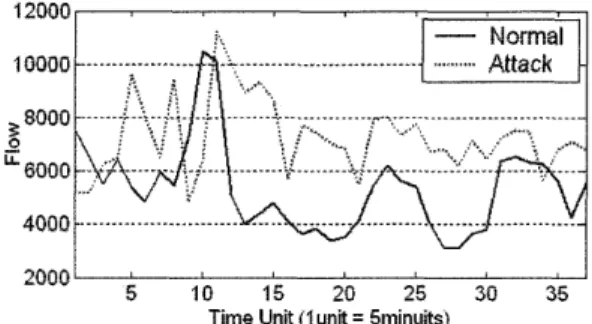
As
an experimental result, we canget
Fig.1
whichis
theflow
countgathered
atthe
access router connecting ouruni-versity network to
the
Internet,
covering about50eO
hosts
and
performing
the
ingress
filtering.
We
performed
the
in-prefix
spoofing attack withTFN2k
DDoS
tool, one ofthe
most threatening attack
tools,
as an attack scenariothe
at-tack
agents werelocated
atourinternal
network and avic-tim
is
located
atthe
external network.From
results, wecould
know
the
spoofedpacket
considerablyincreased
the
fiow
number, and well-spoofed attack traMc canpass
theingress
filtering
routerbesides,
Secondly,
to
examinehow
manyflows
aregenerated
through an attack tool,we
perfbrmed
the
TFN2k
DDoS
tool
at
the
Pentiurn
IV
(CPU
1
.9
GHz,
10flOO
ma
EtherneO.
As
the
result, thetoolgenerated
the
6212
fiows
pera
secondin
the
TCP
flood
attack case,andthe
13454
fiows
per
asecondin
the
UDP
flood
attack case.This
fiow
count can ovediow the equipment such asL4
switch within avery shorttime,
moreover make
the
networkdown.
22
MobileNetwork
A
mobile netwotkincludes
one or moreMRs
that
connectto
the
global
Internet
in
orderto
provide
session continuity and accessfbr
al1
nodesin
theNEMO,
even asthe networkmoves.
The
NEMO
WG
is
extendingMobile
IPv6
(MIPv6)
[10]
fbr
network mobility,providing
backward
compatibil-ity
withMIPv6.
There
arethree
types
ofnodesin
aNEMO:
local
fixed
nodes(LFNs),
local
mobile nodes(LMNs),
andvisitingmobi]e nodes
(VMNs).
A
node of any ofthese
types
may
be
either ahost
or a router.A
LFN
and aLMN
belong
to
the
mobile network,The
LFN
does
not movetopologi-cally with respect
to
the
MR,
but
the
LMN
does.
A
VMN
can move topologically with
the
MR,
andits
home
link
does
not
belong
to
the
mobile network.MRs
accessthe
Internet
from
access routers(ARs)
on visitedlinks,
Figure
7
depicts
the
general
composition of aNEMO.
Our
defense
assumesKIM andCHAE: PROACTTVE DEFENSE MECHANISM AGAINST IPSPOOFING ON NEMO
1961
'Ib
date,
several
drafts
regardingNEMO
securityhave
been
submitted; most relateto
support ofthe
secureba-sic
NEMO
protocol,
orto
the
protection
of control mes-sages such asbinding
update(BU)
messages.The
basic
requirements of
AAA
servicefor
supporting networkmo-bility
have
also
been
introduced.
However,
evenif
controlmessages are
protected
by
encryption or authentication,the
compromise ofa
MRInode
can spread a spoofing attackto
the
wholeNEMO
via abnormaldata
trathc.Also,
asthe
state of artresearch
topics
for
NEMO,
routing optimiza-tionandload
sharingfsessionpreservation
mechariismshave
been
proposed,
but
the
study onpropeT
security mechanismson
NEMO
is
necessary.2.3
NeighborGraph
Mishra
etal.
[11],
[12]
introducedanovel
data
stmcture,the
IVleighbor
Gmph,
which capturesthe
mobilitytopology
ofa wireless network.
Using
this
data
structure,they
showedthe
reductionin
the authentication time of anIEEE
802,1
1
handoff
by
proactively
distributing
necessarykey
material onehop
ahead
of thc mobile user[1
1],
and thefast
hand-offby
pre-positioning
the
station'scontext ensuringthat
the
station's context always remajns one
hop
ahead[12].
This
proactive
neighbor cashing scheme was adopted as anIEEE
standard,
Inter-Access
Point
Protocol
(IAPP)
specification[13],
whichis
a standardprotocol
for
the
communicationsbetween
APs.
Mishra
et al.defined
anAP
neighborgraph
G=(V,
E)
where
V={api,
ap2,...,op.}
is
the
set of allAP
(Access
Point)s,
andthere
is
an edge e=(api,apP
between
api
andapj
if
there
is
somepath
of motionbetween
them.
They
de-fined
the
associationpattern
r(c)
for
clientc as{(api
,ti),
(ap2,
t2),・・・,(apn,
tn)},whereapi
is
the
AP
towhichthe
sta-tion
reassociates(new
AP)
attime
ti,
and{(api,
ti),
(api+i
,ti.i)}
is
suchthat
the
handoff
occursfrom
opi
to
api+iattime
ti+i.
This
neighborgraph
eanbe
rnaintained eitherin
adis-tributed
fashion
by
the
APs
orin
acentralized manneg andautonomously
learned
and maintainedthrough
an802.1
1
re-association requestframe
containingthe
address ofthe
oldAR
or aMove-Notij},
message ofIAPP
(sent
from
anAP
to
the
oldAP
during
areassociation).3.
ProactiveDefenseMechanism
This
sectionpresents
our overal1defense
architecture.Our
defense
against spoofing trafficon a mobile networkcon-sistsof
five
parts:
speedydetection,
filtering
ofattackpack-ets,
identification
ofattack agents orNEMOs
including
at-tack
agents,isolation
of attack agents'trafic
in
the
lower
layer,
and notificationto
neighboring routers,The
last
two
steps are especia)ly
important
on amobile networkin
orderto
decrease
overalldamage,
owingto
the
wirelesserrviron-ment and themobility of nodes, respectively.
Although
therecan
be
spoofingin
severallayers,
we assumethat
the
spooeing
traMc
is
spoofingthe
sourceIP
address, asin
the
caseof
DDoS
attacksin
wired networks.This
defense
couldbe
adapted
to
handle
spoQfing of otherlayers
in
the
same man-ner.Also,
we assumethat
the
defense
rnechanismis
appliedto
the source network,Although
it
wouldbe
possible
to
use
the
defense
mechanismin
the
targetnetwork, using thedefense
at each source networkis
more eficient and cande-crease
the
damage
before
the
targetis
shutdown,
We
willexplain each
part
of ourdefense
against spoofingtraMc
in
the
fo11owing
sub-sections.3.1Detection
&
Filtering
As
it
is
verydiMcult
toprevent
spoofing attacks,the
first
priority
is
the
rapiddetection,
In
aNEMO
environment, wecannot assume that
there
is
atleast
onedetection
agentper
router,
because
aNEMO
canbe
very small, as with aRAN
(Personal
AreaNetwork).
Therefbre,
we consider two cases:in
one case,al1
MRs
perfbrm
detection
andfi]tering;
jn
the
other, one agent
per
AR
perfbrms
these roies,In
the
first
case,MRs
can checkthe
outboundpack-ets choosing one of
two
different
detection
mechanisms,according to
the
number of served nodes.For
the
speedydetection,
these
mechanisms are situated atthe
source-sidenetwork
frem
the
attacker(spoofing-agent)
point
of viewbe-cause
the
damage
of most spoofing attacks startsfrom
the
outbound attack
packets
that
arefbrwarded
into
the
Inter-net.
One
method uses the configured network addresses andthe
other usesthe
rateofchange ofIP
addressesfor
a singleMAC
address.Each
attackdetection
conditionis
shownin
Figs.
2
and3,
Tlhe
first
method makes use ofthe
characteristicthat
most spoofing attaek
tools
rotate a specificrange ofIP
ad-dresses
asthe
source address.Thus,
these
spoofingad-dresses
include
one or more non-configured address, such asarouter address,
denied
address(e.g.
rnulticast address), ora
ditferent
subnet address.This
methodis
similar toIngress
Filtering
[7]
and uRPF(unieast
Reverse
Packet
Filtering)
(slPeCAi)OR(sll'EDAi)OR(slPERAi)
- sM:
Source
IPaddress ofapacket.
CAi={CaT,
Ca2..,,,Cak
}:
Configurable
IP
uddresses assoarce addressin
theshared media- DAi;{Dal, Da2,...Dat}:Denied IPaddresses as source
dressintheshared media
.
RAi={Ral,
Ra2,..,,Ra.}/
Directly
connected router IPdresses
Fig.2Detectionconditionusingconfigurableaddressinformation,
[t[slPl,srmCllPi
-
t[slP2,sMACI]Pj1 s Tcne.rate . sMAC:Source
MAC
address ofapacket
. t[sJIIsrmC]ny':Time of
discovering
thepacket
i7havingsif' and sfiMC,. Tcng.rate: UppeT thresholdforchange intervalfor spoofed
packets,
This
is
thechangeinterval
(seeonds)
of source IPdresses
for
asourceMAC
address,IEICETRANS,FUNDAMENTALS,VOL,E89-A,NO,7JUI;Y2006
1962
that
arerepresentative methodsfor
defending
against spooring
attackin
the recentInternet.
However,
mostlyIngress
Filtering
setby
ACL
(Access
Control
List)
atthe
routerchecks
the
only networkprefix,
thus
actuallyit
maypass
over
in-prefix
spoofingpackets
as results ofFig.1.
0ur
method
is
not novel,but
we emphasizethe
necessity ofmonitoring configured addresses
like
Fig.
2
in
detail,
This
method needs
to
discover
configured address, routerad-dress,
anddenied
address.In
aNEMO
environment, whena
NEMO
attemptsto
become
nested,its
network addressescan
be
conveyed toits
parent
MR
orAR
as a stepin
the
handoff.
The
first
method may notbe
asfast
asthe
second,but
the
required storageis
smaller and middleMRs
in
the
nested structure can easilyperform
the
detection
feature
us-ing
the
same mechanism.However,
it
is
notthat
the
first
method candetect
allspoofing
packets
atsource side orbe
used atal1
cases.If
privacy
extension[14]
orCGA
approach[4]
whichgenerate
arandominterfaceidentifiertoprotecttheprivacyorsupportthe
security respeetively, are used, thefirst
method could notbe
useddue
to
the
frequent
change of source address.Also,
this
methodhas
the
weaknessin
the
casethat
both
spoofingsource address and victim address are configured address,
that
is,
both
attacker and victim areincluded
in
the
sourceside network,
For
the
strongerdetection,
the
second methoduses
the
characteristicthat
the
sourceMAC
addressdoes
notchange
during
anIP
spoofing attack, although spoofingat-tack
tools
rapidly changethe
source address.[[bst
resultsindicate
that
the
rate of changeis
aboutO.074
millisecondsfor
the
TFN2k
DDoS
attacktool.
Therefbre,
the
admissibleTc.grr.at.
canbe
setto
aninterval
such as2
s(seconds),
con-sidering thata
person
changesthe
IP
address of amachine orL4],
[14]
are used,taking
atleast
few
minutes.
This
methodprovides
the
faster
detection,
but
it
is
limited
to
monitoringgeneral
serverhosts
because
routersfbrward
packets
withvarious source
IP
addressesfor
the
sameMAC
address.lf
amiddle
MR
in
anestedNEMO
usesthis
method asthe
de-tection
feature,
it
shoulddetermine
whetherthe
served nodeis
aMR
or ageneral
host,
in
thehandoff
process.
Also,
this
method should specially managethe
hosts
usingthe
IP
aliasing at an
interface,
But,
because
eachIPv6
router canknow
the
multiple addresses ofthe
hosts
usingthe
IP
alias-ing
in
the
auto-configuration,the
MR
cantreat
in
disregard
of the change to
aliased
IP
addressesfor
aMAC
address.For
these
two
methods,proper
andfast
detection
has
been
established using well-known,
powerfu1
spoofingtools
on a real network[5].
In
the
caseexplained aboye, allMRs
perfOrm
detection
and
filtering.
This
assumptionis
ideal,
but
is
notalways
the
reality.
The
possible
detectionlfiltering/identification
pro-cesses of
the
second case are explainedin
the
next section.make
the
identification,
that
is,
to
find
the
realIP
address ofanattackagent,
the
defending
agent shouldhave
anfi'2MAC
table that
includes
the mapping of anIP
address toaMAC
address.
As
explained above, whenalI
MRs
perform
the
defense
feature,
aMR
canquickly
deterrnine
the attack agentsby
using an
LP2MAC
table.
However,
as second caseif
onlyone
detection
agentper
AR
perfbrms
the
detection
feature,
the
detection
agent needsto
determine
the
MR
that
includes
the attack agent
by
means ofits
ff'2MAC
table.In
thiscase,it
notifiesthe
MR
ofthe
detected
attackin
orderto
transfer
the
identification
job,
andit
filters
the
traMcfrom
theMR
that
includes
the
attack agent untilit
finds
the
exact attackagents,
This
detection
and notification workis
iterated
overthe
downward
path
of nestedNEMOs
unti1it
finds
the
attackagents,
When
the
MR
finds
the
attack agents,it
notifiesthe
parent-MRs
regarding theidentification,
with a request tofbrward
the
normaltraMc
ofthe
NEMO.
If
this
notificationis
conveyedto
thefirst
detection
agent, onlythe
attacktraficis
fi]tered.
The
result ofisolating
attack agents' traMcin
the
lower
layer
is
that
the
MAC
layer
denies
grant
ofthe
channelto
the
attack agents;
for
example,in
the
case of802.11,
it
refusesto send a clear to send
(CTS)
messagein
response to are-quest
to
send(RTS)
message.This
is
important
in
awirelessenvironment
that
uses aCSMAICA
(Carrier
Sense
Multiple
AccesstCollision
Avoidance)
like
802.1
1
because
granting
achannel
to
attack agents considerably affectsthe
transmis-sion rateofother nodes, even while
filtering
of attacktraMc
occurs at
the
IP
layer.
3.3
NotificationtoNeighbor
This
part
ofdefense
against attackis
specific to aNEMO,
and
is
necessarybecause
NEMOs
that
include
attack agents,or
the
attackagentsthemselves,
can moveto
otherMRslAR.
We
assumethat
mobile router should authenticate a servedmobile node
before
it
is
handoffed,
thus all nodesin
aNEMO
cantmst
each other after successful authenticationfrom
parent
node.Therefbre,
there
is
atrust
relationshipbetween
neighborMRs,
Tb
decrease
thetime
for
detection
and
identification
atthe
handed-off
parent
MRs!AR,
the
first
agent
that
detects
andidentifies
the
attack agentprovides
its
neighboringMRslAR
withinfbrmation
about the attackagents, such as
the
realIP
orMAC
address.If
allMRs
areperforming
thedefense
feature
andthe
attack agents aremo-bile,
the
MR
handling
the
attack agentprovides
the
subse-quently
affectedMRslAR
withthe
attackinfbrmation
aboutthe
attack agent,If
there
is
only onedetection
agentper
AR,
it
provides
the
neighboringdetection
agents withthe
attackinformation,
3.2
Identification&IsolationofAttackNodes
A]though
IP
spoofing makesit
diMcult
to
defend
againstDDoS
attacks,
it
is
important
to
quickly
and accuratelyiden-tify
attack agentsin
orderto
minimizepossible
clamage.
[Ib
How
the
neighborgraph
createsThere
are several waysto
makethe
neighborgraph.
First,
in
the
case of usingthe
IEEE
802.11
wirelessLAN
and
IEEE
802,lf
inter-AP
Protocol
asthe
layer
2
mes-KTM and CHAE/PROACTIVEDEFIiNSEMECHANISMAGAINSTIPSPOOFLNGONNEMO 1963 o l211 3 E'SPOIZ34SE7S901 TypeLellgthR Reserved TBA(Te BeAssigned)
8bit unsigried integerindicadngthe1engthin octets of
the
option excludmg thetype
and lengthfields,Setto18, The MobileRouierFlagissettoindicatetoPareniMR?AR thatthismessage isfrornaMobile Router.IftheflAgisset toD,thePtuent-MRfAR assurnes thattheMobileRouterisjust
behavingase,MobileNode.Thisfieldisunused fornow. Thevalue MUST beinitialized
tozerobythesender,andMUSTbeigrioredbytheTeceiver, IPAddress otOldParent-MR
Fig.4
A l6bytefieldcontains theMobileRauterIPAddress
beforehandoff.
Old
parent-MRisP
address option format.sage can
be
usedfor
creating the neighborgraph
like
[11],[12].
However,
layer
2
protocol
fbr
constmctingthe
NEMO
canbecome
otherprotocols,
fOr
examplethe
ll]EE
802.15,3WPAN
(Wireless
IAN),
IEEE
802.15.4
Low-bit
WPAN
fbr
internetworking
with sensor network, and so on,TIhus,
the
support ofhigher
layer
is
necessary,but
this
sup-port
should notburden
onthe
wireless communication andwireless
device.
Therefbre,
wedesign
this
job
extendingthe
IPv6
messages.IPv6
originallyprovides
awayto
keep
track
of whichneighbors are reachable
by
ws
(Neighbor
solicitation),M
(NeighborAdvertisement),
RS
(Router
Solicitation),
andR4
(RouterAdvertisement)
messages[15].
The
infbrmation
ofDDoS
attackagents canbe
obviously notifiedto
allofreach-able neighbors
in
the
transmission
range.However,
if
wewould
know
the movementpattern
of attack agents orpos-sible neighbors, we could not only minimize
the
requiredbandwidth
for
notification,but
also minimizethe
precess-ing
overheadfbr
the
defense
in
the
casethat
each routerper-fOrms
the
defending
mechanism afteracentralsystem
trig-gers.
Possib]e
neighbors arereachable routersthat
handoff
can occur, and are
decided
according-tothe
layout
ofgeog-raphy, street,or
indoors.
Thus,
like
Fig.4,
we addthe
oldparent-MR's
IP
addressinto
an optionfield
ofRSXNS
mes-sage or
DHCP
request rnessagein
order toinform
theirpre-vious
parent
MR's
IP
address,because
the
handoff
finishes
after
getting
the
CoA
(Care
ofAddress).
With
this
simpleoption, acentral
defense
systemper
AR
cangrasp
the
neigh-boring
relationshipbetween
MRs,
orthe movementpattem
per
eachhost
in
detai1.
However,
in
the
casethat
allMRs
are
perfbrming
the
defense
feature,
move notij5i message atthe
IP
]ayer
shouldtransmit
to
the
oldparent
MR
afterthe
handoff
finishes,
in
orderto
reportthe
"movementto"
infor-mation.
It
canbe
constituted asa simple messagethat
the
new
parent
MR
notifiesits
own addressto
the
oldparent
MR
for
the
newjoining
host.
In
the
case of stateless auto-configuration,if,a
VMNIMR
movesinside
the
domain
of anotherMR,
it
can/i
'Sin16ts
'
ma
.grkemantwA:
'
ee
'"
itw
ww
iwa
''
ffr-
paa;ngma
Phijsical
topologyeftrainartdstatienFig.5
Correspendingneighborgraph
An
exampleplacement
ofARslMRs
and the neighborgraph.
get
its
newCoA
from
aperiodic
Re4
message, oraRA
mes-sagefbr
its
RS
message andperfbrms
the
DAD
(Duplicate
IP
Address
Detection)
by
NS
messagein
orderto
checkthe
du-plicate.
Then,
it
adds theprevious
parent
MR's
IP
addressin
the
optionfield
ofRsyws
messagein
orderto
inforrn
anew
parent
MR
about oldparent
MR.
Thus,
if
aparent-MR
receives
this
information,
it
updatesthe
associationpattern
F(c)
for
clientor neighborgraph,
afterit
monitorsthe
an-swer of
DAD,
Then
the
newparent-MR
sends themoveno-tij5,message to
the
oldparent-MR
in
the
option, asit
needs.Lastly,
the
notified oldparent-MR
updatesthe
associationpattern
F(c)
for
clientor neighborgraph.
If
we considerthe
placement
ofARslMRs
in
a trainandastation scenario as shown
in
Fig.
5,
the
systems ofpassen-gers
andMR6
belonging
to
crew can movebetween
four
carsof
the
trainortolfrom
station.However,
MRI
belong-ing
to
engineman stays mainly atthe
first
carofthe
train,
orstation,
We
canbuild
the
corresponding neighborgraph
like
Fig.
5,
accordingto
the
path
of motion.Tn
the
case ofstatefu1auto-configuration
like
usingDHCR
amoved mobile nodecan
inform
its
oldparent
MR's
IP
addressin
the
optionfield
of
DHCP
req"est messagein
the
process
ofgetting
CoA.
Processes
afterreceivingthis
information
are similarto
the
stateless case.Also,
sincethe
spacefor
neighborgraph
is
limited,
the entTy of table canbe
managedin
aLeast
Re-cently
Used
(LRU)
fashion.
According
to the management capacity of eachMRs,
it
can only manage alist
of neighborMRs
instead
ofthe
movement
pattern
of eachVMNpaR,
orthis
neighborgraph
can
be
managedin
the
centralized sty]eby
anAS
(Authen-tication
Server)
orAR
(Access
Router).
Thus,
if
aVMN
rnoves
to
the
administrationdomain
ofthe
AS,
AS
keeps
track
ofthe
path
information
per
each movingVMN
through
the
process
of authentication.In
thiscase,if
aMR
detects
the
DDoS
attack,it
can requestthe
AS
to
notifythe
candi-date
neighbors ofthe
information
for
attack agents,4.
Evaluation
We
suggestedthe
architecturefor
defending
the
spoofingat-tack
that
consisted offive
processing
steps.In
this
section,we willeyaluate
the
performance
of each stepfrom
thevar-ious
points
of view.4.l
Detection
&
Idcntification
Speed
First,
we considerhow
quickly
the spoofingtraMc
canbe
IEICETRANS.FUNDAMENTALS,VOL.E89-A,NO.7.TUL/Y2006 1964
in
a wired network resultedin
detection
andidentification
times
ofless
than
50ms
(mi11iseconds)
for
allthree
sug-gested
schernes[5].
Although
the
environrnent consideredhere
is
wire]ess rather than wired,the
detection
andidentifi-cation mechanism
for
aMR
is
almostthe
same asthe
mon-itoring
agentin
[5].
This
resultis
dependent
onthe
numberof received
packets,
the
capacity ofthe
monitoring agent, whether theIP
addresses of attackpackets
are enteredin
theJP2MAC
table
in
the
case of scheme213[5],
the
spoofedad-dress,
the
speed of attack, and so on.In
order to explainthis
relationship, wedefine
the
symbolsthat
we usein
the
equations, as shown
in
Fig.
6.
There
aretwo
waysto
detect
aspoofing attack such asthe
onedescribed
in
Sect.
3.
0ne
wayis
touse networkcon-figuration
information.
In
thiscase, we can representthe
relationship
between
the
detection
/identification
time
andinfiuential
elements as shownin
Eqs.
(1)
and(2)
in
Fig.
6.
Another
wayis
to
checkthe
rate of change of sourceIP
addresses
for
agiven
sourceMAC
address.We
canrep-resent
the
relationbetween
detection
time
andinfluential
el-ements as shown
in
Eq.(3)
in
Fig.
6.
In
this
case,the
iden-tificationtime
dQes
not need toinclude
additionaltime,
be-cause
the
agent canimmediately
determine
the
IP
address ofthe
DDoS
attack agentin
the
detection
process.
Of
course,these
upperbound
times
candecrease
if
the
sets(e.g.
CAi)
or
IP2anC
table are managed as atree
data
structure.For
example,
Eq.
(3)
canbe
changedinto
Eq.
(4).
Tdt s zaTcmp・ICAil+uTcmp・IDAil+uTcmp・IRAil+Tsp
zaTcmp
-
(rCAil
+PDAi]
+IRAil)
+Tsp
Tidents uTcmp・IIP2MACI-isThere(macAdr)
Tclt < uTcmp-lfP2MACI・2+Tsp
Tdt < ,tTcmp-Iog(IIP2MACI)・2+Tsp
(1)(2)(3)<4)
.
Ildt:
Time
fordetecting
spoofing attack. ndent:
Time
for
identifying
therealP
address ofspeefing at-tack agent. "7bmp: Unittimet'orcomparingllVMAC addresswith an entity of address set
(e.g,
CAi)
.
isTkereCmacAdr):
afunction
that
retums1
if
thereis
an entryfor
a MAC addressin
thell'2ma4Ctable,otherwise O.ffthisfunction
eutputsO,
theiclentification
process
fails,. Tsp:Spenttimethatthe
first
spoofing packet appears after theattack isrnounted
. ll'2rmC/ P & MAC address mapping table that the
detec-tionlidentificationagentmanuges
Fig.6 EquatipnsrelatedwithdetectionVidentificationspeed.
4.2
SimulationResults
At
first,
we configure asimple
but
general
simulationnet-work with reference
to
NEMO
standarddocument
[9]
asshown
in
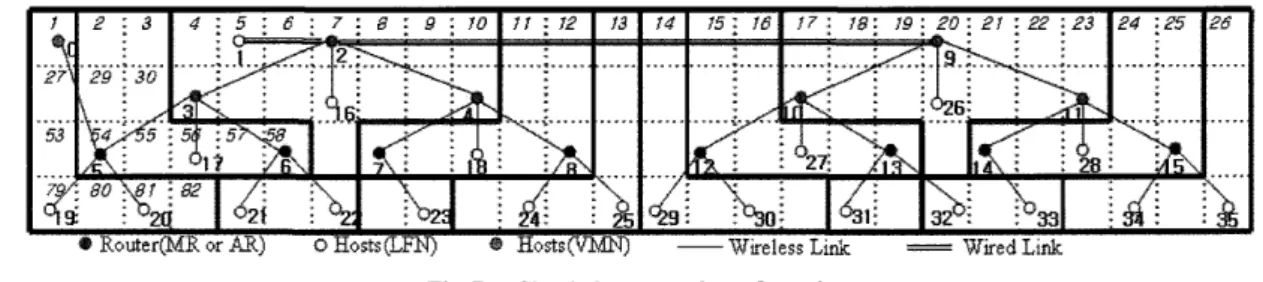
Fig,7.
In
orderto
analyzethe
infiuence
on aNEMO
of spoofing attack traMc andthe
effectof our eachprocess,
we simulateit
withGloMoSim
(Global
Mobile
In-formation
Systems
Simulation
Ljbrary)
that
provides
ascal-able simulation environment
for
wireless and wired networksystems
[15].
The
terrain
of simulation networkis
(2600
meter,
400
meter).For
routing, wedivide
the
who]eter-rain
into
104
sub-terrains as a100-meter unit,and theitalic
number
in
asub-terrainindicates
the
number of sub-terrains.Thus,
the
traMc
ofanodelocating
in
sub-terrain1,
2Z
53,
79,
80,
81
or82
wouldbe
fOrwarded
to
MR5,
andthe
parent-MR
of anodelocating
in
sub-terrain2,
3,
29,
30,
54,
55,
56,
57
or58
is
MR3.
We
depict
azone ofsub-terrains servedby
each
MR
wnh abold
line.
For
generating
attacktraMc,
we configurefive
movingattack nodes
(node
O,17,18,19
and23)
and one stationary attack node22.
Three
moving attack nodes start to move at(50,50),
(350,250),
(950,250),
(50,350),
and(850,350)
re-spectively at
the
startofsimulationby
the
random-waypointway with aminimum speed
(1
meterper
sec) and amaxi-mum speed
(20
meterper
sec),Each
attack node starts tomount
the
IP
spoofing attackto
node1
at10,
20,
30,
40
and5e
secondsin
order of nodeO,19,17,18
and23,
and theyfin-ish
to
attack atl20
seconds.TIhe
stationary nede22
startsto
mountthe
attackto
node1
at120
seconds untilthe
endof simulation.
This
attack trafficis
generated
with60B
UDP
traffic
in
O.2
millisecondsinterval,
These
parameters
areori-ented
from
the
experiment of realIP
spoofing attack toolsatFig,
l.
Also,
as normaltraMc,
node21
continuously sendsnode
1
CBR
(Constant
Bit
Rate)
traMc of1460B
in
O.2
mil-liseconds
interval
atthe
startof simulation untilthe end ofsimulation.
Wt)
applythe
seconddefense
deployment.
That
is,
AR2
andAR9
onlyperfbrm
the
defense
features
atthe
first
time,
and
then
hand
over theidentification
feature
to childMRs
when
detecting
the
attackin
orderto
find
the
exact attackagent.
We
setCSMA
for
the
wiredlink
and802.1
1
b
for
the
wirelesslink,
thus
the
link
bandwidth
is
1
1
Mbps.
First
ofall,Fig.
8
depicts
the
thrwarzling
Ilacket
Count
at
AR219
andMRs
as simulation time(unit
is
second)goes
by,
performing
defense
features
stepby
step.In
Fig.
8(a),
because
of no actionfor
defense,
the
trafic
of nodes are1 4;s:fi:7:s:g:yv
-tti-t;1:r2.ISr4;S:IS.17:;S:I9:20:e"ff:e3e4:2S
ttt-
t
:I:,2.::
t:-:I :t:...-t....:t..t.t.tt.:t..tt
t:t
:'?FtttttS3
tt'
e:s::bb''l'bb"ltttt;ttttt.tttt)ttlttttt.r'ttt'tt:ttt''・l:::
tt
'
;i:t::tttt}ttttt
:tt:ttttt:::vttttt'::.ttttttttttItttt.:ttttt:;tt-.."I"...:"".;.g
t:l:
;i:I6:l:
e6tttttttttt 4-S:S:::::s'e.Ii!ttt.:1 :::ttttittttttttttttt-t.:/.
::.!:7;・'ttttt
:::}::t..;t.t....:t:::-tttttzI9sal-i{lliia?ttt2ti:
: :' :i r t:tttt:::tttt:-[ :::;:o:i1:
:t::32::ma:r: ::: ::;ttttt eRoutttror)oHests(LF)I)eHosts(VMN) WireiessLinic WiredL{akKIMandCHAE:PROACTIVEDEFENSEMECHANISMAGALNSTIPSPOOFTNGONNEMO
196S
soe-=g4oDN--Osi3ootk'xeoSdeo
)
(a)
No-Action(No
FilteringlNoIsolatiomfNoNotification)
lao,,,td6oel;:-$lao8a Secig-eoctg,,L to 1gm-ti8.o!aslL
Cb)
L3 Filtering 10(c)
L3FilteringtL2Isolatien---rwu'----'"
-1
Teescx=-b"Hde<
tt.xttt
t
tt/tttt
.
tt
t
tl
tl
d 1 ...a..-.;;-'g'" Tb'eSFFP 239';.
-...L/...
/i,
IM
:'
i
・"
o t/
'・
-.
t'ts
tI
J
MR6,
at around60s
and80s.
These
decrease
situationsoccur
in
the case(b)
and(c)
also,
At
around55s,
attackagents move within
the
NEMO
ofAR9,
thus theforwarding
count of
AR9
increases
considerably atthat
time.
As
the
first
defense,
L3
filtering
filters
outthe
attack traMc mostlyas shown
in
Fig,
8(b).
However,
the
trathc
ofAR2!MR6
is
fluctuated
also, asthe
start of attack and the rnobility ofattack agents.
Figure
8(c)
showsthat
L2
isolation
canmit-igate
their
influence.
Straightforwardly,
whilethe
sumfor
forwarding
normalpackets
ofMR6
is
19579
in
the
(b),
thesurn
is
22878
in
the(c).
Therefbre,
L2
isotation
makesthe
perforrnance
of normaltrafic
enhance.For
comparingre-sults
befbre
and afterthe
appLication ofIVbtifcation,
wede-pict
(d)
asalog
scalegraph
of(c).
As
thefinal
defense,
Notijication
decreases
FFP
(Fkeulty
florwarding
Ilackets)
that
is
apacket
count offbr-warding theattack trathc.
Due
to
IVbtijication,
the
decrease
in
FEP
valueis
41%,
and moreoverthe
decrease
amountwould enlarge
in
the
realnetworkdue
to
severer attack, a number of attack agents, and more complicate networkcon-figuration,
In
addition to,weperfOrTn
at-test
withthe
FFP
value ofFigs.
8(d)
and・8(e)for
comparingthe
difference
be-tween
FEP
valuesbefore
and after anintervention
ofAfoti-,fication
feature,
The
t-test
procedure
produces
ap-value
ofO.0267
less
than
significantlevel
0.05,
thus we can concludethat
the
intervention
ofIVbtptcation
feature
produces
statis-tical]ysignificant
improvements
in
the
FFP
value.g8mle'genpgie'iLtod
50 SimuSatlofiTirne(sec)10S
(d)
L3FilteringtL2rsolation
15e
Defense
Ability
&
Overhead
ofIVbtijication
In
orderto
evaluate ourproactive
IVbtijication
feature
usjng neighbor
graph,
we eompareit
with otherpossible
variants,
NOTII
andNcrI]I2.
They
aredifferent
in
whoma
detecting
nodeis
notifiedto,
For
example,if
AR2
woulddetect
an attack,it
would notifyto
MR2!314!5!6!7!8
in
the
NOTII,
to
MR314
in
theNcrI]I2,
and toMR3!4!617
in
the
NOTI3.
IDEse,ol:tr.geleept: o r---m'-'-EtLL1j[[e[L/ltE','.l.,t
hitttt
-ttt.tt..a
ms /'e ts"
'・Tb{alFFP.
--r
・
.
i
xp
m
i
-fl?....
/v
"''''
"'',.Lth
til'
l・・・)
{,
I
iOoL sosirrtu)ationTEme{sec)iet asc
(e)
L3FilteringXL2IsotationfNotification
Fig.8
Ebrwanting
thcket
Count
attherouters<Legend
of(b),(d)
and(e)
isthesame as
(c)),
fiuctuated
from
10
sin
which nodeO
startsto
attack, asat-tack
agent moves,For
example, nodeO
and19
move nearto
MR3
ataround30s,
andtheir
traMcthrough
MR3
com-petes
withthe
trafic
ofAR2.
Thus,
the
trafic
ofAR2
de-creases
deeply
at thattime,Due
tothe
similar reason,the
traMc
ofAR2
decreases
deeply
in
comparison withthat
of.
NOTII:
Notification
to
al1
MRs
underthe
AR
.
NOTI2:
Notification
to
its
parent
and childMRs
eNOTI3:
Notification
to
moyingpossible
neighborMRs
using neighborgraph
We
usethe
fOllowing
criteria to comparethe
perfbr-mance and eMciency:
CNTIL
andFFP.
CN7:L
(Control
mes-sage) measures
the
number of control messagesto
needfor
notification, which
indicates
the overheadfor
notificationfeature.
As
the
perfbrmance
of notification,FFP
measuresthe
sum offorwarded
attackpackets
at each router. Basi-cally,this
experiment usesthe
network configuration andscenario of
Fig.
8,
but
we simulateduring
1000
sfor
enoughsimulation and yary
four
parameters
that
could affectthe
eMciency of
Nbtipcation:
(1)
number of stationary attackagents and
their
deployment
types,
(2)
number of movingattack agents,
(3)
movement speed of attack agent, and(4)
number ofnodes
in
aNEMO,
Firstly,
to examinethe
effect ofthe
number ofsta-tionary
attack agents andtheir
deployment
types
(Disper-sion andConcentration),
wegradually
add stationary attackIEICETRANS.FUNDAMENmuS,VOL,ES9-A,NO,7JUUYT2006
1966
eose 40e2SOe 2a10 rm....NOTIS/ wwNOT12/ ' -NOT13 ii;':
'l'i'1:1
/ii''
/'I'
soo2SO200&t' sufon5D oDepioymEscTypeops,bmiS/'er/sieptn,}Oim/eCLRratian DepievneSi')TypSl-opmu,'sepeelsionD,E%eRCc/:R)mtion
(NumberofEtteckapenis) ENuntberofattackegerks)
Fig.9 CIVTLandFFP vs. the number ofstationary attack agents
includ-ing a meving attack agent and
deployment
type,403{F l30i,,l2glS6"le E
.---.
-
t-sueTlllLl,l)'
NOTi!1
/
s/.Pt.l...-・-.tt
IOt tO: 10/ SFm"letionTimeEseor)(a)
Movement
Speed
ofAttack
Agent:1-・2mfs 2oli 1"at fua 950
:ge,
ajl:i
4e taoF 2a sc' 1.s
le a 3 io NuimrotMonngNtaetAgerts NumberotMeviggAttaekAgents
Fig.
10
CNTL
and FFP vs.thenumber ofmoving attackagents.lmuww-NOTItiNOTI21Non31
i':/H1s''
''r
t
1
/1
'': :: 1/'
' 401(a)
Movement
Speed
ofAttack
Agemt/t-・2rrifs 20 15 S 2ge 10fft Sima1ntIomT[me(set} SimulatienTimle(see)
(b)
Movement
Speed
ofAttack
<b)
Movement
Speed
ofAttack
Agent:
15--30m!sAgent:
15-30mls
fig.
11
CN7Z
andFFP
vs.movement speed ofattack agent.agents
to
a moving attack agent atthe
nodeO.
Figure
9
depicts
the
effectasCIV7:L
andEFP.
The
valuein
the
paren-theses
indicates
the
number of attack agents.As
the
nurn-ber
of attack agentsincreases
and theydisperse,
theCN7Z
and
17FP
increase.
NOTI2
has
the
smal]estCiV7:L
value,but
NOTI3
using neighborgraph
has
mostlythe
smallestFlilP
value,
Also,
asthe
number ofthe
attack agentsincreases
and
they
disperse,
NOTI3
has
better
performance
andless
oyerhead than
NOTI1.
The
effect onthe
number of movingattack agents
is
shownin
Fig.
1O.
As
the
nurnber of movingattack agents
increases,
the
CNTI/EFP
ofNCfTII
rapidlyincrease.
The
defense
performance
ofNOTI3
usingneigh-bor
graph
is
moreprominent
in
the
enyironment of manyexisting moving attack agents.
In
Fig.
1
1
, asthe
movement speed oftwo
attack agents(e,g.
(a)
human
speed,(b)
motorcyclefcar)increases,
CiVTL
and
FFP
alsoincrease
because
offrequent
handoff.
NOTI2
has
the smallestCNTL
valuein
all speeds,but
theFFP
ofNOTI2
increases
most steeply asthe
speedincreases.
NOTI3
using neighborgraph
has
the
smallestFFP
valueand
increases
rnostgently
asthe
speedincreases,
although
resultingin
the
alittle
high
CAJTL
value atthe
high
speed.In
conclusion, when we considerthe
obtainablebenefit
(de-crease of
FFP)
with overhead(ewIIL),
NorI3
is
the
best
solution even at
the
high
speed.Lastly,
Fig.
12
depicts
the
effectonthe
number ofnodesin
aNEMO,
We
combine twoNEMOs
ofAR2fAR9in
Fig,
7
into
abigger
NEMO
in
orderto
enlargethe
netwotk sizeatthis experiment, and mount
the
attackby
amoving attackagent
based
on simi]ar simulation scenario usingfbr
Fig.
8.
As
the
number of nodeslMRsis
1arge,
the
CN7L
ofNOTII
steeply
increases
because
ofthe
notificationto
al1
MRs
un-der
anAR,
as we expect.On
the
other side,the
increase
degree
ofFEP
valuefor
threeNbt(fications
is
similar,but
5040segroie
doo cogoto
7(1thBS) 15eOrafi) 7tlon]e) t5C20rs6) MR#lneNEMOCnede#inaNEmaOITofelnode#) MR#inaNEMDCnode#iReNEMOtTetalRodeab
Fig.
12
CNTI]
andFFP
vs.thenumber ofnodesin
aNEMO,
NOTI2
has
the
largest
FFP
value.In
conclusion, we canget
two
important
points
aboutnotification
feature.
Firstly,
IVbtijication
feature
strengthensthe
defense
mechanismin
comparison withperfbrming
onlythree
defense
features
(detection,
L3
filtering
andL2
isola-tion)
especially against mobile attacks.Secondly,
NOTI2
notifying only to
parent
and childMRs
has
the
smallestoverhead
(CIV71L)
for
allparameters,
but
its
defense
ability(MP)
is
notgood
relatively.In
theview ofdefense
ability,especially
NcrI'I3
Tnakes aconspicuousfigure
in
the
severeattack
by
lots
of attack agents such asDDoS
attack, andin
the
attackby
fast
mobile nodes.5.
Conclusion
In
this
paper,
wehave
proposed
a mechanismthat
rapidly andproactively
defends
againstIP
spoofing attacks on amo-bile
network.The
defense
mechanism consists of speedydetection,
filtering
of attackpackets,
identification
ofattackagents,
isolation
of attack agents, and notificationto
neigh-boring
routers,Of
greatest
importance
on amobile network arethe
processes
ofisolating
attack agentsin
layer
2
andnotifying neighboring routers.