저작자표시-비영리-변경금지 2.0 대한민국 이용자는 아래의 조건을 따르는 경우에 한하여 자유롭게 l 이 저작물을 복제, 배포, 전송, 전시, 공연 및 방송할 수 있습니다. 다음과 같은 조건을 따라야 합니다: l 귀하는, 이 저작물의 재이용이나 배포의 경우, 이 저작물에 적용된 이용허락조건 을 명확하게 나타내어야 합니다. l 저작권자로부터 별도의 허가를 받으면 이러한 조건들은 적용되지 않습니다. 저작권법에 따른 이용자의 권리는 위의 내용에 의하여 영향을 받지 않습니다. 이것은 이용허락규약(Legal Code)을 이해하기 쉽게 요약한 것입니다. Disclaimer 저작자표시. 귀하는 원저작자를 표시하여야 합니다. 비영리. 귀하는 이 저작물을 영리 목적으로 이용할 수 없습니다. 변경금지. 귀하는 이 저작물을 개작, 변형 또는 가공할 수 없습니다.
Effects of orlistat/phentermine versus
phentermine on vascular endothelial
cell function in obese and overweight
adults: A randomized, double-blind,
placebo-controlled trial
Yu-Jin Kwon
Department of Medicine
The Graduate School, Yonsei University
[UCI]I804:11046-000000521971
[UCI]I804:11046-000000521971
[UCI]I804:11046-000000521971
[UCI]I804:11046-000000521971
[UCI]I804:11046-000000521971
[UCI]I804:11046-000000521971
Effects of orlistat/phentermine versus
phentermine on vascular endothelial
cell function in obese and overweight
adults: A randomized, double-blind,
placebo-controlled trial
Yu-Jin Kwon
Department of Medicine
Effects of orlistat/phentermine versus
phentermine on vascular endothelial
cell function in obese and overweight
adults: A randomized, double-blind,
placebo-controlled trial
Directed by Professor Lee Ji Won
The Doctoral Dissertation
submitted to the Department of Medicine
the Graduate School of Yonsei University
in partial fulfillment of the requirements for the degree
of Doctor of Philosophy
Yu-Jin Kwon
December 2019
This certifies that the Doctoral
Dissertation of Yu-Jin Kwon is
approved.
---
Thesis Supervisor: Ji Won Lee
---
Thesis Committee Member #1: Chung Mo Nam
---
Thesis Committee Member #2: Hyuk-Jae Chang
---
Thesis Committee Member #3: Hyangkyu Lee
---
Thesis Committee Member #4: Young Ran Yoon
The Graduate School
Yonsei University
ACKNOWLEDGEMENTS
I was able to finish this thesis thanks to the amazing energy of
my inspiring mentor and supervisor, Professor Ji Won Lee.
Although, this work was my first at this level, Professor Lee’s
kind and patient tutelage gave me the strength to reach the
finish line. Through her constant guidance, I am always
learning and growing.
I am also deeply grateful for the opportunity to work with
Professors Chung Mo Nam, Hyuk-Jae Chang, Hyangkyu Lee,
and Young-Ran Yoon. Their diligence impacted my own and I
thank each of them for all the great things they have done.
I would like to extend a special thanks to family of Family
medicine in Severance Hospital, and Doctors Soul Han and
Sung-Kwan Oh. Without their support, I could not have
completed this thesis.
This manuscript is dedicated to my dear husband and my
beautiful daughter, Sohee, who always support me.
<TABLE OF CONTENTS>
ABSTRACT ··· 1
I. INTRODUCTION ··· 3
II. METHOD ··· 6
1. Study design and patients ··· 6
2. Randomization and masking ··· 7
3. Procedures and endpoints ··· 8
4. Safety and compliance ··· 11
5. Assessment of vascular endothelial cell function ··· 11
6. Statistical analysis ··· 12
III. RESULTS ··· 14
IV. DISCUSSION ··· 24
V. CONCLUSION ··· 29
REFERENCES ··· 33
LIST OF FIGURES
Figure 1. Flow chart of study cohort enrollment ··· 8
Figure 2.
Adjusted mean changes of lipids and FMD ··· 21
Appendix Figure 1. Spider plot of lipids, FMD and NMD for
four subgroups ··· 32
LIST OF TABLES
Table 1. Baseline characteristics of study participants ··· 14
Table 2. Metabolic parameters of placebo/phentermine and
orlistat/phentermine groups at baseline ··· 16
Table 3. Characteristics of transthoracic echocardiography of
placebo/phentermine and orlistat/phentermine groups at
baseline ··· 17
Table 4. Characteristics of placebo/phentermine and
orlistat/phentermine groups at baseline and 12 weeks ··· 18
Table 5. Changes of mean ± standard error of metabolic
parameters in placebo/phentermine and orlistat/phentermine
groups from baseline to 12 weeks ··· 19
Table 6. Adverse events of placebo/phentermine and
Appendix Table 1. Changes from baseline to 12 weeks in
placebo/phentermine and orlistat/ phentermine in per protocol
set (n=96) ··· 30
Appendix Table 2. Characteristics of transthoracic
echocardiography in placebo/phentermine and
1
ABSTRACT
Effects of orlistat/phentermine versus phentermine on vascular
endothelial cell function in obese and overweight adults: A randomized,
double-blind, placebo-controlled trial
Yu-Jin Kwon
Department of Medicine
The Graduate School, Yonsei University
(Directed by Professor Lee Ji Won)
Background: Obesity is a significant risk factor for increased morbidity and mortality associated with cardiovascular disease (CVD) and other chronic diseases. The endothelium controls micro and macrovascular circulation. Obesity leads to endothelial cell dysfunction which often precedes irreversible atherosclerotic CVD. Although weight reduction decreases cardiovascular risk, several anti-obesity drugs pose concerns for cardiovascular safety. Orlistat, a strong lipase inhibitor, is effective in reducing CVD risk factors such as blood glucose and cholesterol in obese adults. This study aimed to compare the efficacy and effectiveness of concomitant administration of orlistat and phentermine versus phentermine alone on endothelial cell function in overweight and obese adults with back pain.
Methods: We conducted a 12-week, double blinded, placebo-controlled clinical trial involving 114 patients with a body mass index (BMI) of at least 30 or over or a BMI of at least 27 or over with weight-related comorbidities. We randomly assigned patients
2
in a 1:1 ratio to receive orlistat (120 mg) three times daily and phentermine (37.5 mg) once daily, or a placebo three times daily and phentermine (37.5 mg) once daily. Both groups were instructed to intake a calorie reduced diet and undertake light to moderate exercise. Primary endpoint was changes in endothelium dependent vasodilatation measured by ultrasound assessment of flow mediated dilatation (FMD). Differences within groups after intervention were compared using the paired t-test or Wilcoxon signed rank test. Differences of changes between groups were calculated using an analysis of covariance after adjusting for each baseline value.
Results: Mean weight loss during the 12-week study period was 6.1 kg in the orlistat/phentermine group and 6.0 kg in the placebo/phentermine group. Adjusted mean changes in total cholesterol (TC) and non-high density cholesterol (HDL-C) were significantly greater in the orlistat/phentermine group than the placebo/phentermine group (difference of TC: -0.62±0.07 mmol/l vs. -0.32±0.07 mmol/l, respectively, p=0.005; difference of non-HDL-C: -0.53±0.07 mmol/l vs. -0.30±0.07 mmol/l, respectively, p=0.016). Adjusted mean changes in endothelium dependent FMD were significantly greater in the orlistat/phentermine group than the placebo/phentermine group (4.97±0.98% vs. 2.05±0.99%, respectively; p=0.038). Changes in endothelium-independent NMD were not significantly different between groups.
Conclusion: Orlistat/phentermine significantly improved vascular endothelial cell function compared to phentermine alone. Orlistat taken concomitantly with phentermine may decrease the risk of cardiovascular disease, especially in overweight and obese patients with comorbidities.
Key words: orlistat; phentermine; obesity; back pain; cholesterol; endothelial cell function
3
Effects of orlistat/phentermine versus phentermine on vascular
endothelial cell function in obese and overweight adults: A randomized,
double-blind, placebo-controlled trial
Yu-Jin Kwon
Department of Medicine
The Graduate School, Yonsei University
(Directed by Professor Lee Ji Won)
I. INTRODUCTION
The prevalence of obesity is gradually increasing globally.1 In Korean, the prevalence
of obesity increased from 29.7% in 2009 to 32.4% in 2015.2 Obesity is defined as
abnormal and excessive fat accumulation that may worsen health.3 Obesity is closely
link to insulin resistance, inflammation, activated sympathetic nerve system, dyslipidemia, and cardiac complications.1,4,5 The endothelium, which is comprised of a
monolayer of endothelial cells, maintains vascular homeostasis by producing and releasing vasoactive molecules.6 When the vessel is under shear stress, a
4
nitric oxide synthase (eNOS) and leads to an increase of NO.7 Phosphorylation of eNOS
by Akt is also involved in the Ca2+-independent regulatory mechanism and the activation of eNOS.8 In a prolonged state of shear stress, eNOS gene transcription alters
to regulate output of NO.7 Endothelial cell dysfunction is a pathological status which
covers all maladaptive changes, including the down-regulation of the bioavailability of nitric oxide, and increased proinflammatory cytokines and adhesion molecules.9,10
Because the endothelium regulates the micro and macro circulation of blood flow, endothelial dysfunction is considered to be an early indicator of cardiovascular diseases (CVD).9,10 Obesity and its related comorbidities, such as hypertension and
hypercholesterolemia, are risk factors of endothelial cell dysfunction.11 Weight loss, or
metabolic parameter improvement regardless of weight loss, ameliorate endothelial cell function.12-14 Lifestyle modifications, consisting of reduced calorie intake, physical
activity, and behavior interventions, should be the first approach to treating obesity.15,16
Recently, obesity or overweight has been reported to be closely associated with lower back pain.17 Obese people with lower back pain face physical limitations.18 Physical
inactivity over the long time further physical function decline and obesity.18 Therefore,
concurrent initiation of pharmacotherapy could be recommended in overweight or obese patients with weight-related complications that may be improved by weight loss.16,19,20
Anti-obesity drugs can be divided into two mechanisms: central acting mechanism (appetite suppressants) and peripheral acting mechanism (acting on the gastrointestinal tract).21,22 Despite being effective for weight loss, several appetite suppressants (i.e.
5
fenfluramine, dexfenfluramine, and sibutramine) were withdrawn from market due to associated cardiovascular risks.21,23
As a result, the US Food and Drug Administration (FDA) now require newly developed anti-obesity drugs to demonstrate efficacy and safety, including an acceptable cardiovascular safety profile.23 Combination anti-obesity drugs which have
different mechanisms (i.e.. phentermine plus topiramate and naltrexone plus bupropion) have attracted a great interest because of their improved efficacy and safety.23-25
Phentermine hydrochloride (HCl), a sympathomimetic amine, was approved for short-term use (up to 12 weeks) of obesity treatment.21 Phentermine is the most commonly
prescribed anti-obesity drug in the United State, and other countries.26,27 Phentermine’s
efficacy has been demonstrated in terms of weight loss and improved metabolic parameters without clinically severe adverse events.28,29 However, concerns still remain
about the associated stimulant-like side effects resulting from its sympathomimetic pharmacology, including increased heart rate (HR) and blood pressure (BP).22
Orlistat, a gastrointestinal (GI) lipase inhibitor, is a long-term approved anti-obesity medication which acts on the GI tract; not the central nervous system.30,31 Treatment of
obesity with orlistat combined with lifestyle modification has demonstrated metabolic benefits such as lowering blood sugar levels and BP, as well as improving the lipid profile by inhibiting fat absorption.31-33 In addition, several studies have noted the
antioxidant and anti-tumor effects of orlistat.34,35 We expect these metabolic benefits to
reduce the cardiovascular side effects of previous obesity drugs.
6
phentermine is commonly used off-label in clinical practice.36 However, there have
been no clinical trials to assess whether the concomitant administration of these two drugs improves metabolic parameters in addition to weight loss. We hypothesized that adding orlistat to phentermine improves endothelial cell function compared to phentermine alone in obese and overweight adults with weight-related comorbidities and lower back pain.
II. METHOD
1. Study design and patients
This study was a randomized, double-blind, placebo-controlled 12-week clinical trial. The protocol was approved by the institutional review boards of Yongin Severance Hospital (IRB No. 9-2018-0004) and registered with ClinicalTrails.gov (number: NCT03675191). This study was performed in compliance with the Declaration of Helsinki.
Patients were recruited from October 2018 to May 2019 at Yongin Severance Hospital (Yongin, South Korea). Eligible patients, aged 20-70 years, were obese (body mass index [BMI]≥30 kg/m2) or overweight (BMI≥27 kg/m2) with at least one weight-related
complication (e.g. diabetes, prediabetes, hypertension, dyslipidemia, or metabolic syndrome).16 Patients had lower back pain that limited the implementation and
effectiveness of exercise, with visual analog scale (VAS) score more than 3. Exclusion criteria included the following contraindications for use of phentermine or orlistat: progressive atherosclerosis, symptomatic CVD, pulmonary hypertension, valvular
7
heart diseases, blood pressure (BP) greater than 180/120 mmHg, hyperthyroidism, glaucoma, fasting glucose 11.1 mmol/L, hepatic disease, renal diseases; as well as history of psychiatric illness, taking medications such as monoamine oxidase inhibitors within 14 days of screening, pregnancy, breast feeding, loss of more than 5 kg within three months, and treatment with other anti-obesity medication within one year. Written consent from was obtained from all patients prior to participation.
2. Randomization and masking
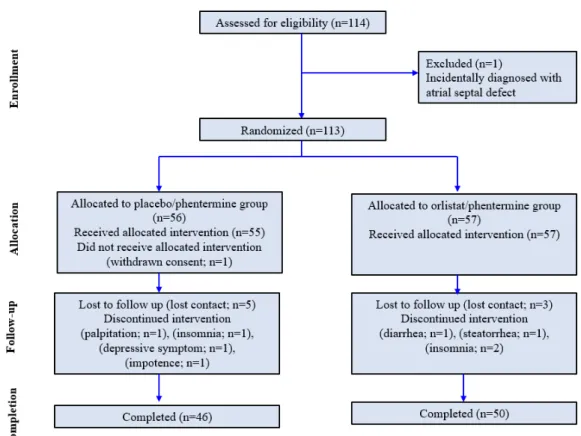
Participants were randomly assigned in a 1:1 ratio to receive a placebo three times a day plus phentermine hydrochloride (37.5 mg) once daily or orlistat (120 mg) three times a day plus phentermine hydrochloride (37.5 mg) once daily. Subjects were instructed that if they a skipped meal, they should also skip the corresponding orlistat dose. Randomization was performed using a centralized computer-generated system. Investigators and patients were masked to treatment assignment throughout the study. Active drug and placebo capsules were identical in appearance and produced by the study sponsor (Hanmi Pharmaceutical Co. Ltd). Of the initial 114 participants assessed for eligibility, one patient was excluded at screening due to an incidental diagnosis of atrial septal defect. A total of 113 participants were enrolled in this study. After undergoing 1:1 ratio randomization, 56 subjects were assigned to receive placebo plus phentermine (placebo/phentermine group) and 57 subjects were assigned to receive orlistat plus phentermine (orlistat/phentermine group). One participant assigned to the placebo/phentermine group withdrew consent before allocating receiving intervention
8
(Figure 1). Five participants in placebo/phentermine group and three participants in orlistat/phentermine group did not reach contact after first or second visit. Each four participants withdrew consent during clinical trials due to adverse event. This study was completed by 46 participants in the placebo/phentermine group and 50 participants in the orlistat/phentermine group.
Figure 1. Flow chart of study cohort enrollment, allocation, follow-up and completion
9
Study visits were scheduled at screening, baseline, and at 4, 8, and 12 weeks. Body weight, waist circumference (WC), systolic blood pressure (SBP), and diastolic blood pressure (DBP) were measured at each visit. Laboratory tests, heart rate variability (HRV), body composition measurement, and FMD were measured at baseline and 12 weeks. Health-related (physical activity, smoking, alcohol consumption) and food intake (using a 24-hour recall method) questionnaires were administered at baseline and 12 weeks. Participants were categorized into never smoker, ex-smoker, and current smoker groups. An alcohol drinker was defined as a person who drinks alcohol more than once a month. Physical activity was defined as undertaking light to moderate exercise (e.g. brisk walking, gardening, hiking, bicycling 5-9 mph, aqua aerobic) more than two times per week. We used a binary variable with the presence or absence of history of hypertension, dyslipidemia, or diabetes, according to a self-reported questionnaire.
We assessed VAS score and Oswestry Disability Index (ODI) at screening and 12 weeks. The VAS score is a validated pain rating scale by recording with a handwritten mark on a 10cm line that represents a continuum between no pain (0cm) and worst pain (10cm).37 The ODI is a self-administered questionnaire to quantify disability related to
lower back pain.38 It comprises of ten questions related to pain, lifting, ability to care
for oneself, ability to walk, ability to sit, sexual function, ability to stand, social life, sleep quality, and ability to travel. Each question is scored from 0 to 5 and the total score is multiplied by 2.
10
waist to hip ratio [WHR]) was assessed via bioelectrical impedance analysis using the Inbody720 body composition analyzer (Biospace, Seoul, South Korea). Waist circumference was measured using a measuring tape on the horizontal plane midway between the lowest rib and the iliac crest.
Blood samples were obtained after more than eight hours fasting. White blood cell (WBC) counts were quantified by flow cytometry using a XN2000 (Sysmex, Kobe, Japan). Insulin levels were analyzed by chemiluminescent microparticle immunoassay using an Architect i2000SR (Abbott, Abbott park, IL, USA). Lipids (total cholesterol [TC], low-density lipoprotein cholesterol [LDL-C], non-high-density lipoprotein cholesterol [non-HDL-C], triglyceride [TG], HDL-C) were analyzed enzymatic color test. C-reactive protein (CRP) was analyzed using an Immuno-turbidimetric method. The homeostasis model assessment of insulin resistance (HOMA-IR) was calculated using the following equation: fasting glucose (mmol/L)× fasting insulin (uU/mL)/22.5. At every visit, all participants were consulted about diet and exercise by a doctor and advised to follow a hypocaloric diet (consuming 500 kcal below individual estimated energy requirements per day) and light (~3 MET) to moderate intensity exercise more (3~6 MET) than three time per week.
The primary efficacy endpoint was change of flow mediated dilation (FMD) based on ultrasound assessment. Secondary endpoints were change in weight, WC, BMI, fat mass, fat, percentage, lipids (TC, non-HDL-C, LDL-C, TG), CRP, glycemic variables (fasting glucose, fasting insulin, HOMA-IR), and VAS and ODI of lower back pain.
11
4. Safety and compliance
Safety assessment consisted of assessment of adverse events and use of concomitant medications, measurement of vital signs (SBP and DBP, HR), laboratory tests (AST, ALT, Cr), and echocardiography. Adverse event and use of concomitant medications were checked at every visit and vital signs were measured at every visit. Mean HR was recorded at baseline and 12 weeks using a heart rate variability analyzer with a 3-lead ECG (MEDICORE, Gyeonggi, Korea) for five minutes, in the supine position, in a quiet room.
A trained and certified sonographer conducted all echocardiography using the SSH-880CV ultrasound system (Artida, Tokyo, Japan) at screening and 12 weeks. A cardiologist supervised and interpreted the results. Two-dimensional and M-mode echocardiography, and conventional doppler echocardiography data were obtained. The echocardiography checklist included chamber size, hypertrophy, right ventricular function, left ventricular systolic function, left ventricular diastolic function, valves, atrial or ventricular septal defects, thrombus, mass, and other incidental findings.
Drug compliance was measured by counting the remaining pills at every visit. Compliance rate was set at more than 70%. For orlistat, the compliance rate was determined after taking the number of meals skipped into consideration.
5. Assessment of vascular endothelial cell function
Endothelium-dependent FMD was assessed according to the guidelines for ultrasound assessment of endothelial-dependent flow mediated vasodilatation of the brachial artery
12
introduced by the International Brachial Artery Reactivity Task Force.7 A B-mode
ultrasound with a 7.5 MHz linear array transducer (Acuson, SIEMENS sequoia C 512; Mountain View, CA, USA) was used to assess brachial artery diameter. Flow mediated dilatation was conducted after 8 hr to 12 hr fasting in a quiet, temperature-controlled room. Patients were not permitted to take antihypertensive medication (calcium channel blocker, nitrate, beta-blocker, angiotensin-converting-enzyme inhibitor, angiotensin II receptor blockers) within 48 hr before the FMD. Patients were not permitted caffeine or smoking within 8 hours. A sphygmomanometer cuff was placed above the antecubital fossa on the forearm and inflated to at least 50 mmHg above patients’ SBP. Images of the brachial artery were recorded before inflation and 30 second (s), 45 s, 60 s, 75 s, and 90 s after deflation of the cuff. After 10 minutes rest, 0.6 mg sublingual nitroglycerin was administered and endothelium independent dilatation was assessed. Images were obtained before nitroglycerin administration and at 3 and 4minutes post nitroglycerin administration. Vessel diameter was measured at the end diastole incident (at the R-wave) on electrocardiogram (ECG). Endothelium dependent (FMD) and independent vasodilatation (NMD) were calculated as follows: FMD (%) or NMD (%) = ([maximal diameter-baseline diameter]/baseline diameter)×100. The same blinded investigator performed all FMD assessments. The intraclass correlation coefficient was 0.979 (0.970-0.985).
6. Statistical analysis
13
distribution of values before analysis. Data are presented as mean± standard deviations (SDs) or median (interquartile ranges [IQR]). For efficacy analyses we used data from the full analysis set, which included all patients who underwent randomization and had at least one assessment. Missing values were imputed using the last-observation-carried-forward method.
Differences in baseline characteristics between placebo/phentermine and orlistat/phentermine were compared using the independent t-test or Mann Whitney U test. Differences after intervention within groups were compared using the paired t-test or Wilcoxon signed rank test. Differences in changes between groups were calculated using an analysis of covariance after adjusting for each baseline value. Significance tests were two-sided, with an alpha value of 0.05. All statistical analyses were performed using SPSS software version 25.0 (IBM Corp., Armonk, NY, USA).
For calculation of sample size, there was no RCT to investigate the effect of orlistat on endothelial cell function using the FMD. Because LDL-C was significantly correlated with FMD in previous studies,39,40 we calculated the effect size based on
absolute LDL-C changes between the orlistat group (-0.53±0.65) and the placebo/phentermine group (-0.09±0.8; effect size=0.6).41 We assumed that the effect
size would be similar to the effect size of FMD. Cohen’s effect size 0.6 indicates a medium to large effect size. Sample size was calculated using an independent two sample t-test with 80% power, a two-sided significance level of 5%, and a dropout rate of 20%.
14 III. RESULTS
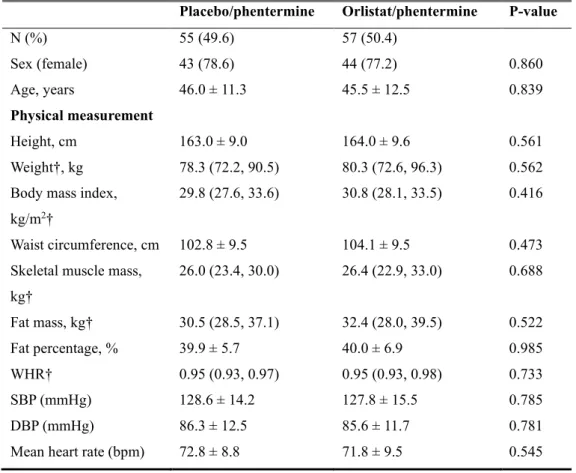
Of the 113 patients who participated in this study, 77.9% were female. Rates of study drop-out were similar between groups. Baseline characteristics were similar between the orlistat/phentermine group (n=57) and the placebo/phentermine group (n=55) in terms of age (45.5±12.5 years vs. 46.0±11.3 years, respectively; p =0.839), gender (44 female vs. 44 female; p=0.860), and BMI (30.8 (28.1, 33.5) vs. 29.8 (27.6, 33.6); p=0.416) (Table 1).
Table 1. Baseline characteristics of study participants
Placebo/phentermine Orlistat/phentermine P-value
N (%) 55 (49.6) 57 (50.4) Sex (female) 43 (78.6) 44 (77.2) 0.860 Age, years 46.0 ± 11.3 45.5 ± 12.5 0.839 Physical measurement Height, cm 163.0 ± 9.0 164.0 ± 9.6 0.561 Weight†, kg 78.3 (72.2, 90.5) 80.3 (72.6, 96.3) 0.562 Body mass index,
kg/m2†
29.8 (27.6, 33.6) 30.8 (28.1, 33.5) 0.416
Waist circumference, cm 102.8 ± 9.5 104.1 ± 9.5 0.473 Skeletal muscle mass,
kg† 26.0 (23.4, 30.0) 26.4 (22.9, 33.0) 0.688 Fat mass, kg† 30.5 (28.5, 37.1) 32.4 (28.0, 39.5) 0.522 Fat percentage, % 39.9 ± 5.7 40.0 ± 6.9 0.985 WHR† 0.95 (0.93, 0.97) 0.95 (0.93, 0.98) 0.733 SBP (mmHg) 128.6 ± 14.2 127.8 ± 15.5 0.785 DBP (mmHg) 86.3 ± 12.5 85.6 ± 11.7 0.781
15
Data are presented as mean±standard deviations, median (interquartile ranges), or number (percentage).
P-values calculated using independent two sample t-test or Mann Whitney U test. † Continuous values calculated using Mann Whitney U test and categorical values calculated using chi-square test.
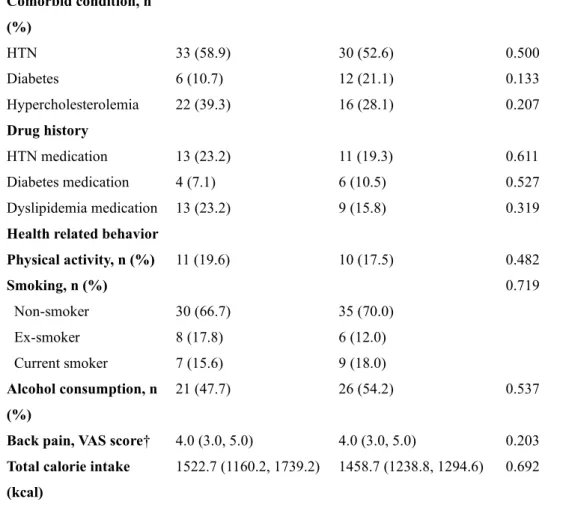
The metabolic parameters and values of FMD were well balanced between groups (Table 2).
Table 2. Metabolic parameters of placebo/phentermine and orlistat/phentermine Comorbid condition, n (%) HTN 33 (58.9) 30 (52.6) 0.500 Diabetes 6 (10.7) 12 (21.1) 0.133 Hypercholesterolemia 22 (39.3) 16 (28.1) 0.207 Drug history HTN medication 13 (23.2) 11 (19.3) 0.611 Diabetes medication 4 (7.1) 6 (10.5) 0.527 Dyslipidemia medication 13 (23.2) 9 (15.8) 0.319 Health related behavior
Physical activity, n (%) 11 (19.6) 10 (17.5) 0.482 Smoking, n (%) 0.719 Non-smoker 30 (66.7) 35 (70.0) Ex-smoker 8 (17.8) 6 (12.0) Current smoker 7 (15.6) 9 (18.0) Alcohol consumption, n (%) 21 (47.7) 26 (54.2) 0.537
Back pain, VAS score† 4.0 (3.0, 5.0) 4.0 (3.0, 5.0) 0.203 Total calorie intake
(kcal)
16
groups at baseline
P-values calculated using independent two sample t-test or Mann Whitney U test. The baseline values of TTE are described in Table 3.
Table 3. Characteristics of transthoracic echocardiography of placebo/phentermine
and orlistat/phentermine groups at baseline
Placebo/phentermine Orlistat/phentermine P-value Laboratory test WBC 6662 ± 173 6577 ± 173 0.794 CRP 1.25 (0.73, 2.08) 1.50 (0.60, 2.70) 0.922 AST 24.0 (19.3, 30.8) 25.0 (19.0, 33.5) 0.573 ALT 25.0 (17.3, 31.8) 25.0 (15.5, 44.0) 0.473 Cr 0.75 (0.68, 0.86) 0.73 (0.68, 0.87) 0.719 Glucose (mmol/l) 5.61 (5.38, 6.11) 5.72 (5.33, 6.43) 0.269 Insulin 8.65 (6.88, 12.98) 8.20 (5.60, 12.85) 0.399 HOMA-IR 2.27 (1.77, 3.49) 2.05 (1.39, 3.66) 0.713 Triglyceride (mmol/l) 1.47 (1.04, 1.78) 1.36 (0.98, 1.68) 0.617 Total cholesterol (mmol/l) 5.33 ± 1.04 5.02 ± 0.92 0.101 LDL cholesterol (mmol/l) 3.40 ± 0.80 3.10 ± 0.62 0.024 Non-HDL cholesterol (mmol/l) 4.00 ± 1.03 3.66 ± 0.88 0.072 HDL cholesterol (mmol/l) 1.34 ± 0.23 1.36 ± 0.33 0.076 Flow mediated dilatation FMD (%) 11.2 ± 5.4 10.6 ± 6.1 0.557 NMD (%) 10.4 ± 7.3 9.6 ± 6.2 0.621
17
P-values calculated using a Mann Whitney U test.
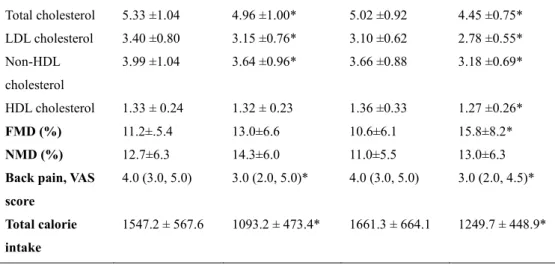
Table 4 shows the characteristics of the two groups before and after intervention. There was significant weight loss in both groups after 12 weeks (-6.1 in orlistat/phentermine vs -6.0kg in placebo/phentermine). All other values regarding body composition such as BMI, WC, fat mass, fat percentage, and WHR were significantly decreased in both groups (all p<0.001). Skeletal muscle mass was also significantly decreased in both groups (p<0.001). Blood pressure (SBP and DBP) was significantly decreased, and mean heart rate was increased without significance in both groups. Fasting insulin levels and HOMA-IR were significantly decreased in both groups. However, fasting glucose levels were not changed in either groups. Inflammatory marker CRP and TG, TC, LDL-C, and non-HDL-C levels were
Placebo/phentermine Orlistat/phentermine P-value
LVEF, % 62.2 ± 4.7 62.6 ± 4.6 0.632 E wave velocity, cm/s 0.52 ± 0.13 0.52 ± 0.14 0.975 A wave velocity, cm/s 0.57 ± 0.11 0.56 ± 0.12 0.474 E/A 0.86 (0.72, 1.14) 0.89 (0.73, 1.17) 0.756
E wave Decel time, ms 150 (150, 180) 150 (150, 170) 0.960 E’ 0.06 (0.05, 0.08) 0.06 (0.05, 0.07) 0.936 E/E’ 8.3 ± 1.7 8.2 ± 1.8 0.765 LAVI 16.7 ±4.2 18.2 ±4.9 0.081 LVEDD, mm 45.7 ± 3.7 45.8 ± 3.9 0.910 LVESD, mm 31.5 ± 2.9 31.4 ± 3.1 0.902 RVSP 26.2 ± 4.3 26.2 ± 3.1 0.988
18
significantly decreased in both groups. Whereas, HDL-C levels were significantly decreased in the orlistat/phentermine group only.
Endothelium-dependent FMD was significantly improved in the orlistat/phentermine group only (p<0.001; orlistat/phentermine vs. p=0.098; placebo/phentermine). However, endothelium-independent NMD changes were not improved in either group.
Table 4. Characteristics of placebo/phentermine and orlistat/phentermine groups at
baseline and 12 weeks
Placebo /phentermine Orlistat /phentermine Baseline 12 weeks Baseline 12 weeks Physical
measurement
Weight 82.6 ± 16.0 76.5 ±16.4* 84.9 ±16.0 78.8 ±15.3* Body mass index 31.0 ± 4.2 28.9 ± 4.3* 31.4 ±3.9 29.1 ±3.7* Waist circumference 102.8 ± 9.5 94.6 ±10.0 104.1 ±9.5 95.0 ±10.3* Skeletal muscle mass 26.0 (23.4, 30.0) 24.5 (22.9, 28.7)* 26.4 (22.9, 33.0) 25.0 (22.1, 31.2)* Fat mass 30.5 (28.5, 37.1) 27.6 (23.4, 32.5)* 32.4 (28.0, 39.5) 28.1(24.0, 33.6)* Fat percentage 39.6(36.2,44.0)* 38.0(32.7,42.6)* 40.1(36.2, 45.3) 37.7 (33.4, 42.4)* WHR 0.95 90.93, 0.97) 0.93 (0.91, 0.97)* 0.98 (0.93,0.98) 0.94 (0.91, 0.96)* SBP 128.6 ±14.2 119.5 ±13.1* 127.8 ±15.5 118.9 ±12.8* DBP 86.3 ±12.5 77.8 ±9.9* 85.6 ±11.7 77.4 ±11.4* Mean heart rate 72.8 ±8.8 73.2 ± 10.3 71.8 ±9.5 74.1 ±9.9 WBC 6660 ±173 6453 ±1.66 6577 ±173 6639 ±169 CRP 1.2 (0.7,2.1) 1.2 (0.5, 1.5)* 1.5 (0.6, 2.7) 1.0(0.4, 1.75)* Glucose (mmol/l) 5.6 (5.4, 6.1) 5.6 (5.2, 6.0) 5.7 (5.3, 6.4) 5.7 (5.4, 3.6) Insulin 9.8 ±4.4 7.8 ±4.2* 9.6 ±5.6 7.8 ±4.4* HOMA-IR 2.27 (1.77, 3.49) 1.89 (1.13, 2.33)* 2.05(1.39, 3.66) 1.71(1.07,3.11)* Lipid profiles Triglyceride 1.47(1.04,1.78)* 1.13(0.93, 1.47)* 1.36(0.98,1.68) 1.18(0.82, 1.59)*
19
Adjusted mean changes in anthropometric measurements (weight, BMI, WC, fat mass, fat percentage), BP, CRP, insulin, and HOMA-IR were not different between groups (Table 5).
Table 5. Changes of mean ± standard error of metabolic parameters in
placebo/phentermine and orlistat/phentermine groups from baseline to 12 weeks Total cholesterol 5.33 ±1.04 4.96 ±1.00* 5.02 ±0.92 4.45 ±0.75* LDL cholesterol 3.40 ±0.80 3.15 ±0.76* 3.10 ±0.62 2.78 ±0.55* Non-HDL cholesterol 3.99 ±1.04 3.64 ±0.96* 3.66 ±0.88 3.18 ±0.69* HDL cholesterol 1.33 ± 0.24 1.32 ± 0.23 1.36 ±0.33 1.27 ±0.26* FMD (%) 11.2±.5.4 13.0±6.6 10.6±6.1 15.8±8.2* NMD (%) 12.7±6.3 14.3±6.0 11.0±5.5 13.0±6.3
Back pain, VAS score
4.0 (3.0, 5.0) 3.0 (2.0, 5.0)* 4.0 (3.0, 5.0) 3.0 (2.0, 4.5)*
Total calorie intake
1547.2 ± 567.6 1093.2 ± 473.4* 1661.3 ± 664.1 1249.7 ± 448.9*
Placebo/phentermine Orlistat/phentermine p-value Physical
measurement
Weight -6.2±0.6 -6.0±0.6 0.941
Body mass index† -2.1±0.2 -2.3±0.2 0.510
Waist circumference† -8.6±0.8 -9.0±0.8 0.751 Skeletal muscle mass -1.08±0.18 -1.04±0.18 0.889 Fat mass -3.80±0.47 -4.29±0.47 0.462 Fat percentage -2.20±0.42 -2.47±0.42 0.652 WHR -0.02±0.02 -0.02±0.02 0.944
20
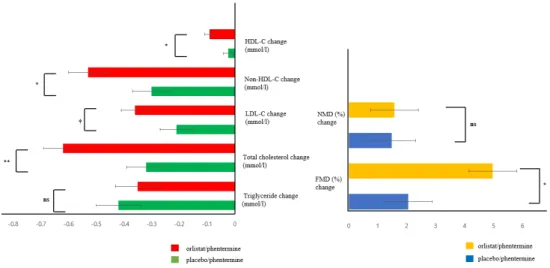
Figures 2A and 2B show the adjusted mean changes of concentrates of lipids and FMD. Changes in TC and non-HDL-C were significantly greater in the orlistat/phentermine group than the placebo/phentermine group (-0.62±0.07 mmol/l vs. -0.32±0.07 mmol/l, respectively, p=0.005; -0.53±0.07 mmol/l vs. -0.30±0.07 mmol/l respectively, p=0.016). Although there was no statistical significance, adjusted mean LDL was further decreased in the orlistat/phentermine group than in the placebo/phentermine group (0.36±0.05 mmol/l vs -0.21±0.06 mmol/l, p=0.053). Adjusted mean changes in TG were not significantly different between groups.
Adjusted mean changes in endothelium-dependent FMD were significantly greater in the orlistat/phentermine than in the placebo/phentermine group (4.97±0.98% vs. 2.05±0.99%, respectively; p=0.038), while the changes in endothelium-independent NMD were not significantly different.
SBP -9.1±1.9 -8.9±1.9 0.918
DBP -8.4±1.2 -8.2±1.2 0.970
Mean heart rate 0.7±1.2 2.1±1.2 0.374
WBC -19.5±16.0 -5±15.9 0.283
hs-CRP -0.60±0.18 -0.49±0.18 0.673
Glucose (mmol/l) -0.40±0.09 -0.20±0.09 0.122
Insulin -1.96±0.50 -1.77±0.49 0.797
HOMA-IR -0.60±0.15 -0.60±0.15 0.993
Back pain, VAS score
-1.07±0.22 -0.60±0.22 0.238
Total calorie intake
21
Figure 2. Adjusted mean changes of lipids and flow mediated dilatation (FMD)
HDL-C, high density lipoprotein cholesterol; LDL-C, low density lipoprotein cholesterol; FMD, flow mediated dilatation; NMD, nitroglycerin mediated dilatation (A): Lipid profile (B): endothelium dependent FMD and endothelium independent NMD
** p <0.01, * p <0.05, †p <0.1, ns: non-significance
The changes of lipids, FMD, and NMD were similar in the per protocol set (n=96) (Appendix Table 1).
Appendix Figure 1 shows a spider plot displaying standardized changes of lipids (TC, TG, non-HDL, LDL, and HDL), FMD, and NMD. Changes of FMD were more prominent in the orlistat /phentermine group. Changes of TC, non-HDL, LDL and HDL were also more prominent in the orlistat/phentermine group.
One volunteer was incidentally diagnosed with atrial septal defect during screening and was unable to participate in the study. There were no other findings on transthoracic
22
echocardiography (TTE) and no cases of increased right ventricular systolic pressure. In both groups, LV, diastolic function measured by E/E ratio was significantly improved (Appendix Table 2) with no significant difference between groups.
Adverse event
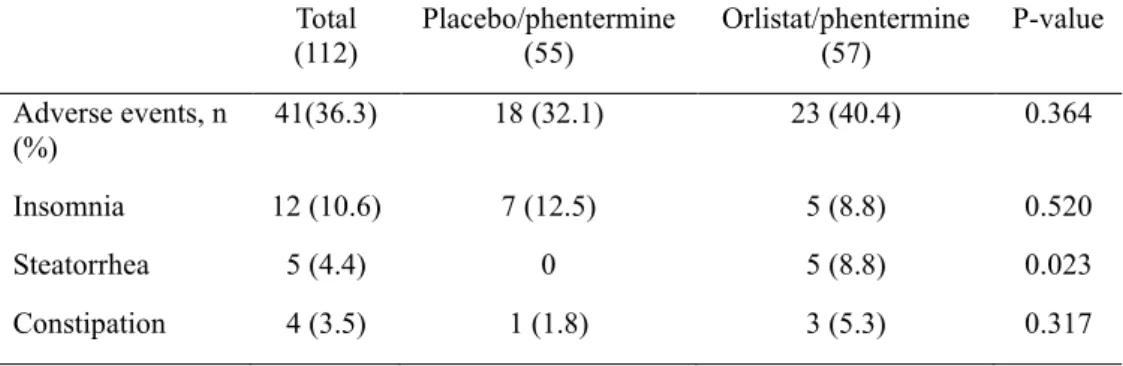
The percentages of patients with adverse event in the full analysis set were similar between the placebo/phentermine group (n=18 [32.1%]) and the orlistat/phentermine group (n=23 [40.4%]) (Table 6). The most common adverse event reported in the placebo/phentermine group was insomnia (12.5%), followed by dry mouth (7.1%) and depressive mood (3.6%) and heart palpitation (3.6%). Other infrequently reported AEs for this group were constipation, headache and impotence (1.8% each). The most common adverse events reported in the orlistat/phentermine group were insomnia (8.8%) and steatorrhea (8.8%) followed by constipation (5.3%), nervousness (3.5%) and diarrhea (3.5%). Depressive mood, nausea, dry mouth, dizziness, headaches and impotence were each reported once (1.8% each) for this group.
Table 6. Adverse events of placebo/phentermine and orlistat/phentermine groups Total
(112) Placebo/phentermine (55) Orlistat/phentermine (57) P-value Adverse events, n
(%) 41(36.3) 18 (32.1) 23 (40.4) 0.364
Insomnia 12 (10.6) 7 (12.5) 5 (8.8) 0.520
Steatorrhea 5 (4.4) 0 5 (8.8) 0.023
23
Adverse events reported in the orlistat/phentermine group were more frequently related to GI tract disturbances (steatorrhea). Adverse events related with phentermine were similar between groups, transiently occurred, and were mostly mild to moderate in severity.
Safety were measured by BP, heart rate, and echocardiography. Compared with baseline, both SBP and DBP decreased by about 10 mmHg at 12 weeks, in both groups. Echocardiography revealed no valvular heart diseases, pulmonary artery hypertension, or other significant findings.
Lower back pain
We recruited patients who were overweight or obese with lower back pain with a VAS score over 3.
The baseline median IQR of the VAS score and mean ± SD of the ODI were not significantly different between groups. The average VAS improved from baseline to 12 weeks by 1 point in the orlistat/phentermine group (p=0.005) and 2 points (p<0.001) in
Dry mouth 5 (4.4) 4 (7.1) 1 (1.8) 0.156 Nervousness 2 (1.8) 0 2 (3.5) 0.083 Depressive mood 3 (2.7) 2 (3.6) 1 (1.8) 0.548 Nausea 1 (0.9) 0 1 (1.8) 0.311 Diarrhea 2 (1.8) 0 2 (3.5) 0.157 Palpitations 2 (1.7) 2 (3.6) 0 0.150 Dizziness 1 (0.9) 0 1 (1.8) 0.311 Headache 2 (1.8) 1 (1.8) 1 (1.8) 0.891 Impotence 2 (1.8) 1 (1.8) 1 (1.8) 0.891
24
the placebo/phentermine group.
The ODI was also significantly improved from baseline to 12 weeks by 3 point in the orlistat/phentermine group (p=0.012) and 5 point in placebo/phentermine group (p=0.002). The differences in the VAS and ODI scores were not significantly different between groups.
IV. DISCUSSION
During this study, mean weight loss was decreased by about 7.8% in both groups, which indicates concomitant treatment of orlistat with phentermine does not provide additive weight loss effects. Our findings are similar to previous studies which report weight loss in orlistat plus sibutramine was similar to sibutramine alone.42,43 However,
unlike previous studies which focused on weight loss as a primary endpoint, we investigated the effect of concomitant orlistat and phentermine on endothelial cell function. Our results, measured by FMD, indicate that orlistat plus phentermine, along with mild exercise and calorie reduction, results in greater improvement in endothelial cell function in overweight and obese adults than phentermine alone.
In the current study, mean weight loss was similar between groups. Moreover, BMI, WC, BP, CRP, and insulin levels were significantly improved, and the adjusted mean changes were similar between groups. We believe that these metabolic parameters were mainly affected by weight loss.
We found that HDL-C significantly decreased in the orlistat/phentermine group. Although the exact reason for decrease of HDL in orlistat/phentermine is not clear, due
25
to its mechanism of orlistat inhibits an intestinal fat digestion and absorption about 30% of the dietary fat, HDL-C simultaneously decreased with decreasing serum cholesterol.44 However, several studies reported that , after at least 6months, the
HDL-C subsequently increased with sustained long-term weight loss.44,45 Because this study
was conducted during relatively short term period (12weeks), it was difficult to predict continuous changes in HDL-C.
Additionally, we included overweight or obese adults with lower back pain with a more than VAS score over 3. Physical limitations with lower back pain could be important obstacle for reduction weight.18 We found that positive role of weight loss in
improvement in pain score and quality score related to lower back pain. Actually, recent studies have suggested that overweight/obesity could aggravate the lower back pain.17
Many anti-obesity drugs failed to enter the market and several were withdrawn due to safety concerns some of which were related to CVD risk (including valvular heart disease, pulmonary hypertension, stroke, and other cardiovascular-related increased mortality). Therefore, the FDA requires that anti-obesity drugs must meet the following criteria: (a) mean placebo-subtracted weight loss ≥5% or (b) proportion of drug-treated subjects who lose ≥5% of baseline body weight is ≥35% and (c) approximately double the proportion who lose ≥5% in the placebo/phentermine group.46 Additionally, the
FDA require anti-obesity drugs to result in improvements in BP, heart rate, lipid profile, glucose, insulin, WC, and quality of life.46 Although phentermine is a widely prescribed
anti-obesity drug in the US and other countries, including Korea,26,27 there have been
26
stroke,47 vasoconstriction,48 mental illness49 and pulmonary arterial hypertension.50
Therefore, phentermine is contraindicated in patients with progressive atherosclerosis, valvular heart disease, symptomatic CVD, pulmonary hypertension, and uncontrolled hypertension.
The Korean Ministry of Food and Drug Safety investigated the prescription of appetite suppressants, from July 2018 to April 2019, to facilitate the development of a strategy to inform physicians about appropriately prescribing weight loss medications and providing safe and supportive environments to reduce the need for psychotropic drugs.51 In Korea, 1.16 million patients were prescribed appetite suppressants during a
10 month period. This accounts for one out of 45 Koreans (2.2 percent of the population). Of note, the largest number of patients (740,000 people) were prescribed phentermine.51 This strongly suggests that strategies are needed to prevent and monitor
the appetite suppressants for cardiovascular adverse events in line with growing prevalence of obesity.
Orlistat, is long-term approved anti-obesity drug and the only drug indicated by the US FDA for use in adolescents aged 12 years and older.21 Orlistat also has no reported
significant interactions with other anti-obesity drugs, including phentermine52,53 and no
serious adverse event related to its use in combination with norepinephrine and or a serotonin-reuptake inhibitor.42,43
In this study, endothelium-dependent FMD was significantly improved in the orlistat/phentermine group only. The NMD was not significantly affected in either group. Several studies have investigated the role of orlistat in endothelial cell function.
27
Sekuri et al54 showed orlistat treatment for 12 weeks improved FMD in young obese
women (age 18-34 years). Brook et al 55 found no significant improvement in FMD
after 12 weeks open-label trials in healthy overweight adults (age 18-50 years). The participants in these two studies were relatively healthy obese adults. Our study included not only obese adults but also overweight adults with comorbidities such as diabetes, hypertension and dyslipidemia. Liu.J et al32 reported a significant positive
effect of orlistat on FMD in obese adults with hypertension. However, this study did not have a control group, and neither did the studies by Sekuri and Brook. A randomized controlled trial13 showed orlistat treatment improved endothelium dependent
vasodilatation in obese women with gestational diabetes, despite similar weight loss in the orlistat and placebo group. Bergholm et al13 suggests that blood flow response to
acetylcholine is significantly associated with LDL-C reduction by orlistat, not with weight reduction. Muls et al41 also showed that orlistat reduces TC and LDL-C in
overweight and obese patients with hypercholesterolemia, independent of weight loss. These results are in line with our own findings. The current study demonstrated that TG, TC, non-HDL-C, and LDL-C were significantly decreased in both groups over the 12-week treatment period. Despite identical weight loss between groups, we found that the orlistat/phentermine group had greater reduction of total cholesterol and non-HDL, and a mild, but greater reduction of LDL cholesterol compared to the placebo/phentermine. These results could support that reduction of serum cholesterol might lead to the improvement of endothelial cell function in this study.
28
endothelium by upregulating the caveolin protein and inhibiting eNOS activity. Therefore, in hypercholesterolemia, the reduced bioavailability of NO leads to impaired endothelium-dependent vasodilation.57 Previous studies have demonstrated that statin,
a class of cholesterol lowering drugs, improved endothelial function by increasing NO bioavailability.58,59
Anti-inflammatory and anti-cancer effects of orlistat could be another possible mechanisms to support oust results.34,35,60 Inflammation is a key factor in
pathophysiology in obesity and CVD.61 Inflammation has been known to decrease
endothelial cell function by decreasing NO availability through labilizing eNOS mRNA expression.62 Samuelsson et al63 reported that treatment with orlistat for 1year
significantly reduced the tumor necrosis factor alpha (TNF-alpha), a potent inflammatory mediator compared to placebo. Although there were not significant differences in reduction of CRP in both groups in our study, these results might be attribute to short-term orlistat treatment duration.
Previous study revealed that elevated free fatty acids (FFA) is related with impaired endothelial cell function.64 First, FFA reduced NO production in endothelial cell by
down-regulation the AMPK/PI3K/Akt/eNOS signaling.65 Second, FFA also induced the
endothelial cell dysfunction through disruption of calcium signaling mediated NO production.66 Third, FFA, per se, is a source of reactive oxygen species which lead to
oxidative stress that impair the endothelium.67 Interestingly, orlistat has been known as
a novel fatty acid synthase inhibitor.34,35 Therefore, treatment with orlistat could lead to
29
This is the first randomized double blinded placebo-controlled study to investigate the efficacy and safety of concomitant administration of orlistat and phentermine. However, there are some limitations in this study. First, FMD is the standard test for noninvasive assessment of conduit artery endothelial function because it is repeatable, validated, and has a firm link to biology characteristics.6 However, FMD requires
highly trained technicians and FMD could be affected by temperature and environmental factors. Second, the treatment term (12 weeks) is relatively too short to fully evaluate the effect of phentermine or orlistat on cardiovascular risk such as HR, as well as long-term safety evaluation. Third, this study included Korean subjects only, thus these results may not be transferrable to different ethnicities. Finally, although investigators instructed patients to decrease calorie intake by 500 kcal and preform light to moderate exercise more than twice a week, adherence to diet and exercise regimen was not mandatory. Nonetheless, participants consumed the reduced calorie about 500kcal and the proportion of exercise was increased about 13% in the both groups.
V. CONCLUSION
This study demonstrated that orlistat improves endothelial-dependent FMD in obese adults independent of weight loss. Adding orlistat to phentermine may be a practical approach in clinical practice to reduce cardiovascular risk by improving endothelial cell function, especially in overweight patients with comorbidities or obese patients who are physically restricted.
30
Appendix Table 1. Changes of lipids, flow mediated dilatation and nitroglycerin
mediated dilatation from baseline to 12 weeks in placebo/phentermine and orlistat/ phentermine in per protocol set (n=96)
*p-values<0.05, **p-value <0.01
†p-value; differences of changes between two groups calculated using an analysis of covariance after adjusting for each baseline values.
Placebo/phentermine Orlistat/phentermine P-value† Baseline 12 weeks Baseline 12 weeks
Lipids Triglyceride 1.53 (1.03, 2.00) 1.09 (0.90, 1.36)* 1.36 (0.98, 1.67) 1.14 (0.83, 1.49)* Changes -0.48 ± 0.08 -0.43 ± 0.08 0.657 Total cholesterol 5.27 ± 1.06 4.82 ± 0.94* 5.05 ± 0.94 4.39 ±0.71** Changes -0.41 ± 0.08 -0.70 ± 0.76 0.009 LDL cholesterol 3.36 ± 0.8 3.05 ± 0.73* 3.08 ± 0.65 2.72 ± 0.55** Changes -0.26 ± 0.06 -0.41 ± 0.06 0.071 HDL cholesterol 1.34 ± 0.24 1.32 ± 0.26 1.37 ± 0.35 1.26 ± 0.26** Changes -0.03 ± 0.02 -0.10 ± 0.02 0.013 Endothelial cell function FMD (%) 11.6 ± 5.5 13.8 ± 6.6 10.6 ± 6.3 16.5 ± 8.3 Changes 2.12 ± 1.19 6.02 ± 1.14 0.020 NMD (%) 12.7 ± 6.3 14.3 ± 6.0 11.0 ± 5.5 13.0 ± 6.3 Changes 1.59 ± 1.07 2.27 ± 1.02 0.645
31
Appendix Table 2. Characteristics of transthoracic echocardiography in
placebo/phentermine and orlistat/phentermine groups at baseline and 12 weeks
* P value <0.05
Placebo/phentermine Orlistat/phentermine Baseline 12 weeks Baseline 12 weeks
LVEF, % 62.2 ± 4.7 63.0 ± 4.1 62.6 ± 5.8 62.3 ± 5.4 Changes 0.63 ±0.64 -0.11 ± 0.64 E wave velocity, cm/s 0.52 ± 0.13 0.49 ± 0.13* 0.51 ± 0.14 0.48 ± 0.13* Changes -0.03 ± 0.01 -0.04 ± 0.01 A wave velocity, cm/s 0.57 ± 0.11 0.56 ± 0.11 0.56 ± 0.12 0.54 ± 0.11 Changes -0.02 ± 0.01 -0.02 ± 0.01 E/A 0.86 (0.72, 1.14) 0.75 (0.61, 1.14)** 0.89 (0.71, 1.17) 0.71 (0.55, 1.67)** Changes -0.001 ±0.078 -0.112 ± 0.078 E wave Decel time, ms 150 (150, 180) 150 (150, 179) 150 (150, 175) 150 (150, 176) Changes -2.23 ± 3.80 0.07 ± 3.79 E’ 0.06 (0.05, 0.08) 0.06 (0.05, 0.08) 0.06 (0.05, 0.07) 0.06 (0.05, 0.08) Changes 0.001 ± 0.002 0.001 ± 0.002 E/E’ 8.32 ±1.74 7.76 ± 1.66** 8.22 ± 1.79 7.77 ± 2.10* Changes -0.54 ± 0.21 -0.47 ± 0.21 LAVI 16.7 ± 4.2 16.1 ± 4.8 18.2 ± 4.9 16.6 ± 3.9** Changes -0.84 ± 0.44 -1.33 ± 0.36 LVEDD, mm 45.7 ± 3.7 45.2 ± 3.9 45.8 ± 3.9 44.8 ± 4.1* Changes -0.51 ± 0.37 -0.96 ± 0.36 LVESD, mm 31.5 ± 2.9 31.0 ± 3.0 31.4 ± 3.1 30.9 ± 3.3 Changes -0.48 ± 0.27 -0.52 ± 0.26 RVSP 26.2 ± 4.3 25.6 ± 4.1 26.2 ± 3.1 25.3 ± 3.0 Changes -0.61 ± 0.44 -0.92 ± 0.44
32
Appendix Figure 1. Spider plot of changes of lipids, flow mediated dilatation, and
nitrogen mediated dilatation
FMD, flow mediated dilatation; NMD, nitrogen mediated dilatation; TG, triglyceride; TC, total cholesterol; NHDL, non-high density lipoprotein; LDL, low density lipoprotein; HDL, high density lipoprotein
Blue line, placebo/phentermine; Red line, orlistat /phentermine 0 0.1 0.2 0.3 0.4 0.5 0.6 FMD NMD TG TC NHDL LDL HDL placebo/phentermine orlistat/phentermine
33 REFERENCES
1. Afshin A, Forouzanfar MH, Reitsma MB, Sur P, Estep K, Lee A, et al. Health Effects of Overweight and Obesity in 195 Countries over 25 Years. N Engl J Med 2017;377:13-27.
2. Seo MH, Lee WY, Kim SS, Kang JH, Kang JH, Kim KK, et al. 2018 Korean Society for the Study of Obesity Guideline for the Management of Obesity in Korea. J Obes Metab Syndr 2019;28:40-5.
3. Müller M, Geisler C. Defining obesity as a disease. Nature Publishing Group; 2017.
4. Whitlock G, Lewington S, Sherliker P, Clarke R, Emberson J, Halsey J, et al. Body-mass index and cause-specific mortality in 900 000 adults: collaborative analyses of 57 prospective studies. Lancet 2009;373:1083-96.
5. Khan SS, Ning H, Wilkins JT, Allen N, Carnethon M, Berry JD, et al. Association of Body Mass Index With Lifetime Risk of Cardiovascular Disease and Compression of Morbidity. JAMA Cardiol 2018;3:280-7.
6. Deanfield JE, Halcox JP, Rabelink TJ. Endothelial function and dysfunction: testing and clinical relevance. Circulation 2007;115:1285-95.
7. Corretti MC, Anderson TJ, Benjamin EJ, Celermajer D, Charbonneau F, Creager MA, et al. Guidelines for the ultrasound assessment of endothelial-dependent flow-mediated vasodilation of the brachial artery: a report of the International Brachial Artery Reactivity Task Force. J Am Coll Cardiol
34
2002;39:257-65.
8. Dimmeler S, Fleming I, Fisslthaler B, Hermann C, Busse R, Zeiher AM. Activation of nitric oxide synthase in endothelial cells by Akt-dependent phosphorylation. Nature 1999;399:601-5.
9. Yeboah J, Folsom AR, Burke GL, Johnson C, Polak JF, Post W, et al. Predictive value of brachial flow-mediated dilation for incident cardiovascular events in a population-based study: the multi-ethnic study of atherosclerosis. Circulation 2009;120:502-9.
10. Maruhashi T, Soga J, Fujimura N, Idei N, Mikami S, Iwamoto Y, et al. Endothelial Dysfunction, Increased Arterial Stiffness, and Cardiovascular Risk Prediction in Patients With Coronary Artery Disease: FMD-J (Flow-Mediated Dilation Japan) Study A. J Am Heart Assoc 2018;7.
11. Meyers MR, Gokce N. Endothelial dysfunction in obesity: etiological role in atherosclerosis. Curr Opin Endocrinol Diabetes Obes 2007;14:365-9.
12. Bigornia SJ, Mott MM, Hess DT, Apovian CM, McDonnell ME, Duess MA, et al. Long-term successful weight loss improves vascular endothelial function in severely obese individuals. Obesity (Silver Spring) 2010;18:754-9.
13. Bergholm R, Tiikkainen M, Vehkavaara S, Tamminen M, Teramo K, Rissanen A, et al. Lowering of LDL cholesterol rather than moderate weight loss improves endothelium-dependent vasodilatation in obese women with previous gestational diabetes. Diabetes Care 2003;26:1667-72.
35
14. Radenkovic M, Stojanovic M, Potpara T, Prostran M. Therapeutic approach in the improvement of endothelial dysfunction: the current state of the art. Biomed Res Int 2013;2013:252158.
15. Jensen MD, Ryan DH, Apovian CM, Ard JD, Comuzzie AG, Donato KA, et al. 2013 AHA/ACC/TOS guideline for the management of overweight and obesity in adults: a report of the American College of Cardiology/American Heart Association Task Force on Practice Guidelines and The Obesity Society. Circulation 2014;129:S102-38.
16. Garvey WT, Mechanick JI, Brett EM, Garber AJ, Hurley DL, Jastreboff AM, et al. AMERICAN ASSOCIATION OF CLINICAL ENDOCRINOLOGISTS AND AMERICAN COLLEGE OF ENDOCRINOLOGY COMPREHENSIVE CLINICAL PRACTICE GUIDELINES FOR MEDICAL CARE OF PATIENTS WITH OBESITY. Endocr Pract 2016;22 Suppl 3:1-203.
17. Shiri R, Karppinen J, Leino-Arjas P, Solovieva S, Viikari-Juntura E. The association between obesity and low back pain: a meta-analysis. Am J Epidemiol 2010;171:135-54.
18. Wasser JG, Vasilopoulos T, Zdziarski LA, Vincent HK. Exercise Benefits for Chronic Low Back Pain in Overweight and Obese Individuals. Pm r 2017;9:181-92.
19. Bohula EA, Scirica BM, Inzucchi SE, McGuire DK, Keech AC, Smith SR, et al. Effect of lorcaserin on prevention and remission of type 2 diabetes in
36
overweight and obese patients (CAMELLIA-TIMI 61): a randomised, placebo-controlled trial. Lancet 2018;392:2269-79.
20. Mancia G, Fagard R, Narkiewicz K, Redon J, Zanchetti A, Bohm M, et al. 2013 ESH/ESC Guidelines for the management of arterial hypertension: the Task Force for the management of arterial hypertension of the European Society of Hypertension (ESH) and of the European Society of Cardiology (ESC). J Hypertens 2013;31:1281-357.
21. Velazquez A, Apovian CM. Updates on obesity pharmacotherapy. Ann N Y Acad Sci 2018;1411:106-19.
22. Srivastava G, Apovian CM. Current pharmacotherapy for obesity. Nat Rev Endocrinol 2018;14:12-24.
23. Jordan J, Astrup A, Engeli S, Narkiewicz K, Day WW, Finer N. Cardiovascular effects of phentermine and topiramate: a new drug combination for the treatment of obesity. J Hypertens 2014;32:1178-88.
24. Gadde KM, Allison DB, Ryan DH, Peterson CA, Troupin B, Schwiers ML, et al. Effects of low-dose, controlled-release, phentermine plus topiramate combination on weight and associated comorbidities in overweight and obese adults (CONQUER): a randomised, placebo-controlled, phase 3 trial. Lancet 2011;377:1341-52.
25. Greenway FL, Fujioka K, Plodkowski RA, Mudaliar S, Guttadauria M, Erickson J, et al. Effect of naltrexone plus bupropion on weight loss in
37
overweight and obese adults (COR-I): a multicentre, randomised, double-blind, placebo-controlled, phase 3 trial. Lancet 2010;376:595-605.
26. Xia Y, Kelton CM, Guo JJ, Bian B, Heaton PC. Treatment of obesity: Pharmacotherapy trends in the United States from 1999 to 2010. Obesity (Silver Spring) 2015;23:1721-8.
27. Stafford RS, Radley DC. National trends in antiobesity medication use. Arch Intern Med 2003;163:1046-50.
28. Kang JG, Park CY, Kang JH, Park YW, Park SW. Randomized controlled trial to investigate the effects of a newly developed formulation of phentermine diffuse-controlled release for obesity. Diabetes Obes Metab 2010;12:876-82. 29. Bray GA, Ryan DH. Medical therapy for the patient with obesity. Circulation
2012;125:1695-703.
30. Ballinger A. Orlistat in the treatment of obesity. Expert Opin Pharmacother 2000;1:841-7.
31. Torgerson JS, Hauptman J, Boldrin MN, Sjostrom L. XENical in the prevention of diabetes in obese subjects (XENDOS) study: a randomized study of orlistat as an adjunct to lifestyle changes for the prevention of type 2 diabetes in obese patients. Diabetes Care 2004;27:155-61.
32. Liu J, Sun N, Yang S, Ma Z, Yang J. Effect of orlistat-assisted weight loss on endothelium-dependent vasodilation in obese Chinese subjects with hypertension. Clin Exp Hypertens 2010;32:395-9.
38
33. Yu CC, Li AM, Chan KO, Chook P, Kam JT, Au CT, et al. Orlistat improves endothelial function in obese adolescents: a randomised trial. J Paediatr Child Health 2013;49:969-75.
34. Browne CD, Hindmarsh EJ, Smith JW. Inhibition of endothelial cell proliferation and angiogenesis by orlistat, a fatty acid synthase inhibitor. Faseb j 2006;20:2027-35.
35. Kridel SJ, Axelrod F, Rozenkrantz N, Smith JW. Orlistat is a novel inhibitor of fatty acid synthase with antitumor activity. Cancer Res 2004;64:2070-5. 36. Halpern B, Oliveira ES, Faria AM, Halpern A, Melo MEd, Cercato C, et al.
Combinations of drugs in the treatment of obesity. Pharmaceuticals 2010;3:2398-415.
37. Delgado DA, Lambert BS, Boutris N, McCulloch PC, Robbins AB, Moreno MR, et al. Validation of Digital Visual Analog Scale Pain Scoring With a Traditional Paper-based Visual Analog Scale in Adults. J Am Acad Orthop Surg Glob Res Rev 2018;2:e088.
38. Fairbank JC, Pynsent PB. The Oswestry Disability Index. Spine (Phila Pa 1976) 2000;25:2940-52; discussion 52.
39. Ras RT, Fuchs D, Koppenol WP, Garczarek U, Greyling A, Keicher C, et al. The effect of a low-fat spread with added plant sterols on vascular function markers: results of the Investigating Vascular Function Effects of Plant Sterols (INVEST) study. Am J Clin Nutr 2015;101:733-41.
39
40. Matsui S, Kajikawa M, Hida E, Maruhashi T, Iwamoto Y, Iwamoto A, et al. Optimal Target Level of Low-density Lipoprotein Cholesterol for Vascular Function in Statin Naive Individuals. Sci Rep 2017;7:8422.
41. Muls E, Kolanowski J, Scheen A, Van Gaal L. The effects of orlistat on weight and on serum lipids in obese patients with hypercholesterolemia: a randomized, double-blind, placebo-controlled, multicentre study. Int J Obes Relat Metab Disord 2001;25:1713-21.
42. Wadden TA, Berkowitz RI, Womble LG, Sarwer DB, Arnold ME, Steinberg CM. Effects of sibutramine plus orlistat in obese women following 1 year of treatment by sibutramine alone: a placebo-controlled trial. Obes Res 2000;8:431-7.
43. Sari R, Balci MK, Cakir M, Altunbas H, Karayalcin U. Comparison of efficacy of sibutramine or orlistat versus their combination in obese women. Endocr Res 2004;30:159-67.
44. Erdmann J, Lippl F, Klose G, Schusdziarra V. Cholesterol lowering effect of dietary weight loss and orlistat treatment--efficacy and limitations. Aliment Pharmacol Ther 2004;19:1173-9.
45. Rossner S, Sjostrom L, Noack R, Meinders AE, Noseda G. Weight loss, weight maintenance, and improved cardiovascular risk factors after 2 years treatment with orlistat for obesity. European Orlistat Obesity Study Group. Obes Res 2000;8:49-61.
40
46. Colman E. Food and Drug Administration's Obesity Drug Guidance Document: a short history. Circulation 2012;125:2156-64.
47. Kokkinos J, Levine SR. Possible association of ischemic stroke with phentermine. Stroke 1993;24:310-3.
48. Prasad M, El Sabbagh A, Rihal C, Lerman A. Phentermine and Coronary Vasospasm-Induced Myocardial Infarction. Mayo Clin Proc 2019;94:1374-7. 49. Jo HS, Wang SM, Kim JJ. Recurrent Psychosis after Phentermine
Administration in a Young Female: A Case Report. Clin Psychopharmacol Neurosci 2019;17:130-3.
50. Bang WD, Kim JY, Yu HT, Cho SS, Jang JY, Oh CM, et al. Pulmonary hypertension associated with use of phentermine. Yonsei Med J 2010;51:971-3.
51. Safety MoFaD. Safe use of appetite suppressants using big data (in Korean). Available at: https://www.mfds.go.kr/brd/m_99/view.do?seq=43610 [Accessed August,06 2019]
52. Weber C, Tam YK, Schmidtke-Schrezenmeier G, Jonkmann JH, van Brummelen P. Effect of the lipase inhibitor orlistat on the pharmacokinetics of four different antihypertensive drugs in healthy volunteers. Eur J Clin Pharmacol 1996;51:87-90.
53. Drug Interactions between orlistat and phentermine. Available at:
https://www.drugs.com/drug-interactions/orlistat-with-phentermine-1756-0-41
1851-0.html
54. Sekuri C, Tavli T, Avsar A, Sozcuer H, Uyanik BS, Ari Z. The acute effect of orlistat on endothelial function in young obese women. Int J Clin Pharmacol Res 2003;23:111-7.
55. Brook RD, Bard RL, Glazewski L, Kehrer C, Bodary PF, Eitzman DL, et al. Effect of short-term weight loss on the metabolic syndrome and conduit vascular endothelial function in overweight adults. Am J Cardiol 2004;93:1012-6.
56. Feron O, Dessy C, Moniotte S, Desager JP, Balligand JL. Hypercholesterolemia decreases nitric oxide production by promoting the interaction of caveolin and endothelial nitric oxide synthase. J Clin Invest 1999;103:897-905.
57. Landmesser U, Hornig B, Drexler H. Endothelial dysfunction in hypercholesterolemia: mechanisms, pathophysiological importance, and therapeutic interventions. Semin Thromb Hemost 2000;26:529-37.
58. John S, Schlaich M, Langenfeld M, Weihprecht H, Schmitz G, Weidinger G, et al. Increased bioavailability of nitric oxide after lipid-lowering therapy in hypercholesterolemic patients: a randomized, placebo-controlled, double-blind study. Circulation 1998;98:211-6.
59. O'Driscoll G, Green D, Taylor RR. Simvastatin, an HMG-coenzyme A reductase inhibitor, improves endothelial function within 1 month. Circulation
42
1997;95:1126-31.
60. Martin H, McGhie TK, Bentley-Hewitt K, Christeller J. PPARgamma as a sensor of lipase activity and a target for the lipase inhibitor orlistat. Lipids Health Dis 2013;12:48.
61. Lumeng CN, Saltiel AR. Inflammatory links between obesity and metabolic disease. J Clin Invest 2011;121:2111-7.
62. Dinh QN, Drummond GR, Sobey CG, Chrissobolis S. Roles of inflammation, oxidative stress, and vascular dysfunction in hypertension. Biomed Res Int 2014;2014:406960.
63. Samuelsson L, Gottsater A, Lindgarde F. Decreasing levels of tumour necrosis factor alpha and interleukin 6 during lowering of body mass index with orlistat or placebo in obese subjects with cardiovascular risk factors. Diabetes Obes Metab 2003;5:195-201.
64. Steinberg HO, Tarshoby M, Monestel R, Hook G, Cronin J, Johnson A, et al. Elevated circulating free fatty acid levels impair endothelium-dependent vasodilation. J Clin Invest 1997;100:1230-9.
65. Kim F, Tysseling KA, Rice J, Pham M, Haji L, Gallis BM, et al. Free fatty acid impairment of nitric oxide production in endothelial cells is mediated by IKKbeta. Arterioscler Thromb Vasc Biol 2005;25:989-94.
66. Esenabhalu VE, Schaeffer G, Graier WF. Free fatty acid overload attenuates Ca2+ signaling and NO production in endothelial cells. Antioxid Redox Signal
43
2003;5:147-53.
67. Zhang WY, Schwartz E, Wang Y, Attrep J, Li Z, Reaven P. Elevated concentrations of nonesterified fatty acids increase monocyte expression of CD11b and adhesion to endothelial cells. Arterioscler Thromb Vasc Biol 2006;26:514-9.
44
ABSTRACT (IN KOREAN)
Orlistat 와 phentermine 병용요법이 위약과 phentermine 단독
요법에 비해 비만 및 과체중 환자들의 혈관 내피세포 기능에 미치는
영향: 무작위, 이중 맹검, 위약 대조군 연구
<지도교수 이 지 원>
연세대학교 대학원 의학과
권유진
배경: 비만은 심혈관계 질환의 중요한 위험인자이다. 비만은 혈관 내피세포 기능을 악화시킨다고 알려져 있다. 혈관 내피세포 기능 이상은 관상동맥질환의 선행 인자인 혈관 손상의 초기 지표이다. 체중 감소는 심혈관계 질환의 위험을 줄일 수 있는 중요한 치료 전략 중 하나이나, 몇몇의 중추 신경에 작용하는 항비만 약제는 심혈관계에 대한 부작용 때문에 주의가 요구된다. 오르리스타트는 장에 작용하는 지방흡수 억제제로서 식이 지방의 약 30% 정도의 흡수를 저해함으로써, 비만 환자에서 혈압 및 혈당을 비롯하여 혈청 콜레스테롤 수치와 같은 심혈관계 관련 대사적 지표를 개선하는 것으로 알려져 있다. 본 연구는 오르리스타트와 펜터민을 병용하였을 때 펜터민을 단독 사용하였을 때와 비교하여 과체중 및 비만 환자에서 혈관 내피세포 기능 개선 정도를 알아보고자 하였다.45 방법: 본 연구는 12주 동안 무작위 이중 맹검 위약 대조군 연구로 진행이 되었다. 총 114명의 허리 통증이 있으면서 동반질환이 있고 체질량지수가 27kg/m2 이상인 과체중 환자 또는 허리 통증이 있으면서 체질량지수 30kg/m2 이상인 비만 환자가 본 연구에 등록되었다. 1:1 무작위 배정이 되었으며, 실험 군은 오르리 스타트 120mg 하루 세 번과 펜터민 37.5mg을 하루 한 번 처방을 받았고, 대조군은 위약 하루 세 번과 펜터민 37.5mg을 하루 한 번 처방을 받았다. 두 군 모두 에너지 섭취량을 하루에 약 500kcal 줄이고 경증에서 중등도의 운동을 일주일에 세 번 이상 하도록 권고받았다. 본 연구의 일차적 목표는 초음파로 측정한 혈관 내피세포 확장 정도였다. 본 연구의 이차적 목표는 체중, 체질량지수, 그리고 대사적 지표의 변화를 살펴보는 것이었다. 본 연구의 분석은 연구에 등록된 후 스크리닝 검사를 받고, 약품을 한 번이라도 처방을 받은 사람은 모두 분석 대상자로 하였다. 결과: 12주 동안 오르리스타트와 펜터민 병용 군과 위약과 펜터민 병용 군의 평균 체중은 각각 6.1kg 와 6.0kg 유의하게 감소하였으나 두 군 사이의 차이는 없었다. 혈관 내피세포의 존 기능 평가에서 오르리 스타트와 펜터민 병용 군에서 혈관 확장 정도의 초깃값을 보정한 뒤 위약과 펜터민 병용 군보다 더 유의한 혈관 내피세포의 존 확장을 보였다. 혈관 내피세포 비 의존 기능 평가에서는 양 군의 혈관확장 정도는 유의하지 않았으며, 양 군 간의 유의한 차이는 없었다. 오르리 스타트와 펜터민 병용 군에서 총 콜레스테롤과 비 HDL 콜레스테롤은 각 초기값을 보정한 뒤에 위약과 펜터민 병용 군보다 더 유의하게 감소하였다.