INTRODUCTION
Primary debulking surgery followed by adjuvant
chemothera-py is considered a standard treatment for ovarian cancer. How-ever, for patients with advanced ovarian cancer and with a high perioperative risk or a low likelihood of achieving optimal cytoreduction, neoadjuvant chemotherapy (NAC) followed by interval debulking surgery (IDS) may be an alternative treat-ment option.1-4 After the ICON7 and GOG-218 trials,
bevaci-zumab, a humanized VEGF-neutralizing monoclonal anti-body, was proposed as an additive to first-line ovarian cancer therapies: the ICON7 and GOG-218 trials showed that bevaci-zumab improved progression-free survival (PFS) when incor-porated with platinum-based adjuvant chemotherapy.5,6
Ac-cording to the ANTHALYA trial, bevacizumab-containing NAC is safe and increases the complete resection rate after IDS.7 In
recent years, the number of patients with advanced ovarian
A Single-Center, Retrospective Study
of Bevacizumab-Containing Neoadjuvant
Chemotherapy followed by Interval Debulking
Surgery for Ovarian Cancer
Junsik Park, Kyung Jin Eoh, Eun Ji Nam, Sunghoon Kim, Sang Wun Kim, Young Tae Kim, and Jung-Yun Lee
Department of Obstetrics and Gynecology, Institute of Women’s Life Medical Science, Yonsei University College of Medicine, Seoul, Korea.
Purpose: We evaluated whether adding bevacizumab to current platinum-based chemotherapy could improve clinical outcomes without affecting safety.
Materials and Methods: We retrospectively reviewed medical records of patients with pathologically confirmed ovarian cancer who received neoadjuvant chemotherapy (NAC) at Yonsei Cancer Hospital. We divided the patients into groups based on the use of bevacizumab for NAC (CP group: carboplatin+paclitaxel vs. BCP group: bevacizumab+carboplatin+paclitaxel) and compared pa-tient characteristics, responses to NAC, and surgical and survival outcomes between the two groups. Overall, 88 papa-tients in the CP group and 16 patients in the BCP group received NAC. The primary endpoint was survival outcomes. Complete resection rate after interval debulking surgery (IDS), cancer antigen 125 (CA-125) normalization after NAC, and chemotherapy response score were secondary endpoints.
Results: After NAC treatment, all patients underwent IDS. There were no significant differences in adverse events during NAC or postoperative complications between the two groups (p=0.293 and p=0.485, respectively). There were also no significant differ-ences in CA-125 normalization after NAC (42.0% vs. 43.8%, p=0.899) or complete resection rate after IDS (47.7% vs. 56.3%, p=0.530). However, although the BCP group did not show longer overall survival (OS) (log-rank p=0.854), they had significantly longer pro-gression-free survival (PFS) than the CP group (log-rank p=0.048).
Conclusion: Bevacizumab-containing NAC might be safe and provide longer PFS than chemotherapy alone in patients with ad-vanced ovarian cancer. However, further study is necessary to investigate the impact of bevacizumab-containing NAC on OS.
Key Words: Bevacizumab, epithelial ovarian cancer, interval debulking surgery, neoadjuvant chemotherapy
pISSN: 0513-5796 · eISSN: 1976-2437
Received: December 11, 2019 Revised: March 3, 2020 Accepted: March 4, 2020
Corresponding author: Jung-Yun Lee, MD, PhD, Department of Obstetrics and
Gynecology, Institution of Women’s Medical Life Science, Yonsei University College of Medicine, 50-1 Yonsei-ro, Seodaemun-gu, Seoul 03722, Korea.
Tel: 82-2-2228-2237, Fax: 82-2-313-8357, E-mail: [email protected] •The authors have no potential conflicts of interest to disclose. © Copyright: Yonsei University College of Medicine 2020
This is an Open Access article distributed under the terms of the Creative Com-mons Attribution Non-Commercial License (https://creativecomCom-mons.org/licenses/ by-nc/4.0) which permits unrestricted non-commercial use, distribution, and repro-duction in any medium, provided the original work is properly cited.
Yonsei Med J 2020 Apr;61(4):284-290 https://doi.org/10.3349/ymj.2020.61.4.284
cancer treated with this NAC-IDS strategy has increased. However, data are scarce on the efficacy and safety of NAC regimens that incorporate bevacizumab. In the ANTHALYA trial, 15 mg/kg of bevacizumab was added to the NAC regi-men; however, 7.5 mg/kg of bevacizumab (the dose used in ICON7) is the current dose permitted in Korea by the Health Insurance Review & Assessment Service.
In this study, we retrospectively investigated the efficacy and safety of a bevacizumab-containing NAC regimen fol-lowed by IDS in patients with newly diagnosed advanced ovar-ian cancer in Korea. We hypothesized that NAC with bevaci-zumab could be safely administered to patients with advanced ovarian cancer and would lead to more successful IDS, thereby improving survival outcomes.
MATERIALS AND METHODS
Study population and patient characteristicsWe retrospectively reviewed the medical records of 112 pa-tients with pathologically confirmed epithelial ovarian cancer who received at least one cycle of NAC at Yonsei Cancer Hos-pital between August 2016 and May 2019. All patients were histologically or cytologically confirmed to have International Federation of Gynecology and Obstetrics (FIGO) stage IIIC–IV epithelial ovarian cancer before starting chemotherapy. Diag-noses were obtained via either laparoscopic or image-biopsy samples or fine-needle aspiration of a tumor site or ascites/ effusion. All surgical procedures were performed by one of five gynecologic oncology surgeons at our institute. Histological diagnoses were based on World Health Organization criteria,
and all microscopic slides were reviewed by two experienced gynecologic pathologists.
NAC was performed if at least one of the following three cri-teria was met:8 1) pulmonary and/or hepatic parenchymal
metastases were observed in imaging studies before surgery, 2) the patient was medically inoperable, or 3) optimal cytore-duction was not achievable owing to a high tumor burden (Fagotti score ≥8) observed by diagnostic laparoscopy.9,10
Ac-cording to our institutional policy, IDS was performed after three cycles of NAC. The timing of IDS was delayed when op-timal cytoreduction was not achievable, as determined at the clinician’s discretion.
We excluded patients who had other malignancies (n=1), who had been treated with immune checkpoint inhibitors (n=3), or who had incomplete medical records owing to loss at follow-up (n=4). The final study population comprised 104 patients (Fig. 1). Patients were divided into two groups based on the administration of bevacizumab with NAC.
The following data were extracted from the patients’ medi-cal records: age, body mass index (BMI), American Society of Anesthesiologists (ASA) score, serum cancer antigen 125 (CA-125) levels, serum human epididymis protein 4 (HE4) levels, FIGO stage, histology, residual disease after IDS, date of pro-gression or recurrence, and date of last follow up. The present study was reviewed and approved by our Institutional Review Board (4-2018-0518) in accordance with the Declaration of Helsinki and the International Conference on Harmonisation Good Clinical Practice guidelines.
NAC, surgery, and perioperative complications All NAC regimens included carboplatin and paclitaxel (CP).
Newly diagnosed FIGO stages IIIC–IV ovarian, tubal, or peritoneal serous adenocarcinoma who received NAC between 2016 and 2019 (n=112)
Excluded
Other malignancy was accompanied (n=1) Additionally treated with other agents (n=3) Unavailable medical records (n=4)
CP (n=88) BCP (n=16) Carboplatin AUC 5–6 mg/mL/min Paclitaxel 175 mg/m2 Carboplatin AUC 5–6 mg/mL/min Paclitaxel 175 mg/m2 Bevacizumab 7.5 mg/kg Carboplatin AUC 5–6 mg/mL/min Paclitaxel 175 mg/m2 Carboplatin AUC 5–6 mg/mL/min Paclitaxel 175 mg/m2 Adjuvant chemotherapy Neoadjuvant chemotherapy Bevacizumab 7.5 mg/kg (C5–C18) IDS
Fig. 1. Flow diagram of the study population consisting of the standard carboplatin-paclitaxel chemotherapy group (CP, n=88) and the bevacizumab-con-taining chemotherapy group (BCP, n=16). FIGO, Federation of Gynecology and Obstetrics; NAC, neoadjuvant chemotherapy; IDS, interval debulking sur-gery; AUC,area under the curve.
In addition, stage IIIC or IV patients for whom optimal prima-ry cytoreduction was not achievable, owing to a high tumor burden, additionally received bevacizumab (BCP). Because the study was retrospective, use of the bevacizumab was de-termined in accordance with the clinician’s discretion, and 16 patients were treated with BCP. Dosing schedules for NAC were as follows: all patients received paclitaxel (175 mg/m2)
and carboplatin (area under the curve, 5–6 mg/mL/min) ev-ery 3 weeks for cycles 1–3. Patients in the BCP group addition-ally received bevacizumab (7.5 mg/kg) every 3 weeks in cycles 2 and 3. Conventional surgical procedures included the sam-pling of free fluid or peritoneal washings for cytology; a thor-ough inspection of the abdomen and pelvis, including the up-per abdominal viscera, diaphragm, and retroup-peritoneal spaces; and hysterectomy, bilateral oophorectomy and omen-tectomy, pelvic/para-aortic lymph node dissection, and ap-pendectomy. Radical surgery included bowel resection, dia-phragm or other peritoneal surface stripping, splenectomy, partial hepatectomy, partial gastrectomy, partial cystectomy and/or ureteroneocystostomy, cholecystectomy, and/or dis-tal pancreatectomy.11-13
Perioperative complications were graded according to the Memorial Sloan-Kettering Cancer Center surgical secondary events grading system;14,15 a score ≥3 indicated a major
compli-cation. Operative mortality was defined as death occurring within 30 days after surgery (grade 5).
Surveillance and follow-up
We routinely evaluated CA-125 levels and performed imaging studies for surveillance. Our institutional follow-up strategy was to follow up patients every 3 months for the first 2 years after treatment and every 6 months thereafter. Recurrence was defined as the date of appearance of radiologically detected disease during a follow-up examination. An increase in CA-125 levels without clinical signs of relapse was not considered to indicate progression, but prompted further radiological ex-aminations. PFS was defined as the time from diagnosis to objective disease progression on imaging (according to modi-fied response evaluation criteria in solid tumor (RECSIST), ver-sion 1.1).
Statistical analysis
The Statistical Package for Social Sciences software (version 21.0; IBM Corp., Armonk, NY, USA) was used for all statistical analyses. Descriptive statistics were used for demographic data and are summarized as medians (ranges) or frequencies (percentages). Differences in patient characteristics between groups were compared with respect to time intervals using chi-square or Mann-Whitney U tests. Overall survival (OS) and PFS were analyzed using the Kaplan-Meier method and log-rank tests. For all analyses, p<0.05 indicated statistical signifi-cance.
RESULTS
Patient demographics
Of 112 patients, 104 were eligible for analysis in this study. Of these, 88 patients received conventional NAC (CP), and 16 pa-tients received bevacizumab-containing NAC (BCP). Patient and clinical characteristics are shown in Table 1. The median ages, mean BMI, and ASA scores of patients in both groups were comparable. Although the serum CA-125 and HE4 levels and FIGO stages at diagnosis of the BCP group were higher Table 1. Baseline and Disease Characteristics
CP (n=88) (n=16)BCP (n=104)Total p value Age (yr) Median (range) 58 (39–77) 56 (39–78) 58 (39–78) 0.943 BMI, kg/m2 23.67±3.61 23.38±4.24 23.62±3.69 0.702 FIGO stage 0.164 IIIC 37 (42.0) 3 (18.8) 40 (38.5) IVA 7 (8.0) 3 (18.8) 10 (9.6) IVB 44 (50.0) 10 (62.5) 54 (51.9) Histologic type 0.353 HGSC 80 (81.2) 16 (100) 96 (92.3) Non-HGSC 8 (9.1) 0 (0.0) 8 (7.7) Histologic grade 0.353 G1 3 (3.4) 0 (0.0) 3 (2.9) G2 2 (2.3) 0 (0.0) 2 (1.9) G3 83 (94.3) 16 (100) 99 (95.2)
Germline BRCA status 0.873
Wild 51 (63.7) 10 (66.7) 61 (64.2) Mutation 23 (28.7) 3 (20.0) 26 (27.4) VOUS 6 (7.5) 2 (25.0) 8 (8.4) Not available* �8� 1� 9� CA-125 level at diagnosis, U/mL 2727.73± 3848.45 4600.20± 4823.63 3015.81± 4044.65 0.077 ≤500 U/mL 23 (26.1) 4 (25.0) 27 (26.0) > 0.999 >500 U/mL 65 (73.9) 12 (75.0) 77 (74.0) HE4 level at diagnosis†, pmol/L 629.98± 501.73 822.79± 529.22 667.14± 509.61 0.124 ASA score 0.444 1 2 (2.3) 0 (0.0) 2 (1.9) 2 47 (53.4) 7 (43.8) 54 (51.9) 3 37 (42.0) 9 (56.3) 46 (44.2) 4 2 (2.3) 0 (0.0) 2 (1.9)
CP, carboplatin+paclitaxel; BCP, bevacizumab+carboplatin+paclitaxel; BMI, body mass index; FIGO, International Federation of Gynecology and Obstet-rics; HGSC, high-grade serous adenocarcinoma; BRCA, breast cancer suscep-tibility gene; VOUS, variant of unknown significance; CA-125, cancer antigen 125; HE4, human epididymis protein 4; ASA, American Society of Anes-the-siologists.
Values are presented as mean±standard deviation or n (%) unless otherwise noticed.
*Missing values are excluded from the calculation of percentages, †The HE4
than those of the CP group, these differences were not signifi-cant. Serous carcinoma histology types were found in over 90% of all patients. BRCA1 or BRCA2 mutation statuses were com-parable between both groups.
Feasibility and safety of bevacizumab-containing NAC followed by interval debulking surgery
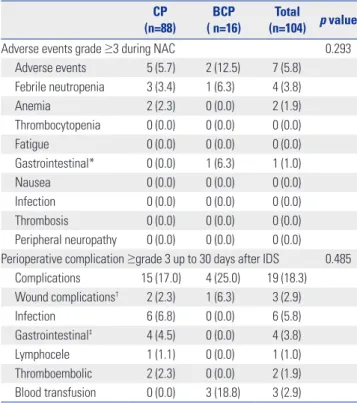
The median number of NAC cycles was three. The frequencies of grade ≥3 adverse events during NAC and perioperative complications within 30 days after IDS are summarized in Ta-ble 2. All patients underwent IDS after NAC. Among 104 pa-tients, 7 (5.8%) experienced major adverse events during NAC. Of these, febrile neutropenia and anemia were the most fre-quent in both groups. One case of gastrointestinal perforation occurred in the BCP group, but this result was not significant. None of the patients developed grade ≥4 adverse events.
Regarding perioperative complications after IDS, none of the patients developed grade ≥4 adverse events, and the com-plications are summarized in Table 2. Nineteen (18.3%) pa-tients experienced perioperative complications within 30 days after IDS. Among these complications, blood transfusion was the most common in the BCP group (18.8%); however, this was not statistically significant. In addition, none of the patients developed bleeding complications, thromboembolic compli-cations, fistulas/abscesses, or perforations in the BCP group.
Response to NAC and surgical treatment
The responses following NAC are summarized in Table 3. In terms of pathological response, omental chemotherapy response scores (CRSs) were reported for 97 of 104 patients (93.3%). The two groups had comparable omental CRS: a score of 3 was ob-served in 4 patients (25.0%) in the BCP group and 22 patients (27.2%) in the CP group (p=0.736). There were no significant differences in the normalization of serum CA-125 and HE4 lev-els after NAC between the two groups (p=0.899 and p=0.453, respectively).
After NAC treatment, all patients underwent IDS. The re-sults of IDS are shown in Table 4. Regarding types of IDS, most patients (n=76, 86.5%) underwent open surgery (86.4% vs. 87.5% of the CP and BCP groups, respectively, p=1.000). Com-plete resection rates after IDS (R0 state) were not significantly different between the two groups (47.7% vs. 56.3%, respectively,
p=0.530).
At the time of analysis, 13 patients (11.2%, excluding 4 pa-tients lost in follow up) died, and 54 (45.0%) experienced
re-Table 2. Adverse Events During NAC and Perioperative Complications after IDS CP (n=88) BCP ( n=16) Total (n=104) p value
Adverse events grade ≥3 during NAC 0.293
Adverse events 5 (5.7) 2 (12.5) 7 (5.8) Febrile neutropenia 3 (3.4) 1 (6.3) 4 (3.8) Anemia 2 (2.3) 0 (0.0) 2 (1.9) Thrombocytopenia 0 (0.0) 0 (0.0) 0 (0.0) Fatigue 0 (0.0) 0 (0.0) 0 (0.0) Gastrointestinal* 0 (0.0) 1 (6.3) 1 (1.0) Nausea 0 (0.0) 0 (0.0) 0 (0.0) Infection 0 (0.0) 0 (0.0) 0 (0.0) Thrombosis 0 (0.0) 0 (0.0) 0 (0.0) Peripheral neuropathy 0 (0.0) 0 (0.0) 0 (0.0) Perioperative complication ≥grade 3 up to 30 days after IDS 0.485
Complications 15 (17.0) 4 (25.0) 19 (18.3) Wound complications† 2 (2.3) 1 (6.3) 3 (2.9) Infection 6 (6.8) 0 (0.0) 6 (5.8) Gastrointestinal‡ 4 (4.5) 0 (0.0) 4 (3.8) Lymphocele 1 (1.1) 0 (0.0) 1 (1.0) Thromboembolic 2 (2.3) 0 (0.0) 2 (1.9) Blood transfusion 0 (0.0) 3 (18.8) 3 (2.9)
CP, carboplatin+paclitaxel; BCP, bevacizumab+carboplatin+paclitaxel; NAC, neoadjuvant chemotherapy; IDS, interval debulking surgery.
Values are presented as n (%).
*Colonic perforation, †Wound dehiscence, ‡Ileus (3), small bowel obstruc-tion (1).
Table 3. Responses to NAC Evaluated by Blood Tests, Image Studies, Debulking Status, and CRS
CP (n=88) (n=16)BCP (n=104)Total valuep CRS 0.736 1 3 (3.7) 1 (6.3) 4 (4.1) 2 56 (69.1) 11 (68.8) 67 (69.1) 3 22 (27.2) 4 (25.0) 26 (26.8) Not available* 7� 0� 7� Response to NAC 0.929 CR 0 (0.0) 0 (0.0) 0 (0.0) PR 83 (94.3) 15 (93.8) 98 (94.2) SD 5 (5.7) 1 (6.3) 6 (5.8) PD 0 (0.0) 0 (0.0) 0 (0.0)
CA-125 after NAC,
U/mL (range) 281.06± 1663.09 136.77± 194.79 258.86± 1531.17 0.248
CA-125 normalization after NAC 0.899
Normal 37 (42.0) 7 (43.8) 44 (42.3)
Abnormal 51 (58.0) 9 (56.3) 60 (57.7) HE4 after NAC†,
pmol/L 121.31±125.19 133.15±84.43 124.69±114.29 0.140
HE4 normalization after NAC† 0.453
Normal 14 (40.0) 4 (28.6) 18 (36.7)
Abnormal 21 (60.0) 10 (71.4) 31 (63.6)
NAC, neoadjuvant chemotherapy; CP, carboplatin+paclitaxel; BCP, bevacizum ab+carboplatin+paclitaxel; CRS, Chemotherapy Response Score; CR, complete remission; PR, partial remission; SD, stable disease; PD, progressive disease; CA-125, cancer antigen 125; HE4, human epididymis protein 4.
Values are presented as mean±standard deviation or n (%) unless otherwise noticed.
*The CRS of 39 patients were not measured after NAC. Missing values are excluded from the calculation of percentages, †The HE4 levels of 39 patients were not measured after NAC. Missing values are excluded from the calcu-lation of percentages.
currence. The relative frequency of patients with recurrence was significantly lower in the BCP group than in the CP group (18.8% vs. 49.0%, respectively; p=0.023). PFS and OS were ana-lyzed using Kaplan-Meier curves and log-rank tests; the BCP group had longer PFS than the CP group (hazard ratio=0.32, 95% confidence interval 0.22–0.99; log-rank p=0.048) (Fig. 2A). However, owing to the small sample size and short follow-up period, there was no significant difference in OS between the two groups (hazard ratio=0.82, 95% confidence interval 0.12– 5.8; log-rank p=0.854) (Fig. 2B).
DISCUSSION
In this study, we investigated the feasibility, safety, and effec-tiveness of bevacizumab-containing NAC followed by IDS for advanced epithelial ovarian cancer. Our results indicated that bevacizumab could be feasibly and safely added to NAC-IDS regimens for advanced ovarian cancer. Despite other trials that incorporated bevacizumab in NAC, including the AN-THALYA and GEICO 1250 trials, at a standard dose of 15 mg/ kg, our institution was limited to using a half dose of bevaci-zumab (7.5 mg/kg), owing to regulations from the Korean na-tional health system. Although the number of patients treated with bevacizumab in this study was small and the follow-up period was short, we observed improved PFS in patients who received bevacizumab-containing NAC-IDS with safety end-points comparable to those in patients who received conven-tional NAC. The current study showed that, at least, bevacizum-ab-containing NAC-IDS could be safely applied in real practice and could show effects similar to those observed in the ICON-7 and GOG-0218 trials.
After five phase III randomized clinical trials on combina-tion therapy including bevacizumab and chemotherapy for ovarian cancer,5,6,16-18 the United States Food and Drug
Admin-istration (US FDA) has approved bevacizumab for all lines of ovarian cancer management. Based on results from the
AU-RELIA, OSEAN, and GOG-213 trials,16-18 the US FDA approved
bevacizumab-combined chemotherapy for recurrent ovarian cancer,16 and after the ICON-7 and GOG-218 trials,5,6
bevaci-zumab was approved for naïve primary ovarian cancer. Stan-dard chemotherapy with bevacizumab in patients with newly diagnosed ovarian cancer did not result in improvements in OS;19 however, improved PFS was reported by both the ICON-7
and GOG-218 trials.
For patients with advanced ovarian cancer and with a high perioperative risk or a low likelihood of achieving optimal cy-toreduction, NAC-IDS strategies are alternative treatment op-tions. After the ICON-7 and GOG-218 trials, studies were con-ducted on the incorporation of bevacizumab in NAC-IDS. A subgroup analysis of the MITO-16A-MaNGO OV2A phase IV trial showed that adding bevacizumab to NAC did not impede Table 4. Surgical Details and Results of IDS Evaluated by Blood Tests
and Complete Resection Rates CP (n=88) (n=16)BCP (n=104)Total p value IDS type 1.000 Open 76 (86.4) 14 (87.5) 90 (86.5) Laparoscopy 12 (11.5) 2 (12.5) 14 (11.7) Residual disease 0.530 None (R0) 42 (47.7) 9 (56.3) 51 (49.0) Any residual 46 (52.3) 7 (43.7) 53 (51.0)
Interval from IDS to POAC, days 0.002
Median (range) 16 (7–37) 21.5 (10–50) 17 (7–50)
IDS, interval debulking surgery; CP, carboplatin+paclitaxel; BCP, bevacizumab +carboplatin+paclitaxel; POAC, postoperative adjuvant chemotherapy. Values are presented as n (%) unless otherwise noticed.
1.0 0.8 0.6 0.4 0.2 0.0 1.0 0.8 0.6 0.4 0.2 0.0 0 5 10 15 20 25 30 35 40 0 5 10 15 20 25 30 35 40 Follow-up time (months)
OS
Follow-up time (months) CP BCP CP BCP p=0.854 PFS probability OS probability A B CP (n=88) BCP (n=16) PFS events, n (%) 48 (55) 3 (19) Hazard ratio Log-rank p=0.0480.32 (0.22–0.99) PFS rate, %
6-month 97 100 1-year 68 100 2-year 35 50
Fig. 2. Kaplan-Meier curves of progression-free survival (PFS) (A) and overall survival (OS) (B) in patients treated with standard carboplatin-pa-clitaxel chemotherapy (CP, n=88) and bevacizumab-containing chemo-therapy (BCP, n=16) regimens.
IDS and resulted in a similar rate of perioperative complica-tions, compared to conventional NAC-IDS.20 The ANTHALYA
trial, a French multicenter non-comparative randomized phase II study, showed that bevacizumab could be safely added to preoperative NAC and lead to higher complete resection rates after IDS. More recently, the GEICO 1250 trial, a randomized phase II trial on bevacizumab-containing NAC, demonstrated that bevacizumab did not improve complete macroscopic re-sponse rates or PFS, but did improve surgical operability with-out increased toxicity.21 The current study showed that
beva-cizumab improved PFS, but did not show any improvement in OS. Because the follow-up period was short, more data matu-rity period will be needed. As for safety, the current study had one case of colonic perforation during NAC in BCP group. Af-ter emergency operation for colonic perforation, the patient re-covered and then received IDS and the rest of the adjuvant che-motherapy. According to a multicenter, observational study in a real-world clinical study to evaluate the effectiveness of beva-cizumab treatment based on AURELIA (KGOG 3041; REBE-CA), grade ≥3 gastrointestinal perforation occurred only in 1.3% of the safety analysis population.22 In addition, although
REBECA study was for recurrent ovarian cancer, grade ≥3 ad-verse events were acceptable in light of real-world experience. Accordingly, we suggest that bevacizumab can generally be safely added to preoperative NAC, although careful use will be required due to the potential for serious complications, such as bowel perforation.
The limitations of current study are that it was retrospective and dependent on medical records in addition to being based in a single institution. Therefore, the sample size was relatively small, and the follow-up period was not sufficiently long to calculate OS.
In conclusion, bevacizumab-containing NAC might be safe and provide longer PFS than chemotherapy alone in patients with advanced ovarian cancer. However, further study is neces-sary to investigate the impact of bevacizumab-containing NAC on OS.
ACKNOWLEDGEMENTS
This study was supported by a faculty research grant of Yonsei University College of Medicine (6-2018-0169).
AUTHOR CONTRIBUTIONS
Conceptualization: Jung-Yun Lee. Data curation: Junsik Park. Formal
analysis: Junsik Park. Funding acquisition: Jung-Yun Lee.
Investiga-tion: Junsik Park. Methodology: Junsik Park and Jung-Yun Lee. Project
administration: Jung-Yun Lee. Resources: Kyung Jin Eoh, Eun Ji Nam,
Sunghoon Kim, Sang Wun Kim, Young Tae Kim, and Jung-Yun Lee.
Software: Junsik Park. Supervision: Sunghoon Kim. Validation: Young
Tae Kim. Visualization: Junsik Park. Writing—original draft: Junsik Park. Writing—review & editing: Jung-Yun Lee. Approval of final
manuscript: all authors.
ORCID iDs
Junsik Park https://orcid.org/0000-0003-4094-2097 Kyung Jin Eoh https://orcid.org/0000-0002-1684-2267 Eun Ji Nam https://orcid.org/0000-0003-0189-3560 Sunghoon Kim https://orcid.org/0000-0002-1645-7473 Sang Wun Kim https://orcid.org/0000-0002-8342-8701 Young Tae Kim https://orcid.org/0000-0002-7347-1052 Jung-Yun Lee https://orcid.org/0000-0001-7948-1350
REFERENCES
1. Vergote I, Tropé CG, Amant F, Kristensen GB, Ehlen T, Johnson N, et al. Neoadjuvant chemotherapy or primary surgery in stage IIIC or IV ovarian cancer. N Engl J Med 2010;363:943-53.
2. Kehoe S, Hook J, Nankivell M, Jayson GC, Kitchener H, Lopes T, et al. Primary chemotherapy versus primary surgery for newly diag-nosed advanced ovarian cancer (CHORUS): an open-label, ran-domised, controlled, non-inferiority trial. Lancet 2015;386:249-57. 3. Onda T, Satoh T, Saito T, Kasamatsu T, Nakanishi T, Nakamura K,
et al. Comparison of treatment invasiveness between upfront de-bulking surgery versus interval dede-bulking surgery following neo-adjuvant chemotherapy for stage III/IV ovarian, tubal, and peri-toneal cancers in a phase III randomised trial: Japan Clinical Oncology Group Study JCOG0602. Eur J Cancer 2016;64:22-31. 4. Wright AA, Bohlke K, Armstrong DK, Bookman MA, Cliby WA,
Coleman RL, et al. Neoadjuvant chemotherapy for newly diag-nosed, advanced ovarian cancer: Society of Gynecologic Oncolo-gy and American Society of Clinical OncoloOncolo-gy Clinical Practice Guideline. Gynecol Oncol 2016;143:3-15.
5. Perren TJ, Swart AM, Pfisterer J, Ledermann JA, Pujade-Lauraine E, Kristensen G, et al. A phase 3 trial of bevacizumab in ovarian cancer. N Engl J Med 2011;365:2484-96.
6. Burger RA, Brady MF, Bookman MA, Fleming GF, Monk BJ, Huang H, et al. Incorporation of bevacizumab in the primary treatment of ovarian cancer. N Engl J Med 2011;365:2473-83.
7. Rouzier R, Gouy S, Selle F, Lambaudie E, Floquet A, Fourchotte V, et al. Efficacy and safety of bevacizumab-containing neoadjuvant therapy followed by interval debulking surgery in advanced ovari-an covari-ancer: results from the ANTHALYA trial. Eur J Covari-ancer 2017; 70:133-42.
8. Lee YJ, Lee JY, Cho MS, Nam EJ, Kim SW, Kim S, et al. Incorpora-tion of paclitaxel-based hyperthermic intraperitoneal chemo-therapy in patients with advanced-stage ovarian cancer treated with neoadjuvant chemotherapy followed by interval debulking surgery: a protocol-based pilot study. J Gynecol Oncol 2019;30:e3. 9. Fagotti A, Vizzielli G, Fanfani F, Costantini B, Ferrandina G, Gal-lotta V, et al. Introduction of staging laparoscopy in the manage-ment of advanced epithelial ovarian, tubal and peritoneal cancer: impact on prognosis in a single institution experience. Gynecol Oncol 2013;131:341-6.
10. Fagotti A, Ferrandina G, Fanfani F, Garganese G, Vizzielli G, Carone V, et al. Prospective validation of a laparoscopic predictive model for optimal cytoreduction in advanced ovarian carcinoma. Am J Obstet Gynecol 2008;199:642.e1-6.
11. Chi DS, Eisenhauer EL, Zivanovic O, Sonoda Y, Abu-Rustum NR, Levine DA, et al. Improved progression-free and overall survival in advanced ovarian cancer as a result of a change in surgical para-digm. Gynecol Oncol 2009;114:26-31.
12. Wimberger P, Lehmann N, Kimmig R, Burges A, Meier W, Du Bois A, Arbeitsgemeinschaft Gynaekologische Onkologie Ovarian Can-cer Study Group. Prognostic factors for complete debulking in
ad-vanced ovarian cancer and its impact on survival. An exploratory analysis of a prospectively randomized phase III study of the Arbe-itsgemeinschaft Gynaekologische Onkologie Ovarian Cancer Study Group (AGO-OVAR). Gynecol Oncol 2007;106:69-74. 13. Eisenhauer EL, Abu-Rustum NR, Sonoda Y, Levine DA, Poynor
EA, Aghajanian C, et al. The addition of extensive upper abdomi-nal surgery to achieve optimal cytoreduction improves survival in patients with stages IIIC-IV epithelial ovarian cancer. Gynecol On-col 2006;103:1083-90.
14. Strong VE, Selby LV, Sovel M, Disa JJ, Hoskins W, Dematteo R, et al. Development and assessment of Memorial Sloan Kettering Cancer Center’s Surgical Secondary Events grading system. Ann Surg Oncol 2015;22:1061-7.
15. Chi DS, Franklin CC, Levine DA, Akselrod F, Sabbatini P, Jarnagin WR, et al. Improved optimal cytoreduction rates for stages IIIC and IV epithelial ovarian, fallopian tube, and primary peritoneal cancer: a change in surgical approach. Gynecol Oncol 2004;94: 650-4.
16. Coleman RL, Brady MF, Herzog TJ, Sabbatini P, Armstrong DK, Walker JL, et al. Bevacizumab and paclitaxel-carboplatin chemo-therapy and secondary cytoreduction in recurrent, platinum-sen-sitive ovarian cancer (NRG Oncology/Gynecologic Oncology Group study GOG-0213): a multicentre, open-label, randomised, phase 3 trial. Lancet Oncol 2017;18:779-91.
17. Aghajanian C, Blank SV, Goff BA, Judson PL, Teneriello MG, Hu-sain A, et al. OCEANS: a randomized, double-blind, placebo-con-trolled phase III trial of chemotherapy with or without
bevacizum-ab in patients with platinum-sensitive recurrent epithelial ovarian, primary peritoneal, or fallopian tube cancer. J Clin Oncol 2012;30: 2039-45.
18. Pujade-Lauraine E, Hilpert F, Weber B, Reuss A, Poveda A, Kris-tensen G, et al. Bevacizumab combined with chemotherapy for platinum-resistant recurrent ovarian cancer: the AURELIA open-label randomized phase III trial. J Clin Oncol 2014;32:1302-8. 19. Oza AM, Cook AD, Pfisterer J, Embleton A, Ledermann JA,
Pujade-Lauraine E, et al. Standard chemotherapy with or without bevaci-zumab for women with newly diagnosed ovarian cancer (ICON7): overall survival results of a phase 3 randomised trial. Lancet Oncol 2015;16:928-36.
20. Daniele G, Lorusso D, Scambia G, Cecere SC, Nicoletto MO, Breda E, et al. Feasibility and outcome of interval debulking surgery (IDS) after carboplatin-paclitaxel-bevacizumab (CPB): a subgroup anal-ysis of the MITO-16A-MaNGO OV2A phase 4 trial. Gynecol Oncol 2017;144:256-9.
21. Garcia Garcia Y, de Juan Ferré A, Mendiola C, Barretina-Ginesta MP, Gaba Garcia L, Santaballa Bertrán A, et al. Efficacy and safety results from GEICO 1205, a randomized phase II trial of neoadju-vant chemotherapy with or without bevacizumab for advanced epithelial ovarian cancer. Int J Gynecol Cancer 2019;29:1050-6. 22. Lee JY, Park JY, Park SY, Lee JW, Kim JW, Kim YB, et al. Real-world
effectiveness of bevacizumab based on AURELIA in platinum-re-sistant recurrent ovarian cancer (REBECA): a Korean Gynecologic Oncology Group study (KGOG 3041). Gynecol Oncol 2019;152: 61-7.