INTRODUCTION
A considerable number of psychiatric disorders in adults begin to develop in childhood or adolescence [1]. That is, behavioral and emotional problems in the preschool period persist until subsequent periods [2]. A study that followed children aged 9–13 years until 16 years confirmed the conti-nuity of psychiatric disorders [3]. Neurodevelopmental dis-orders, such as autism spectrum disorder (ASD) or atten-tion-deficit/hyperactivity disorder (ADHD) may also begin in childhood and persist throughout life, further highlight-ing the need for a survey on the prevalence of psychiatric disorders in children, including preschoolers, and adoles-cents [4].
The Zürich Epidemiological Study of Child and Adoles-cent Psychopathology (ZESCAP), which was conducted on 1,964 individuals aged 7–16 years, reported a 6-month
men-tal disorder prevalence of 22.5% based on parent report or self-report form such as the Child Behavior Checklist and Youth Self-Report [5]. The British Child and Adolescent Mental Health Survey examined the prevalence of mental disorders in 10,438 individuals aged 5–15 years using the Development and Well-Being Assessment and reported a prevalence rate of 9.5% [6]. In a study on 1,251 individuals aged 7–14 years in Brazil, the prevalence of mental disorders was 12.7% [7]. As shown here, despite the growing volume of epidemiological study findings on children, the results differ substantially by methodology and target population, and data reflective of the actual clinical setting is limited.
Korea runs a national health insurance system, and care costs claimed by healthcare facilities are reviewed by the Health Insurance Review & Assessment Service (HIRA). Ap-proximately 97% of the entire population are enrolled in the National Health Insurance (NHI), and the remaining 2–3% of the population are beneficiaries of medical aid, whose healthcare costs are paid by the government [8]. The NHI Claims Data (NHICD) is an integration of the data that has This is an Open Access article distributed under the terms of the Creative Commons
Attribution Non-Commercial License (https://creativecommons.org/licenses/by-nc/4.0) which permits unrestricted non-commercial use, distribution, and reproduction in any medium, provided the original work is properly cited.
Patterns of the Diagnosis Prevalence of Psychiatric
Disorders in the Population Aged 0–18 Years Based
on the Nationwide Insurance Sample Data
Seung Yup Lee1 and Geon Ho Bahn2
1Happy Medical Clinic, Osan, Korea
2Department of Psychiatry, Kyung Hee University School of Medicine, Seoul, Korea
Objectives: This study aimed to examine the trend in diagnostic prevalence of psychiatric disorders in children and adolescents.
Methods: Individuals aged 0–18 years were included in the study based on the National Health Insurance Claims Data. To investigate
the trends in diagnosis and diagnostic prevalence of psychiatric disorders reflecting the decrease in the birth rate, data were analyzed from 2010 as a reference year to 2015.
Results: The number of patients diagnosed with psychiatric disorder decreased annually, from 23,412 on 2010 to 18,821 on 2015. The
most common disorder was hyperkinetic disorder in male and depressive episode in female. Although there was no significant change in overall diagnostic prevalence rate of psychiatric disorders, age groups <10 years and some disorders had significant changes in preva-lence rate. This study classified the diagnostic prevapreva-lence by age into two unique patterns: group in which the diagnosis rate increases with age and group in which the diagnosis rate peaks at a certain age and then decreases.
Conclusion: Diagnostic prevalence of psychiatric disorders was different according to age and sex. These patterns should be reflected
in the formulation of policies related to mental health and in medical practice for pediatric patients. It is urgent to identify how these patterns change in young adults.
Key Words: Psychiatric disorder; Diagnosis prevalence; Adolescents; Childhood; Pattern; Trend.
Received: April 13, 2020 / Revision: June 26, 2020 / Accepted: July 7, 2020
Address for correspondence: Geon Ho Bahn, Department of Psychiatry, Kyung Hee University School of Medicine, 23 Kyungheedae-ro, Dongdaemoon-gu, Seoul 02447, Korea
Tel: +82-2-858-8556, Fax: +82-2-957-1997, E-mail: [email protected]
J Korean Acad Child Adolesc Psychiatry 2020;31(4):214-224 https://doi.org/10.5765/jkacap.200017
been reviewed by the HIRA and contains information about patient’s general characteristics, diagnosis, history of care, and features of healthcare facility, with 99% of the data com-puterized [8]. Therefore, the NHICD is a nationally represen-tative data that feature good objectivity and efficiency.
In the present study, the pediatric patient sample data were obtained from the NHICD for analysis to select com-mon psychiatric disorders in the population aged <19 years and examine the trend in the change of diagnostic preva-lence and sex- and age-specific differences to complement for the limitations of existing studies on the prevalence of psychiatric disorders in children and adolescents.
METHODS
Study population
The study population is the HIRA pediatric patient sample (HIRA-PPS) for 6 years from 2010 to 2015. The sample size for the HIRA-PPS consisted of 10% of the entire pediatric popula-tion, which was 1,047,802 in 2010 and 932,657 in 2015, with an annual average of 989,016 (Supplementary Table 1 in the on-line-only Data Supplement). Based on the authors’ experience of the previous analysis of 2010 NHICD [9], the present study was set from 2010. As the Korean Standard Classification of Diseases (KCD) [10] underwent a seventh revision in 2016, the study period was set to 2010–2015. The KCD is based on the International Classification of Diseases [11].
The HIRA-PPS consists of statistically sampled, deidenti-fied data from the NHICD and contains information on the claims for cares made for a period of one year from the date of care initiation. The data were established via patient-unit stratified hierarchical sampling according to sex and age groups of all patients who utilized healthcare service during the 1-year period and contained information about the de-tails of their care and prescriptions [8]. These data are pro-vided upon submission of a data request form available on the HIRA website along with a written promise regarding the use of the data and a small fee. However, as the HIRA-PPS data is extracted from the insurance claims by year, it is not appropriate for longitudinal studies that follow-up on a group of patients over several years [8].
From individuals who received outpatient or inpatient care from a primary, secondary, or tertiary mental health-care service institutions, those aged <19 years who had been assigned F codes from F00 to F99 for psychiatric disorder in the KCD [10] were extracted for analysis. To enhance the di-agnostic accuracy, patients diagnosed with a psychiatric dis-order exclusively by psychiatrists were included in the analy-sis. As previous studies that utilized the NHICD [9,12] set their study population to those aged <19 years, the study
population was also set to those aged <19 years to enable comparison with the authors’ previous studies. Both the main diagnosis and subdiagnosis were included, and the di-agnoses were classified by the KCD [10].
Methods
To compare with the authors’ previous studies that uti-lized the NHICD [9,12], the study population was divided into 3-year units to analyze the prevalence of F code by year, age, and sex. The year 2010, which is the first year of data for the study population, was set as the reference point to compare yearly trends. This study was approved by the In-stitutional Review Board of Kyunghee University Hospital (KMC IRB 2017-07-029).
Statistical analysis
The changes in the prevalence of psychiatric disorders from 2010 to 2015 by age, sex, and insurance type were ex-amined based on the rate of increase or decrease in the an-nual average and significance of the trends using a trend test. The prevalence rate was converted to a percentage of the F code diagnosed by psychiatrists per 1,000 population includ-ed in each group as designatinclud-ed by Statistics Korea.
In addition, for F codes with a prevalence rate of ≥1%, yearly changes in their prevalence by sex were analyzed us-ing a trend test.
The data were analyzed using the SAS 9.4 software (SAS Institute Inc., Cary, NC, USA), R 3.5.1 (https://cran.r-proj-ect.org), and yearly and sex-specific diagnostic prevalence rates were graphed using “gridExtra,” “ggplot2,” “plyr,” and “gtools” packages. The trend test was performed by apply-ing the “lm” package. The statistical significance was set at 0.05 for all analyses.
RESULTS
Of patients aged <19 years who received outpatient or in-patient care in psychiatric healthcare institutions as shown in the HIRA-PPS data, an annual average of 22,150 patients, with 23,412 in 2010 and 18,821 in 2015, were diagnosed with psychiatric disorders (F00–99) (Supplementary Table 2 in the online-only Data Supplement).
There were 14 psychiatric disorders with a diagnostic prevalence of ≥1% in the study population, written in the or-der of the following codes: bipolar affective disoror-der (F31); depressive episode (F32); other anxiety disorders (F41); reac-tion to stress and adjustment disorders (F43); somatoform disorders (F45); other neurotic disorders (F48); mental retar-dation, mild (F70); specific developmental disorders of speech and language (F80); pervasive developmental
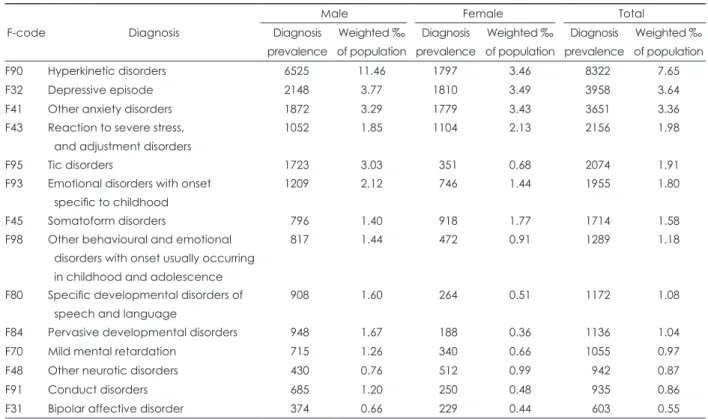
disor-der (F84); hyperkinetic disordisor-ders (F90); conduct disordisor-ders (F91); emotional disorders with onset specific to childhood (F93); tic disorders (F95); and other behavioral and emotion-al disorders with onset usuemotion-ally occurring in childhood and adolescence (F98) (Supplementary Table 3 in the online-only Data Supplement). In the reference year of 2010, the highest diagnostic prevalence for the entire subjects including both sexes was observed in F90, followed by F32, F41, F43, and F95 (Table 1). The diagnostic prevalence distribution dif-fered between the two sexes, with the most common diagno-sis being F90, followed by F32, F41, F95, and F93, in male but F32, followed by F90, F41, F43, and F45, in female.
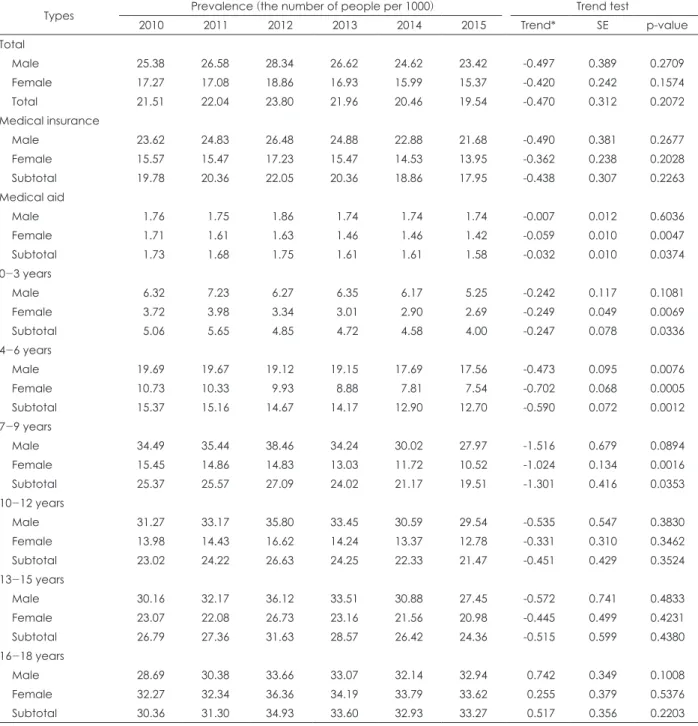
While the number of individuals diagnosed with a psychi-atric disorder declined over the years, the percentage of diag-nosis in the entire population did not change statistically sig-nificantly (Table 2). However, this rate was on a significant decline only in the female medical aid beneficiary group. By age, there was a significant declining trend in the ≤9 years group (Table 2). Regarding changes in the annual diagnostic rates, there was a significant increasing trend for codes F31, F32, F41, F80, F84, and F95 in both male and female (Table 3). In male, there was a significant increasing trend also for code F91, but the diagnostic rate for F48 and F98 significantly de-creased. In female, the diagnostic rate for F93 and F98 signifi-cantly decreased. When compared between sexes, the increas-ing trend for F31 and F84 was stronger in male than in female.
By age group, there was a fixed, unique pattern for each psychiatric disorder (Figs. 1 and 2). Two different patterns were detected: 1) the diagnosis rate increases with age for F31, F32, F41, F43, F45, and F48 in both sexes; 2) the diag-nosis rate peaks at a certain age and then decreases, which in turn can be subdivided into three subgroups: 2-1) peaks at 4–6 years and decreases rapidly for F80, F84, and F98; 2-2) peaks at 7–9 years and decreases for F70, F90, F93, and F95; and 2-3) peaks at 13–15 years for F91. Exception-ally, for F98, the diagnosis rate peaks at 4–6 years or 7–9 years in male.
DISCUSSION
The results of this study showed that there were no signif-icant changes in the diagnostic prevalence for psychiatric disorders. Particularly, the diagnostic prevalence of hyper-activity disorder did not change significantly. This is con-tradictory to the argument that the diagnosis of ADHD is sharply increasing annually and that medications are mis-used and abmis-used in children [13]. This is also in contrast with the result of a study on the long-term incidence rate of ADHD that the number of diagnoses is continuously in-creasing [14]. In this study, the authors observed that the di-agnosis rate has significantly decreased in the ≤9 years group annually. In fact, the ADHD diagnostic rate or drug
Table 1. High ranked psychiatric disorders as standard of diagnosis prevalence in the year 2010
F-code Diagnosis
Male Female Total Diagnosis prevalence Weighted ‰ of population Diagnosis prevalence Weighted ‰ of population Diagnosis prevalence Weighted ‰ of population F90 Hyperkinetic disorders 6525 11.46 1797 3.46 8322 7.65 F32 Depressive episode 2148 3.77 1810 3.49 3958 3.64 F41 Other anxiety disorders 1872 3.29 1779 3.43 3651 3.36 F43 Reaction to severe stress,
and adjustment disorders
1052 1.85 1104 2.13 2156 1.98 F95 Tic disorders 1723 3.03 351 0.68 2074 1.91 F93 Emotional disorders with onset
specific to childhood
1209 2.12 746 1.44 1955 1.80 F45 Somatoform disorders 796 1.40 918 1.77 1714 1.58 F98 Other behavioural and emotional
disorders with onset usually occurring in childhood and adolescence
817 1.44 472 0.91 1289 1.18
F80 Specific developmental disorders of speech and language
908 1.60 264 0.51 1172 1.08 F84 Pervasive developmental disorders 948 1.67 188 0.36 1136 1.04 F70 Mild mental retardation 715 1.26 340 0.66 1055 0.97 F48 Other neurotic disorders 430 0.76 512 0.99 942 0.87 F91 Conduct disorders 685 1.20 250 0.48 935 0.86 F31 Bipolar affective disorder 374 0.66 229 0.44 603 0.55
therapy rate in Korea is markedly lower than the anticipated prevalence [15], so a multilateral analysis is needed for the low number of diagnosis and therapeutic exposure. Certain pediatric neurodevelopmental disorders, such as ASD and ADHD, show early onset, which highlights the pressing need to analyze the structural problem underlying the ab-sence of change in the diagnostic rate, as a delay of early di-agnosis raises concerns for exacerbation of symptoms and secondary complications [16].
In this study, the diagnosis of bipolar affective disorder, depressive episode, other anxiety disorders, specific mental disorders of speech and language, pervasive develop-mental disorder, and tic disorder increased over the years in both male and female. While the increase in the diagnostic rate of bipolar affective disorder may be reflective of an actu-al increase in the diagnosis, it may actu-also be associated with the change in the insurance payout criteria pertaining to the prescription of psychotropics used for ADHD or ASD [8,16].
Table 2. Trend analysis of psychiatric diagnosis prevalence according to age and years during 2010-2015
Types Prevalence (the number of people per 1000) Trend test
2010 2011 2012 2013 2014 2015 Trend* SE p-value Total Male 25.38 26.58 28.34 26.62 24.62 23.42 -0.497 0.389 0.2709 Female 17.27 17.08 18.86 16.93 15.99 15.37 -0.420 0.242 0.1574 Total 21.51 22.04 23.80 21.96 20.46 19.54 -0.470 0.312 0.2072 Medical insurance Male 23.62 24.83 26.48 24.88 22.88 21.68 -0.490 0.381 0.2677 Female 15.57 15.47 17.23 15.47 14.53 13.95 -0.362 0.238 0.2028 Subtotal 19.78 20.36 22.05 20.36 18.86 17.95 -0.438 0.307 0.2263 Medical aid Male 1.76 1.75 1.86 1.74 1.74 1.74 -0.007 0.012 0.6036 Female 1.71 1.61 1.63 1.46 1.46 1.42 -0.059 0.010 0.0047 Subtotal 1.73 1.68 1.75 1.61 1.61 1.58 -0.032 0.010 0.0374 0-3 years Male 6.32 7.23 6.27 6.35 6.17 5.25 -0.242 0.117 0.1081 Female 3.72 3.98 3.34 3.01 2.90 2.69 -0.249 0.049 0.0069 Subtotal 5.06 5.65 4.85 4.72 4.58 4.00 -0.247 0.078 0.0336 4-6 years Male 19.69 19.67 19.12 19.15 17.69 17.56 -0.473 0.095 0.0076 Female 10.73 10.33 9.93 8.88 7.81 7.54 -0.702 0.068 0.0005 Subtotal 15.37 15.16 14.67 14.17 12.90 12.70 -0.590 0.072 0.0012 7-9 years Male 34.49 35.44 38.46 34.24 30.02 27.97 -1.516 0.679 0.0894 Female 15.45 14.86 14.83 13.03 11.72 10.52 -1.024 0.134 0.0016 Subtotal 25.37 25.57 27.09 24.02 21.17 19.51 -1.301 0.416 0.0353 10-12 years Male 31.27 33.17 35.80 33.45 30.59 29.54 -0.535 0.547 0.3830 Female 13.98 14.43 16.62 14.24 13.37 12.78 -0.331 0.310 0.3462 Subtotal 23.02 24.22 26.63 24.25 22.33 21.47 -0.451 0.429 0.3524 13-15 years Male 30.16 32.17 36.12 33.51 30.88 27.45 -0.572 0.741 0.4833 Female 23.07 22.08 26.73 23.16 21.56 20.98 -0.445 0.499 0.4231 Subtotal 26.79 27.36 31.63 28.57 26.42 24.36 -0.515 0.599 0.4380 16-18 years Male 28.69 30.38 33.66 33.07 32.14 32.94 0.742 0.349 0.1008 Female 32.27 32.34 36.36 34.19 33.79 33.62 0.255 0.379 0.5376 Subtotal 30.36 31.30 34.93 33.60 32.93 33.27 0.517 0.356 0.2203 *annual average growth rate. SE: standard error
Table 3.
Trend analysis of prevalence rate for each psychiatric diagnosis under 19 years old
F-code
Male prevalence
(the number of people per 1000
)
Female prevalence
(the number of people per 1000
) 2010 2011 2012 2013 2014 2015 Trend* SE p-value 2010 2011 2012 2013 2014 2015 Trend* SE p-value F31 0.66 0.81 1.30 1.36 1.62 1.75 0.23 0.02 0.0007 0.44 0.51 0.90 0.90 0.89 1.09 0.12 0.03 0.0094 F32 3.77 3.82 4.94 4.79 4.23 4.53 0.14 0.11 0.2792 3.49 3.48 4.74 4.17 3.95 3.95 0.09 0.12 0.4840 F41 3.29 3.88 4.99 4.92 4.42 4.25 0.18 0.15 0.2834 3.43 3.61 4.48 4.42 4.16 4.23 0.16 0.08 0.1337 F43 1.85 1.96 2.17 1.72 1.78 1.51 -0.08 0.05 0.1675 2.13 2.05 2.36 1.93 1.95 1.62 -0.09 0.05 0.1151 F45 1.40 1.29 1.35 1.44 1.20 1.07 -0.05 0.03 0.1152 1.77 1.73 1.85 1.76 1.62 1.60 -0.04 0.02 0.1216 F48 0.76 0.81 0.77 0.72 0.68 0.61 -0.03 0.01 0.0235 0.99 1.00 1.06 0.97 1.00 0.82 -0.03 0.02 0.1966 F70 1.26 1.33 1.44 1.24 1.11 1.26 -0.03 0.03 0.3946 0.66 0.69 0.69 0.61 0.62 0.57 -0.02 0.01 0.0632 F80 1.60 1.74 1.78 1.98 1.92 1.91 0.07 0.02 0.0292 0.51 0.56 0.56 0.64 0.64 0.67 0.03 0.01 0.0036 F84 1.67 1.93 1.99 2.10 2.21 2.35 0.13 0.01 0.0006 0.36 0.43 0.43 0.51 0.51 0.57 0.04 0.00 0.0007 F90 11.46 12.28 13.45 12.33 11.15 10.63 -0.25 0.24 0.3597 3.46 3.59 4.04 3.56 3.29 3.29 -0.06 0.07 0.3979 F91 1.20 1.26 1.64 1.55 1.44 1.49 0.05 0.04 0.2039 0.48 0.42 0.57 0.48 0.46 0.47 0.00 0.01 0.9557 F93 2.12 2.57 2.70 2.34 1.99 1.86 -0.10 0.07 0.2526 1.44 1.52 1.64 1.27 1.05 1.02 -0.11 0.04 0.0469 F95 3.03 3.13 3.71 3.59 3.57 3.19 0.06 0.07 0.4725 0.68 0.77 0.83 0.81 0.79 0.84 0.02 0.01 0.0804 F98 1.44 1.57 1.66 1.46 1.31 1.14 -0.07 0.03 0.1139 0.91 0.90 0.95 0.79 0.68 0.65 -0.06 0.02 0.0169 Other 7.67 7.78 8.47 7.94 7.37 7.58 -0.06 0.10 0.5479 5.61 5.38 6.20 5.57 5.57 5.48 -0.02 0.08 0.8041
*annual average growth
rate.
SE
: standard error.
F-codes; F31
=bipolar affective disorder, F32 =depressive episode, F41 =other
anxiety disorders, F43
=reaction
to severe stress, and
adjustment di sorders, F45 = somatoform disorders, F48 =
other neurotic disorders, F7
0= mil d mental retardation, F80 = specific devel opmental disorders of speech and language, F84
=pervasive developmental disorders, F90 =hyperkinetic disorders, F91 =conduct disorders, F93 =emotional disorders with onset specific to childhood, F95 =tic disorders, F98 =other
The analysis of Korea’s NHICD from 2008 to 2015 showed that the annual diagnostic rate of ASD increased from 5.04 (per 100,000 individuals) to 10.97 [16]. In the US National Health Interview Survey, the prevalence of ASD increased
from 1.1% in 2009 to 2.5% in 2017 [4]. The reasons for the in-creasing ASD diagnostic rate may include the broader diag-nostic criteria for ASD than pervasive developmental disor-der, increased awareness of the disease among experts and
Fig. 1. Characteristics in the diagnosis prevalence of psychiatric disorders in males according to age during 2010-2015. *Age;
g1=0-3 years old, g2=4-6 years old, g3=7-9 years old, g4=10-12 years old, g5=13-15 years old, g6=16-18 years old. F-codes; F31=bipolar affective disorder, F32=depressive episode, F41=other anxiety disorders, F43=reaction to severe stress, and adjustment disorders, F45=somatoform disorders, F48=other neurotic disorders, F70=mild mental retardation, F80=specific developmental disor-ders of speech and language, F84=pervasive developmental disordisor-ders, F90=hyperkinetic disordisor-ders, F91=conduct disordisor-ders, F93=emotional disorders with onset specific to childhood, F95=tic disorders, F98=other behavioural and emotional disorders with on-set usually occurring in childhood and adolescence.
3 2 1 0 10′ 11′ 12′ 13′ 14′ 15′ F31 F32 F41 F43 F45 F48 F80 F84 F98 F70 F90 F93 F95 F91 3 2 1 0 2.0 1.5 1.0 0.5 0.0 2.0 1.5 1.0 0.5 0.0 20 10 0 6 4 2 0 6 4 2 0 3 2 1 0 6 4 2 0 4 3 2 1 0 4 3 2 1 0 3 2 1 0 10.0 7.5 5.0 2.5 0.0 7.5 5.0 2.5 0.0 g1 g2 g3 g4 g5 g6 g1 g2 g3 g4 g5 g6 g1 g2 g3 g4 g5 g6 g1 g2 g3 g4 g5 g6 Age* g1 g2 g3 g4 g5 g6 g1 g2 g3 g4 g5 g6
Fig. 2. Characteristics in the diagnosis prevalence of psychiatric disorders in females according to age during 2010-2015. *Age; g1=0-3 years old, g2=4-6 years old, g3=7-9 years old, g4=10-12 years old, g5=13-15 years old, g6=16-18 years old. F-codes; F31=bipolar affective disorder, F32=depressive episode, F41=other anxiety disorders, F43=reaction to severe stress, and adjustment disorders, F45=somatoform disorders, F48=other neurotic disorders, F70=mild mental retardation, F80=specific developmental disor-ders of speech and language, F84=pervasive developmental disordisor-ders, F90=hyperkinetic disordisor-ders, F91=conduct disordisor-ders, F93=emotional disorders with onset specific to childhood, F95=tic disorders, F98=other behavioural and emotional disorders with on-set usually occurring in childhood and adolescence.
parents, and increased development of early intervention services for these children [4]. In Korea, the reason for the increase in the prevalence of specific developmental disor-ders of speech and language may be attributable to the
vouchers for families of children with disability [17]. Thus, this may be due to the launching of vouchers for develop-mental rehabilitation service in February 2009 and vouchers for speech-language therapy service in August 2010 [17].
Be-3 2 1 0 10′ 11′ 12′ 13′ 14′ 15′ F31 F32 F41 F43 F45 F48 F80 F84 F98 F70 F90 F93 F95 F91 5 4 3 2 1 0 3 2 1 0 2.0 1.5 1.0 0.5 0.0 2.0 1.5 1.0 0.5 0.0 1.5 1.0 0.5 0.0 1.0 0.5 0.0 1.00 0.75 0.50 0.25 0.00 1.00 0.75 0.50 0.25 0.00 6 4 2 0 3 2 1 0 4 3 2 1 0 12.5 10.0 7.5 5.0 2.5 0.0 12.5 10.0 7.5 5.0 2.5 0.0 g1 g2 g3 g4 g5 g6 g1 g2 g3 g4 g5 g6 g1 g2 g3 g4 g5 g6 g1 g2 g3 g4 g5 g6 Age* g1 g2 g3 g4 g5 g6 g1 g2 g3 g4 g5 g6
cause people consider the diagnosis of a mental disorder as a stigma, there are cases in which parents seek treatment un-der the code as R62, delayed milestone, and R47, speech dis-turbance not elsewhere classified, which increases the possi-bility that the actual prevalence of specific developmental disorders of speech and language and pervasive develop-mental disorder may be higher [17].
A 2005 Korean pediatric prevalence report for psychiatric disorders [18] showed the order of prevalence as ADHD, tic disorders, and anxiety disorders, but a recent study reported that other anxiety disorders and depressive episodes had the highest diagnostic rate in late adolescence and early female adulthood [19]. In a study on the prevalence of pediatric mental disorders in Taiwan, which runs a national health insurance system similar to that of Korea, the lifetime prev-alence was the highest for anxiety disorder at 15.2%, fol-lowed by ADHD, sleep disorder, and tic disorder [20]. In the present study, the increasing trends of bipolar affective dis-order and pervasive developmental disdis-order were stronger in male than in female. While the result for pervasive devel-opmental disorder is similar to that observed in previous studies, the result that the increasing trend in bipolar affec-tive disorder was stronger in male than in female differs from the findings of a community-based study, where most trends were consistent between male and female [3]. As pre-viously mentioned, this may be related to the increasing use of psychotropics prescribed to patients with ASD as a result of an increase in the diagnostic rate of ASD [9].
The authors identified a characteristic pattern in the dis-tribution of diagnostic prevalence by age. There were two patterns: 1) continuous increase in diagnostic rate with age and 2) peaks at a certain age and decrease. First, the diagno-sis rate increases continually with advancing age in bipolar affective disorder (F31), depressive episode (F32), other anxi-ety disorders (F41), reaction to stress and adjustment disor-der (F43), and somatoform disordisor-ders (F45). In the present study, depressive episode increases with increasing age re-gardless of sex, particularly after the age of 13 years. In the Quebec Child Mental Health Survey (QCMHS) conducted on children and adolescents aged 6–14 years, depressive dis-order was more prevalent in younger children than in ado-lescents in male and was about 6.6 times more prevalent in female adolescents compared to male adolescents [21]. Simi-lar to our findings, a Korean study that assessed depressive symptoms in 2,203 individuals observed that depressive symptoms increased in the high school period compared to the middle school period [22].
In this study, other anxiety disorders were more common among female and increased with increasing age in both sexes. It was more common in female than in male and those
aged 6–8 years than those aged 12–14 years from QCMHS [21]. However, unlike the present study, the said study in-cluded separation anxiety disorder and simple phobia, which do not fall under other anxiety disorders (code F41). A fol-low-up of children aged 9–13 years until the age of 16 years revealed that the prevalence of depressive disorder and social phobia increased among female adolescents [3]. The preva-lence of anxiety disorder among preschool children aged 2–5 years was <1%, with 0.5% for separation anxiety disorder and 0.6% for simple phobia [23]. The lower prevalence in this group compared to older children may be due to the diffi-culty of identifying internalizing symptoms in young child-hood.
The prevalence of specific developmental disorders of speech and language (F80), pervasive developmental disor-der (F84), and other behavioral and emotional disordisor-ders with onset usually occurring in childhood and adolescence (F98) peaks in 4–6 years group, after which it continues to decline. Following early diagnosis, patients with these disor-ders are likely to receive intervention under the diagnosis of different mental problems with R or Z codes or due to coex-istent symptoms after the age of 6 years [17]. This is because when patients with ASD are prescribed medications due to behavioral problems during growth, such as self-mutilation, impulsivity, and aggression, the diagnosis of psychoticism-related disorders must be provided in place of ASD due to the current health insurance regulations [9]. The reason for the decline in the prevalence after 4–6 years may be that the chief discomfort from specific developmental disorders of speech and language shifts from language to problems in so-cial functioning and soso-cial relationships in adulthood [1]. As rehabilitation service utilization among children aged <19 years with disabilities is increasing annually from 56.0% in 2011 to 62.5% in 2014 and 69.4% in 2017 in Korea, it is possi-ble that this pediatric patient population may receive service from paramedical specialists, which is not covered by na-tional health insurance, once they pass the preschool period [17]. The reason for the decrease in the diagnostic rate of other behavioral and emotional disorders with onset usually occurring in childhood and adolescence with advancing age may be attributable to possible improvement of problems in young childhood in later ages, possibility that the patient did not seek medical care even with persistent problems, and possibility that the patient was rediagnosed with another psychiatric disorder later in life as the problems became clearer [12].
The prevalence rate for mental retardation (F70), hyper-activity disorder (F90), emotional disorder with onset spe-cific to childhood (F93), and tic disorder (F95) spikes in a certain age group and then declines. Mental retardation
in-creases with advancing age until reaching a plateau, after which it begins to decline. A meta-analysis of the prevalence of mental retardation reported that mental retardation be-comes less prevalent among adults compared to children and adolescents, because, even though children and adoles-cents had been burdened with school, adults have left school and thus show a decline in academic pressure and preva-lence of mental retardation [24]. Although this might be a result reflecting the loss of the need to diagnose mental re-tardation, as patients with mild mental retardation show mild improvements in adaptive functions through early di-agnosis and intervention, it may also be a result of discon-tinuation of treatment following diagnosis [12]. In the pres-ent study, the diagnostic rate of hyperactivity disorder sharply increases at the age of 7–9 years and then begins to decline slowly. A study that observed changes from elemen-tary school period to adolescence reported that the preva-lence of ADHD, separation anxiety disorder, enuresis, en-copresis, and tic disorder had a downturn from the age of 12 years [3]. A study that investigated diagnostic rates in the period between ages 3 and 6 years found that the 3-month prevalence of ADHD significantly increased from 2.4% among children aged 3 years to 5.4% among children aged 6 years [25]. As the period of school entry is marked by esca-lated social and academic needs and needs for behavioral control, symptoms are more clearly identified.
Lastly, conduct disorder (F91) in childhood is known to have an adverse effect on the development of internalization symptoms in adulthood [26]; however, it might not fit well in the clinical practice. It also differs culturally and by country. The diagnostic rate of conduct disorder in this study steeply increased at the age of 13–15 years and de-clined afterward. In the previous studies that analyzed HI-RA-NPS of the year 2011, the diagnostic rates of F91 were 1.9% among the 0–18-year-old population [12] and dropped to 0.09% among the 19–30-year-old population [19]. Esti-mates of point prevalence rate of conduct disorder from 5–15 years in the UK [6] and from youths aged 11–17 years in the USA [27] were 1.47% and 3.32%, respectively. Inter-estingly, the diagnostic prevalence of conduct disorder abruptly increased from 1.25% in the 11–12-year-old popu-lation to 3.31% in the 13–15-year-old popupopu-lation in the UK study [6]. The 12-month first incidence rate of conduct dis-order was 1.88% in a community study with youths aged 11–17 years [28]. While oppositional defiant disorder and conduct disorder are the most common disruptive disorders in adolescence, accompanied by substance use disorder, such as alcohol or marijuana abuse/dependence [27], the lifetime prevalence of substance abuse/dependence in Korea is as low as 0.25% [29].
These patterns do not reflect the actual prevalence rates. Some disorders exhibit a repeated cycle of improvement and exacerbation, such as tic disorder, but the reason for the changes in the diagnostic rate of neurodevelopmental disor-ders that persist for a prolonged period, such as ASD and ADHD, may be that the symptoms of coexisting mental disorders are the major treatment targets in patients with these disorders as an underlying disorder. Based on such age-specific diagnostic distribution patterns for pediatric mental disorders, relevant experts should understand that the currently manifested symptoms are simply phenotypes and that patients may have a persistent underlying illness [30]. Large-scale longitudinal studies are urgently needed to shed light on the changes of diagnosis in the same group of patients as they age.
This study has a few limitations. First, the limitations of the NHICD should be considered. Patients who received health-care under R and Z codes as opposed to F code, patients who received treatment with non-reimbursement, patients who received treatment with paramedical specialists, and patients prescribed non-reimbursed medications are excluded from the NHICD. There is also limited information about the spe-cific diagnostic instruments or methods used. Second, per the Personal Information Protection Act, information about patients’ socioeconomic factors, such as income and educa-tion, and health-related factors, such as smoking and drink-ing, are not provided to researchers. Subsequent studies should obtain socioeconomic factors with cooperation from government agencies and include them in their analysis. Third, this is a cross-sectional study, not a longitudinal study, so long-term follow-up of patients was not possible. Thus, an-alyzing the trends of changes in diagnoses of an individual through long-term follow-up cohort studies would enable a more detailed design of intervention services.
Despite these limitations, this study has the following sig-nificance: as this study only analyzed data on diagnoses made by psychiatrists from the HIRA data, it reflects the incidence rate of mental disorders among the population aged <19 years in the clinical setting in Korea.
CONCLUSION
In the analysis of the annual trends in the diagnostic prevalence of mental disorders in the population aged <19 years, there were no significant changes in the overall diag-nostic prevalence rate, but there were some significant changes by sex, age, and psychiatric disorder. The most common diagnoses were hyperactivity disorder in male and depressive episode in female. The prevalence of bipolar af-fective disorder, depressive episode, specific developmental
disorders of speech and language, pervasive developmental disorder, and tic disorders significantly increased. Four pat-terns of change were observed in the diagnostic prevalence rates according to age: fortissimo-pianissimo type, crescen-do type, accelerancrescen-do-piano type, and forte-decrescencrescen-do type. Follow-up studies are needed to examine how the age-specific patterns for each disorder continue onto early adulthood.
Supplementary Materials
The online-only Data Supplement is available with this ar-ticle at https://doi.org/10.5765/jkacap.200017.
Acknowledgments
This work was supported by the Korea Mental Health R & D Proj-ect, Republic of Korea (No. HM15C1084), and by the Korea Health Technology R&D Project, Ministry of Health & Welfare, Republic of Korea (No. HI12C0021/A120029).
The contents including tables and figures in this article are part of Seung Yup Lee’s PhD’s thesis submitted to the Kyung Hee University School of Medicine in February 2019.
Conflicts of Interest
The authors have no potential conflicts of interest to disclose.
Author Contributions
Conceptualization: Geon Ho Bahn. Data curation: Seung Yup Lee. Investigation: Geon Ho Bahn, Seung Yup Lee. Methodology: Geon Ho Bahn. Writing statistics: Seung Yup Lee. Writing—original draft: Seung Yup Lee. Writing—review and editing: Geon Ho Bahn.
ORCID iDs
Geon Ho Bahn https://orcid.org/0000-0002-3550-0422 Seung Yup Lee https://orcid.org/0000-0003-4120-5603
REFERENCES
1) Rutter M, Kim-Cohen J, Maughan B. Continuities and disconti-nuities in psychopathology between childhood and adult life. J Child Psychol Psychiatry 2006;47:276-295.
2) Mesman J, Bongers IL, Koot HM. Preschool developmental path-ways to preadolescent internalizing and externalizing problems. J Child Psychol Psychiatry 2001;42:679-689.
3) Costello EJ, Mustillo S, Erkanli A, Keeler G, Angold A. Prevalence and development of psychiatric disorders in childhood and ado-lescence. Arch Gen Psychiatry 2003;60:837-844.
4) Zablotsky B, Black LI, Maenner MJ, Schieve LA, Danielson ML,
Bitsko RH, et al. Prevalence and trends of developmental
disabili-ties among children in the United States: 2009-2017. Pediatrics 2019;144:e20190811.
5) Steinhausen HC, Metzke CW, Meier M, Kannenberg R. Preva-lence of child and adolescent psychiatric disorders: the Zürich Ep-idemiological Study. Acta Psychiatr Scand 1998;98:262-271. 6) Ford T, Goodman R, Meltzer H. The British Child and Adolescent
Mental Health Survey 1999: the prevalence of DSM-IV disorders. J Am Acad Child Adolesc Psychiatry 2003;42:1203-1211. 7) Fleitlich-Bilyk B, Goodman R. Prevalence of child and adolescent
psychiatric disorders in southeast Brazil. J Am Acad Child Ado-lesc Psychiatry 2004;43:727-734.
8) Kim JA, Yoon S, Kim LY, Kim DS. Towards Actualizing the Value Potential of Korea Health Insurance Review and Assessment (HIRA) data as a resource for health research: strengths,
limita-tions, applicalimita-tions, and strategies for optimal use of HIRA data. J Korean Med Sci 2017;32:718-728.
9) Hong M, Lee SY, Han J, Park JC, Lee YJ, Hwangbo R, et al. Pre-scription trends of psychotropics in children and adolescents with autism based on nationwide health insurance data. J Korean Med Sci 2017;32:1687-1693.
10) Statistics Korea. Korean Standard Classification of Diseases [cited 2020 March 1]. Available from URL: http://kssc.kostat.go.kr/kssc-New_web/index.jsp#.
11) World Health Organization. The ICD-10 classification of mental and behavioural disorders: clinical descriptions and diagnostic guidelines. Geneva: World Health Organization;1992.
12) Hwangbo R, Chang H, Hong M, Cho S, Bahn GH. The diagnostic distribution of psychiatric disorders among the population under 19 years old: based on the national insurance data. J Korean Acad Child Adolesc Psychiatry 2016;27:139-145.
13) Singh I. Stimulants: not just naughty, 50 years of stimulant drug advertising. In: Tone A, Watkins ES, editors. Medicating modern America: prescription drugs in history. New York, NY: New York University Press;2007. p.131-155.
14) Huang CL, Wang JJ, Ho CH. Trends in incidence rates of diag-nosed attention-deficit/hyperactivity disorder (ADHD) over 12 years in Taiwan: a nationwide population-based study. Psychiatry Res 2020;284:112792.
15) Hong M, Kim B, Hwang JW, Bhang SY, Choi HY, Oh IH, et al. Naturalistic pharmacotherapy compliance among pediatric pa-tients with attention deficit/hyperactivity disorder: a study based on three-year nationwide data. J Korean Med Sci 2016;31:611-616. 16) Hong M, Lee SM, Park S, Yoon SJ, Kim YE, Oh IH. Prevalence and economic burden of autism spectrum disorder in South Korea using national health insurance data from 2008 to 2015. J Autism Dev Disord 2020;50:333-339.
17) Kim J, Kim T, Lee J, Jung K. A study on use status and subsidy appropriateness of developmental rehabilitation service in speech-language therapy for disabled children: parental survey. Commun Sci Disord 2018;23:1127-1145.
18) Yoo HI, Cho SC, Kim BN, Kim SY, Shin MS, Hong KE. Psychiat-ric morbidity of second and third grade primary school children in Korea. Child Psychiatry Hum Dev 2005;36:215-225.
19) Hwangbo R, Chang H, Bahn GH. Diagnostic distribution of psy-chiatric disorders among Korean young adults. J Korean Acad Child Adolesc Psychiatry 2020;31:80-87.
20) Chen YL, Chen WJ, Lin KC, Shen LJ, Gau SS. Prevalence of DSM-5 mental disorders in a nationally representative sample of chil-dren in Taiwan: methodology and main findings. Epidemiol Psy-chiatr Sci 2019;29:e15.
21) Breton JJ, Bergeron L, Valla JP, Berthiaume C, Gaudet N,
Lam-bert J, et al. Quebec Child Mental Health Survey: prevalence of
DSM-III-R mental health disorders. J Child Psychol Psychiatry 1999;40:375-384.
22) Cho SJ, Jeon HJ, Kim MJ, Kim JK, Kim US, Lyoo IK, et al. Preva-lence and correlates of depressive symptoms among the adoles-cents in an urban area in Korea. J Korean Neuropsychiatr Assoc 2001;40:627-639.
23) Lavigne JV, Lebailly SA, Hopkins J, Gouze KR, Binns HJ. The prevalence of ADHD, ODD, depression, and anxiety in a commu-nity sample of 4-year-olds. J Clin Child Adolesc Psychol 2009;38:315-328.
24) Maulik PK, Mascarenhas MN, Mathers CD, Dua T, Saxena S. Prevalence of intellectual disability: a meta-analysis of popula-tion-based studies. Res Dev Disabil 2011;32:419-436.
25) Bufferd SJ, Dougherty LR, Carlson GA, Rose S, Klein DN. Psychi-atric disorders in preschoolers: continuity from ages 3 to 6. Am J Psychiatry 2012;169:1157-1164.
26) Lichtenstein P, Cederlöf M, Lundström S, D’Onofrio BM,
prob-lems in childhood and adverse outcomes in emerging adulthood: a longitudinal Swedish nationwide twin cohort. J Child Psychol Psychiatry 2020;61:798-806.
27) Roberts RE, Roberts CR, Xing Y. Rates of DSM-IV psychiatric disorders among adolescents in a large metropolitan area. J Psy-chiatr Res 2007;41:959-967.
28) Roberts RE, Roberts CR, Chan W. One-year incidence of psychi-atric disorders and associated risk factors among adolescents in the community. J Child Psychol Psychiatry 2009;50:405-415.
29) Cho MJ, Hahm BJ, Kim JK, Park KK, Chung EK, Suh TW, et al. Korean Epidemiologic Catchment Area (KECA) study for psychi-atric disorders: prevalence of specific psychipsychi-atric disorders. J Ko-rean Neuropsychiatr Assoc 2004;43:470-480.
30) Bahn GH, Lee YJ, Han JH. Descriptive psychiatry and the devel-opment of diagnostic criteria in the history of child psychiatry and phenomenological descriptive psychiatry. J Korean Acad Child Adolesc Psychiatry 2015;26:1-11.