Influence of the CYP3A5 and MDR1 genetic
polymorphisms on the pharmacokinetics of tacrolimus
in healthy Korean subjects
Ji H. Choi, Yoon J. Lee, Seong B. Jang, Jong-Eun Lee,1Kyung H. Kim & Kyungsoo Park
Department of Pharmacology, Yonsei University College of Medicine and1DNA Link Inc., Seodaemun-Gu, Seoul, Korea
OnlineOpen: This article is available free online at www.blackwell-synergy.com
What is already known about this subject
• It was found that the genetic polymorphisms of CYP3A5, CYP3A4and MDR1 could affect the pharmacokinetics of tacrolimus.
• This study was conducted to find such a possibility in the Korean population.
What this study adds
• CYP3A5 polymorphisms are likely to be associated with altered pharmacokinetics of tacrolimus in Koreans. • MDR1 polymorphisms have no important role in the
pharmacokinetics of tacrolimus.
Correspondence
Kyungsoo Park MD, PhD,
Department of Pharmacology, Yonsei University College of Medicine, 134 Shinchon-dong, Seodaemun-gu, Seoul 120–752, Korea. Tel.: + 82 2 2228 1735 Fax: + 82 2313 1894 E-mail: [email protected] ...
J.H.C. and Y.J.L. contributed equally to this work. ... Keywords CYP3A5, MDR1, pharmacokinetics, polymorphism, tacrolimus ... Received 2 October 2006 Accepted 17 January 2007 Published OnlineEarly 28 March 2007 Aims
To determine the frequencies of the genotypes of CYP3A5 and MDR1 and to examine the influence of the polymorphisms of these genes on tacrolimus pharmacokinetics in the Korean population.
Methods
Twenty-nine healthy Koreans who participated in the previous tacrolimus pharmacokinetic study were genotyped for CYP3A4*1B, CYP3A5*3, MDR1 c.1236C→T, MDR1 c.2677G→A/T and MDR1 c.3435C→T. The relationship between the genotypes so obtained and tacrolimus pharmacokinetics observed in the previous study was examined.
Results
No subject in this study had the CYP3A4*1B variant. The observed frequencies of CYP3A5*1/*1, *1/*3, and *3/*3 were 0.069 [confidence interval (CI) -0.023, 0.161], 0.483 (CI 0.301, 0.665) and 0.448 (CI 0.267, 0.629), respectively. AUC0–• for the
CYP3A5*1/*1 or *1/*3 genotype was 131.5⫾ 44.8 ng h ml-1 (CI 109.6, 153.5), which was much lower compared with the CYP3A5*3/*3 genotype of 323.8⫾ 129.3 ng h ml-1 (CI 253.5, 394.1) (P = 2.063E-07). Similarly, C
max for the
CYP3A5*1/*1 or *1/*3 genotype was 11.8⫾ 3.4 ng ml-1(CI 10.1, 13.5), which was also much lower compared with the CYP3A5*3/*3 genotype of 24.4⫾ 12.3 ng ml-1 (CI 17.8, 31.1) (P = 0.0001). However, there was no significant difference in tacrolimus pharmacokinetics among the MDR1 diplotypes of CGC-CGC, CGC-TTT, CGC-TGC, TTT-TGC or TTT-TTT (P = 0.2486).
Conclusions
This study shows that the CYP3A5*3 genetic polymorphisms may be associated with the individual difference in tacrolimus pharmacokinetics. An individualized dosage regimen design incorporating such genetic information would help increase clinical efficacy of the drug while reducing adverse drug reactions.
Introduction
Tacrolimus, one of the calcineurin inhibitors, is highly effective in preventing acute rejection after transplanta-tion of solid organs, including the liver and kidney [1]. However, tacrolimus shows high between- and within-subject variability in pharmacokinetics, with a narrow therapeutic index, necessitating therapeutic drug moni-toring to optimize treatment [2–4].
It has become clear that the variability in the pharma-cokinetics of tacrolimus is largely determined by differ-ences in oral bioavailability [5]. Tacrolimus is a substrate of P-glycoprotein, the product of the multidrug resistance (MDR1) gene and has been known to undergo extensive hepatic metabolism by cytochrome P450 3A4 (CYP3A4) and CYP3A5 [6–8]. The variability in oral bioavailability of tacrolimus thus has been attributed to individual differences in expression of CYP3A4, CYP3A5 and P-glycoprotein [9].
A limited number of studies have reported on the association between CYP3A4 variants and the pharma-cokinetics of tacrolimus. Hesselink et al. found that CYP3A4*1B carriers require larger dose of tacrolimus to reach target trough concentrations compared with CYP3A4*1 homozygotes [5]. In their work, it was estab-lished that the dose requirement for tacrolimus could be affected by CYP3A5 variants. Several studies have reported that the dose-adjusted trough concentration of tacrolimus is much higher in CYP3A5*3/ *3 subjects than in *1/ *1 or *1/ *3 subjects [10–15]. The CYP3A5*3 variant creates an alternative splice in pre-mRNA and produces aberrant mRNA that does not translate into functional CYP3A5 protein [16]. In contrast, numerous studies have investigated whether the genetic polymor-phisms in MDR1, including c.1236C→T, c.2677G→ A/T and c.3435C→T, could affect the pharmacokinetics of tacrolimus, yielding controversial results [9].
In a previous pharmacokinetic study, we compared the pharmacokinetics of twice-daily dosing of 1-mg tac-rolimus capsules of two different formulations in healthy Korean volunteers: Prograf (Astellas Pharma Korea, Inc.), the reference, or conventional formulation, and TacroBell® (Chong Kun Dang Pharmaceutical Corp., Korea), the test, or newly developed formulation. While no significant difference in formulation was observed, we found high interindividual variability [51–76%, coefficient of variation (CV)] in the pharma-cokinetics of tacrolimus and suspected a possible genetic polymorphism as a source of pharmacokinetic variation [17]. In this regard, this study was intended to see if such a possibility existed in the Korean popula-tion. Subjects who had participated in the previous tac-rolimus pharmacokinetic study were therefore first
examined for the frequencies of CYP3A4*1B, CYP3A5*3 and three single nucleotide polymorphisms (SNPs) of MDR1, c.1236C→T, c.2677G→A/T and c.3435C→ T, and then for an association between the resulting genotypes and tacrolimus pharmacokinetics obtained in the previous study.
Materials and methods
Subjects
This study was approved by the institutional review board of Yonsei University Medical Centre, Seoul, Korea. A total of 29 unrelated healthy Korean volunteers participated in this study after giving written informed consent. They were recruited from the volunteers who had participated in the previous pharmacokinetic study of two oral formulations of tacrolimus [17].
Genetic analysis
We investigated the genotype frequencies of CYP3A4*1B (GenBank accession number AC069294), CYP3A5*3 (GenBank accession number AC005020) and three SNPs of MDR1, c.1236C→T, c.2677G→A/T
and c.3435C→T (GenBank accession numbers
NC000007, NM000927) for the subjects by direct se-quencing using an automated genetic analyser (Model 3700; Applied Biosystems, Foster City, CA, USA). The nomenclature of CYP3A4 and CYP3A5 was based on the website http://www.cypalleles.ki.se/. For each subject, one blood sample was collected and DNA was extracted using a purification kit (Qiagen, Hilden, Germany). Hap-lotype assembly was performed using the Haploview 3.2 program (Broad Institute of Harvard and MIT, Cam-bridge, MA, USA), based on a standard expectation-maximization algorithm to reconstruct individual haplotypes from population genotype data [18].
Pharmacokinetic data
For pharmacokinetic data, we used data obtained from the previous pharmacokinetic study, which can be sum-marized as follows [17]. It was as an open-label, ran-domized, two-period, cross-over study with a 3-week wash-out period in 29 healthy Korean volunteers. Each subject received two 1-mg capsules of a conventional (reference) or a newly developed (test) oral tacrolimus formulation twice a day, morning and evening (total daily dose of 4 mg). Blood samples were collected before dosing and at 0.5, 1, 1.5, 2, 3, 4, 7, 12, 12.5, 13, 13.5, 14, 15, 16, 19, 24, 36, 48, 72 and 96 h after dosing. Whole blood concentrations were analysed by LC/MS/ MS. Pharmacokinetic parameters such as area under the concentration curve from time zero to infinity (AUC0–•),
half-life (t1/2) for tacrolimus were estimated by noncom-partmental analysis using WinNonlin Professional 4.1. In results, the two formulations were not significantly different and showed similarly large interindividual variation in tacrolimus pharmacokinetics [59.3–61.1% (test) and 50.7–75.6% (reference) in CV]. Therefore, in this study, without loss of generality, only the conven-tional formulation’s pharmacokinetic data were used in examining genetic influences on tacrolimus pharmaco-kinetics.
Statistical analysis
Differences in pharmacokinetic parameters between the genotype groups were tested using the Wilcoxon rank sum test or the Kruskal–Wallis test. The frequency of CYP3A5*3/*3 genotype was compared with that of the other ethnic groups, usingc2test. P-values< 0.05 were considered to be statistically significant.
Results
Polymorphisms ofCYP3A5 and MDR1 in Koreans
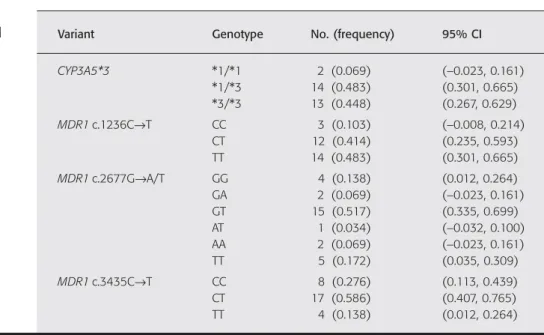
Table 1 shows frequency distributions of CYP3A5 and MDR1 genotypes in 29 Korean subjects examined in this study. Each genotype did not deviate from Hardy– Weinberg equilibrium. Among the CYP3A4*1B, CYP3A5*3 and MDR1 genotypes examined in our study, the CYP3A4*1B genotype was not observed in any subject and the CYP3A5*1/ *1 genotype was observed in only two subjects, yielding a frequency of 0.069 [confi-dence interval (CI)-0.023, 0.161), with CI indicating a 95% CI. In contrast, for the CYP3A5*3 variant, the het-erozygous allele was observed in 14 subjects with a
frequency of 0.483 (CI 0.301, 0.665), while the homozy-gous allele was observed in 13 subjects with a frequency of 0.448 (CI 0.267, 0.629). The frequency of CYP3A5*3/*3 observed with our subjects was similar to that of 0.400 (CI 0.268, 0.532) with Chinese
(P= 0.5313) or 0.583 (CI 0.512, 0.654) with Japanese
(P= 0.1737) [19, 20]. However, some significant
differ-ences were also found in the frequency of this genotype. That is, the frequency of CYP3A5*3/*3 genotype was higher in Koreans compared with the frequency of 0.029
(CI-0.027, 0.085) in African-Americans (P = 0.0001),
but was much lower compared with the frequency of 0.830 (CI 0.756, 0.904) in Whites (P= 0.0001) [21, 22]. These results suggest that the frequency of CYP3A5*3/ *3 genotype is dependent on ethnicity.
The MDR1 haplotypes were estimated from the three MDR1 genotypes at c.1236C→T, c.2677G→A/T and c.3435C→T using a standard expectation-maximization algorithm (Table 2). Three major haplotypes that were relatively commonly observed were TTT, CGC and TGC, accounting for 41.4%, 20.7% and 20.7% of the total haplotype diversity, respectively. The combinations of these three predominant haplotypes constituted the five diplotypes examined in this study, CGC-CGC (3.4%, n= 1), CGC-TTT (17.2%, n = 5), CGC-TGC (10.3%, n= 3), TTT-TGC (31.0%, n = 9) and TTT-TTT (10.3%, n= 3) (Table 3).
Pharmacokinetic parameters of tacrolimus
In this study, pharmacokinetic values were given as
mean⫾ SD with 95% CI. Table 4 shows that AUC0–•for
the subject with the CYP3A5*1/ *1 or *1/ *3 genotype
Table 1
Genotype frequencies for CYP3A5 and
MDR1in healthy Koreans (n = 29)
Variant Genotype No. (frequency) 95% CI
CYP3A5*3 *1/*1 2 (0.069) (-0.023, 0.161) *1/*3 14 (0.483) (0.301, 0.665) *3/*3 13 (0.448) (0.267, 0.629) MDR1c.1236C→T CC 3 (0.103) (-0.008, 0.214) CT 12 (0.414) (0.235, 0.593) TT 14 (0.483) (0.301, 0.665) MDR1c.2677G→A/T GG 4 (0.138) (0.012, 0.264) GA 2 (0.069) (-0.023, 0.161) GT 15 (0.517) (0.335, 0.699) AT 1 (0.034) (-0.032, 0.100) AA 2 (0.069) (-0.023, 0.161) TT 5 (0.172) (0.035, 0.309) MDR1c.3435C→T CC 8 (0.276) (0.113, 0.439) CT 17 (0.586) (0.407, 0.765) TT 4 (0.138) (0.012, 0.264)
was 131.5⫾ 44.8 ng h ml-1 (CI 109.6, 153.5), which was much lower compared with the CYP3A5*3/ *3 genotype of 323.8⫾ 129.3 ng h ml-1 (CI 253.5, 394.1)
(P= 2.063E-07). Table 4 also shows that Cmax for the
subject with the CYP3A5*1/*1 or *1/ *3 genotype was
11.8⫾ 3.4 ng ml-1(CI 10.1, 13.5), which was also much
lower compared with the CYP3A5*3/ *3 genotype of
24.4⫾ 12.3 ng ml-1 (CI 17.8, 31.1) (P= 0.0001). The
Table 2
Haplotype frequencies of
MDR1c.1236C→T, c.2677G→A/T, c.3435C→T in healthy Koreans (n = 29) Haplotype c.1236C,T c.2677G,A/T c.3435C,T Frequency (95% CI)
TTT T T T 0.414 (0.287, 0.541) CGC C G C 0.207 (0.103, 0.311) TGC T G C 0.207 (0.103, 0.311) CAC C A C 0.069 (0.004, 0.134) TAC T A C 0.034 (-0.013, 0.081) TTC T T C 0.034 (-0.013, 0.081) CGT C G T 0.017 (-0.016, 0.050) Table 3
Tacrolimus pharmacokinetic parameters against major MDR1 genotypes in healthy Koreans (n = 21) Diplotype (no.) AUC0–• (ng h ml-1) Cmax (ng ml-1) tmax (h) t1/2 (h) CGC-CGC 565.7 30.9 2.0 31.2 (1) CGC-TTT 138.1⫾ 38.9 11.7⫾ 3.5 1.2⫾ 0.3 23.3⫾ 12.6 (5) (104.0, 172.2) (8.6, 14.8) (1.0, 1.4) (12.3, 34.4) CGC-TGC 233.0⫾ 106.0 18.3⫾ 4.4 1.7⫾ 0.3 23.4⫾ 3.1 (3) (113.1, 353.0) (13.3, 23.3) (1.3, 2.0) (19.9, 26.9) TTT-TGC 250.9⫾ 157.8 19.0⫾ 13.4 1.6⫾ 0.9 31.6⫾ 12.0 (9) (147.9, 354.0) (10.3, 27.7) (1.0, 2.2) (23.8, 39.4) TTT-TTT 200.3⫾ 69.2 16.3⫾ 5.6 1.3⫾ 0.3 33.9⫾ 11.4 (3) (122.0, 278.6) (9.9, 22.6) (1.0, 1.7) (21.0, 46.9) P-value* 0.2486 0.3926 0.4733 0.4609
Values are given as mean ⫾ SD. Values in parentheses represent the 95%
confidence interval.*Kruskal–Wallis test.
Table 4
Tacrolimus pharmacokinetic parameters
vs. CYP3A5genotypes in healthy Koreans
(n = 29) Genotype AUC0–• (ng h ml-1) Cmax (ng ml-1) tmax (h) t1/2 (h) CYP3A5 131.5⫾ 44.8 11.8⫾ 3.4 1.4⫾ 0.7 23.9⫾ 11.9 *1/*1or *1/*3 (109.6, 153.5) (10.1, 13.5) (1.1, 1.7) (18.0, 29.7) CYP3A5 323.8⫾ 129.3 24.4⫾ 12.3 1.6⫾ 0.4 30.6⫾ 8.7 *3/*3 (253.5, 394.1) (17.8, 31.1) (1.4, 1.8) (25.9, 35.3) P-value* 2.0630E-07 0.0001 0.1160 0.1103
Values are given as mean ⫾ SD. Values in parentheses represent the 95%
values of tmaxand t1/2were similar between the two geno-type groups (P= 0.1160, 0.1103, respectively). The genotype differences in AUC0–•and Cmaxof tacrolimus
are visually depicted in Figure 1.
There was no significant difference in pharmacokinet-ics of tacrolimus among the five MDR1 diplotype groups
(P= 0.2486) (Table 3).
Discussion
In the present study, we observed a significant association between the blood concentration of tacrolimus and the CYP3A5*3 variant. Our results show that subjects with the CYP3A5*1/ *1 or *1/ *3 genotype yield much lower AUC0–• and Cmax values than the CYP3A5*3/ *3
geno-type. To investigate other possibilities that may contribute to such pharmacokinetic differences, demographic factors including age, sex, height and body weight were compared between the two genotype groups. No demo-graphic factor showed a significant difference between the two groups other than age, which showed distribu-tions (mean ⫾ SD) of 31.4 ⫾ 8.3 years for the CYP3A5*1/ *1 or *1/ *3 genotype vs. 25.6⫾ 2.1 years for the CYP3A5*3/*3 genotype (P= 0.0153) (Table 5). However, it has been reported that CYP3A activity is not significantly influenced by age [23].
Several studies have reported the interethnic variation in the pharmacokinetics of tacrolimus [24, 25]. In rela-tion to interethnic differences in the frequency of the CYP3A5*3 allele, Thompson et al. found that the fre-quency is lowest in sub-Saharan Africa and highest in European and East Asian populations, showing an increasing trend with distance from the equator [26]. Similarly in this work, we found that the CYP3A5*3/ *3 genotype was more common in Koreans and Whites than in African-Americans. The interethnic difference in the frequency of CYP3A5*3/*3 genotype may contribute to the interethnic variation in the pharmacokinetics of tacrolimus.
In our subjects, no one had the CYP3A4*1B variant. According to the work by Lamba et al., this genotype was not found in Japanese-Americans or in
Chinese-600 P = 0.0000 AU C 0-• (ng·h/mL) 500 400 300 200 100 0 A *1/*1 + *1/*3 (n = 16) *3/*3 (n = 13) 50 P = 0.0001 Cmax (ng/mL) 45 35 30 20 25 5 10 15 0 B *1/*1 + *1/*3 (n = 16) *3/*3 (n = 13) Figure 1
AUC0–•(A) and Cmax(B) of tacrolimus illustrated according to the
CYP3A5genotype. Triangles, CYP3A5*1/*1 or *1/*3 (n = 16); circles,
CYP3A5*3/*3 (n = 13). A thick bar indicates the mean value of the group
Table 5
Demographic characteristics of the
CYP3A5genotype in healthy Koreans
(n = 29) Genotype Sex (male:female) Age* (years) Weight* (kg) Height* (cm) CYP3A5 12 : 4 31.4⫾ 8.3 64.4⫾ 9.0 170.5⫾ 5.4 *1/*1or *1/*3 (20–51) (48–78) (160–182) CYP3A5 10 : 3 25.6⫾ 2.1 68.7⫾ 11.1 172.2⫾ 8.5 *3/*3 (23–30) (48–87) (155–181) P-value >0.9999† 0.0153‡ 0.2760‡ 0.5314‡
*Values are given as mean ⫾ SD. Values in parentheses represent the range.
Americans, while frequencies of 2.0–9.6% and 35–67% were observed in Whites and African-Americans, respectively [16]. These findings indicate that the fre-quency of the CYP3A4*1B allele may vary among ethnic groups.
In our results, no significant difference was found in tacrolimus pharmacokinetics against MDR1 polymor-phisms in c.1236C→T, c.2677G→A/T or c.3435C→T, indicating a nonsignificant association between the blood concentration of tacrolimus and these three genotype groups (data not shown). Although many researchers have tried to examine whether these three SNPs could affect the expression and function of MDR1, the results are still controversial [27]. Recently, it has been con-firmed that MDR1 c.3435C→T is in significant linkage disequilibrium with c.1236C→T and c.2677G→A/T and the analysis of MDR1 haplotypes may be superior to that of SNPs in revealing genotype–phenotype associations in pharmacokinetic studies [8, 27–29].
In our work, we estimated the MDR1 haplotypes from the three MDR1 genotypes at c.1236C→T, c.2677G→A/T and c.3435C→T using a standard expectation-maximization algorithm. Three predomi-nant haplotypes were observed and the combinations of these three haplotypes constituted the five diplotypes, with no significant difference observed in tacrolimus pharmacokinetics among these five MDR1 diplotypes. Thus, although it was found that the subject with CGC-CGC diplotype showed much higher AUC0–• and Cmax
compared with the other subjects (Table 3), this may be mainly due to the influence of the CYP3A5*3/ *3 geno-type of this subject (Table 4).
In conclusion, our study demonstrates that the CYP3A5 genetic polymorphisms may be associated with the pharmacokinetic variation of tacrolimus in Korean populations. Therefore, dosage regimen design incorpo-rating genetic polymorphisms in CYP3A5 may be of help in identifying the optimal dose for the individual patient.
This study was supported by the grant 03-PJ10-PG13-GD01-0002 from the Korea Health 21 R&D Project, Ministry of Health & Welfare, Korea, by the grant A050001 from the Korean Ministry of Health and Welfare Public Health and Medical Technology Infra-structure Development Plan, by the grant from the Brain Korea 21 Project of the Korean Ministry of Education and Human Resources Development, and by Chong Kun Dang Pharmaceutical Corp., Seoul, Korea. [Correction added after online publication 10 July 2007: acknowl-edgement omitted].
References
1 First MR. Tacrolimus based immunosuppression. J Nephrol 2004; 17 (Suppl. 8): S25–31.
2 Felipe CR, Silva HT, Machado PG, Garcia R, da Silva Moreira SR, Pestana JO. The impact of ethnic miscegenation on tacrolimus clinical pharmacokinetics and therapeutic drug monitoring. Clin Transplant 2002; 16: 262–72.
3 Taylor AL, Watson CJ, Bradley JA. Immunosuppressive agents in solid organ transplantation: mechanisms of action and therapeutic efficacy. Crit Rev Oncol Hematol 2005; 56: 23–46. 4 Scott LJ, McKeage K, Keam SJ, Plosker GL. Tacrolimus: a further update of its use in the management of organ transplantation. Drugs 2003; 63: 1247–97.
5 Hesselink DA, van Schaik RH, van der Heiden IP, van der Werf M, Gregoor PJ, Lindemans J, Weimar W, van Gelder T. Genetic polymorphisms of the CYP3A4, CYP3A5, and MDR-1 genes and pharmacokinetics of the calcineurin inhibitors cyclosporine and tacrolimus. Clin Pharmacol Ther 2003; 74: 245–54.
6 Roy JN, Barama A, Poirier C, Vinet B, Roger M. Cyp3A4, Cyp3A5, and MDR-1 genetic influences on tacrolimus pharmacokinetics in renal transplant recipients. Pharmacogenet Genomics 2006; 16: 659–65.
7 Anglicheau D, Verstuyft C, Laurent-Puig P, Becquemont L, Schlageter MH, Cassinat B, Beaune P, Legendre C, Thervet E. Association of the multidrug resistance-1 gene single-nucleotide polymorphisms with the tacrolimus dose requirements in renal transplant recipients. J Am Soc Nephrol 2003; 14: 1889–96.
8 Mai I, Perloff ES, Bauer S, Goldammer M, Johne A, Filler G, Budde K, Roots I. MDR1 haplotypes derived from exons 21 and 26 do not affect the steady-state pharmacokinetics of
tacrolimus in renal transplant patients. Br J Clin Pharmacol 2004; 58: 548–53.
9 Hesselink DA, van Gelder T, van Schaik RH. The
pharmacogenetics of calcineurin inhibitors: one step closer toward individualized immunosuppression? Pharmacogenomics 2005; 6: 323–37.
10 Macphee IA, Fredericks S, Mohamed M, Moreton M, Carter ND, Johnston A, Goldberg L, Holt DW. Tacrolimus pharmacogenetics: the CYP3A5*1 allele predicts low dose-normalized tacrolimus blood concentrations in whites and South Asians.
Transplantation 2005; 79: 499–502.
11 Tsuchiya N, Satoh S, Tada H, Li Z, Ohyama C, Sato K, Suzuki T, Habuchi T, Kato T. Influence of CYP3A5 and MDR1 (ABCB1) polymorphisms on the pharmacokinetics of tacrolimus in renal transplant recipients. Transplantation 2004; 78: 1182–7. 12 Zheng H, Webber S, Zeevi A, Schuetz E, Zhang J, Bowman P,
Boyle G, Law Y, Miller S, Lamba J, Burckart GJ. Tacrolimus dosing in pediatric heart transplant patients is related to CYP3A5 and MDR1 gene polymorphisms. Am J Transplant 2003; 3: 477–83.
13 Goto M, Masuda S, Kiuchi T, Ogura Y, Oike F, Okuda M, Tanaka K, Inui K. CYP3A5*1-carrying graft liver reduces the
living-donor liver transplantation. Pharmacogenetics 2004; 14: 471–8.
14 Zheng H, Zeevi A, Schuetz E, Lamba J, McCurry K, Griffith BP, Webber S, Ristich J, Dauber J, Iacono A, Grgurich W, Zaldonis D, McDade K, Zhang J, Burckart GJ. Tacrolimus dosing in adult lung transplant patients is related to cytochrome P4503A5
gene polymorphism. J Clin Pharmacol 2004; 44: 135–40. 15 Thervet E, Anglicheau D, King B, Schlageter MH, Cassinat B,
Beaune P, Legendre C, Daly AK. Impact of cytochrome p450 3A5 genetic polymorphism on tacrolimus doses and concentration-to-dose ratio in renal transplant recipients. Transplantation 2003; 76: 1233–5.
16 Lamba JK, Lin YS, Schuetz EG, Thummel KE. Genetic contribution to variable human CYP3A-mediated metabolism. Adv Drug Deliv Rev 2002; 54: 1271–94.
17 Park K, Kim YS, Kwon K, Park MS, Lee YJ, Kim KH. A randomized, open-label, two-period cross-over bioavailability study of two oral formualtions of tacrolimus in healthy Korean adults. Clin Ther 2007; 29: 154–62.
18 Barrett JC, Fry B, Maller J, Daly MJ. Haploview: analysis and visualization of LD and haplotype maps. Bioinformatics 2005; 21: 263–5.
19 Yu S, Wu L, Jin J, Yan S, Jiang G, Xie H, Zheng S. Influence of CYP3A5 gene polymorphisms of donor rather than recipient to tacrolimus individual dose requirement in liver transplantation. Transplantation 2006; 81: 46–51.
20 Saeki M, Saito Y, Nakamura T, Murayama N, Kim SR, Ozawa S, Komamura K, Ueno K, Kamakura S, Nakajima T, Saito H, Kitamura Y, Kamatani N, Sawada J. Single nucleotide polymorphisms and haplotype frequencies of CYP3A5 in a Japanese population. Hum Mutat 2003; 21: 653.
21 Floyd MD, Gervasini G, Masica AL, Mayo G, George AL Jr, Bhat K, Kim RB, Wilkinson GR. Genotype–phenotype associations for common CYP3A4 and CYP3A5 variants in the basal and induced metabolism of midazolam in European- and
African-American men and women. Pharmacogenetics 2003; 13: 595–606.
22 Haufroid V, Mourad M, Van Kerckhove V, Wawrzyniak J, De Meyer M, Eddour DC, Malaise J, Lison D, Squifflet JP, Wallemacq P. The effect of CYP3A5 and MDR1 (ABCB1) polymorphisms on cyclosporine and tacrolimus dose
requirements and trough blood levels in stable renal transplant patients. Pharmacogenetics 2004; 14: 147–54.
23 Baker SD, van Schaik RH, Rivory LP, Ten Tije AJ, Dinh K, Graveland WJ, Schenk PW, Charles KA, Clarke SJ, Carducci MA, McGuire WP, Dawkins F, Gelderblom H, Verweij J, Sparreboom A. Factors affecting cytochrome P-450 3A activity in cancer patients. Clin Cancer Res 2004; 10: 8341–50.
24 Mancinelli LM, Frassetto L, Floren LC, Dressler D, Carrier S, Bekersky I, Benet LZ, Christians U. The pharmacokinetics and metabolic disposition of tacrolimus: a comparison across ethnic groups. Clin Pharmacol Ther 2001; 69: 24–31.
25 Dirks NL, Huth B, Yates CR, Meibohm B. Pharmacokinetics of immunosuppressants: a perspective on ethnic differences. Int J Clin Pharmacol Ther 2004; 42: 701–18.
26 Thompson EE, Kuttab-Boulos H, Witonsky D, Yang L, Roe BA, Di Rienzo A. CYP3A variation and the evolution of salt-sensitivity variants. Am J Hum Genet 2004; 75: 1059–69.
27 Sakaeda T, Nakamura T, Okumura K. Pharmacogenetics of MDR1 and its impact on the pharmacokinetics and pharmacodynamics of drugs. Pharmacogenomics 2003; 4: 397–410.
28 Johne A, Kopke K, Gerloff T, Mai I, Rietbrock S, Meisel C, Hoffmeyer S, Kerb R, Fromm MF, Brinkmann U, Eichelbaum M, Brockmoller J, Cascorbi I, Roots I. Modulation of steady-state kinetics of digoxin by haplotypes of the P-glycoprotein MDR1 gene. Clin Pharmacol Ther 2002; 72: 584–94.
29 Woodahl EL, Ho RJ. The role of MDR1 genetic polymorphisms in interindividual variability in P-glycoprotein expression and function. Curr Drug Metab 2004; 5: 11–9.