J Korean Acad Community Health Nurs (지역사회간호학회지)
Vol. 29 No. 1, 11-20, March 2018 https://doi.org/10.12799/jkachn.2018.29.1.11
Testing Reliability and Validity of the Person-centered Climate
Questionnaire-staff version in Korean for Long-term Care Facilities
Sagong, Hae
1· Kim, Da Eun
1· Bae, Soyoung
1· Lee, Ga Eon
2· David Edvardsson
3· Yoon, Ju Young
41College of Nursing, Seoul National University, Seoul 2Department of Nursing, Dong-A University, Busan
3Northern Health Clinical Schools of Nursing College of Science, La Trobe University, Heidelberg, Australia 4Research Institute of Nursing Science, Seoul National University, Korea
Purpose: To test the reliability and validity of the Korean version of the Person-centered Climate Questionnaire - staff version (KPCQ-S) in long-term care institutions. Methods: A total of 297 staff in long-term care institutions includ-ing nine nursinclud-ing homes (NHs) and 4 long-term care hospitals (LTCHs) were included. The KPCQ-S was developed following the WHO guidelines of the process of translation and adaptation of instruments. An internal consistency using Cronbach’s ⍺ was tested for reliability. Exploratory factor analysis (EFA) was used to examine the construct validity. Convergent and discriminant validity were examined using Pearson correlation. Results: EFA demonstrated the construct validity of the 14-item KPCQ-S with three-factor solutions, specifically three factors (safety, everyday-ness, and community) in NHs and four factors (safety, everydayeveryday-ness, community, and comprehensibility) in LTCHs. Convergent validity was found in the correlation with the work satisfaction (r=.55). The KPCQ-S showed satisfactory internal consistency reliability (Cronbach’s ⍺=.91). Conclusion: The KPCQ-S is found to be a reliable and valid tool for measuring staff perceptions of the person centeredness of long-term care environments.
Key Words: Personhood, Long-term care, Environment
Corresponding author: Yoon,Ju Young
Research Institute of Nursing Science, Seoul National University, 103 Daehak-ro, Jongno-gu, Seoul 03080, Korea. Tel: +82-2-740-8817, Fax: +82-2-766-1852, E-mail: [email protected]
- This research was supported by Research Resettlement Fund for the new faculty of Seoul National University(Grant No. 810-2016005) and Basic Science Research Program through the National Research Foundation of Korea funded by the Ministry of Science, ICT & Future Planning(Grant No. 2017R1C1B1002872).
Received: Jul 14, 2017 / Revised: Nov 14, 2017 / Accepted: Jan 26, 2018
This is an open access article distributed under the terms of the Creative Commons Attribution Non-Commercial License (http://creativecommons.org/licenses/ by-nc/3.0), which permits unrestricted non-commercial use, distribution, and reproduction in any medium, provided the original work is properly cited.
INTRODUCTION
1. Background
To ensure the quality of life for elderly people living in long-term care facilities, there is a growing perception that the long-term care facilities need to provide ‘person-cen-tered care’ rather than ‘provider-cen‘person-cen-tered care’ in many countries such as Europe, the United States, the United Kingdom and Australia [1]. Person-centered care is sim-ilar to client/resident-centered care, but it is a more com-prehensive term. Person-centered care represents a philos-ophy of care that aims to improve the quality of services of long-term care facilities and the residents’ quality of life [2]. Specifically, person-centered care is holistic care that
considers the physical, social, emotional, and spiritual as-pects of residents [3]. Also, person-centered care presents individualized care upon individual needs, empowers res-idents‘decision-making on their care, and instills autono-my and confidence in them [3]. In addition, person-cen-tered care is a continuous process of determining the direc-tion of care together in consideradirec-tion of individual resi-dents’ preference, values, and lifestyle, which should be based on sincere communication between the residents and staff, instead of not simply giving residents whatever they want, nor about merely providing information [4].
Several studies have shown that the person-centered care in long-term care facilities had positive effects on the residents and staff. As for the resident outcomes, studies showed a decrease in boredom, helplessness, and
depres-sion by improving residents’ social relationships, growing plants or animals, or involving the residents in care deci-sion-making [5]. The small-scale nursing homes (NHs) have also improved residents’ quality of life by allowing residents to have more comfortable and individualized care [6]. Regarding the staff outcomes, the improvement of communication with residents decreased the staff’s burn-out and emotional exhaustion from work, increased their job satisfaction [7], and enhanced their confidence and ability by providing individualized care to residents based on the philosophical change of person-centeredness [8].
According to the conceptual framework of McCormack and McCane [9], person-centered care is largely composed of four concepts. 1) The first concept is the attributes of caregivers, which is whether caregivers have professional capacity for care and whether they know the values or preferences of clients based on effective communication skills. 2) The environment encompasses not only the phys-ical environment but also the organizational aspects (eg, staffing level, organizational culture, leadership, etc.) with-in the organization. The level of person-centeredness of the physical and organizational environments of an facil-ity is known to play a very important role in implementing person-centered care. 3) The person-centered care process is a process in which individual care activities are planned based on the preferences and values of residents and their active participation are encouraged throughout the care processes. 4) The fourth concept is the outcomes that can be expected from the three components described above. Positive outcomes can be expected through person-cen-tered care activities, and they can be assessed at the resi-dent level (eg. satisfaction and well-being) and at the or-ganizational level (eg. quality of care).
Among the four components above, the environment is a fundamental element in transforming long-term care fa-cilities into person-centered environments, as it is an im-portant factor in promoting or restricting the person-ctered care process in practice. The supportive physical en-vironment that ensures privacy and facilitates activities is expected to reduce the anxiety and behavioral symptoms of residents with dementia and to decrease dependence in social relationships and daily life [10]. In addition, the per-son-centered organizational environment can be defined as a sharing of power, appropriate skill-mix, shared deci-sion-making, collaborative staff relationships, supportive organizational system, and the potential for innovation and risk-taking [9]. This person-centered organizational environment allows the staff to have autonomy and re-sponsibility on their work, which can allow residents to experience higher life satisfaction [11] and to develop
so-cial relations with others [12].
To date, a variety of measurement tools have been de-veloped and used to assess diverse aspects of such per-son-centered care in long-term care facilities internationally. However, only the ‘Person-Directed Care Measure’[13] and the ‘Person-Centered Care Assessment Tool’[14] are cur-rently available to use in Korea. Moreover, these both tools assess the degree of person-centered care processes in long- term care facilities; thus, there is no measurement tool avail-able to assess the extent of person-centeredness of the over-all climate or environment of the long-term care facilities in Korea.
The purpose of this study was to test the validity and re-liability of the Korean version of ‘Person-centred Climate Questionnaire-Staff (PCQ-S)’ tool translated from the En-glish version developed by Edvardsson et al [15]. The PCQ- S was originally developed in Swedish and it is a self-re-porting tool for staff working in the hospitals to assess the degree of person-centeredness of the environments in which they work [16]. The PCQ-S has been translated and adapted in English (2010)[15], Norwegian (2012)[17] and Slovenian (2017)[18] to date. In particular, the validity and reliability of PCQ-S have been tested in all areas of general and surgical wards in hospitals [15, 18] and long-term care facilities [17]. In other words, The PCQ-S can be used to measure the person-centered environment in various me-dical environments as well as long-term care facilities with a focus on evaluating the environmental person-centered-ness perceived by the staff upon the physical and psycho-logical aspects [15]. The PCQ has three versions depend-ing on the subjects; for the staff [16], for patients/residents [19], and for families [20]. As all three versions have sim-ilar items, the PCQ has the advantage that it can be used to evaluate the degree of person-centeredness of the physical and organizational environments of an facility in multiple perspectives.
Currently, Korea is in the early stage of research on per-son-centered care. Despite the need to disseminate the person-centered care in Korean long-term care facilities, there is a lack of proven tools for assessing the person-cen-tered aspects. The types of long-term care facilities in Ko-rea include NHs and long-term care hospitals (LTCHs). Although the roles and functions of the two types of ties are different from each other in legal terms, both facili-ties offer long-term care services to older adults, and there is no clear distinction in terms of the health status and me-dical needs of residents [21]. Therefore, the present study was designed to develop the PCQ-S in Korean by examin-ing its cultural adaptation and applicability in NHs and LTCHs in Korea.
2. Objectives
The purpose of this study is to examine the reliability and validity of the Korean version of the PCQ-S (KPCQ-S) among staff in long-term care facilities including NHs and LTCHs. The specific aims are to develop the KPCQ-S and to test the reliability and validity of the KPCQ-S.
METHODS
1. Study Design
This study is a methodological study to test the reliabil-ity and validreliabil-ity of the KPCQ-S translated from the English version of PCQ-S [15].
2. Data Collection and Participants
The data were collected in 9 NHs and 4 LTCHs located in Seoul, Kyeonggi-do, Gwangju, and Busan by conveni-ence sampling from November 2016 to February 2017. After describing the purpose and procedure of the study to the manager of each institution, the participants were recruited specifically, registered nurses (RNs), nurse aids (NAs), personal care workers (PCWs), social workers, and physical therapists. Inclusion criteria were those who had the work experience of one month or more, and under-stood the purpose of the study and voluntarily agreed to participate. A total of 297 persons (163 in NHs and 134 in LTCHs) were included in data analysis. This sample size meets the criterion of 10 times of the number of items of the instrument (14 items) for obtaining a stable factor struc-ture. In addition, the sample size of more than 200 partic-ipants has been presented as sufficient for factor analysis in recent years [22], so the number of participants in this study is thought to be sufficient. The organizational char-acteristics of the long-term care facilities were collected from the manager of the facilities.
3. Measures
1) Person-centered Climate Questionnaire-staff version (PCQ-S) The PCQ-S is a self-reporting tool developed by Ed-vardsson et al.(2008) in Swedish to measure the person- centered environment perceived by the staff in medical institutions. In this study, due to the difficulty of trans-lating Swedish into Korean, we used an English version of PCQ-S adapted from the original Swedish version after the permission of the original author [15]. The PCQ-S con-sists of a total of fourteen items in three sub-domains (‘a
climate of safety’, ‘a climate of everydayness’, and ‘a cli-mate of community’), but the English version used in this study has been composed of four categories (‘a climate of comprehensibility’ in addition to the three sub-domains). Each item was measured on a 6-point Likert-scale, and higher scores indicate a more person-centered environ-ment. The Cronbach’s ⍺ was .88 at the time of develop-ment of this tool, and .91 in the present study.
2) Job Satisfaction
The literature shows that the person-centered care in-creases staff’sjob satisfaction through improved commu-nication between the staff and residents and among the staff [7]. Job satisfaction was used to examine the con-vergent validity with KPCQ-S.Job satisfaction was meas-ured using the Korean version of COPSOQ II (COPSOQ- K)[24], which was originally developed by the National Institute of Occupational Health in Denmark [23] and modified byJune et al., [24]. Among the seven domains of COPSOQ-K, thejob satisfaction scale was used in a part of the ‘work-individual interphase’ domain. This scale con-sists of four items on a 4-point Likert scale, and higher scores indicate higher levels ofjob satisfaction. Cronbach’s ⍺ for job satisfaction was .79[24], and .86 in the present study.
3) General Characteristics
The general characteristics of the participants were ex-amined by age, gender, education attainment, marital sta-tus, type of occupation, work experience, and experiences of internal and external education about person-centered care. The work related characteristics included work shift and monthly wages. Organizational characteristics includ-ing location, ownership, operatinclud-ing years, total number of beds, and the number of staff by occupation were investi-gated.
4. Procedures
After obtaining approval from the original author for the use of the tool on developing the KPCQ-S, the English version of KPCQ-S was translated and adapted in accord-ance with the guidelines on the process of translation and adaptation of instruments proposed by the World Health Organization [25]. The original tool was developed in Swe-dish, but due to the difficulty of translation, the English version translated from the original tool [15] was used for translation into Korean under the permission of the origi-nal author. First, a graduate student in nursing who lived in the United States for secondary and college education
for more than 10 years translated the English version into Korean. Second, three researchers (a professor, a doctoral student, and a master’s student in nursing) who were flu-ent in English and had sufficiflu-ent experiences in person- centered care reviewed and revised the Korean version of the questionnaire in terms of correctness and cultural and institutional suitability several times. In the process, one item (3. A place where I feel I can be myself.) was consid-ered somewhat vague, so the research team checked the exact meaning of the item with the original author by e-mail, and we translated it into a more specific question after obtaining the author’s consent. Third, a graduate stu-dent in nursing who is bilingual in both English and Kore-an Kore-and has completed her bachelor’s degree in nursing in the United States translated it back into English to verify the revised Korean version of the questionnaire. Then, three researchers compared the original English version and the English version of back translated from the Kore-an version, confirming that there were not Kore-any significKore-ant differences in the meaning of each item and the choice of words. Finally, after cognitive interviews and pilot sur-veys of five staff members (one RNs, two NAs, and two so-cial workers) working in long-term care facilities using the final KPCQ-S, it was found that there is no difficulty in un-derstanding and responding to the questions. The final KPCQ-S was used to collect data from the staff working in the long-term care facilities, and then tested the reliability and validity of the tool.
5. Ethical Considerations
This study was approved by the Institutional Review Board of the Seoul National University (IRB No. 1609/001- 003). The participants of the study were those who agreed to participate in the study and signed the informed con-sent form after they were provided with the explanation of the study. The participants were informed that the sponses would not be used for any purpose other than re-search and they could discontinue or reject anytime dur-ing the survey without any disadvantages. They were also provided with the name and contact information of the principal investigator so that they could contact us when they had questions about their rights or the content of the survey.
6. Data Analysis
First, general characteristics of the participants and long- term care facilities were analyzed using descriptive sta-tistics including mean, standard deviation, frequency and
percentage. The t-test and the x2 test were used to compare the characteristics of NHs and LTCHs.
Second, for the item analysis, item-to-total correlation and Cronbach’s ⍺ if item deleted were calculated, and Cronbach’s ⍺ was calculated for all items and sub-factors to examine internal consistency, a measure of reliability.
Third, exploratory factor analysis (EFA) was conducted to examine the construct validity. Considering that the structures of sub-factors differed slightly in different fa-cilities in various countries, EFA was performed to de-termine how the factor structure of PCQ-S in Korean long-term care facilities. The maximum likelihood method was used as the factor extraction method and the geomin method among oblique rotation methods was used for fac-tor rotation. In addition, we separately conducted EFA by facility type to investigate whether there are any differ-ences in the factor structure between NHs and LTCHs.
Fourth, we used correlation analysis to test convergent validity withjob satisfaction.
The descriptive statistics were conducted using IBM SPSS 24.0 and the EFA was performed using Mplus 7.0.
RESULTS
1. General Characteristics of Participants and
Long-term Care Facilities
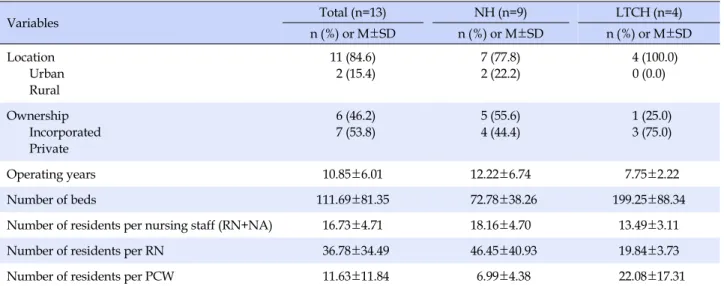
Table 1 shows the characteristics of the participants of each type of facility. The average operating period was 12.22 years for NHs and 7.75 years for LTCHs. The average number of beds per facility was 73 in NHs and 200 in LTCHs. The number of patients per PCW was 22.08 per-sons for NHs and 6.99 perper-sons for LTCHs. The number of patients per RN was 19.84 persons in LTCHs and 46.45 persons in NHs. The staffing levels between NHs and LTCHs were not directly compared because each facility type has a different staffing standard on workforce regula-tion.
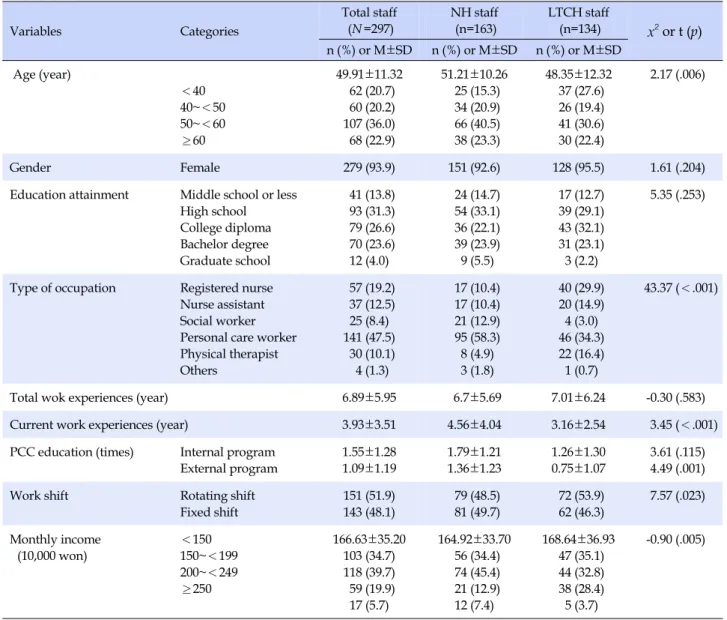
Table 2 shows the general characteristics of the partici-pants. Most of the staff in long-term care facilities were women, with an average age of about 50 years. Regarding staffing levels, the proportion of PCW was the highest at 58.3%, followed by that of social workers at 12.9% in NHs, while the proportion of PCW was 34.3% and that of RNs was 29.9% in LTCHs.
The number of education about person-centered care refers to the number of education perceived by the staff and it is measured by the question ‘Have you had train-ing/education in person-centered care (internal or external
Table 1. General Characteristics of Long-term Care Facilities Variables Total (n=13) NH (n=9) LTCH (n=4) n (%) or M±SD n (%) or M±SD n (%) or M±SD Location Urban Rural 11 (84.6) 2 (15.4) 7 (77.8) 2 (22.2) 4 (100.0) 0 (0.0) Ownership Incorporated Private 6 (46.2) 7 (53.8) 5 (55.6) 4 (44.4) 1 (25.0) 3 (75.0) Operating years 10.85±6.01 12.22±6.74 7.75±2.22 Number of beds 111.69±81.35 72.78±38.26 199.25±88.34
Number of residents per nursing staff (RN+NA) 16.73±4.71 18.16±4.70 13.49±3.11
Number of residents per RN 36.78±34.49 46.45±40.93 19.84±3.73
Number of residents per PCW 11.63±11.84 6.99±4.38 22.08±17.31
NH=nursing home; LTCH=long-term care hospital; RN=registered nurse; NA=nurse aid; PCW=personal care worker.
training/education)?’. The frequency of person-centered training/education was higher in the staff of NHs than that of LTCHs, especially in the external training/education (t=4.49, p<.05).
2. Item Analysis and Reliability Analysis
Table 3 shows the results of item analysis of KPCQ-S. The mean score of KPCQ-S was 4.71 out of 6. The item with the highest score (5.07) was ‘13. A place where it is easy for the patients to talk to the staff,’ and the item with the low-est score (4.31) was ‘3. A place where I feel I can be myself.’ The correlation coefficients of the 14 items ranged from .52 to .72, which means no redundancy or duplication of items. The Cronbach’s ⍺ value was .91 which satisfied the internal consistency of the scale.
3. Validity Analysis
1) Construct validity(1) Exploratory factor analysis
The Kaiser-Meyer-Olkin test was conducted to deter-mine the suitability for the factor analysis of 14 items, and the value was .90. The Bartlett’s test of sphericity was sig-nificant (x2=2038.39, p<.001) which means that the sam-ple was suitable for factor analysis. In a scree plot with an eigen value of 1 or more, three factors were extracted.
Table 3 shows item factor loadings indicating .67~1.02 (Factor 1), .43~.96 (Factor 2), and .66~.86 (Factor 3). The ex-planatory power of each factor was 18.1%(Factor 1), 24.1 %(Factor 2), and 23.6%(Factor 3), and three factors ac-counted for 65.8% of the total variance. As for the names of
the factors, we tried to maintain the names of the factors of the original tool, if possible [16]. Factor 1 included three items about employee competence and interpersonal skills, and was named ‘a climate of safety.’ Factor 2 included 7 items about the daily characteristics of the medical envi-ronment related to the supporting organizational system, and was named ‘a climate of everydayness.’ Factor 3 in-cluded 4 items related to an atmosphere that allows pa-tients to form relationships with the employees and their families, colleagues, and friends, and was named ‘a cli-mate of community’ that promotes patient participation.
(2) Exploratory factor analysis by facility type
Considering that there are two types of long-term care facilities in Korea, we conducted an EFA by distinguishing between staff of NHs and those of LTCHs to examine whether the factor structures of the two types of facilities are identical. The two data sets by facility type were found to be suitable for factor analysis as a result of the KMO test and Bartlett’s test of sphericity. As shown in the right side of Table 3, the sample of the staff in NHs derived three fac-tors as same as the factor structure derived using the total sample. However, in the sample of staff in LTCHs, a total of four factors were derived. The item 4, 5, 6, and 10 were the items that were loaded in the ‘climate of everydayness’ in the factor analysis using the whole sample, but they were derived as Factor 4 additionally in the factor analysis using the staff of LTCHs. This fourth factor was named as a ‘climate of comprehensibility’[15], which provides a means to understand the patient’s past and present experi-ence of diseases and the direction of care.
Table 2. General Characteristics of Study Participants Variables Categories Total staff (N =297) NH staff (n=163) LTCH staff (n=134) x2 or t (p) n (%) or M±SD n (%) or M±SD n (%) or M±SD Age (year) <40 40~<50 50~<60 ≥60 49.91±11.32 62 (20.7) 60 (20.2) 107 (36.0) 68 (22.9) 51.21±10.26 25 (15.3) 34 (20.9) 66 (40.5) 38 (23.3) 48.35±12.32 37 (27.6) 26 (19.4) 41 (30.6) 30 (22.4) 2.17 (.006) Gender Female 279 (93.9) 151 (92.6) 128 (95.5) 1.61 (.204)
Education attainment Middle school or less
High school College diploma Bachelor degree Graduate school 41 (13.8) 93 (31.3) 79 (26.6) 70 (23.6) 12 (4.0) 24 (14.7) 54 (33.1) 36 (22.1) 39 (23.9) 9 (5.5) 17 (12.7) 39 (29.1) 43 (32.1) 31 (23.1) 3 (2.2) 5.35 (.253)
Type of occupation Registered nurse
Nurse assistant Social worker Personal care worker Physical therapist Others 57 (19.2) 37 (12.5) 25 (8.4) 141 (47.5) 30 (10.1) 4 (1.3) 17 (10.4) 17 (10.4) 21 (12.9) 95 (58.3) 8 (4.9) 3 (1.8) 40 (29.9) 20 (14.9) 4 (3.0) 46 (34.3) 22 (16.4) 1 (0.7) 43.37 (<.001)
Total wok experiences (year) 6.89±5.95 6.7±5.69 7.01±6.24 -0.30 (.583)
Current work experiences (year) 3.93±3.51 4.56±4.04 3.16±2.54 3.45 (<.001)
PCC education (times) Internal program
External program 1.55±1.28 1.09±1.19 1.79±1.21 1.36±1.23 1.26±1.30 0.75±1.07 3.61 (.115) 4.49 (.001)
Work shift Rotating shift
Fixed shift 151 (51.9) 143 (48.1) 79 (48.5) 81 (49.7) 72 (53.9) 62 (46.3) 7.57 (.023) Monthly income (10,000 won) <150 150~<199 200~<249 ≥250 166.63±35.20 103 (34.7) 118 (39.7) 59 (19.9) 17 (5.7) 164.92±33.70 56 (34.4) 74 (45.4) 21 (12.9) 12 (7.4) 168.64±36.93 47 (35.1) 44 (32.8) 38 (28.4) 5 (3.7) -0.90 (.005)
NH=nursing home; LTCH=long-term care hospital; PCC=person-centered care; Missing cases [Age: NH=3, LTCH=1; Gender: NH=2, LTCH=2; Education level: NH=1, LTCH=1; Length of employment with the current facility: NH=4, LTCH=3, Total career: NH=46, LTCH=23, PCC internal education: NH=3, LTCH=1, PCC external education: NH=6, LTCH=1, Working type: NH=3].
2) Convergent validity
Correlation analysis was used to examine the conver-gent validity of KPCQ-S andjob satisfaction. The correla-tion coefficient between KPCQ-S andjob satisfaction in-dicated a high positive correlation with r=.55 (p<.001). Therefore, convergent validity of KPCQ-S with job satis-faction was verified [27].
DISCUSSION
The aim of this study was to develop the KPCQ-S to measure the person-centered environment perceived by staff working in Korean long-term care facilities. The
En-glish version of PCQ-S developed by Edvardsson et al. (2008)[15] was translated into Korean and modified in ac-cordance with the guidelines of the WHO [25], and tested its reliability and validity to a total of 297 staff from nine NHs and four LTCHs. This study demonstraed that the KPCQ-S was applicable for measuring the person-centered environment from the perspective of the staff in Korean long-term care facilities.
As for the overall factor structure, three factors were identified as follows: ‘a climate of safety,’ ‘a climate of ev-erydayness,’ and ‘a climate of community’ from the total sample. Also, the factor loading of the items was similar to that of the Swedish original PCQ-S, but two items were
Tab le 3. Ite m P erfo rm an ce , R elia bility and R esul t of Fact or Anal ysi s It em It em c on te nt s M ± SD C orre ct ed Item –tota l corr elat io n C ro nb ac h's ⍺ if item de le te d Tot al st aff (n=2 97) NH st af f( n= 163 ) LT C H st af f( n=1 34) Fact or 1 Fact or 2 Fact or 3 Fact or 1 Fact or 2 Fact or 3 Fa ct or 1 Fa ct or 2 Fact or 3 Fact or 4 1 A pla ce whe re I fee l we lco m e 4. 47 ± 0. 86 .5 6 .90 0. 67 0. 03 0. 06 0. 53 0. 15 0. 12 0. 76 0. 13 0. 08 -0. 19 2 A p lace w here I fe el ack no w le dg ed as a pe rs on 4. 50 ± 0. 83 .6 4 .9 0 1. 02 -0 .1 2 0. 04 0. 99 -0 .0 8 0. 05 0. 96 -0 .1 6 -0 .0 4 0. 15 3 A pla ce whe re I fe el I can b e myse lf 4. 31 ± 1. 11 .5 2 .90 0. 67 0. 17 -0. 15 0. 77 0. 12 -0. 13 0. 62 0. 12 -0. 05 0. 04 4 A pla ce whe re t he pat ien ts ar e in s af e han ds 4. 76 ± 0. 80 .6 8 .9 0 0. 08 0. 55 0. 17 0. 11 0. 73 -0 .0 1 -0 .0 8 0. 01 0. 11 0. 74 5 A pla ce whe re t he st af f us e a la nguage th at th e p atie nts c an un dersta nd 4. 84 ± 0. 65 .6 8 .90 0. 14 0. 43 0. 25 0. 13 0. 42 0. 28 0. 03 0. 05 -0. 15 0. 92 6 A pla ce whi ch fe el s ho me ly ev en th ough it is in an institution 4. 75 ± 0. 88 .7 2 .8 9 0. 07 0. 67 0. 08 0. 11 0. 68 0. 03 0. 06 0. 30 0. 10 0. 41 7 A pla ce whe re t he re is s ome thi ng nice to loo k at 4. 50 ± 1. 14 .5 4 .90 -0 .0 4 0.7 2 -0. 08 0. 04 0. 63 0. 06 -0. 01 0. 76 -0. 15 0. 02 8 A p la ce w her e it is quiet and p eaceful 4. 70 ± 0. 86 .7 1 .8 9 -0 .0 6 0. 96 -0 .1 2 -0 .0 4 0. 94 -0 .1 2 -0 .0 1 0. 77 0. 03 0. 12 9 A p la ce w her e it is po ssible to get un pl ea sa nt tho ug hts o ut of y our h ea d 4. 33 ± 1. 00 .5 5 .90 0. 16 0. 48 -0. 00 0. 22 0. 47 -0. 08 0. 13 0. 46 0. 25 -0. 11 10 A pla ce whi ch is ne at an d cle an 4. 76 ± 0. 85 .6 5 .9 0 -0 .0 0 0. 48 0. 28 -0 .1 0 0. 66 0. 18 0. 06 0. 07 0. 22 0. 44 11 A p la ce w her e it is easy for the p ati ents to k ee p in c onta ct w ith th eir lov ed on es 4. 86 ± 0. 82 .6 1 .90 -0 .0 2 0.1 3 0. 66 -0. 12 0. 36 0. 55 0. 02 -0. 23 0. 51 0. 40 12 A p la ce w her e it is easy for the p ati ents to re ce ive v is itors 5. 03 ± 0. 71 .5 2 .9 0 0. 01 -0 .1 7 0. 86 -0 .0 4 -0 .0 7 0. 88 0. 06 -0 .0 6 0. 76 -0 .1 0 13 A p la ce w her e it is easy for the p ati ents to ta lk to th e sta ff 5. 07 ± 0. 66 .6 3 .90 -0 .0 2 -0 .0 3 0. 86 0. 08 -0. 13 0. 93 -0. 10 0. 13 0. 82 -0. 01 14 A pla ce whe re t he pat ien ts hav e so m eon e to ta lk to if the y s o w is h 40 .9 1 ± 0. 73 .6 2 .9 0 -0 .0 5 0. 11 0. 73 -0 .0 1 0. 08 0. 70 0. 00 -0 .0 2 0. 78 0. 06 M ± SD of sub-dom ai 4.4 3 ± 0. 83 4. 67 ± 0. 66 4. 97 ± 0. 61 4. 43 ± 0. 82 4. 84 ± 0. 62 5. 10 ± 0. 57 4. 42 ± 0. 82 4. 22 ± 0. 83 4. 81 ± 0. 62 4. 63 ± 0. 68 M ± SD of w hole s cal e 4. 71 ± 0. 58 4. 82 ± 0. 55 4. 55 ± 0. 58 Cr on bach 's ⍺ of s ub -d om ain .8 3 .6 6 .8 5 .8 3 .8 7 .8 7 .8 3 .70 .8 1 .8 4 Cr on bach 's ⍺ of w ho le s ca le .9 1 .9 1 .8 9 Ex pl ai ne d v ar ia nc e (% ) 65. 8% 67. 8% 70. 8% N H =n urs in g h om e; LT C H =l on g-te rm c are h os pi ta l; F ac tor 1: A c lim at e of s af et y, Fa ct or 2 : A c lim at e of e ve ryda yn es s, Fa ct or 3 : A c lim at e of c om m un ity , F ac to r 4 : A c lim at e of c om pr eh en sib ili ty .
differently loaded. While ‘4. A place where the patients are in safe hands.’ and ‘5. A place where the staff use a lan-guage that the patients can understand.’ were loaded on the ‘climate of safety’ factor in the study of Swedish hospi-tal medical personnel [16]; however, it was loaded on the ‘climate of everydayness’ factor in the present study. In the Norwegian study, which conducted a psychometric assessment for NH staff in 2012, the item ‘4. A place where the patients are in safe hands.’ was derived not as an item of the ‘climate of safety’ but as an item of the ‘climate of community’[17]. Regarding the study participants, the present study and the Norwegian study were conducted with the staff in long-term care settings, while the Swedish PCQ-S was conducted with the staff in acute care hospi-tals. The question asking about safety of the working envi-ronment can be regarded literally as related to ‘safety’ of the hospitals. However, in the long-term care setting, it is considered as everyday life environment or community environment in terms of the perception of the as a safe en-vironment like a ‘home’. Since the PCQ-S is a tool that can be effectively used to compare differences in person-cen-tered environments between wards in acute care hospitals in Korea, where patient-centered services are currently emphasized, it is necessary to conduct a comparative anal-ysis about whether similar or different factor structures of the items are derived through further research on acute hospitals.
In addition, since this study investigated two facility types (NHs and LTCHs) in Korea with different character-istics providing care for the elderly, EFA was conducted for each facility type. In general, when determining the number of factors in EFA, it is common to employ the Kaiser’s eigen value >1 criterion. However, in the present study, there was a difficulty in identifying the factor struc-ture only with the eigenvalue for each facility type. In the sample of the NHs, considering the eigen value (0.972) and the model fit of the tool, three factors were derived as same as that of the EFA with the total sample of facilities.
On the other hand, the EFA using only LTCH sample showed a different factor structure. When the four factor structure was determined considering the eigen value (0.979) and model fit, the four items (‘4. A place where the patients are in safe hands,’ ‘5. The workers speaks to me in a comprehensible manner,’ ‘6. A place which feels homely even though it is in an institution,’ and ‘10. A place which is neat and clean’), which were included in the ‘climate of everydayness’ factor, were derived as a new factor. These new factor may be considered similar to those derived from an English-version PCQ-S study of the staff in the Australian short-term inpatient hospitals. Edvardsson et
al.(2009) named this new factor as a ‘climate of compre-hensibility,’ explaining that it provides a means to under-stand the patient’s past and present experience of diseases and directions of care [15]. We also named the fourth new-ly derived factor as a ‘climate of comprehensibility.’ LTCHs are the facilities that provide long-term care services, but they have a stronger nature of medical institutions than NHs. Residents in NHs have relatively lower needs for medical care compared to the residents in LTCHs, and have a nature of a place of residence. However, in LTCHs, the time for treatment is relatively longer as medical prac-titioners perform rehabilitation therapy, skilled nursing care, or oriental medicine treatment, and administer rou-tine medications. LTCH staff may regard the environment in which staff talk about medical matters in easy ways to residents in a neat, safe and home-like circumstances as a separate domain for improving the effects of treatment and understanding the direction of care. Therefore, it is re-commanded that the factor structure of the items should be applied differently when calculating the scores of the sub-domains according to the facility type.
The mean score of KPCQ-S was 4.71 points (4.82 points for NHs and 4.55 points for LTCHs), which is similar to 4.88 points in the Norwegian study of NH staff [17], but higher than 4.39 points in the Slovenian study of nursing staff of operating rooms and general wards [18] and 4.52 points in the Swedish study of staff of general wards [16]. This difference is presumably due to differences in the fa-cilities. The mean score of the KPCQ-S in Korean NHs was 4.82 points, which is similar to the result of the Norwegian study of NHs. The mean score for LTCHs was 4.55 points, which is similar to the finding of the Slovenian study (4.39 points) and of the Swedish study (4.52 points) conducted with hospitals. In particular, comparing the mean scores of each factors, the scores of NHs were higher than those of LTCHs in the ‘climate of everydayness’(4.84 points for NHs and 4.22 points for LTCHs) and ‘climate of commun-ity’(5.10 points for NHs and 4.81 points for LTCHs). This difference shows that although both NHs and LTCHs pro-vide a certain level of long-term care services in Korea, NH residents are likely to have a longer period of stay and share more of everyday life with staff than the LTCH resi-dents, which have a relatively stronger therapeutic purpose.
As described above, NHs showed higher KPCQ-S scores than LTCHs, which may be attributed to the fact that LTCHs provide relatively more treatment and medical services, and the ratios of nursing staff and therapists are relatively higher than NHs. This characteristic of LTCHs may have staff to perceive their care environments to be less person-centered compared to NH staff. Nevertheless,
considering that both NHs and LTCHs are the facilities where elderly people live for a certain period of time, the person-centered environment is should be emphasized in both settings.
In this study, we evaluated the applicability of the KPCQ-S among a total of 297 staff in 13 long-term care facilities. However, there is a limitation that participants were selected not by systematic quota sampling but by convenience sampling. Nevertheless, this study will con-tribute as the cornerstone of future research efforts on per-son-centered care in the field of long-term care, which is increasingly attracting attention worldwide. Regarding the possibility of its specific applicability in practice, it can be used as the instrument for continuous quality improve-ment of the environimprove-ments in long-term care settings through comparative and longitudinal analysis by assessing the level of the person-centered environment of each ward or unit within the same facility. Second, since KPCQ-S is composed of specific items, it can be applied to the inter-vention studies to create person-centered environments in long-term care facilities using individual items. To realize a person-centered environment, it is necessary to develop intervention programs that enables the implementation of a safe environment where overall comprehensibility is en-sured and everyday life and communality are emphasized. Finally, since the PCQ-S is currently being used in practice as translated and modified versions in many countries, it can be used effectively for international studies of com-parative analysis.
CONCLUSION
This study was conducted to test the applicability of the PCQ-S in Korea. The KPCQ-S has been proven to be a suit-able tool for evaluating the person-centered environment of long-term care facilities in Korea in terms of reliability and validity. However, it was shown that there are some differences in the person-centered environment according to the facility type by deriving slightly different factors be-tween NHs and LTCHs. The KPCQ-S can contribute to conduct further studies on investigating the levels of the person-centered environment of various long-term care facilities and to promote interests in the person-centered care of the facilities.
REFERENCES
1. Chappell NL, Reid RC, GishJA. Staff-based measures of
in-dividualized care for persons with dementia in long-term care facilities. Dementia. 2007;6(4):527-47.
https://doi.org/10.1177/1471301207084372
2. Crandall LG, White DL, Schuldheis S, Talerico KA. Initiating
person-centered care practices in long-term care facilities.
Jour-nal of Gerontological Nursing. 2007;33(11):47-56.
3. Morgan S, Yoder LH. A concept analysis of person-centered
care.Journal of Holistic Nursing. 2012;30(1):6-15.
https://doi.org/10.1177/0898010111412189
4. De Silva D. Helping Measure Person Centred Care [Internet]. London, UK: The Health Foundation. 2014 [cited 2017 May 15]. Available from:
http://www.health.org.uk/publication/helping-measure-pe rson-centred-care
5. Bergman-Evans B. Beyond the basics: Effects of the Eden
alter-native model on quality of life issues.Journal of gerontological
nursing. 2004;30(6):27-34.
https://doi.org/10.3928/0098-9134-20040601-07
6. Kane RA, Lum TY, Cutler LJ, Degenholtz HB, Yu TC. Resident outcomes in small-house nursing homes: A longitudinal
eval-uation of the Initial Green House Program.Journal of the
Ame-rican Geriatrics Society. 2007;55(6):832-839. https://doi.org/10.1111/j.1532-5415.2007.01169.x
7. Barbosa A, Sousa L, Nolan M, Figueiredo D. Effects of per-son-centered care approaches to dementia care on staff: A
sys-tematic review. AmericanJournal of Alzheimer's Disease &
Other Dementias®. 2015;30(8):713-722. https://doi.org/10.1177/1533317513520213
8. Berkhout AJ, Boumans NP, Nijhuis FJ, Van Breukelen GP,
Abu-Saad HH. Effects of resident-oriented care onjob
char-acteristics of nursing caregivers. Work & Stress. 2003;17(4): 337-353. https://doi.org/10.1080/02678370310001647645 9. McCormack B, McCance TV. Development of a framework for
person-centred nursing.Journal of Advanced Nursing. 2006;
56(5):472-479.
https://doi.org/10.1111/j.1365-2648.2006.04042.x
10. Chaudhury H, Hung L, Badger M. The role of physical environ-ment in supporting person-centered dining in long-term care.
AmericanJournal of Alzheimer's Disease & Other Dementias®.
2013;28(5):491-500.
https://doi.org/10.1177/1533317513488923
11. Yoon JY, Roberts T, Grau B, Edvardsson D. Person-centered
Climate Questionnaire-Patient in English: A psychometric eval-uation study in long-term care settings. Archives of Gerontolo-gy and Geriatrics. 2015;61(1):81-87.
https://doi.org/10.1016/j.archger.2015.03.010
12. Edvardsson JD, Sandman PO, Rasmussen BH. Sensing an
at-mosphere of ease: A tentative theory of supportive care settings.
ScandinavianJournal of Caring Sciences. 2005;19(4):344-353.
https://doi.org/10.1111/j.1471-6712.2005.00356.x
13. ChoiJS, Lee MH. Psychometric properties of a Korean
Social Work Practice. 2014;24(6):676-684. https://doi.org/10.1177/1049731513509897
14. Tak YR, Woo HY, You SY, KimJH. Validity and reliability of
the person-centered care assessment tool in long-term care
fa-cilities in Korea.Journal of Korean Academy of Nursing. 2015;
45(3):412-419. https://doi.org/10.4040/jkan.2015.45.3.412 15. Edvardsson D, Koch S, Nay R. Psychometric evaluation of the
English language Person-centred Climate Questionnaire-staff
version.Journal of Nursing Management. 2010;18(1):54-60.
https://doi.org/10.1111/j.1365-2834.2009.01038.x
16. Edvardsson D, Sandman PO, Rasmussen B. Construction and psychometric evaluation of the Swedish language
Person-cen-tred Climate Questionnaire - staff version.Journal of Nursing
Management. 2009;17(7):790-795.
https://doi.org/10.1111/j.1365-2834.2009.01005.x
17. Bergland A, Kirkevold M, Edvardsson D. Psychometric proper-ties of the Norwegian Person-centred Climate Questionnaire
from a nursing home context. ScandinavianJournal of Caring
Sciences. 2012;26(4):820-828.
https://doi.org/10.1111/j.1471-6712.2012.00979.x.
18. Vrbnjak D, Pahor D, Povalej Brzan PP, Edvardsson D, Pajnkihar M. Psychometric testing of the Slovenian personcentred
cli-mate questionnaire - staff version.Journal of Nursing
Manage-ment. 2017;25(6):421-429.
https://doi.org/10.1111/jonm.12479
19. Edvardsson D, Sandman PO, Rasmussen B. Swedish language person-centred climate questionnaire - patient version:
Construc-tion and psychometric evaluaConstruc-tion.Journal of Advanced
Nurs-ing. 2008;63(3):302-309.
https://doi.org/10.1111/j.1365-2648.2008.04709.x
20. LindahlJ, Elmqvist C, Thulesius H, Edvardsson D.
Psychomet-ric evaluation of the Swedish language person-centred
cli-mate questionnaire - Family version. ScandinavianJournal of
Caring Sciences. 2015;29(4):859-864. https://doi.org/10.1111/scs.12198
21. Choi ID, Lee EM. Study on the efficient integration of long- term care facilities and geriatric hospitals by using NHIC
sur-vey data.Journal of the Korean Gerontological Society. 2010;
30(3):855-869.
22. Kline RB. Principles and practice of structural equation model-ing. 4th ed.. New York:Guilford Press; 2016. 534 p.
23. PejtersenJH, Kristensen TS, Borg V, BjornerJB. The second
ver-sion of the Copenhagen Psychosocial Questionnaire.
Scandina-vianJournal of Public Health. 2010;38(3):8-24.
https://doi.org/10.1177/1403494809349858
24. June KJ, Choi ES. Reliability and validity of the Korean version of the Copenhagen Psyco-social Questionnaire Scale. Korean Journal of Occupational Health Nursing. 2013;22(1):1-12. https://doi.org/10.5807/kjohn.2013.22.1.1
25. World Health Organization. Process of translation and adapta-tion of instruments. [Internet]. Geneva: World Health Organi-zation. 2017 [cited 2017 April 25]. Available from:
http://www.who.int/substance_abuse/research_tools/trans lation/en/
26. Andy Field,Jeremy Miles, Zoë Field. MilesJ, Field Z, editors.
Discovering statistics using R. London: Thousand Oaks, Calif.: Sage; 2012. 992 p.
27. Devon HA, Block ME, Moyle-Wright P, Ernst DM, Hayden SJ, Lazzara DJ, et al. A psychometric toolbox for testing validity
and reliability.Journal of Nursing Scholarship. 2007;39(2):155-