IntroductIon
DNA methylation, histone modification, and non-coding RNA modulation are the major epigenetic regulation mech-anisms involving in genome-wide transcription of eukary-otic genomes. These epigenetic changes affect the devel-opment and environmental stress response in plants (Chin-nusamy and Zhu 2009; Boyko and Kovalchuk 2011).
More-over, the epigenetic regulation has been reported in ionizing radiation responses(Ma et al. 2010). Recent studies of Ara-bidopsis thaliana have shown that gamma irradiation could induce locus-specific non-CG DNA hypomethylation in the genome(Kim et al. 2013a) and histone modification associ-ated with transcription of some DNA repair genes(Mondal et al. 2016).
DNA methylation is crucial in maintaining genome sta-bility. Global DNA hypomethylation has been directly correlated with genomic instability in breast or colorectal ─ 181 ─
Technical Paper
* Corresponding author: Jin-Hong Kim, Tel. +82-63-570-3333, Fax. +82-63-570-3391, E-mail. [email protected]
Confirmation of no Causal Relationship between Genome-wide
DNA Methylation and Transcriptome Changes
after Gamma Irradiation
Jin-Hong Kim1,2,*, Jin Kyu Kim1,2, Tae Ho Ryu1,3 and Seung Sik Lee1,2
1Advanced Radiation Technology Institute, Korea Atomic Energy Research Institute, 29, Geumgu-gil, Jeongeup-si, Jeollabuk-do 56212, Republic of Korea 2Department of Radiation Biotechnology and Applied Radioisotope Science,
University of Science and Technology, 217, Gajeong-ro, Yuseong-gu, Daejeon 34113, Republic of Korea
3Department of Biotechnology, Chonnam National University, 77, Yongbong-ro, Buk-gu, Gwangju 61186, Republic of Korea
Abstract - Genome-wide dnA methylation change is one of the major epigenetic regulation mechanisms involved in dnA damage response(ddr) and genome stability. Whole-genome bisulfite sequencing analysis demonstrated genomic dnA hypomethylation in all Arabidopsis genomes after gamma irradiation, but preferentially at non-cG sites of nuclear chromosomes. chloroplastic or mitochondrial genome was the most resistant or the most sensitive to dnA hypomethylation induced by gamma irradiation, respectively. the methylation changes of those genomes displayed no difference between cG and non-cG sites. In contrast, the genomic dnA hypomethylation of nuclear chromosomes slightly differed depending on the gene regions or genomic features. the number of differentially methylated regions(dMrs) with decreased dnA methylation was much more than that of dMrs with increased dnA methylation in accordance with the overall DNA hypomethylaton of the whole genomes. Thirty-four DMRs were identified to be associated with transcriptome changes after gamma irradiation, but none of them were correlated with transcriptional induction of ddr genes. these results suggest that the genome-wide dnA hypomethylation would play a role in indirect ddr mechanisms rather than in direct transcriptional activation for ddr genes.
Key words : differentially methylated region, dnA damage response, dnA methylation, Gamma radiation, transcriptome
cancer cell lines(Vilain et al. 1999; Rodriguez et al. 2006). However, transmission or delay of radiation-induced ge-nomic instability in mouse embryonic stem cells was inde-pendent of global DNA hypomethylation(Rugo et al. 2011; Armstrong et al. 2012). Instead, individual functional DNA methytransferases can be associated with the radiation-in-duced genomic instability depending on their distinct roles (Armstrong et al. 2012; Huumonen et al. 2014).
Although we demonstrated a possible correlation between the promoter DNA methylation and transcription changes of some gamma radiation-responsive genes through an Ara-bidopsis Whole Genome ChIP-on-Chip Microarray analysis (Kim et al. 2013b), there are still no data available to show quantitative genome-wide methylation changes in plants upon exposure to ionizing radiation. The non-CG DNA hy-pomethylation after gamma irradiation was locus-specifi-cally induced in the Arabidopsis genome(Kim et al. 2013a), while the transcriptional changes of DNA damage repair genes were partly associated with histone modification but not with DNA methylation(Kim et al. 2013b; Mondal et al. 2016). Therefore, the judgment on the correlation between the genome-wide DNA methylation and transcriptome changes in plants upon exposure to ionizing radiation had to be reserved up to date.
The present study aimed to reveal whether differentially methylated regions(DMRs) in the Arabidopsis whole ge-nome after gamma irradiation can be causally correlated with differentially expressed genes(DEGs). Additionally, the interaction of DMRs and histone modification will also be discussed in terms of transcriptional changes of DNA damage response genes.
MAterIAls And Methods
1. Plant materials and gamma irradiationArabidopsis thaliana plants(ecotype Columbia; Col-0) were grown on soil in a growth room with a 16-h photope-riod at 23°C for 28d. Plants were irradiated with gamma radiation at a dose rate of 50Gy·h-1 for 4h using a 60Co γ irradiator(IR-222, MDS Nordion Inc., Kanata, Canada) at the Advanced Radiation Technology Institute(ARTI), and they were placed under the growth condition for 1 day after irradiation. Then, the whole rosette leaves were harvested and pooled from more than ten plants to minimize
inter-plant variation, and they were used for extraction of genom-ic DNA with the DNeasy Plant Maxi Kit(Qiagen GmbH., Hilden, Germany).
2. Whole-genome bisulfite-sequencing(Bs-seq) analysis
Genomic DNA samples were fragmented by sonication using the Diagenome’s Bioruptor Sonicator to a mean size of approximately 100~300bp, followed by blunting 3′-end addition of dA, and ligation of methylated adaptors. The bi-sulfite conversion of adaptor-ligated sample DNA was car-ried out using the EZ DNA Methylation-Gold Kit(ZYMO Research, Irvine, CA). Bisulfite-treated DNAs were PCR amplified with ten cycles. The resultant DNAs were applied to paired-end sequencing with the read length of 90bp for each end using the ultrahigh-throughput Illumina HiSeqTM 2000 based on the manufacturer’s instructions(Illumina Inc., San Diego, CA). Images generated by HiSeqTM2000 were converted into nucleotide sequences by base calling and stored in FASTQ format. By filtering the dirty reads, which contain adaptors, unknown(N base number >10%) or low phred quality scored-bases(>10% of <Q20) from raw reads, clean reads were generated.
Clean reads were mapped to reference Arabidopsis thaliana genome and gene sequences(TAIR10) using SOAPaligner(Li et al. 2008). As DNA methylation has strand specificity, separate alignments were generated for both plus- and minus-strands of the Arabidopsis genome. In detail, each cytosine in reference genome sequences was converted into thymine, termed T-genome which represents the plus strand. Meanwhile, each guanine in reference ge-nome sequences was converted into adenosine, termed A-genome, which represents the minus strand. To map the sequenced pair-ended BS-Seq reads, the original reads were computationally converted into the alignment forms with the following steps: (1) observed cytosines on the forward read of each read pair were in silico replaced by thymines, and (2) observed guanines on the reverse read of each read pair were in silico replaced by adenosines. The converted reads were then mapped to both strands of the A- and T-ge-nome sequence using SOAPaligner allowing up to 2 mis-matches per read. Reads mapped to the same start position for both ends were regarded as clonal duplicates, which might have been generated during the PCR process, and every hit with a single placement with minimum numbers
of mismatches and a clear strand assignment was defined as an unambiguous alignment(uniquely mapped reads) and was used for methyl-cytosine ascertainment. Only uniquely mapped reads were used to estimate the copy numbers of the local region. After the above filtration, for methylcyto-sine(mC) detection, cytosines in the BS-Seq reads match-ing the correspondmatch-ing cytosines in the plus strand of the reference genome, or guanines in the BS-Seq reads match-ing the correspondmatch-ing guanines in the minus strand of the reference genome were regarded as potential mCs. To ex-clude the false positive caused by the base calling process, those potential mCs with Q scores lower than 20 were re-moved, which means that a base is correctly called at more than 99% probability, a highly conservative criterion for calling reliable bases. Moreover, the sum of non-conversion rate ant T-C sequencing error rate was calculated using the unmethylated chloroplast genome, and then binomial tests using these values were conducted with a false positive rate of below 5% to exclude those mCs that may be the results of a non-conversion of cytosines during bisulfite treatment or T to C sequencing errors during the base calling process.
3. Genome-wide transcriptome analysis
To investigate the correlation of genome-wide DNA methylation and transcriptome changes after gamma irradi-ation, we used our previous transcriptome data, which were
registered as accession numbers GSE43947, GSM1074828, GSM1074830, GSM1074836, and GSM1074838 in the NCBI Gene Expression Omnibus(GEO) database(http:// www.ncbi.nlm.nih.gov/geo/)(Kim et al. 2013a).
results And dIscussIon
1. dnA methylation change in the Arabidopsisgenome after gamma irradiation
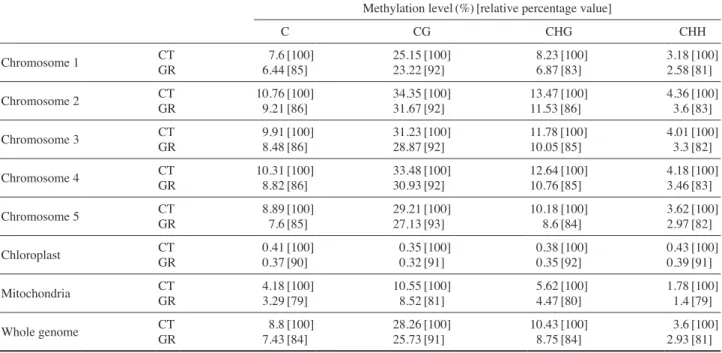
Genome-wide DNA methylation levels were compared between the control and irradiated groups by whole-genome bisulfite-sequencing. Methylation levels of all nuclear, chlo-roplastic and mitochondrial genomes decreased regardless the methylation types - CG, CHG, and CHH(Table 1). Ge-nomic DNA methylation of nuclear chromosomes 1 through 5 decreased more substantially at non-CG sites than at CG sites in the order of CHH, CHG, and CG after gamma irra-diation. This result is in good accordance with our previous data that demonstrated non-CG DNA hypomethylation of Arabidopsis genome after gamma irradiation(Kim et al. 2013a). However, the more decrease of DNA methylation at non-CG sites was not found in chloroplastic and mito-chondrial genomes(Table 1). Moreover, the chloroplastic genome was the most resistant to the genomic DNA hy-pomethylation induced by gamma irradiation, while the
mi-table 1. Methylation level of cytosines in each chromosome
Methylation level(%)[relative percentage value]
C CG CHG CHH Chromosome 1 CTGR 7.6 6.44[100][85] 23.2225.15[100][92] 8.23 6.87[83][100] 2.583.18[100][81] Chromosome 2 CTGR 10.76 9.21[100][86] 31.6734.35[100][92] 13.4711.53[86][100] 3.64.36[100][83] Chromosome 3 CTGR 9.91 8.48[100][86] 31.2328.87[92][100] 11.7810.05[100][85] 3.34.01[100][82] Chromosome 4 CTGR 10.31 8.82[100][86] 30.9333.48[100][92] 12.6410.76[85][100] 3.464.18[100][83] Chromosome 5 CTGR 8.89 7.6[100][85] 27.1329.21[100][93] 10.18 8.6[84][100] 2.973.62[100][82] Chloroplast CTGR 0.41 0.37[100][90] 0.32 0.35[100][91] 0.38 0.35[92][100] 0.390.43[100][91] Mitochondria CTGR 4.18 3.29[100][79] 8.5210.55[100][81] 5.62 4.47[80][100] 1.41.78[100][79] Whole genome CTGR 8.8 7.43[100][84] 25.7328.26[100][91] 10.43 8.75[84][100] 2.93 3.6[100][81]
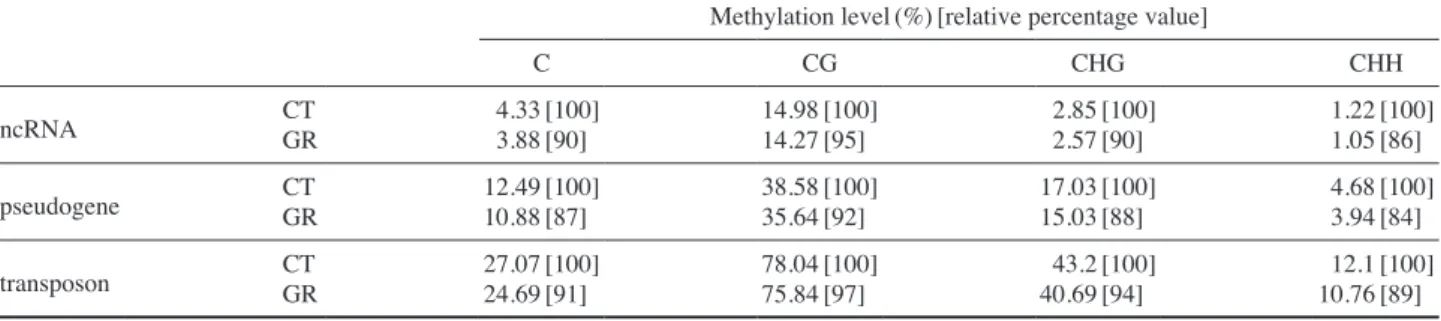
tochondrial genome was the most sensitive. In comparison with different gene regions, coding sequences were the most resistant to the genomic DNA hypomethylation with the least change at the CG site, while 5′-untranslated regions showed no distinct difference between the CG and non-CG methylation changes(Table 2). In comparison of the differ-ent genomic features, the methylation level of transposon was relatively less affected by gamma irradiation compared with those of noncoding RNA and pseudogene(Table 3). These results suggest that gamma irradiation should induce the genomic DNA hypomethylation preferentially at non-CG sites of nuclear chromosomes regardless of the gene re-gions and genomic features.
2. Identification of differentially methylated regions after gamma irradiation
Genome-wide DNA methylation levels were further ana-lyzed to identify differentially methylated regions(DMRs). The criteria for definition and two-direction extension of DMRs were as follows: 1) five CpG sites for a sliding win-dow and a Chi-square test with a Fisher exact test P<0.05, 2) maximum distance(<200bp) between two consecutive
CpG sites, 3) more than two-fold DMRs, and 4) more than 10% methylated region. Additional filtering was performed based on the conditions of false discovery rate(FDR)>0.05 and average coverage of candidate DMRs>20 reads (cover-age of one CpG>10 reads). Although the methylation levels of Arabidopsis genomes except chloroplastic genome were commonly higher at CG sites than at non-CG sites(Table 1), the number of differentially methylated regions(DMRs) was bigger in the order of CHH, CHG, and CG(Fig. 1). This re-sult is in good accordance with our previous data that non-CG DNA methylation levels are preferentially affected by gam-ma irradiation at the genome-wide level(Kim et al. 2013a). Therefore, the greater number of DMRs with a decreased methylation after gamma irradiation should be attributed to the overall decrease of genome-wide DNA methylation (Tables 1~3). Similarly, no DMRs in chloroplastic genome after gamma irradiation can be explained by the least DNA methylation change in the genome(Table 1, Figs. 1 and 2).
table 2. Methylation level of cytosines in different gene regions
Methylation level(%)[relative percentage value]
C CG CHG CHH
3′-UTR CT 2.03GR 1.73[100] 10.11[85] 9.1[100] 1.18[90] 1[100] 0.77[85] 0.64[100][83] 5′-UTR CT 1.04GR 0.92[100] 2.59[88] 2.37[100] 0.76[92] 0.68[100] 0.55[89] 0.5[100][91] CDS CT 3.6GR 3.32[100] 15.72[92] 15.36[100] 1.22[98] 1.07[100] 0.68[88] 0.59[100][87] Intron CT 3.14GR 2.77[100] 20.43[88] 19.28[100] 1.94[94] 1.61[100] 0.98[83] 0.83[100][85]
CT, control; and GR, gamma-irradiated. UTR, untranslated region; and CDS, coding sequence.
table 3. Methylation level of cytosines in different genomic features
Methylation level(%)[relative percentage value]
C CG CHG CHH
ncRNA CTGR 4.33 3.88[100][90] 14.2714.98[100][95] 2.85 2.57[90][100] 1.05 1.22[100][86] pseudogene CTGR 12.4910.88[100][87] 35.6438.58[100][92] 17.0315.03[88][100] 3.94 4.68[100][84] transposon CTGR 27.0724.69[100][91] 75.8478.04[100][97] 43.240.69[94][100] 10.76 12.1[100][89]
CT, control; and GR, gamma-irradiated. ncRNA, noncoding RNA.
Fig. 1. Number of CG-, CHG-, and CHH-type DMR in each
chro-mosome. Chr1 Chr2 Chr3 Chr4 Chr5 ChrC ChrM Chromosome # r egions down # r egions up 1500 1000 2500 5000 40 30 20 10 0 30 60 90 120
3. differentially expressed genes associated with dMrs after gamma irradiation
As shown above, the number of DMRs with decreased DNA methylation after gamma irradiation was much more than that with increased DNA methylation(Fig. 1). Previ-ously, the genome-wide transcriptome profile after gamma
irradiation was revealed to include about a two-fold higher number of induced genes than that of repressed genes(Kim et al. 2013b). Therefore, it is necessary to confirm whether the genome-wide DMRs are associated with differentially expressed genes(DEGs) after gamma irradiation. Our pre-vious study identified a few DNA methylation-associated transcriptomes through a promoter methylation analysis
Fig. 2. Methylation level of cytosines in mitochondria(a) and chloroplast(b) chromosome. CT, control; and GR, gamma-irradiated. +/-, sense/antisense strand. (a) Mitochondria (b) Chloroplast 5-mC/C (%) 5-mC/C (%) 5-mC/C (%) 5-mC/C (%) 5-mC/C (%) 5-mC/C (%) 5-mC/C (%) 5-mC/C (%) Coordinates(bp) Coordinates(bp)
0 1e+5 2e+5 3e+5 4e+5
0.0 3.0e+4 6.0e+4 9.0e+4 1.2e+5 1.5e+5
CT(+) CT(+) CT( - ) CT( - ) GR(+) GR(+) GR( - ) GR( - ) 120 100 80 60 40 20 0 5 4 3 2 1 0 120 100 80 60 40 20 0 5 4 3 2 1 0 120 100 80 60 40 20 0 5 4 3 2 1 0 120 100 80 60 40 20 0 5 4 3 2 1 0
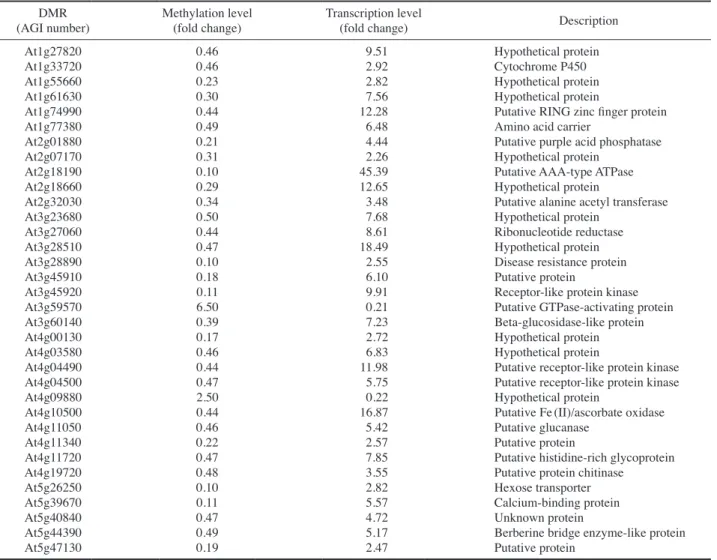
using an Arabidopsis Whole Genome ChIP-on-Chip Mi-croarray(Kim et al. 2013b). In contrast, the present study investigated all genomic regions including the gene body and untranslated region as well as the promoter. The data showed that thirty-four DMRs can be positively correlated with transcriptional changes of the corresponding DEGs after gamma irradiation(Table 4). Recently, it was report-ed that DNA methylation levels of the major DNA dam-age response(DDR) genes such as At1g31280(AtAgo2), At2g30360(AtCIPK11), At4g19130(AtRPA1E), At5g20850 (AtRad51) and At5g24280(AtGMI1), were not substantial-ly affected by gamma radiation(Mondal et al. 2016). Ex-pressions of these DDR genes could not be correlated with DNA methylation changes in their promoter or gene body regions. Moreover, none of these DDR genes were included in the DMRs associated with transcription(Table 4). Al-though non-CG DNA hypomethylation was associated with
transcriptional activation of the centromeric CEN and the pericentromeric TSI repeats after gamma irradiation(Kim et al. 2013a), a genome-wide DNA methylation change is unlikely to determine the overall transcriptional levels of the gamma-ray-responsive DEGs including DDR genes. In-stead, it can indirectly involve in transcriptional regulation of the gamma-ray-responsive DEGs by affecting the ge-nome instability or chromatin remodeling(Ma et al. 2010; Armstrong et al. 2012).
conclusIons
The present study revealed that gamma irradiation in-duces genome-wide DNA hypomethylation preferentially at non-CG sites of nuclear chromosomes in Arabidopsis. Thirty-four DMRs were found to be positively associated
table 4. Differentially methylated regions(DMRs) associated with transcription in each chromosome. DMRs were indicated by the corre-sponding Arabidopsis Genome Initiative(AGI) numbers
DMR
(AGI number) Methylation level(fold change) Transcription level(fold change) Description
At1g27820 0.46 9.51 Hypothetical protein
At1g33720 0.46 2.92 Cytochrome P450
At1g55660 0.23 2.82 Hypothetical protein
At1g61630 0.30 7.56 Hypothetical protein
At1g74990 0.44 12.28 Putative RING zinc finger protein
At1g77380 0.49 6.48 Amino acid carrier
At2g01880 0.21 4.44 Putative purple acid phosphatase
At2g07170 0.31 2.26 Hypothetical protein
At2g18190 0.10 45.39 Putative AAA-type ATPase
At2g18660 0.29 12.65 Hypothetical protein
At2g32030 0.34 3.48 Putative alanine acetyl transferase
At3g23680 0.50 7.68 Hypothetical protein
At3g27060 0.44 8.61 Ribonucleotide reductase
At3g28510 0.47 18.49 Hypothetical protein
At3g28890 0.10 2.55 Disease resistance protein
At3g45910 0.18 6.10 Putative protein
At3g45920 0.11 9.91 Receptor-like protein kinase
At3g59570 6.50 0.21 Putative GTPase-activating protein
At3g60140 0.39 7.23 Beta-glucosidase-like protein
At4g00130 0.17 2.72 Hypothetical protein
At4g03580 0.46 6.83 Hypothetical protein
At4g04490 0.44 11.98 Putative receptor-like protein kinase
At4g04500 0.47 5.75 Putative receptor-like protein kinase
At4g09880 2.50 0.22 Hypothetical protein
At4g10500 0.44 16.87 Putative Fe(II)/ascorbate oxidase
At4g11050 0.46 5.42 Putative glucanase
At4g11340 0.22 2.57 Putative protein
At4g11720 0.47 7.85 Putative histidine-rich glycoprotein
At4g19720 0.48 3.55 Putative protein chitinase
At5g26250 0.10 2.82 Hexose transporter
At5g39670 0.11 5.57 Calcium-binding protein
At5g40840 0.47 4.72 Unknown protein
At5g44390 0.49 5.17 Berberine bridge enzyme-like protein
with DEGs after gamma irradiation, but these did not in-clude DDR genes. Therefore, although the genome-wide DNA hypomethylation has been associated with transcrip-tional activation of some transposable elements, repeats, or functional genes, a direct correlation is unlikely between the hypomethylation and transcriptional induction of DDR genes. However, a further study is needed to test the possi-bility that the gamma-ray-induced DNA methylation change could contribute indirectly to the transcriptional changes of DDR genes through unknown interactions with histone pro-teins or chromatin remodelers.
AcKnoWledGMent
This study was supported by the Ministry of Science and ICT, Republic of Korea.
reFerences
Armstrong C, Jones GD, Anderson R, Iyer P, Narayanan D, Sandhu J, Singh R, Talbot CJ and Tufarelli C. 2012. DNMTs are required for delayed genome instability caused by radiation. Epigenetics 7:892-902.
Boyko A and Kovalchuk I. 2011. Genome instability and epi-genetic modification-heritable responses to environmen-tal stress. Curr. Opin. Plant Biol. 14:1-7.
Chinnusamy V and Zhu JK. 2009. Epigenetic regulation of stress responses in plants. Curr. Opin. Plant Biol. 12:133-139.
Huumonen K, Korkalainen M, Viluksela M, Lahtinen T, Naarala J and Juutilainen J. 2014. Role of microRNAs and DNA methyltransferases in transmitting induced genomic insta-bility between cell generations. Front. Public Health 2:139.
doi:10.3389/fpubh.2014.00139.
Kim JE, Lee MH, Cho EJ, Kim JH, Chung BY and Kim J-H. 2013a. Characterization of non-CG genomic hypomethyl-ation associated with gamma-ray-induced suppression of
CMT3 transcription in Arabidopsis thaliana. Radiat. Res. 180:638-648.
Kim JH, Kim JE, Lee MH, Lee SW, Cho EJ and Chung BY. 2013b. Integrated analysis of diverse transcriptomic data
Arabidopsis reveals genetic markers that reliably and
re-producibly respond to ionizing radiation. Gene 518:273-279.
Li R, Li Y, Kristiansen K and Wang J. 2008. SOAP: short oli-gonucleotide alignment program. Bioinformatics 24:713-714.
Ma S, Liu X, Jiao B, Yang Y and Liu X. 2010. Low-dose radia-tion-induced responses: Focusing on epigenetic regulation.
Int. J. Radiat. Biol. 86:517-528.
Modal S, Go YS, Lee SS, Chung BY and Kim J-H. 2016. Characterization of histone modifications associated with DNA damage repair genes upon exposure to gamma rays in Arabidopsis seedling. J. Radiat. Res. 57(6):646-654. Rodriguez J, Frigola J, Vendrell E, Risques R-A, Fraga MF,
Morales C, Moreno V, Esteller M, Capellà G, Ribas M and Peinado MA. 2006. Chromosomal instability correlates with genome-wide DNA demethylation in human primary colorectal cancer. Cancer Res. 66(17):8462-8468.
Rugo RE, Mutamba JT, Mohan KN, Yee T, Chaillet JR, Green-berger JS and Engelward BP. 2011. Methyltransferases me-diate cell memory of a genotoxic insult. Oncogene 30:751-756.
Vilain A, Vogt N, Dutrillaux B and Malfoy B. 1999. DNA methylation and chromosome instability in breast cancer cell lines. FEBS Lett. 460:231-234.
Received: 18 October 2017 Revised: 2 November 2017 Revision accepted: 15 November 2017