Interaction and ordering of vacancy defects in NiO
Sohee Park,1 Hyo-Shin Ahn,1 Choong-Ki Lee,1Hanchul Kim,4 Hosub Jin,2Hyo-Sug Lee,3Sunae Seo,3Jaejun Yu,2and Seungwu Han1,
*
1Department of Physics, Ewha Womans University, Seoul 120-750, Republic of Korea 2School of Physics and CSCMR, Seoul National University, Seoul 151-747, Korea
3Samsung Advanced Institute of Technology, Suwon 440-600, Korea
4Korea Research Institute of Standards and Science, P.O. Box 102, Yuseong, Daejeon 305-600, Korea 共Received 11 February 2007; revised manuscript received 25 December 2007; published 7 April 2008兲
By using a first-principles method employing the local density approximation plus Hubbard parameter approach, we study point defects in NiO and interactions between them. The defect states associated with nickel or oxygen vacancies are identified within the energy gap. It is found that nickel vacancies introduce shallow levels in the density of states for the spin direction opposite to that of the removed Ni atom, while the oxygen vacancy creates more localized in-gap states. The interaction profiles between vacancies indicate that specific defect arrangements are strongly favored for both nickel and oxygen vacancies. In the case of nickel vacancies, defect ordering in a simple-cubic style is found to be most stable, leading to a half-metallic behavior. The ionized oxygen vacancies also show a tendency toward clustering, more strongly than neutral pairs. The microscopic origin of vacancy clustering is understood based on overlap integrals between defect states.
DOI:10.1103/PhysRevB.77.134103 PACS number共s兲: 71.55.⫺i, 71.15.Mb
I. INTRODUCTION
Vacancies at anion or cation sites in insulating transition-metal oxides often give rise to the generation of charge car-riers or conducting channels, thereby profoundly affecting transport properties of the host material.1To clarify how va-cancy defects modify the electronic structures of materials, various experimental and theoretical efforts are employed, but it is a challenging task to distinguish vacancy-related properties from those that originate from other types of de-fects. The situation becomes even more complicated in the case of nonstoichiometric oxides with higher densities of the vacancy; the vacancy-vacancy interaction can trigger a cer-tain type of defect ordering by overcoming entropic penal-ties. As an example, oxygen vacancies in highly reduced barium titanate 共BaTiO3兲 were found to be ordered in a superstructure.2 As the experimental techniques are devel-oped to control compositional ratios within the materials, the importance of vacancy clusters has been greatly increased.3
In this work, we carry out first-principles studies on va-cancy defects in nickel oxide共NiO兲 with isolated or associ-ated forms. NiO has been extensively studied to understand correlation effects of localized d electrons. The origin of in-sulating behaviors has been debated, and it is now widely accepted that NiO is a charge-transfer-type insulator.4 NiO shows a p-type conductivity with hole carriers generated by cation vacancies. Despite their importance to the transport properties, point defects in NiO have been rarely studied using theoretical approaches,5leading to the dearth of micro-scopic pictures of vacancy structures. Our interests in NiO stem partly from a recent application to a nonvolatile memory, which exploits resistance switching behaviors of NiO.6 Although the underlying mechanism of resistance switching is yet to be unraveled, it is likely that defects play a central role in bistable resistance properties.7
The electron correlation in NiO requires a theoretical framework that goes beyond the conventional local density
approximation 共LDA兲. Previous studies show that the elec-tronic structure of NiO is strongly affected by the on-site Coulomb interaction between electrons occupying Ni d orbit-als. LDA suffers from the inherent self-interaction, which substantially affects the energy levels associated with the lo-calized orbital. There are several methods that are capable of overcoming the limitation of LDA; GW method,8 self-interaction correction共SIC兲,9pseudo-SIC,10 Hartree–Fock,11 cluster approach based on the configuration interactions,12,13 hybrid density functionals,14 and LDA+ U method.15–17 Among them, the LDA+ U method is computationally effi-cient with a moderate increase of the computational costs from conventional density functional calculations, although the inherent empirical parameters necessitate further valida-tion. The LDA+ U method has been applied to understand the bulk properties of NiO,15–17 the electronic structures of NiO surfaces,18and their interactions with small molecules.17 Insofar as we are aware, this method has not been employed for studying defect properties of NiO. In this work, we iden-tify defect states in NiO induced by vacancies and show that their spatial distributions are detrimental to defect associa-tions, possibly leading to a spatial ordering. Furthermore, it is found that orbital symmetries as well as detailed electronic structures are crucial in the determination of the electronic structures in NiO related to defects. This result may shed light on the understanding of electronic structures and inter-actions of vacancy defects in other transition-metal oxides, such as CoO or BaTiO3. This paper is organized as follows: In Sec. II, the computational setup is outlined. Computa-tional results and discussions are given in Sec. III, and main achievements are summarized in Sec. IV.
II. COMPUTATIONAL METHODS
For first-principles calculations, we use a computational code of Vienna ab initio simulation package 共VASP兲.19 The
interactions between electrons and ions are described by projector-augmented-wave potentials.20The valence configu-rations are 3d84s2 and 2s22p4 for Ni and O atoms, respec-tively. The exchange and correlation energies of electrons are described within the spin-polarized generalized gradient ap-proximation 共SGGA兲 with a functional form proposed in Ref. 21. The plane waves with an energy cutoff of 400 eV are used for expanding electronic wave functions. For the
k-point integration, 4⫻4⫻4 and 2⫻2⫻2 regular meshes
are used for simple-cubic and face-centered-cubic supercells containing 64 and 128 atomic sites, respectively共see below兲. To test the convergence, we increase the energy cutoff up to 600 eV and the k-point mesh up to 6⫻6⫻6 in the 64-atom supercell and find that atomic relaxations and defect forma-tion energies change by less than 0.01 Å and 0.01 eV, re-spectively. The density of states共DOS兲 is broadened with a Gaussian function with a width of 0.02 eV. The atomic po-sitions are relaxed until the Hellmann–Feynman force on each atom is reduced to within 0.05 eV/Å. As mentioned above, the electronic correlation effects in NiO need an ex-plicit description of on-site Coulomb interactions associated with Ni d electrons. We employ SGGA+ U methods as implemented within the code. We use 6.3 and 1.0 eV for U and J parameters, indicating the on-site screened Coulomb energy and exchange interactions, respectively. This follows a recipe given in Ref.17where extensive calculations were performed to test parameters. We employ the rotationally in-variant form of the SGGA+ U functional in Ref.15; there-fore, the model Hamiltonian describing the on-site interac-tion depends only on U-J.
For calculating point defects within the periodic boundary conditions, we adopt supercells that are compatible with the type-II antiferromagnetic structure of NiO共see below兲. We consider two types of the supercell geometry, as displayed in Fig.1. The smaller one is a simple-cubic cell containing 64 atoms共Ni32O32兲. A larger supercell is obtained by expanding face-centered-cubic unit cells of NiO twice along each lattice vector, and it contains 128 atoms共Ni64O64兲.
III. RESULTS AND DISCUSSIONS A. Bulk properties
We first calculate on the structural and electronic proper-ties of crystalline NiO in type-II antiferromagnetic ordering.
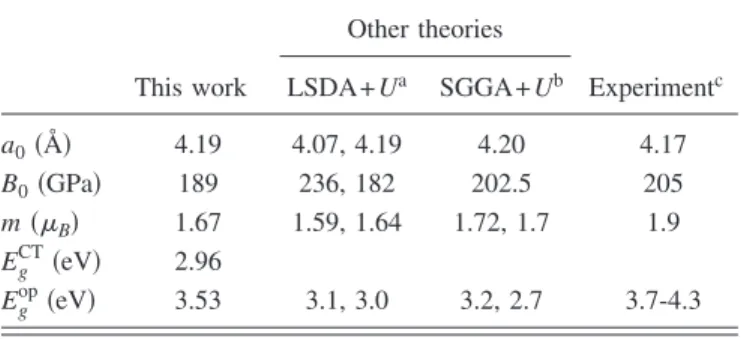
Type-II ordering means that the spin moments of Ni atoms within the same 共111兲 plane are ferromagnetically aligned with the spin direction alternating between neighboring planes. The results are compiled in Table I, together with previous experimental and theoretical data for a comparison purpose. The overall agreements with previous literatures are satisfactory. To compare stability between different magnetic orderings, we also calculate on ferromagnetic or type-I anti-ferromagnetic NiO. In a type-I antianti-ferromagnetic phase, the ordering vector is along 共100兲. The equilibrium lattice pa-rameters are computed to be 4.21 Å for both cases, slightly longer than that of NiO in the type-II ordering. The calcu-lated total energies indicate that ferromagnetic and type-I antiferromagnetic phases are higher in energy than the type-II phase by 0.11 and 0.12 eV/f.u. of NiO, respectively. In Fig.2, partial DOS is shown by projecting each state onto atomic orbitals. It is found that the valence top is a hybrid-ized character between Ni t2gand O p orbitals, while the con-duction bottom is mainly composed of Ni eg orbitals in spin
minority, indicating that the band gap is a charge-transfer type.
B. Properties of point defects
1. Single nickel vacancy
Under a typical growth condition, NiO is deficient with cations, which explains p-type conducting behaviors.1 We
(a) (b)
FIG. 1. Supercell geometries used for calculating defect proper-ties.共a兲 A simple-cubic style supercell with the f.u. of Ni32O32.共b兲 A face-centered-cubic共fcc兲 supercell 共Ni64O64兲 is obtained by ex-panding the lattice vectors of fcc unit cell twice along each direc-tion. The lengths of lattice vectors in 共a兲 and 共b兲 are 8.38 and 11.85 Å, respectively. The black and gray spheres indicate oxygen and nickel atoms, respectively.
TABLE I. Computational results on the bulk properties of NiO. Lattice parameters共a0兲, bulk modulus 共B0兲, magnetic moment at Ni sites 共m兲, minimum energy gap 共EgCT兲, and optical gap 共Egop兲 are shown. The magnetic moment is obtained by projecting the spin density onto d orbitals of Ni atoms. Other experimental and theo-retical results are also shown for comparison.
This work Other theories Experimentc LSDA+ Ua SGGA+ Ub a0共Å兲 4.19 4.07, 4.19 4.20 4.17 B0共GPa兲 189 236, 182 202.5 205 m共B兲 1.67 1.59, 1.64 1.72, 1.7 1.9 EgCT共eV兲 2.96 Egop共eV兲 3.53 3.1, 3.0 3.2, 2.7 3.7-4.3 aReferences15,17, and22. bReferences17and23. cReferences15and24–29. PDOS (states/eV/unit cell) -6 -4 -2 0 2 4 Energy (eV) Ni-t2g Ni-eg 0 4 2 2 4 6 O-p Majority Minority
FIG. 2. Partial DOS of NiO in type-II antiferromagnetic order-ing. The Fermi level is set to zero共vertical dotted line兲.
note that the nickel vacancy共VNi兲 in a real situation can be filled with other impurity atoms, such as Fe or Li. In order to study single VNi, we use a face-centered-cubic supercell in-cluding 128 atoms shown in Fig. 1共b兲 and remove one Ni atom with a spin-up direction. The relaxation pattern shows that nearby oxygen atoms around the defect site relax out-ward by 0.17 Å. This can be explained based on the electro-static interaction between the defect site and nearby atoms; with loosely bound holes共see below兲, the effective charge of
VNiis negative, which is identical to those of oxygen atoms. Therefore, oxygen atoms are repelled from the defect site, accounting for the relaxation pattern.
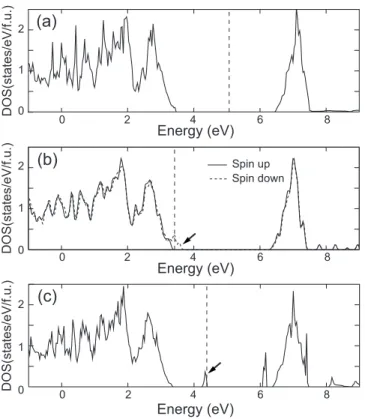
In Fig. 3共b兲, the total DOS is shown in the presence of single VNi. For comparison, the DOS for crystalline NiO is also shown in Fig.3共a兲. The electronic structure indicates a half-metallic property; i.e., only one spin channel is metallic. The holes are created in the down spin that is opposite to the spin direction of the removed Ni atom. A similar observation was reported in Ref. 5. In real situations, however, nickel vacancies at diluted limits are randomly distributed through-out the material. Therefore, DOS would be nearly symmetric for both spin directions, canceling out the half-metallic prop-erty. This can be changed when one considers defect cluster-ing, which will be discussed in Sec. III C. From the analysis on the partial DOS共not shown兲, it is found that holes are of a mixed character of Ni d and O p orbitals in six oxygen and
nickel atoms that are closest to the defect site along six bond-ing directions. This is consistent with Fig.4共a兲, which shows a contour plot of the squared wave function sampled near the valence maximum共down spin兲. It can be seen that the wave function is localized noticeably at six oxygen and nickel at-oms along the bonding directions. This is due to the super-exchange interaction between Ni d orbitals mediated by O p orbitals. As a result, the coupling between second nearest neighbor共NN兲 Ni atoms is much larger than those between the first NN pairs. This is in line with the scanning-tunneling-microscope image obtained from the Ni defect on the NiO共001兲 surfaces.30,31The majority spin of Ni atoms at the second NN sites from the defect is along the down direc-tion; therefore, the creation of holes in the spin-down chan-nel reduces the magnetic moments of these Ni atoms to 1.45Bas compared to 1.67Bin the bulk共see TableI兲. The
binding energy of the hole at the nickel vacancy can be es-timated from the energy difference between the center of defect bands共first moment兲 and the valence edge. From the inspection of the band structure, we find a binding energy of ⬃0.2 eV. This is in good comparison with an experimental activation barrier of 0.3 eV reported in Ref. 32 although a correlated hopping model proposed in the work is not born out within the SGGA+ U framework.
2. Single oxygen vacancy
Although the cation vacancy is known to be a major point defect in bulk NiO, the growth condition with low oxygen pressures may result in appreciable concentrations of the oxygen vacancy共VO兲. For calculating the oxygen vacancy, a cubic supercell with 64 atoms is used关see Fig. 1共a兲兴. After the geometry optimization, Ni atoms around the vacancy site relax inward by 0.06 Å, a pattern opposite to the case of VNi. This can be understood by the spatial distribution of defect levels, as detailed below. In Fig.3共c兲, DOS in the presence of one oxygen vacancy is shown. Three impurity levels are no-ticeable within the energy gap; one deep level holding two electrons is located at 1 eV above the valence top and two empty levels are found at 0.3 eV below the conduction edge. All three states are dominantly Ni egcharacters in the
minor-ity spin direction. This means that the defect levels are de-rived from the conduction band共see Fig.2兲. The occupation of electrons in the minority spin direction reduces the
mag-DOS(states/eV/f.u.) Energy (eV)
(a)
(b)
(c)
0 1 2 0 2 4 6 8 0 1 2 0 1 2 DOS(states/eV/f.u.) DOS(states/eV/f.u.) Energy (eV) Energy (eV) Spin up Spin down 0 2 4 6 8 0 2 4 6 8FIG. 3. The total density of states 共TDOS兲 of crystalline and defective NiO.共a兲 TDOS of defect-free NiO in type-II antiferro-magnetic ordering.共b兲 TDOS of Ni63O64, including one vacancy at the Ni site with an up-spin direction.共c兲 TDOS of Ni32O31with one oxygen vacancy. The Fermi levels are indicated by vertical dashed lines. For comparison between structures with different numbers of atoms, DOS is divided by the number of f.u.
(b) (a)
Oxygen
Nickel Nickel Oxygen
FIG. 4. The squared wave function of defect states indicated by arrows in Figs.3共b兲and3共c兲.共a兲 The defect level at the valence top in the presence of the nickel vacancy关see Fig.3共b兲兴. 共b兲 The in-gap
state created by the oxygen vacancy in Fig.3共c兲. The charge den-sities are added over the spin directions.
netic moments of Ni atoms to 1.57Bfrom the bulk value of
1.67B共see TableI兲, a similar effect to the case of VNi. It is
interesting that both VNi and VO reduce the magnetic mo-ments of nearby Ni atoms although the microscopic origins are not correlated. The difference between deep and shallow levels lies in the phase relation between six Ni eg orbitals
surrounding the vacancy site. For the deep level, the wave functions are in phase while for the shallow level, they are out of phase, as evidenced in nodal structures between orbit-als. These can be interpreted as bonding and antibonding natures, respectively. The bonding character of the occupied deep level is enhanced if Ni atoms relax toward the vacancy site. This would be the main reason for the small inward relaxations mentioned above. The highly localized nature of defect states implies that the presence of the oxygen vacancy in NiO could be confirmed with the luminescence experi-ment similarly to F centers in ionic crystals.
C. VNi-VNiinteraction
In order to investigate the interaction between cation va-cancies, we remove two Ni atoms with various relative po-sitions within the 128-atom supercell and relax atomic posi-tions. The interaction energy共Eint兲 is evaluated with respect to the reference configuration where two vacancies are infi-nitely away, as formulated in the following equation:
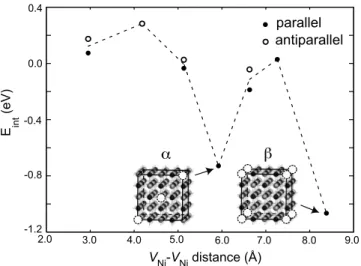
Eint= Etot共2VNi兲 + Etot共0VNi兲 − 2Etot共1VNi兲, 共1兲 where Etot is the total energy of the supercell, including as many nickel vacancies共VNi兲 as the number given in the pa-rentheses. Figure5shows computed interaction energies for all possible positions in the 128-atom supercell. The most notable thing in Fig.5is that two configurations, denoted as
␣ and , are substantially lower in energy than the others. The defect positions in these geometries are shown as insets in the figure.共For visual clarity, only part of the supercell is drawn.兲 Figure 6 displays DOS and wave functions at the valence top for␣and. The DOS for␣关Fig.6共a兲兴 indicates an insulating property with a small gap opening of 0.2 eV. On the other hand, DOS forshows a half-metallic charac-ter 关see Fig. 6共c兲兴. We note that nickel vacancies in the configuration form a simple-cubic lattice, and the model sys-tem is, in fact, identical to the case of single VNi in the 64-atom supercell in Fig.1共a兲. The same structure was inves-tigated in Ref.5 using the SIC method, and a half-metallic property was also noted. However, structural relaxation was not considered in that work, and the choice of stoichiometry was rather arbitrary. Our results provide additional informa-tion that the  configuration leading to a half-metallicity is energetically favored as well. This means that when the de-fect density is sufficiently high, nickel vacancies may con-dense into a cubic pattern to produce half-metallic domains. It would be worth examining whether the defect cluster-ing depends on the choice of U. For this, we compare the energy difference between the first and seventh NN positions 共the most stable one兲 as a function of U. The computational results show that relative energies change only by 0.04 and −0.09 eV as reducing or increasing U by 1 eV, respectively 共J is fixed兲. This little affects the energetics in Fig.5. There-fore, the tendency toward clustering is likely to be a real effect and could be verified experimentally. The insensitivity of interaction energies also implies that the results would not be an artifact of the LDA+ U method.
We point out that spatial distributions of defect states play a key role in stabilizing␣andconfigurations. As observed in Fig.4共a兲, the wave functions corresponding to defect lev-els are weighted at Ni and O atoms along bonding directions. Therefore, they overlap substantially at certain Ni atoms in␣ and configurations. This is verified in Figs.6共b兲 and6共d兲,
antiparallel 0.4 0.0 E int (eV ) VNi-VNidistance (Å) 2.0 3.0 4.0 5.0 6.0 7.0 8.0 9.0 -0.4 -0.8 -1.2 parallel α β
FIG. 5. The VNi-VNi interaction energy 共Eint兲 with respect to distance. The energy zero is set to the value when two defects are infinitely away. Filled and empty circles indicate data when spin directions of two removed Ni atoms are parallel and antiparallel, respectively. The dashed line is a guide to the eye. In the inset, the defect共blank circles兲 arrangements for most stable configurations are displayed for a cubic part of the supercell.共The actual compu-tations are done with 128-atom supercells.兲
(b) D OS (states /eV /unit cell ) 0 50 100 100 50 D OS (states /eV /unit cell ) 50 100 100 50 0 Energy (eV) 4 3 2 1 -1 0 -2 (d) 4 3 2 1 -1 0 -2 Energy (eV) (c) (a) Oxygen Nickel Oxygen Nickel
FIG. 6.共a兲 The density of states for the␣ configuration in Fig.
5. The Fermi level is set to zero.共b兲 The squared wave function for a state at the Fermi level in共a兲 is projected on a plane including paired vacancies共dashed circles兲. This plane is the front face of the cubic model in Fig.5.共c兲 and 共d兲 are similar plots for the con-figuration. In共b兲 and 共d兲, the egcharacter at Ni atoms connecting
which display states at the valence top for␣ and, respec-tively. It can be seen that the eg character at Ni atoms
con-necting vacancies are significantly enhanced compared to the single vacancy in Fig.4共a兲, and the weights at those Ni at-oms are comparable to or even bigger than those of O p orbitals. In passing, we note that there are pairs existing at smaller separations with defect states overlapping at O at-oms. However, spin directions are opposite in that case, and the defect states do not couple to each other. We also add that vacancies are multiply bonded in␣andconfigurations, and the interaction energy in Eq. 共1兲 might be divided by the number of bonds per supercell to conform to the definition. This leads to interaction energies per each pair of Ni vacan-cies of around −0.4 and −0.2 eV for␣andconfigurations, respectively.
In order to investigate the role of the lattice in mediating the interactions, we examine the relaxation energies calcu-lated by the energy difference between relaxed and unrelaxed supercells. These energies are −1.92, −1.70, −1.81, −2.15 共␣兲, −1.81, −1.81, and −2.25 共兲 eV for configurations with the increasing order of VNi-VNi separations 共see Fig. 5兲. Therefore, the clustering of Ni vacancies is well correlated with the relaxation energy of the lattice. The inspection of DOS for the unrelaxed lattices for the␣andconfigurations indicates that DOS is similar to that for the isolated single vacancy in Fig.3共b兲, meaning that defect states are not split much. Therefore, the lattice relaxation effectively enhances the wave function overlap between defect levels, thereby lowering energies for␣andconfigurations.
D. VO-VOinteraction
Next, we calculate the interaction energy between two oxygen vacancies in a similar manner to nickel vacancies, using 128-atom supercells. The results are shown in Fig.7. Depending on the spin direction of nearby Ni atoms, there are two nonequivalent configurations for some VO-VO sepa-rations. However, computed energy differences are negligi-bly small共0.01 eV at the first NN position兲, and only one of them is displayed in Fig.7. Compared to cation vacancies, the interactions between oxygen vacancies are relatively weak with a minimum Eintof −0.1 eV. When oxygen
vacan-cies are close to each other, defect states overlap and energy levels are split due to bonding or antibonding combinations of wave functions. However, changes in the total energy are small because those states are already fully occupied. This is contrasted to the case of nickel vacancies where defect levels are partially occupied, and substantial energy gain is achieved by occupying only defect levels with a bonding character. However, the results change drastically when oxy-gen vacancies are partially ionized; by reducing the total number of electrons within the supercell by 2, one can com-pute interaction energies between two singly ionized vacan-cies关VO共+兲兴 as in the following:
Eint= Etot共2VO; + 2兲 + Etot共0VO; + 0兲 − 2Etot共1VO; + 1兲, 共2兲 where +n indicates the charge state of the supercell.33,34The negative jellium charges are introduced to compensate for the positive charges in Eq. 共2兲. The computed interaction energies are shown in Fig.7. It is interesting that most inter-action energies for the charged defects are negative although repulsive electrostatic interactions are expected between de-fects or dopants with same charge states.34In particular, it is noted that the stability of VO’s at the second NN position is greatly enhanced. A detailed analysis will be given below. Since the charged defects are repeated under three-dimensional periodic boundary conditions, the spurious elec-trostatic interactions might influence the binding energies. In order to confirm that the computed results are well con-verged with respect to the supercell size, we carry out addi-tional calculations with a larger supercell including 192 at-oms constructed by expanding the conventional cell of NiO with a hexagonal symmetry. The unit cell lengths of super-cells are a = 11.85 Å and c = 14.52 Å. This supercell is 50% larger than the one used in Fig.7. We calculate the interac-tion energy for the most stable geometry共second NN pair兲 based on Eq.共2兲 and find that the interaction energy changes by less than 3% 共from −0.472 to −0.485 eV兲. This reflects that the interaction energies presented in Fig.7are well con-verged with respect to the supercell size, especially those for small separations.
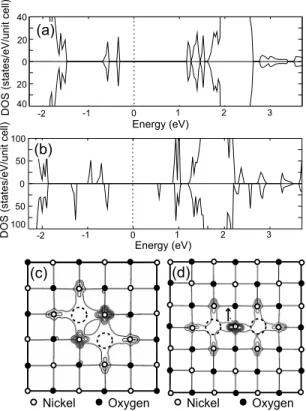
In order to enlighten the microscopic origin of VO-VO interactions, we first examine relaxation energies for each configuration. They are −0.47, −0.39 共most stable兲, −0.41, −0.28, −0.43, −0.41, and −0.31 eV for configurations in Fig. 7with the increasing order of defect separations. Compared to Ni vacancies discussed above, the relaxation energies are much smaller, and they are not correlated to the stability of paired vacancies. Next, we inspect DOS as well as squared wave functions for neutral oxygen vacancies. In Fig. 8共a兲, DOS for the first NN pair is drawn. It can be seen that energy levels of defect states are split by 0.2 eV due to the overlap of wave functions. The energy splitting is rather small be-cause two Ni egorbitals that originate from different VO’s are orthogonal to each other关see Fig. 8共c兲兴. On the other hand, for second NN pairs of VO, only one Ni atom is shared, but the orbital shape is common for two defect states关see Fig. 8共d兲兴. This increases the overlap integral at the Ni site, and the energy splitting in the down-spin direction is as much as
VO- VO VO(+) - VO(+) -0.2 0 0.2 -0.4 0.1 -0.5 -0.3 -0.1 E int (eV) VO-VOdistance (Å) 2.0 3.0 4.0 5.0 6.0 7.0 8.0 9.0
FIG. 7. The interaction energy between two oxygen vacancies. The oxygen vacancies are neutral共VO兲 and singly ionized 关VO共+兲兴.
0.8 eV, as shown in Fig.8共b兲. In constrast, the defect levels in the up-spin direction are split much less. As shown in Fig. 8共d兲, two VO’s are connected to Ni atoms with the up-spin direction. As discussed in Sec. III B 2, the defect states are derived from the conduction band with a minority spin di-rection of host Ni atoms. Therefore, the maximum overlap occurs for the down-spin direction since the overlapping Ni atom is in the up-spin direction. The large energy splitting explains why charged defects show a strong tendency toward pairing at the second NN position; as defect clusters are
dis-posed of two electrons, only high-lying states of the anti-bonding character are emptied. Therefore, configurations showing a large splitting of the defect levels are energetically favored among charged defects. This also indicates that the maximum interaction energy will be achieved when two VO’s are singly ionized. For example, if only one electron is re-moved from the supercell, imitating interaction between
VO共+兲 and VO, the magnitude of the interaction energy of second NN pairs is reduced by 0.1 eV. The generality of the above discussion implies that the attractive interactions be-tween charged oxygen vacancies could apply to other oxides as well. In fact, we find a similar behavior in Al2O3.35
IV. SUMMARY
In summary, we studied electronic properties of NiO in-cluding vacancy defects using the LDA+ U method. In the case of the nickel vacancy, we identified bound hole states extending over approximately 4 Å from the vacancy site with the binding energy of 0.2 eV. On the other hand, the oxygen vacancy creates defect levels within the energy gap similar to F centers in ionic crystals. The interactions be-tween vacancies were consistently explained based on the overlap of defect states. It was found that nickel vacancies could be ordered in a simple-cubic pattern, leading to a half-metallic property. In the case of oxygen vacancies, the rela-tive position sharing one Ni atom was most favored with its stability greatly enhanced when defects are singly ionized. For both nickel and oxygen vacancies, the partial occupation of defect states was important to enhance the tendency to-ward defect ordering or clustering.
ACKNOWLEDGMENTS
The work was supported by the National Program for 0.1 Terabit NVM Devices, the Korea Science and Engineer-ing Foundation through the Basic Research program共Grant No. R01-2006-000-10883-0兲, and Samsung Electronics. The computations were carried out at Korea Institute of Science and Technology Information 共KISTI兲 through the seventh Strategic Supercomputing Program.
*Corresponding author: [email protected]
1P. A. Cox, Transition Metal Oxides: An Introduction to Their Electronic Structure and Properties, The International Series of Monographs on Chemistry Vol. 27共Clarendon, Oxford, 1995兲. 2D. I. Woodward, I. M. Reaney, G. Y. Yang, E. C. Dickey, and C.
A. Randall, Appl. Phys. Lett. 84, 4650共2004兲.
3D. A. Muller, N. Nakagawa, A. Ohtomo, J. L. Grazul, and H. Y. Hwang, Nature共London兲 430, 657 共2004兲.
4K. Terakura, T. Oguchi, A. R. Williams, and J. Kübler, Phys. Rev. B 30, 4734共1984兲.
5D. Ködderitzsch, W. Hergert, Z. Szotek, and W. M. Temmerman, Phys. Rev. B 68, 125114共2003兲.
6S. Seo, M. J. Lee, D. H. Seo, E. J. Jeoung, D.-S. Suh, Y. S. Joung, I. K. Yoo, I. R. Hwang, S. H. Kim, I. S. Byun, J.-S. Kim,
J. S. Choi, and B. H. Park, Appl. Phys. Lett. 85, 5655共2004兲. 7S. H. Jeon, B. Park, J. Lee, B. Lee, and S. Han, Appl. Phys. Lett.
89, 042904共2006兲.
8S. V. Faleev, M. van Schilfgaarde, and T. Kotani, Phys. Rev. Lett. 93, 126406共2004兲.
9D. Ködderitzsch, W. Hergert, W. M. Temmerman, Z. Szotek, A. Ernst, and H. Winter, Phys. Rev. B 66, 064434共2002兲. 10A. Filippetti and N. A. Spaldin, Phys. Rev. B 67, 125109共2003兲. 11M. D. Towler, N. L. Allan, N. M. Harrison, V. R. Saunders, W.
C. Mackrodt, and E. Aprà, Phys. Rev. B 50, 5041共1994兲. 12G. Lefkidis and W. Hübner, Phys. Rev. Lett. 95, 077401共2005兲. 13C. de Graaf, F. Illas, R. Broer, and W. C. Nieuwpoort, J. Chem.
Phys. 106, 3287共1997兲.
14T. Bredow and A. R. Gerson, Phys. Rev. B 61, 5194共2000兲.
DOS (states/eV/unit cell) 0 50 100 100 50 DOS (states/eV/unit cell) 20 40 40 20 0 Energy (eV) Energy (eV) (a) (b) -2 -1 0 1 2 3 -2 -1 0 1 2 3 (c) (d) Oxygen
Nickel Nickel Oxygen
FIG. 8. Total density of states for共a兲 first NN and 共b兲 second NN pairs of neutral oxygen vacancies. The Fermi level is denoted by vertical dotted lines.共c兲 and 共d兲 show squared wave functions of highest occupied states, added over spin directions. The arrow in共d兲 denotes the majority spin direction at the overlapping Ni site.
15S. L. Dudarev, G. A. Botton, S. Y. Savrasov, C. J. Humphreys, and A. P. Sutton, Phys. Rev. B 57, 1505共1998兲.
16O. Bengone, M. Alouani, P. Blöchl, and J. Hugel, Phys. Rev. B 62, 16392共2000兲.
17A. Rohrbach, J. Hafner, and G. Kresse, Phys. Rev. B 69, 075413 共2004兲.
18M. R. Castell, S. L. Dudarev, G. A. D. Briggs, and A. P. Sutton, Phys. Rev. B 59, 7342共1999兲.
19G. Kresse and J. Hafner, Phys. Rev. B 47, 558共R兲 共1993兲; 49, 14251共1994兲.
20P. E. Blöchl, Phys. Rev. B 50, 17953共1994兲.
21J. P. Perdew, K. Burke, and M. Ernzerhof, Phys. Rev. Lett. 77, 3865共1996兲.
22V. I. Anisimov, J. Zaanen, and O. K. Andersen, Phys. Rev. B 44, 943共1991兲.
23M. Cococcioni and S. de Gironcoli, Phys. Rev. B 71, 035105 共2005兲.
24R. W. G. Wyckoff, Crystal Structures共Interscience, New York, 1964兲.
25A. K. Cheetham and D. A. O. Hope, Phys. Rev. B 27, 6964 共1983兲.
26R. J. Powell and W. E. Spicer, Phys. Rev. B 2, 2182共1970兲. 27D. Adler and J. Feinleib, Phys. Rev. B 2, 3112共1970兲. 28J. McNatt, Phys. Rev. Lett. 23, 915共1969兲.
29S. Hüfner and T. Riesterer, Phys. Rev. B 33, 7267共1986兲. 30M. R. Castell, P. L. Wincott, N. G. Condon, C. Muggelberg, G.
Thornton, S. L. Dudarev, A. P. Sutton, and G. A. D. Briggs, Phys. Rev. B 55, 7859共1997兲.
31S. L. Dudarev, A. I. Liechtenstein, M. R. Castell, G. A. D. Briggs, and A. P. Sutton, Phys. Rev. B 56, 4900共1997兲. 32P. Lunkenheimer, A. Loidl, C. R. Ottermann, and K. Bange,
Phys. Rev. B 44, 5927共1991兲.
33S. Limpijumnong, S. B. Zhang, S.-H. Wei, and C. H. Park, Phys. Rev. Lett. 92, 155504共2004兲.
34Y.-S. Kim, E.-C. Lee, and K. J. Chang, Phys. Rev. Lett. 91, 125503共2003兲.