1439
ⓒ The Korean Society of Food Science and Technology
Improving Solubility through Carboxymethylation of Different-sized
Endosperm, Bran, and Husk Rice Powders
Kyeong Ok Choi, Seung Cheol Yang, Dong Eun Kim1, Wie-Soo Kang2, Malshick Shin3, Yoon-Hee Choi4, and Sanghoon Ko*
Department of Food Science and Technology, Sejong University, Seoul 143-747, Korea
1Division of Biological Systems Engineering, College of Agriculture, Kangwon National University, Chuncheon, Gangwon 200-701, Korea
2Division of Biotechnology, School of Bioscience & Biotechnology, Kangwon National University, Chuncheon, Gangwon 200-701, Korea
3Department of Food and Nutrition, Chonnam National University, Gwangju 500-757, Korea
4National Academy of Agricultural Science, Rural Development Administration, Suwon, Gyeonggi 441-707, Korea
Abstract The surfaces of different-sized endosperm, bran, and husk rice powders were modified using carboxymethylation.
Carboxymethylation was carried out using aqueous alkalization and neutralization. After the carboxymethylation process, the centrifuged products were milled and classified by size: particles passed through sieves of 45, 106, and 300-µm width. The
effect of carboxymethylation on physical properties such as solubility and dispersibility of endosperm, bran, and husk particles were studied. Overall, carboxymethylation increased solubility of the particles, while size reduction increased dispersibility. In particular, carboxymethylation created good aqueous suspensions by minimizing interparticle agglomeration. Our results show that the combination of size reduction and carboxymethylation improves solubility and dispersibility, resulting in better stability of the suspension. This study may be helpful for expanding the use of rice and its byproducts as ingredients in a variety of food and beverage applications.
Keywords: rice, ultrafine milling, carboxymethylation, solubility, surface modification
Introduction
Rice and its byproducts, bran and husk, are abundant but underutilized. Rice can be used in a variety of foods and beverages and offer health-related benefits such as vitamins, minerals, fibers, and antioxidants. They are usually powdered to provide long-term biological stability and easier transportation and handling (1). Powdered rice ingredients are mixed with other food ingredients and then processed to manufacture a variety of food and beverage products. Solubility and dispersibility of particles are important for practical applications of powdered rice ingredients.
According to the Stokes’ law, smaller particles precipitate more slowly; thus, using ultrafine particles can improve suspension stability. Ultrafine particles offer a number of distinct advantages such as higher intracellular uptake (2,3). Ultrafine particles have high surface-to-volume ratios, giving them potential use for the delivery of bioactive components. However, small particles tend to form secondary agglomerates to minimize their surface energy in aqueous systems (4,5). Larger secondary agglomeration can decrease effectiveness in processing, storage, and uptake of food materials in particulate form. Thus, it is critical to prevent interparticle agglomeration in order to create good suspensions.
Surface modification of the particles can also increase
solubility and dispersibility in an aqueous suspension. One way to increase hydrophilicity is to modify the preformed particles with a reagent capable of producing hydrophilic residues on the surface (6,7). Increasing the hydrophilicity of the particles is advantageous, because such particles may exhibit more desirable surface physical and chemical properties, especially in food and beverage applications. Carboxymethylation is one of the most versatile functionalization procedures, as it provides valuable properties such as emulsification, suspension, and water holding capacity (8). Carboxymethylation has been used to improve the physical and chemical properties of ingredients such as cellulose (9), starch (10), seed gums (11,12), and corn cob (13). Carboxymethylation generally increases hydrophilicity and solution clarity; it makes the ingredient more soluble in aqueous systems since it introduces carboxymethyl groups on the surface of ingredient molecules (7). Carboxymethylation reduces interparticle surface interactions due to increase of repulsions. Thus, increased surface hydrophilicity of particles prevents interparticle agglomeration and enhances suspension stability in the aqueous environment. Recently, carboxymethylation has been studied for a variety of husks including cellulose and hemicelluloses (14,15). Especially, carboxymethylation of xylans from various sources has been found to provide anionic functionality (16,17).
The objective of this study was to modify the surface of different-sized endosperm, bran, and husk rice powders using carboxymethylation. In addition, we investigated the effect of carboxymethylation on physical properties such as solubility and dispersibility. Improvement of solubility and dispersibility by size reduction and carboxymethylation of
*Corresponding author: Tel: +82-2-3408-3260; Fax: +82-2-3408-3419 E-mail: [email protected]
Received July 1, 2009; Revised September 1, 2009; Accepted September 1, 2009
endosperm, bran, and husk rice powders were discussed.
Materials and Methods
Materials Endosperm of rice and its by-products, bran and husk obtained from a local grain processing plant (Gangwon Nonghyup, Korea) were cleaned by eliminating impurities and subsequently stored in a refrigerator until milling. Preparation of different-sized endosperm, bran, and husk powders Endosperm grain, bran, and husk were milled separately to prepared different-sized powders. The milling procedures were published in a recent report by Lee et al. (18). In brief, a pin crusher (JIC-P10-2;
Myungsung Machine, Seoul, Korea) with a 30 mesh sieve was used to mill the endosperm, bran, and husks of rice at 1,000 rpm. Standard sieves (Φ 20-cm, Chunggye Industrial
MFG. Co., Seoul, Korea) installed on a sieve shaker (CG-213; Ro-Top, Chunggye Industrial MFG. Co., Seoul, Korea) classified the endosperm, bran, and husk powders in size; some particles passed through the sieve with openings that were 106-µm wide, and some passed through
the sieve with openings that were 300-µm wide. An
ultrafine air mill (Turbo Mill, HKP-05; Korea Energy Technology, Seoul, Korea) was used to produce ultrafine powders.
The endosperm, bran, and husk powders produced by the pin crusher were placed in the ultrafine air mill, which reduced and classified the particle size at the same time. The ultrafine air mill was operated at 3 kg/hr of the feeding rate and at 100 m/sec of the circumferential velocity of the impeller in the grinding zone. The endosperm powders were classified as E_ultra, E_106, and E_300 according to size (ultrafine, 106, or 300µm, respectively). Similarly, the
bran powders were labeled as B_ultra, B_106, and B_300, respectively, and the husk powders as H_ultra, H_106, and H_300, respectively. The powders were put into plastic bags and stored at 4oC in a desiccator until further analysis. Carboxymethylation of endosperm, bran, and husk particles The carboxymethylation procedures reported in several publications were modified as necessary. The endosperm, bran, and husk powders were used to prepare different-sized carboxymethylated powders. First, alkalization was performed by mixing 40 g of different-sized powders, 120 mL of ethanol (Daejung Chemicals & Metals Co., Siheung, Korea), and 28 mL of aqueous 11.5 M NaOH (A.C.S. Reagent, Sigma-Aldrich, Steinheim, Germany) solution at 25oC. Subsequently, the mixture was stirred for
20 min. In the second step, 43 g of sodium chloroacetate (Na-MCA, 98%; Avocado Research Chemicals Ltd., Heysham, Lancashire, UK) was added in the mixture, heated to 58oC, and stirred on a magnet stirrer (MS-MP4;
Daihan, Seoul, Korea) at that temperature for 100 min. After the reaction, the results, the salt form of carboxymethylated products were called Na-CM products.
The synthesized Na-CM samples were purified by neutralizing them with 0.1 M HCl solution (Daejung Chemicals & Metals Co.) and subsequently precipitating them with ethanol. The precipitated Na-CM samples were centrifuged (Centrifuge 5804 R; Eppendorf, Hamburg, Germany) at 12,855×g for 15 min, and the pellet was dried
at 50oC in an oven (Yuyu Scientific MFG, Ansan, Korea)
and then ground to 150 mesh powder in an analytical mill (MF-10; IKA-Werke, Staufen, Germany). The obtained Na-CM product was dispersed in acetone solvent (99.5%, Daejung Chemicals & Metals Co.) by stirring on the magnetic stirrer and then converted to the acid form (H-CM product) by adding 30 mL of 6 M aqueous HCl/10 g of the Na-CM sample. After stirring the H-CM product for 30 min, the sample was centrifuged at 12,855×g for 15 min to remove the excess acid. The 80%(v/v) methanol-water solution (Daejung Chemicals & Metals Co.) was added dropwise until the conductivity of the dispersion reached 25µS/cm. The dispersion was centrifuged at 12,855×g for
15 min. The pellet was redispersed in acetone, filtered with #1 Advantec filter paper (6-µm, Hyundai Micro Co., Ltd.,
Seoul, Korea) under vacuum, and dried at 50oC in the
oven. The carboxymethylated particles were ground using an analytical mill (MF-10; IKA-Werke) and classified using the standard sieves (Φ 20 cm, Chunggye Industrial
MFG. Co.).
Particle size analysis Mean diameter and size distribution of the endosperm, bran, and husk particles were measured using a commercial particle size analyzer (Mastersizer-2000; Malvern Ins. Ltd., Worcestershire, UK). In order to prepare a sample for size measurement, the particles prepared were dispersed in 10 mL of distilled water at a 1:400 (w/v) ratio. The particle suspension samples were stirred continuously at room temperature for 30 min and then measured at 25oC with a scattering angle of 90o. The
particle size measurement was repeated at least 3 times for each sample.
Scanning electron microscopy The endosperm, bran, and husk particles were investigated in a low vacuum scanning electron microscope (S-3500N; Hitachi Science Systems, Ltd., Ibaraki, Japan) that operated an accelerating voltage of 10 kV, 3.0 nm resolution at high voltage and 4.0 nm resolution at low voltage. The monochrome photographs show the size and morphology of the endosperm, bran, and husk particles. All imaging procedures were performed at the Korea Basic Science Institute (KBSI, Kangwon National University, Chuncheon, Korea).
Solubility measurement For the solubility measurement, 2.5 g of endosperm, bran, or husk powder (dry sample weight) were suspended in 30 mL of distilled water by stirring at 700 rpm and 25oC for 30 min on a magnet stirrer.
Each sample was centrifuged at 7,232×g for 30 min; subsequently, the supernatant was dried at 105oC for 5 hr in
an oven. The weights of the sediment in the tube (wet sample weight) and the dry supernatant (dry supernatant weight) after centrifugation were measured, and 3 corresponding solubility indices were determined using the equations as follows (19):
Water absorption index (WAI) Wet sediment weight=---Dry sample weight Water solubility (WS, %) Dry supernatant weight=--- 100Dry sample weight ×
Dispersibility measurement The dispersibility measurement was published in a recent report by Lee et al. (18). In order
to prepare a sample for dispersibility measurement, 50 mL of pH 7.4 phosphate buffered saline solution (D-PBS D5652; Sigma-Aldrich) was mixed with 0.1 g of endosperm, bran, or husk powder. The mixture was stirred at 500 rpm for 10 min, and then 1 mL of the mixture was collected in a cuvette to measure the absorbance at 650 nm wavelength using a spectrophotometer (DU 730;, Beckman Coulter, Fullerton, CA, USA) for 20min. The normalized absorbance profiles were displayed as a function of time for first 5 min. The dispersibility measurements were repeated 3 times for each sample.
Results and Discussion
Carboxymethylation of endosperm, bran, and husk powders of rice Endosperm, bran, and husk powders were carboxymethylated using the aqueous alkalization and neutralization procedures. The carboxymethylated rice powders were classified by size. The carboxymethylated endosperm powders that passed through sieves with 45, 106, and 300-µm wide openings were labeled as CM
E_45, CM E_106, and CM E_300, respectively. Similarly, the bran and husk samples were labeled as CM B_45, CM B_106, CM B_300, CM H_45, CM H_106, and CM H_300 after carboxymethylation. The carboxymethylated powder that passed through the 45-µm sieve was
manufactured from the ultrafine powder; it was milled and classified using the analytical mill, since amount of the carboxymethylated samples prepared was too small to operate the ultrafine air mill.
Swelling power (SP) Wet sediment weight
Dry sample weight 1 WS(%)×⎝⎛ –---100 ⎠⎞
---=
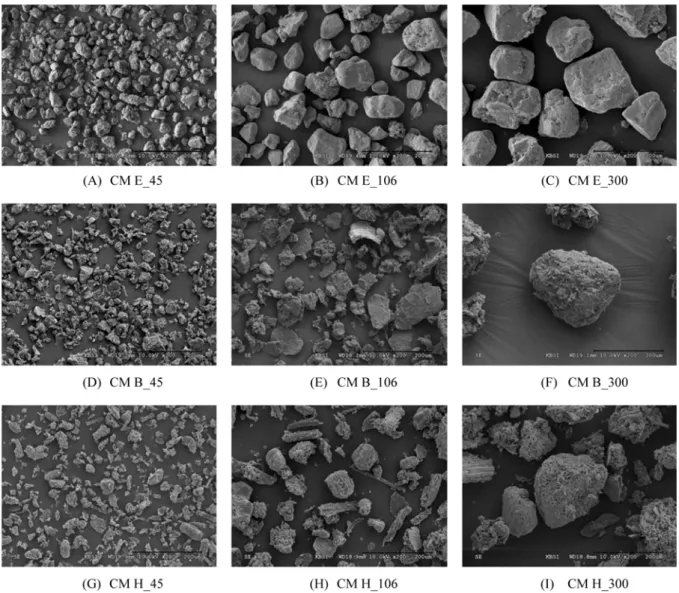
Fig. 1. Scanning electron micrographs of carboxymethylated endosperm, bran, and husk rice particles. Scale bar is 200µm on the micrograph. CM E, endosperm power (A, B, and C); CM B, bran power (D, E, and F); CM H, husk power (G, H, and I). Each number 45, 106, and 300 means particles pass through sieves with 45, 106, and 300-µm wide openings, respectively.
The scanning electron micrographs of the endosperm, bran, and husk particles after carboxymethylation are shown in Fig. 1. Compared with the images of non-carboxymethylated particles in the previous report (18), the observations in the present investigation reveal that the carboxymethylation, a kind of wet process rounds the perimeter of the particles. However, even after carboxymethylation, the husk particles remain irregular in shape: fibers were cut due to shear force, resulting in angulated corners; in contrast, endosperm particles were broken down due to impact.
The processing conditions affect the carboxymethylation of food ingredients such as starch (20). In general, carboxymethylation was executed using strong NaOH and monochloroacetic acid in aqueous medium at elevated temperature (21). Carboxymethylation can be performed in water as a solvent (22-24) or in water-miscible organic solvents containing small amounts of water (11,25-27). Besides the solvent type and composition, the main factors affecting carboxymethylation are the concentration of sodium hydroxide and monochloroacetic acid, reaction time, and reaction temperature (11,23-25,27).
Effect of carboxymethylation on solubility Rice endosperm powder: The effect of carboxymethylation on water absorption index (WAI) of endosperm powder is shown in Fig. 2A. WAI is the amount of water absorbed in the particles during submersion. The WAI values of the carboxymethylated endosperm powders improved compared to those of the non-carboxymethylated endosperm powders. For all endosperm powders, WAI of the carboxymethylated samples increased more than twice. Water hardly penetrated the crystalline starch structure of the endosperm at room temperature (28,29), resulting in smaller water solubility (WS) values of the endosperm powder.
The effects of particle size and carboxymethylation on WS of endosperm powder are shown in Fig. 2B. Size reduction and carboxymethylation clearly improved WS through of the endosperm particles. The WS of the carboxymethylated endosperm powders were much larger than that of the non-carboxymethylated endosperm powders. The average WS values of CM E_45, CM E_106, and CM E_300 were 15.9, 13.1, and 11.1%, respectively, whereas those of E_ultra, E_106, and E_300 were 4.47, 3.13, and 1.65%, respectively. For all endosperm powder samples, the WS increased with decreasing particle size regardless of carboxymethylation. In conclusion, the size reduction up to less than 100µm allowed endosperm particles more
soluble for both the carboxymethylated and the non-carboxymethylated endosperm powders.
The effect of carboxymethylation on swelling power (SP) of endosperm powder is shown in Fig. 2C. Endosperm powder swells, since it absorbs water. SP is the ratio of the wet weight of the sedimented particles to their dry weight, which is usually related to viscosity of noodle and paste (30). The mean SP values of CM E_45, CM E_106, and CM E_300 were 5.29, 5.19, and 5.34, respectively, whereas those of E_ultra, E_106, and E_300 were 2.44, 2.25, and 2.01, respectively. For all endosperm powders, the carboxymethylation process increased SP more than twice. Our results were similar to those of Bhattacharyya et al. (27) and Nattapulwat et al. (31), who found that WS
and SP of carboxymethylated starch were higher than for native starch. The effect of particle size on SP was negligible for both the carboxymethylated and the non-carboxymethylated endosperm powders.
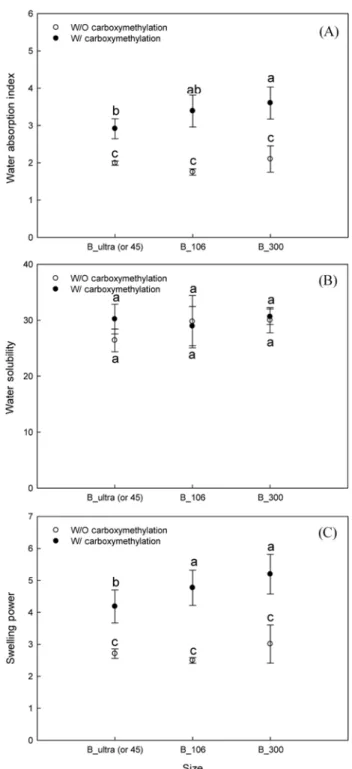
Rice bran powder: The effect of carboxymethylation on WAI of bran powder is shown in Fig. 3A. For all bran powders, the WAI values of the carboxymethylated bran
Fig. 2. Effects of particle size and carboxymethylation on water solubility indices of endosperm rice powder. Means with different letters (a, b, and c) within a column indicate significant differences, p≤0.05. Data of the non-carboxymethylated particles were obtained from the previous report by Lee et al. (18) for comparative study of the carboxymethylation effect.
powders were larger than those of the non-carboxymethylated bran powders. Carboxymethylation increased water absorption in the bran particles during submersion. However, the effect of the carboxymethylation on WAI of the bran powders was less than that of the endosperm powders. For example, the WAI values of the ultrafine particles increased from about 1.99 to 2.91 for the bran powders but
from 2.33 to 4.41 for the endosperm powders. This effect was similar for the large sized particles. The results mean that carboxymethylation contributes more to the endosperm, which is composed mainly of starch (32). In other words, more hydrophilic groups are replaced in endosperm.
The effect of carboxymethylation on WS of rice bran powder is shown in Fig. 3B. The average WS values of CM B_45, CM B_106, and CM B_300 were 30.2, 28.9, and 30.6, respectively, whereas those of B_ultra, B_106, and B_300 were 26.4, 29.8, and 30.0, respectively. The WS values of both carboxymethylated and non-carboxymethylated bran powders were relatively large; thus, the effect of the carboxymethylation treatment on WS was negligible. As previously mentioned, the composition and the microstructure of bran particles allow for easy water penetration and absorption, which are critical for solubility. As a result, the WS of bran powder was generally large. For all bran powder samples, the WS values were independent of particle size regardless of carboxymethylation. Especially, CM B_45 also showed good solubility, even though increase of total surface area by size reduction was highly susceptible to hydration. Our results were similar to previous studies (11,12,16,17,22).
The effect of carboxymethylation on SP of bran powder is shown in Fig. 3C. For all powders, the SP values of the carboxymethylated bran powders were larger than those of the non-carboxymethylated powders. The mean SP values of CM B_45, CM B_106, and CM B_300 were 4.18, 4.78, and 5.19, respectively whereas those of B_ultra, B_106, and B_300 were 2.71, 2.50, and 3.01, respectively. The carboxymethylation improved the aqueous SP of the bran particles, but its strength was less than that of the endosperm powders. This tendency was similar for all bran powders.
Rice husk powder: The effect of carboxymethylation on
WAI, WS, and SP, respectively for different-sized husk powders is shown in Fig. 4. The effect of the carboxy-methylation on the WS characteristics of the rice husk powders was negligible or less than that in case of endosperm and bran powders. For example, the mean WS values of CM H_45, CM H_106, and CM H_300 were 10.2, 11.5, and 11.5%, respectively, whereas those of H_ultra, H_106, and H_300 were 10.8, 8.25, and 4.15%, respectively. The mean SP values of CM H_45, CM H_106, and CM H_300 were 3.7, 3.8, and 3.6, respectively, whereas those of H_ultra, H_106, and H_300 were 2.84, 3.79, and 3.87, respectively. The WAI, WS, and SP values did not change after the carboxymethylation.
It is possible that the carboxymethyl group was not replaced sufficiently during the carboxymethylation or that the carboxymethylated husk particles were not sufficiently hydrophilic. The high content of insoluble fibers such as cellulose and lignin contributed to the reduced effectiveness of carboxymethylation. Rice is 38% alpha cellulose, 22% lignin, 20% ash, and 19% silica (33). Carboxymethylation decreased the influence of particle size on the solubility characteristics of the husk powders. All characteristic values of the carboxymethylated husk powders were independent of particle size. In contrast to the endosperm powders, the WAI and the SP values of non-carboxymethylated husk powders decreased with smaller particle size. Carboxy-methylation increased WAI and SP for smaller husk
Fig. 3. Effects of particle size and carboxymethylation on
water solubility indices of bran rice powder. Means with
different letters (a, b, and c) within a column indicate significant differences, p≤0.05. Data of the non-carboxymethylated particles were obtained from the previous report by Lee et al. (18) for comparative study of the carboxymethylation effect.
particles; as a result, there was no particle size effect on WAI and SP among the carboxymethylated husk powder samples.
Effect of carboxymethylation on dispersibility Effect of carboxymethylation on dispersibility of powders: In
general, the initial absorbance of the carboxymethylated particles was smaller than those without carboxymethylation, since the transparency of particles improved after carboxy-methylation. As a result, the absorbance of the aqueous suspension decreased after carboxymethylation. In order to overcome the discrepancy of the absorbance value, the profiles of the absorbance as a function of time were normalized. From a normalized absorbance profile, a large absorbance value means that particles are dispersed or suspended well in an aqueous solution. In general, absorbance decreased over time for all endosperm, bran, and husk powders regardless of carboxymethylation. Several samples, including large-sized particles, settled down quickly, resulting in sudden decrease of absorbance value; however, small-sized particles were suspended well at the initial stage after mixing. For example, the normalized absorbance of the CM E_300 particles decreased in less than 1 min.
Rice endosperm powder: The effect of carboxymethylation on time-dependent aqueous dispersibility of endosperm powder is shown in Fig. 5. Carboxymethylation did not improve dispersibility of any of the endosperm particles, but it was effective for enhancing solubility. The particle size effect on dispersibility was clear. The sediment rate of the endosperm particles decreased with smaller particle size for both carboxymethylated and non-carboxymethylated endosperm powders. In conclusion, smaller-sized endosperm particles obtained better dispersibility regardless of carboxymethylation. These results agree with the previous reports that the precipitation of particles governed by Stokes’ law depends on their size (18,34). Thus, ultrafine endosperm powder can be used to form a stable suspension in an aqueous system, minimizing precipitation.
Rice bran powder: The effect of carboxymethylation on the dispersibility of different-sized bran powders is shown in Fig. 6. The absorbance values of both carboxymethylated and non-carboxymethylated bran powders were relatively large and stable over time. The effect of the carboxy-methylation treatment on the dispersibility of the rice bran
Fig. 4. Effects of particle size and carboxymethylation on
water solubility indices of husk rice powder. Means with
different letters (a, b, and c) within a column indicate significant differences, p≤0.05. Data of the non-carboxymethylated particles were obtained from the previous report by Lee et al. (18) for comparative study of the carboxymethylation effect.
Fig. 5. Effects of particle size and carboxymethylation on
dispersibility of endosperm rice powders. Data of the
non-carboxymethylated particles were obtained from the previous report by Lee et al. (18) for comparative study of the carboxy-methylation effect.
powders was negligible or similar to that in case of endosperm powders. Constituents such as protein and soluble fibers in the bran powders provide better dispersibility compared to other components in rice crops. For all bran powder samples, absorbance decreased slowly over time, indicating that better dispersibility. The hydrophilic protein-water and soluble fiber-water interactions allowed the bran particles to suspend well (35). Different-sized bran particles were dispersed similarly in aqueous solution. The size effect of bran particles on dispersibility was not as significant as that of endosperm particles. All bran particles were fairly stable for both carboxymethylated and non-carboxymethylated powders, even though slow sediment appeared over time. The rate of particle sedimentation decreased with particle size, but the magnitude of the particle sedimentation rate was less than that of the endosperm or husk particles.
Rice husk powder: The effect of carboxymethylation on
different-sized husk powders is shown in Fig. 7. Carboxymethylation improved the dispersibility of all endosperm particles, but it was not as strong as the particle size effect. For all husk powders, the carboxymethylated particles settled down more slowly than those not treated with carboxymethylation. The sediment rate of the bran particles decreased with particle size. The smaller-sized husk particles showed better dispersibility for both carboxymethylated and non-carboxymethylated endosperm powders. Like endosperm powders, ultrafine husk powders can be applied to the food industry due to the improved dispersibility in aqueous solution.
Our results suggest that the combined strategy of size reduction and carboxymethylation improve solubility and dispersibility, resulting in better stability. Carboxy-methylation increases the hydrophilicity of particles and creates good aqueous suspension by minimizing interparticle agglomeration. Hydrophilic particles are considered advantageous, since they may exhibit more desirable process compliance in food and beverage applications.
Acknowledgments
This study was carried out with the support of ‘Cooperative Research Program for Agricultural Science & Technology Development (Project No. 20070401080043)’, RDA, Republic of Korea.
References
1. Chen XD, Li D. Food powder technology. J. Food Eng. 94: 129-129 (2009)
2. Desai MP, Labhasetwar V, Amidon GL, Levy RJ. Gastrointestinal uptake of biodegradable microparticles: Effect of particle size. Pharm. Res. 13: 1838-1845 (1996)
3. Desai MP, Labhasetwar V, Walter E, Levy RJ, Amidon GL. The mechanism of uptake of biodegradable microparticles in Caco-2 cells is size dependent. Pharm. Res. 14: 1568-1573 (1997) 4. Hogekamp S, Schubert H. Rehydration of food powders. Food Sci.
Technol. Int. 9: 223-235 (2003)
5. Jillavenkatesa A, Kelly JF. Nanopowder characterization: Challenges and future directions. J. Nanopart. Res. 4: 463-468 (2002) 6. Goldberg EP, McCluskey R, Hoffmann EM, Longo WE. Recent
studies on hydrophilic microspheres as controlled delivery drug carriers. Abstr. Pap. Am. Chem. S. 190: 130 (1985)
7. MacAdam AB, Shafi ZB, James SL, Marriott C, Martin GP. Preparation of hydrophobic and hydrophilic albumin microspheres and determination of surface carboxylic acid and amino residues. Int. J. Pharm. 151: 47-55 (1997)
8. Heinze T. New ionic polymers by cellulose functionalization. Macromol. Chem. Physic. 199: 2341-2364 (1998)
9. Cheng F, Li G, Feng J, Zhang J. Characteristics of carboxymethyl cellulose synthesized in two-phase medium C6H6-C2H5OH. I.
Distribution of substituent groups in the anhydroglucose unit. J. Appl. Polym. Sci. 61: 1831-1838 (1996)
10. Kooijmann LM, Ganzeveld KJ, Manurung RM, Heeres HJ. Experimental studies on the carboxymethylation of arrowroot starch in isopropanol-water media. Starch-Starke 55: 495-503 (2003) 11. Sharma BR, Kumar V, Soni PL, Sharma P. Carboxymethylation of
Cassia tora gum. J. Appl. Polym. Sci. 89: 3216-3219 (2003) 12. Gupta S, Sharma P, Soni PL. Carboxymethylation of Cassia
occidentalis seed gum. J. Appl. Polym. Sci. 94: 1606-1611 (2004)
13. Ebringerov A, Hromadkov Z, Hribalov V. Structure and mitogenic activities of corn cob heteroxylans. Int. J. Biol. Macromol. 17: 327-331 (1995)
14. Heinze T, Koschella A, Ebringerova A. Chemical functionalization
Fig. 6. Effects of particle size and carboxymethylation on
dispersibility of bran rice powders. Data of the
non-carboxymethylated particles were obtained from the previous report by Lee et al. (18) for comparative study of the carboxy-methylation effect.
Fig. 7. Effects of particle size and carboxymethylation on
dispersibility of husk rice powders. Data of the
non-carboxymethylated particles were obtained from the previous report by Lee et al. (18) for comparative study of the carboxy-methylation effect.
of xylan: A short review. Vol. 864, pp. 312-325. In: Hemicelluloses: Science and Technology (ACS Symposium Series). Gatenholm P, Tenkanen M (eds). An American Chemical Society Publication, Washington, DC, USA (2004)
15. Khasgiwal PC, Mithal BM. Derivatives of Plantago ovata
(Ispaghula) seed husk gum. Part I. Carboxymethyl derivative.
Indian J. Pharm. 37: 53-55 (1975)
16. Petzold K, Schwikal K, Gunther W, Heinze T. Carboxymethyl xylan - Control of properties by synthesis. Macromol. Symp. 232: 27-36 (2006)
17. Petzold K, Schwikal K, Heinze T. Carboxymethyl xylan - Synthesis and detailed structure characterization. Carbohyd. Polym. 64: 292-298 (2006)
18. Lee JE, Jun JY, Kang WS, Lim JD, Kim DE, Lee KY, Ko S. Effect of particle size on the solubility and dispersibility of endosperm, bran, and husk powders of rice. Food Sci. Biotechnol. 17: 833-838 (2008)
19. Lai HM, Cheng HH. Properties of pregelatinized rice flour made by hot air or gum puffing. Int. J. Food Sci. Tech. 39: 201-212 (2004) 20. Lawal OS, Lechner MD, Hartmann B, Kulicke W-M.
Carboxymethyl cocoyam starch: Synthesis, characterisation, and influence of reaction parameters. Starch-Starke 59: 224-233 (2007) 21. Green JW. O-Carboxymethyl cellulose. Methods Carbohyd. Chem.
3: 325-326 (1963)
22. Kamel M, El-Thalouth IA, Amer MA, Ragheb A, Nassar SH. Chemical modification of guaran gum. Part I: Carboxymethylation in aqueous medium. Starch-Starke 44: 433-437 (1992)
23. Hebeish A, Khalil MI, Hashem A. Carboxymethylation of starch and oxidized starches. Starch-Starke 42: 185-191 (1990)
24. Hebeish A, Khalil MI. Chemical factors affecting preparation of carboxymethyl starch. Starch-Starke 40: 147-150 (1988)
25. Ragheb AA, El-Sayiad HS, Hebeish A. Preparation and characterization of carboxymethyl starch (CMS) products and their utilization in textile printing. Starch-Staerke 49: 238-245 (1997) 26. Kwon K, Auh JH, Kim JW, Park KH, Park CH, Ko CJ.
Physicochemical properties and functionality of highly carboxymethylated starch. Starch-Starke 49: 499-505 (1997) 27. Bhattacharyya D, Singhal RS, Kulkarni PR. A comparative account
of conditions for synthesis of sodium carboxymethyl starch from corn and amaranth starch. Carbohyd. Polym. 27: 247-253 (1995) 28. Bello MO, Tolaba MP, Suarez C. Water absorption and starch
gelatinization in whole rice grain during soaking. LWT-Food Sci. Technol. 40: 313-318 (2007)
29. Cunningham SE, McMinn WAM, Magee TRA, Richardson PS. Modelling water absorption of pasta during soaking. J. Food Eng. 82: 600-607 (2007)
30. Crosbie GB. The relationship between starch swelling properties, paste viscosity, and boiled noodle quality in wheat flours. J. Cereal Sci. 13: 145-150 (1991)
31. Nattapulwat N, Purkkao N, Suwithayapan O. Preparation and application of carboxymethyl yam (Dioscorea esculenta) starch.
AAPS PharmSciTech. 10: 193-198 (2009)
32. Saunders RM. Rice bran: Composition and potential food uses. Food Rev. Int. 1: 465-495 (1985)
33. Govindarao VMH. Utilization of rice husk-a preliminary analysis. J. Sci. Ind. Res. India 39: 495-515 (1980)
34. Genovese DB, Lozano JE. Particle size determination of food suspensions: Application to cloudy apple juice. J. Food Process Eng. 23: 437-452 (2000)
35. Hamada JS. Use of proteases to enhance solubilization of rice bran proteins. J. Food Biochem. 23: 307-321 (1999)